Hindu Diaspora Keeps Traditions Alive Worldwide with Vibrant December Celebrations
By HinduTone Special Correspondent December 22, 2025 As the winter solstice approaches and the year draws to a close, Hindu communities across the global…
By HinduTone Special Correspondent December 22, 2025 As the winter solstice approaches and the year draws to a close, Hindu communities across the global…
By HinduTone Special Correspondent December 22, 2025
As the winter solstice approaches and the year draws to a close, Hindu communities across the global diaspora have come alive with spiritual fervor, celebrating key December festivals that reinforce faith, culture, and family bonds far from the motherland.
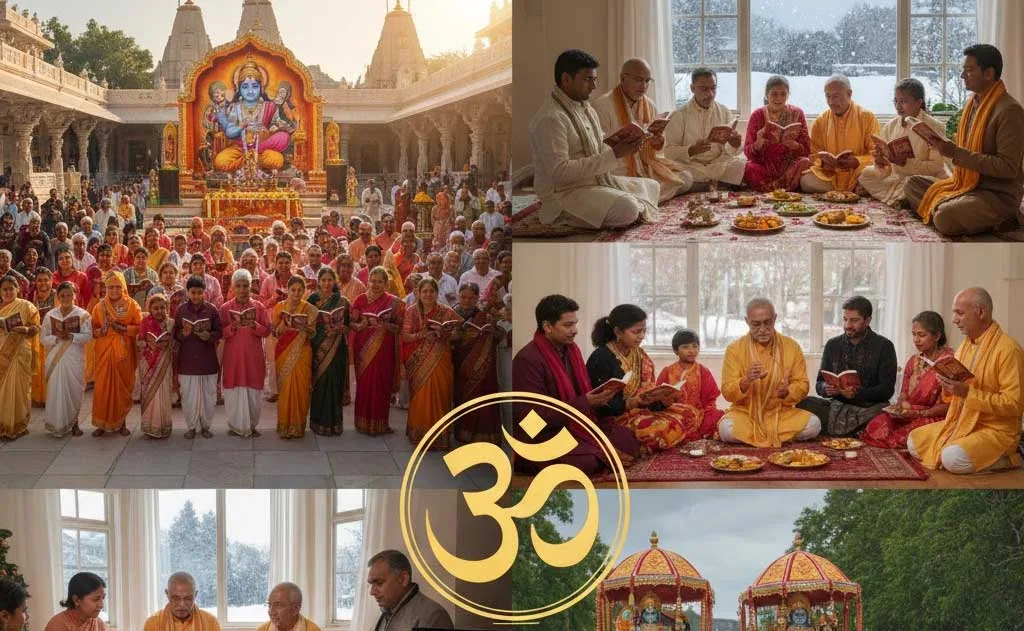
Gita Jayanti, marking the anniversary of Lord Krishna's delivery of the Bhagavad Gita to Arjuna on the battlefield of Kurukshetra, was observed with particular devotion on December 11 this year. From bustling temples in the United States to serene mandirs in the United Kingdom, Canada, Australia, and beyond, devotees gathered for mass recitations of the sacred text, discourses by learned scholars, and heartfelt bhajans.
In New Jersey's Sri Venkateswara Temple, thousands participated in a 24-hour Akhanda Gita Pathan, where the entire 700 verses were chanted continuously. Similar events unfolded at the BAPS Shri Swaminarayan Mandir in London, where families brought children to listen to simplified explanations of the Gita's timeless teachings on duty, righteousness, and devotion.
The month also saw vibrant lamp-lighting ceremonies honoring Margashirsha Ekadashi and other auspicious days. Homes and temples were adorned with diyas, symbolizing the triumph of knowledge over ignorance. Community feasts featuring traditional sattvic meals brought together generations, with elders sharing stories of festivals back in India while younger members embraced the rituals with fresh enthusiasm.
In the San Francisco Bay Area, the Livermore Shiva-Vishnu Temple hosted a grand Gita Jayanti mahotsav complete with cultural performances, including Bharatanatyam dances depicting scenes from the Mahabharata. Meanwhile, in Sydney, Australia, the Sri Durga Temple organized interfaith dialogues centered on the Gita's universal message of harmony and selflessness.
"Hinduism thrives because our traditions are living and adaptable," said Pt. Rajesh Sharma, a priest at the Hindu Temple of Greater Chicago. "In the diaspora, we not only preserve these sacred observances but pass them on with pride to our children born abroad."
Organizations like the Vishva Hindu Parishad (VHP) of America and Hindu Swayamsevak Sangh (HSS) played key roles in coordinating events, ensuring even smaller communities in cities like Dublin, Toronto, and Dubai could participate meaningfully.
These celebrations serve as powerful reminders of cultural continuity amid modern challenges. In an era of rapid globalization, the Hindu diaspora—estimated at over 30 million strong—continues to build temples, establish weekend Bal Vihar classes, and organize festivals that bridge the gap between ancient wisdom and contemporary life.
As one young devotee in London shared, "Lighting the diya here feels just as special as it would in Varanasi. It connects us to our roots and to each other."
HinduTone salutes the unwavering spirit of our global Hindu family in keeping the flame of Sanatana Dharma burning bright across continents.
Stay connected with HinduTone for inspiring stories of faith, culture, and community from Hindus around the world. Jai Shri Krishna!s
What Makes Gita Jayanti Theologically Significant Beyond a Birthday Celebration
Gita Jayanti falls on the Shukla Ekadashi of the month of Margashirsha, a tithi that Lord Krishna himself identifies as sacred in the Bhagavad Gita's tenth chapter, the Vibhuti Yoga, where he declares: 'Among months I am Margashirsha.' This convergence of an auspicious month and an auspicious Ekadashi amplifies the spiritual potency of the observance, making it a day for both commemoration and deep personal practice.
The Bhagavad Gita's 700 shlokas, spread across 18 chapters, were spoken on the battlefield of Kurukshetra in a remarkably compressed window — tradition holds it lasted no longer than the time before armies clashed. Yet the philosophical scope encompasses the doctrines of Karma Yoga, Jnana Yoga, Bhakti Yoga, and Raja Yoga, providing what many acharyas call a complete manual of dharmic living. For diaspora communities far from Tirtha-kshetras and pilgrimage routes, the annual Akhanda Gita Pathan provides a surrogate sacred geography, turning any temple hall into Kurukshetra for a day.
How Margashirsha Ekadashi Carries Its Own Distinct Observance Separate from Gita Jayanti
While Gita Jayanti and Mokshada Ekadashi (the specific Ekadashi on which the Gita was delivered) often overlap in public programming, Margashirsha Ekadashi carries independent scriptural weight. The Padma Purana describes Mokshada Ekadashi as one of the most liberating fasts of the Vaishnava calendar, promising the merit of Ashvamedha Yajna to those who observe it with sincere upavasa — a complete or partial fast accompanied by all-night vigil and Vishnu nama-smarana.
In diaspora temples, this Ekadashi fast is frequently observed communally rather than individually. Devotees gather after sunset for Vishnu Sahasranama recitation, followed by a midnight arati and the breaking of fast with a simple prasad of fruits and milk. The communal format helps younger generations experience the rhythm of a traditional Ekadashi that might otherwise be difficult to observe in isolation amid school or work schedules.
Which Diaspora Hubs Have Become Unexpected Centers of Sanskrit and Vedic Learning
Beyond festival observances, several diaspora cities have quietly developed infrastructure for formal Vedic and Sanskrit education that rivals institutional programs in India. The Chinmaya Mission centers in Houston, Texas, and in Mississauga, Ontario, run year-round Balavihar programs that introduce children to Sanskrit chanting, the Ramayana, and selected Upanishads. In the December season, these centers align their curriculum culmination ceremonies with Gita Jayanti, having students recite memorized shlokas before the assembled congregation.
In the United Kingdom, organizations affiliated with the Swaminarayan Sampraday have established structured Satsang Diksha programs in Leicester and Harrow where adults study the Vachanamrut and Satsangi Jivan alongside Prasthanatrayi texts. These efforts mean that in some diaspora families, the grandchildren can recite Bhagavad Gita shlokas with correct svara (tone) even when their parents' generation grew up with only a surface familiarity with the text.
Why the Winter Solstice Period Holds Independent Significance in the Vedic Calendar
The astronomical event of the winter solstice — known in Sanskrit as Uttarayana Arambha in its approximate sense — carries specific metaphysical weight in Vedic cosmology. The Bhagavad Gita's eighth chapter describes two cosmic paths: the Uttarayana (northern course of the sun, associated with light, fire, and liberation) and the Dakshinayana (southern course, associated with smoke and cyclical rebirth). While the technical Uttarayana by Hindu reckoning begins at Makar Sankranti in January, the December solstice period is understood in diaspora communities as a threshold moment worth marking with heightened sadhana.
This understanding creates a natural bridge in diaspora settings between the Hindu calendar and the broader civic calendar of December celebrations. Hindu families who illuminate their homes with diyas during this period often articulate to their non-Hindu neighbors that the symbolism — light triumphing over the longest night — is not borrowed but is intrinsic to Vedic tradition. It becomes a point of cultural confidence rather than defensiveness.
How Interfaith Engagement Around the Gita Has Grown in Western Countries
The Bhagavad Gita's reputation as a text with universal philosophical reach has made it a natural anchor for Hindu participation in interfaith forums, particularly in December when civic spaces in the West are already oriented toward reflection and spiritual community. The interfaith dialogues organized at the Sri Durga Temple in Sydney are part of a broader pattern seen at the Hindu Temple of Greater Chicago in Lemont, Illinois, and the Vedanta Society centers in New York and San Francisco, where scholars from Christian, Jewish, and Buddhist traditions are invited to engage with the Gita's teachings on non-attachment and the nature of the self.
These events serve a dual purpose: they correct common misconceptions about Hinduism as an exclusivist tradition, and they give second- and third-generation Hindu youth a framework for speaking about their heritage with precision and confidence. Participants often note that presenting the Gita's concept of Nishkama Karma — selfless action without attachment to fruit — resonates strongly with social-justice vocabularies current in Western civic discourse, opening productive conversations rather than defensive ones.
What Role Bharatanatyam and Classical Arts Play in Transmitting Itihasa Abroad
The Bharatanatyam performances staged at the Livermore Shiva-Vishnu Temple and similar venues during Gita Jayanti mahotsavs are not merely cultural entertainment; they are a carefully preserved form of shastra-based transmission. Bharatanatyam is classified as a Margi art form rooted in the Natyashastra of Bharata Muni, and its abhinaya (expressive gesture) vocabulary is specifically designed to communicate the emotional and philosophical states — the navarasas — that underpin stories from the Mahabharata and Ramayana.
In diaspora academies from Fremont, California, to Melbourne, Australia, young students train for years to present Arangetram, the formal graduation performance. When these performances coincide with Gita Jayanti or other December observances, they carry the weight of a rite of passage that connects the dancer personally to the story of Arjuna's transformation on Kurukshetra. Parents and grandparents in the audience recognize that the continuity of classical arts is, for many diaspora families, the most viscerally felt proof that Hindu civilization travels intact across oceans.
Frequently Asked Questions
What is Hindu Diaspora Keeps Traditions Alive Worldwide?
By HinduTone Special Correspondent December 22, 2025 As the winter solstice approaches and the year draws to a close, Hindu communities across the global diaspora have come alive with spiritual fervor, celebrating key December festivals that reinforce faith, culture, and family bonds far from the motherland. Gita Jayanti, marking the anniversary of Lord Kris
What are the key points about Hindu Diaspora Keeps Traditions Alive Worldwide?
From bustling temples in the United States to serene mandirs in the United Kingdom, Canada, Australia, and beyond, devotees gathered for mass recitations of the sacred text, discourses by learned scholars, and heartfelt bhajans. In New Jersey's Sri Venkateswara Temple, thousands participated in a 24-hour Akhanda Gita Pathan, where the ent
Why does Hindu Diaspora Keeps Traditions Alive Worldwide matter in Hinduism?
It reflects core values of Sanatana Dharma and offers practical and spiritual guidance that remains relevant across generations.
How can devotees apply Hindu Diaspora Keeps Traditions Alive Worldwide in daily life?
By reflecting on its teaching, incorporating the related practices or observances into daily routine, and approaching it with sincere devotion and understanding.
You might also like
Purushottam Maas 2026: Lord Vishnu's Sacred Gift of Spiritual Multiplication & Divine Grace
Shani Jayanti 2026: Date, Significance, Rituals & Powerful Mantras
Hindu Priest Jobs New Zealand 2026 — Auckland, Wellington, Christchurch Vacancies & NZ Religious Worker Visa Guide