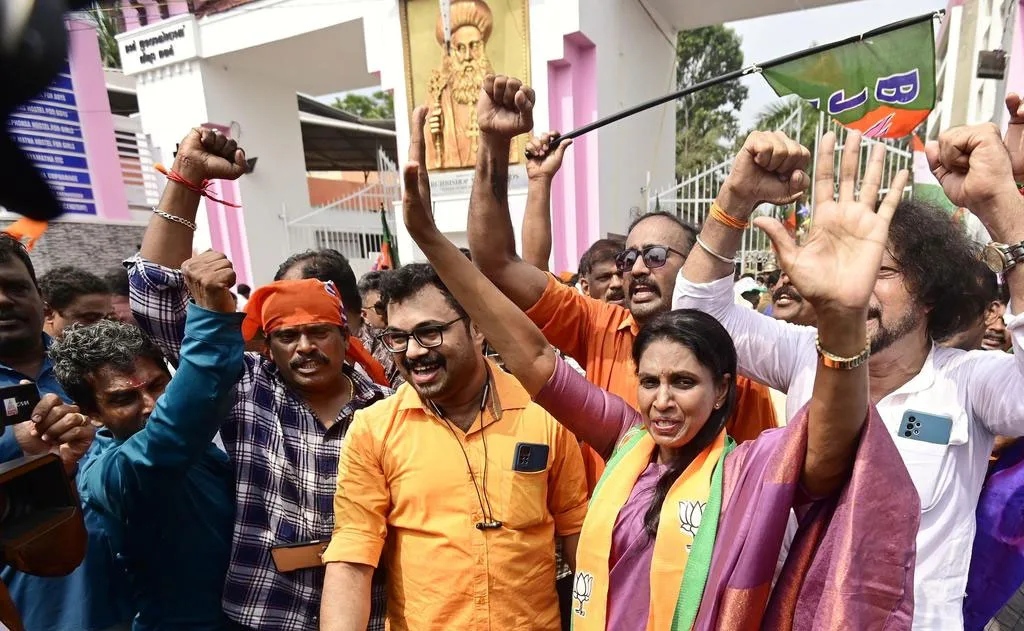
BJP Scripts History: Wins Thiruvananthapuram Corporation, Ends LDF's 45-Year Dominance in Kerala Capital
Thiruvananthapuram, December 15, 2025 – In a landmark victory that signals a major shift in Kerala's political landscape, the Bharatiya Janata Party (BJP)-led…
Thiruvananthapuram, December 15, 2025 – In a landmark victory that signals a major shift in Kerala's political landscape, the Bharatiya Janata Party (BJP)-led…
Thiruvananthapuram, December 15, 2025 – In a landmark victory that signals a major shift in Kerala's political landscape, the Bharatiya Janata Party (BJP)-led National Democratic Alliance (NDA) has captured the Thiruvananthapuram Municipal Corporation, securing 50 out of 100 contested wards. This breakthrough ends the Left Democratic Front (LDF)'s over four-decade-long hold on the state capital's civic body and paves the way for Kerala's first-ever BJP Mayor.
Key Election Results in Thiruvananthapuram Corporation:
- BJP-NDA: 50 seats (majority achieved due to one ward polling postponed after a candidate's death)
- LDF: 29 seats
- UDF: 19 seats
- Others/Independents: 2 seats
The victory marks a significant urban gain for the BJP amid widespread anti-incumbency against the ruling LDF government. Prominent contenders for the mayoral post include former DGP R. Sreelekha, who won from Sasthamangalam ward, and senior leader V.V. Rajesh.
Prime Minister Narendra Modi hailed the win as a "watershed moment in Kerala’s politics," stating on X: "Thank you Thiruvananthapuram! The mandate the BJP-NDA got in the Thiruvananthapuram Corporation is a powerful signal that people trust us for development and ease of living."
Statewide Context: UDF Dominates, LDF Retains Kozhikode
While the BJP celebrated its historic urban breakthrough in the capital (and also captured Tripunithura Municipality), the Congress-led United Democratic Front (UDF) emerged as the biggest gainer statewide:
- UDF secured control of four municipal corporations (including Kochi, Thrissur, Kollam, and Kannur).
- LDF held onto Kozhikode Corporation but suffered heavy losses elsewhere.
- Overall, UDF swept numerous panchayats and municipalities, reflecting voter dissatisfaction with LDF's governance.
Congress MP Shashi Tharoor, whose Lok Sabha constituency includes Thiruvananthapuram, acknowledged the BJP's "historic performance" while congratulating UDF's statewide success.
This result is seen as a bellwether for the 2026 Kerala Assembly elections, highlighting growing urban support for BJP's development agenda under PM Modi's leadership.
Stay tuned to Hindutone.com for the latest updates on Kerala's political developments, BJP's rising influence, and the upcoming mayoral election in Thiruvananthapuram.
What made Thiruvananthapuram a historic battleground for BJP?
Thiruvananthapuram, the ancient city known as 'Ananthapuri' — the city of the divine serpent Ananta on whom Lord Vishnu reclines — has long been a stronghold of Left politics dating back to the early 1980s. The city's municipal corporation, established in its modern form after Kerala's reorganisation, had remained under LDF control through successive waves of state-level political change, making BJP's entry into its council chambers a genuinely unprecedented development.
The BJP's strategy in the capital was deliberately long-term. The party invested heavily in booth-level organisation across all 100 wards, leveraging the Sabarimala agitation aftermath of 2018–19, which galvanised large sections of Hindu voters in the southern districts. The constituency's significant population of government employees, defence personnel, and a growing urban professional class created a voter base more receptive to BJP's development-centric messaging than in northern Kerala.
Who is R. Sreelekha and why does her candidacy carry symbolic weight?
R. Sreelekha, a 1987-batch IPS officer and former Director General of Police (DGP) of Kerala, is one of the most recognisable names in the race for the mayoral post. She is notable as the first woman to have served as DGP of Kerala Police, and her victory from the Sasthamangalam ward — a centrally located, politically competitive ward — adds both administrative credibility and symbolic resonance to the BJP's Thiruvananthapuram chapter.
Her joining the BJP and contesting civic polls represents a broader NDA effort to field candidates with strong public-service credentials rather than exclusively career politicians. If elected Mayor, she would simultaneously be Kerala's first BJP Mayor and the first former police chief to lead a major Kerala corporation, a combination that BJP strategists believe can project a governance-first image ahead of the 2026 state assembly elections.
How does the Sabarimala factor continue to shape BJP's Kerala trajectory?
The 2018 Supreme Court verdict permitting women of all ages to enter the Sabarimala Sree Dharmasastha temple, and the subsequent LDF government's decision to enforce it, triggered one of the most intense socio-religious mobilisations in post-Independence Kerala. The BJP, along with the Nair Service Society and several other Hindu organisations, led sustained protests that translated into tangible electoral gains in the 2019 Lok Sabha polls, where the party's vote share in Thiruvananthapuram district rose sharply.
That momentum has not entirely dissipated. Political analysts note that in southern Kerala — where communities with strong Ayyappa devotion are concentrated — the Sabarimala controversy left a residual consolidation of Hindu votes toward the NDA. The 2025 corporation results suggest this consolidation has become structural enough to deliver majority seats rather than merely improved vote percentages, marking a qualitative shift in BJP's ground presence.
What does the UDF's statewide sweep signal about Kerala's political realignment?
While BJP's win in Thiruvananthapuram dominated headlines, the Congress-led UDF's control of four out of six major municipal corporations — Kochi, Thrissur, Kollam, and Kannur — tells a parallel story of anti-incumbency against a two-term LDF government. Chief Minister Pinarayi Vijayan's administration, which has faced prolonged criticism over the K-Rail (SilverLine) project controversy, allegations of gold smuggling case links, and perceived governance fatigue after ten years in power, absorbed punishing losses across urban local bodies.
The results sketch a Kerala where the traditional bipolar LDF-UDF contest is giving way to a triangular competition, particularly in the southern districts. For Congress, retaining Kochi — the commercial capital — and capturing Kannur, which has historically been an LDF fortress in northern Kerala, signals that the party's revival under its state leadership is broader than a single urban pocket. This three-way dynamic will be the central structural reality heading into the 2026 Kerala Legislative Assembly elections.
What administrative priorities will shape the new BJP-led corporation's first term?
Thiruvananthapuram Corporation administers one of India's fastest-growing state capitals, with pressing challenges that include solid waste management, flooding in low-lying wards along the Karamana and Killiyar rivers, and the expansion of civic infrastructure to newly merged peripheral areas. BJP's campaign had centred promises around transparent ward-level fund utilisation, accelerated Smart City project implementation, and improving the Thiruvananthapuram city bus network in coordination with KSRTC.
The party will also need to navigate the practical complexity of running a corporation in a state where the elected LDF government controls the administrative machinery, including the appointment of senior municipal officers. This centre-periphery tension — a BJP-led corporation working within a state governed by LDF — will test the new council's ability to deliver visible results without state-level cooperation, and will itself become a campaigning narrative for the 2026 assembly cycle.
How do these results fit into BJP's broader southern India expansion strategy?
The Thiruvananthapuram victory is the most significant local-body breakthrough for BJP in peninsular India since the party consolidated power in parts of coastal Karnataka. In Tamil Nadu, Telangana, and Kerala, the party has historically struggled to translate Lok Sabha vote shares into local body majorities, making this corporation win a proof-of-concept that urban civic administration is an achievable entry point into southern polities.
BJP's national leadership has consistently framed the southern states as the next frontier of organisational expansion, and a functioning BJP Mayor in Thiruvananthapuram — a city that houses the Sree Padmanabhaswamy temple, one of the wealthiest and most venerated Vishnu shrines in the country — carries cultural and symbolic significance beyond electoral arithmetic. It signals to the broader Hindu voter base in Kerala that the party is no longer a permanent opposition force in the state but a credible governing alternative at the local level, a perception that can compound ahead of 2026.
Frequently Asked Questions
What is BJP Scripts History?
Thiruvananthapuram, December 15, 2025 – In a landmark victory that signals a major shift in Kerala's political landscape, the Bharatiya Janata Party (BJP)-led National Democratic Alliance (NDA) has captured the Thiruvananthapuram Municipal Corporation, securing 50 out of 100 contested wards. This breakthrough ends the Left Democratic Front (LDF)'s over four-
What are the key points about BJP Scripts History?
Key Election Results in Thiruvananthapuram Corporation: BJP-NDA : 50 seats (majority achieved due to one ward polling postponed after a candidate's death) LDF : 29 seats UDF : 19 seats Others/Independents : 2 seats The victory marks a significant urban gain for the BJP amid widespread anti-incumbency against the ruling LDF government. Pro
Why does BJP Scripts History matter in Hinduism?
It reflects core values of Sanatana Dharma and offers practical and spiritual guidance that remains relevant across generations.
How can devotees apply BJP Scripts History in daily life?
By reflecting on its teaching, incorporating the related practices or observances into daily routine, and approaching it with sincere devotion and understanding.
You might also like

Divine Hindu Temple News, Festivals & Global Devotion in Jyeshtha Adhik Maas 2026

Sacred Hindu Festivals & Temple News: Divine Week — May 2026

Jyeshtha Masam 2026: Dates, Significance, Festivals, Mantras, and Danas – Complete Guide