Beyond Asana: A Beginner's Guide to the 8 Limbs of Yoga from the Patanjali Yoga Sutras
Introduction: What is Real Yoga? When most people think of yoga, they picture downward dogs, warrior poses, and perhaps a peaceful savasana at the end of…
Introduction: What is Real Yoga? When most people think of yoga, they picture downward dogs, warrior poses, and perhaps a peaceful savasana at the end of…
Introduction: What is Real Yoga?
When most people think of yoga, they picture downward dogs, warrior poses, and perhaps a peaceful savasana at the end of class. But what if I told you that the physical postures—the part we call "asana"—represent just one-eighth of what yoga truly is?
Welcome to the ancient wisdom of the Patanjali Yoga Sutras, a timeless text that reveals yoga as a complete system for living a meaningful, purposeful life. Written by the sage Patanjali over 2,000 years ago, the Yoga Sutras outline the Ashtanga Yoga—literally "eight-limbed yoga"—a comprehensive path to self-realization and inner peace.
In our modern world filled with stress, distraction, and disconnection, these eight limbs offer a roadmap back to ourselves. Whether you're a seasoned practitioner or someone who's never set foot on a yoga mat, this guide will help you understand the profound depth of yoga philosophy and how to apply it to your daily life.
Let's embark on this transformative journey through the eight limbs of yoga.
The Eight Limbs: An Overview
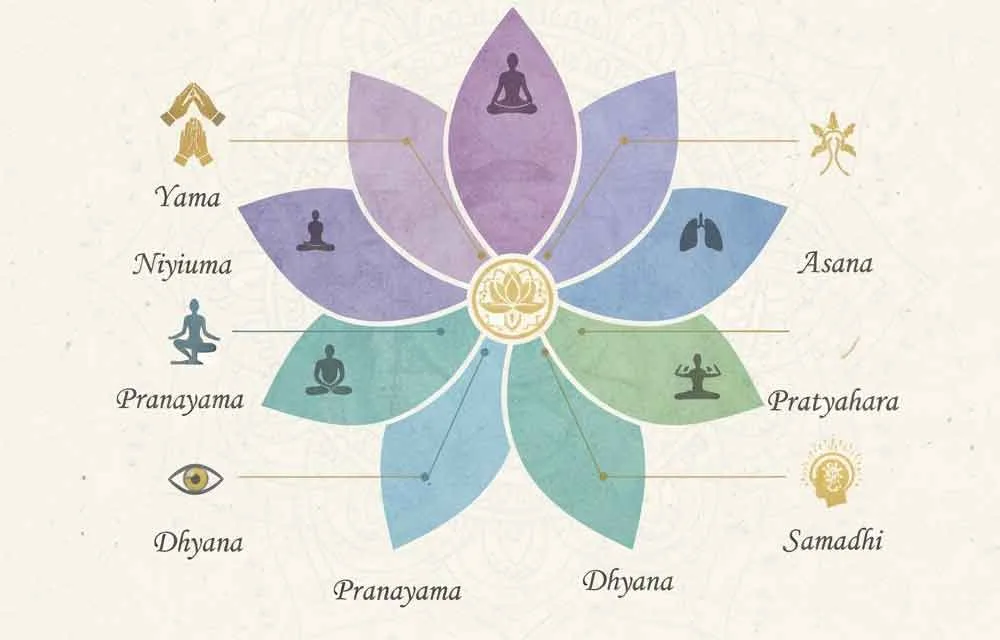
Before we dive deep into each limb, here's a bird's-eye view of the complete system:
- Yama (Ethical restraints) - How we relate to others
- Niyama (Personal observances) - How we relate to ourselves
- Asana (Physical postures) - Preparing the body
- Pranayama (Breath control) - Harnessing life force energy
- Pratyahara (Withdrawal of senses) - Turning inward
- Dharana (Concentration) - Focusing the mind
- Dhyana (Meditation) - Sustained awareness
- Samadhi (Absorption) - Union with the divine
Think of these limbs as steps on a ladder, each one supporting and preparing you for the next. However, they're not strictly linear—you can practice multiple limbs simultaneously as you progress on your yoga journey.
First Limb: Yama (Ethical Restraints)
Understanding Yama
The Yamas are five ethical guidelines that govern how we interact with the world around us. They form the moral foundation of yoga practice, helping us live in harmony with others and cultivate positive karma.
The Five Yamas:
1. Ahimsa (Non-violence) Ahimsa is the practice of non-harming in thought, word, and deed. It extends beyond physical violence to include our mental and emotional states.
In Daily Life: Choose compassionate communication over harsh criticism. Consider your dietary choices and their impact on all living beings. Notice when you're being violent toward yourself through negative self-talk.
2. Satya (Truthfulness) Satya encourages us to live authentically and speak honestly, while balancing truth with kindness (remember ahimsa comes first).
In Daily Life: Practice honesty in your relationships. Be genuine on social media rather than projecting a false image. Speak your truth with compassion.
3. Asteya (Non-stealing) Beyond literal theft, Asteya means not taking what isn't freely given—including people's time, energy, or credit for their ideas.
In Daily Life: Arrive on time for appointments. Give proper credit to others' work. Don't take more than your share of resources.
4. Brahmacharya (Energy moderation) Traditionally interpreted as celibacy, modern practitioners often understand this as the wise use of our vital energy and practicing moderation in all things.
In Daily Life: Use your energy mindfully. Practice moderation with food, entertainment, and social media. Channel your creative energy into meaningful pursuits.
5. Aparigraha (Non-possessiveness) Aparigraha teaches us to take only what we need and let go of greed, jealousy, and attachment to material things.
In Daily Life: Declutter your space regularly. Practice gratitude for what you have. Let go of the need to control outcomes.
Why Yama Matters
The Yamas aren't just rules—they're practices that free us from creating suffering for ourselves and others. When we harm others, we harm ourselves. When we live with integrity, we experience inner peace.
Second Limb: Niyama (Personal Observances)
Understanding Niyama
While Yamas focus on our external behavior, Niyamas are internal practices—how we treat ourselves and cultivate our inner landscape. These five principles help us build character and spiritual strength.
The Five Niyamas:
1. Saucha (Purity/Cleanliness) Saucha encompasses both physical cleanliness and mental clarity. It's about creating a clean environment—inside and out.
In Daily Life: Maintain personal hygiene and a clean living space. Eat pure, wholesome foods. Clear your mind through meditation. Surround yourself with uplifting influences.
2. Santosha (Contentment) Santosha is the practice of finding peace and satisfaction with what is, right now. It doesn't mean complacency but rather acceptance without constant wanting.
In Daily Life: Practice gratitude journaling. Notice when you're comparing yourself to others. Find joy in simple pleasures. Accept circumstances you cannot change.
3. Tapas (Discipline/Austerity) Tapas literally means "heat" and refers to the burning enthusiasm and self-discipline needed to transform ourselves. It's about doing the work even when it's hard.
In Daily Life: Maintain a regular practice (yoga, meditation, exercise). Follow through on commitments. Step out of your comfort zone. Build positive habits through consistency.
4. Svadhyaya (Self-study) Svadhyaya involves studying spiritual texts, but more importantly, studying yourself—your patterns, reactions, and inner workings.
In Daily Life: Read sacred texts or philosophy. Journal about your experiences and emotions. Reflect on your behaviors and motivations. Seek to understand your true nature.
5. Ishvara Pranidhana (Surrender to the Divine) This niyama invites us to recognize something greater than ourselves—whether you call it God, the Universe, or Higher Consciousness—and surrender our ego's need for control.
In Daily Life: Practice letting go of outcomes. Dedicate your actions to something greater than yourself. Cultivate faith and trust. Recognize the sacred in everyday life.
Why Niyama Matters
The Niyamas build inner resilience and spiritual strength. They help us create the right conditions—both externally and internally—for deeper practice and self-realization.
Third Limb: Asana (Physical Postures)
Understanding Asana
Here's where most modern yoga practitioners begin—and there's nothing wrong with that! Asana practice prepares the body to sit comfortably for meditation and pranayama. Patanjali actually gives very little instruction about asana in the Sutras, simply stating that the posture should be "steady and comfortable."
The Purpose of Asana
The physical postures serve several purposes:
- Physical Health: Strength, flexibility, balance, and overall wellbeing
- Energy Flow: Removing blockages and allowing prana (life force) to flow freely
- Body Awareness: Developing mindfulness and presence in the physical form
- Preparation for Stillness: Building the endurance to sit in meditation
- Mind-Body Connection: Uniting consciousness with the physical vessel
Beyond the Mat
While practicing various poses is valuable, remember that asana is ultimately about finding steadiness and ease—in your body and in your life. The lessons you learn on the mat about balance, persistence, and breath should extend into your daily activities.
In Daily Life: Notice your posture throughout the day. Take movement breaks. Approach challenges with the same steady breath you use in difficult poses. Find ease within effort.
Why Asana Matters
A healthy, strong, flexible body supports spiritual practice. When we're not distracted by physical discomfort or disease, we can turn our attention inward more easily.
Fourth Limb: Pranayama (Breath Control)
Understanding Pranayama
Pranayama is the practice of regulating the breath to control prana—the vital life force energy that animates all living things. "Prana" means life force, and "yama" means control or extension.
The breath is the bridge between body and mind. By controlling the breath, we influence our nervous system, emotional state, and mental clarity.
Basic Pranayama Techniques
1. Dirga (Three-Part Breath) A foundational practice that fills the belly, ribs, and chest sequentially, promoting full oxygen exchange and relaxation.
2. Nadi Shodhana (Alternate Nostril Breathing) Balances the left and right hemispheres of the brain, calming the nervous system and clearing energetic channels.
3. Ujjayi (Victorious Breath) A slightly constricted breath creating an ocean sound, used during asana practice to maintain focus and build internal heat.
4. Kapalabhati (Skull Shining Breath) A energizing breath consisting of forceful exhales and passive inhales, cleansing the respiratory system and awakening energy.
5. Bhramari (Bee Breath) A humming breath that calms anxiety and quiets mental chatter through vibration.
Why Pranayama Matters
Breath is life. When we learn to master our breath, we gain control over our energy, emotions, and mental states. Pranayama practices prepare us for the deeper internal work of the remaining limbs.
In Daily Life: Use breath to manage stress. Practice conscious breathing during emotional moments. Begin and end your day with a few minutes of pranayama.
Fifth Limb: Pratyahara (Withdrawal of the Senses)
Understanding Pratyahara
Pratyahara marks a crucial transition in the eight limbs—the pivot from external practices to internal work. It's the practice of withdrawing the senses from external objects and turning our awareness inward.
Think of it like a turtle drawing its limbs into its shell, or closing the windows of a house so you can focus on what's inside.
The Challenge of Sense Withdrawal
We live in a world designed to capture our attention. Our senses are constantly bombarded with stimulation—screens, sounds, notifications, advertisements, endless options. This constant external focus fragments our awareness and depletes our energy.
Pratyahara isn't about denying sensory experience or rejecting the world. It's about developing the ability to consciously choose where to direct our attention rather than being pulled in every direction by external stimuli.
Practicing Pratyahara
Sensory Fasting: Periodically reduce sensory input—turn off screens, practice silence, spend time in nature, or try a sensory deprivation float.
Mindful Eating: Eat without distractions, fully experiencing taste, texture, and aroma without TV, phone, or reading material.
Yoga Nidra: This guided meditation practice naturally induces pratyahara as you systematically relax the body and withdraw from external awareness.
Observing Without Reacting: When you notice sensory input, practice observing it without immediately reacting or engaging with it.
Why Pratyahara Matters
Without the ability to withdraw from the senses, deeper meditation is nearly impossible. Pratyahara gives us mastery over our attention—one of our most valuable resources. It's the foundation for concentration and meditation.
In Daily Life: Create phone-free zones or times. Practice single-tasking. Take regular breaks from sensory overload. Notice when you're seeking external stimulation to avoid being with yourself.
Sixth Limb: Dharana (Concentration)
Understanding Dharana
Dharana is the practice of focused concentration—directing and holding the mind's attention on a single point without wavering. If Pratyahara is withdrawing from external distractions, Dharana is actively focusing on one thing.
The Sanskrit word "dharana" comes from the root "dhr," meaning "to hold." You're literally learning to hold your attention steady.
The Scattered Mind
Our minds are naturally restless, jumping from thought to thought like a monkey swinging from branch to branch. Buddhist philosophy calls this the "monkey mind." In the Yoga Sutras, Patanjali describes the mind as having five states, with the scattered, distracted state being the most common.
Dharana trains the mind to become stable and focused, which is essential for meditation and ultimately, enlightenment.
Practicing Dharana
Single-Point Focus Objects:
- A candle flame (trataka meditation)
- A mantra or sacred word repeated mentally
- The breath flowing in and out
- A visual symbol like a yantra or mandala
- A sensation in the body
- The space between the eyebrows (ajna chakra)
The Practice:
- Choose your focus object
- Sit comfortably with an alert but relaxed posture
- Direct your complete attention to the object
- When the mind wanders (and it will), gently bring it back
- Continue for a set period (start with 5-10 minutes)
Why Dharana Matters
Concentration is a superpower in our distracted age. The ability to focus deeply on one thing creates the conditions for flow states, creative breakthroughs, and profound insights. In spiritual terms, it's the doorway to meditation.
In Daily Life: Practice single-tasking in your work. Give people your undivided attention in conversation. Notice when you're multitasking and gently redirect to one thing. Build your concentration muscle gradually.
Seventh Limb: Dhyana (Meditation)
Understanding Dhyana
Dhyana is the natural progression from Dharana. While Dharana is focused concentration requiring effort, Dhyana is the effortless flow of concentration—sustained, unbroken awareness. It's when the effort dissolves and you merge with the object of meditation.
If Dharana is like pouring water in a thin, controlled stream, Dhyana is like that stream becoming continuous and unbroken—a steady flow of attention.
The Difference Between Dharana and Dhyana
- Dharana: You concentrate on your breath. Your mind wanders. You bring it back. Effort is required.
- Dhyana: You become the breath. There's no separate "you" watching. Just breathing. Awareness. Presence. No effort.
Dhyana happens when the object of meditation, the act of meditation, and the meditator become one.
Cultivating Dhyana
You cannot force Dhyana—it arises naturally from consistent Dharana practice. It's a state of grace that emerges when conditions are right.
Supporting Conditions:
- Regular practice (consistency matters more than duration)
- Proper preparation through the earlier limbs
- A quiet, comfortable space
- Letting go of expectations
- Patience and self-compassion
Signs You're Entering Dhyana:
- Time seems to disappear
- Effort becomes effortless
- The sense of "I" softens
- Deep peace and clarity arise
- Thoughts slow or cease
- You feel connected to something greater
Types of Meditation
While Dhyana is a state rather than a technique, various meditation practices can lead you there:
- Breath meditation (following the natural breath)
- Mantra meditation (repeating a sacred sound)
- Loving-kindness meditation (cultivating compassion)
- Body scan meditation (systematic awareness)
- Vipassana (insight meditation)
- Zazen (just sitting in Zen tradition)
Why Dhyana Matters
Meditation is where transformation happens. In this state of sustained awareness, we begin to see the true nature of reality, dissolve the illusion of separation, and experience our essential being beyond the ego.
In Daily Life: Establish a daily meditation practice, even if brief. Find moments of meditative awareness—washing dishes mindfully, walking in nature, or simply being present with loved ones. Remember that meditation is not just sitting on a cushion but a quality of presence you can bring to any moment.
Eighth Limb: Samadhi (Absorption/Enlightenment)
Understanding Samadhi
Samadhi is the ultimate goal of yoga—complete absorption, union, enlightenment, or liberation (moksha). It's the state where all sense of separation dissolves, and you experience unity with all existence.
The word "Samadhi" comes from "sam" (together) and "adhi" (toward), suggesting a coming together or union. This is yoga in its truest sense: union of individual consciousness with universal consciousness.
The Paradox of Samadhi
Samadhi is both the ultimate goal and the recognition that there was never anywhere to go. It's the realization that what you've been seeking has been your true nature all along. The seeker, the seeking, and the sought are one.
Patanjali describes different levels or types of Samadhi:
Samprajnata Samadhi (Samadhi with seed): The meditator still maintains awareness of an object or support for meditation. There's still a subtle duality—the experiencer and the experience, though they're intimately connected.
Asamprajnata Samadhi (Seedless Samadhi): Complete absorption where all mental activity ceases. No object, no observer, no separation. Pure consciousness experiencing itself. This is considered the highest state and leads to liberation (kaivalya).
Glimpses of Samadhi
While sustained Samadhi might seem like something only advanced yogis achieve after decades of practice, many people have brief glimpses of this state:
- Moments in nature when you forget yourself completely
- The zone state athletes describe
- Times when time stops during creative flow
- Experiences of unconditional love
- Profound moments of presence
- Spontaneous feelings of unity and connection
These tastes of Samadhi show us what's possible and inspire continued practice.
Why Samadhi Matters
Samadhi represents the end of suffering caused by identification with the ego-self. It's the realization of who you truly are beyond name, form, and story. While this might sound abstract, it has practical implications: freedom from fear, genuine inner peace, unconditional love, and the ability to live fully in each moment.
The Journey Is the Destination
Here's the beautiful paradox: while Samadhi is described as the final limb, the entire eight-limbed path is itself the practice of yoga. You don't practice the first seven limbs to "get to" Samadhi. Each limb, practiced sincerely, is an expression of yoga—union.
Integrating the Eight Limbs Into Modern Life
Start Where You Are
You don't need to master the Yamas and Niyamas before stepping onto your yoga mat, nor do you need to perfect your asana before exploring meditation. The eight limbs are interconnected and mutually reinforcing.
A Practical Approach:
Morning:
- Begin with Ishvara Pranidhana (surrender/intention setting)
- Practice Asana (10-20 minutes of movement)
- Follow with Pranayama (5-10 minutes of breathwork)
- End with Dharana or Dhyana (5-15 minutes of meditation)
Throughout the Day:
- Apply Yamas in your interactions (non-violence, truthfulness, non-stealing)
- Practice Niyamas in your habits (cleanliness, contentment, discipline)
- Take Pratyahara breaks (stepping away from screens and sensory overload)
Evening:
- Practice Svadhyaya (self-reflection or journaling)
- Cultivate Santosha (gratitude for the day)
- Gentle Asana and Pranayama to wind down
Common Misconceptions
Misconception 1: "I need to be flexible to do yoga." Reality: Yoga is about awareness and presence, not perfect poses. Start where you are.
Misconception 2: "The eight limbs must be practiced in strict order." Reality: While they build on each other, you can engage with multiple limbs simultaneously.
Misconception 3: "Samadhi is only for enlightened masters." Reality: Everyone can experience glimpses of unity consciousness; it's your natural state.
Misconception 4: "Real yoga means giving up worldly life." Reality: The eight limbs offer tools for living more consciously in the world, not escaping it.
Creating Your Personal Practice
The beauty of the eight limbs is that they offer a complete framework you can customize to your life:
For the Busy Professional: Focus on Yamas and Niyamas in work relationships, use Pranayama for stress management, and brief Dhyana sessions for mental clarity.
For the Physical Practitioner: Deepen your Asana practice by incorporating the philosophical foundation of Yamas and Niyamas, making each pose a meditation (Dharana).
For the Spiritual Seeker: Dive deep into Svadhyaya, establish a strong meditation practice (Dharana and Dhyana), while staying grounded through Asana and Pranayama.
For the Beginner: Start with one Yama or Niyama that resonates with you. Add simple Asana and Pranayama. Be patient with yourself.
The Transformative Power of the Eight Limbs
Beyond Self-Improvement
While the eight limbs certainly improve your life—better health, reduced stress, improved relationships, greater focus—they point to something far more profound than self-improvement. They're about self-realization.
The eight limbs are a technology for remembering who you truly are beneath the layers of conditioning, identity, and ego. They help you peel back the veils that obscure your essential nature—pure consciousness, love, and peace.
A Living Tradition
The Yoga Sutras were written over 2,000 years ago, but their wisdom is timeless. Each generation must interpret and apply these teachings in their own context. Our challenge today is honoring the depth and authenticity of the tradition while making it accessible and relevant to modern life.
The Ripple Effect
As you practice the eight limbs, you'll notice changes not just within yourself but in your relationships and environment. When you embody Ahimsa (non-violence), you create peace around you. When you practice Satya (truthfulness), you inspire authenticity in others. When you cultivate Santosha (contentment), you become a source of calm in a restless world.
Your personal practice becomes a gift to the collective.
Conclusion: The Journey Continues
The eight limbs of yoga offer a profound path of transformation that begins with how we treat others and ourselves and culminates in the direct experience of unity consciousness. But remember: yoga is not about reaching some distant destination. It's about how you walk the path.
Each time you choose kindness over cruelty (Ahimsa), you're practicing yoga. Each time you speak your truth with compassion (Satya), you're practicing yoga. Each time you move mindfully (Asana), you're practicing yoga. Each time you breathe consciously (Pranayama), you're practicing yoga. Each time you turn inward (Pratyahara), you're practicing yoga. Each time you focus your attention (Dharana), you're practicing yoga. Each time you rest in awareness (Dhyana), you're practicing yoga. Each time you recognize your oneness with all things (Samadhi), you're practicing yoga.
Yoga is happening right now, in this moment. The Sutras are not ancient history but living wisdom waiting to be embodied.
Whether you came to yoga for flexibility, stress relief, or spiritual growth, the eight limbs offer a complete roadmap for the journey. Start wherever you are. Practice what speaks to you. Be patient with yourself. Trust the process.
The path of yoga is walked one step—or one limb—at a time. And each step brings you home to yourself.
Further Resources
Books:
- "The Yoga Sutras of Patanjali" translated by Sri Swami Satchidananda
- "Light on Yoga" by B.K.S. Iyengar
- "The Heart of Yoga" by T.K.V. Desikachar
- "Living the Sutras" by Kelly Dinardo and Amy Pearce-Hayden
Final Reflection
Take a moment right now. Notice your breath. Feel your body. Observe your thoughts. Recognize the awareness that's noticing all of this.
That awareness is yoga. You are yoga.
Everything else is just practice.
Namaste
The light in me honors the light in you.
This guide is meant as an introduction to the profound wisdom of the Patanjali Yoga Sutras. May it inspire you to explore deeper, practice consistently, and experience the transformative power of the eight limbs in your own life.
Frequently Asked Questions
What is Beyond Asana?
Introduction: What is Real Yoga? When most people think of yoga, they picture downward dogs, warrior poses, and perhaps a peaceful savasana at the end of class.
What are the key points about Beyond Asana?
But what if I told you that the physical postures—the part we call "asana"—represent just one-eighth of what yoga truly is? Welcome to the ancient wisdom of the Patanjali Yoga Sutras, a timeless text that reveals yoga as a complete system for living a meaningful, purposeful life.
Why does Beyond Asana matter in Hinduism?
It reflects core values of Sanatana Dharma and offers practical and spiritual guidance that remains relevant across generations.
How can devotees apply Beyond Asana in daily life?
By reflecting on its teaching, incorporating the related practices or observances into daily routine, and approaching it with sincere devotion and understanding.
You might also like
Purushottam Maas 2026: Lord Vishnu's Sacred Gift of Spiritual Multiplication & Divine Grace
Shani Jayanti 2026: Date, Significance, Rituals & Powerful Mantras
Hindu Priest Jobs New Zealand 2026 — Auckland, Wellington, Christchurch Vacancies & NZ Religious Worker Visa Guide