Hindu Beliefs on Vegetarian Food: Why Hinduism Embraces a Plant-Based Life | HinduTone
Hindu Beliefs on Vegetarian Food: A Complete Spiritual and Cultural Guide Across India and the world, Hinduism is widely associated with vegetarianism — and…
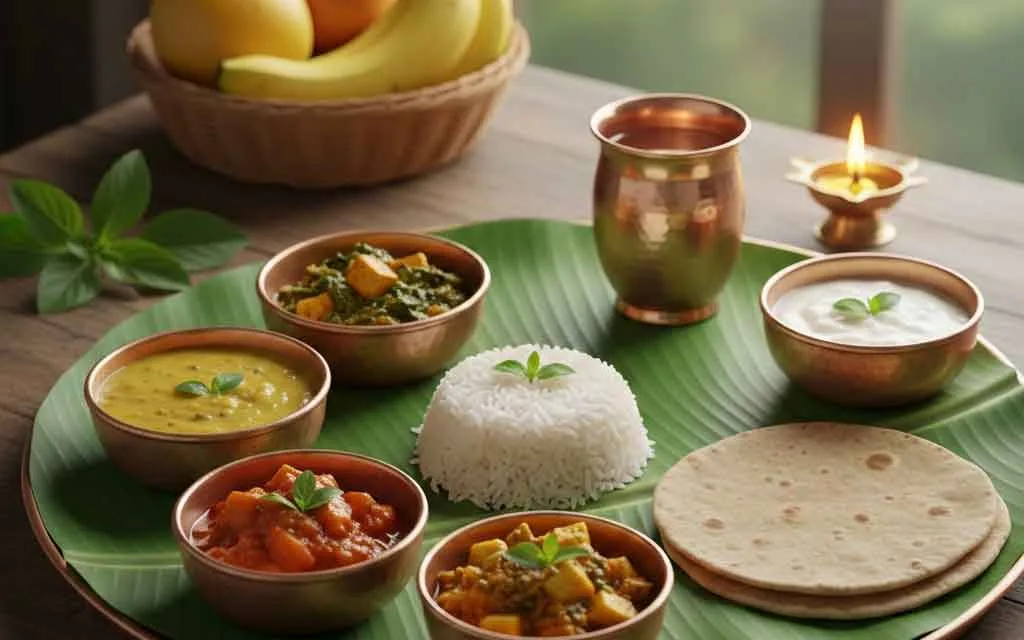
Hindu Beliefs on Vegetarian Food: A Complete Spiritual and Cultural Guide Across India and the world, Hinduism is widely associated with vegetarianism — and…
Hindu Beliefs on Vegetarian Food: A Complete Spiritual and Cultural Guide
Across India and the world, Hinduism is widely associated with vegetarianism — and for profound reasons. The Hindu belief on vegetarian food is not a simple dietary preference or cultural habit. It is a deeply philosophical, spiritual, and ethical way of living, rooted in thousands of years of Vedic wisdom, sacred scripture, and devotional practice.
From the principle of Ahimsa (non-violence) to the concept of Sattvic food (pure, life-giving nourishment), Hinduism offers one of the world's most comprehensive and spiritually grounded arguments for a plant-based lifestyle.
In this in-depth guide, HinduTone explores everything you need to know about Hindu beliefs on vegetarian food — the philosophical foundations, scriptural references, spiritual benefits, regional practices, and the living traditions that make vegetarianism central to Hindu identity.
The Core Philosophy: Ahimsa — Non-Violence Toward All Life
At the very heart of Hindu vegetarianism lies the ancient principle of Ahimsa (अहिंसा) — non-violence, non-harm, and compassion toward all living beings.
What Is Ahimsa?
The Sanskrit word Ahimsa is formed from "a" (non) and "himsa" (violence or injury). It is the moral commitment to avoid causing harm — physically, verbally, or mentally — to any living creature. Ahimsa is not passive indifference; it is an active, conscious expression of love and respect for all life.
In Hindu philosophy, every living being — plant, animal, insect, or human — is believed to contain the divine spark of Atman (soul). The Chandogya Upanishad declares: "Tat Tvam Asi" — "That Thou Art" — meaning the divine essence in you is the same as the divine essence in all living things.
If every creature shares the same divine consciousness, then killing and consuming animals becomes an act of violence against the very Self — a violation of cosmic unity.
Ahimsa and Food Choice
The logical extension of Ahimsa in daily life is the choice of vegetarian food. Hindus who follow Ahimsa believe that:
- Eating meat requires the deliberate killing of sentient beings capable of experiencing pain, fear, and suffering
- This killing generates negative karma (Papa) that binds the soul and delays spiritual liberation
- A vegetarian diet allows one to nourish the body without causing harm, keeping both conscience and karma clean
The great sage Patanjali, in his Yoga Sutras, listed Ahimsa as the very first of the Yamas (moral restraints) — foundational ethical principles that every spiritual seeker must observe. Without Ahimsa in one's diet, genuine spiritual progress is considered difficult.
The Sattvic Diet: The Hindu Science of Pure Food
Beyond Ahimsa, Hindu beliefs about food are deeply shaped by the ancient science of the three Gunas (qualities) — Sattva, Rajas, and Tamas — described in the Bhagavad Gita and Ayurvedic texts.
The Three Gunas and Food
Hindu philosophy teaches that everything in the universe — including food — is made up of three fundamental qualities:
Sattva (सत्त्व) — Purity, Clarity, and Light Sattvic foods promote mental clarity, spiritual awareness, compassion, peace, and vitality. They are light, nourishing, fresh, and naturally pleasant. Sattvic foods are the ideal foundation of a Hindu vegetarian diet.
Examples: Fresh fruits, vegetables, whole grains, legumes, dairy (milk, ghee, curd), nuts, seeds, honey, and herbs.
Rajas (रजस्) — Activity, Passion, and Stimulation Rajasic foods excite the mind and body, generating restlessness, aggression, and strong desires. They are neither harmful nor beneficial for spiritual growth but create distraction and turbulence. Consumed in excess, they pull the mind away from inner peace.
Examples: Spicy foods, onion, garlic, coffee, tea, very salty or sour foods, and highly processed items.
Tamas (तमस्) — Inertia, Heaviness, and Dullness Tamasic foods dull the mind, promote lethargy, ignorance, and negative emotions. They are considered the most spiritually harmful category of food in Hindu belief. Meat and alcohol fall squarely into this category.
Examples: Meat, fish, eggs, alcohol, stale or overripe food, heavily fried or processed food, and food cooked more than three hours before eating.
The Bhagavad Gita on Sattvic Food
Lord Krishna himself addresses the nature of food in the Bhagavad Gita, Chapter 17, verses 8–10, providing one of the clearest scriptural foundations for Hindu vegetarianism:
Verse 17.8: "Foods that promote longevity, virtue, strength, health, happiness, and joy — which are juicy, smooth, substantial, and pleasing to the heart — are dear to those endowed with Sattva."
Verse 17.9: "Foods that are bitter, sour, salty, very hot, pungent, dry, and burning — which cause pain, grief, and disease — are liked by the Rajasic."
Verse 17.10: "Food that is stale, tasteless, putrid, rotten, and impure — the remnants of others — is dear to the Tamasic."
According to this Vedic science, choosing Sattvic vegetarian food is not just a health decision — it is a conscious spiritual act that shapes the quality of one's mind, emotions, and ultimately, one's spiritual progress.
What the Hindu Scriptures Say About Vegetarian Food
The Hindu scriptural tradition is vast, and references to the sanctity of vegetarian food and the sinfulness of meat-eating appear throughout:
The Manusmriti
One of Hinduism's most ancient law codes, the Manusmriti (5.49), states:
"Having well considered the origin of flesh and the cruelty of fettering and slaying corporeal beings, let him entirely abstain from eating flesh."
The text further identifies the chain of karmic responsibility in meat-eating — the one who permits the slaughter, the one who cuts, the one who kills, the one who sells, the one who buys, the one who cooks, and the one who eats — all incur karma from the act.
The Mahabharata
The epic Mahabharata contains extensive discussions on vegetarianism, particularly in the Anushasana Parva (Chapter 115). The sage Bhishma, lying on his deathbed, instructs Yudhishthira:
"That man who wishes to increase his own flesh by the flesh of another living creature is such that there is none meaner and more cruel than he."
The Mahabharata also states: "Ahimsa is the highest dharma. Ahimsa is the greatest gift. Ahimsa is the highest self-control." This principle is inseparable from food choices.
The Tirukkural (Tamil Vedic Classic)
The Tirukkural, a revered Tamil scripture by the sage Thiruvalluvar, dedicates an entire chapter (Chapter 26: Abstaining from Killing) to the sacredness of not taking life. It states: "How can he practice true compassion who eats the flesh of an animal to fatten his own flesh?"
The Srimad Bhagavatam
The Srimad Bhagavatam speaks of food offered to the Lord — Prasadam — which is always vegetarian. It teaches that a devotee eats only what is first offered to God, and since God does not accept meat, fish, or eggs, these are excluded from a devotee's diet entirely.
The Yoga Sutras of Patanjali
Patanjali's Yoga Sutras establish Ahimsa as the first and most foundational principle of yoga. Without a non-violent diet, the practitioner's spiritual practice (sadhana) is considered incomplete and compromised.
Why Do Hindus Choose Vegetarian Food? Key Spiritual Reasons
1. Karma and the Cycle of Rebirth
Hindu philosophy teaches the law of Karma — that every action, thought, and intention generates consequences that shape future experiences, including future lifetimes. Killing and consuming animals generates negative karma that must eventually be balanced — either in this life or a future one.
By choosing vegetarian food, Hindus aim to live with a light karmic footprint, keeping their spiritual progress unimpeded.
2. Purity of Mind for Meditation and Prayer
The mind is profoundly influenced by what the body consumes. Sattvic vegetarian food keeps the mind calm, clear, and receptive — qualities essential for meditation (dhyana), prayer (puja), and the study of scripture (svadhyaya). Hindu sages and yogis have consistently recommended a vegetarian diet as prerequisite for serious spiritual practice.
3. Respect for All Life as Divine
The Hindu concept of Vasudhaiva Kutumbakam — "The world is one family" — extends compassion to all creatures, not just humans. Animals, birds, and even insects are part of the divine family. Choosing not to eat them is an expression of this universal brotherhood.
4. Food as Sacred Offering (Prasadam)
In Hindu worship, food is first offered to the deity before being consumed. This transformed food, called Prasadam, carries the divine blessing of the Lord. Since only pure vegetarian food is offered to Hindu deities, Prasadam is always vegetarian — and consuming it is considered an act of grace and purification.
5. The Body as a Temple
The Upanishads describe the human body as the temple of the Atman (Soul). Just as one would not defile a temple with impure offerings, one should not defile the body-temple with impure food. Vegetarian food is considered the purest fuel for the divine vessel that is the human body.
Sattvic Vegetarian Foods Blessed in Hindu Tradition
Sacred Foods in Hinduism
Panchamrita (The Five Nectars) A sacred mixture of milk, curd (yogurt), honey, ghee (clarified butter), and sugar used in Hindu worship. All five are vegetarian and are considered divinely pure.
Tulsi (Holy Basil) Revered as the earthly form of the goddess Lakshmi, Tulsi is the most sacred plant in Hindu households. Tulsi leaves are added to food and water for purification and divine blessing.
Ghee (Clarified Butter) Ghee is considered the purest of all dairy products and is used extensively in religious rituals, fire offerings (Havan/Yajna), and daily cooking. The Rigveda praises ghee as the essence of the cow — itself sacred in Hinduism.
Fruits and Flowers Fruits are among the most Sattvic of all foods — grown without killing the plant, they represent nature's pure gift. Hindus offer fruits to deities during worship and consume them during fasting (Vrat) days.
Cow's Milk The cow is sacred in Hinduism — considered a mother figure and symbol of abundance. Her milk, given voluntarily, is regarded as one of the purest and most nourishing Sattvic foods.
Hindu Fasting (Vrat) and Vegetarian Food
Hindu fasting traditions reinforce vegetarianism in profound ways. On sacred fasting days — Ekadashi, Pradosh, Navratri, Shivaratri, Mondays (for Shiva), Saturdays (for Hanuman) — Hindus not only avoid meat but often follow strict Sattvic food rules, abstaining even from onion, garlic, and certain grains.
Why No Onion and Garlic?
Onion and garlic, while vegetarian, are classified as Rajasic and Tamasic foods in Ayurvedic and Vedic tradition. They are believed to:
- Stimulate excessive passion and aggression (Rajas)
- Promote lethargy and dullness (Tamas)
- Disturb the mind's clarity needed for prayer and meditation
This is why Brahmin communities, ISKCON devotees, Jain-influenced Hindu practitioners, and serious yogis traditionally avoid onion and garlic — even though they are technically vegetarian.
Vegetarianism Across Different Hindu Traditions
Vaishnavism (Devotees of Vishnu/Krishna)
Vaishnavas are among the most committed vegetarians in the Hindu world. The Hare Krishna movement (ISKCON) popularized the concept of "Ahimsa food" globally — vegetarian food offered to Lord Krishna and then distributed as Prasadam. Vaishnavas avoid not just meat but also onion and garlic.
Shaivism (Devotees of Shiva)
Shaivite practice varies. Many devout Shaivites are vegetarian, particularly on fasting days like Shivaratri and Mondays. However, some Shaiva traditions (particularly Shakta-Shaiva and Tantric traditions) may include meat in certain ritual contexts — a minority practice that differs from mainstream Hindu vegetarianism.
Shaktism (Devotees of Devi)
Shakta traditions show the widest variation. While many Shakta devotees are vegetarian, some specific tantric rituals associated with goddesses like Kali or Durga in certain regional traditions historically involved animal sacrifice. However, this practice has significantly declined and is condemned by many contemporary Hindu leaders and scholars.
Smartism and Brahmin Communities
Brahmin communities across India — the traditional custodians of Vedic learning and ritual — have historically been the most strictly vegetarian section of Hindu society. Vegetarianism among Brahmins is considered inseparable from ritual purity, scriptural study, and priestly duty.
Vegetarianism and Ayurveda: The Hindu Science of Life
Ayurveda — the ancient Hindu system of medicine and wellbeing — fully supports vegetarianism as the foundation of physical health and spiritual vitality. Ayurvedic texts classify foods by their effects on the three doshas (Vata, Pitta, Kapha) and the three Gunas, consistently recommending Sattvic vegetarian foods for balance, longevity, and mental clarity.
Key Ayurvedic insights on vegetarian food include the idea that plant-based foods are easier to digest, generate less metabolic toxin (Ama), support emotional stability, and align the body with the natural rhythms of the cosmos. The great Ayurvedic physician Charaka wrote extensively in the Charaka Samhita about the superiority of plant-based diets for health and longevity.
The Cow: The Most Sacred Animal in Hindu Food Culture
No discussion of Hindu beliefs on vegetarian food is complete without the cow. In Hinduism, the cow — called Gau Mata (Mother Cow) — is among the most sacred of all animals and the strongest symbol of vegetarian values.
The cow is revered because she gives milk, ghee, curd, and other nourishing gifts without asking anything in return — a living embodiment of selfless motherhood and abundance. She is associated with Lord Krishna (the divine cowherd), Goddess Lakshmi (prosperity), and the Kamdhenu — the mythological wish-fulfilling cow of paradise.
The slaughter of cows is considered one of the gravest sins (Maha Papas) in Hinduism. The phrase "Gau Hatya" (cow slaughter) is treated with the same gravity as violence against a human parent. This deep reverence for the cow is inseparable from Hindu vegetarianism and the principle of Ahimsa.
Modern Hindu Voices on Vegetarianism
Several of Hinduism's greatest modern teachers have been powerful advocates for vegetarianism:
Swami Vivekananda emphasized that a pure mind requires a pure diet, and that Ahimsa is the foundation of all spiritual development.
Mahatma Gandhi — one of the 20th century's most iconic Hindus — was a lifelong and passionate vegetarian. He wrote extensively about vegetarianism as a moral, spiritual, and health imperative, connecting it directly to Ahimsa and Hindu values.
Srila Prabhupada (ISKCON founder) introduced the concept of "higher taste" — the idea that vegetarian Prasadam offered to Krishna provides a deeply satisfying spiritual nourishment that transcends the temporary pleasures of meat-eating.
Sadguru Jaggi Vasudev teaches that vegetarian food maintains the body in the most responsive state for spiritual practice, as plant-based foods carry life energy (Prana) without the karmic weight of slaughter.
Vegetarianism as a Global Hindu Legacy
Today, Hinduism's vegetarian tradition is inspiring people far beyond the Hindu world. As plant-based diets grow in global popularity for health, environmental, and ethical reasons, the ancient Hindu wisdom of Ahimsa and Sattvic eating is being rediscovered and celebrated worldwide.
India remains the country with the world's largest vegetarian population — estimated at over 375 million people — with Hindu beliefs playing a central role in this reality. From the vegetarian thalis of Rajasthan to the temple Prasadam of South India, Hindu vegetarian food culture is among the richest, most diverse, and most flavorful plant-based cuisines on Earth.
Frequently Asked Questions (FAQs) — Hindu Beliefs on Vegetarian Food
Q1: Is vegetarianism mandatory in Hinduism?
Vegetarianism is not a universal mandatory rule in Hinduism, but it is strongly encouraged by Hindu scripture, philosophy, and tradition, particularly for those on a spiritual path. Different Hindu communities and traditions have varying levels of vegetarian practice.
Q2: Why do Hindus not eat beef?
The cow is considered sacred in Hinduism — a mother figure associated with divine abundance. Killing and eating cows is considered a grave sin (Gau Hatya) and is deeply contrary to the principle of Ahimsa.
Q3: Do all Hindus eat vegetarian food?
Not all Hindus are vegetarian. Practices vary by region, caste, tradition, and personal conviction. However, vegetarianism is the ideal upheld by Hindu scripture, and millions of Hindus worldwide follow it with great devotion.
Q4: Why do Hindus avoid onion and garlic?
Onion and garlic are classified as Rajasic and Tamasic foods in Hindu tradition. They are believed to agitate the mind, stimulate excessive passion, and disturb the clarity needed for prayer and meditation. Many devout Hindus, Brahmins, and ISKCON followers avoid them for this reason.
Q5: What is Sattvic food in Hinduism?
Sattvic food refers to pure, light, nourishing vegetarian foods that promote mental clarity, spiritual awareness, and physical health. Fresh fruits, vegetables, whole grains, dairy, nuts, and natural sweeteners are considered Sattvic according to the Bhagavad Gita and Ayurveda.
Q6: Is a vegetarian diet part of yoga in Hinduism?
Yes. Classical Hindu yoga traditions, beginning with Patanjali's Yoga Sutras, consider Ahimsa (non-violence) — and therefore vegetarianism — an essential foundation of the yogic path. Many yoga traditions teach that a vegetarian diet is necessary for serious spiritual practice.
Q7: What is Prasadam and why is it always vegetarian?
Prasadam is food first offered to a Hindu deity and then consumed as a divine blessing. Since Hindu deities do not accept meat, fish, or eggs, Prasadam is always vegetarian. Consuming Prasadam is considered an act of purification and spiritual grace.
Q8: Does Hinduism allow eating eggs?
Eggs are generally considered non-vegetarian in Hindu tradition, as they are animal products associated with potential life. Many devout Hindus and all practitioners following strict Sattvic diet avoid eggs.
Conclusion: Vegetarianism as a Living Hindu Value
The Hindu belief on vegetarian food is not a rigid rule but a living, breathing expression of some of the deepest values in Hindu civilization — compassion for all life, purity of body and mind, respect for the divine in all creatures, and the pursuit of spiritual liberation.
From the Vedas and Upanishads to the Bhagavad Gita and Ayurveda, from the wisdom of ancient sages to the teachings of modern spiritual masters, Hinduism has consistently upheld the vegetarian ideal as the most harmonious, most compassionate, and most spiritually productive way to nourish the human body.
As the world rediscovers plant-based living, Hindu vegetarianism stands as an ancient, proven, and profoundly beautiful model — one that nourishes not just the body but the soul.
At HinduTone, we celebrate this sacred tradition and invite you to explore it with us.
Discover more about Hindu lifestyle, dharma, and sacred traditions at www.hindutone.com
Related Articles on HinduTone:
- Ahimsa in Hinduism: The Complete Guide to Non-Violence
- Sattvic Diet: What to Eat and Avoid for Spiritual Growth
- Hindu Fasting (Vrat): Rules, Benefits & Sacred Days
- The Sacred Cow in Hinduism: Why Gau Mata Is Revered
- Ayurveda and Hindu Diet: Eating for Body, Mind & Soul
- Prasadam: The Spiritual Significance of Blessed Food
Tags: Hindu beliefs vegetarian food, Hinduism vegetarianism, Sattvic diet, Ahimsa Hindu food, why Hindus are vegetarian, Hindu plant-based diet, vegetarian Hindu scripture, Bhagavad Gita food, Hindu fasting food rules, Prasadam, HinduTone
Author: HinduTone Editorial Team
Last Updated: February 2026
You might also like

Purushottam Maas 2026: Lord Vishnu's Sacred Gift of Spiritual Multiplication & Divine Grace
Shani Jayanti 2026: Date, Significance, Rituals & Powerful Mantras

Hindu Priest Jobs New Zealand 2026 — Auckland, Wellington, Christchurch Vacancies & NZ Religious Worker Visa Guide