Srirangam Ranganatha Temple: The Grandest Vaikuntha Ekadashi Celebration in India
Srirangam Ranganatha Temple: The Grandest Vaikuntha Ekadashi Celebration in India Paramapada Vasal, Pagal Pathu–Ira Pathu Utsavams & the Cosmic Meaning of Lord…
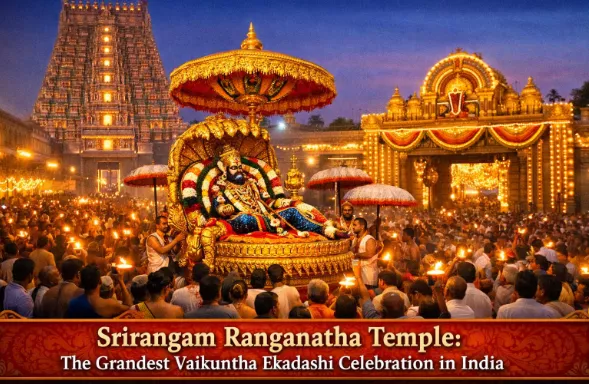
Srirangam Ranganatha Temple: The Grandest Vaikuntha Ekadashi Celebration in India Paramapada Vasal, Pagal Pathu–Ira Pathu Utsavams & the Cosmic Meaning of Lord…
Srirangam Ranganatha Temple: The Grandest Vaikuntha Ekadashi Celebration in India
Paramapada Vasal, Pagal Pathu–Ira Pathu Utsavams & the Cosmic Meaning of Lord Ranganatha’s Reclining Form
Introduction: When Vaikuntha Descends Upon Earth at Srirangam
Among all Vishnu temples across Bharata, Srirangam Ranganatha Temple stands unrivaled in its Vaikuntha Ekadashi celebration. Here, Vaikuntha Ekadashi is not a single day—it is a civilizational festival, unfolding over 10 divine days, rooted in Tamil Vaishnava bhakti, ancient Agamic rituals, and the living poetry of the Divya Prabandham.
Just days ago, in the final weeks of December 2025, lakhs of devotees gathered along the Cauvery as temple authorities finalized elaborate arrangements for the Paramapada Vasal opening, reaffirming Srirangam’s role as the spiritual capital of Sri Vaishnavism. For devotees, this is not merely darshan—it is crossing into Paramapada (Vaikuntha) with Lord Ranganatha Himself.
This article explores why Srirangam’s Vaikuntha Ekadashi is considered the grandest and most theologically complete celebration in India, covering:
- The Paramapada Vasal ritual
- The Pagal Pathu & Ira Pathu festivals
- The profound symbolism of Lord Ranganatha’s reclining posture
—all crafted for Hindutone’s spiritually rooted readers.
Why Srirangam Is the Heart of Vaikuntha Ekadashi
Primary Keyword: Srirangam Vaikuntha Ekadashi celebration
The Srirangam Vaikuntha Ekadashi celebration is unique because:
- It follows Sri Vaishnava Sampradaya theology
- It integrates Alvar bhakti, Agamic worship, and temple architecture
- It preserves Paramapada symbolism more completely than any other temple
Here, Vaikuntha is not imagined—it is ritually enacted.
Historical Roots: From Alvars to Acharyas
Alvar Legacy
- Nammalvar, the greatest of the 12 Alvars, envisioned Paramapada through divine poetry
- His Tiruvaimozhi describes the soul’s final union with Vishnu
Ramanujacharya’s Contribution
- Institutionalized Ira Pathu festival
- Declared Srirangam as Bhooloka Vaikuntha
- Emphasized open access to salvation through bhakti
From household Ekadashi vrata, Srirangam transformed Vaikuntha Ekadashi into a collective liberation festival.
Paramapada Vasal: The Gateway to Liberation
What Is Paramapada Vasal?
The Paramapada Vasal is a specially sanctified northern gate inside the temple, opened only once a year on Vaikuntha Ekadashi.
Symbolism
- North = Uttarayana, the soul’s ascent path
- Crossing the gate signifies release from samsara
- Represents Lord Vishnu’s open invitation to moksha
When devotees pass through the Paramapada Vasal at Srirangam, tradition holds that:
Even the greatest yogis aspire for this moment.
The 10-Day Festival: Pagal Pathu & Ira Pathu Explained
Pagal Pathu (Day Festival – First 5 Days)
- Conducted during daylight
- Focus on celebratory devotion
- Divya Prabandham recited publicly
- Lord Ranganatha appears in majestic procession
Spiritual Meaning:
Represents the soul’s awakening and yearning for Vishnu.
Ira Pathu (Night Festival – Last 5 Days)
The crown jewel of Srirangam’s celebration.
Key Highlights
- Conducted entirely at night
- Continuous recitation of Tiruvaimozhi
- Culminates on Vaikuntha Ekadashi night
Nammalvar Moksha Utsavam
- Nammalvar is symbolically taken to Paramapada
- Lord Ranganatha receives him as a liberated soul
- Devotees witness moksha enacted before their eyes
This ritual is exclusive to Srirangam in its fullness.
Vaikuntha Ekadashi Night at Srirangam: A Living Vaikuntha
Temple Atmosphere
- Oil lamps illuminate ancient corridors
- Chanting echoes across seven prakarams
- Silence and ecstasy coexist
Devotees describe:
- Tears during Paramapada Vasal crossing
- Loss of body-consciousness
- Profound inner stillness
Many say:
“Tirumala shows Vishnu’s compassion; Srirangam shows His promise of liberation.”
Symbolism of Lord Ranganatha’s Reclining Posture
Why Lord Ranganatha Reclines
Unlike standing Vishnu forms, Ranganatha reclines on Adisesha.
Spiritual Meaning
- Represents yoga nidra, cosmic awareness
- Indicates Vishnu is always accessible
- Signifies preservation of the universe
Vaikuntha Connection
- Reclining posture mirrors eternal Vaikuntha rest
- Devotees approach not a distant god—but a compassionate protector
This posture reinforces Srirangam’s identity as Paramapada on Earth.
Ritual Flow on Vaikuntha Ekadashi Day
Brahma Muhurta
- Suprabhata Seva
- Sanctum purification
Paramapada Vasal Opening
- Special aradhana
- Alvar hymns recited
- Devotees cross in silence
Sarva Darshan
- No caste, class, or status distinctions
- Liberation is universal
Fasting & Jagaran at Srirangam
Temple encourages:
- Nirjala fasting for capable devotees
- Phalahar fasting for others
- Night-long jagaran with Divya Prabandham
Food abstinence is secondary to ego abstinence.
Scientific & Psychological Dimensions
Ayurvedic Insight
- Ekadashi aligns with digestive rest
- Night vigils enhance mental clarity
Neuroscience & Bhakti
- Repetitive chanting induces meditative brain states
- Collective devotion reduces anxiety
- Creates deep emotional purification
India & USA Devotees: Global Srirangam Influence
Sri Vaishnava temples worldwide follow Srirangam calendar:
- ISKCON temples adapt Ira Pathu concepts
- USA temples stream Divya Prabandham recitations
- NRI devotees align fasting with Srirangam timings
Srirangam remains the spiritual axis of Vaikuntha Ekadashi globally.
FAQs: People Also Ask About Srirangam Vaikuntha Ekadashi
1. Why is Srirangam considered Bhooloka Vaikuntha?
Because Paramapada rituals are fully enacted here.
2. What is unique about Ira Pathu?
It symbolizes the soul’s final liberation.
3. Can anyone pass through Paramapada Vasal?
Yes, without discrimination.
4. Is this festival mentioned in scriptures?
Yes, in Alvar hymns and Sri Vaishnava texts.
5. Why is Nammalvar important here?
He embodies the liberated soul.
6. Is fasting compulsory?
Recommended, not compulsory.
7. How long does the festival last?
Ten days, culminating on Vaikuntha Ekadashi.
8. Is Srirangam more significant than Tirupati?
Spiritually different—Tirupati emphasizes grace, Srirangam emphasizes liberation.
For More Devotional Journey, Follow
- Temples
/temples/ - Tirumala Updates
/tirumala/ - Sabarimala Yatra
/category/sabarimala-yatra/ - Pooja, Slokas & Mantras
/pooja-slokas-and-mantras/ - Hindu Gods
/hindu-gods/
Conclusion: Srirangam—Where Liberation Is Celebrated, Not Promised
The Srirangam Vaikuntha Ekadashi celebration is not a spectacle—it is moksha made visible. Through Paramapada Vasal, Ira Pathu, and the serene presence of Lord Ranganatha, devotees do not merely pray for liberation—they walk through it.
As echoed by pilgrims in December 2025:
“We did not visit Vaikuntha—Vaikuntha visited us.”
How to Reach — Travel Guide — Sri Ranganathaswamy Temple, Srirangam
✈️ By Flight
Tiruchirapalli International Airport (TRZ, ~13 km from Srirangam) is the nearest, with flights from Chennai, Bengaluru, Mumbai, Delhi, Singapore, Sharjah, Dubai and Colombo.
🚂 By Train
Srirangam Railway Station (SRGM, ~1 km from the temple) sits on a branch from Trichy. Tiruchirappalli Junction (10 km) is the major hub with Chennai (Pallavan, Vaigai), Bengaluru, Madurai, Mumbai trains.
🚌 By Bus
Trichy Central Bus Station (Chathiram, 8 km) and Srirangam local stand (500 m). TNSTC city buses connect the temple every few minutes; SETC services from Chennai (5.5 hrs), Bengaluru (7 hrs), Madurai (3 hrs), Coimbatore.
🚗 By Road / Car
On the Cauvery delta island between Cauvery and Coleroon (Kollidam) rivers. From Trichy city centre (10 km), Thanjavur (55 km), Madurai (140 km), Chennai (335 km), Bengaluru (350 km).
Best Places to Visit Near Sri Ranganathaswamy Temple, Srirangam
Combine your darshan at Sri Ranganathaswamy Temple, Srirangam with these well-known nearby attractions for a complete pilgrimage and travel experience:
Rockfort Ucchi Pillayar Temple, Trichy (8 km) — hilltop Ganesha temple with sweeping city views.
Jambukeshwara Temple, Thiruvanaikaval (2 km) — the Jala (water) Pancha Bhuta Sthala; right next to Srirangam.
Samayapuram Mariamman Temple (15 km) — major Devi shrine; second-highest revenue temple in Tamil Nadu.
Vayalur Murugan Temple (12 km) — important Murugan kshetra near Trichy.
Thanjavur Brihadeeswarar Temple (55 km) — the Great Living Chola temple.
Mukkombu (Upper Anaicut) (18 km) — historic dam and picnic spot at the Cauvery–Coleroon split.
All distances are approximate; please verify on Google Maps and check current road, weather and local conditions before travelling. For latest darshan timings and special pilgrim arrangements, refer to the temple's official authority website.
Frequently Asked Questions
Where is Srirangam Ranganatha Temple located?
Srirangam Ranganatha Temple: The Grandest Vaikuntha Ekadashi Celebration in India Paramapada Vasal, Pagal Pathu–Ira Pathu Utsavams & the Cosmic Meaning of Lord Ranganatha’s Reclining Form Introduction: When Vaikuntha Descends Upon Earth at Srirangam Among all Vishnu temples across Bharata, Srirangam Ranganatha Temple stands unrivaled in its Vaikuntha Ekadash
Who is the presiding deity of Srirangam Ranganatha Temple?
The temple's presiding deity and its significance are described in the guide above.
What are the timings and how do I reach Srirangam Ranganatha Temple?
Temples typically open early morning and evening; confirm current darshan timings before visiting. The nearest airport, railway station and road routes are covered in the guide above.
What is the best time to visit Srirangam Ranganatha Temple?
Major festival days and the cooler months are popular, though weekday mornings offer a calmer darshan. Plan around the temple's key festivals for the most vibrant experience.
You might also like
Shani Deva Temples Worldwide & Must-Performed Rituals — Complete Devotee's Guide
Purushottam Maas 2026: Lord Vishnu's Sacred Gift of Spiritual Multiplication & Divine Grace
Divine Hindu Temple News, Festivals & Global Devotion in Jyeshtha Adhik Maas 2026