
Mandukya Upanishad: The Shortest Path to Liberation (Moksha) in Advaita Vedanta | HinduTone
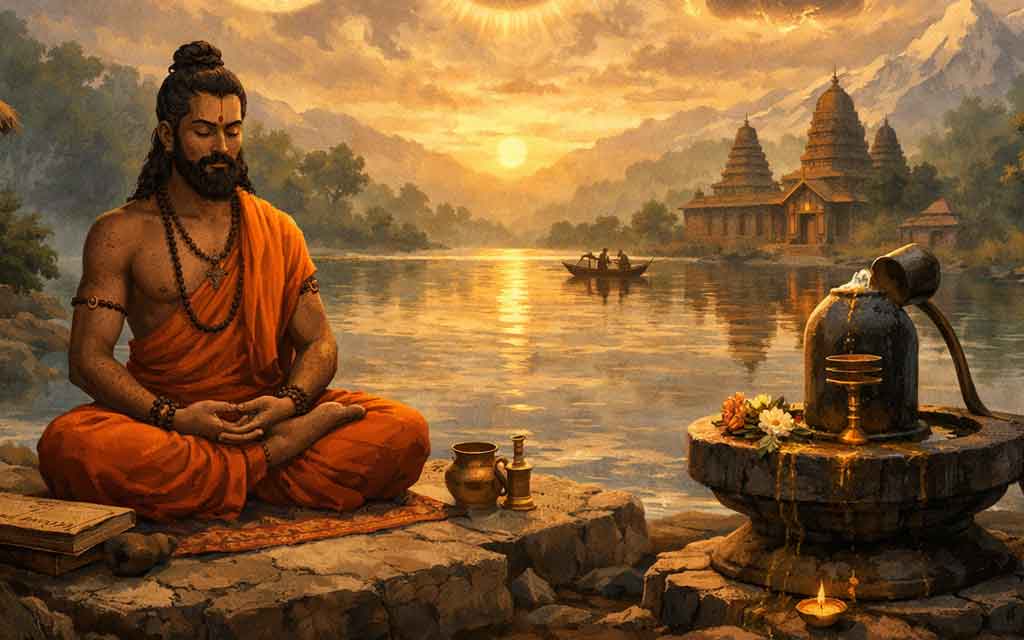
Discover the profound wisdom packed in just 12 verses of the Mandukya Upanishad — the shortest yet one of the most powerful principal Upanishads. It reveals the sacred meaning of AUM (OM), the four states of consciousness, and the direct, effortless path to moksha (liberation) through realization of Turiya — your true non-dual Self.
Published: April 9, 2026 Reading Time: 10 minutes Category: Hindu Scriptures | Upanishads | Advaita Vedanta | Vedanta Philosophy
ॐ इत्येतदक्षरमिदं सर्वं तस्योपव्याख्यानं भूतं भवत् भविष्यदिति सर्वमोंकार एव।
“AUM — this imperishable syllable is all that exists. Whatever was, is, or will be — verily is AUM. And whatever is beyond the three periods of time is also AUM.” — Mandukya Upanishad, Verse 1
In the vast treasure of Hindu scriptures, the Mandukya Upanishad shines as a rare gem. Comprising only 12 concise verses and belonging to the Atharvaveda, it is the shortest of the principal (Mukhya) Upanishads. Yet, Adi Shankaracharya declared that this single Upanishad, along with Gaudapada’s Karika, is sufficient for a sincere seeker to attain moksha (liberation).
If you chant OM daily, meditate on consciousness, or seek the ultimate truth of existence, the Mandukya Upanishad offers the most direct and concentrated teaching of Advaita Vedanta (non-dualism).
What Makes the Mandukya Upanishad Unique?
Unlike longer Upanishads rich in stories and dialogues, the Mandukya is pure, distilled philosophy. It does not prescribe elaborate rituals or long practices. Instead, it points straight to the nature of reality through two interconnected revelations:
- The sacred syllable AUM as the symbol of Brahman (ultimate reality).
- The analysis of four states of consciousness that every human experiences.
The Muktika Upanishad (in a dialogue between Rama and Hanuman) recommends the Mandukya as the one Upanishad sufficient for liberation. Gaudapada’s Mandukya Karika (215 verses) expands it into the foundational text of Advaita Vedanta, later illuminated by Adi Shankaracharya’s commentary.
“The Mandukya Upanishad alone is sufficient for the attainment of liberation.” — Adi Shankaracharya
The Four States of Consciousness (Avastha Traya + Turiya)
The core of the Mandukya Upanishad is its profound mapping of human experience through four states of awareness:
- Jagrat (Waking State) — Vaishvanara Ordinary waking consciousness. We perceive the gross, external world through the senses. This is the realm of duality — “I” and “the world.”
- Svapna (Dream State) — Taijasa Dreaming consciousness. The mind creates its own subtle inner world of thoughts, images, and experiences. The Upanishad treats dream reality as valid within its own sphere.
- Sushupti (Deep Sleep) — Prajna Dreamless deep sleep. A state of blissful, undifferentiated consciousness where all dualities and desires dissolve temporarily. Yet, ignorance remains veiled in bliss.
- Turiya (The Fourth) — The Transcendent State Not a state among the others, but the pure, unchanging witnessing awareness that pervades and underlies all three. It is shantam, shivam, advaitam — peaceful, auspicious, and non-dual. Turiya is Atman, and Atman is Brahman.
Key Insight: Turiya is not something you “enter” through effort. It is your eternal nature — the silent background always present, even now as you read this. Realizing this brings immediate liberation.
AUM: The Sound Symbol of Brahman
The Mandukya beautifully correlates the syllable AUM with the four states, turning chanting OM into a complete meditation:
- A — Corresponds to Jagrat (waking / gross world)
- U — Corresponds to Svapna (dream / subtle world)
- M — Corresponds to Sushupti (deep sleep / causal world)
- Silence after AUM — Corresponds to Turiya (pure Brahman)
When you chant OM slowly:
- Feel “A” vibrating in the abdomen (beginning of creation),
- “U” rising through the chest (sustenance),
- “M” resonating in the head (dissolution),
- Then rest in the silence — the fullness of pure awareness beyond time and space.
This practice reveals that AUM is not just a sound — it is the entire universe and what transcends it.
The Radical Teaching: Ajativada (Non-Origination)
Gaudapada’s Karika takes the Upanishad’s wisdom to its ultimate conclusion with Ajativada — the doctrine that nothing ever truly originates or is created.
The apparent world of multiplicity, birth, death, bondage, and liberation is like a rope mistaken for a snake in dim light — an illusion (maya) superimposed on the unchanging Brahman. In reality, only non-dual Brahman exists eternally.
“There is no dissolution, no origination, none in bondage, none striving for liberation, none liberated. This is the ultimate truth.” — Gaudapada, Mandukya Karika (II.32)
This is not pessimism but the highest freedom: If you were never truly bound, liberation is simply recognizing what you have always been.
The Mahavakya of Mandukya Upanishad
The Mandukya contributes one of the four great mahavakyas (grand pronouncements) of Vedanta:
अयम् आत्मा ब्रह्म Ayam Atma Brahma — “This Self (Atman) is Brahman.”
The word “ayam” (this) makes it immediate — pointing to the very awareness reading these words right now. Not a distant God, but your own pure consciousness.
Practical Meditation with the Mandukya Upanishad
The Upanishad is not mere theory — it is a living meditation manual. Here is a simple daily practice:
- Sit comfortably and chant AUM slowly three times, feeling each syllable and resting in the silence.
- Observe your daily transitions through waking, dreaming, and deep sleep. Inquire: What remains constant as the witness?
- In meditation, rest as the observer of thoughts and experiences — not as a separate “I”, but as the open space in which everything appears.
- Contemplate Ayam Atma Brahma with deep feeling, allowing the truth to dawn naturally.
No long austerities are needed. The path is jnana (knowledge) — removing ignorance through clear seeing.
Mandukya Upanishad at a Glance
| Aspect | Details |
|---|---|
| Number of Verses | 12 (shortest principal Upanishad) |
| Veda | Atharvaveda |
| Core Topics | AUM, Four States of Consciousness, Turiya |
| Key Commentary | Gaudapada’s Mandukya Karika (215 verses) |
| Philosophical School | Advaita Vedanta (Non-dualism) |
| Mahavakya | Ayam Atma Brahma |
| Ultimate Doctrine | Ajativada – Non-origination |
| Goal | Moksha through direct recognition of Self |
Why the Mandukya Upanishad Matters Today
In our fast-paced, information-overloaded world, the Mandukya offers rare clarity and simplicity. It does not demand blind faith or decades of ritual. It invites sincere self-inquiry into the nature of consciousness — a topic modern neuroscience is only beginning to explore.
Whether you are a beginner in Vedanta, a serious spiritual seeker, or someone who simply wants to understand the deeper meaning behind chanting OM, this 12-verse text provides the most direct pointer to your true nature.
Realization of Turiya is not a future achievement — it is the recognition that you are already That.
Jai OM! Shanti Shanti Shanti.
Frequently Asked Questions (FAQ)
What is the Mandukya Upanishad? It is the shortest principal Upanishad with only 12 verses, belonging to the Atharvaveda. It explains the meaning of AUM and analyzes the four states of consciousness, leading to the realization that Atman is Brahman.
Why is it considered the shortest path to moksha? Adi Shankaracharya taught that the Mandukya alone, with Gaudapada’s Karika, is sufficient for liberation because it offers direct knowledge (jnana) of Turiya — your true non-dual nature — rather than gradual practices.
What are the four states of consciousness?
- Jagrat (waking), 2. Svapna (dreaming), 3. Sushupti (deep sleep), and 4. Turiya (the transcendent witness that is pure Brahman).
What does AUM represent? AUM symbolizes the entire universe. Its syllables A-U-M correspond to waking, dream, and deep sleep states, while the silence after AUM represents Turiya — pure consciousness and liberation.
What is Ajativada? The doctrine of non-origination taught by Gaudapada. Nothing has ever truly been created; the world of duality is an illusion. Only eternal, non-dual Brahman exists.
Tags: Mandukya Upanishad, AUM OM Meaning, Four States of Consciousness, Turiya State, Advaita Vedanta, Moksha Liberation, Adi Shankaracharya, Gaudapada Karika, Atharvaveda, Hindu Philosophy, Upanishads, Vedanta
HinduTone Editorial – Preserving and sharing authentic Sanatan Dharma wisdom for modern seekers.
Share this article with fellow spiritual seekers on WhatsApp, Facebook, or X to spread the light of Vedanta.
Related posts:
 Mauni Amavasya (Maghi Amavasya)
 Sacred Rivers in Hindu Culture: Spiritual Lifelines and Ecological Guardians
 Jyeshtha Amavasya 2025: Date, Rituals, Pitru Tarpan & Spiritual Significance
 Children’s Corner: Fun Sunday Activities to Teach Surya Worship
 The Prophetic Return: Hanuman and Kalki at the Dawn of Dharma
 Top 10 Sacred Temples to Visit on Independence Day: A Divine Journey Through Bharat’s Spiritual Heritage
 How to Pray Lord Radha Krishna in 2026: Mantras, Poojas, Important Dates, Temples & Rituals | HinduTone
 The Sacred Importance of Tuesday in Hinduism: Essential Rituals for Mangalvar Vrat, Hanuman Puja, and How NRIs Can Perform Devotion to Bajrang Bali with Unwavering Faith