
Chhatrapati Shivaji Maharaj Jayanti 2026: Honouring the Great Protector of Hindu Dharma
Date: February 19, 2026 (Thursday) | 396th Birth Anniversary | Jai Bhavani! Jai Shivaji!
On this auspicious day of Chhatrapati Shivaji Maharaj Jayanti 2026, we bow our heads in reverence to one of the greatest Hindu warrior kings in Indian history — Chhatrapati Shivaji Maharaj. Born on February 19, 1630, at Shivneri Fort in Maharashtra, Shivaji Raje Bhonsle rose to become the founder of the mighty Maratha Empire and an eternal symbol of Hindu pride, courage, and Swarajya (self-rule).
As India celebrates his 396th birth anniversary, HinduTone pays heartfelt tribute to the man who stood as an unshakable fortress between Hindu civilization and its adversaries. His life was not merely the story of a king — it was the story of Dharma triumphant over tyranny.
Who Was Chhatrapati Shivaji Maharaj?
Shivaji Maharaj was born to Shahaji Bhonsle, a Maratha general, and Jijabai, a deeply devout and courageous woman who shaped her son’s soul. From childhood, Jijabai narrated stories from the Ramayana and Mahabharata to young Shivaji, planting the seeds of devotion to Dharma, fearlessness, and righteousness deep in his heart.
He grew up to become one of India’s greatest heroes — a warrior king who carved the Maratha Empire out of the shadows of mighty sultanates.
His name itself carries divine blessing — it is derived from the goddess Shivai, to whom his mother prayed for a son who would be a protector of the people.
Chhatrapati Shivaji Maharaj Jayanti 2026: Date & Significance
The Maharashtra government has officially recognised February 19 as Shivaji Maharaj’s birth date, based on research by a committee of historians. In 2026, this falls on a Thursday and is observed as a public holiday with state-level celebrations.
Additionally, many traditional devotees observe Shiv Jayanti on March 6, 2026, which corresponds to Falgun Tritiya as per the Hindu Panchang. Both dates carry deep cultural and spiritual significance.
Shivaji Maharaj’s Glorious Contributions to Hindu Dharma
1.  The Founder of Hindavi Swarajya
 The Founder of Hindavi Swarajya
Shivaji Maharaj’s greatest contribution was the establishment of Hindavi Swarajya — a sovereign Hindu kingdom for the Hindu people, governed by Hindu values and Dharmic principles. At a time when large parts of the Indian subcontinent were under the rule of the Mughal empire and Deccan Sultanates, Shivaji Maharaj raised the saffron flag of independence.
His coronation took place in 1674 at Raigad Fort, marking the formal establishment of Hindavi Swarajya — a kingdom of and for the people.
2. Protector of Temples and Hindu Culture
 Protector of Temples and Hindu Culture
Shivaji Maharaj was a fierce protector of Hindu temples, priests, and sacred traditions. Unlike many rulers of his era, he strictly forbade his soldiers from damaging temples or harassing Hindu religious leaders. He personally donated to temple construction and restoration across his kingdom, ensuring that the flame of Hindu Dharma was never extinguished on his watch.
He held deep reverence for saints like Sant Tukaram and Samarth Ramdas Swami, his spiritual guru, who guided him with the message: “Ramdasi nation is strong when Dharma is strong.”
3. Devotee of Goddess Bhavani (Shakti)
Shivaji Maharaj was a devout worshipper of Goddess Bhavani (Tulja Bhavani) of Tuljapur — one of the Shakti Peethas of Maharashtra. It is believed that Goddess Bhavani herself bestowed upon him the divine sword, Bhavani Talwar, which became his most sacred weapon and symbol of divine power in the service of Dharma.
His war cry — “Jai Bhavani! Jai Shivaji!” — remains one of the most electrifying battle cries in Hindu history, connecting military courage with divine blessing.
4. Defender Against Religious Persecution
 Defender Against Religious Persecution
The era in which Shivaji Maharaj lived was marked by widespread forced conversions, destruction of temples, and persecution of Hindus under Mughal and Sultanate rule. Shivaji Maharaj stood as a bulwark against this oppression. He liberated many regions from oppressive rulers and allowed Hindu communities to practice their faith freely.
He famously resisted Aurangzeb’s religious tyranny, becoming a symbol of Hindu resistance at one of the most critical periods in Indian history.
5. Pioneer of Naval Power — Protecting the Konkan Coastline
 Pioneer of Naval Power — Protecting the Konkan Coastline
Shivaji Maharaj was one of the first Indian rulers to introduce the concept of a naval force to defend the Konkan side of Maharashtra. He built a powerful fleet that protected coastal Hindu towns and trade from foreign invaders, ensuring the safety of pilgrimage routes and coastal temples.
6. Just and Dharmic Governance
 Just and Dharmic Governance
Shivaji Maharaj established an administration firmly rooted in Dharmic principles. His governance model — known for fairness, accountability, and care for the common people — was inspired by the values enshrined in the Arthashastra and Hindu political thought.
He believed that the real strength of a state lay in fair governance, not fear. He treated all his subjects — farmers, traders, soldiers, and priests — with dignity and justice.
7. Respect for Women and All Communities
 Respect for Women and All Communities
Shivaji Maharaj’s code of conduct was extraordinary for his time. He strictly enforced laws against harassment of women — even those of enemy kingdoms. His respect for women was rooted in his belief that they were manifestations of Goddess Shakti.
He was secular to his core and employed many Muslim soldiers in his battalion, yet he never compromised on his duty to protect Hindu Dharma and culture. This reflected the Hindu ideal of Vasudhaiva Kutumbakam — the world is one family.
8. Promotion of Marathi Language and Sanskrit
 Promotion of Marathi Language and Sanskrit
Shivaji Maharaj was a strong proponent of the Marathi language as the administrative language of his empire, replacing Persian which was used by many Mughal and Sultanate courts. He promoted Sanskrit scholarship and ensured that Dharmic literature was preserved and respected in his kingdom.
He established the Raj Vyavahar Kosh — a Sanskrit-Marathi administrative glossary — to indigenise the language of governance and reconnect his people with their cultural roots.
Key Achievements of Chhatrapati Shivaji Maharaj at a Glance
| Achievement | Significance for Hinduism |
|---|---|
| Founded the Maratha Empire (1674) | Restored Hindu political sovereignty |
| Established Hindavi Swarajya | Created a kingdom based on Dharmic governance |
| Built the Maratha Navy | Protected coastal Hindu pilgrim sites and communities |
| Protected temples & priests | Preserved Hindu religious heritage |
| Devotee of Goddess Bhavani | Connected military power with divine Shakti worship |
| Respected Samarth Ramdas Swami | Honored the Guru-disciple tradition of Hinduism |
| Promoted Marathi & Sanskrit | Preserved Hindu linguistic and cultural heritage |
| Just administration | Modeled Dharma Rajya for future generations |
Shivaji Maharaj and His Spiritual Guru: Samarth Ramdas Swami
One of the most beautiful dimensions of Shivaji Maharaj’s life was his relationship with Samarth Ramdas Swami, the great saint-poet who composed the Dasbodh — a classic of Marathi spiritual literature. Ramdas Swami was Shivaji’s guide in matters of Dharma, governance, and inner strength.
The relationship between Shivaji Maharaj and Samarth Ramdas exemplifies the ancient Hindu ideal of Kshatriya (warrior) guided by Brahma-jnana (spiritual wisdom) — a union of sword and scripture in the service of Dharma.
How Shivaji Maharaj Jayanti is Celebrated
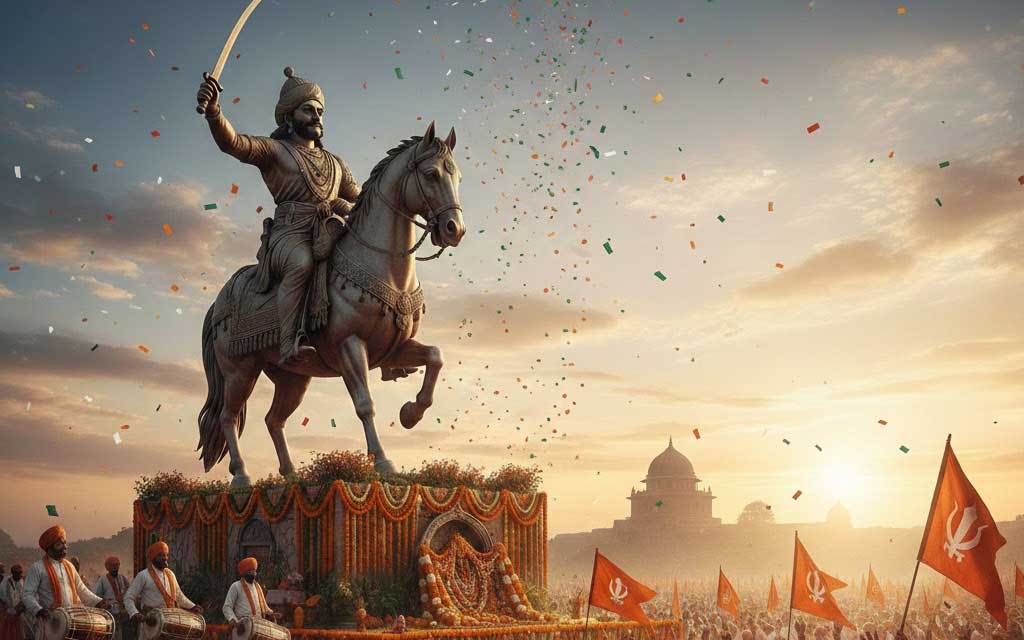
Across Maharashtra, celebrations are vibrant and grand. Large processions featuring traditional dhol-tasha performances, lezim dance, and tableaux depicting historical events are organised in cities like Mumbai, Pune, Nashik, and Kolhapur. Devotees and history enthusiasts also visit historic forts such as Shivneri, Raigad, and Pratapgad to pay tribute.
Celebrations typically include:
- Floral tributes at Shivaji Maharaj statues across India
- Bhajan and kirtan sessions at temples
- Processions with saffron flags and portraits of Shivaji Maharaj
- Cultural programmes depicting key events of his life
- Educational events in schools and colleges honoring his legacy
- Visits to forts associated with the Maratha Empire
Inspiring Quotes by and About Chhatrapati Shivaji Maharaj
“Freedom is a boon, which everyone has the right to receive.” — Chhatrapati Shivaji Maharaj
“Even if there were a sword in the hands of a woman, I would not harm her.” — Chhatrapati Shivaji Maharaj (on respect for women)
“Swarajya is my birthright and I shall have it.” — In the spirit of Shivaji Maharaj’s Hindavi Swarajya
Lessons from Shivaji Maharaj for Today’s Hindu Youth
Shivaji Maharaj’s life offers timeless lessons that are profoundly relevant in today’s world:
- Dharma comes before power — He was guided by moral and spiritual principles, not mere ambition.
- Courage is rooted in devotion — His fearlessness in battle came from his deep faith in Goddess Bhavani.
- Protect the weak and the devout — He saw the protection of priests, women, and common people as a sacred duty.
- Swarajya starts within — True independence begins with self-mastery and righteous conduct.
- Unite under Dharma — He built a powerful nation by bringing diverse communities under the umbrella of just governance.
Conclusion: Jai Bhavani! Jai Shivaji!
On this Chhatrapati Shivaji Maharaj Jayanti 2026, let us not merely remember a great king — let us rededicate ourselves to the values he lived and died for: Dharma, Swarajya, justice, and Hindu pride.
Shivaji Maharaj did not just build an empire. He rekindled the flame of Hindu civilization at a time when it was under severe threat. He proved that righteousness and courage, when united under divine grace, are unconquerable.
His life reminds us that true leadership combines courage, compassion, and vision.
Jai Bhavani! Jai Shivaji! Jai Hind! 

Published by HinduTone | February 19, 2026 Tags: #ShivajiJayanti2026 #ChhatrapatiShivajiMaharaj #HindaviSwarajya #HinduDharma #MarathaEmpire #JaiBhavani #HinduWarriorKing #HinduTone
Related posts:
 Swami Srila Prabhupada
 Garikapati Narasimha Rao is a well-known spiritual scholar andspeaker
 Sarvepalli Radhakrishnan: Philosopher and India’s First Hindu President
 Amrita Sher-Gil: The Iconic Painter with Deep Hindu Cultural Influences
 Raghavendra Swami: The Madhva Saint of Devotion and Miracles
 The Untold Greatness of Chhatrapati Shivaji Maharaj: A Saga of Valor, Vision, and Hindu Revival
 Celebrating a Thousand Years of Rajendra Chola I’s Legacy: Maritime Expedition, Gangaikonda Cholapuram, and Aadi Thiruvathirai Festival
 Sathya Sai Baba 100th Birthday Celebrations 2025