Hindu Beliefs on Death and the Afterlife: A Complete Devotional Guide
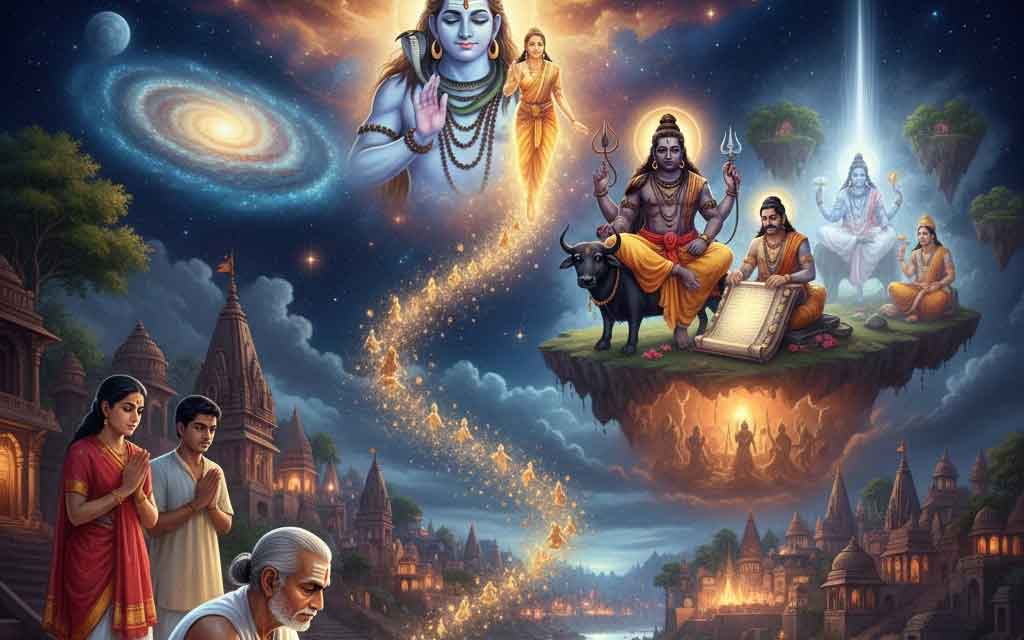
Table of Contents
- A Devotional Invocation
- Introduction: Death Is Not the End
- The Hindu Understanding of Death: Mahamrityu and Mahaprasthana
- The Moment of Death: What the Soul Experiences
- The Subtle Body: The Soul’s Vehicle Beyond Death
- Yama: The Lord of Death and Divine Justice
- Chitragupta: The Cosmic Accountant of Karma
- The Realms Beyond Death: Lokas and Their Significance
- Svarga: The Hindu Heaven
- Naraka: The Hindu Hell and Its Purpose
- Pitru Loka: The Realm of Ancestors
- The Garuda Purana: Hinduism’s Complete Guide to the Afterlife
- Hindu Funeral Rites: The Sacred Journey of the Departed Soul
- Shraddha and Tarpana: Honoring the Ancestors
- Reincarnation: The Soul’s Return to Earth
- The Last Thought at Death: Its Power and Significance
- Sacred Places to Die: Kashi and the Gift of Liberation
- Death in Hindu Sacred Stories
- Different Hindu Schools on Death and the Afterlife
- The Death of the Ego: Spiritual Death as Liberation
- How Hinduism Transforms Our Relationship with Death
- Frequently Asked Questions
- A Devotional Closing: The Deathless Shore
1. A Devotional Invocation {#invocation}
Aum. Mrityur ma amritam gamaya. Lead me from death to Immortality. — Brihadaranyaka Upanishad
Maranam hi dhruvo janmanah. Death is certain for the one who is born. — Bhagavad Gita 2.27
Na jaayate mriyate va kadachin nayam bhutva bhavita va na bhuyah ajo nityah shashvato yam purano na hanyate hanyamane sharire.
The soul is never born nor dies at any time. It has not come into being, does not come into being, and will not come into being. It is unborn, eternal, ever-existing, and primeval. It is not slain when the body is slain. — Bhagavad Gita 2.20
These words — spoken by God himself on a battlefield, to a warrior trembling before death — have consoled billions of human hearts across three thousand years of history. They do not deny death. They reveal what death cannot touch.
With this sacred truth as our lamp, let us walk together into the mystery that every human heart must eventually face.
2. Introduction: Death Is Not the End {#introduction}
Every civilization that has ever existed has asked the question.
Every mother who has watched a child breathe their last. Every soldier on every battlefield. Every elder lying in the dark, feeling the tide of life retreating. Every philosopher, every priest, every poet who has stared into the void of impermanence and asked:
Is this all there is? Is this truly the end?
Hinduism — the world’s oldest living spiritual tradition — answers this question not with wishful thinking, not with comforting mythology alone, but with the most rigorous and penetrating philosophical inquiry the human mind has ever conducted into the nature of consciousness, identity, and the soul.
And the answer, arrived at through direct inner experience by the greatest sages who have ever lived, is this:
Death is real. The body truly dies. And the soul truly lives on.
Not as a pale ghost haunting the ruins of its former life. Not as an abstract principle floating in philosophical space. But as a living, conscious, purposeful being — continuing a journey of extraordinary depth and meaning, moving — always, inevitably — toward its ultimate homecoming in the infinite light of the Divine.
This is what Hinduism teaches about death. This is what the ancient seers discovered in the depths of meditation, in the fire of devotion, and in the transparent clarity of Jnana. This is what the Garuda Purana maps, what the Upanishads whisper, what the Bhagavad Gita proclaims on the battlefield of all human existence.
And this teaching — however ancient its roots — is perhaps the most urgently relevant wisdom available to the modern world, which has largely lost its capacity to face death with wisdom, grace, and courage.
Let us receive it together.
3. The Hindu Understanding of Death: Mahamrityu and Mahaprasthana {#understanding-death}
Death Has Many Names
In Sanskrit, death is known by many names — each illuminating a different facet of its profound reality:
- Mrityu — death, the cessation of the physical body’s life force
- Mahamrityu — the Great Death — the complete dissolution of the body at the end of life
- Mahaprasthana — the Great Departure — death understood as a sacred journey onward
- Dehaanta — the end of the body
- Kaal — time itself, personified as the force that consumes all things
- Antakaal — the final time, the moment of departure
Notice how the Sanskrit language approaches death not with evasion or euphemism, but with a rich vocabulary that honors death as one of the most significant events in the soul’s journey — a Great Departure, a Sacred Transition.
Death as a Teacher
Hindu wisdom regards death not as the enemy of life but as its greatest teacher. The recognition of mortality — the understanding that this body, these relationships, these circumstances are impermanent — is, in Hindu thought, one of the most powerful catalysts for spiritual awakening.
The great philosopher Adi Shankaracharya wrote: “Punarapi jananam punarapi maranam punarapi janani jathare shayanam. Iha samsare bahu dustare kripayapare pahi murare.”
“Again birth, again death, again lying in a mother’s womb — this ocean of samsara is very difficult to cross. O Lord, save me by Your grace.”
This is not a cry of despair. It is the beginning of wisdom — the recognition of what is truly at stake in human existence, and the turning of the heart toward what alone can free it.
Death as Doorway, Not Wall
Perhaps the most fundamental shift that Hindu teaching offers is this: death is not a wall — a final ending beyond which there is nothing. Death is a doorway — a transition from one form of existence to another, from one chapter of the soul’s story to the next.
The Katha Upanishad uses the beautiful metaphor of a caterpillar: it reaches the end of one leaf, and before releasing it, takes firm hold of the next. So the soul, at the moment of death, reaches the end of one life and — in the very act of releasing it — takes hold of the next.
The journey continues.
4. The Moment of Death: What the Soul Experiences {#moment-of-death}
What actually happens at the moment of death, according to Hindu understanding? The sacred texts offer accounts of remarkable specificity and depth.
The Withdrawal of the Pranas
At the moment of death, the five pranas (vital life forces) that animate the physical body begin to withdraw from their stations throughout the body and gather at the heart — the spiritual center of the physical form.
The Brihadaranyaka Upanishad describes this process: “When a person is about to die, his speech merges into his mind. His mind merges into his breath. His breath merges into heat. And his heat merges into the Supreme.”
This progressive withdrawal of consciousness from the periphery toward the center — from the senses to the mind, from the mind to the breath, from the breath to the deepest inner awareness — mirrors the process of deep meditation. In Hindu understanding, the dying person who has practiced meditation throughout life will recognize this withdrawal as familiar territory — as a deepening rather than an extinction.
The Soul’s Departure from the Body
The subtle body (sukshma sharira) — carrying the mind, intellect, ego, and all accumulated karmic impressions — separates from the gross physical body. Hindu texts describe the soul departing through one of several openings in the body, with the opening through which it departs being of great spiritual significance:
- Through the crown (Brahmarandhra) — the highest exit, associated with liberation and the highest states of consciousness, attained by advanced yogis and devotees
- Through the eyes, nose, or mouth — intermediate departures, associated with ordinary worldly consciousness
- Through the lower openings — associated with heavier karmic states and lower rebirths
The Chandogya Upanishad teaches that the soul of a spiritually advanced person rises at death, following the path of light — the Devayana (path of the gods) — toward liberation. The soul of one still bound by karma and worldly desire follows the Pitriyana (path of the ancestors) — toward the realm of the ancestors and eventual rebirth on earth.
The Experience of the Dying Moment
Hindu texts and the testimonies of saints suggest that the dying moment — for one who has prepared spiritually — can be an experience of extraordinary peace, luminosity, and recognition. The veils of the senses, which ordinarily obscure the soul’s awareness of its true nature, begin to thin. The inner light of the Atman — always present but usually masked by the noise of sensory experience — may become perceptible.
This is why the great emphasis in Hindu tradition on conscious dying — on being in a state of prayer, remembrance of God, and inner stillness at the moment of death. The quality of consciousness at death is understood to have a decisive influence on what follows.
5. The Subtle Body: The Soul’s Vehicle Beyond Death {#subtle-body}
After the physical body is released, the soul does not become a disembodied ghost floating in empty space. It continues to inhabit its subtle body (sukshma sharira) — the non-physical vehicle of consciousness that carries the soul from one life to the next.
What the Subtle Body Carries
The subtle body is a rich and complex vehicle. It contains:
- The mind (manas) — with all its memories, emotions, and habitual patterns
- The intellect (buddhi) — the capacity for discernment and understanding
- The ego (ahamkara) — the sense of individual identity
- The five subtle senses — the capacity for experience, even without physical sense organs
- The five pranas — the vital life forces
- All accumulated karmic impressions (samskaras) — the deep imprints of every significant action and experience across all past lives
- All deep tendencies (vasanas) — the soul’s characteristic patterns of desire, fear, and response
This subtle body is the soul’s true luggage — it travels with the soul through death and into the next life, shaping the nature of that life from within.
The Subtle Body and Experience After Death
Because the subtle body contains the five subtle senses, the soul can continue to experience after physical death — to see, hear, and know — even without physical sense organs. The experiences of the afterlife realms described in the Garuda Purana and other texts are experienced through the subtle body.
This understanding prevents the false picture of death as the soul becoming a mere abstract principle or blank awareness. The soul remains a living, experiencing, responding being throughout its journey — until it either takes a new physical birth or attains the formless liberation of Moksha.
6. Yama: The Lord of Death and Divine Justice {#yama}
No figure in Hindu mythology is more associated with death — and more widely misunderstood — than Yama, the Lord of Death.
Who Is Yama?
Yama (Sanskrit: yam — “to bind, to restrain”) is one of the most ancient figures in the Hindu pantheon, appearing even in the Rig Veda as the first mortal being to die and subsequently become the ruler of the realm of the dead.
Yama is not a being of evil or malice. He is the embodiment of Dharma — cosmic righteousness. His role is not to punish arbitrarily but to ensure that the precise and perfect justice of the karmic law is upheld. He is sometimes called Dharmaraja — the King of Dharma.
Yama is depicted riding a black buffalo (mahisha), carrying a noose (pasha) with which he binds the soul at death, and a staff (danda) representing his authority. He is dark in complexion — not as a symbol of evil, but as a symbol of the darkness into which all things temporarily return before their rebirth.
His two messengers (Yamadoots) travel throughout the living world, observing the actions of all beings and reporting to Yama. When the appointed time of death arrives, the Yamadoots come to escort the departing soul to Yama’s realm (Yamaloka or Yamapur).
Yama as Spiritual Teacher
The most profound revelation about Yama comes from the Katha Upanishad, in which the young boy Nachiketa journeys to Yama’s realm and demands to know the secret of death. Rather than being the fearsome executioner of popular imagination, Yama reveals himself in this text as the supreme teacher of the soul’s immortality — the one being who can speak with absolute authority about what lies beyond death because he dwells in the very heart of it.
It is Yama who teaches Nachiketa — and through him, all humanity — the deathless nature of the Atman:
“The wise one who knows the Self as bodiless within the bodies, as unchanging among changing things, as great and omnipresent — that wise person does not grieve.” — Katha Upanishad 2.22
Yama’s Court: The Review of a Life
After death, according to Hindu texts, the soul is brought before Yama’s court — not for punishment, but for the review and accounting of the life just lived. Here, in Yama’s presence, the entire record of the soul’s actions, thoughts, and intentions is examined — with complete transparency, complete accuracy, and complete justice.
Nothing is hidden. Nothing is distorted. The soul sees itself as it truly is — without the self-deceptions and rationalizations that obscure clear self-knowledge in life.
This is not the terrifying judgment of an angry deity. It is the compassionate, precise reckoning of a perfect mirror — showing the soul exactly where it stands in its journey and what it needs in its next chapter of experience to move forward toward liberation.
7. Chitragupta: The Cosmic Accountant of Karma {#chitragupta}
Standing at Yama’s side in the realm of the dead is Chitragupta — one of Hinduism’s most unique and theologically fascinating figures.
Who Is Chitragupta?
Chitragupta (Sanskrit: chitra — picture/varied, gupta — hidden/secret) is the divine scribe and accountant of karma — the being who maintains the perfect, complete record of every soul’s actions across all its lifetimes.
According to the Padma Purana and other texts, Chitragupta was created by Lord Brahma to assist Yama in the administration of karmic justice. While Brahma created all other beings with eyes closed in meditation, Chitragupta emerged after twelve thousand years of contemplation — fully formed, pen in hand, with a complete knowledge of the souls and their karmic records.
The Chitragupta Register
Chitragupta maintains a cosmic register — the Agra-sandhi or Chitragupta Granth — in which every deed of every soul is recorded with perfect accuracy. When a soul arrives in Yama’s court, Chitragupta reads the complete record of that soul’s life: every act of kindness, every act of cruelty, every truthful word, every deception, every prayer offered, every moment of compassion or callousness.
On the basis of this record, Yama determines the soul’s next experience — whether a period of enjoyment in the higher realms, a period of purification in the lower realms, or an immediate return to earth for another birth.
The Devotion of the Kayastha Community
The Kayastha community — traditionally associated with the role of scribes and record-keepers in Indian society — considers Chitragupta their divine progenitor and patron deity. The festival of Chitragupta Puja (celebrated on the second day after Diwali) is their most sacred celebration, in which pens, ink, and account books are worshipped — honoring the divine principle of accurate record-keeping and moral accountability.
8. The Realms Beyond Death: Lokas and Their Significance {#lokas}
Hindu cosmology describes a vast, multi-dimensional universe consisting of numerous lokas (realms, planes of existence) — each corresponding to different states of consciousness and karmic conditions.
The Fourteen Lokas
Classical Hindu cosmology recognizes fourteen principal lokas — seven higher and seven lower:
The Seven Higher Lokas (Urdhva Lokas):
| Loka | Name | Nature |
|---|---|---|
| 1 | Bhuloka | Earth — the physical world we inhabit |
| 2 | Bhuvarloka | The atmospheric realm between earth and sun |
| 3 | Svarloka (Svarga) | Heaven — the realm of the gods and blessed souls |
| 4 | Maharloka | The realm of great sages and saints |
| 5 | Janarloka | The realm of divine beings of high spiritual attainment |
| 6 | Taparloka | The realm of intense spiritual tapas (austerity) |
| 7 | Satyaloka (Brahmaloka) | The realm of Brahma — the highest cosmic realm |
The Seven Lower Lokas (Adho Lokas): These range from the realm just below the physical world to the deepest regions of purification (Naraka or Patala) — each corresponding to progressively denser karmic states.
The Soul’s Journey Through the Lokas
After death, the soul travels to the realm that corresponds to its accumulated karma and state of consciousness. A soul of great virtue and spiritual development ascends to the higher lokas. A soul burdened with heavy negative karma passes through purifying experiences in the lower realms.
But — and this is crucial to the Hindu understanding — none of these realms is permanent. They are temporary stations on the soul’s ongoing journey, not eternal destinations. Whether the soul enjoys a sojourn in the celestial realms or undergoes purification in the lower realms, it will eventually return to earth for another human birth — unless it attains the supreme liberation of Moksha.
9. Svarga: The Hindu Heaven {#svarga}
Svarga (Sanskrit: sva — own/bliss, ga — going to; literally “going to one’s own bliss”) is the Hindu concept of heaven — the realm of divine beauty, joy, and elevated experience where souls who have accumulated great merit (punya) reside after death.
The Nature of Svarga
Svarga is described in the Puranas as a realm of extraordinary beauty — celestial gardens, rivers of nectar, music of divine perfection, and the company of the gods (devas) and blessed souls. Here, the soul experiences the fruits of its good karma in the form of sublime joy, freedom from suffering, and access to the divine presence.
The presiding deity of Svarga is Indra — the king of the gods — who rules over the celestial realm with the thirty-three principal deities (tridasha) of the Vedic pantheon.
Svarga Is Not Moksha
This is one of the most important and distinctive teachings of Hindu afterlife theology: Svarga is not the ultimate destination. Even the most beautiful heaven is a temporary reward — not the soul’s final liberation.
The Bhagavad Gita (9.21) states explicitly:
“When they have thus enjoyed the vast heavenly sense pleasures and the results of their pious activities are exhausted, they return to this mortal planet again. Thus those who seek sense enjoyment by adhering to the principles of the three Vedas achieve only repeated birth and death.”
This is a radical teaching. It says that even heaven — even the most exalted experience the created universe can offer — is ultimately insufficient for the soul’s deepest longing. Only Moksha — the direct recognition of one’s identity with the Supreme — permanently satisfies and permanently liberates.
Vaikuntha and Kailasha: The Divine Realms Beyond Svarga
Above and beyond the ordinary heavenly realms, Hindu tradition describes the eternal divine abodes that are the destination of liberated souls in the devotional traditions:
- Vaikuntha — the eternal realm of Lord Vishnu, described as a world of infinite light, beauty, and divine love, where liberated souls dwell in eternal service and devotion to the Lord
- Goloka Vrindavan — the supreme realm of Lord Krishna, the eternal home of divine love (rasa), where the soul lives in the bliss of perfect relationship with Krishna forever
- Kailasha — the eternal abode of Lord Shiva, the realm of supreme consciousness and liberation
These are not temporary heavenly realms. They are eternal — the destinations of souls who have achieved true liberation through devotion and grace.
10. Naraka: The Hindu Hell and Its Purpose {#naraka}
What Is Naraka?
Naraka (Sanskrit: related to nara — human) is the realm of purification that Hindu cosmology describes for souls carrying heavy negative karma. It is commonly translated as “hell” — but this translation carries misleading connotations drawn from other religious traditions.
Hindu Naraka is fundamentally different from the concept of eternal hell in some traditions. It is:
- Temporary — no soul remains in Naraka forever
- Purposeful — it is a realm of karmic purification, not sadistic punishment
- Proportional — the nature and duration of experiences in Naraka are precisely proportional to the nature and weight of the karma that brought the soul there
- Ultimately merciful — even the most difficult experiences in Naraka serve the soul’s ultimate good, burning away karmic residue that would otherwise require many more difficult earth lives to clear
The Twenty-Eight Narakas
The Garuda Purana, Vishnu Purana, and other texts describe up to twenty-eight distinct Naraka regions — each corresponding to specific categories of negative karma and providing experiences precisely suited to the purification of those karmas.
The names and descriptions of these regions are vivid and sometimes disturbing — not as exercises in spiritual horror, but as moral teachings. Each Naraka region and its associated karma is described in detail precisely to discourage the actions that lead to it:
- Tamisra — for those who rob others of their possessions and wives
- Andhatamisra — for those who deceive their spouses
- Raurava — for those who cause suffering to animals and other beings
- Maharaurava — for those who live entirely for their own pleasure at others’ expense
- Kumbhipaka — for those who kill and eat animals without necessity
- Kalasutra — for those who disrespect and harm their parents and elders
The Garuda Purana teaches these not to inspire terror but to inspire dharmic living — the understanding that our actions have real consequences, that the universe is morally ordered, and that every act of cruelty or injustice must eventually be faced and cleared.
No Soul Is Ever Lost
The most compassionate and radical teaching of Hindu Naraka theology is this: no soul is permanently condemned. Every experience in Naraka, however intense, has a beginning, a duration proportional to the karma, and an end. When the karma is exhausted, the soul returns to earth for another chance — another life, another opportunity to choose more wisely, to love more fully, to move more surely toward liberation.
This is why Hindu theology has no equivalent of eternal damnation — because an infinite punishment for finite actions is, in Hindu understanding, neither just nor consistent with the infinite compassion of the Divine.
“Even if you are the most sinful among all sinners, you will cross over all sin by the raft of knowledge alone.” — Bhagavad Gita 4.36
11. Pitru Loka: The Realm of Ancestors {#pitru-loka}
Between the world of the living and the higher or lower realms lies Pitru Loka — the realm of ancestors — where many souls reside temporarily after death, awaiting their next birth or their ascent to higher realms.
Who Dwells in Pitru Loka?
Pitru Loka is generally understood as the intermediate realm where souls that were neither significantly virtuous (destined for Svarga) nor significantly negative (requiring purification in Naraka) reside — ordinary souls processing their karmic balance before taking their next birth.
The Sanskrit word Pitru means “father” or “ancestor” — reflecting the belief that the souls of one’s departed parents, grandparents, and ancestors continue to exist in this realm and maintain a connection with their living descendants.
The Connection Between the Living and the Dead
Hindu tradition maintains a profound understanding that the relationship between the living and the dead does not end at death. The souls of the departed in Pitru Loka continue to be connected to their living family members — and can be supported, nourished, and helped on their journey through the devotional and ritual actions of the living.
This is the theological foundation for the elaborate tradition of Shraddha (ancestor worship) — through which the living offer food, water, prayers, and love to their departed ancestors, providing sustenance for the subtle body and supporting the soul’s ongoing journey.
Pitru Paksha: The Fortnight of the Ancestors
Once each year — during the dark fortnight of the lunar month of Bhadrapada (typically September) — Hindus observe Pitru Paksha (the fortnight of ancestors), a period dedicated entirely to honoring, remembering, and performing rites for departed ancestors.
During this sacred period, the veil between the world of the living and Pitru Loka is believed to thin. Rituals performed during Pitru Paksha are considered especially potent in reaching and benefiting departed souls — even those who have already taken new births but retain some connection to their ancestral lineage.
12. The Garuda Purana: Hinduism’s Complete Guide to the Afterlife {#garuda-purana}
Of all the Hindu sacred texts, none addresses the afterlife with more detail, more vividness, and more thoroughness than the Garuda Purana — one of the eighteen principal Mahapuranas.
What Is the Garuda Purana?
The Garuda Purana takes its name from Garuda — the divine eagle, vehicle of Lord Vishnu — who is the recipient of this teaching. The text is framed as a dialogue between Lord Vishnu and Garuda, in which Vishnu reveals the complete truth about what happens to the soul after death.
The Garuda Purana covers:
- The precise process of the soul’s departure from the body at death
- The journey of the soul through the realm of Yama
- Detailed descriptions of every realm — Svarga, Naraka, and the intermediate states
- The precise karmas that lead to each realm
- The Hindu funeral rites (antyesti) and their significance for the departed soul
- The power of prayers, rituals, and sacred texts in supporting the dead
- The path to Moksha and liberation from the entire cycle
Why the Garuda Purana Is Read at Death
In Hindu tradition, the Garuda Purana is traditionally read aloud in the home of a deceased person during the thirteen days of mourning (trayodasha dina) that follow death. This practice serves multiple purposes:
- For the departed soul — the sacred text is believed to reach the soul in its subtle form, providing guidance and orientation in the unfamiliar territory of the afterlife
- For the family — the teachings provide genuine philosophical consolation, helping the bereaved understand death in its proper cosmic context
- For the community — the gathering of family and community around the sacred text creates a field of collective prayer and intention that supports the soul’s journey
13. Hindu Funeral Rites: The Sacred Journey of the Departed Soul {#funeral-rites}
No aspect of Hindu practice more fully expresses the tradition’s understanding of death than its elaborate and deeply meaningful funeral rites (antyesti samskaras — the last of the sixteen sacraments of life).
Hindu funeral rites are not merely social customs. They are precise spiritual technologies — designed to support the departing soul’s transition, to honor the profound significance of the soul’s journey, and to maintain the sacred bond between the living and the dead.
The Sixteen Stages of Hindu Death Rites
At the Moment of Death:
- The dying person is ideally laid on the ground (close to the earth, which receives the body)
- Sacred texts are read aloud — especially the Bhagavad Gita, the Vishnu Sahasranama (the thousand names of Vishnu), or the Gita Govinda
- The name of God (Rama, Om Namah Shivaya, or the name of the family’s ishta devata) is whispered in the dying person’s ear
- Holy water from the Ganges (Gangajal) is placed on the lips
- If possible, death in the sacred city of Varanasi (Kashi) is sought — believed to grant liberation
Preparation of the Body:
- The body is washed and anointed with sacred oils and sandalwood
- It is clothed in white (the color of purity and liberation) or, for a married woman, in auspicious red or bridal colors
- The body is decorated with flowers and sacred marks (tilak)
- A lamp (deepa) is lit near the body and kept burning throughout — symbolizing the eternal light of the soul
The Funeral Procession:
- The body is carried on a bier through the streets to the cremation ground (shmashana)
- The procession chants “Ram naam satya hai” — “The name of Rama is Truth” — affirming even in grief the eternal reality of the Divine
- The eldest son (or nearest male relative) traditionally leads the procession, walking ahead of the bier
Cremation: The Sacred Fire of Liberation
Cremation (dahana) is the dominant funeral practice in Hinduism — and its theological rationale is profound.
The physical body, composed of the five elements, is returned to those elements through fire. The sacred fire (agni) is the divine witness of all human life (Agni, the fire god, was invoked at every significant life event from birth). To offer the body to Agni at death is to complete the sacred circuit — to return to the divine fire what was received from it.
The eldest son (or nearest male heir) lights the funeral pyre — a sacred duty of the deepest gravity. The act of lighting the fire is both an act of love and an act of liberation — releasing the soul from its attachment to the physical form and sending it forward on its journey.
In some Hindu communities in South India, burial is practiced — particularly for saints, children, and certain communities for whom burial is the traditional custom.
The Thirteen Days of Mourning
Following cremation, the family observes thirteen days (trayodasha) of mourning and ritual:
- The Garuda Purana is read aloud in the home
- The family observes simplicity in food, dress, and activity
- Pinda dana — offerings of rice balls — are made daily, providing nourishment to the subtle body of the departed soul as it adjusts to its new condition
- On the twelfth day, a feast is held for Brahmins and the community — the merit generated by this act of generosity is believed to benefit the departed soul
- On the thirteenth day, the soul is formally released from the domestic space and commended to its onward journey
Asthi Visarjan: The Immersion of Ashes
After cremation, the ashes and bone fragments (asthi) are collected and — within days to weeks — immersed in a sacred river, ideally the Ganges (Ganga). This act of asthi visarjan (immersion of remains) is one of the most moving and theologically rich of all Hindu death rites.
The Ganges is Hinduism’s most sacred river — the earthly form of the divine river flowing from Lord Vishnu’s feet and through Lord Shiva’s matted locks. To offer the remains of the body to the Ganges is to place them in the hands of the Divine — an act of ultimate surrender and trust.
Major pilgrimage sites for asthi visarjan include Haridwar, Varanasi, Prayagraj (Allahabad), and Nasik — all at confluences of sacred rivers where the barrier between the earthly and the divine is considered especially thin.
14. Shraddha and Tarpana: Honoring the Ancestors {#shraddha}
What Is Shraddha?
Shraddha (Sanskrit: shrad — faith, dhaa — to hold/place) is the ritual of honoring departed ancestors through offerings, prayers, and sacred rites. The word itself means “that which is performed with faith” — emphasizing that the efficacy of these rites depends on the sincere devotion and love of the one performing them.
Shraddha rites are traditionally performed by the eldest son (or nearest male relative) on specific days prescribed by the Hindu calendar — particularly on the death anniversary of the departed (tithi), during the Pitru Paksha fortnight, and on other auspicious occasions.
The Components of Shraddha
Pinda Dana — the offering of rice balls (pinda) representing the physical body, offered with prayers and mantras to nourish the subtle body of the departed ancestor.
Tarpana — the offering of water mixed with black sesame seeds, kusha grass, and sometimes milk and honey — poured with hands cupped toward the direction of the ancestors, while sacred mantras are recited. Tarpana means “to satiate” — the act of satisfying the departed souls with this offering of liquid nourishment.
Anna Dana — the offering of cooked food to Brahmins (who receive it as representatives of the ancestors) or to the poor — generating merit that is dedicated to the welfare of the departed soul.
Prayers and Mantras — sacred recitations from the Vedas and Puranas, the chanting of the names of God, and heartfelt prayers for the departed soul’s peace, progress, and ultimate liberation.
Why Shraddha Matters
Hindu theology teaches that the souls of ancestors in Pitru Loka genuinely benefit from the sincere performance of Shraddha rites by their living descendants. The offerings of love, prayer, food, and water made by the living reach the subtle bodies of the departed in a real, if non-physical, way — providing sustenance, comfort, and spiritual merit that supports their ongoing journey.
The Mahabharata (Anushasana Parva) states: “One should perform Shraddha with the greatest care. It is Shraddha which perpetuates the line. Shraddha pleases the ancestors. Shraddha satisfies the gods.”
And it is not only the departed who benefit. The one who performs Shraddha with sincere love and faith generates powerful karma of devotion and filial piety that purifies their own consciousness and strengthens their spiritual path.
15. Reincarnation: The Soul’s Return to Earth {#reincarnation}
After the soul has passed through the intermediate realms — experiencing the fruits of its accumulated karma in Svarga, Naraka, or Pitru Loka — it returns to earth for another human birth.
The Mechanism of Rebirth
The Brihadaranyaka Upanishad describes the soul’s return to earth with striking detail: the soul descends through the moon and the rain, entering plants and grains that are then eaten by animals or humans. Through the process of conception, the soul enters its new physical form — carrying its accumulated karma and vasanas into the fresh circumstances of a new life.
This ancient teaching prefigures modern understandings of the cycling of elements through the ecosystem. It is not meant as a literal biological description but as a poetic map of the soul’s intimate entanglement with all of material existence.
What Determines the Next Birth?
The nature of the next birth is shaped by:
Sanchita karma — the accumulated karmic balance from all past lives Predominant vasanas — the strongest tendencies and desires that characterize the soul at the moment of death The quality of the dying moment — the state of consciousness at the time of death has a particularly powerful influence on the next birth Divine will and grace — in devotional traditions, God’s compassionate guidance of the soul toward the circumstances most suited for its continued evolution
The Extraordinary Gift of Human Birth
Hindu tradition emphasizes with great tenderness that human birth — specifically — is extraordinarily rare and precious. Out of the vast ocean of possible forms of embodiment, the human form is the one in which the soul possesses full self-reflective consciousness, free will, and the capacity to seek and attain liberation.
“Labdhva sudurlabham idam bahu-sambhavante manushyam arthadam anityam apiha dhirah turnam yateta na pated anumrityu yavan nihshreyasaya vishayah khalu sarvatah syat.”
“Having obtained this rare human birth after countless births — this body which, though temporary, is the means to the highest attainment — the wise person should quickly strive for liberation before death comes again, for sensory pleasures can be had in all circumstances.” — Bhagavata Purana 11.9.29
Every human life — however ordinary it may appear — is, in the Hindu understanding, a precious and unrepeatable spiritual opportunity.
16. The Last Thought at Death: Its Power and Significance {#last-thought}
One of the most distinctive and practically important teachings in Hindu death theology is the extraordinary significance placed on the last thought at the moment of death.
The Bhagavad Gita’s Teaching
“Whoever, at the time of death, gives up the body remembering Me alone, reaches My state. Of this there is no doubt.” — Bhagavad Gita 8.5
“Whatever state of being one remembers when he quits his body at the end of life, that state he will attain without fail.” — Bhagavad Gita 8.6
These two verses articulate what may be the most consequential teaching in Hindu eschatology: the consciousness with which one dies has a decisive influence on the nature of what follows death.
Why the Last Thought Matters So Much
At the moment of death, the ordinary distractions and noise of sensory life fall away. The mind — stripped of its usual occupations — becomes a kind of magnifying lens, intensifying whatever it is focused on. The predominant thought, feeling, or awareness at this moment is like a seed dropped into extraordinarily fertile soil: it sprouts quickly and powerfully into the landscape of the next experience.
This is why Hindu tradition places such immense importance on Nama Smarana — the constant remembrance of God’s name throughout life. Not because God needs our remembrance, but because the soul that has cultivated this habit throughout life will naturally — effortlessly — turn toward the Divine at the moment of death, when that turning matters most.
King Bharata and the Deer: A Warning
The Bhagavata Purana tells the sobering story of the great King Bharata — a spiritually advanced ruler who abandoned his kingdom to seek God in the forest. He rescued an orphaned fawn and allowed himself to become deeply attached to it. When death came, his last thought was of the deer — and he was reborn as a deer, retaining a vague memory of his human spiritual life.
The story is not told to terrify, but to illumine: attachment, in its final moment, draws the soul toward its object of attachment. The entire art of spiritual practice is, in one sense, the progressive redirection of the deepest attachments — from the finite to the Infinite, from the temporary to the Eternal.
The Practice of Conscious Dying
This teaching motivates several distinctive Hindu practices around death and dying:
- Nama japa (repetition of God’s name) maintained throughout life as a daily practice, so it becomes the mind’s natural resting place at death
- Reading or chanting sacred texts at the deathbed — the Bhagavad Gita, Vishnu Sahasranama, Ramayana, or any sacred text beloved by the dying person
- Pilgrimage to Kashi (Varanasi) in old age — dying in the sacred city is believed to be particularly auspicious
- Keeping sacred images in the place where one dies — the last sight of a beloved deity is understood to be deeply beneficial
- Dying surrounded by loving, spiritually aware family and friends who chant God’s names and maintain a sacred atmosphere
17. Sacred Places to Die: Kashi and the Gift of Liberation {#kashi}
Varanasi: The City Where Death Grants Liberation
Of all the sacred sites in Hinduism’s vast sacred geography, none is more intimately associated with death and liberation than Varanasi — also known as Kashi (“the city of light”) or Benares.
Varanasi is considered the earthly dwelling place of Lord Shiva — the city that he holds eternally on his trident, that was never submerged even when the great Deluge came. It is the oldest continuously inhabited city in the world and the spiritual heart of Hinduism.
The Hindu tradition holds that anyone who dies within the sacred boundaries of Kashi receives the Taraka Mantra — the liberating mantra — whispered in their ear by Lord Shiva himself at the moment of death. Through this divine grace, even a person of no particular spiritual development who dies in Kashi is said to receive liberation — bypassing the normal karmic journey of rebirth.
“Kashyam maranam muktih” — “Death in Kashi is liberation.”
This is why countless thousands of Hindus — from every corner of India and the world — journey to Varanasi in old age or grave illness, hoping to breathe their last in the shadow of the Vishwanath temple, on the banks of the sacred Ganges.
The Manikarnika Ghat and Harishchandra Ghat — the two great cremation grounds on the banks of the Ganges at Varanasi — have burned continuously, without interruption, for thousands of years. Here, death is not hidden or sanitized. It is honored as a sacred event, witnessed openly by the living, processed with reverence and ritual, and offered to the Divine.
Prayagraj: The Confluence of Sacred Rivers
Prayagraj (ancient Allahabad) — at the confluence (Triveni Sangam) of the Ganges, Yamuna, and the invisible Saraswati — is another supremely sacred site for death rites. Offering the ashes of the departed at the Triveni Sangam is considered exceptionally powerful in supporting the soul’s liberation.
The Narmada: The River That Liberates by Sight
The Narmada River in central India holds the unique distinction in Hindu tradition of being the only river that liberates simply by being seen — while the Ganges liberates by bathing and the Saraswati by drinking. To die on the banks of the Narmada, or to have one’s ashes immersed in it, is considered deeply auspicious.
18. Death in Hindu Sacred Stories {#sacred-stories}
Nachiketa and Yama: The Boy Who Demanded Truth
The most profound story of death in Hindu literature is found in the Katha Upanishad — the tale of young Nachiketa who, through an act of his father’s careless speech, finds himself in the realm of death.
When Nachiketa’s father Vajashravasa performed a sacrifice, he gave away cows that were old, barren, and useless. Young Nachiketa, troubled by his father’s dishonesty, asked pointedly: “Father, to whom will you give me?” — the boy recognizing that a sacrifice performed with inferior gifts was no real sacrifice.
Stung by his son’s question, the father cried in anger: “I give you to Death!”
And so Nachiketa journeyed to Yama’s realm. But Yama was away, and Nachiketa waited at the door of Death for three days without food or water. When Yama returned and found the young Brahmin boy waiting patiently, he granted three boons in compensation.
For his third boon, Nachiketa asked: “There is this doubt, when a man is dead — some say he exists, others say he does not. Taught by you, I would know this. This is the third of my boons.”
Yama tried to dissuade him — offering worlds, wealth, pleasures, power. Nachiketa refused them all. He wanted only truth.
And Yama — the Lord of Death himself, moved by the boy’s extraordinary courage and clarity — revealed the supreme teaching: the soul is immortal, eternal, deathless. The body dies. The Atman never dies. This is the truth that death itself, paradoxically, is uniquely qualified to reveal.
Savitri and Satyavan: Love That Transcends Death
When Savitri chose to marry Satyavan despite a divine prophecy that he would die within one year, she was not being naive or romantic. She was acting from the deepest wisdom of love — the understanding that the soul’s bond with its beloved transcends the accident of bodily death.
When Yama came for Satyavan’s soul, Savitri followed him — step by step, argument by argument, virtue by virtue — into the territory of death itself. Her extraordinary steadfastness of love, her brilliant philosophical arguments, her perfect dharma in the face of the ultimate test — these forced Yama himself to yield, restoring her husband’s life.
The story teaches that love — genuine, selfless, dharmic love — is not extinguished by death. It reaches across the divide between the living and the dead and can even, in its supreme forms, reverse the current of karma.
The Death of Bhishma: The Art of Conscious Dying
In the Mahabharata, the patriarch Bhishma — mortally wounded by a thousand arrows on the battlefield of Kurukshetra — chooses not to die immediately. He waits, lying on a bed of arrows (shara-shaiya), for the auspicious moment of Uttarayan (the northward journey of the sun) before releasing his life breath.
For fifty-eight days he lies on the battlefield, in pain, teaching dharma to the assembled kings and warriors. When the auspicious moment finally arrives, Bhishma consciously withdraws his pranas upward through his body and departs — a perfect act of conscious dying that becomes one of the most celebrated events in the entire Mahabharata.
Bhishma’s death is the Hindu ideal: a life lived entirely in dharma, culminating in a death chosen with full awareness and offered to the Divine.
19. Different Hindu Schools on Death and the Afterlife {#schools}
Advaita Vedanta: Death as the Return to Brahman
For Advaita Vedanta, physical death is the dissolution of the gross body — but the subtle body and causal body continue until final liberation. Moksha, in the Advaita understanding, is Videhamukti — liberation after the death of the body — in which the individual soul merges back into Brahman like a wave merging into the ocean. There is no “individual soul” left to experience an afterlife — only Brahman, which was always the only reality.
For the Jivanmukta — the sage liberated while still alive — death is simply the final dropping of the last garment. There is no journey afterward, no realm to travel to. The wave simply becomes the ocean, which it always was.
Vishishtadvaita: Death as Transition to Vaikuntha
For Ramanujacharya’s Vishishtadvaita, the liberated soul at death travels along the path of light (Arciradi Marga or Devayana) to Vaikuntha — the eternal realm of Lord Vishnu — where it dwells forever in blissful service and love. The soul retains its individual identity in liberation, now purified and perfected, in eternal loving relationship with the Supreme.
Dvaita: Death and the Eternal Soul
For Madhvacharya’s Dvaita, the soul at death travels to the realm appropriate to its karma. The liberated soul enters Vaikuntha and remains there eternally — distinct from God, never merging, but experiencing the infinite bliss of God’s loving presence forever. The unreleased soul returns to earth for further lives of spiritual development.
Shaiva Traditions: Shiva Liberates at Death
In Shaiva traditions — particularly in the understanding of Kashi — Lord Shiva himself intervenes at the moment of death to grant liberation. The Taraka Mantra whispered by Shiva at the moment of death dissolves all karma and grants the soul immediate liberation. This is the most direct expression of divine grace overriding the karmic law — the supreme mercy of Shiva who destroys even the power of death over the devoted soul.
20. The Death of the Ego: Spiritual Death as Liberation {#ego-death}
Hindu wisdom teaches a profound paradox: the death most worth dying is not physical death but the death of the ego.
The Ego as the Root of Death-Fear
The terror of physical death — which drives so much of human behavior and so much of human suffering — is, at its root, the terror of the ego. The ego (ahamkara) is the false sense of being a separate, isolated, limited self — and it is this false self that fears annihilation.
But the Atman — the true Self — cannot die. The Atman was never born. When the ego is seen through — when its claims to be the true self are exposed as the fundamental mistake of existence — the fear of death dissolves naturally. You cannot fear the death of something you know yourself not to be.
The Sages Who Died Before Dying
The great sages and mystics of Hindu tradition describe spiritual death — the complete death of the ego — as the supreme liberation. Ramana Maharshi described his spiritual awakening at age sixteen as a direct confrontation with death: “Suddenly, the fear of death overwhelmed me. I lay down with my limbs stretched out stiff as though rigor mortis had set in, and imitated what I thought death would be like.”
In that moment of absolute stillness — with the body playing dead — he asked: “Who is it that dies? Who is it that is afraid of death?” And in the inquiry, the ego dissolved — not into nothingness, but into the vast, luminous, boundless awareness that was the true Self. From that moment, Ramana was completely free from the fear of death — because he had found what death cannot touch.
This is the deepest teaching of Hindu death theology: learn to die before you die — and in that death, find the eternal life that was always yours.
“Die before you die, and you shall not die when you die.” — echoed across Sufi and Hindu mystical traditions alike
21. How Hinduism Transforms Our Relationship with Death {#transforms}
The Hindu understanding of death is not merely a system of beliefs about what happens after physical death. It is a complete transformation of consciousness — a way of living in relationship to mortality that changes everything about how one inhabits life.
Death Reminds Us What Matters
The Hindu practice of vairagya — dispassion toward worldly things — is not nihilism or depression. It is the soul’s natural response to the clear-eyed recognition of impermanence. When one truly understands that the body will die, the possessions will scatter, the name will be forgotten — the heart naturally turns toward what is eternal: love, truth, God, the Atman.
Every encounter with death — one’s own aging, the death of a loved one, a brush with mortality — is, in Hindu understanding, a gift: an invitation to drop the trivial and embrace the essential.
Death Teaches Equanimity
The soul that has genuinely absorbed the Hindu understanding of death — that the Atman is immortal, that karma is just, that God’s grace is real, that liberation is available — develops an extraordinary equanimity in the face of life’s impermanence. Not coldness. Not detachment from love. But a spacious, rooted peace that neither collapses in grief nor grasps in fear.
This equanimity is not the absence of emotion. The Hindu sages wept. They loved. They grieved. But they grieved as people who know the larger story — who can hold the grief of loss within a context of cosmic purpose and eternal love.
Death Motivates Spiritual Practice
Ultimately, the most powerful gift of the Hindu teaching on death is the urgency it gives to spiritual practice. This life is precious. This body is temporary. The opportunity to practice, to love, to serve, to realize the truth of the Atman — it is available right now, in this breath. Do not waste it.
The great saint Kabir sang: “Do not say tomorrow. Do the work of today. When the bird of death comes, it does not say ‘come tomorrow.'”
22. Frequently Asked Questions {#faq}
Q: What do Hindus believe happens after death? In Hinduism, the soul (Atman) does not die with the body. After physical death, the subtle body — carrying the soul’s accumulated karma and impressions — travels to appropriate afterlife realms under the guidance of Yama, the lord of death. Depending on its karma, the soul may experience heavenly realms (Svarga), purificatory realms (Naraka), or the ancestral realm (Pitru Loka) before eventually taking a new birth on earth. The ultimate goal is Moksha — liberation from the entire cycle of rebirth.
Q: Do Hindus believe in heaven and hell? Yes, but differently from many Western traditions. Hindu heaven (Svarga) and hell (Naraka) are both temporary states — not permanent destinations. They are stages in the soul’s ongoing journey where it experiences the fruits of its good or negative karma before returning to earth. No soul remains in hell forever; the Hindu understanding explicitly rejects eternal damnation.
Q: Why do Hindus cremate the dead? Cremation (dahana) is the dominant Hindu funeral practice because the sacred fire returns the physical body — composed of the five elements — back to those elements, symbolically completing the soul’s release from its physical form. The fire is also associated with the divine witness Agni, making it a sacred and purifying act. Cremation is believed to help free the soul from attachment to the physical body.
Q: What is Shraddha in Hinduism? Shraddha is the Hindu ritual of honoring and nourishing departed ancestors through offerings of food, water, prayer, and sacred rites. It is based on the belief that the souls of departed family members in Pitru Loka genuinely benefit from the sincere love and ritual attention of their living descendants. The most important Shraddha period is Pitru Paksha — the annual fortnight dedicated to ancestor worship.
Q: Why do Hindus want to die in Varanasi? Varanasi (Kashi) is considered Lord Shiva’s eternal city, and Hindu tradition holds that anyone who dies within its sacred boundaries receives the liberating mantra whispered by Shiva himself at the moment of death, granting immediate Moksha regardless of their karma. This makes death in Kashi uniquely auspicious — the ultimate gift of divine grace.
Q: What happens to the soul between death and rebirth? After death, the soul passes through intermediate realms — experiencing either the joys of Svarga (if its karma is meritorious), purification in Naraka (if its karma is heavy with negative action), or a period in Pitru Loka (the ancestral realm) — before the conditions ripen for a new birth on earth. The duration of this intermediate period varies with the soul’s karma.
Q: Can prayers help a departed soul? Yes. Hindu tradition firmly holds that sincere prayers, Shraddha rituals, Garuda Purana readings, and acts of charity (dana) performed by the living with the intention of benefiting a departed soul do genuinely reach and help that soul in its afterlife journey. The love and spiritual merit generated by these acts provide real sustenance and support to the subtle body of the departed.
Q: Is it bad karma to fear death in Hinduism? Fear of death is understood in Hinduism as a natural consequence of identifying with the body rather than with the immortal Atman. It is not “bad karma” — it is simply ignorance of one’s true nature. The spiritual path — particularly the practice of Self-inquiry, meditation, and devotion — gradually dissolves this fear by revealing the deathless awareness that is one’s true identity. The goal is not the suppression of death-fear but its natural dissolution through the direct knowledge of the Atman.
23. A Devotional Closing: The Deathless Shore {#closing}
There is a river. You have been crossing it your entire life — and for thousands of lives before this one.
The river is samsara — the river of birth and death, of gain and loss, of joy and grief, of meeting and parting. Its currents are strong. Sometimes you are swept far downstream. Sometimes you find calm pools where you rest and breathe and forget for a moment that you are a traveler.
But you are always a traveler.
And on the other shore — not far, not close, but present in a dimension orthogonal to all distance — there is a light.
It has been visible since the beginning. It never disappeared. On the darkest nights of the soul, when the current was strongest and the water coldest, when grief pressed down like a stone — the light was still there. You could feel it in the moments you least expected: in the silence between two thoughts, in the unexpected beauty of an ordinary afternoon, in the look of love in another’s eyes, in the strange peace that sometimes descends without reason in the darkest hours.
That light is the Atman. That light is Brahman. That light is the Supreme — closer to you than your heartbeat, more intimate than your breath, more real than any thought you have ever thought or any feeling you have ever felt.
Death does not extinguish this light. Death cannot reach it. Death is simply the moment when the river of this particular life completes its course — and the soul, shedding the garment of this body with all its beauty and its weight, turns again toward the light on the other shore.
And one day — one extraordinary, ordinary day — the crossing will be complete. The soul will step onto the shore it has been moving toward since the very first moment of its journey. And it will look back at the river — at all those lifetimes of struggle and love and learning and loss — and it will understand.
It was never lost. It was always arriving. Every life, even the most painful, was a step on the path home.
“Do not fear death, O warrior. The soul that dwells within this body is eternal, indestructible, without beginning or end. Grieve not for that which cannot be grieved.” — Lord Krishna, Bhagavad Gita
Aum Tryambakam yajamahe sugandhim pushti-vardhanam. Urvarukamiva bandhanan mrityor mukshiya maamritat.
We worship the three-eyed Lord Shiva, the fragrant one who nourishes all beings. As the cucumber is freed from its vine, may we be liberated from death — and not from immortality. — Maha Mrityunjaya Mantra, Rig Veda 7.59.12
Aum Shanti. Shanti. Shanti.
This article is offered with devotion and love by HinduTone — a sacred space for all seekers on the eternal path toward the Deathless Shore.
Tags: Hindu beliefs on death and afterlife, what happens after death Hinduism, Hindu afterlife, Yama lord of death, Chitragupta karma, Garuda Purana afterlife, Hindu heaven Svarga, Hindu hell Naraka, Pitru Loka ancestors, Hindu funeral rites antyesti, shraddha tarpana, reincarnation Hinduism, last thought at death Bhagavad Gita, dying in Kashi Varanasi liberation, asthi visarjan, Pitru Paksha, moksha after death, subtle body after death, Hindu death rituals
Related Articles on HinduTone:
- Hindu Beliefs on Soul and Rebirth: Atman, Karma & Samsara Explained
- Karma Explained: The Hindu Law of Cause and Effect
- What Is Moksha? The Four Paths to Liberation in Hinduism
- Hindu Beliefs on the Supreme God: Brahman, Ishvara & the Divine
- Dharma Explained: The Hindu Law of Right Conduct
- Hindu Funeral Rites: A Complete Guide to Antyesti Samskaras
Published on HinduTone.com — Your devotional home for Hindu spirituality, culture, and sacred wisdom. © HinduTone | www.hindutone.com
Related posts:
 Here are some engaging blog ideas on Hindu Gods that cater to diverse interests, from mythology and spirituality to cultural significance:
 “The Bhagavad Gita: Timeless Wisdom for Spiritual Growth” &Gita influence on Science and Technology
 That is why there is a popular saying that even God is afraid of the naked.
 Vidhiya: Significance, Rituals, Mantras, Myths, and Stories in Hinduism
 Instant Karma and Mindfulness: How Meditation Enhances Awareness of Karma
 Title: How Mudra Loans by BJP and Modi Empower Hindu Entrepreneurs to Run Successful Businesses
 Hindu Eco-Spirituality: Sustainable Living Through Sanatana Dharma
 Vaikuntha Ekadashi & Moksha: Can One Day Truly Change Your Karma?