





Shroud of Turin DNA Study Revives Debate: Nearly 40% Human DNA Traces Linked to Indian Lineages – But Does It Mean Jesus Had Indian Origins?
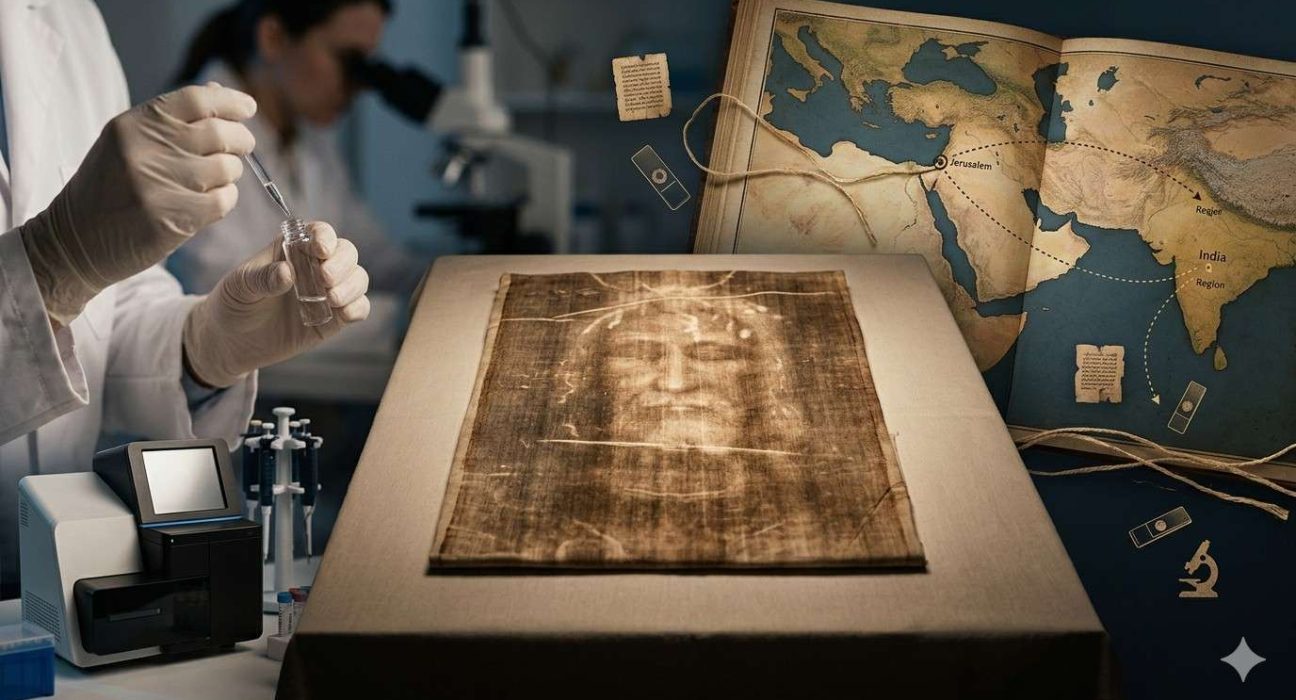
A new pre-print study from researchers at the University of Padova in Italy has sparked global interest — and some sensational headlines — suggesting that the famous Shroud of Turin, the linen cloth venerated by millions of Christians as the burial shroud of Jesus Christ, carries a significant genetic footprint from Indian lineages.
The study, led by plant geneticist Gianni Barcaccia and posted on bioRxiv in March 2026 (not yet peer-reviewed), re-analyzes DNA from dust and material vacuumed from the shroud during the 1978 official sampling. It reports that approximately 38.7% of the identifiable human genomic data belongs to Indian lineages.
Researchers note: “The presence of 38.7 per cent of the overall human genomic data from Indian lineages is unexpected and is potentially linked to historical interactions associated with importing linen or yarn from regions near the Indus Valley.” They add that the DNA traces suggest “the potentially extensive exposure of the cloth in the Mediterranean region and the possibility that the yarn was produced in India.”
This builds on Barcaccia’s earlier 2015 paper in Scientific Reports, which first flagged Indian mitochondrial haplogroups (such as M56 and R8) among the mixed DNA on the shroud and raised the intriguing possibility of Indian manufacture of the linen.
What the DNA Actually Shows
The shroud is heavily contaminated — as one would expect from a 4.4-metre relic handled by pilgrims, clergy, restorers, and scientists for centuries. The new metagenomic analysis reveals DNA from:
- Multiple human sources (Western Eurasian, Near Eastern, and Indian lineages).
- Plants (Mediterranean species plus others from Asia and the Americas).
- Animals (cats, dogs, cattle, pigs, chickens, and more).
- Microbes and fungi consistent with long-term storage and handling.
One strong human signal even matches the mitogenome of the 1978 official collector, highlighting modern contamination.
The Indian component is prominent but interpreted cautiously by the authors as likely stemming from the fabric’s possible origin or early trade rather than direct contact with a single individual. Ancient Romans imported luxury textiles, including fine linens, from the East (India was known for high-quality cotton and linen). The Greek term “sindon” (used for the shroud in the Gospels) has been speculatively linked by some to “Sindh,” a region famed for textiles.
The study does not extract DNA from Jesus himself. No ancient blood or body fluid DNA provides a direct genetic profile of the man depicted on the cloth. The human DNA is environmental contamination accumulated over time.
Historical and Scientific Context
The Shroud of Turin has long been controversial:
- Carbon dating in 1988 (by three independent labs) dated the linen to 1260–1390 CE, suggesting a medieval origin. Many shroud defenders argue the sampled corner was repaired or contaminated.
- The faint, negative-like image of a crucified man shows realistic details (wounds, blood flows) that some scientists find difficult to explain as a simple medieval forgery, while others point to artistic techniques or natural processes.
- Pollen and other analyses have been cited both for and against a Middle Eastern origin.
The 2015 and 2026 DNA work adds a layer: the cloth (or its yarn) may have traveled widely or been produced in a region with strong textile traditions, possibly including ancient India or areas connected via Roman-Indian trade routes (well-documented in sources like the Periplus of the Erythraean Sea).
However, experts outside the study remain skeptical. Geneticist Anders Götherström (Stockholm University) stated he sees “no reason to doubt that the shroud is French and from the 13th-14th century.” Contamination makes it extremely hard to pinpoint the original material’s source with confidence.
Does This Mean Jesus Was Indian or Spent Time in India?
No. The viral claims linking this to “Jesus having Indian DNA,” “Indian origin,” or his “lost years” in Kashmir/India go far beyond the science.
- The DNA is not from Jesus or his family. It is mostly surface contamination.
- The Indian signals are attributed by the researchers to possible yarn/fabric origin or centuries of handling/trade — not to the ethnicity of the crucified man (if the shroud is authentic).
- Theories about Jesus traveling to India (e.g., Nicolas Notovitch’s 19th-century claims, or the Roza Bal tomb in Srinagar) remain fringe and lack mainstream historical or archaeological support. The Bible places his life firmly in 1st-century Judea and Galilee.
Speculation about Jesus studying Vedas or Buddhism, or having Indian ancestry, has circulated for decades in certain esoteric or syncretic circles. The new DNA data does not substantiate those ideas; it speaks to the cloth’s possible manufacturing or trade history, not the identity of any person wrapped in it.
Ancient India-Mediterranean Connections
India and the Roman world did have extensive trade. Roman ships sailed to Indian ports for spices, textiles, pearls, and gems. Indian merchants reached the Red Sea and beyond. Fine linens from the East were prized. The idea that a high-quality burial cloth in 1st-century Jerusalem (or a medieval European one) could incorporate Eastern yarn is therefore historically plausible — but it proves nothing about Jesus’s personal background.
India and Christianity also share ancient threads: St. Thomas is traditionally believed to have brought Christianity to Kerala in the 1st century CE. Philosophical parallels between early Christian thought and Indian traditions have been noted by scholars. But these cultural exchanges do not rewrite the Levantine origins of Jesus as described in the Gospels.
Clickbait, Science, or Paradigm Shift?
The timing (late March 2026) and sensational framing in some social media posts (“2 Billion Christians Worshipping an Indian?”) suggest April Fools-style amplification or clickbait. The study itself is measured: it highlights contamination, multiple sources, and a hypothesis about yarn origin.
For believers, the shroud remains a powerful object of faith regardless of scientific debates. For skeptics, it is likely a remarkable medieval artifact. For historians and geneticists, the DNA adds another data point to the shroud’s complex biography — but does not overturn established scholarship on the historical Jesus.
The full story deserves nuance: ancient trade routes were more connected than many realize, relics accumulate layers of history (and DNA), and science continues to probe one of Christianity’s most enigmatic relics. Indian genetic traces on the cloth are intriguing in the context of Indo-Roman exchange, but they do not transform Jesus into an Indian figure.
As the researchers themselves emphasize, the findings illuminate the shroud’s long journey and environmental interactions — not a rewriting of religious origins.
Related posts:
 Hindu Weddings: A Sacred Union with Deep Cultural Roots
 Adi Shankaracharya
 How Diwali Helps in Modern Life Style
 Bhagavad Gita: Lessons need to learn by Software engineers, Management Students, Science Students:
 Rava Laddu: A Beloved Hindu Sweet for Festivals and Celebrations
 Dasavatara as a Path to Understanding the Concept of Time Cycles in Hinduism
 Hindu Gods Across Regions: Unity in Diversity
 Amavasya Shraddha vs Pitru Paksha – Ultimate Ancestor Ritual Guide
