Adi Shankaracharya – Life, Philosophy, Teachings & The Saint Who Saved Sanatan Dharma
[image: 🙏] Adi Shankaracharya — The Light That Saved Sanatan Dharma There are moments in history when an entire civilization stands at the edge of darkness —…
[image: 🙏] Adi Shankaracharya — The Light That Saved Sanatan Dharma There are moments in history when an entire civilization stands at the edge of darkness —…
[image: 🙏] Adi Shankaracharya — The Light That Saved Sanatan Dharma
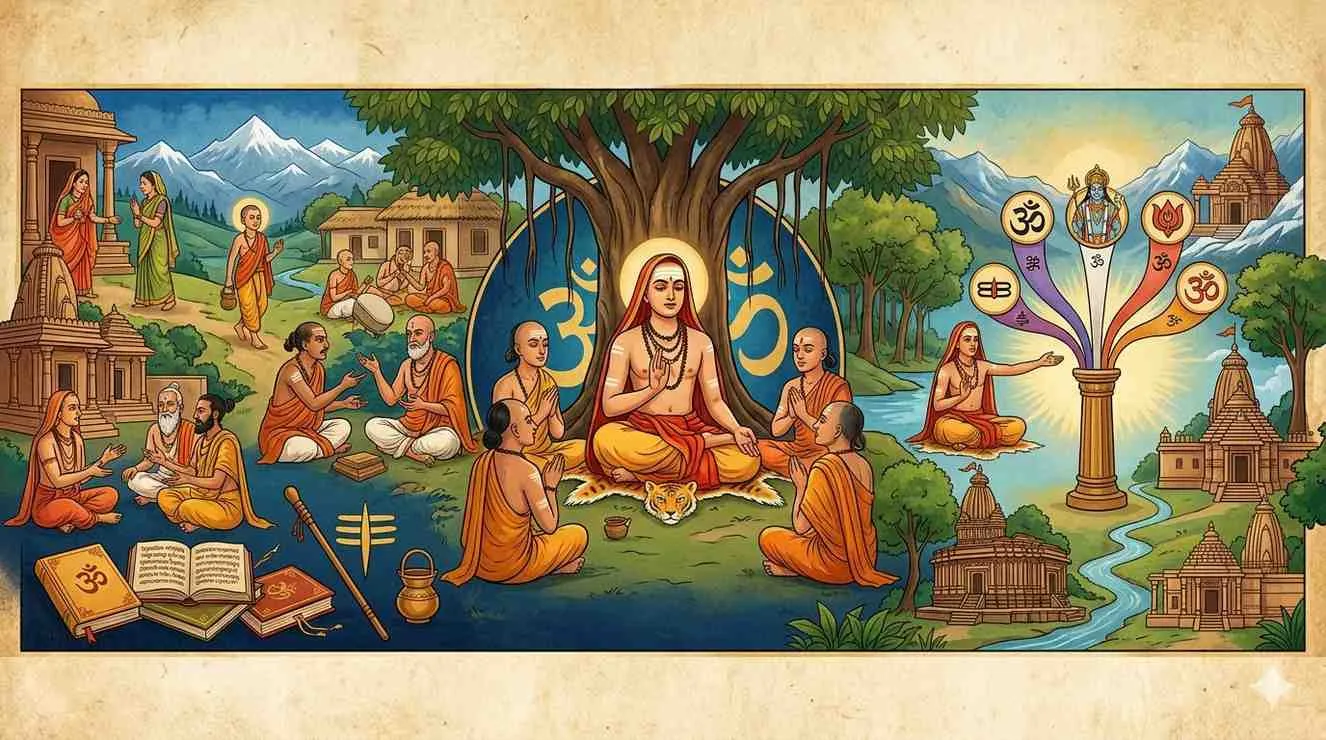
There are moments in history when an entire civilization stands at the edge of darkness — when the accumulated wisdom of thousands of years faces the real possibility of being lost, diluted, or forgotten forever.
In the 8th century CE, Sanatan Dharma faced exactly such a moment.
Buddhism and Jainism had swept across the Indian subcontinent with tremendous force. Countless rituals had been performed without wisdom. The caste system had calcified into cruel rigidity. The philosophy of the Vedas and Upanishads had become the exclusive property of a learned few. The spiritual unity of India — the invisible thread that connected Kanyakumari to Kashmir, that bound the Tamil Shaiva to the Kashmiri Brahmin, the Bengali Shakta to the Gujarati Vaishnava — had frayed dangerously.
Into this twilight walked a small boy from a tiny village in Kerala.
He was eight years old when he mastered the Vedas. Sixteen when he wrote his commentary on the Brahma Sutras — one of the most sophisticated philosophical works in human history. Twenty-eight when he had already walked the entire length and breadth of India, debated every school of thought, established four monastic centers from the Himalayas to the southernmost tip of the continent, composed hundreds of devotional and philosophical works, initiated disciples who would carry his mission for centuries, and — at the age of thirty-two — attained mahasamadhi (conscious death) at the sacred site of Kedarnath in the high Himalayas.
In thirty-two years, Adi Shankaracharya did what no single human being had done before or since: he walked all of India for dharma — and saved it.
At HinduTone, we offer you the complete spiritual biography of Jagat Guru Adi Shankaracharya — his miraculous birth, his extraordinary life's journey, his timeless philosophy, his disciples, his literary works, his four sacred Mathas, and the eternal relevance of his teachings for the 21st century.
[image: 📅] Adi Shankaracharya — Life at a Glance
[image: 🌟] The Miraculous Birth at Kaladi — A Village Blessed by the Divine
The Barren Couple's Prayer
In the small, forested village of Kaladi on the banks of the Periyar River in Kerala, there lived a pious Brahmin couple — Sivaguru and Aryamba. They were devoted, learned, generous, and deeply in love with each other. But one grief shadowed their happiness: despite years of marriage, they remained childless.
With hearts full of longing, they undertook a long pilgrimage to the ancient Vadakkunnatha Temple in Thrissur — one of Kerala's oldest and holiest Shiva shrines. There, they performed intense tapasya (austerities) and prayed to Lord Shiva for the boon of a child.
Lord Shiva himself appeared to them in a vision. He gave them a choice:
"I can give you many ordinary sons who will live long, ordinary lives — or I can give you one extraordinary son, who will be an incarnation of my own divine intelligence, who will illuminate the world — but who will live only a short life. Choose."
Aryamba, with the intuition of a mother who understood dharma, chose without hesitation:
"Give me one son who belongs to You, O Lord — who will serve the world. That is worth more than a hundred ordinary lives."
Nine months later, a son was born to Aryamba — brilliant, with large luminous eyes that seemed to hold all the wisdom of the universe in their depths. They named him Shankara — the one who brings auspiciousness; another name of Lord Shiva himself.
The Child Prodigy of Kaladi
From the very beginning, Shankara was unlike any child his parents or village had ever seen.
- By age two, he could speak in full sentences in Sanskrit
- By age three, he had memorized entire sections of the Puranas simply by listening to his father recite them
- By age five, after the traditional Upanayana ceremony (sacred thread initiation), he was sent to a gurukul (residential school)
- Within one year, he had mastered all the texts of his gurukul — completing in months what other students took a decade to accomplish
By age eight, Shankara had returned to Kaladi having mastered the four Vedas, the six Vedangas, the Upanishads, the Brahma Sutras, and the Bhagavad Gita. His teachers — themselves learned scholars — confessed they had nothing left to teach him.
But tragedy arrived early. Sivaguru, Shankara's father, passed away when the boy was just five years old. Mother and son lived alone in their home in Kaladi, with Aryamba deeply devoted to her extraordinary child.
The Crocodile in the Periyar — The Moment Everything Changed
When Shankara was eight years old, he and his mother went to the Periyar River for the daily ritual bath. As Shankara waded into the river, a huge crocodile grabbed his leg and pulled him deeper into the water.
Aryamba screamed in terror from the bank.
Shankara called out from the river — calmly, without panic — his words carrying a clarity extraordinary for a child in mortal danger:
"Mother — a crocodile has caught me. I will die. Give me permission to take Sanyasa (monastic vows) right now. If you give permission, the crocodile will release me. If I die in Sanyasa, my soul will be liberated. Please — bless me to take Sanyasa."
This was the ancient tradition of Aapat Sanyasa — monastic vows taken in a moment of mortal crisis. Aryamba, weeping and terrified, gave her permission.
The moment she spoke the word — the crocodile released Shankara. He walked out of the river unharmed, in a state of perfect calm.
He had taken the vows of sanyasa. His extraordinary journey had begun.
The crocodile, the ancient texts say, was no ordinary animal. It was a divine messenger — the instrument through which the universe ensured that Shankara would not remain a householder, absorbed in domestic life, but would go forth into the world to fulfill his cosmic purpose.
[image: 🚶] The Young Sannyasi Seeks His Guru — The Journey North
Leaving Kaladi
Shankara's departure from Kaladi was not without grief. Aryamba wept, understanding she was losing the child she had prayed for — yet also understanding, in the deeper part of herself, that she had always known he belonged not to her but to the world.
Shankara made one promise to his mother:
"When your time comes, I will be there. Wherever I am in the world — I will come. This is my promise."
He then set out — barefoot, wearing only the ochre robes of a monk, carrying only a water pot and a walking staff — for the forests of Omkareshwar on the Narmada River in central India, where he had heard of a great sage named Govindapada.
Sri Govindapada — The Master on the River Bank
At the banks of the Narmada River at Omkareshwar, Shankara found the cave of Govindapada Acharya — a realized master who was himself a disciple of the legendary sage Gaudapada (author of the Mandukya Karika — one of the foundational texts of Advaita Vedanta).
When Shankara arrived at the cave's entrance, Govindapada was deep in meditation inside. Without opening his eyes, the sage called out:
"Who is there?"
Shankara replied with a spontaneous Sanskrit verse — composing it on the spot — that described himself not as a person defined by body, mind, name, or social position, but as pure Consciousness itself:
"Na bhūmirna toyam na tejo na vāyuḥ,
na khaṃ nendriyaṃ vā na teṣāṃ samūhaḥ।
Anantācyutānanda-rūpam śivam tam
aham brahmāsmi - the knower, pure consciousness — this am I."
Govindapada opened his eyes, looked at the boy standing in the bright morning light of the Narmada bank, and smiled — the smile of a master who recognizes a truth already fully formed.
"I have been waiting for you," he said.
For the next two years, Shankara studied at Govindapada's feet — not because he needed to learn, but because the tradition required that even the greatest knowledge be transmitted through the living guru-disciple relationship, not through books alone.
When Govindapada declared Shankara's training complete, he gave him one instruction:
"Go to Kashi. Write the commentary on the Brahma Sutras. Then walk the length of India. Restore the knowledge of the Upanishads to the people. The time has come."
[image: 📜] Kashi — The Commentaries That Changed Everything
At the Feet of Lord Vishwanath
Shankara arrived at Kashi (Varanasi) — the eternal city, the spiritual capital of Hinduism — and settled into the concentrated work of a lifetime: writing his Brahma Sutra Bhashya (Commentary on the Brahma Sutras).
The Brahma Sutras — composed by Sage Veda Vyasa — are 555 terse, cryptic aphorisms that attempt to systematize the teaching of the Upanishads. Before Shankara, various commentators had interpreted them in radically different ways, leading to fragmentation and confusion in the philosophical tradition.
Shankara's commentary was — and remains — a literary, philosophical, and spiritual masterwork. In dense, precise, magnificent Sanskrit prose, he demonstrated:
- That the Upanishads, the Brahma Sutras, and the Bhagavad Gita — the three pillars of Vedanta (known as the Prasthanatrayi) — form a perfectly consistent, unified system of philosophy
- That the ultimate reality is One, undivided, attributeless Consciousness — Brahman
- That the apparent diversity of the universe is Maya — not illusion in the sense of non-existence, but in the sense of misperception — like mistaking a rope for a snake in dim light
- That the individual self (Atman) and the universal self (Brahman) are ultimately identical — Aham Brahmasmi — "I am Brahman"
- That liberation (Moksha) is not something to be attained in the future — it is the recognition of one's already-existing nature as pure consciousness
This philosophy — Advaita Vedanta (Non-Dual Vedanta) — would become the philosophical backbone of modern Hinduism.
The Meeting with Mandana Mishra — The Greatest Debate in Indian History
In Kashi, Shankara heard of Mandana Mishra — perhaps the greatest living scholar of Mimamsa philosophy in India, who lived in the city of Mahishmati (present-day Maheshwar, Madhya Pradesh). Mandana Mishra championed the view that Vedic ritual (karma-kanda) was the supreme path to liberation — directly contradicting Shankara's position that knowledge (jnana) alone leads to liberation.
Shankara went to Mahishmati and arrived at Mandana Mishra's home — which he identified by the remarkable sight of birds in the garden cages spontaneously reciting Vedic verses (such was the spiritual atmosphere of the household). Mandana Mishra was in the middle of a great Vedic yajna (sacrifice).
Shankara challenged Mandana Mishra to a formal debate — with the condition that whoever lost would become the disciple of the winner.
The judge of the debate? Ubhaya Bharati — Mandana Mishra's own wife — herself a scholar of such extraordinary learning that she alone among all the sages present was considered impartial and competent enough to judge the contest.
The debate lasted seventeen days.
It ranged across every domain of Vedic philosophy — the nature of Brahman, the role of karma, the path to liberation, the status of the world, the meaning of the Upanishads. Scholars from all over India attended. Kings sent observers to report on the outcome.
On the seventeenth day, Ubhaya Bharati declared: Shankara had won.
Mandana Mishra accepted defeat gracefully and offered to become Shankara's disciple.
But Ubhaya Bharati was not finished. She raised one final challenge:
"You have defeated my husband. But he and I are one — like two halves of a single being, as husband and wife always are. To truly defeat him, you must also defeat me."
She began questioning Shankara on the science of love and marital relations (Kama Shastra) — a domain in which a celibate monk would be expected to have no knowledge whatsoever.
Shankara requested a month's pause, which Ubhaya Bharati granted.
Parakaya Pravesh — The Philosopher Who Experienced Everything
What Shankara did next stands as one of the most extraordinary episodes in all of Indian hagiography.
Learning through his yogic vision that a local king — Amaruka — had just died, Shankara employed the mystical power of Parakaya Pravesh (entering another body). He left his own body in the care of his disciples with instructions to protect it, and entered the body of the dead king, reviving him.
As King Amaruka, Shankara lived the full experience of royal life — including the experience of love and marriage — for several weeks. He immersed himself completely in the knowledge that was, until then, beyond his personal experience.
But the ministers and queens of the court, over time, began to suspect that their king was not himself. They sent spies to look for a renunciant's body hidden somewhere with disciples guarding it — knowing that if they destroyed that body, the soul within could not return to it and would have to remain in the king's body permanently.
Shankara, sensing the danger through his yogic awareness, hastily returned to his monk's body — but not before absorbing, through direct experience, the complete knowledge of love, desire, attachment, grief, and human relationships that he needed.
He returned to Ubhaya Bharati and answered every question with such depth, grace, and lived understanding that she was silenced — and acknowledged his complete victory.
Mandana Mishra took Sanyasa and became Shankara's disciple, taking the monastic name Sureshvaracharya — one of Shankara's four principal disciples.
This episode is a profound teaching in itself: Real wisdom encompasses all of human experience — not just the ascetic dimensions. Shankara needed to know love before he could fully teach liberation. The philosopher became the experiencer — and returned to philosophy richer, more whole, more human.
[image: 🗺️] The Great Digvijaya — Walking All of India for Dharma
What is the Digvijaya?
Digvijaya literally means "conquest of all directions." In the Sanskrit tradition, a great teacher's Digvijaya was their triumphant journey across the land — debating scholars of all schools, establishing the supremacy of their philosophy through both intellectual argument and lived spiritual authority.
Adi Shankaracharya's Digvijaya was the most extraordinary in Indian history. Between the ages of approximately twelve and thirty-two, he walked — on bare feet, across mountain ranges, river crossings, dense forests, scorching deserts, and coastal plains — the entire length and breadth of India.
The Route of the Digvijaya
From Kerala → Through South India → North to Kashi → West to Mahishmati → North to Himalayas → East to Bengal → South again → Back to Kashi and North
The complete circuit covered what scholars estimate as tens of thousands of kilometers — all traversed on foot, in an era before roads, maps, or modern transportation.
At every stop, Shankara did several things simultaneously:
- Debated every school of philosophy — Mimamsa, Sankhya, Nyaya, Vaisheshika, Charvaka, Buddhist Madhyamaka, Yogachara — and demonstrated the philosophical supremacy of Advaita Vedanta
- Composed hymns and prayers to bring the people back to devotion
- Reformed the worship at major temple sites, reorganizing the Shanmata (six-path) system
- Initiated disciples who would carry his mission forward
- Established institutions for the long-term preservation of Vedic knowledge
Major Philosophical Battles of the Digvijaya
The Victory Over the Kapalikas — Ugra Bhairava's Challenge
One of the most dramatic episodes of the Digvijaya occurred when Shankara encountered a group of Kapalikas — followers of a fierce, esoteric form of Shaivism who used human skulls, blood offerings, and extreme tantric practices. Their leader, Ugra Bhairava, challenged Shankara to a contest — demanding that Shankara offer his own head as a sacrifice to Bhairava to prove his detachment from the body.
Shankara, with absolute equanimity, agreed. He entered a state of deep samadhi, fully prepared for physical death.
At that moment, his disciple Padmapadacharya — who was in meditation at a distant location — received an inner vision of his guru's danger. He immediately invoked the fierce form of Lord Vishnu as Nrisimha (the half-lion), and it is said that divine power manifested to protect Shankara, destroying the threat and demonstrating that genuine spiritual authority cannot be overcome by dark powers.
The teaching: True non-dual consciousness is fearless. The sage who knows that the Self cannot be killed has no fear even in the face of death. Yet the universe itself protects such a sage.
The Debate with the Mimamsakas of Kashi
The Mimamsa school — which held that the Vedic rituals were themselves the supreme reality and liberation meant continuation in a heavenly realm, not the realization of Brahman — was enormously powerful in 8th century India, supported by the priestly class whose livelihood depended on ritual performance.
Shankara debated the leading Mimamsakas in Kashi publicly, demonstrating through careful textual analysis that the Vedas themselves, in their highest teaching (the Upanishads), transcend ritual and point toward direct knowledge of Brahman as the path to liberation. He showed that karma and jnana are not contradictory — karma purifies the mind, making it fit for knowledge — but knowledge alone liberates.
The Kashmir Sharada Pitha — The Seat of Goddess Saraswati
At Sarvagnapitha (Sharada Pitha) in Kashmir — an ancient seat of learning where Goddess Saraswati herself was said to preside — scholars from across Asia gathered to debate the supreme philosophy. Entry was granted only by ascending a symbolic staircase representing different levels of knowledge.
Shankara ascended this staircase with complete confidence and engaged scholars from every tradition. He emerged victorious and was awarded the title "Jagat Guru" — Teacher of the Universe — by the assembled scholars at Sarvagnapitha.
He then climbed to the top of the Sarada Pitha and changed the direction of the flag (which had always faced south — the direction of the greatest existing scholarship) to face all four directions simultaneously — signifying that knowledge now belonged to all directions, all peoples, all traditions.
[image: 🏛️] The Four Mathas — Shankara's Greatest Institutional Gift
Adi Shankaracharya's most enduring institutional contribution was the establishment of four Amnaya Mathas (monastic centers) at the four cardinal corners of India — a living organizational system to preserve and propagate Vedantic knowledge across centuries and millennia.
Each Matha was placed at a geographically and spiritually strategic location. Each was assigned a specific section of the Vedas, a specific Mahavakya (Great Saying), a presiding deity, and one of his four principal disciples as the first Acharya.
The Four Mathas — Complete Table
The Sannyasa Lineage
Each Matha maintains an unbroken lineage of Shankaracharyas (Acharyas in Shankara's tradition) to this day — over 1,200 years of continuous spiritual succession. The current Shankaracharyas of these four Mathas are among the most respected spiritual authorities in the Hindu world.
The monastic order Shankara established — the Dashanami Sampradaya (Ten-Named Order) — is one of the largest and most influential monastic orders in the world, with hundreds of thousands of sannyasis (monks) bearing one of ten traditional names:
Saraswati, Bharati, Puri, Tirtha, Ashrama, Giri, Parvata, Sagara, Vana, Aranya
These ten names represent ten rivers, ten mountains, ten forests — symbolizing that the Dashanami monk belongs to all of nature, not to any single place, community, or institution.
[image: 📚] The Literary Works of Adi Shankaracharya
In thirty-two years — many of which were spent walking across India — Shankara composed over 300 works covering philosophy, devotional poetry, grammatical analysis, and mystical hymns. This output is staggering in both quantity and quality — each work a masterpiece in its own domain.
Major Philosophical Commentaries (Bhashyas)
These are the foundational texts of Advaita Vedanta — Shankara's systematic commentaries on the three pillars of Vedantic philosophy:
Original Philosophical Prakaranas (Independent Works)
Devotional Hymns (Stotras) — Songs for the Hearts of All
Perhaps the most beloved of all Shankara's works are his devotional hymns — poems of such extraordinary beauty and depth that they have been sung continuously in Hindu temples and households for 1,200 years. They reveal the other face of Shankara — not the razor-sharp philosopher but the melting devotee, the child singing to the Divine Mother.
[image: 🌟] The Five Most Moving Stories from Shankara's Life
Story 1: The Kanakadhara Stotram — The Rain of Gold
As a young brahmachari (student) wandering before finding his guru, the young Shankara would go from house to house in the tradition of biksha (alms) — a student's dependence on the community's generosity as a practice of both humility and gratitude.
One morning, he arrived at the home of an extremely poor Brahmin woman. She had nothing in the house to offer — not a grain of rice, not a fruit. She searched every corner of the house. All she found was a single dried gooseberry (amla).
She offered this single, dried fruit to the young monk with profound embarrassment and apology, tears in her eyes.
Something broke open in Shankara's heart. He stood at her doorway and composed — spontaneously, in one continuous inspiration — the Kanakadhara Stotram (Hymn to the Golden Stream), 21 verses of breathtaking beauty to Goddess Lakshmi, praying for the poor woman's liberation from poverty.
As the final verse left his lips, tradition records that a shower of golden amla (gooseberries) fell from the sky into the woman's home — filling her courtyard and transforming her poverty into abundance forever.
Teaching: True compassion moves the cosmos. When a saint's heart breaks open for another's suffering, the laws of the universe themselves bend in response.
Story 2: The Chandala on the Ghats — The Birth of the Manisha Panchakam
One morning at the Manikarnika Ghat in Kashi, Shankara was returning from the Ganga after his ritual bath. He was accompanied by his disciples and moving through the narrow lanes of the old city.
Ahead of them walked a man with four dogs — a Chandala (from the lowest social strata), who by the conventions of that time was required to step aside and make way for Brahmins. Shankara's disciples called out for the man to move aside.
But the Chandala stopped. He turned around. And with steady, penetrating eyes, he asked a question that silenced everyone:
"O great teacher of non-dualism — you who declare that all is One Brahman, that there is no second — whom do you ask to step aside? The body, made of the same five elements in both of us? The awareness, which shines equally in the Brahmin and the Chandala? Tell me — which of these two can be separate from the other? Who is pure? Who is impure?"
Shankara stood still. A profound silence descended. Then he fell to his knees — prostrating himself at the feet of the Chandala.
Rising, he composed the Manisha Panchakam — Five Verses of Conviction — on the spot, each verse ending with the refrain:
"Manīṣā mama — this is my conviction."
The five verses declare: He who has realized the identity of his own awareness with the universal Brahman — whether he is a Brahmin or a Chandala, a householder or a monk — he is my guru. I bow to him.
When Shankara finished the fifth verse, tradition says the Chandala and his dogs transformed into Lord Shiva and his four divine attendants — Shiva himself having taken the form of a low-caste man to test and teach his own beloved devotee.
Teaching: The Advaita philosophy Shankara taught was not merely intellectual. When truly realized, it abolishes every barrier of caste, status, and social hierarchy. The Chandala was Shankara's greatest teacher — and Shankara was great enough to recognize it.
Story 3: The Promise Kept — Aryamba's Last Breath
Years after leaving Kaladi, while Shankara was in the midst of his Digvijaya — thousands of kilometers away — he received an inner vision: his mother Aryamba was dying.
He had made her a promise. He kept it.
Through the power of his yogic abilities, Shankara traveled vast distances and arrived at Kaladi in time to be at his mother's bedside. He held her hands as she breathed her last, and he performed the Vedic death rites for her — chanting, offering the sacred fire, completing every ritual with the love and precision of a devoted son.
But here arose a difficulty. The local Brahmins of Kaladi refused to help a sannyasi (monk) perform the funeral rites for his mother — a monk, they argued, has renounced all family bonds and therefore cannot perform family rituals. No firewood would be lent. No help offered.
Shankara, undeterred, is said to have performed the cremation singlehandedly — in the small courtyard of the family home, having gathered firewood himself, performing every rite alone with perfect devotion.
This episode is cited in traditional accounts as one of the most humanizing moments in Shankara's life — the great philosopher, the Jagat Guru, the debater who had conquered all of India — weeping over his mother's body in a small village in Kerala, performing the final rituals alone because society would not help him, refusing to let convention prevent him from honoring the woman who had given him life and let him go.
Teaching: Renunciation is not the absence of love. Shankara renounced everything for dharma — but he never renounced love. His promise to his mother was kept across thousands of kilometers because love is not limited by geography, status, or monastic rule.
Story 4: Totakacharya and the Grace That Comes to the Devoted
Among Shankara's four principal disciples, one stands out for the extraordinarily moving story of how he received the master's grace.
Giri (who would later be known as Totakacharya) was the simplest of Shankara's disciples — not particularly learned in scripture, not gifted with sharp intellect. But he was devoted to Shankara with an absolute, uncomplicated love that had no ego in it whatsoever. Every morning, before the other disciples awoke, Giri would go to the river, wash Shankara's robes, and return with them dry and neatly folded — always there, always serving, always quiet.
One morning, the other disciples — Sureshvaracharya, Padmapadacharya, and Hastamalaka — were in the middle of a learned discourse waiting for Shankara to begin his teaching session. Shankara was waiting for Giri, who had not yet returned from washing his robes.
The other disciples grew impatient: "Why do we wait for the simple one? He has nothing to contribute to the discussion."
At that moment, Shankara closed his eyes and sent a stream of divine grace to Giri at the river bank. In an instant, the simple disciple was illumined — not gradually, not through study, but through the direct transmission of the master's grace.
Giri returned, and as he walked toward the assembled disciples, he spontaneously began composing Sanskrit verses of profound philosophical beauty — the Totakashtakam — in the most complex Sanskrit meter (Totaka meter — named for him after this event), extolling his guru's greatness with a mastery that left the learned scholars speechless.
Shankara smiled at his other disciples:
"True learning can be transmitted through grace in an instant — to the one whose vessel is empty enough to receive it. Giri's absolute devotion emptied him completely. Grace had nowhere to go but into him."
Teaching: The devotee who serves without ego, without ambition, without intellectual pride — who is simply, completely present before the master — receives more than all the learned ones combined.
Story 5: Mahasamadhi at Kedarnath — The Saint Returns to Shiva
By the time Shankara was thirty-two years old, his work in the world was complete. He had established the four Mathas, trained his disciples, composed his commentaries, walked every sacred site in India, and systematized a philosophy that would sustain Hindu civilization for millennia.
He ascended to Kedarnath — high in the Himalayas, at the sacred abode of Lord Shiva — where the Pandavas had sought liberation, where the god himself was said to be present in the triangular rock hump on the cold mountain.
At Kedarnath, Shankara entered his final meditation. He composed the Kedara Ashtakam — eight verses of extraordinary beauty to Lord Shiva of Kedarnath. Then, in the presence of his disciples and the vast Himalayan silence, he consciously withdrew his life force and attained Mahasamadhi — the state from which the realized sage does not return.
His physical body was interred at Kedarnath — behind the main temple. The Samadhi shrine of Adi Shankaracharya at Kedarnath stands to this day, just behind the ancient temple, a destination of profound pilgrimage for seekers of all traditions.
He was thirty-two years old.
In thirty-two years, he had done what most saints cannot do in ten lifetimes.
[image: 🕉️] The Philosophy of Advaita Vedanta — Understanding Shankara's Core Teaching
The Central Declaration: Brahman is the Only Reality
Shankara's entire philosophical edifice rests on a single, radical, uncompromising declaration:
"Brahma satyam, jagat mithya, jivo brahmaiva naparah."
Brahman alone is real. The world as perceived by the unenlightened mind is superimposition (mithya). The individual soul is none other than Brahman.
This is not a religious belief to be accepted on faith. It is — Shankara insists — a direct recognizable truth available to every human being through the proper combination of study (shravana), reflection (manana), and contemplative absorption (nididhyasana).
The Four Mahavakyas — The Great Declarations
The Upanishads contain four supreme declarations — Mahavakyas — that point directly to the non-dual reality:
These four statements, Shankara teaches, are not metaphors. They are direct descriptions of the actual nature of reality — available to anyone who purifies the mind sufficiently to perceive it clearly.
The Three Levels of Reality (Tripartite Ontology)
Shankara introduces a brilliant three-level framework for understanding apparent reality:
1. Paramarthika Satta (Absolute Reality): Pure Brahman — attributeless, formless, limitless consciousness. This alone is ultimately real.
2. Vyavaharika Satta (Conventional Reality): The world of ordinary experience — the realm of objects, people, relationships, cause and effect. This is real enough for practical purposes but is not the ultimate reality. Like a dream — vivid and real while you're in it, recognized as unreal upon waking.
3. Pratibhasika Satta (Apparent Reality): The level of pure illusion — like the snake seen in a rope at dusk, or silver seen in mother-of-pearl. Completely negated when the misperception is corrected.
Maya — What Shankara Actually Taught
Perhaps the most misunderstood aspect of Advaita Vedanta is the concept of Maya. It is commonly translated as "illusion" — leading many to conclude that Shankara taught the world doesn't exist and is therefore worthless.
This is a serious misreading.
Shankara's Maya is not the claim that the world doesn't exist. It is the claim that the world as it appears to the unenlightened mind — as a collection of separate, independent objects — is a misperception of the one undivided Brahman.
The analogy he uses: A rope lying on a dark path is mistaken for a snake. The rope is real. The snake is the misperception. When you bring a lamp and see the rope clearly — the snake never existed, but the rope always did.
Similarly: Brahman is the rope. The world of separate selves and objects is the snake. Liberation is the lamp of knowledge — not the destruction of the world, but the correct perception of it as Brahman.
The Four Prerequisites for the Spiritual Path (Sadhana Chatustaya)
Shankara identifies four essential qualifications for a student of Vedanta:
[image: 🔥] The Shanmata System — Shankara's Six-Path Reform
One of Shankara's most important practical contributions to Hindu unity was the establishment of the Shanmata — the worship of six forms of the Divine as different faces of the one Brahman:
Shankara's genius was to declare that all six are equally valid paths to the one Brahman — that the Shaiva, the Vaishnava, and the Shakta all worship the same ultimate reality through different forms appropriate to their temperament and tradition.
This was a revolutionary act of spiritual diplomacy — unifying the many streams of Hindu devotion under the philosophical umbrella of Advaita Vedanta without demanding that any tradition abandon its unique forms and practices.
[image: 🌍] Why Adi Shankaracharya Matters in the 21st Century
More than 1,200 years after his mahasamadhi, Adi Shankaracharya's relevance has not diminished — if anything, it has grown deeper. His philosophy speaks directly to the most pressing questions of our age.
1. In a World of Divisive Identities — Advaita Teaches Unity
When religious communities clash, when national and ethnic identities harden into walls, when "us vs. them" threatens civilization — Shankara's core teaching strikes at the root: there is only One. There is no "other" to fear, hate, or destroy. The one who hates is the same consciousness as the one who is hated. The realization of this oneness is not naive idealism — it is the most hardheaded philosophical conclusion available to a clear mind.
2. In a World of Materialism — Advaita Offers Depth
Modern science gives us extraordinary maps of the physical universe — and yet leaves unanswered the most fundamental question: what is consciousness? Shankara's Advaita places consciousness not as a byproduct of matter, but as the very ground of all existence — the one thing that cannot be denied because the denier is always already consciousness. This places Advaita in a remarkable conversation with the cutting edge of consciousness studies, quantum physics, and cognitive science.
3. In a World of Anxiety — Advaita Offers Fearlessness
The root of all human anxiety, Shankara teaches, is the false belief in a separate, vulnerable self. When this false self is seen through — when the Atman is recognized as Brahman — what is there to fear? What can be lost when you are the whole? This is not escapism. It is the most radical form of psychological liberation available.
4. In a World of Religious Fragmentation — Advaita Offers Synthesis
The Shanmata system Shankara established — honoring six different paths as equally valid — offers a model of genuine pluralism that is philosophically grounded, not merely politically polite. Different forms for different temperaments; one truth underlying all forms.
[image: 🛕] Pilgrimage Sites Associated with Adi Shankaracharya
Devotees of Adi Shankaracharya visit these sacred sites connected to his life:
[image: 🙏] Adi Shankaracharya's Prayers — For the Modern Devotee
Nirvana Shatakam — The Supreme Prayer of the Self
Perhaps the most powerful self-inquiry text ever composed — six verses, each a hammer blow to false identity
मनो बुद्ध्यहंकार चित्तानि नाहम्
न च श्रोत्र जिह्वे न च घ्राण नेत्रे।
न च व्योम भूमिर्न तेजो न वायु:
चिदानन्द रूप: शिवोऽहम् शिवोऽहम् ॥
Mano buddhi ahankara chittani naham
Na cha shrotra jihve na cha ghrana netre
Na cha vyoma bhumir na tejo na vayuh
Chidananda rupah Shivoham Shivoham
Meaning: I am not the mind, intellect, ego, or memory. I am not the ears, tongue, nose, or eyes. I am not the sky, earth, fire, or air. I am of the form of consciousness-bliss — I am Shiva, I am Shiva.
Bhaja Govindam — The Urgent Call to Devotion
भज गोविन्दम् भज गोविन्दम्
गोविन्दम् भज मूढमते।
सम्प्राप्ते सन्निहिते काले
न हि न हि रक्षति डुकृञ्करणे ॥
Bhaja Govindam Bhaja Govindam
Govindam Bhaja Mudha Mate
Samprapte Sannihite Kale
Na Hi Na Hi Rakshati Dukrijnkarane
Meaning: Worship Govinda, worship Govinda, worship Govinda, O foolish mind! When the time of death arrives, the rules of grammar will not save you.
Dakshinamurti Dhyana Shloka
गुरुर्ब्रह्मा गुरुर्विष्णुः गुरुर्देवो महेश्वरः।
गुरुः साक्षात् परब्रह्म तस्मै श्री गुरवे नमः ॥
Guru Brahma Guru Vishnu Guru Devo Maheshvarah
Guru Sakshat Para Brahma Tasmai Shri Gurave Namah
Meaning: The Guru is Brahma, the Guru is Vishnu, the Guru is Maheshvara. The Guru is verily the Supreme Brahman itself — to that Guru I offer my salutations.
[image: 🌺] Shankaracharya Jayanti 2026
Shankara Jayanti — the birth anniversary of Adi Shankaracharya — is celebrated on Vaishakha Shukla Panchami (the fifth day of the bright fortnight of the month of Vaishakha).
In 2026, Shankara Jayanti falls on April 25, 2026.
How to Observe Shankara Jayanti
- Reading: Read at least one chapter of Vivekachudamani or Bhaja Govindam
- Chanting: Recite the Nirvana Shatakam or Soundarya Lahari
- Meditation: Sit in silent meditation after sunrise, contemplating the question "Who am I?" — the central inquiry of Advaita Vedanta
- Visit: Visit the nearest Advaita Matha or Shankara-related temple
- Dana: Donate books on Vedanta to libraries or seekers
- Reflection: Spend time with the Mahavakyas — write one in your journal and sit with it through the day
[image: ✨] The Eternal Legacy
When the young boy from Kaladi finally merged back into the Silence at Kedarnath — when the brief, brilliant flame of his physical existence went out in the cold Himalayan wind — what he had lit in thirty-two years would never go out.
The four Mathas stand today, as they have stood for twelve centuries, carrying his unbroken lineage.
The Dashanami monks — in their thousands — still carry his ochre robes and walking staff across the length of India.
The Vivekachudamani is still read every morning in Vedanta monasteries across the world.
The Bhaja Govindam is still sung by grandmothers who may not know its philosophy but feel its truth.
The Nirvana Shatakam is still chanted in meditation halls in India, Europe, America, Japan — wherever human beings sit quietly and ask the oldest question:
Who am I?
And in the silence after that question — in the profound stillness that descends when the mind has finally given up its habitual noise and become genuinely quiet — the answer Shankara always pointed toward is simply there:
Chidananda rupah — Shivoham, Shivoham.
I am of the form of consciousness-bliss. I am Shiva. I am Shiva.
It was true when he said it in the 8th century.
It is true now.
It will always be true.
Jai Adi Shankaracharya | Om Namah Shivaya | Aham Brahmasmi
[image: 📖] Frequently Asked Questions
Q1. When was Adi Shankaracharya born and how long did he live?
A: Traditional accounts date Adi Shankaracharya's birth to 788 CE in Kaladi, Kerala. He attained mahasamadhi in 820 CE at Kedarnath, living for only 32 years — yet producing a philosophical and institutional legacy unmatched in scope by any single figure in Indian religious history.
Q2. What is Advaita Vedanta in simple terms?
A: Advaita Vedanta is the philosophy that Reality is ultimately One — pure, undivided Consciousness (Brahman). The apparent diversity of the universe and the sense of being a separate individual self are the result of a fundamental misperception (Maya). Liberation means seeing through this misperception and recognizing that your innermost self (Atman) is identical with Brahman — the universal consciousness. The core formula is: Brahma satyam, jagat mithya, jivo brahmaiva naparah.
Q3. What are the four Mathas established by Adi Shankaracharya?
A: The four Amnaya Mathas are Sringeri Sharada Pitha (South — Karnataka), Dwaraka Pitha (West — Gujarat), Govardhana Pitha at Puri (East — Odisha), and Jyotir Math at Joshimath (North — Uttarakhand). Each Matha is headed by a Shankaracharya who continues the unbroken spiritual lineage established 1,200+ years ago.
Q4. Where did Adi Shankaracharya attain mahasamadhi?
A: Adi Shankaracharya attained mahasamadhi at Kedarnath in the Himalayas at the age of 32. His samadhi shrine stands directly behind the Kedarnath Temple and is a major site of pilgrimage. Some traditions — particularly the Kanchi Kamakoti Pitha — hold that his mahasamadhi occurred at Kanchipuram, Tamil Nadu.
Q5. What is the Dashanami Sampradaya?
A: The Dashanami Sampradaya (Ten-Named Order) is the monastic tradition established by Adi Shankaracharya. Monks in this order bear one of ten traditional names — Saraswati, Bharati, Puri, Tirtha, Ashrama, Giri, Parvata, Sagara, Vana, or Aranya — symbolizing their belonging to all of nature. It is one of the most influential monastic traditions in the world.
Q6. What is Bhaja Govindam and why is it so important?
A: Bhaja Govindam (also called Mohamudgara — "The Hammer That Destroys Delusion") is a collection of 31 devotional verses composed by Adi Shankaracharya, traditionally said to have been composed spontaneously when he overheard a student obsessively memorizing Sanskrit grammar. The verses warn of life's impermanence and urge immediate devotion to Govinda (Vishnu). It remains one of the most-sung Sanskrit compositions in India, beloved across all traditions.
Q7. Can non-Brahmins and non-Hindus study Advaita Vedanta?
A: Absolutely. While Adi Shankaracharya operated within the social conventions of his era, the philosophy of Advaita Vedanta itself recognizes no caste, gender, or religious boundary — as powerfully demonstrated by the Manisha Panchakam episode where Shankara prostrated before a Chandala. Modern Advaita teachers including Ramana Maharshi, Nisargadatta Maharaj, and Swami Vivekananda have taught seekers of all backgrounds. Advaita's central question — "Who am I?" — belongs to every human being.
[image: 🔗] Explore More at HinduTone
Related Posts You May Like:
- Char Dham Yatra 2026: The Complete Pilgrimage Guide
- Kedarnath Temple: The Complete Spiritual & Travel Guide
- Advaita Vedanta: A Complete Beginner's Guide to Non-Dual Philosophy
- The Four Vedas: What They Are and Why They Matter
- Bhagavad Gita: Chapter-by-Chapter Summary and Spiritual Guide
- Guru Pournami 2026: Honoring the Guru Tradition
- Vivekachudamani: Shankara's Crown Jewel of Wisdom Explained
© 2026 HinduTone.com | All Rights Reserved
hindutone— Your Trusted Guide to Hindu Spirituality, Philosophy, and Sacred Traditions
🪷 New on HinduTone: Guru Purnima 2026: Vyasa-puja Vidhi & Mantras — verified Drik Panchang dates, full vidhi and NRI-friendly notes.
Frequently asked questions
Where was Adi Shankaracharya born?
He was born in the village of Kaladi on the banks of the Periyar River in Kerala, to Sivaguru and Aryamba. As commonly told, they prayed to Lord Shiva at the Vadakkunnatha Temple in Thrissur for a child.
How did Shankaracharya become a sannyasi at eight?
As commonly told, a crocodile seized him in the Periyar while bathing, and he asked his mother Aryamba for permission to take sanyasa. She agreed, the crocodile released him, and he took the vows of Aapat Sanyasa.
Who was Adi Shankaracharya's guru?
His guru was Govindapada Acharya, whom he found in a cave at Omkareshwar on the Narmada River. Govindapada was a disciple of Gaudapada, author of the Mandukya Karika, and Shankara studied with him for two years.
What did Shankaracharya write at Kashi?
At Kashi (Varanasi) he wrote his Brahma Sutra Bhashya, a commentary on the 555 aphorisms of the Brahma Sutras composed by Sage Veda Vyasa. It brought coherence to a tradition where commentators had interpreted the sutras in very different ways.
How old was Shankaracharya when he attained mahasamadhi, and where?
He attained mahasamadhi at the age of thirty-two at the sacred site of Kedarnath in the Himalayas. In that short life he established four monastic centers from the Himalayas to the southernmost tip of India.
What promise did Shankara make to his mother when he left Kaladi?
He promised that when her time came he would be there, wherever he was in the world. He left Kaladi barefoot, in ochre robes, carrying only a water pot and a walking staff.
You might also like
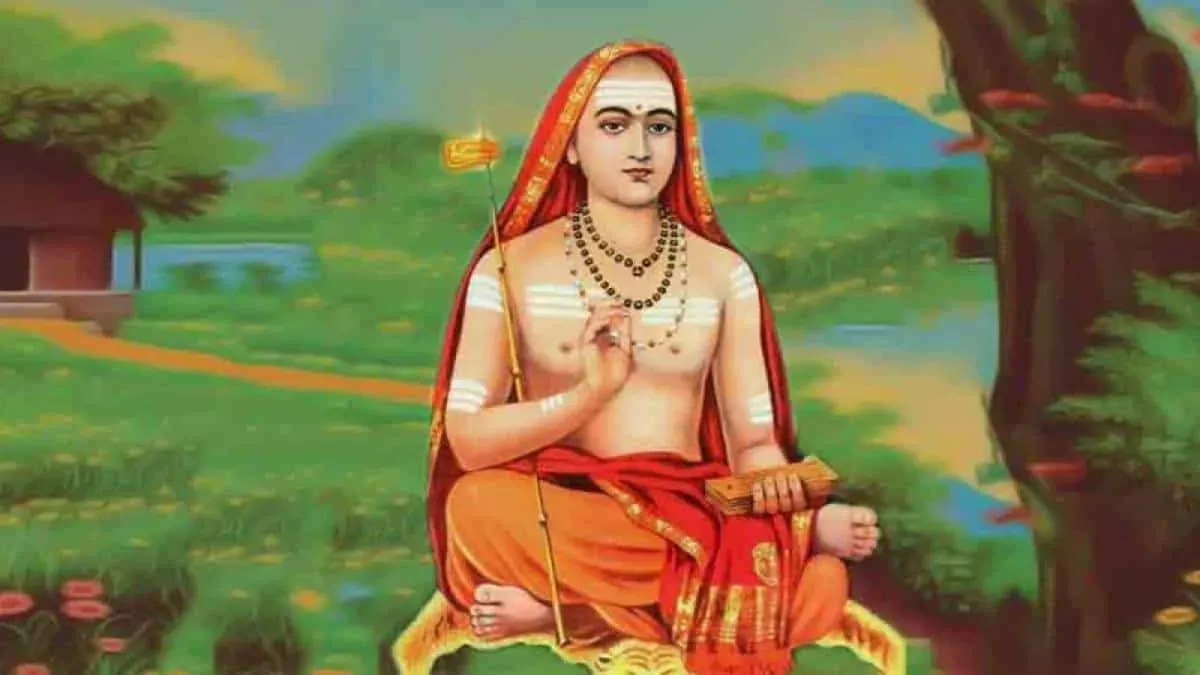
What Hindus and the World Must Learn from Adi Shankaracharya — Timeless Wisdom for the Modern Age
Shroud of Turin DNA Study Revives Debate: Nearly 40% Human DNA Traces Linked to Indian Lineages – But Does It Mean Jesus Had Indian Origins?
Bhaja Govindam: Adi Shankaracharya's Most Beloved Philosophical Hymn — Complete Guide to 31 Verses