
Mangalvar — The Sacred Tuesday: Complete Guide to Rituals, Hanuman Puja, Fasting & Worship for Hindus in India and Across the World
Published by HinduTone.com | Dharma · Devotion · Daily Practice
“Manojavam Marutatulyavegam, Jitendriyam Buddhimataam Varishtham, Vaataatmajam Vaanarayoothmukhyam, Shri Raamdootam Sharanam Prapadye.”
I take refuge in Sri Rama’s messenger — swift as the mind, fast as the wind, master of the senses, chief among the wise, son of Vayu, leader of the Vanara host.
Introduction — Why Tuesday Belongs to Lord Hanuman
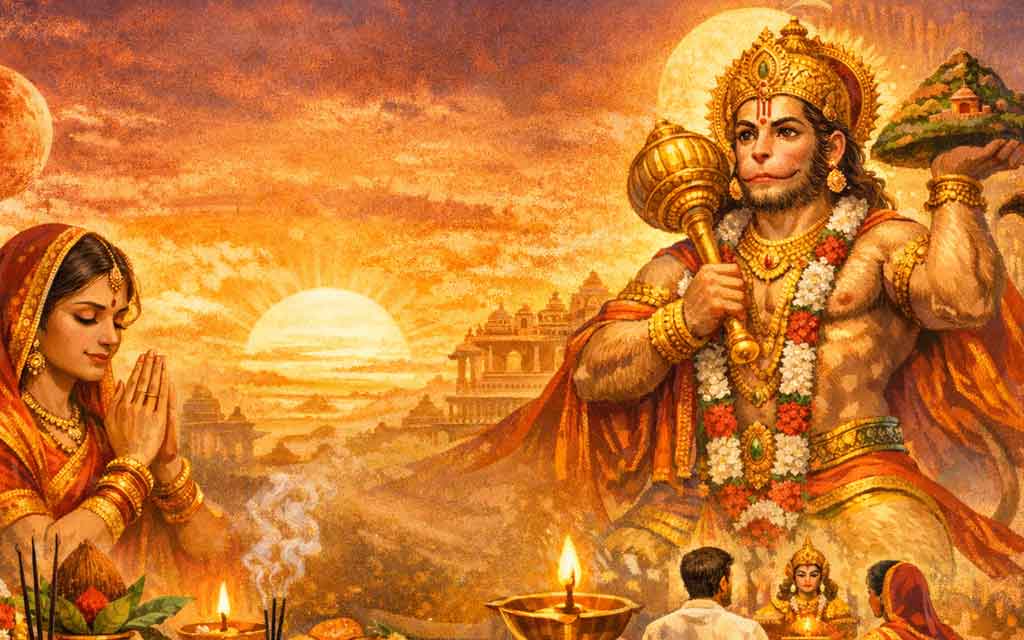
In the sacred architecture of the Hindu week — where each day is a living gateway to a specific divine energy — Tuesday, Mangalvar, stands as the day of fire, force, and fearless devotion. It is the day of Bajrang Bali: the mighty, invincible, eternally loyal Hanuman — son of Vayu (the Wind God), eleventh avatar of Rudra (Lord Shiva), greatest devotee of Sri Rama, and the most accessible protector in the entire Hindu pantheon.
The name Mangalvar comes from Mangal — the Sanskrit name for the planet Mars — whose fierce, fiery, action-oriented energy governs this day. In Vedic astrology, Mangal is the planet of courage, aggression, determination, physical vitality, and the warrior spirit. When Mars is well-placed in a person’s horoscope, it grants strength, leadership, and victory. When afflicted, it causes Mangal Dosha — delays in marriage, conflict in relationships, accidents, and health challenges. And across all of Hindu tradition, there is one being who is recognised as the supreme pacifier and transformer of Mangal’s malefic energy: Lord Hanuman.
Mangalwar (Tuesday) is considered the birthday of Lord Hanuman — the day on which Anjana Devi gave birth to Hanuman through Lord Shiva’s blessing. Every Tuesday is therefore simultaneously a celebration of Hanuman’s birth and an occasion to invoke his extraordinary protection over every sphere of life.
At HinduTone.com, we bring you the most complete, most devotion-rich guide to Tuesday worship — covering every ritual, every mantra, every fast rule, the Mangalvar Vrat Katha, the 21-Tuesday Vrat, Hanuman’s sacred temples across India, and complete practical guidance for NRI Hindus in the USA, UK, Australia, and Canada to observe Mangalvar with full bhakti, wherever in the world they may be.
“Bhoot pisaach nikat nahin aave, Mahaveer jab naam sunaave.” — Hanuman Chalisa (Tulsidas) (Ghosts and evil spirits dare not come near the one who utters the name of Mahaveer Hanuman.)
The Spiritual Significance of Mangalvar — Eight Sacred Dimensions
1. Hanuman as the Eleventh Rudra
Lord Hanuman is an incarnation of Lord Shiva and is the eleventh avatar of Rudra, who descended to earth to serve Lord Rama — the seventh avatar of Lord Vishnu. This makes Hanuman uniquely positioned at the intersection of the two greatest streams of Hindu devotion: Shaivism and Vaishnavism. To worship Hanuman is to honour both Shiva and Rama simultaneously.
2. The Supreme Devotee — The Model of Bhakti
In the entire sweep of Hindu scripture, no being embodies the quality of bhakti (devotion) more completely than Hanuman. His devotion to Rama is so total — so absolute, so selfless, so unconditional — that he is revered not merely as a deity but as the ideal of what a devotee can become. The Ramayana tells us that when Hanuman tore open his chest, the image of Rama and Sita was found inscribed on his heart. This is the Tuesday ideal: devotion so deep it becomes the very substance of one’s being.
3. Mangal Dosha — The Mars Affliction and Its Remedy
In Vedic astrology, an afflicted Mangal in one’s horoscope can cause Mangal Dosha, delays in marriage, conflicts, or health issues. Yet, Lord Hanuman is revered as the supreme pacifier of Mangal’s malefic effects — for he alone possesses the power to channel Mars’ raw force into positive action, fearlessness, and protection. Tuesday worship and fasting is the single most powerful remedy for Mangal Dosha in Jyotish.
4. Protection from All Negative Forces
The Hanuman Chalisa — recited on every Tuesday by tens of millions of Hindus — contains the explicit declaration that no ghost, evil spirit, negative energy, or black magic can touch the devotee who utters Hanuman’s name. Lord Hanuman guards against negativity, black magic, and emotional disturbances. Tuesday is the day when this protection is invoked most powerfully.
5. The Granter of Strength, Courage, and Victory
Hanuman’s own nature — boundless physical strength, fearless courage, lightning-fast intelligence, and complete mastery over the senses — becomes available to the sincere devotee through Tuesday worship. Students, athletes, soldiers, entrepreneurs, and anyone facing a great challenge in life turn to Hanuman on Tuesdays for the infusion of Vira Shakti (the energy of the hero).
6. Blessings for Marriage and Children
Tuesday fast of Lord Hanuman is believed to be the ultimate way to seek blessings of God to get a child. Many couples observe this fast with full faith and are blessed with a child. It is also a powerful vrat for those with Mangal Dosha seeking a suitable life partner or harmony in marriage.
7. South Indian Tuesday — Skanda/Murugan
In South India, Tuesday is dedicated to Skanda, also known as Murugan or Kartikeya — the war god, son of Shiva, commander of the divine army, and the presiding deity of Tamil Nadu. Murugan temples across Tamil Nadu, Kerala, Karnataka, and the global Tamil diaspora observe Tuesday with extraordinary grandeur — elaborate Kavadi rituals, vel worship, and special Abhishekam.
8. Lord Ganesha on Tuesday
Some devotees also observe fasts on Tuesday for Lord Ganesha. Fasting rules and the fast procedure is the same for Ganesha vrat. Devotees worship Vighnaharta on Vinayak Chaturthi and on Tuesdays to get desired blessings. Ganesha — the remover of all obstacles — is always propitiated first before any worship begins, and some Tuesdays are observed in his honour specifically.
The Three Forms of Mangalvar Vrat
Form 1 — Simple Mangalvar Vrat (Weekly Tuesday Fast)
The basic, weekly Tuesday fast that any devotee can begin on any Tuesday of the year. Fast from sunrise to sunset, observe Hanuman Puja morning and evening, chant the Hanuman Chalisa, and break the fast with simple sattvic food after the evening aarti. No specific start date, no specific duration — it can be observed every Tuesday for life.
Form 2 — Ekavisha Mangalvar Vrat (The 21-Tuesday Fast)
By doing Mangalvar Vrat continuously for 21 weeks, one gets rid of all Mars-related problems — typically physical, natural, and economic troubles. The 21-Tuesday Vrat is the most commonly prescribed form for those with Mangal Dosha, for those seeking marriage, children, career success, or overcoming a specific life obstacle. A devotee can start Mangalvar Vrat from the first Tuesday of the bright half of the lunar month when the Sun is in Uttarayana (from 15th January to 15th June). On the 22nd Tuesday (the day after the 21st fast), the Udyapan (concluding ceremony) is performed.
Form 3 — Lifelong Mangalvar Vrat
Many devoted Hanuman bhaktas — particularly women in North India and men who have experienced a dramatic miracle through Hanuman’s grace — observe the Tuesday fast for their entire lives. This is considered the most meritorious form and is believed to extend the Hanuman kavach (divine shield of protection) over the devotee and their entire family indefinitely.
Complete Mangalvar Puja Vidhi — Step by Step
Preparation the Night Before
- Gather all puja materials: Hanuman murti or picture, red flowers or red flower garland, sindoor (vermilion), oil (sesame or mustard oil), Tulsi leaves, incense, ghee lamp, banana, coconut, besan laddoo (chickpea flour sweet).
- Red is the sacred colour of Tuesday — wear red clothing, use red flowers, offer red cloth to Hanuman.
- From Monday evening, maintain a clean, sattvic mind — avoid anger, harsh speech, and tamasic food.
Morning Routine — The Sacred Beginning
Step 1 — Rise Before Sunrise Wake before sunrise — ideally during Brahma Muhurta (4:00–5:30 AM). Take a bath before sunrise and wear clean clothing. Red clothing is preferred, as the colour is sacred to Hanuman.
Step 2 — Purify the Puja Space Sprinkle some holy Ganga water inside the puja room to purify the atmosphere, then place the idol or image of Lord Ganesha and Lord Hanuman in a suitable place. Always worship Ganesha first — even a brief invocation — before commencing Hanuman puja.
Step 3 — Set Up the Altar Arrange your puja space with:
- Hanuman murti or picture (preferably showing Hanuman with Rama and Sita in his heart, or in the Vira (heroic) pose)
- Red flowers — Palash (flame of the forest), red hibiscus, red rose
- Red garland
- Sindoor (vermilion) — most sacred to Hanuman
- Sesame oil or mustard oil for the lamp and for Sindoor-oil offering
- Tulsi mala and fresh Tulsi leaves
- Besan laddoo (Hanuman’s favourite prasad)
- Banana and coconut
- Incense — jasmine or sandalwood
- Ghee lamp (diya)
- Betel leaves (paan patta)
Step 4 — Sankalpa (Sacred Vow) Sit facing east. Sprinkle clean water over yourself. Join your palms, close your eyes, and declare your Sankalpa:
“Om Namo Hanumate Rudratmakaya. Adya Mangalavare, Shri Hanuman prasadartham, [state your wish — protection, Mangal Dosha nivaran, strength, marriage, child, career], aham Mangalavar Vrat karishye.”
(O Hanuman, born of Rudra. Today, Tuesday, for the grace of Shri Hanuman and for [state your purpose], I observe this Mangalvar Vrat.)
The Heart of the Puja — Hanuman Abhishekam and Archana
Abhishekam (Ritual Bathing of Hanuman’s Murti):
- Begin with water — pour clean water or Ganga Jal gently over the Hanuman murti.
- Offer milk (dugdha Abhishekam) while chanting “Om Hanumate Namah.”
- Offer honey mixed with water.
- Offer rose water.
- Final rinse with clean water.
- Dry the murti gently with a clean red or saffron cloth.
Sindoor Chadhana — The Supreme Hanuman Offering: Applying sindoor (vermilion) to Lord Hanuman is the single most characteristic act of Tuesday worship. The mythology behind this practice is beautiful: Sita Ma, upon seeing Hanuman apply sindoor to his entire body, asked why. Hanuman replied: “Mata, you apply sindoor in your parting for the long life of my Lord Rama. If a small amount in your parting gives Rama such long life, I will cover my entire body in sindoor for his even longer life and health.” Rama, moved by this pure love, declared that whoever offers sindoor to Hanuman will receive his eternal blessings.
Method: Mix sindoor with a small amount of sesame oil or mustard oil. Apply it gently to the Hanuman murti starting from the feet upward, while chanting “Om Hanumate Namah” or “Jai Bajrang Bali.”
Oil Offering: Offering oil to Hanuman Ji on Tuesday repels the ill effects of Mars, as per astrology. Pour a small amount of sesame or mustard oil into a small bowl and offer it at the feet of Hanuman’s murti.
Flower Archana: Offer red flowers one by one to Hanuman while chanting his 108 names (Hanuman Ashtottara Shatanamavali). If performing the full Archana is not possible, offer the flowers as a garland with the simple recitation of “Om Hanumate Namah.”
What to Offer Lord Hanuman on Tuesday
| Offering | Significance |
|---|---|
| Sindoor (Vermilion) | The supreme offering — grants all desires and eternal protection |
| Sesame or Mustard Oil | Pacifies Mars; grants strength and removes obstacles |
| Red Flowers | Devotion and auspiciousness; red is Mars’ and Hanuman’s colour |
| Besan Laddoo | Hanuman’s favourite sweet; grants nourishment and family harmony |
| Banana | Hanuman is fond of fruits — offering bananas grants health and vitality |
| Coconut | Purity and wholeness; breaks through obstacles |
| Betel Leaves (Paan) | Freshness and auspiciousness |
| Tulsi Mala / Leaves | Sacred to Rama and therefore to Hanuman; grants devotion |
| Jasmine Garland | Purity of devotion |
| Chameli (Jasmine) Oil | For the lamp — most pleasing to Hanuman |
| Jaggery (Gur) | Sweetness in life; offering jaggery on Tuesday removes Mangal Dosha |
| Wheat and Jaggery Mixed | The traditional Tuesday prasad — fulfils desires |
What NOT to offer on Tuesday:
- Non-vegetarian food (strictly avoided)
- Alcohol or tamasic substances
- Withered or broken flowers
- Black sesame seeds (these are for Shani/Saturn worship, not Hanuman)
Mantra Recitation — The Sacred Sounds of Tuesday
The Primary Hanuman Mantra
ॐ श्री हनुमते नमः Om Shri Hanumate Namah
The simplest and most powerful Hanuman mantra. Chant 108 times on Tuesday morning and evening using a Rudraksha mala. It is highly beneficial if you can keep count of the number of times on a Rudraksha mala.
The Panchamukhi Hanuman Mantra
ॐ हं पंचवक्त्र हनुमते नमः Om Ham Pancavaktra Hanumate Namah
Meaning: Salutations to the five-faced Hanuman. This mantra invokes Hanuman in his most powerful form — Panchamukhi (five-faced), representing his protection across all five directions and against all five categories of evil. Chant 108 times for maximum protection.
The Hanuman Beeja Mantra
ॐ हं हनुमते रुद्रात्मकाय हुं फट् Om Hum Hanumate Rudratmakaya Hum Phat
Meaning: O Hanuman, of the nature of Rudra — destroy (the obstacles)! This is the most potent seed-mantra of Hanuman — particularly powerful for protection, the dissolution of Mangal Dosha, and the destruction of enemies (inner and outer). Chant 108 times.
The Hanuman Gayatri Mantra
ॐ आञ्जनेयाय विद्महे वायुपुत्राय धीमहि। तन्नो हनुमत् प्रचोदयात्॥
Om Aanjaneyaya Vidmahe Vaayuputraya Dhimahi, Tanno Hanumat Prachodayat.
Meaning: We meditate upon the son of Anjana, the son of Vayu. May Hanuman inspire and illuminate our intellect. Chant 108 times on Tuesday mornings for inner strength, intelligence, and divine guidance.
Om Bhaumaya Namah — The Mangal (Mars) Mantra
ॐ भौमाय नमः Om Bhaumaya Namah
Meaning: Salutation to Bhuma — the planet Mars. Chanting “Om Bhaumaya Namah” directly addresses the Mars energy of Tuesday and, when combined with Hanuman worship, transforms Mars’ fire from a destructive force into an energising, victorious one. Chant 108 times.
The Hanuman Chalisa — The Forty Verses of Hanuman
The Hanuman Chalisa, composed by Goswami Tulsidas in Awadhi Hindi, is the single most recited Hindu prayer in the world — chanted by more people daily than any other text. Its 40 verses (plus two dohas) encompass the entire mythology of Hanuman, his qualities, his deeds, and the boundless blessings he bestows on his devotees. On Tuesdays, the Hanuman Chalisa should be recited at minimum once in the morning and once in the evening. During the 21-Tuesday Vrat, it is recited 11 times each Tuesday. During special occasions such as Hanuman Jayanti, it is recited 108 times.
Opening Doha:
Shri Guru Charan Saroj Raj, Nij Man Mukur Sudhari, Barnau Raghuvar Bimal Yash, Jo Daayak Phal Chari.
Buddhheen Tanu Jaanike, Sumirau Pavan Kumar, Bal Budhdhi Vidya Dehu Mohi, Harahu Kalesh Vikaar.
Key Chaupais (Couplets):
“Jai Hanuman Gyan Gun Sagar, Jai Kapis Tihun Lok Ujagar.” (Victory to Hanuman, ocean of wisdom and virtue; victory to the Lord of Monkeys who illuminates the three worlds.)
“Ram Doot Atulit Bal Dhama, Anjani Putra Pavan Sut Naama.” (Messenger of Rama, abode of incomparable strength, son of Anjana, known as the son of Vayu.)
“Bhoot Pisaach Nikat Nahin Aave, Mahaveer Jab Naam Sunaave.” (No ghost or evil spirit dares to come near when the name of Mahaveer is uttered.)
“Nasai Rog Hare Sab Peera, Japat Nirantar Hanumat Beera.” (All diseases are destroyed, all pain is removed, by constant chanting of the name of the brave Hanuman.)
Sundarkand — The Beautiful Chapter
The Sundarkand — the fifth kanda (book) of Valmiki’s Ramayana, recounting Hanuman’s extraordinary journey to Lanka — is considered the most powerful single text for invoking Hanuman’s grace. Its recitation on Tuesdays (particularly during the 21-Tuesday Vrat) is said to remove the deepest obstacles, dissolve Mangal Dosha, and grant miraculous protection. Many Hindu families observe a monthly or weekly Sundarkand Paath as a sacred family ritual.
The 108 Names of Lord Hanuman (Hanuman Ashtottara Shatanamavali)
Reciting the 108 names of Hanuman on Tuesdays — offering a red flower with each name — is one of the most complete acts of Tuesday worship. Key names include:
Om Hanumate Namah · Om Anjaniputraya Namah · Om Vayuputraya Namah · Om Mahashaktimante Namah · Om Rameshthaya Namah · Om Phalguna Sakhaya Namah · Om Pingakshaya Namah · Om Amitavikramaya Namah · Om Udadhikramanaya Namah · Om Sitashoka Vinashakaya Namah · Om Lakshmanapranadatraya Namah · Om Dashagriva Darpaghnaya Namah · Om Ramakathaluolaya Namah · Om Kapishvaraya Namah · Om Mahakaya Namah · Om Sarvagrahavimochakaya Namah · Om Brahmavidyajanaya Namah · Om Shankaraya Namah · Om Kesarine Namah · Om Chiranjivine Namah…
Evening Puja — Completing the Day’s Worship
The evening puja on Mangalvar should not be neglected. Hanuman is worshipped twice — at sunrise and at sunset:
- Re-light the ghee or oil lamp at dusk.
- Offer fresh red flowers and jasmine.
- Re-apply a small amount of sindoor to Hanuman’s murti.
- Recite the Hanuman Chalisa once (minimum).
- Read or listen to the Mangalvar Vrat Katha.
- Perform Hanuman Aarti — “Aarti Kije Hanuman Lala Ki” — circling the lamp clockwise 7 times before the murti.
- Distribute besan laddoo and banana as prasad to all family members.
- Break the fast after the evening puja.
Fasting Rules — Mangalvar Upavasa
Complete Fast (Nirahara Vrat)
No food from sunrise to sunset. Water, coconut water, and fruit juices are generally permitted. Break the fast after the evening puja with simple, sattvic, grain-based food.
Partial Fast (Phal-Ahar Vrat)
Permitted throughout the day: fresh fruits, milk, curd, coconut water, dry fruits (dates, raisins, almonds), sabudana (tapioca), sendha namak (rock salt) preparations, sweet potato, and potato.
Not permitted: regular grain (wheat, rice, maize), table salt, lentils, non-vegetarian food, onion, garlic, and alcohol.
The Traditional Tuesday Meal
Worshippers who perform the fast on this day eat food made from wheat and jaggery only. The one-meal breaking of the fast in the evening traditionally consists of: wheat (atta) roti or halwa made with ghee and jaggery, accompanied by simple vegetables in rock salt. No salt is used in the strictest observance.
Tuesday Vrat Food Specialities
- Atte ka Halwa (wheat flour pudding with ghee and jaggery) — the classic Tuesday fast-break
- Besan Laddoo — offered to Hanuman and then eaten as prasad
- Banana and milk
- Sabudana Khichdi (tapioca with peanuts)
- Kuttu ki Puri (buckwheat bread)
- Sweet potato (shakarkandi)
- Dates and almonds
- Fresh coconut pieces
- Makhana (fox nut) in ghee
- Panakam (raw cane sugar and ginger drink — a South Indian Hanuman prasad)
What to Strictly Avoid on Tuesday
- Non-vegetarian food — never on Tuesday
- Onion and garlic (tamasic — clouds the mind and reduces devotional energy)
- Anger and harsh speech — Mangal’s energy amplified by anger becomes destructive; on Tuesday, consciously transform aggression into courage and decisiveness
- Cutting hair or nails — traditionally avoided on Tuesday
- Lending or borrowing money — Tuesday is considered inauspicious for financial transactions in traditional belief
Ekavisha Mangalvar Vrat — The 21-Tuesday Fast
The Sacred Number 21
The number 21 holds deep significance in Hanuman’s mythology and in Vedic numerology. Hanuman leapt across a 100-yojana ocean to reach Lanka. He brought the Sanjeevani mountain. He expanded to cosmic size and shrank to microscopic dimensions. The number 21 encodes the completion of a full karmic cycle in the Mars energy field — seven planetary weeks, three full cycles of the Navagraha (nine planets). Completing 21 consecutive Tuesdays with sincere devotion is said to reset one’s relationship with Mangal entirely.
Who Should Observe the 21-Tuesday Vrat?
- Those with Mangal Dosha (Manglik) in their horoscope — especially for marriage
- Those facing repeated delays, obstacles, or failures in career or business
- Those with chronic health issues — particularly blood, bone, and energy-related conditions (all governed by Mars)
- Those seeking protection from enemies, legal troubles, or conflict
- Those seeking to have children
- Those who have experienced accidents or surgeries (both governed by Mars)
- Young men and children — Hanuman is particularly protective of young males
- Those suffering from fear, anxiety, or cowardice — seeking Hanuman’s fearless energy
Rules of the 21-Tuesday Vrat
- Begin on any Tuesday — ideally the first Tuesday of Shravan, Chaitra, or when the Sun is in Uttarayana (January 15 to July 15).
- Fast for all 21 consecutive Tuesdays without interruption.
- On each Tuesday: bathe before sunrise, wear red, perform full Hanuman puja with sindoor and oil offering, chant the Hanuman Chalisa at least once (ideally 11 times), recite the Mangalvar Vrat Katha, and observe the fast until evening.
- Maintain brahmacharya (celibacy) on each Tuesday of the vrat.
- Offer besan laddoos — at least 5 — to Hanuman on each Tuesday, then distribute as prasad.
- Avoid cutting hair and nails during the 21-week period (or at minimum on each Tuesday).
- Consistency in these rituals, especially for 11, 21, or 40 Tuesdays, amplifies results. Many observe it lifelong for ongoing protection.
Udyapan — The Concluding Ceremony (22nd Tuesday)
On the 22nd Tuesday — after completing all 21 fasting Tuesdays:
- Perform an elaborate Hanuman Puja with all 16 Upachara (offerings).
- Recite the Hanuman Chalisa 21 times.
- Prepare and offer 21 besan laddoos.
- If possible, invite Brahmins (minimum 1, ideally more) and feed them with respect.
- Donate red cloth, sindoor, oil, and food items to priests and the needy.
- Perform the same puja vidhi on the 22nd Tuesday and feed 21 Brahmins if possible to complete the fast.
- Distribute prasad to family, friends, neighbours, and the poor.
The Mangalvar Vrat Katha — Sacred Tuesday Stories
The Brahmin Couple’s Miracle
This is the most celebrated Mangalvar Vrat Katha, recited on every Tuesday of the 21-Tuesday Vrat. Once, there lived a devoted Brahmin woman named Sunanda who observed the Mangalvar Vrat with extraordinary sincerity every Tuesday, fasting all day and offering food to Hanuman before eating anything herself. One Tuesday, the Brahmin woman was too weak to cook after fasting. She vowed to eat only after offering food to Hanuman Ji the following week and lay hungry for six days. Her unwavering devotion moved Hanuman Ji, who appeared before her and blessed her with a son named Mangal.
When the Brahmin husband returned after a long journey and found a child, he doubted his wife’s fidelity and refused to accept the boy. To test her, he threw Mangal into a well, but the boy returned home unharmed. That night, Hanuman Ji appeared in the Brahmin’s dream, revealing Mangal was His divine gift. The couple’s faith was restored, and they lived happily ever after.
The Katha teaches: True devotion, even in weakness and hunger, moves the heart of Hanuman. No sincere devotee is ever abandoned.
Hanuman Saves Lakshmana — The Sanjeevani Story
During the battle of Lanka, Ravana’s son Meghnad used the Shakti weapon against Lakshmana, rendering him unconscious and near death. The Vaidya (physician) Sushena declared that only the Sanjeevani herb — found on a specific mountain in the Himalayas — could save Lakshmana before sunrise. Hanuman flew across all of India in an instant. Unable to identify the specific herb on the mountain, he simply uprooted the entire mountain and carried it back to Lanka — covering thousands of kilometres in minutes. Lakshmana was saved. This story is told every Tuesday to remind devotees: when human means are exhausted, Hanuman’s grace creates the impossible.
Hanuman’s Discovery by Sita
When Hanuman leapt across the ocean and found Sita imprisoned in Lanka’s Ashoka Vatika, he did not immediately reveal himself. He sat in the trees and chanted Rama’s name softly, watching Sita. Sita at first thought this was one of Ravana’s tricks. But as Hanuman continued to chant — Shri Rama Jai Rama Jai Jai Rama — she recognised the absolute purity of the chanting and knew it could only come from a true devotee of her Lord. This story is the essence of Tuesday’s teaching: the power of Rama’s name, chanted with Hanuman’s purity, overcomes all illusion and separation.
Key Mangalvar Timings in India
| Period | Time (Approximate, IST) | Practice |
|---|---|---|
| Brahma Muhurta | 4:00 – 5:30 AM | Rise, bathe, meditate, Sankalpa |
| Sunrise Puja | 6:00 – 7:30 AM (varies by city) | Full Hanuman puja with Abhishekam and Sindoor Chadhana |
| Mantra Japa | Morning hours | Hanuman Chalisa (11 times), Beeja Mantra (108 times) |
| Sundarkand Paath | Morning or afternoon | Full recitation (approx. 45–60 minutes) |
| Mangalvar Vrat Katha | Afternoon | Read or listen with family |
| Evening Aarti | Sunset (6:00 – 7:30 PM, varies) | Aarti, final offering, fast-breaking |
| Fast-Breaking Meal | After evening aarti | Wheat and jaggery, or fruit — simple and sattvic |
India city-wise sunrise on a representative Tuesday: Delhi ~7:05 AM · Mumbai ~7:15 AM · Chennai ~6:28 AM · Kolkata ~6:18 AM · Hyderabad ~6:35 AM · Bengaluru ~6:42 AM
Major Hanuman Temples Across India — Where Tuesday is Celebrated with Greatest Glory
The Supreme Hanuman Shrines
| Temple | Location | Distinction |
|---|---|---|
| Sankat Mochan Hanuman Temple | Varanasi, Uttar Pradesh | Founded by Goswami Tulsidas (author of Hanuman Chalisa); most revered Hanuman temple in India |
| Mahavir Hanuman Temple | Patna, Bihar | One of the oldest and most visited — draws massive Tuesday crowds |
| Hanuman Dhara | Chitrakoot, MP | Where Rama himself cooled Hanuman’s tail after Lanka; supremely sacred |
| Jakhu Temple | Shimla, Himachal Pradesh | Ancient hilltop temple; home to a massive Hanuman statue |
| Salasar Balaji | Salasar, Rajasthan | Self-manifested Hanuman with beard and moustache; immensely popular for wish-fulfilment |
| Mehandipur Balaji | Dausa, Rajasthan | Uniquely powerful for removing negative spirits and black magic |
| Kasimedu Anjaneyar Temple | Chennai, Tamil Nadu | Major South Indian Hanuman shrine |
| Namakkal Anjaneyar Temple | Namakkal, Tamil Nadu | Hanuman as the lotus carrier; famous for students’ prayers |
| Hanuman Garhi | Ayodhya, Uttar Pradesh | Temple in Lord Rama’s birthplace; central to Ayodhya’s spiritual life |
| Panchamukhi Hanuman Temple | Rameswaram, Tamil Nadu | Where Hanuman took his five-faced form to defeat Ahiravana |
| Sri Anjaneyaswami Temple | Tirumala (Tirupati), AP | Within the Tirumala complex; visited by lakhs of devotees |
| Murudeshwar | Karnataka | 123-foot Shiva statue; also home to a celebrated Hanuman shrine |
Murugan / Skanda Temples (South India — Tuesday)
| Temple | Location | Significance |
|---|---|---|
| Palani Murugan | Palani, Tamil Nadu | Supreme Murugan temple; Kavadi festival; major Tuesday pilgrimage |
| Tiruchendur Murugan | Tiruchendur, Tamil Nadu | Shore temple on the Bay of Bengal; one of the six Paadal Petra Sthalams |
| Swamimalai Murugan | Kumbakonam, Tamil Nadu | Where Murugan taught the meaning of Om to Shiva |
| Sri Subrahmanya Temple | Kukke, Karnataka | Most powerful for Sarpa Dosha (snake affliction) removal |
| Thiruttani Murugan | Tiruttani, Tamil Nadu | Where Murugan recovered after the Soorasamharam battle |
| Pazhani Murugan (Aarupadai Veedu) | 6 principal shrines of Murugan, Tamil Nadu | The six sacred battle camps of Murugan — supreme Tuesday pilgrimage circuit |
Tuesday Rituals for NRI Hindus — Complete Country-Wise Guide
For the global Hindu diaspora, every Tuesday is a sacred opportunity to invoke Hanuman’s protection, no matter how far from India’s temples. Hanuman ji’s devotion remains borderless. NRIs can adapt Mangalvar practices seamlessly: follow local sunrise/sunset for timing; set up a small altar with Hanuman picture (order online); use available fruits, milk, and besan for laddoos; chant Hanuman Chalisa via apps or YouTube; join virtual temple streams from global Hanuman mandirs.
 India — Regional Traditions
 India — Regional Traditions
North India (UP, Bihar, Delhi, Rajasthan, MP, Punjab, Haryana): Tuesday is the most energetically observed day for Hanuman bhakti in North India. Hanuman temples — from the humblest roadside shrine to Sankat Mochan Varanasi — are packed at dawn. Red flowers, sindoor, oil lamps, and the sound of Hanuman Chalisa fill every neighbourhood. The Solah (16) and Ekavisha (21) Mangalvar Vrat are extremely popular for Mangal Dosha resolution and marriage. Young men, in particular, form a deep and lifelong bond with Hanuman beginning in childhood.
Maharashtra: Maruti (as Hanuman is known in Maharashtra) is the most beloved deity in the state after Vitthal and Ganesha. Tuesday Maruti puja in Maharashtra involves Panchamrit Abhishekam, application of sindoor, and the recitation of Ramdas’s Manache Shlok (Samarth Ramdas Swami’s hymns to Hanuman). The Maruti temples in Pune, Nashik, and Mumbai are thronged on Tuesdays.
Gujarat: Hanuman is worshipped as Balaji across Gujarat. Tuesday puja includes oil and sindoor offerings, Hanuman Chalisa recitation, and special bhajans. Many Gujarati families observe the 21-Tuesday Vrat as a family unit, with children participating from a young age.
Tamil Nadu, Karnataka, Kerala: Tuesday is primarily a Murugan / Skanda day in the Tamil tradition. Kavadi rituals, Vel puja, and special Abhishekam at Murugan temples. The Tamil diaspora worldwide observes these Tuesday traditions with remarkable fidelity — from Singapore to Sri Lanka to South Africa to Canada.
Andhra Pradesh & Telangana: Both Hanuman (as Anjaneya Swami) and Murugan (as Subramanya Swami) are worshipped on Tuesdays. Panchamrit Abhishekam at Anjaneya temples, with special offerings of vada (lentil fritters) and coconut.
United States of America
 United States of America
Setting Up Tuesday Worship at Home: All items needed for Tuesday puja are readily available across the USA. Indian grocery stores (Patel Brothers, India Palace, Apna Bazar, Subzi Mandi, and South Indian stores in New Jersey, Houston, and the Bay Area) carry sindoor, Hanuman murtis and pictures, red flowers (often available at Indian stores and Trader Joe’s), besan (chickpea flour for laddoos), sesame oil, and Tulsi plants. Hanuman Chalisa books are available in all Indian stores and on Amazon.
If Specific Items Are Unavailable:
- Besan laddoo can be made at home (besan + ghee + jaggery/sugar) — widely available ingredients
- Red roses from any supermarket substitute perfectly for palash flowers
- Ganga Jal is available at most Indian stores; alternatively use clean spring water
Major Hanuman Temples in the USA:
| City / Region | Temple | Notes |
|---|---|---|
| Flushing, NY | Shiv Mandir (with Hanuman shrine) | Major Tuesday crowds |
| Bridgewater / Robbinsville, NJ | BAPS Swaminarayan Mandir | Tuesday puja |
| Lanham, MD | Shri Siva Vishnu Temple | Hanuman section; Tuesday Abhishekam |
| Livermore, CA | Shiva Vishnu Temple | Anjaneya shrine; Tuesday special puja |
| Pearland / Houston, TX | Meenakshi Temple | Hanuman shrine; major Tuesday observance |
| Malibu, CA | Sri Venkateswara Temple | Hanuman shrine; Tuesday special |
| Pittsburgh, PA | Bharatiya Temple (Shiva-Hanuman) | Tuesday open puja |
| Chicago (Lemont), IL | Hindu Temple of Greater Chicago | Hanuman gallery; Tuesday worship |
| Atlanta, GA | Hindu Temple of Atlanta | Hanuman shrine; Tuesday special |
| Sunnyvale / San Jose, CA | Shiv Durga Temple | Hanuman section |
| Nashville, TN | Sri Ganesha Temple | Hanuman shrine; Tuesday Chalisa |
| Dallas, TX | Shiva Vishnu Temple of DFW | Hanuman section; Tuesday services |
| Orlando, FL | Hindu Society of Central Florida | Hanuman shrine; Tuesday puja |
NRI Tuesday Tip — USA: Many Hanuman temples across the USA stream live Tuesday Abhishekam and Aarti on YouTube and Facebook. Watching and chanting along from home is a valid and powerful form of participation. The BAPS Swaminarayan network also streams daily puja from India.
United Kingdom
 United Kingdom
Home Worship: Indian stores in Leicester (Belgrave Road — the “Golden Mile”), Southall, Wembley, Harrow, and Birmingham’s Soho Road carry all Tuesday puja essentials. Sindoor, besan, sesame oil, red flowers, and Hanuman murtis are standard stock in all large Indian grocery stores.
Major Hanuman Temples in the UK:
| City | Temple | Notes |
|---|---|---|
| London (Neasden) | BAPS Swaminarayan Mandir | Tuesday Aarti and worship programmes |
| London (Wembley) | Shree Sanatan Hindu Mandir | Hanuman shrine; Tuesday Chalisa groups |
| London (Southall) | Shree Ram Mandir Southall | Active Tuesday Hanuman worship |
| Birmingham | Shree Krishna Mandir (Handsworth) | Tuesday bhajan sessions |
| Leicester | Shree Sanatan Mandir | One of UK’s oldest — vibrant Tuesday worship |
| Leicester | Shree Geeta Bhawan | Tuesday Hanuman Chalisa and aarti |
| Coventry | Shree Krishna Mandir | Tuesday puja |
| Bradford | Lakshmi Narayan Temple | Hanuman shrine; Tuesday devotional |
| Wolverhampton | Shri Venkateswara Balaji Temple | Hanuman section active Tuesdays |
| Glasgow | Hindu Mandir Glasgow | Tuesday community worship |
UK Special Note: Leicester has one of the world’s largest communities of Gujarati Hindus outside India — and their Tuesday Hanuman bhakti traditions are remarkably vibrant. Many Leicester Hindu homes observe the 21-Tuesday Vrat as a family tradition, with the Hanuman Chalisa recited by three generations together. The Belgrave Mandir and surrounding community centres host group Tuesday Chalisa sessions that the wider community is welcome to join.
Australia
 Australia
Home Worship: Indian grocery stores in Sydney (Parramatta, Harris Park — known as “Little India”), Melbourne (Dandenong, Clayton), Brisbane (Sunnybank), and Perth carry all essential Tuesday puja items. Sindoor, besan, oil, and red flowers are widely available. The large South Indian communities in Sydney and Melbourne also stock items for Murugan / Subramanya Tuesday worship.
Major Hanuman and Murugan Temples in Australia:
| City | Temple | Notes |
|---|---|---|
| Sydney (Helensburgh) | Sri Venkateswara Temple | Hanuman shrine; Tuesday puja |
| Sydney (Edmondson Park) | Shiva-Vishnu Temple | Active Tuesday Hanuman worship |
| Sydney (Westmead) | Murugan Temple (Tamil community) | Major Tuesday Murugan worship |
| Melbourne (Carrum Downs) | Shiva Vishnu Temple | Hanuman section; Tuesday bhajans |
| Melbourne (Bayswater) | BAPS Swaminarayan Mandir | Tuesday worship programmes |
| Brisbane (Rocklea) | Shri Shiva Vishnu Temple | Tuesday Hanuman Abhishekam |
| Brisbane | Sri Murugan Temple | Tamil Tuesday Murugan worship |
| Perth | Hindu Swayamsevak Sangh (HSS) | Tuesday devotional gatherings |
| Adelaide | Sri Mandir | Hanuman shrine; Tuesday worship |
Australia Tuesday Note: The Tamil community in Sydney and Melbourne — one of Australia’s largest South Asian subgroups — observes Murugan Tuesday with particular devotion. Many Tamil Hindu families in Sydney travel to the Sri Venkateswara Temple at Helensburgh (the “Tirupati of Australia”) on Tuesdays, as it houses a dedicated Murugan / Subramanya shrine. During school holidays, family-wide Hanuman Chalisa recitation sessions at home are a cherished tradition.
Canada
 Canada
Home Worship: The Greater Toronto Area (Brampton, Mississauga, Scarborough), Greater Vancouver, and Calgary have excellent access to Indian puja materials. Iqbal Foods, Nations Fresh Foods, and numerous South Asian stores in Brampton’s Peel Village carry sindoor, besan, sesame oil, and Hanuman items. Online stores (Amazon Canada, Indian puja shops in Brampton) deliver nationally.
Major Hanuman and Murugan Temples in Canada:
| City | Temple | Notes |
|---|---|---|
| Brampton, ON | Shri Gauri Shankar Mandir | Tuesday Hanuman puja; morning Abhishekam |
| Brampton, ON | Shri Ram Mandir | One of North America’s largest; major Tuesday worship |
| Mississauga, ON | Hindu Mandir of Mississauga | Hanuman section; Tuesday Chalisa |
| Toronto, ON | Sri Ayyappa Temple | Hanuman shrine active Tuesdays |
| Toronto, ON | Sri Venkateswara Temple | Hanuman section; Tuesday open puja |
| Scarborough, ON | Murugan Temple of Ontario | Major Tamil community Tuesday Murugan worship |
| Vancouver, BC | BAPS Swaminarayan Mandir | Tuesday devotional programmes |
| Vancouver (Surrey), BC | Hindu Temple of BC | Hanuman shrine; Tuesday puja |
| Calgary, AB | Hindu Society of Calgary | Tuesday devotional sessions |
| Edmonton, AB | Hindu Society of Edmonton | Hanuman puja on Tuesdays |
| Ottawa, ON | Hindu Temple of Ottawa-Carleton | Tuesday worship open to community |
| Montréal, QC | Hindu Mission of Canada | Hanuman puja Tuesdays |
Brampton and Scarborough are particularly vibrant. Brampton’s Shri Ram Mandir hosts some of the largest Tuesday Hanuman Chalisa sessions in North America — sometimes drawing hundreds of devotees to a single evening aarti. Scarborough’s Murugan Temple serves Toronto’s large Tamil Hindu population with elaborate Tuesday Vel puja and Murugan Abhishekam. The Vishwa Hindu Parishad (VHP) Canada organises group Sundarkand Paath events on Tuesdays in the GTA throughout the year.
Practical NRI Tips — Adapting Tuesday Rituals Abroad
Item Substitutions
| India Original | NRI Substitute |
|---|---|
| Palash / red dhatura flowers | Red roses, red carnations, red gerbera from any supermarket |
| Fresh besan laddoo | Store-bought laddoo from Indian grocery, or home-made (besan + ghee + jaggery) |
| Ganga Jal for Abhishekam | Clean spring water — intention and mantra consecrate it |
| Sesame oil lamp | Any pure vegetable oil lamp; or a ghee lamp |
| Tulsi from garden | Dried Tulsi (available in Indian stores); or Tulsi tea leaves |
| Rudraksha mala | Available online and in Indian stores globally |
| Panakam (South Indian prasad) | Raw cane sugar + ginger in water — easily made at home |
When Work Prevents Full Observance
Even a five-minute Tuesday ritual carries full merit with Hanuman — he is known as Sulabha Prasad (one who is easily pleased by sincere effort). A minimum Tuesday practice that fits any schedule:
- Chant “Om Hanumate Namah” 108 times on your Rudraksha mala at any time during the day.
- Read or listen to the Hanuman Chalisa (approximately 12 minutes) — while commuting, during a lunch break, or before bed.
- Offer a banana or a small amount of sesame oil to a Hanuman picture at home.
- Avoid anger consciously on Tuesday — this itself is a form of Mangal Dosha sadhana.
Online Resources for NRI Tuesday Worship
- Hanuman Chalisa Apps: Numerous apps (Hanuman Chalisa HD, Hindu Mantra, etc.) provide the full text with audio in multiple languages.
- Live Streams: Sankat Mochan Varanasi, Salasar Balaji, and Mehandipur Balaji all stream Tuesday aarti on YouTube.
- Online Sundarkand Paath: Virtual group Sundarkand Paath sessions are organised by Hindu organisations on WhatsApp and Zoom — many open to NRIs globally.
- Online Puja Booking: IndiaPuja, Vedic Vaani, and 99Pandit offer Hanuman puja performed by qualified priests at Varanasi, Ayodhya, or other major temples on your behalf, with prasad sent by post.
Benefits of Mangalvar Vrat — Worldly and Spiritual
Worldly (Prakritic) Benefits
- Mitigates malefic effects of Mars (Mangal Dosha): balances planetary influences that may cause obstacles, marital problems, or health issues
- Protection from enemies, legal disputes, accidents, and violence
- Removal of obstacles in career, business, and creative endeavours
- Blessing of a child for childless couples
- Enhanced wisdom, inner peace, and emotional balance
- Success in competitive examinations, sports, and physical challenges
- Restoration of health — particularly blood disorders, bone problems, and energy depletion (all governed by Mars)
- Harmony in marriage and family relationships
Spiritual (Adhyatmic) Benefits
- Deepening of Rama bhakti through Hanuman — the supreme gateway to Rama’s grace
- Development of Vira Bhakti — the fearless, warrior form of devotion
- Purification of the ego through the model of Hanuman’s selfless service (seva)
- Cultivation of brahmacharya and discipline through fasting and mantra
- Purifies mind and body: fasting and prayer detoxify physical and mental impurities, enhancing clarity and spiritual growth
- Gradual development of the qualities Hanuman embodies: strength, humility, courage, intelligence, devotion, and service
Health Benefits
- Weekly fasting improves digestive health and metabolic function
- Sattvic diet on Tuesdays reduces toxin accumulation
- Mantra chanting increases alpha brain waves, reducing cortisol and promoting calm
- The conscious avoidance of anger on Tuesday — a direct Mangal Dosha remedy — trains the nervous system toward equanimity
- Early rising and morning ritual practices regulate the body’s circadian rhythm
Closing Blessing — From HinduTone.com
ॐ श्री हनुमते नमः
O Bajrang Bali — Mahaveer, Vayuputra, Anjaniputra, Ramadoot — may your divine light of courage, devotion, and fearless love illuminate every Tuesday of our lives.
May the Hanuman Chalisa that rises from our lips every Mangalvar carry our prayers to the feet of Sri Rama himself. May your sindoor-red grace cover every shadow of doubt, fear, and obstacle in our path. May your boundless strength flow into the hearts of every devotee who reads these words — in India, in America, in Britain, in Australia, in Canada, and in every corner of this earth where Rama’s name is taken with love.
As Hanuman leapt across the impossible ocean with only Rama’s name in his heart — may we, too, find the courage to leap across whatever stands between us and the life we are meant to live.
Jai Bajrang Bali! Jai Hanuman! Jai Shri Ram!
© 2026 HinduTone.com — The Voice of Hindus Worldwide: Unity in Diversity
Address: Nilagiri Block, 513, 5th Floor, Beside Ameerpet Metro Station, Ameerpet, Hyderabad – 500016
Note: Ritual timings vary by location and season. Always confirm sunrise/sunset times for your city on each Tuesday. Spiritual practices yield their greatest fruit when performed with sincerity, consistency, and a heart full of love — regardless of geography or circumstance.
Tags: Mangalvar Vrat · Tuesday fast Hindu · Somvar Vrat 2026 · Hanuman puja Tuesday · 21 Tuesday fast · Ekavisha Mangalvar Vrat · Lord Hanuman rituals · Hanuman Chalisa · Sundarkand Paath · Mangal Dosha remedy · NRI Hanuman puja · Tuesday fast USA UK Australia Canada · Hindu NRI rituals Tuesday · Bajrang Bali worship · Murugan Tuesday · Skanda Sashti · Sindoor offering Hanuman · Hanuman Abhishekam · Sankat Mochan temple · Salasar Balaji · Anjaneya Swami worship
Related posts:
 Hindu Festivals as a Gateway to Spiritual Awareness
 The Role of Nature in Spiritual Growth: Insights from Sadhguru
 Hindu Gurus and the Fight Against Superstition: Dispelling Banamathi & Vashikaran Myths
 The Spiritual Significance of Saturday in Hinduism
 Pradosha Kalam: Significance and Shivaradhana for Hindus
 Onam: Bringing Kerala’s Harvest Festival Home – A Complete NRI Guide
 Ekadasa Rudrabhishekam: Complete Guide to Benefits, Procedure & Significance
 Complete Guide to Skanda Shashti 2025 Celebrations in Canada: Temples, Events, Rituals & Sacred Mantras