
Dhanurmasam 2026-27: Start and End Date (16 December to 14 January), Margazhi, Tiruppavai Day-by-Day and Daily Practice
Dhanurmasam (Margazhi) 2026-27 begins on Wednesday 16 December 2026, when the Sun enters Dhanu at 10:29 AM IST (Drik Panchang), and ends at Makar Sankranti on the night of Thursday 14 January 2027. Here is the 30-day Tiruppavai calendar with every pasuram's title and meaning in plain words, the daily dawn practice, the key days of the month and local times abroad.
Last updated: 21 October 2026
Quick answer: Dhanurmasam 2026-27, the month the Tamil calendar calls Margazhi, begins on Wednesday 16 December 2026. The Sun enters Dhanu (Sagittarius) at 10:29 AM IST that morning, according to Drik Panchang (Hyderabad). The month ends when the Sun enters Makara at 9:14 PM IST on Thursday 14 January 2027. That makes Thursday 14 January, Bhogi, the last day of Dhanurmasam, and Makar Sankranti 2027 and Thai Pongal fall on Friday 15 January. Across the 30 days, one pasuram of Andal's Tiruppavai is sung each dawn. Vaikuntha (Mukkoti) Ekadashi falls on Sunday 20 December 2026.
Dhanurmasam 2026 start date and end date
| Day | Date (India) | What happens | Source |
|---|---|---|---|
| Dhanu Sankranti: Dhanurmasam and Margazhi begin | Wed 16 Dec 2026 | Sun enters Dhanu at 10:29 AM IST. Punya Kala 10:29 AM to 4:25 PM, Maha Punya Kala 10:29 AM to 12:20 PM (Hyderabad) | Drik Panchang |
| Vaikuntha (Mukkoti) Ekadashi, also Gita Jayanti and Mokshada Ekadashi | Sun 20 Dec 2026 | Ekadashi from 10:09 PM Sat 19 Dec to 8:14 PM Sun 20 Dec IST | Drik Panchang (Hyderabad) |
| Dattatreya Jayanti; Purnima begins | Wed 23 Dec 2026 | Purnima from 10:47 AM IST | Drik Panchang (Hyderabad) |
| Dhanurmasa Pournami, Arudra Darshan | Thu 24 Dec 2026 | Purnima at sunrise, ends 6:57 AM IST | Drik Panchang (Hyderabad) |
| Saphala Ekadashi | Sun 3 Jan 2027 | Pausha Krishna Ekadashi | Drik Panchang (Hyderabad) |
| Koodaravalli (27th pasuram) | Mon 11 Jan 2027 | Day 27 by the one-pasuram-a-day count | Count from 16 Dec; confirm with your temple |
| Bhogi: last day of Dhanurmasam, 30th pasuram | Thu 14 Jan 2027 | Sun enters Makara at 9:14 PM IST | Drik Panchang |
| Makar Sankranti, Thai Pongal | Fri 15 Jan 2027 | Punya Kaal from sunrise | Drik Panchang |
Why 16 December? The Sun enters Dhanu in the middle of the morning in India, well before sunset, so in the Tamil and Telugu calendars the new month starts that same day. Makara Sankranti falls at 9:14 PM on 14 January, after sunset, so 14 January still belongs to Dhanurmasam and the festival moves to 15 January. Our own Lahiri calculation agrees with both Drik dates.
Also read: Makar Sankranti 2027: date, Punya Kaal city-wise, Bhogi, Kanuma | Vaikuntha Ekadashi 2026 date
What is Dhanurmasam (Margazhi)?
Dhanurmasam, or Dhanur Masa, is the solar month in which the Sun travels through Dhanu rashi. It runs from about mid-December to mid-January. Tamil families call it Margazhi, Kerala calls it Dhanu, and Telugu and Kannada families call it Dhanurmasam. In the Bhagavad Gita (10.35), Krishna says that among months he is Margashirsha, and most of Dhanurmasam falls in that lunar month. Vaishnava tradition treats this as the most sacred season for worshipping Vishnu.
A traditional explanation says one human year is one day of the gods, and that Dhanurmasam is the hour just before their dawn. That is why the whole month centres on the Brahma muhurta, the quiet time before sunrise. Temples open early, homes wake to the Tiruppavai, and fresh pongal is offered to the Lord before the day begins.
Many Telugu and Kannada families also treat Dhanurmasam as a month for worship rather than for new household beginnings. By custom, weddings and housewarmings are often not scheduled in it. Customs vary, so ask your family priest.
Andal and the Tiruppavai
Andal, also called Goda Devi or Kodhai, is the only woman among the twelve Alvars, the Tamil poet-saints of Vishnu. In the traditional story, Periyalvar (Vishnuchitta) found her as a baby under a tulasi plant in his temple garden at Srivilliputhur and raised her as his daughter. She grew up wishing to marry no one but the Lord, and tradition says she was united with Lord Ranganatha at Srirangam. Some versions add that she wore the deity's garland before it was offered, and that the Lord accepted it gladly, which is why she is called Choodikodutha Nachiyar.
The Tiruppavai is her garland of 30 Tamil verses (pasurams) and forms part of the Nalayira Divya Prabandham. In it, Andal pictures herself as a cowherd girl of Gokul. In the Margazhi dawn she wakes her friends, and together they go to Krishna's door to ask for his grace. The poem moves in clear stages. Verses 1 to 5 set out the vow. Verses 6 to 15 wake the sleeping girls, and verses 16 to 22 wake Nandagopa's household and Nappinnai. Verses 23 to 30 are spoken before Krishna himself and end with the true request: to serve him in every birth.
Also read: Andal: the devotee poetess | Sri Andal Temple, Srivilliputhur
Tiruppavai day by day: 2026-27 calendar with pasuram meanings
In this table, 16 December 2026 counts as day 1 and Bhogi, 14 January 2027, as day 30, so all 30 pasurams fit the month exactly. Each pasuram's title is its opening words, the way it is usually referred to. Each meaning is a short summary in our own words, not a translation. For the full text, use your temple's or your sampradaya's edition.
| Day | Date | Pasuram | Meaning in brief |
|---|---|---|---|
| 1 | Wed 16 Dec 2026 | 1. Margazhi thingal | The vow begins. On a bright Margazhi morning the cowherd girls invite each other to bathe and go to Krishna, who alone can grant what they seek. |
| 2 | Thu 17 Dec 2026 | 2. Vaiyathu vazhveergal | The rules of the vow: rise early, bathe, avoid ghee and milk, skip eye-black and flowers, speak no harsh word and give generously. |
| 3 | Fri 18 Dec 2026 | 3. Ongi ulagalandha | Sing the name of the Lord who grew to measure the worlds, and the land will have timely rain, full fields and cows giving plenty of milk. |
| 4 | Sat 19 Dec 2026 | 4. Aazhi mazhai kanna | A prayer to the rain to come down like the Lord: dark as his body, flashing like his discus, thundering like his conch. |
| 5 | Sun 20 Dec 2026 | 5. Maayanai mannu | Remember Krishna of Mathura and the Yamuna with a pure mind, and past and future faults burn away like cotton in a flame. |
| 6 | Mon 21 Dec 2026 | 6. Pullum silambina kaan | The waking songs begin. Birds are calling and the temple conch is sounding: wake up, girl, the sages are already chanting Hari's name. |
| 7 | Tue 22 Dec 2026 | 7. Keesu keesu endru | The birds chatter and the churning of curd fills the lanes. How can you, our leader, still be asleep while we sing of Keshava? |
| 8 | Wed 23 Dec 2026 | 8. Keezh vaanam vellendru | The eastern sky is pale and the buffaloes are out grazing. We stopped the others so we could go together: rise, and let us go. |
| 9 | Thu 24 Dec 2026 | 9. Thoomani maadathu | To a girl asleep in a lamp-lit mansion, and to her mother: wake her, so that she too may chant the names of Madhava and Vaikuntha. |
| 10 | Fri 25 Dec 2026 | 10. Notru suvargam | You, who think heaven is already won, will not even answer us. Did Kumbhakarna hand his long sleep over to you? |
| 11 | Sat 26 Dec 2026 | 11. Katru karavai | Daughter of a household rich in cattle, golden creeper of the village: your friends are singing the Lord's name at your door, yet you do not stir. |
| 12 | Sun 27 Dec 2026 | 12. Kanaithu ilam katrerumai | The buffaloes, longing for their calves, let milk flow until the yard is wet. Wake up, as we sing of Rama who defeated the king of Lanka. |
| 13 | Mon 28 Dec 2026 | 13. Pullin vaai keendaanai | Sing of the one who split open the demon bird. The morning star has risen and the girls have gone to bathe: do not stay alone in bed. |
| 14 | Tue 29 Dec 2026 | 14. Ungal puzhakkadai | In your garden pond the red lilies have opened and the ascetics are on their way to the temple. You promised to wake us; now keep your word. |
| 15 | Wed 30 Dec 2026 | 15. Elle ilankiliye | A playful exchange with a girl as sweet as a young parrot, who answers back from bed. Everyone is here; come out and count us yourself. |
| 16 | Thu 31 Dec 2026 | 16. Nayaganai nindra | At Nandagopa's palace. The girls ask the guard at the door to let them in: the Lord promised them the drum (parai) only yesterday. |
| 17 | Fri 1 Jan 2027 | 17. Ambarame thanneere | Inside, they wake the household one by one: Nandagopa who gives clothes, water and food freely, Yashoda, Krishna, and his brother Balarama. |
| 18 | Sat 2 Jan 2027 | 18. Undhu madhakalitran | They call Nappinnai, Krishna's beloved: the roosters are crowing and the cuckoos sing, so open the door with your bangled hands. |
| 19 | Sun 3 Jan 2027 | 19. Kuthu vilakkeriya | Krishna rests by lamplight with Nappinnai. The girls gently plead with her not to keep him from waking, even for a moment. |
| 20 | Mon 4 Jan 2027 | 20. Muppathu moovar | To the Lord who frees the thirty-three crore gods from fear, and to Nappinnai: give us the fan and mirror, and send your Lord to us. |
| 21 | Tue 5 Jan 2027 | 21. Etra kalangal | Son of Nandagopa, whose cows fill every pot with milk: just as defeated enemies come to your door, we come to sing your praise. |
| 22 | Wed 6 Jan 2027 | 22. Anganma gnalathu | Like kings who set aside their pride and gather at your throne, we have come. Turn your lotus eyes on us, slowly, so our sorrow lifts. |
| 23 | Thu 7 Jan 2027 | 23. Maari malai muzhainjil | Rise as a lion rises from his mountain cave after the rains, walk to your throne with majesty, and hear why we have come. |
| 24 | Fri 8 Jan 2027 | 24. Anru ivvulagam alandhaai | A song of praise: glory to the feet that measured the worlds, to the strength that won Lanka, and to the hand that lifted Govardhana. |
| 25 | Sat 9 Jan 2027 | 25. Oruthi maganaai | Born to one mother and raised that same night by another, you upset Kamsa's plans. We have come to ask; grant it, and our suffering ends. |
| 26 | Sun 10 Jan 2027 | 26. Maale manivanna | The girls list what the Margazhi vow needs: conches like your Panchajanya, great drums, singers, lamps, banners and a canopy. |
| 27 | Mon 11 Jan 2027 | 27. Koodarai vellum | Govinda, who wins over even those who oppose him: when the vow is done we will feast on milk rice so rich with ghee it runs to our elbows. This is Koodaravalli. |
| 28 | Tue 12 Jan 2027 | 28. Karavaigal pin sendru | We are simple cowherds who follow the cattle and know little, yet our bond with you can never break. Forgive us for calling you by small names. |
| 29 | Wed 13 Jan 2027 | 29. Sitram sirukaale | The real request: not a drum, but to belong to you and serve you in every birth. Turn every other wish in us towards you. |
| 30 | Thu 14 Jan 2027 | 30. Vanga kadal kadaindha | The closing verse. Andal (Kodhai), daughter of Periyalvar of Srivilliputhur, wove this garland of thirty songs; those who sing it receive the Lord's grace. |
Counting differs between temples. Some begin the Tiruppavai on the morning after Dhanu Sankranti, which in 2026 is Thursday 17 December. TTD did this at Tirumala in 2025-26. Others recite all 30 pasurams every morning and give the day's verse special attention. If your temple publishes its own calendar, follow it. For Telugu meanings of every verse, see our Tiruppavai 30 pasurams guide with Telugu meanings.
Dhanurmasam daily practice (Dhanurmasa vratham at home)
- Wake before dawn: Rise in the Brahma muhurta, about an hour and a half before your local sunrise. Bathe, or at least wash and change into clean clothes.
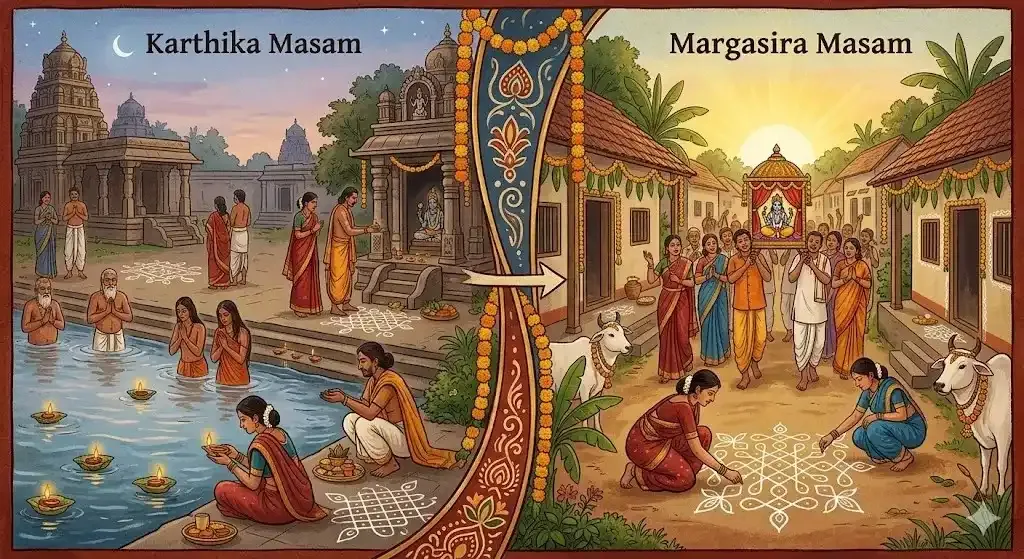
- Kolam or muggu: Draw a kolam (muggu, rangoli) at the doorstep. Many South Indian homes draw larger designs every day of this month.
- Lamp and worship: Light a ghee or oil lamp before an image of Vishnu, Krishna, Venkateswara or Ranganatha, and offer tulasi and flowers.
- The day's pasuram: Sing or listen to the day's Tiruppavai verse from the calendar above.
- Pongal as naivedya: Offer ven pongal or chakkara pongal before sunrise, as the temples do, and share it as prasadam.
- Temple at dawn: Many Vishnu temples hold special early-morning Dhanurmasa pujas. Check your temple's website for its timings.
- Charity: Andal's second verse asks for generous giving during the vow.
A short version works too: five quiet minutes with a lamp and one pasuram before work keeps the month alive.
Also read: Dhanurmasam daily rituals: step-by-step for families | Tiruppavai 30 pasurams
Margazhi 2026 in Tamil homes and temples
In Tamil Nadu, Margazhi is the month of kolam contests in the streets and of bhajan groups walking before dawn. Many Shiva temples sing Manikkavachakar's Tiruvempavai alongside the Tiruppavai. Arudra Darshan, the festival of Nataraja, falls on the Tiruvathirai star in this month; Drik lists it on Thursday 24 December 2026. At Srirangam, Vaikunta Ekadasi comes in the middle of the long Adhyayana Utsavam, when the Paramapada Vasal (the northern gate) is opened. Chennai's Margazhi music season also falls in this month.
Also read: Margazhi 2026: Tamil month festivals | Dhanurmasa Arudra 2026 | Dhanurmasa Pournami 2026
Tiruppavai at Tirumala in Dhanurmasam
At the Srivari temple in Tirumala, Andal's Tiruppavai is recited in place of the Suprabhatam during Dhanurmasam. In 2025-26, TTD's lists show Dhanurmasam beginning on 16 December 2025, the Tiruppavai replacing Suprabhatam from 17 December and Suprabhatam returning on 15 January 2026 (TTD December list, TTD January list, as reproduced by HinduPad). TTD has not yet announced its 2026-27 Dhanurmasam schedule. That includes the start date of the Tiruppavai, the Adhyayanotsavam and the Vaikuntha Dwara darshan arrangements, so all of these are to be confirmed. Check TTD's official website before you plan a visit. We do not list seva timings or ticket details.
Also read: Importance of Tiruppavai at Tirumala | Tirumala Venkateswara Temple
Key days in Dhanurmasam 2026-27
Vaikuntha (Mukkoti) Ekadashi, Sunday 20 December 2026 (Drik). This is the Shukla Ekadashi that falls inside Dhanurmasam. Vishnu temples open the Vaikuntha Dwaram, the northern gate, and devotees fast and keep vigil. In 2026 it is also Gita Jayanti and Mokshada Ekadashi. Dates, parana and temple details are on our Vaikuntha Ekadashi 2026 page.
Dhanurmasa Pournami and Arudra Darshan, Thursday 24 December 2026 (Drik). Purnima begins at 10:47 AM IST on 23 December, which Drik lists as Dattatreya Jayanti, and ends at 6:57 AM on 24 December.
Koodaravalli, Monday 11 January 2027 (by count). This is the day of the 27th pasuram, in which the girls look forward to milk rice dripping with ghee. Homes and temples make akkara adisil or a rich chakkara pongal. Some temples fix the day by their own calendar.
Bhogi and Goda Kalyanam, Thursday 14 January 2027 (Drik). The last day of Dhanurmasam and the 30th pasuram. Telugu and Tamil homes light the Bhogi bonfire before dawn. Many Vishnu temples, especially in the Telugu states, celebrate Goda Kalyanam, Andal's divine wedding, around this day. Check your temple's announcement.
Makar Sankranti and Thai Pongal, Friday 15 January 2027 (Drik). The Sun is in Makara and Uttarayana begins. Bhogi, Kanuma, Mattu Pongal and the city-wise Punya Kaal are covered in our Makar Sankranti 2027 guide.
Dhanu Sankranti and Makar Sankranti times abroad
The Sun changes sign at one instant for the whole world, so the table below simply shows Drik's two moments (10:29 AM IST on 16 December and 9:14 PM IST on 14 January) on local clocks. Canadian clocks follow the 2026 changes: British Columbia stays on UTC−7, Alberta on UTC−6 and Manitoba on UTC−5 all winter. Ontario, Quebec and the US are on standard time, and the UK is on GMT. Which morning your temple counts as day 1, or as the last day, is its own decision.
| City | Sun enters Dhanu (month begins) | Sun enters Makara (month ends) |
|---|---|---|
| New York / New Jersey | Tue 15 Dec, 11:59 PM | Thu 14 Jan, 10:44 AM |
| Toronto | Tue 15 Dec, 11:59 PM | Thu 14 Jan, 10:44 AM |
| Chicago / Houston / Dallas | Tue 15 Dec, 10:59 PM | Thu 14 Jan, 9:44 AM |
| Los Angeles / Bay Area / Seattle | Tue 15 Dec, 8:59 PM | Thu 14 Jan, 7:44 AM |
| Vancouver (UTC−7) | Tue 15 Dec, 9:59 PM | Thu 14 Jan, 8:44 AM |
| Calgary (UTC−6) | Tue 15 Dec, 10:59 PM | Thu 14 Jan, 9:44 AM |
| Winnipeg (UTC−5) | Tue 15 Dec, 11:59 PM | Thu 14 Jan, 10:44 AM |
| London | Wed 16 Dec, 4:59 AM | Thu 14 Jan, 3:44 PM |
| Dubai | Wed 16 Dec, 8:59 AM | Thu 14 Jan, 7:44 PM |
| Singapore | Wed 16 Dec, 12:59 PM | Thu 14 Jan, 11:44 PM |
| Sydney / Melbourne | Wed 16 Dec, 3:59 PM | Fri 15 Jan, 2:44 AM |
| Auckland | Wed 16 Dec, 5:59 PM | Fri 15 Jan, 4:44 AM |
Source: Drik Panchang's Dhanu Sankranti 2026 and Makar Sankranti 2027 moments, converted from IST to local clocks. For Makar Sankranti these match Drik's own city pages. For Winnipeg, we used Manitoba's new UTC−5, one hour later than Drik currently shows. In North America the Sun enters Dhanu on the night of Tuesday 15 December, so Wednesday 16 December is the first Dhanurmasam dawn there too.
Do not take the Ekadashi or Purnima clock times in this article abroad, because those depend on local sunrise. Use the country guides: USA, UK, Canada, Australia, Europe and Singapore.
Dhanurmasam for NRI families
- Dark winter mornings help: In December, sunrise in North America and the UK comes late, around 7 to 8 AM. That leaves time for a short dawn puja before work or school.
- One pasuram a week for children: Even if they cannot keep up with the daily verse, children can learn one pasuram a week and the story behind it.
- Temple programmes: Many Venkateswara, Ranganatha and Vishnu temples abroad hold group Tiruppavai recitation and Dhanurmasa pongal every morning or at weekends. Check your temple's own website.
- Pongal in a small kitchen: Ven pongal or chakkara pongal can be made in a pressure cooker and offered warm at dawn.
A note on health
Dhanurmasam itself does not require fasting. If you choose to fast, for example on Vaikuntha Ekadashi, speak to your doctor first if you are pregnant, diabetic, have blood-pressure problems or take regular medicines. Children and elderly people should eat normally. A simple lamp and prayer at a comfortable hour is a sincere observance, and tradition values devotion over hardship. We make no promise of particular results from any practice.
Frequently asked questions
When does Dhanurmasam 2026 start and end?
Dhanurmasam 2026-27 starts on Wednesday 16 December 2026, when the Sun enters Dhanu (Sagittarius) at 10:29 AM IST, as given by Drik Panchang. It ends when the Sun enters Makara at 9:14 PM IST on Thursday 14 January 2027 (Drik). Thursday 14 January is Bhogi, the last day of the month, and Makar Sankranti and Thai Pongal are on Friday 15 January 2027.
Which Tiruppavai pasuram is recited on which day in 2026?
The usual practice is one pasuram a day. Counting Wednesday 16 December 2026 as day 1, pasuram 1 falls on 16 December, pasuram 16 on 31 December, pasuram 17 on 1 January, pasuram 27 (Koodaravalli) on Monday 11 January and pasuram 30 on Bhogi, Thursday 14 January 2027. Some temples, including Tirumala last season, begin on the day after Dhanu Sankranti, so follow your temple's count.
When is Koodaravalli in 2027?
By the one-pasuram-a-day count from 16 December, the 27th pasuram, 'Koodarai vellum', falls on Monday 11 January 2027 (the 27th day of Margazhi). Families celebrate it with a rich milk-and-ghee sweet pongal. This date is a count, not a Drik listing, so confirm with your temple.
Is Tiruppavai recited instead of Suprabhatam at Tirumala?
Yes. During Dhanurmasam, Andal's Tiruppavai is recited at the Srivari temple in place of the Suprabhatam. In 2025-26 this ran from 17 December 2025, and Suprabhatam came back on 15 January 2026, according to TTD's lists. TTD has not yet published its 2026-27 schedule, so the start date is to be confirmed.
Editor's note
Editor's note (21 October 2026): We refreshed this guide for the 2026-27 season. The Dhanu Sankranti moment (10:29 AM IST, Wed 16 Dec 2026) is from Drik Panchang, and the Makar Sankranti moment (9:14 PM IST, Thu 14 Jan 2027) is from Drik's Makar Sankranti 2027 pages. Both agree with our own Lahiri calculation. Other dates are from Drik's Hyderabad panchang. The Koodaravalli date and the day-by-day pasuram dates are a simple count from 16 December, and temples may count differently. TTD's 2026-27 Dhanurmasam schedule has not been announced; we will update this page when it is. The pasuram meanings are our own short summaries, not translations, and we have not reproduced the verse text. Andal's life is told as tradition tells it. This page is not medical advice.
Related guides
Share this with family and friends
Send it on WhatsApp, post it, or copy the link.
More from Festivals
- Vasant Panchami 2027 (Saraswati Puja, Basant Panchami, Sri Panchami): Date, Panchami Tithi, Puja Muhurat by City, Vidhi and Story
- Holi 2027: Date, Holika Dahan Muhurat City-Wise, Bhadra Timings, Puja Vidhi and Holi Abroad
- Makar Sankranti 2027: Date, Punya Kaal Timings City-Wise, Bhogi, Pongal, Kanuma, Lohri and Uttarayan
- Dev Deepawali 2026 Varanasi: Date, Purnima Time, Ganga Aarti, Story, Puja Vidhi and Deep Daan
- Kartik Purnima 2026: Date, Purnima Time, Snan, Deep Daan, Puja Vidhi and Significance
You might also like
Dhanurmasam 2026 USA: Margazhi Start and End Dates City by City, Dhanu Sankranti Times and a Daily Tiruppavai Routine
Dhanurmasam 2026 in Australia: Margazhi Start and End Times City by City, First Dawn Thursday 17 December and a Summer Tiruppavai Routine
Dhanurmasam 2026 in Canada: Margazhi Start and End Dates, Sankranti Times and Tiruppavai Routine City by City