

Ganapati Atharvashirsha: Meaning, Benefits & Full Text — Complete Guide
Introduction: The Crown Jewel of Ganesha Worship
In the vast treasury of Hindu sacred literature — the Vedas, the Upanishads, the Puranas, the Agamas — there exists a short but extraordinarily luminous text of just 13 verses that devotees of Lord Ganesha consider the most sacred scripture dedicated to the elephant-headed god of wisdom.
It is called the Ganapati Atharvashirsha — also known as the Ganapati Upanishad or Ganapatya Atharvashirsha — and it belongs to the Atharvaveda tradition, appended to the Atharvasikha Upanishad as one of the 108 Upanishads recognized in Hindu scriptural canon.
In just a few hundred words, this magnificent text accomplishes something no ordinary scripture does: it declares Lord Ganesha to be the Supreme Brahman itself — not merely a powerful deity who removes obstacles, not merely the son of Shiva and Parvati, but the very ground of all existence, the source from which the entire universe emerges and into which it dissolves.
It is a text where devotion meets philosophy, where the personal meets the cosmic, where the one who prays and the one who is prayed to are revealed as ultimately one and the same.
Every practicing Hindu — regardless of their primary deity or tradition — knows at least a few lines of the Ganapati Atharvashirsha. Its opening line, “Twameva kevalam kartasi” (“You alone are the creator”), has echoed through temples, homes, and hearts across India for millennia.
This is the complete guide to the Ganapati Atharvashirsha — its origin, its full Sanskrit text with transliteration and meaning, its philosophy, its prescribed method of recitation, and the profound spiritual benefits that devotion to this text brings.
Ganapati Bappa Morya.
Part 1: Origin and Historical Significance of the Ganapati Atharvashirsha
What Is the Atharvashirsha?
The word Atharvashirsha is composed of two parts:
- Atharva — from the Atharvaveda, the fourth Veda associated with cosmic knowledge, sacred formulas, and the mysteries of existence
- Shirsha — meaning “head” or “crown”
An Atharvashirsha is therefore a crown-text of the Atharvaveda — a short Upanishadic text appended to the Atharva tradition that encapsulates the highest philosophical truth about a particular deity. Other Atharvashirshas exist for Shiva (Shiva Atharvashirsha), the Goddess (Devi Atharvashirsha), Vishnu, and Surya — but the Ganapati Atharvashirsha is the most widely known and recited of them all.
Authorship and Dating
The Ganapati Atharvashirsha is attributed to the sage Ganaka (some traditions say Atharvan or a disciple of the Atharvan lineage). It is classified as a minor Upanishad — one of the 108 Upanishads listed in the Muktika Upanishad.
Scholars place its composition between the 7th and 14th centuries CE — during the great flourishing of Ganapatya (Ganesha-centred) devotion in India, particularly in Maharashtra, where the Ganapatya sect (which worships Ganesha as the Supreme Being) was most influential. However, the oral tradition of Ganesha worship and the philosophical content of this text point to roots far older than any written manuscript.
The Ganapatya tradition — one of the six major schools of Hindu worship alongside Shaivism, Vaishnavism, Shaktism, Saura (Sun worship), and Kaumaram (Kartikeya worship) — holds this text as its supreme scripture, analogous to how the Bhagavad Gita is central to Vaishnavism.
Why This Text Is Unique
Most devotional texts about Lord Ganesha describe him as a great god who removes obstacles, grants boons, and presides over beginnings. The Ganapati Atharvashirsha goes far beyond this. It makes the Advaita Vedanta declaration that Ganesha is not merely one deity among many but:
- The Brahman — the ultimate, formless, infinite ground of all reality
- The Atman — the innermost self within every being
- The source of the three gunas (Tamas, Rajas, and Sattva) that constitute all of manifest creation
- Identical with the Panchabhootas — the five elements: earth, water, fire, air, and space
- The same reality as the Rig Veda, Sama Veda, and other Vedas
This is Ganapatya Vedanta — the philosophical school that sees the infinite Brahman through the form of Ganesha. It places the Ganapati Atharvashirsha on a par with the great Upanishads — the Mandukya, the Taittiriya, the Chandogya — as a text of the highest philosophical truth.
Part 2: Full Sanskrit Text of the Ganapati Atharvashirsha
What follows is the complete, authentic text of the Ganapati Atharvashirsha — presented with:
- Original Sanskrit Devanagari script
- IAST Transliteration for accurate pronunciation
- Word-by-word meaning and verse translation
Shanti Patha — Opening Peace Invocation
Sanskrit:
ॐ भद्रं कर्णेभिः शृणुयाम देवाः।
भद्रं पश्येमाक्षभिर्यजत्राः।
स्थिरैरङ्गैस्तुष्टुवाँसस्तनूभिः।
व्यशेम देवहितं यदायुः।
ॐ स्वस्ति न इन्द्रो वृद्धश्रवाः।
स्वस्ति नः पूषा विश्ववेदाः।
स्वस्ति नस्तार्क्ष्यो अरिष्टनेमिः।
स्वस्ति नो बृहस्पतिर्दधातु॥
ॐ शान्तिः शान्तिः शान्तिः॥
Transliteration: Om bhadram karnebhih shrinuyama devah Bhadram pashyemakshabhiryajatrah Sthirairaṅgaistushtuvam sastanubhih Vyashema devahitam yadayuh Om svasti na indro vriddhasravah Svasti nah pusha vishvavedah Svasti nastarksho arishtanemih Svasti no brihaspatirdadhatu Om shantih shantih shantih
Meaning: O Divine Ones, may we hear auspicious things with our ears. May we see auspicious things with our eyes. With steady limbs and bodies, may we sing your praises. May we live a life that is pleasing to the gods.
May Indra of great fame bestow well-being upon us. May Pusha, the knower of all worlds, bestow well-being. May Garuda, who wards off all evil, bestow well-being. May Brihaspati grant us well-being.
Om Peace. Peace. Peace.
Verse 1 — The Invocation of Ganesha as Brahman
Sanskrit:
ॐ नमस्ते गणपतये।
त्वमेव प्रत्यक्षं तत्त्वमसि।
त्वमेव केवलं कर्तासि।
त्वमेव केवलं धर्तासि।
त्वमेव केवलं हर्तासि।
त्वमेव सर्वं खल्विदं ब्रह्मासि।
त्वं साक्षादात्मासि नित्यम्॥
Transliteration: Om namaste Ganapataye Tvameva pratyaksham tattvamasi Tvameva kevalam kartasi Tvameva kevalam dhartasi Tvameva kevalam hartasi Tvameva sarvam khalvidam brahmasi Tvam sakshadatmasi nityam
Word-by-Word Meaning:
| Sanskrit | Meaning |
|---|---|
| Om namaste Ganapataye | Om, salutations to you, Lord Ganapati |
| Tvameva | You alone |
| pratyaksham tattvamasi | are the directly perceived Truth (Brahman) |
| Tvameva kevalam | You alone |
| kartasi | are the Creator |
| dhartasi | are the Sustainer |
| hartasi | are the Destroyer |
| Tvameva sarvam khalvidam | You alone are indeed all this |
| brahmasi | You are Brahman |
| Tvam sakshat atmasi nityam | You are verily the eternal Atman (Self) |
Translation: Om, salutations to you, Lord Ganapati. You alone are the directly perceptible Truth. You alone are the Creator. You alone are the Sustainer. You alone are the Destroyer. You alone are indeed all of this — you are Brahman. You are, without doubt, the eternal Atman (Self).
Significance: This opening verse is the philosophical heart of the entire Upanishad. In one breath, it makes the complete Vedantic declaration: Ganesha is not one of many gods — he is the Brahman, the supreme reality described in the Upanishads as Sat-Chit-Ananda (Being-Consciousness-Bliss). The phrase “Tvameva sarvam khalvidam brahmasi” directly echoes the great Upanishadic declaration “Sarvam khalvidam Brahma” — “All of this is verily Brahman.” Ganesha IS that Brahman.
Verse 2 — Ganesha as the Cosmic Reality
Sanskrit:
ऋतं वच्मि। सत्यं वच्मि॥
Transliteration: Ritam vachmi. Satyam vachmi.
Meaning: I speak the cosmic order (Ṛta). I speak the ultimate truth (Satya).
Significance: This short but powerful declaration establishes the speaker’s authority. Rta is the Vedic concept of cosmic order — the law that governs the universe. Satya is absolute truth. By declaring “I speak Rta and Satya,” the sage announces that what follows is not personal opinion or mythology but cosmic fact and absolute truth. Everything stated in this Upanishad is as true as the laws governing the universe.
Verse 3 — Prayer for Protection
Sanskrit:
अव त्वं माम्।
अव वक्तारम्।
अव श्रोतारम्।
अव दातारम्।
अव धातारम्।
अवानूचानमव शिष्यम्।
अव पश्चात्तात्।
अव पुरस्तात्।
अवोत्तरात्तात्।
अव दक्षिणात्तात्।
अव चोर्ध्वात्तात्।
अवाधरात्तात्।
सर्वतो मां पाहि पाहि समन्तात्॥
Transliteration: Ava tvam mam Ava vaktaram Ava shrotaram Ava dataram Ava dhataram Avanuchanamava shishyam Ava pashchatthat Ava purasthat Avottarattat Ava dakshinattat Ava chordhvattat Avaadharattat Sarvato mam pahi pahi samantat
Translation: Protect me. Protect the speaker. Protect the listener. Protect the giver. Protect the sustainer. Protect the teacher and protect the student. Protect from behind. Protect from the front. Protect from the north. Protect from the south. Protect from above. Protect from below. Protect me from all directions, on all sides, always.
Significance: This verse is a comprehensive prayer for divine protection — covering all eight directions (Ashta Disha) plus above and below, and all relationships: teacher-student, giver-receiver, speaker-listener. The ten-directional protection invoked here mirrors the role of Ganesha as the guardian of all thresholds. Every doorway, every beginning, every direction of life falls under his protection.
Verse 4 — The Esoteric Description of Ganesha
Sanskrit:
त्वं वाङ्मयस्त्वं चिन्मयः।
त्वमानन्दमयस्त्वं ब्रह्ममयः।
त्वं सच्चिदानन्दाऽद्वितीयोऽसि।
त्वं प्रत्यक्षं ब्रह्मासि।
त्वं ज्ञानमयो विज्ञानमयोऽसि॥
Transliteration: Tvam vangmayastvam chinmayah Tvam anandamayastvam brahmamayah Tvam saccidananda advitiyosi Tvam pratyaksham brahmasi Tvam jnanamayo vijnanamayosi
Word-by-Word Meaning:
| Sanskrit | Meaning |
|---|---|
| Tvam vangmayah | You are the embodiment of speech |
| Tvam chinmayah | You are the embodiment of pure consciousness |
| Tvam anandamayah | You are the embodiment of bliss |
| Tvam brahmamayah | You are the embodiment of Brahman |
| Tvam sat-chit-ananda | You are Being-Consciousness-Bliss |
| advitiyosi | You are without a second (non-dual) |
| Tvam pratyaksham brahmasi | You are the directly perceptible Brahman |
| Tvam jnanamayah | You are made of knowledge |
| vijnanamayosi | You are made of wisdom |
Translation: You are the embodiment of speech. You are pure consciousness. You are bliss. You are Brahman. You are Sat-Chit-Ananda (Being-Consciousness-Bliss) — without a second, non-dual. You are the directly perceptible Brahman. You are made of knowledge and wisdom.
Significance: This verse identifies Ganesha with the five koshas (sheaths of existence) and with the supreme Brahman simultaneously. Vangmaya (speech), Chinmaya (consciousness), Anandamaya (bliss), Brahmamaya (ultimate reality), and Jnanamaya (knowledge) — these are all expressions of the one ultimate reality. The declaration “Sat-Chit-Ananda Advitiya” is the most compact expression of Advaita Vedanta — that the ultimate reality is one without a second, and it is Being-Consciousness-Bliss. Ganesha is that reality.
Verse 5 — The Five Elements and Ganesha
Sanskrit:
सर्वं जगदिदं त्वत्तो जायते।
सर्वं जगदिदं त्वत्तस्तिष्ठति।
सर्वं जगदिदं त्वयि लयमेष्यति।
सर्वं जगदिदं त्वयि प्रत्येति।
त्वं भूमिरापोऽनलोऽनिलो नभः।
त्वं चत्वारि वाक्पदानि॥
Transliteration: Sarvam jagadidam tvatto jayate Sarvam jagadidam tvattastishthati Sarvam jagadidam tvayi layameshyati Sarvam jagadidam tvayi pratyeti Tvam bhumirapoanalo anilo nabhah Tvam chatvari vakpadani
Translation: All this universe is born from You. All this universe is sustained by You. All this universe will dissolve into You. All this universe returns to You. You are earth, water, fire, air, and space (the five elements). You are the four modes of speech.
Significance: The first four lines beautifully encapsulate the complete cosmological cycle described in Vedanta: Srishti (creation), Sthiti (sustenance), Laya (dissolution), and Pratyaya (return/resolution). This is the same cosmic function attributed to the Trinity of Brahma-Vishnu-Mahesh — here unified in Ganesha alone.
The declaration that Ganesha is the five elements (Panchabhutas) means he is not separate from the material world — he IS the material world. Every grain of earth, every drop of water, every flame, every breath of wind, every expanse of sky — is Ganesha himself.
The four modes of speech (Chatvari Vakpadani) are: Para (the transcendental), Pashyanti (the visionary), Madhyama (the middle), and Vaikhari (the expressed/spoken). Ganesha is the lord of all speech at every level — from the unspeakable cosmic vibration to the words on your tongue.
Verse 6 — Ganesha and the Gunas, Vedas, and Time
Sanskrit:
त्वं गुणत्रयातीतः।
त्वं देहत्रयातीतः।
त्वं कालत्रयातीतः।
त्वं मूलाधारस्थितोऽसि नित्यम्।
त्वं शक्तित्रयात्मकः।
त्वां योगिनो ध्यायन्ति नित्यम्।
त्वं ब्रह्मा त्वं विष्णुस्त्वं रुद्रस्त्वमिन्द्रस्त्वमग्निस्त्वं वायुस्त्वं सूर्यस्त्वं चन्द्रमास्त्वं ब्रह्मभूर्भुवःस्वरोम्॥
Transliteration: Tvam gunattrayatitah Tvam dehatrayatitah Tvam kalatrayatitah Tvam muladharasthitosi nityam Tvam shaktitrayatmakah Tvam yogino dhyayanti nityam Tvam brahma tvam vishnustvam rudrastvamindrast-vam agnistvam vayustvam suryastvam chandramastvam brahmabhur-bhuvah-svarom
Word-by-Word Meaning:
| Sanskrit | Meaning |
|---|---|
| Tvam gunatrayatitah | You are beyond the three Gunas (Sattva, Rajas, Tamas) |
| Tvam dehatrayatitah | You are beyond the three bodies (gross, subtle, causal) |
| Tvam kalatrayatitah | You are beyond the three times (past, present, future) |
| Tvam muladharasthitosi nityam | You eternally reside in the Muladhara (root chakra) |
| Tvam shaktitrayatmakah | You are the embodiment of the three Shaktis (Iccha, Kriya, Jnana) |
| Tvam yogino dhyayanti nityam | Yogis meditate upon you eternally |
| Tvam brahma tvam vishnu | You are Brahma, you are Vishnu |
| tvam rudra | You are Rudra (Shiva) |
| tvam indra | You are Indra (king of gods) |
| tvam agni | You are Agni (fire) |
| tvam vayu | You are Vayu (wind) |
| tvam surya | You are Surya (sun) |
| tvam chandrama | You are Chandra (moon) |
| tvam brahma bhur-bhuvah-svah om | You are Brahman — the earth, atmosphere, sky, and Om |
Translation: You are beyond the three Gunas. You are beyond the three bodies. You are beyond the three times (past, present, and future). You eternally reside in the Muladhara (root chakra). You are the embodiment of the three divine powers. Yogis eternally meditate upon You.
You are Brahma. You are Vishnu. You are Rudra. You are Indra. You are Agni. You are Vayu. You are Surya. You are Chandra. You are the Brahman that encompasses the three worlds — the earth (Bhur), the atmosphere (Bhuvah), and the sky (Svah). You are Om.
Significance: This verse is among the most philosophically dense in the entire text. It simultaneously:
- Declares Ganesha to be Nirguna (beyond all qualities) — transcending the very gunas that constitute all of manifest existence
- Identifies him as the resident of the Muladhara Chakra — the root energy center at the base of the spine where the kundalini lies dormant, connecting him to the entire yogic tradition
- Unifies all major Hindu deities — Brahma, Vishnu, Rudra, Indra, Agni, Vayu, Surya, Chandra — within Ganesha as their common ground
- Identifies him with Om — the primordial sound-vibration from which all creation emerged
The declaration “Tvam brahma bhur-bhuvah-svah Om” directly echoes the Gayatri Mantra — the most sacred mantra of the Vedas. By identifying Ganesha with this declaration, the text places him at the very center of Vedic cosmology.
Verse 7 — The Description of Ganesha’s Form
Sanskrit:
गणादिं पूर्वमुच्चार्य वर्णादिं तदनन्तरम्।
अनुस्वारः परतरः। अर्धेन्दुलसितम्।
तारेण ऋद्धम्। एतत्तव मनुस्वरूपम्।
गकारः पूर्वरूपम्। अकारो मध्यमरूपम्।
अनुस्वारश्चान्त्यरूपम्। बिन्दुरुत्तररूपम्।
नादः सन्धानम्। सगंहिता सन्धिः।
सैषा गणेशविद्या। गणकऋषिः।
निचृद्गायत्रीच्छन्दः। गणपतिर्देवता।
ॐ गं गणपतये नमः॥
Transliteration: Ganadim purvamuccharya varnadim tadanantaram Anusvarah paratara — ardhendulaasitam Tarena riddham — etat tava manusvarupam Gakarah purvarupam — akaro madhyamarupam Anusvara-schantyarupam — bindurottararupam Nadah sandhanam — sagamhita sandhih Saisha Ganeshvidya — Ganaka-rishih Nichridgayatrih-cchandah — Ganapatirdevata Om Gam Ganapataye Namah
Translation: First pronounce the syllable Ga (from Gana), then the first letter A (from Akara). After that comes the Anusvara (nasal sound — the dot above, making it Gam). Then comes the crescent (Ardha-indu, the half-moon shape of the anusvara). This is elevated by the Pranava (Om). This is your Mantra form.
The letter Ga is your first form. The letter A is your middle form. The Anusvara is your final form. The Bindu (dot) is your transcendent form. The Nada (primordial sound) is the union. The combined form is the sacred syllable Gam.
This is the Ganesha Vidya (sacred knowledge of Ganesha). The sage is Ganaka. The meter is Nichrid Gayatri. The deity is Ganapati.
Om Gam Ganapataye Namah.
Significance: This is one of the most technically remarkable verses in Hindu devotional literature. It unpacks the sacred syllable Gam — the Bija (seed) mantra of Ganesha — letter by letter, explaining how the sound is constructed and what each component represents:
- G (Ga) — the body of the mantra
- A — the life of the mantra
- M with anusvara — the transcendent point
- Bindu — the point of consciousness beyond all sound
- Nada — the vibration connecting all parts into wholeness
This is Mantra Shastra — the science of sacred sound — applied directly to the Ganesha mantra. The verse reveals that Om Gam Ganapataye Namah is not an arbitrary collection of sounds but a precisely engineered sonic architecture that encapsulates Ganesha’s entire nature in a single breath.
Verse 8 — The Eight Names (Ashtanama Vandana)
Sanskrit:
एकदन्ताय विद्महे वक्रतुण्डाय धीमहि।
तन्नो दन्तिः प्रचोदयात्॥

एकदन्तं चतुर्हस्तं पाशमङ्कुशधारिणम्।
रदं च वरदं हस्तैर्बिभ्राणं मूषकध्वजम्।
रक्तं लम्बोदरं शूर्पकर्णकं रक्तवाससम्।
रक्तगन्धानुलिप्ताङ्गं रक्तपुष्पैः सुपूजितम्।
भक्तानुकम्पिनं देवं जगत्कारणमच्युतम्।
आविर्भूतं च सृष्ट्यादौ प्रकृतेः पुरुषात्परम्।
एवं ध्यायति यो नित्यं स योगी योगिनां वरः॥
Transliteration: Ekadantaya vidmahe vakratundaya dhimahi Tanno dantih prachodayat
Ekadantam chaturhastam pashamankushadarinam Radam cha varadam hastairbibhranam mushakadhvajam Raktam lambodaram shurpakarnakam raktavasasam Raktagandhanuliptangam raktapushpaih supujitam Bhaktanukampinam devam jagatkanaramachyutam Avirbhutam cha srishtyadau prakriteh purushatparam Evam dhyayati yo nityam sa yogi yoginam varah
Translation: We know the one-tusked one (Ekadanta). We meditate upon the curved-trunk one (Vakratunda). May that tusk-bearer (Danti) illuminate our minds. (Ganesha Gayatri Mantra)
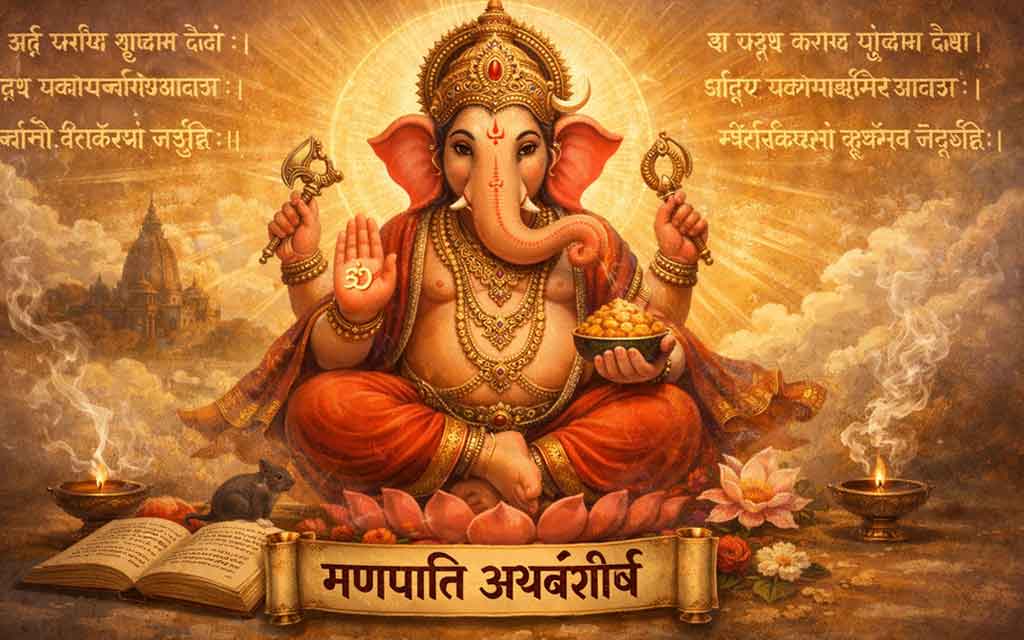
He who has one tusk and four arms — holding a noose (Pasha) and goad (Ankusha), his broken tusk and the boon-granting hand (Varada) — whose flag bears the mouse (Mushaka Dhvaja). He is red in color, with a large belly (Lambodara), fan-shaped ears (Shurpakarna), dressed in red. His body is anointed with red fragrant paste and he is worshipped with red flowers.
He is the compassionate god of devotees. He is the eternal cause of the universe, the imperishable (Achyuta). He manifested at the beginning of creation — beyond Prakriti (nature) and Purusha (consciousness). He who meditates thus daily is the greatest among all yogis.
Significance: This verse contains the Ganesha Gayatri Mantra — the most sacred meditational formula dedicated to Ganesha — followed by a complete Dhyana Shloka (meditation verse) describing his precise iconographic form for visualization practice.
The color red appears five times — red body, red garment, red fragrant paste, red flowers, red energy. In Hindu tantra, red is the color of Shakti — active divine power, creation, and the energy that animates all life. Ganesha’s red form connects him deeply to the Shakta tradition and to his mother Parvati’s creative power.
The declaration “Jagat-karana-achyuta” — “the eternal, imperishable cause of the universe” — again places Ganesha as the supreme cosmic principle, not merely an important deity.
Verse 9 — The Eight Names of Ganesha
Sanskrit:
नमो व्रातपतये। नमो गणपतये।
नमः प्रमथपतये।
नमस्तेऽस्तु लम्बोदरायैकदन्ताय विघ्ननाशिने शिवसुताय
श्रीवरदमूर्तये नमः॥
Transliteration: Namo vratapataye. Namo ganapataye. Namah pramathapataye. Namasteostu lambodarayaikadantaya vighnanashinesiva-sutaya Shri varadamurtaye namah
Translation: Salutations to the Lord of the Vratas (sacred vows). Salutations to the Lord of all Ganas. Salutations to the Lord of the Pramathas (Shiva’s divine attendants). Salutations to you — the large-bellied one, the one-tusked one, the destroyer of obstacles, the son of Shiva, the auspicious one who grants boons. Salutations.
Significance: This verse is a cascade of salutations (Namaskara) — each one offering reverence to a different aspect and role of Ganesha. The progression moves from Ganesha as lord of cosmic vows (Vratapataye), to lord of divine beings (Ganapataye), to lord of Shiva’s personal attendants (Pramathapataye), to his personal iconographic qualities, to his family identity as Shiva’s son, to his ultimate function as the granter of divine grace (Varadamurtaye).
Verse 10 — The Phala Shruti (Fruits of Recitation)
Sanskrit:
एतदथर्वशीर्षं योऽधीते।
स ब्रह्मभूयाय कल्पते।
स सर्वविघ्नैर्न बाध्यते।
स सर्वतः सुखमेधते।
स पञ्चमहापापात्प्रमुच्यते।
सायमधीयानो दिवसकृतं पापं नाशयति।
प्रातरधीयानो रात्रिकृतं पापं नाशयति।
सायं प्रातः प्रयुञ्जानोऽपापो भवति।
सर्वत्राधीयानोऽपविघ्नो भवति।
धर्मार्थकाममोक्षं च विन्दति॥
Transliteration: Etadatharvashirsham yoadhite Sa brahmabhuyaya kalpate Sa sarvavighnairna badhyate Sa sarvatah sukhamdhate Sa panchamahapapat pramuchyate Sayamadhiyano divasakritam papam nashayati Prataradhiyano ratrikritam papam nashayati Sayam pratah prayunjano apapo bhavati Sarvatradhiyano apavighno bhavati Dharmartha-kama-moksham cha vindati
Translation: Whoever studies this Atharvashirsha — becomes fit for union with Brahman. He is not troubled by any obstacle. He attains happiness everywhere. He is freed from the five great sins (Pancha Maha Papas).
If recited in the evening — it destroys the sins committed during the day. If recited in the morning — it destroys the sins committed during the night. If recited morning and evening — one becomes free of all sin. If recited everywhere and always — one becomes free of all obstacles.
Through this, one attains Dharma (righteousness), Artha (prosperity), Kama (fulfillment of desires), and Moksha (liberation).
Significance: The Phala Shruti (declaration of the fruits/benefits) is one of the most comprehensive in all of Hindu scripture. It promises all four goals of human life (Purusharthas) — Dharma, Artha, Kama, and Moksha — as fruits of sincere recitation. This is not hyperbole; it is the traditional declaration of the text’s transformative power when approached with sincerity, devotion, and understanding.
Verse 11 — Further Benefits of Recitation
Sanskrit:
इदमथर्वशीर्षमशिष्याय न देयम्।
यो यदि मोहाद्दास्यति स पापीयान् भवति।
सहस्रावर्तनाद्यं यं काममधीते तं तमनेन साधयेत्॥
Transliteration: Idamatharvashirsham ashishyaya na deyam Yo yadi mohadasyati sa papiyam bhavati Sahasravartanadvam yam kamam adhite tam tamanena sadhayat
Translation: This Atharvashirsha should not be given to one who is not a disciple (one who is not initiated or is unworthy). Whoever, out of delusion, gives it to the unworthy, becomes sinful.
By chanting this 1,000 times, whatever wish one holds, that wish is fulfilled through this sacred text.
Significance: This verse introduces the traditional injunction of sacred knowledge protection — a common feature of Upanishadic texts. The knowledge is not secret out of exclusiveness but out of reverence: sacred sound must be received in the context of a teaching relationship where the recipient is prepared to receive it with the right understanding and attitude. Casual or commercial sharing of sacred knowledge was seen as diminishing both the knowledge and the person.
The promise of wish-fulfillment through 1,000 recitations is the basis of the Sahasra Avartan practice — chanting the Atharvashirsha 1,000 times, typically over several days, as a powerful vrata (vow) of devotion.
Verse 12 — Consecration Through the Atharvashirsha
Sanskrit:
अनेन गणपतिमभिषिञ्चति।
स वाग्मी भवति। चतुर्थ्यामनश्नन् जपति।
स विद्यावान् भवति। इत्यथर्वणवाक्यम्।
ब्रह्माद्यावरणं विद्यात्।
न बिभेति कदाचनेति॥
Transliteration: Anena Ganapatimabhishinchati Sa vagmi bhavati Chaturtthyamanashnan japati Sa vidyavan bhavati Ityatharvanavakhyam Brahmadyavaranam vidyat Na bibheti kadachaneti
Translation: Whoever consecrates (performs Abhisheka of) Lord Ganesha using this text — becomes eloquent in speech. Whoever fasts and chants this on Chaturthi (the 4th day of the lunar calendar) — becomes endowed with knowledge and wisdom. This is the word of the Atharvana (Atharva Veda).
He who knows the covering/veil of Brahman — never fears anything.
Significance: This verse establishes the specific ritualistic use of the Atharvashirsha:
- Abhisheka (sacred bathing of the deity) performed while reciting this text is said to generate extraordinary speech ability
- Chaturthi fasting and chanting — the practice still followed by millions of devotees across India, especially in Maharashtra — grants wisdom and knowledge
- The final declaration — “He who knows the veil of Brahman fears nothing” — is a profound statement: when one recognizes that all appearances are Brahman, and Brahman is one’s own Self, what is there left to fear?
Verse 13 — The Eight-Fold Worship and Final Declaration
Sanskrit:
अष्टौ ब्राह्मणान् सम्यग्ग्राहयित्वा सूर्यवर्चस्वी भवति।
सूर्यग्रहे महानद्यां प्रतिमासन्निधौ वा जप्त्वा सिद्धमन्त्रो भवति।
महाविघ्नात् प्रमुच्यते।
महादोषात् प्रमुच्यते।
महापापात् प्रमुच्यते।
महाप्रत्यवायात् प्रमुच्यते।
स सर्वविद्भवति। स सर्वविद्भवति।
ॐ नमस्ते गणपते।
त्वमेव प्रत्यक्षं तत्त्वमसि।
त्वमेव केवलं कर्तासि।
त्वमेव केवलं धर्तासि।
त्वमेव केवलं हर्तासि।
त्वमेव सर्वं खल्विदं ब्रह्मासि।
त्वं साक्षादात्मासि नित्यम्॥
Transliteration: Ashtau brahmanah samyagrahyitva suryavarchasvi bhavati Suryagrahe mahanadyam pratimasa-nidhau va japtva siddhamantro bhavati Mahavighnat pramuchyate Mahadoshat pramuchyate Mahapapat pramuchyate Mahapratyavayat pramuchyate Sa sarvavidbhavati. Sa sarvavidbhavati. Om namaste Ganapate Tvameva pratyaksham tattvamasi Tvameva kevalam kartasi Tvameva kevalam dhartasi Tvameva kevalam hartasi Tvameva sarvam khalvidam brahmasi Tvam sakshadatmasi nityam
Translation: Whoever rightly teaches this to eight Brahmanas (qualified teachers) — attains the radiance of the Sun. Whoever chants this during a solar eclipse, at a great river, or in the presence of a Ganesha image — attains the full power (Siddhi) of the mantra.
He is freed from the great obstacle. He is freed from the great fault. He is freed from the great sin. He is freed from the great misfortune. He becomes the knower of all. He becomes the knower of all.
Om, salutations to you, Ganapati. You alone are the directly perceptible Truth. You alone are the Creator. You alone are the Sustainer. You alone are the Destroyer. You alone are indeed all this — you are Brahman. You are, without doubt, the eternal Atman (Self).
Significance: The text closes with the same declaration with which it opened — a perfect philosophical circle. The repetition of the opening verses at the end is not redundancy — it is the Upanishadic technique of Anuvritta (return) — showing that the journey through all the names, all the descriptions, all the philosophical declarations, ultimately returns to the same simple truth with which we began: You are Brahman. You are the Self.
The final repetition of “Sa sarvavidbhavati” — “He becomes the knower of all” — twice in succession is a traditional Vedic emphasis (Dvir-ukti) used to declare absolute certainty.
Shanti Patha — Closing Peace Invocation
Sanskrit:
ॐ शान्तिः शान्तिः शान्तिः॥
Transliteration: Om shantih shantih shantih
Meaning: Om. Peace in body (Adhidaivika). Peace in mind (Adhibhautika). Peace in spirit (Adhyatmika).
The three recitations of Shanti address the three planes of disturbance: disturbances caused by supernatural forces, by other beings and the external world, and by one’s own mind and body. Three times peace dissolves all three.
Part 3: The Complete Benefits of the Ganapati Atharvashirsha
Spiritual Benefits
The Ganapati Atharvashirsha is not merely a devotional hymn — it is a transformative spiritual practice (Sadhana). Its benefits, as declared in the text itself and elaborated across the tradition, include:
Liberation and Self-Knowledge: The text declares the devotee becomes “Brahmabhuyaya kalpatae” — fit for union with Brahman. Regular recitation with understanding gradually dissolves the sense of separateness between the devotee and the divine — the ultimate goal of all spiritual practice.
Removal of All Obstacles: The text promises “Sarva-vighnaihi na badhyate” — he is not troubled by any obstacles. This encompasses obstacles in all domains: health, relationships, career, spiritual practice, and inner psychological barriers.
Purification of Sins: The text offers liberation from the Pancha Maha Papas — the five great sins of Hindu ethics: Brahmahatya (harming a sage/teacher), Suvarana-steya (stealing gold/wealth), Sura-pana (taking harmful substances), Guru-talpa (betraying one’s teacher), and Apta-droha (betraying those who trust you).
Attainment of the Four Purusharthas: The text explicitly promises all four goals of human life: Dharma (righteousness), Artha (material well-being), Kama (fulfillment of legitimate desires), and Moksha (liberation from the cycle of birth and death).
Practical and Worldly Benefits
Eloquence of Speech: The verse on Abhisheka promises the devotee becomes “vagmi” — eloquent. This makes the Atharvashirsha especially valuable for teachers, orators, lawyers, writers, performers, and anyone whose livelihood depends on the power of speech.
Academic Excellence and Wisdom: The Chaturthi fasting practice promises “vidyavan bhavati” — the devotee becomes endowed with knowledge. Students, scholars, and knowledge-seekers specifically benefit from this practice.
Solar Radiance and Leadership: Teaching the text correctly to qualified students grants “suryavarchasvi” — the radiance of the Sun. This implies leadership qualities, charisma, and the natural authority that comes from deep spiritual knowledge.
Wish Fulfillment: One thousand recitations (Sahasra Avartan) is said to fulfill whatever sincere desire the devotee holds. This practice is commonly undertaken for specific intentions — marriage, children, career success, or healing.
Universal Happiness: “Sarvatah sukham edhate” — the devotee attains happiness everywhere. This is not circumstantial happiness dependent on conditions but a deep, abiding contentment that persists across changing circumstances.
Part 4: How and When to Recite the Ganapati Atharvashirsha
The Daily Practice
Ideal Times:
- Dawn (Brahma Muhurta — 4–6 AM): The most powerful time. Recitation at dawn destroys the sins of the previous night and sets a sacred tone for the entire day
- Dusk (Sandhya — evening twilight): Destroys the sins accumulated during the day
Preparation:
- Bathe or wash hands, feet, and face
- Sit on a clean mat facing east (during morning recitation) or west (during evening)
- Light a lamp — ideally with ghee, or at minimum sesame oil
- Place an image or idol of Lord Ganesha before you
- Offer red flowers, durva grass, and modak (if available)
- Set your Sankalpa (intention) clearly in your mind
The Practice:
- Begin with three recitations of Om
- Chant the opening Shanti Patha
- Recite the entire Atharvashirsha — clearly, with feeling, and with understanding
- Close with the Shanti Patha
- Sit in silence for 5–10 minutes after recitation — allow the vibrations to settle
Special Occasions for Recitation
| Occasion | Significance | Recommended Practice |
|---|---|---|
| Ganesh Chaturthi | Lord Ganesha’s birthday | 21 recitations throughout the day |
| Sankashti Chaturthi (monthly) | The 4th day of dark lunar fortnight | 1 recitation after moonrise, while fasting |
| Vinayaka Chaturthi (monthly) | The 4th day of bright lunar fortnight | Recitation after morning puja |
| Wednesday (weekly) | Most auspicious day for Ganesha | Daily practice amplified |
| Solar eclipse | Supremely powerful | Recitation during eclipse multiplies merit |
| New beginnings | Starting a business, new home, education | 5 or 11 recitations |
| Sahasra Avartan vrata | Fulfillment of a specific wish | 1,000 recitations over several days |
The Sahasra Avartan — 1,000 Recitations Practice
The Sahasra Avartan (one thousand recitations) of the Ganapati Atharvashirsha is one of the most powerful Ganesha vratas (vows) in the tradition. It is undertaken for:
- Seeking liberation from serious illness
- Overcoming a deeply entrenched obstacle
- Seeking a boon of great significance (marriage, children, business breakthrough)
- Spiritual initiation and deepening
- Expressing extreme gratitude
How to perform Sahasra Avartan:
The 1,000 recitations are typically distributed over 11 days — approximately 90–100 recitations per day. The devotee:
- Maintains brahmacharya (celibacy) during the period
- Follows a sattvic diet (no meat, no alcohol, minimal stimulants)
- Begins and ends each day’s session with Ganesha puja
- Uses a Japamala or keeps count with a tally
- Performs the Udyapan (conclusion ceremony) on the final day with a full Ganesha puja, prasad distribution, and prayer of gratitude
The Traditional 21-Recitation Practice (Ganesh Chaturthi)
On Ganesh Chaturthi — the supreme day of Ganesha worship — the traditional practice is to recite the Atharvashirsha 21 times. In Maharashtra, this has been the standard practice for centuries, observed in homes and temples alike.
The 21 recitations correspond to the 21 forms of Ganesha worshipped in the Ganapatya tradition. Each recitation is offered to a different form, creating a complete devotional circuit.
Part 5: The Ganapati Atharvashirsha in Maharashtra’s Culture
The Heartland of Ganapatya Devotion
No state in India has a deeper, more vibrant, or more culturally embedded relationship with Lord Ganesha than Maharashtra. The Ganapati Atharvashirsha is not merely a religious text in Maharashtra — it is a cultural inheritance, recited at home, in schools, in temples, in community gatherings, and at every major life event.
The eight Ashtavinayak temples of Maharashtra — the eight swayambhu (self-manifested) forms of Ganesha that appeared naturally without human installation — are all associated with the Atharvashirsha tradition. Pilgrims completing the Ashtavinayak Yatra (circuit of all eight temples) traditionally recite the Atharvashirsha at each shrine.
Lokmanya Tilak and the Ganesh Utsav
The modern community celebration of Ganesh Chaturthi — now a 10-day public festival across Maharashtra and much of India — was popularized by Lokmanya Bal Gangadhar Tilak in 1893 as a means of uniting Indians across caste and community in the face of British colonial rule. The Ganapati Atharvashirsha was central to these gatherings — chanted collectively in public pandals, creating a powerful shared experience of devotion and cultural identity.
This tradition continues today: during Ganesh Chaturthi, the sound of the Atharvashirsha rises from millions of homes and pandals across Maharashtra, creating a sonic sea of devotion that is one of the most extraordinary collective spiritual experiences in the world.
Part 6: The Philosophy of the Ganapati Atharvashirsha
Ganesha as Nirguna Brahman
The most philosophically significant teaching of the Atharvashirsha is the identification of Ganesha — a deity with a very specific, iconic, almost whimsical form (elephant head, large belly, mouse vehicle) — with the Nirguna Brahman (the formless, attributeless absolute reality described in Advaita Vedanta).
This is not a contradiction but a profound teaching about the nature of form and formlessness in Hindu philosophy:
- Saguna Brahman (Brahman with qualities) — the divine as personified, with form, name, and attributes — is worshipped as Ganesha, Shiva, Vishnu, Devi, etc.
- Nirguna Brahman (Brahman without qualities) — the divine as infinite, formless, nameless absolute reality — is the ultimate truth that all forms point toward
The Ganapati Atharvashirsha teaches that Ganesha’s form is the Nirguna itself taking the Saguna form — that the elephant-headed god is not a lesser, more accessible version of the truth, but the truth itself, wearing the garment of form out of compassion for those who need form to connect with the formless.
This is precisely the teaching of Adi Shankaracharya in his Advaita Vedanta: all forms of God are equally real as expressions of the one Brahman, and the devotee who worships any form with understanding eventually arrives at the formless truth.
The Muladhara Connection
The declaration that Ganesha “eternally resides in the Muladhara” (Tvam muladharasthitosi nityam) connects this Upanishad to the entire tradition of Kundalini Yoga.
The Muladhara Chakra — the root energy center at the base of the spine — is the resting place of the dormant kundalini shakti (the divine feminine energy coiled within every being). It is the foundation of the entire energetic body. It is governed by the element earth, the color red, and the seed sound LAM.
Ganesha’s residence in the Muladhara means:
- He is the guardian of the root — the foundation upon which all yogic practice is built
- He must be propitiated before kundalini is awakened — because awakening without his grace and without the foundation being stable leads to imbalance
- He is the lord of beginnings precisely because the Muladhara is the beginning of the energetic body — the root from which all spiritual growth rises
This is why Ganesha is worshipped first in all Hindu rituals — not merely out of tradition, but because he governs the energetic foundation without which no spiritual practice can bear fruit.
Frequently Asked Questions
Q1. How long does it take to recite the Ganapati Atharvashirsha?
A single full recitation of the Ganapati Atharvashirsha takes approximately 7–12 minutes depending on pace. The traditional pace is measured and devotional — not hurried. With practice, most devotees settle into a natural rhythm of about 8–10 minutes per recitation.
Q2. Can women recite the Ganapati Atharvashirsha?
Yes, absolutely. The Ganapati Atharvashirsha is open to all devotees regardless of gender. There are no gender restrictions on its recitation. The traditional restriction that sometimes appears in practice (women not reciting during menstruation) is a local cultural convention in some communities, not a scriptural injunction of the text itself.
Q3. Can beginners recite the Atharvashirsha without knowing Sanskrit?
Yes. While Sanskrit pronunciation enhances the vibrational power of the text, the tradition holds that sincere devotion with understanding is more important than phonetic perfection. Beginners are encouraged to learn the transliteration, study the meaning of each verse, and grow their recitation practice gradually. Over time, the Sanskrit itself becomes natural.
Q4. What is the significance of the Sankashti Chaturthi recitation?
Sankashti Chaturthi — the fourth day of the waning moon each month — is the most sacred monthly day for Ganesha worship. The traditional practice involves fasting through the day, performing Ganesha puja at moonrise, reciting the Ganapati Atharvashirsha, and breaking the fast after seeing the moon. This monthly vow, if maintained consistently, is said to dissolve even the most deeply rooted obstacles in one’s life.
Q5. What is the difference between the Ganapati Atharvashirsha and the Ganesh Sahasranama?
The Ganapati Atharvashirsha is a short Upanishadic text (13 verses) that identifies Ganesha with the supreme Brahman — it is philosophical, mantra-based, and meditative. The Ganesh Sahasranama is a long devotional text listing 1,000 names of Ganesha — it is primarily devotional and used in elaborate puja rituals. Both are sacred; the Atharvashirsha is considered more philosophically potent, while the Sahasranama is more devotionally expansive.
Q6. Can the Atharvashirsha be recited silently?
Yes. Silent (manasika) recitation is valid and in some traditions considered even more powerful than verbal recitation — because it requires more concentration and produces deeper internal absorption. However, for beginners, audible recitation is recommended because hearing the sound helps maintain focus and correct pronunciation.
Q7. What should one do if the recitation is interrupted midway?
In the traditional teaching, if recitation is interrupted by an unavoidable disturbance, one should complete the current verse if possible, then pause. When resuming, restart from the beginning of the verse where you paused. If the interruption was unavoidable and complete, offer a short apology to Lord Ganesha mentally, and restart the entire recitation. The tradition emphasizes intention and sincerity over mechanical perfection.
Conclusion: The Living Word of the Divine
The Ganapati Atharvashirsha is not a text you read once and set aside. It is a living companion — a sacred conversation between you and the divine that deepens with every recitation.
In the beginning, you may recite it as a prayer. As you learn the meaning, it becomes a teaching. As the meaning sinks deeper through consistent practice, it becomes a meditation. And eventually — as the tradition promises — the boundary between the one who recites and the one who is recited begins to dissolve, and you glimpse what the text has been declaring all along:
You are Brahman. You are the eternal Self. You are Ganesha.
“Tvam sakshadatmasi nityam.” You are, without doubt, the eternal Atman.
Every time you recite this text — in the quiet of early morning, in the midst of a festival’s noise, in a moment of private grief or joy — you are not merely saying words to a god who lives somewhere outside you. You are remembering yourself. You are tracing your way back to the source, one sacred syllable at a time.
The elephant-headed god with the dancing eyes and the broken tusk and the enormous belly full of the entire universe — he is not far away. He is here. He is in the root of your spine, in the first syllable you ever spoke, in the breath you are taking right now.
He is the obstacle. He is the remover of the obstacle. He is the path. He is the destination.
Om Gam Ganapataye Namah. Ganapati Bappa Morya.
Also Read on HinduTone
- Lord Ganesha: 108 Names, Significance & Mantras
- Sacred Hindu Numbers: The Significance of 108
- Ganesh Chaturthi: Complete Guide to the Festival of Lord Ganesha
- Ganesha Sahasranama: 1000 Names of Lord Ganesha
- Ashtavinayak Yatra: The 8 Sacred Ganesha Temples of Maharashtra
- What Is a Japamala? The Complete Guide to Hindu Prayer Beads
- Muladhara Chakra: Meaning, Activation & Significance
- Ganesha Gayatri Mantra: Meaning, Benefits & Practice
- The Pancha Maha Papas: The Five Great Sins in Hindu Ethics
- Advaita Vedanta: The Philosophy of Non-Duality Explained
Published on: HinduTone — Your Complete Guide to Hindu Spirituality, Temples & Sacred Traditions
Website: www.hindutone.com
Category: Hindu Scripture | Ganesha Worship | Mantras & Upanishads | Spiritual Practice
Tags: Ganapati Atharvashirsha, Ganesha Upanishad, Atharvashirsha full text, Ganapati Atharvashirsha meaning, Ganapati Atharvashirsha benefits, Ganesh Atharvashirsha in English, Ganapati Atharvashirsha Sanskrit, Ganesha mantra, Om Gam Ganapataye Namah, Ganapatya tradition, Ganesh Chaturthi prayer, Sankashti Chaturthi, Sahasra Avartan, Ashtavinayak, Muladhara chakra Ganesha, Ganesha Brahman, Advaita Ganesha
About HinduTone: HinduTone is your dedicated home for Hindu spirituality, sacred scripture, temple culture, and living devotional wisdom. From the deepest philosophy of the Upanishads to the daily joy of festival worship — HinduTone walks with you on every step of the path.
Pronunciation Note: Sanskrit pronunciation varies across regional traditions. The transliterations in this article follow standard IAST (International Alphabet of Sanskrit Transliteration) conventions. Readers are encouraged to supplement this guide with audio recordings of traditional recitation for accurate pronunciation learning.
Disclaimer: This article is intended for spiritual education and devotional enrichment. Interpretations of scriptural verses may vary across lineages and commentarial traditions. Readers are encouraged to study with a qualified teacher for deeper guidance.
Related posts:
 The Importance of Mangalvar (Tuesday) in Hinduism: History, Significance, Poojas, and Deities to Worship
 The Untold Legend of Hanumad Ramayana: A Tale of Divine Sacrifice
 Why Lord Hanuman Is Worshipped on Saturdays: A Sacred Confluence of Mythology and Astrology
 The Twelve Sacred Names of Maa Varahi
 Lord Vishnu: The Eternal Preserver of the Universe
 Om Namah Shivaya Mantra Meaning and Benefits
 108 Names of Lord Kubera — Kubera Ashtottara Shatanamavali with Meaning & Benefits
 Lord Ganesha: 108 Names, Significance & Mantras — The Complete Spiritual Guide