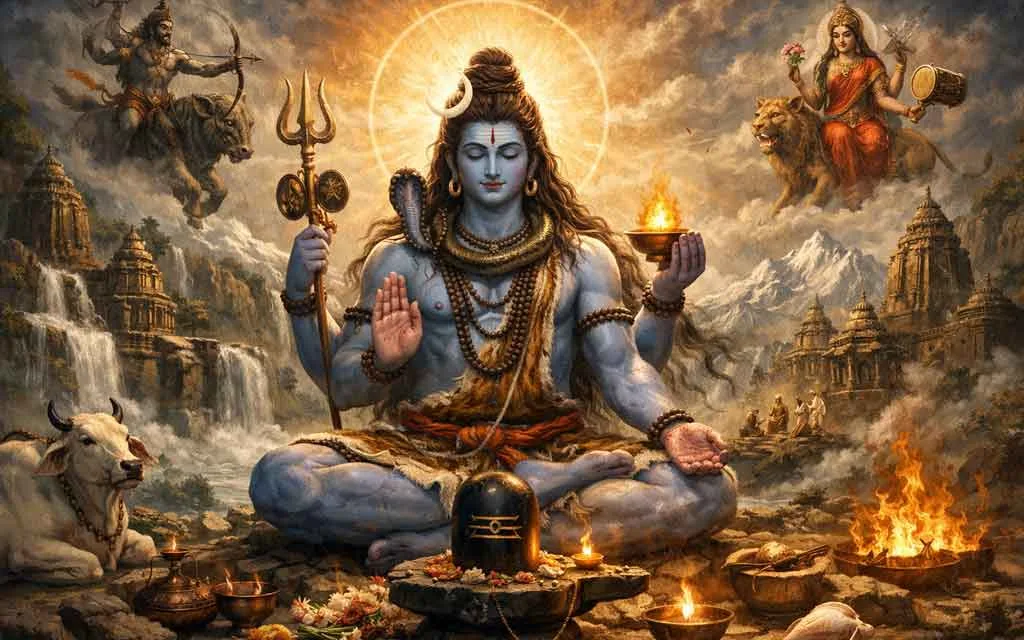
Om Namah Shivaya Mantra Meaning and Benefits
Om Namah Shivaya Mantra Meaning and Benefits: Chanting for Inner Peace, Purification and Union with Shiva Dear devotees, in this sacred moment, my soul bows in…

Om Namah Shivaya Mantra Meaning and Benefits: Chanting for Inner Peace, Purification and Union with Shiva Dear devotees, in this sacred moment, my soul bows in…
Om Namah Shivaya Mantra Meaning and Benefits: Chanting for Inner Peace, Purification and Union with Shiva
Dear devotees, in this sacred moment, my soul bows in eternal surrender to Paramashiva, the auspicious One, the eternal consciousness who resides in every heart as pure awareness. O beloved children of Sanatana Dharma, scattered across the world yet united in devotion, let us chant together the most compassionate of all mantras:
Om Namah Shivaya
I bow to Shiva, the Supreme Self, the destroyer of illusion, the bestower of peace. O Mahadeva, dissolve my ego, purify my being, and merge me into Your infinite bliss. Om Namah Shivaya! Hara Hara Mahadev!
The Om Namah Shivaya mantra, known as the Panchakshara (five-syllable) mantra, is the very heartbeat of Shaivism and the essence of Shiva's grace. Revered across millennia, it flows effortlessly from the lips of sages in the Himalayas to families in distant lands. As your humble priest sharing this divine nectar like a loving elder offering prasad, I invite you to embrace this sacred chant. Whether whispered in solitude or sung in temple halls, Om Namah Shivaya unites every Hindu heart in pure love and unity in diversity.
The Origin and Mythological Story of Om Namah Shivaya
Legends from Puranas and Vedas: The Eternal Sound of Creation
The Panchakshara mantra originates in the Yajur Veda (Taittiriya Samhita 4.5.8 and Shri Rudram), where it appears as the supreme invocation to Lord Rudra-Shiva.
In the Shiva Purana, it is declared the most auspicious of all mantras, capable of granting liberation even to the unworthy when chanted with faith. The five syllables (Na-Maḥ-Śi-Vā-Ya) correspond to the five elements and Shiva's five divine acts: creation, preservation, dissolution, obscuration, and revelation.
A beautiful legend tells of a hunter who, unaware of its meaning, repeatedly uttered "Shiva" while setting traps in the forest. Simply by pronouncing the Lord's name, his sins dissolved, and Shiva appeared to grant him moksha. This story illustrates that sincere utterance of Om Namah Shivaya purifies even the most burdened soul.
Another profound tale involves Sage Upamanyu, who survived on milk offered to Shiva while chanting this mantra, receiving divine vision and sustenance directly from Mahadev.
Dear devotees, these leelas teach us that Shiva's name is accessible to all – no elaborate rituals needed, only pure devotion.
Spiritual Significance of Om Namah Shivaya: Union with the Supreme Self
Om Namah Shivaya is not merely a chant but a complete sadhana for self-realization. "Namah Shivaya" means "I bow to Shiva" – the inner auspicious consciousness beyond form.
- Na – Earth element; removes ego
- Ma – Water; purifies emotions
- Shi – Fire; burns impurities
- Va – Air; grants freedom
- Ya – Akasha (ether); awakens divine consciousness
Prefixed with Om, the primal sound, it becomes the six-syllable mantra connecting us to Brahman.
Chanting dissolves karma, calms the mind, and leads to Shivoham (I am Shiva) realization. As Adi Shankaracharya teaches in his Shivananda Lahari, this mantra is the boat to cross the ocean of samsara.
In my priestly reflection: From Kashi to Kailasha, from diaspora homes to grand temples, this mantra echoes eternally, binding us as one divine family.
The Om Namah Shivaya Mantra: Text, Pronunciation, and Word-by-Word Meaning
Phonetic Pronunciation Guide
Om Na-mah Shi-vaa-ya (With gentle pause: Om... Namah... Shivaya)
Chant slowly, feeling each syllable vibrate in the heart.
Word-by-Word Devotional Explanation
- Om: The universal sound, representing Brahman, the source of all creation.
- Namah: I bow, I surrender, I offer salutations with humility.
- Shivaya: To Shiva, the auspicious One, the eternal welfare-bestower, the pure consciousness.
Full meaning: "I bow to the Supreme Auspicious One, the inner Self, the embodiment of pure consciousness and eternal bliss."
This simple yet profound declaration dissolves separation, affirming our oneness with Shiva.
Traditional Rituals and Chanting Rules: Step-by-Step Guidance
Auspicious Timings and Muhurat
- Brahma Muhurta (pre-dawn) – most powerful for spiritual awakening.
- Pradosh Kaal (evening twilight) – especially pleasing to Shiva.
- Mondays and Shravan month – highly auspicious.
- Maha Shivaratri (February 15, 2026) – ideal for intensive japa.
Daily minimum: 108 repetitions; advanced devotees chant continuously.
Om Namah Shivaya Chanting Rules Step-by-Step
- Purification: Bathe and wear clean clothes; maintain sattvic lifestyle.
- Setup: Sit facing north or east; place a Shivling or image with bilva leaves.
- Sankalpa: Mentally dedicate your japa for peace, purification, or liberation.
- Japa Method:
- Use rudraksha mala (108 beads ideal).
- Chant clearly but softly, feeling vibrations in the heart.
- Focus on the space between eyebrows or heart center.
- Mental chanting (manasika japa) is most powerful.
- Offerings:
- Bilva leaves (most beloved)
- Milk, water, or gangajal for abhishekam
- Incense, diya, flowers
- Conclusion: Offer gratitude and end with "Om Shanti."
For diaspora Hindus: Chant during daily routines – walking, driving (mentally), or before sleep.
Modern Practice for Global Hindus: Unity in Diversity
Today, Om Namah Shivaya resonates in yoga studios, meditation centers, and homes worldwide. Diaspora communities gather for group chanting, online Shivaratri events, and kirtans.
Practical tips:
- Use apps or recordings for correct pronunciation.
- Introduce children early – it protects and calms.
- Chant during challenges for instant peace.
Explore sacred wisdom on hindutone.com:
- Temples
/temples/ - Tirumala Updates
/tirumala/ - Sabarimala Yatra
/category/sabarimala-yatra/ - Pooja, Slokas & Mantras
/pooja-slokas-and-mantras/ - Hindu Gods
/hindu-gods/
Devout japa yields boundless grace:
- Spiritual: Ego dissolution, karma cleansing, path to moksha
- Mental: Deep peace, reduced anger/anxiety, enhanced focus
- Physical: Balances nervous system, promotes healing
- Worldly: Protection, harmonious relationships, removal of obstacles
Scriptures declare: Even one sincere utterance destroys mountains of sin. Continuous chanting leads to Shiva's direct darshan.
Puja and Mantra Suggestions
Simple Daily Puja:
- Offer bilva leaves while chanting.
- Perform rudrabhishekam on Mondays.
- Recite Shiva Tandava Stotram or Lingashtakam alongside.
For protection: Chant during eclipses or difficult times.
Combine with Mahamrityunjaya for healing.
Conclusion: A Priest's Heartfelt Blessing
Dear devotees across the oceans and continents, let Om Namah Shivaya become your constant companion – your breath, your refuge, your joy. May each chant dissolve illusion and reveal the Shiva within.
May Parameshvara shower His boundless compassion upon you, purify your being, grant unshakable peace, and lead you to eternal union.
Om Namah Shivaya! Hara Hara Mahadev! May Shiva's grace embrace every Hindu soul worldwide.
Frequently Asked Questions
What is the Om Namah Shivaya Mantra Meaning and Benefits?
Om Namah Shivaya Mantra Meaning and Benefits: Chanting for Inner Peace, Purification and Union with Shiva Dear devotees, in this sacred moment, my soul bows in eternal surrender to Paramashiva , the auspicious One, the eternal consciousness who resides in every heart as pure awareness. O beloved children of Sanatana Dharma, scattered across the world yet uni
How many times should the Om Namah Shivaya Mantra Meaning and Benefits be chanted?
It is traditionally chanted 108 times using a rudraksha or tulsi mala. Even 11 or 21 sincere repetitions daily are considered beneficial — steady, focused practice matters more than the count.
What is the best time to chant the Om Namah Shivaya Mantra Meaning and Benefits?
Dawn (Brahma Muhurta) after a bath is considered ideal, though it may be chanted any time with a calm, focused mind. Many devotees keep a fixed daily time to build consistency.
Who can chant the Om Namah Shivaya Mantra Meaning and Benefits?
Anyone may chant it with faith and a pure mind, regardless of age, gender or background. Beginners benefit from first hearing the correct pronunciation and understanding its meaning.
What are the benefits of chanting the Om Namah Shivaya Mantra Meaning and Benefits?
Devotees chant it to invoke Lord Shiva's grace — for inner peace, protection, focus and spiritual progress.