Karthika Purnima 2026: Significance, Rituals, and the Triple Festival Across Hindu, Sikh, and Jain Traditions
The full moon of Karthika month — Dev Diwali at Varanasi, Guru Nanak Jayanti for Sikhs, Mahavir's sermon for Jains, Tripura Purnima for Shaivas. Discover the cosmic origin, sacred bath at Ganga, lighting of 365 lamps, and why one of Hinduism's most powerful days unites three Indian religions.
The full moon of Karthika month — Dev Diwali at Varanasi, Guru Nanak Jayanti for Sikhs, Mahavir's sermon for Jains, Tripura Purnima for Shaivas. Discover the cosmic origin, sacred bath at Ganga, lighting of 365 lamps, and why one of Hinduism's most powerful days unites three Indian religions.
On the full moon night of the Karthika month — typically falling in late November — one of the most spiritually charged days in the Hindu calendar arrives. Karthika Purnima is not just a festival; it is the convergence point of three religions. For Hindus, it is the night Lord Shiva slew the demon Tripurasura and the gods rained celestial lamps in celebration — the original Dev Diwali. For Sikhs, it is Guru Nanak Jayanti, the birthday of the founder of the Sikh tradition. For Jains, it is the day Lord Mahavir delivered his first sermon. Three religions; one full moon; one shared moment of light.
This HinduTone guide opens Karthika Purnima 2026: the cosmic origin in the Skanda Purana, the rituals of the sacred Kartik snan, the lighting of 365 wick lamps, the Dev Diwali spectacle at Varanasi where the ghats hold over a million diyas, the Sikh Gurpurab traditions, the Jain observances, and why this single full moon is one of the most powerful spiritual days in the Indian year.
Karthika Purnima 2026: Date and Astronomical Significance
In 2026, Karthika Purnima falls on Tuesday, November 24. The full moon rises in the Kartik nakshatra of the Karthika month — the eighth lunar month in the Hindu calendar. For exact tithi and muhurat times, use Drik Panchang for your city. The bathing ritual (snan-daan) is most powerful at dawn on November 5; the lamp-lighting (deepa-daan) is performed at sunset and through the night.
- Date: Tuesday, November 24, 2026 (Purnima tithi — check Drik Panchang for exact start and end times in your city)
- Guru Nanak Jayanti (Gurpurab) and Varanasi’s Dev Deepawali: also on the Kartika Purnima, 24 November
- Snan-daan: November 24, in the Brahma muhurta before sunrise
- Deepa-daan: November 24, in the Pradosh period after sunset
- Astronomically: the moon is closest to Earth on this night during a winter Purnima, making moonlight unusually intense.
The Cosmic Story: Tripurasura and the Original Dev Diwali
The Skanda Purana, Linga Purana, and Shiva Purana all tell the same story. Three demon brothers — Vidyunmali, Tarakaksha, and Viryavana — performed such intense tapasya that Brahma granted them an unusual boon: they would each be granted a flying city (Tripura — "three cities"), and they could be destroyed only by a single arrow that combined the energy of all the gods, fired at the precise moment when all three cities aligned in the sky.
The brothers used the boon to terrorize the cosmos. Their three flying cities — one of gold in the heavens, one of silver in the sky, one of iron on earth — moved at impossible speeds. The gods, defeated repeatedly, gathered before Lord Shiva and pleaded for intervention. Shiva agreed. The cosmic preparation was unprecedented: Vishnu became the arrow, Brahma the bowstring, the earth itself became the chariot, the four Vedas the horses, the sun and moon the wheels. The bow was made from Mount Mandara.
On Karthika Purnima night, the three cities aligned for a single moment. Shiva fired the arrow. All three Tripuras were destroyed in a single instant. The cosmos, freed from the tyranny of the demons, erupted in celebration — the gods showered the earth with thousands of celestial lamps, lighting up every river, every village, every mountain. That night, the saying goes, even Yamapuri was lit. Karthika Purnima is the anniversary of that cosmic festival of light — the original Dev Diwali, the Diwali of the gods.
The Sacred Kartik Snan: Bathing in the Most Powerful Waters of the Year
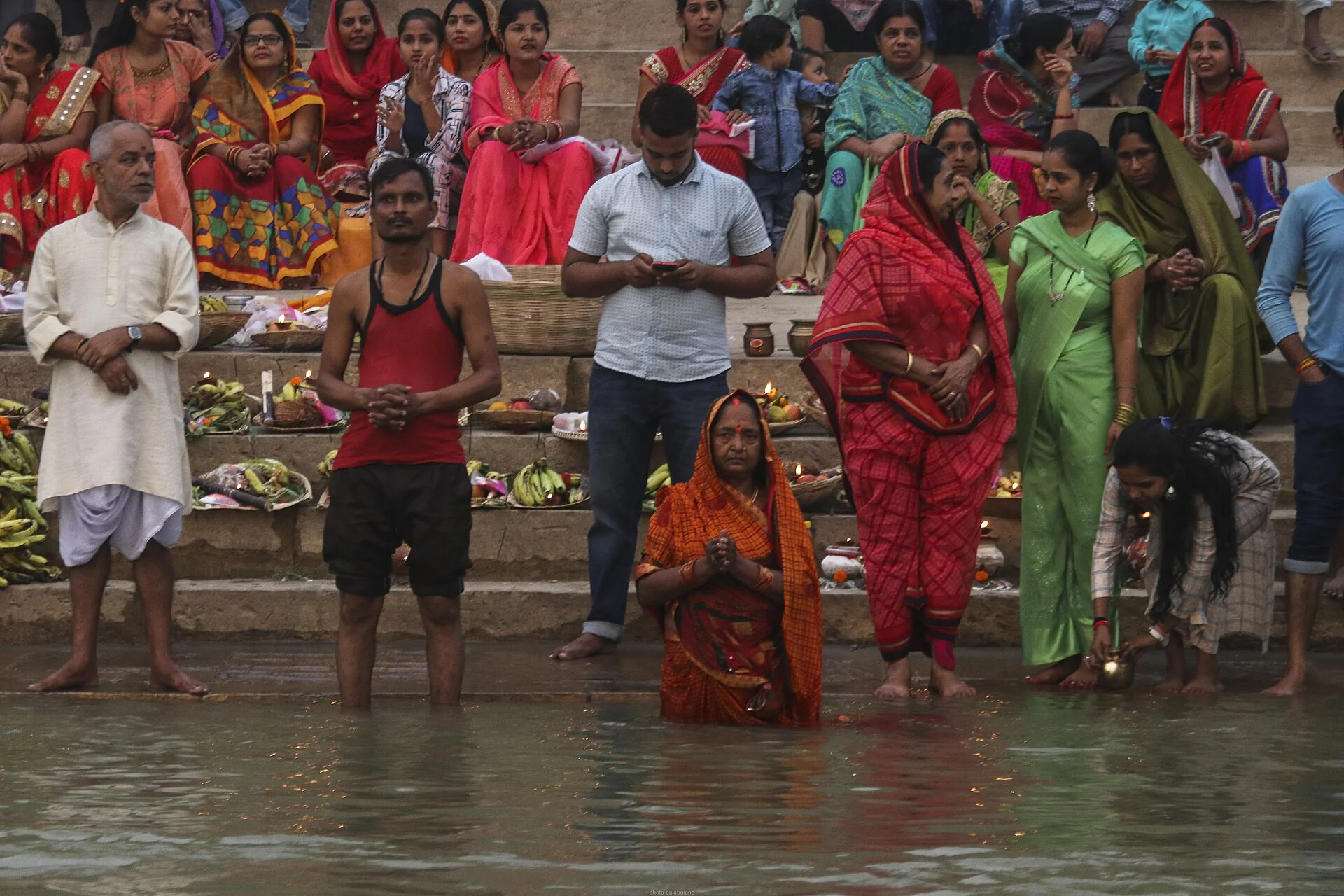
Of all the sacred bathing rituals in Hinduism, the Kartik snan on Karthika Purnima morning is considered the most spiritually powerful. The shastras say that bathing in any holy river at dawn on this day grants the merit of a hundred Ashwamedha yajnas — and that even bathing at home with water touched by a single tulsi leaf carries the karmic weight of a full Ganga pilgrimage.
- Pre-dawn bath at Ganga, Yamuna, Godavari, Krishna, Kaveri, Narmada, or Saraswati at sunrise.
- Sankalpa (vow of intent) before stepping into the water — name your desire for the year.
- Bath with chanting of "Om Namo Narayana" or "Om Namah Shivaya" — both deities are honoured on this day.
- Application of sandal paste, tilak, and bilva or tulsi water after the bath.
- For those who cannot reach a river: a sankalpa-bath at home using water touched with tulsi, bilva, sesame, and one drop of Ganga water (commonly available in bottles).
The most famous Karthika Purnima snan is at Pushkar in Rajasthan. The Brahma temple — the only major Brahma temple in India — performs special abhishekam on this day, and over 200,000 pilgrims gather at the Pushkar lake for the dawn bath. The Pushkar Mela (cattle and camel fair) runs for 14 days around Karthika Purnima, drawing pilgrims, traders, and photographers from around the world.
Dev Diwali at Varanasi: The Million-Diya Spectacle
Of all the Karthika Purnima observances, none is as visually overwhelming as Dev Diwali at Varanasi. The 84 ghats along the western bank of the Ganga are lit with over a million diyas — earthen oil lamps placed at every step, on every parapet, floating in the river itself. The reflections double the count; from the eastern bank, the entire shoreline appears to be made of fire. Devotees describe it as the closest the human world ever comes to looking like the heavens.
The Varanasi Dev Diwali tradition is said to date to the 1985 revival by Pundit Lokesh Chandra of the Ganga Mahotsav. Before 1985 the practice existed locally but was modest; since then, with municipal involvement and global attention, it has grown to one of the most photographed religious events in India. The 21 organized arati performances at major ghats — Dashashwamedh, Manikarnika, Assi, Tulsi, Panchganga — happen simultaneously at sunset, the conches sound together, and a single million-strong audience watches.
- Arrive at Varanasi at least two days in advance — accommodation books out completely.
- Reserve a boat seat from a registered ghat operator for the Ganga-from-water view.
- The Dashashwamedh aarti at sunset is the focal point; arrive by 4:30 PM for a good ground spot.
- After the formal aarti, walk slowly along the ghats — every step is a different diya pattern.
- The 21 ghats are simultaneously lit; you cannot see all in one night, choose your priority area.
The Lighting of 365 Lamps: A Year-Long Vrata in One Night
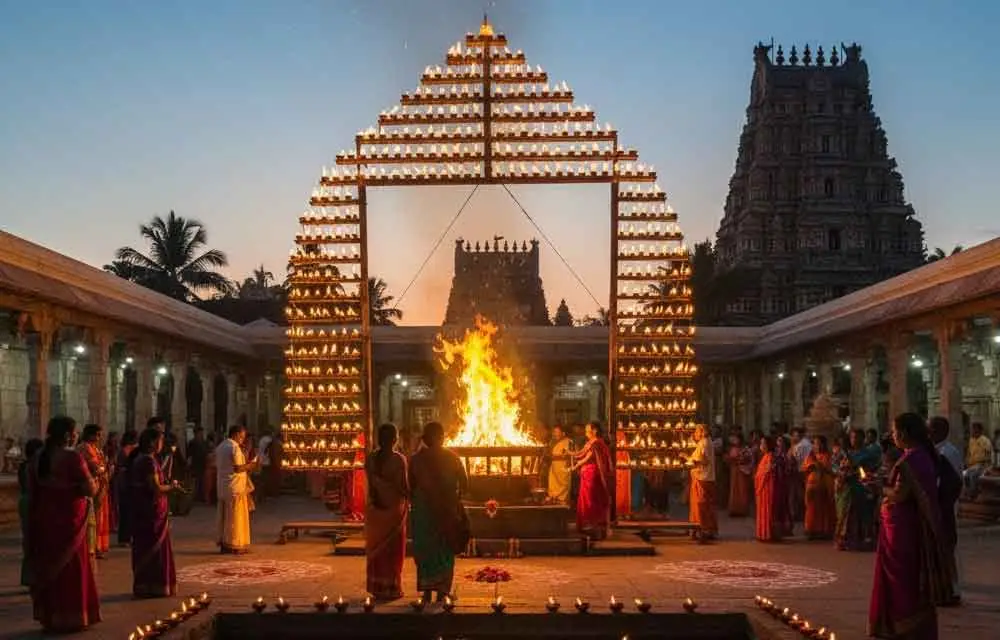
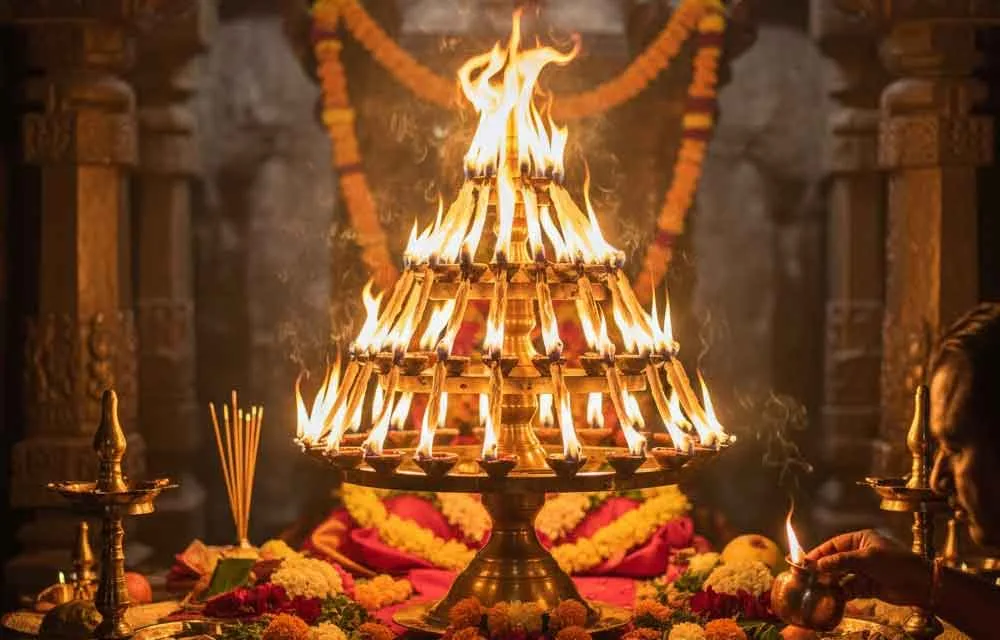
A unique Karthika Purnima tradition, particularly observed in Andhra Pradesh, Telangana, and Karnataka, is the lighting of 365 oil lamps — one for each day of the coming year. This is called the Karthika Pournami Vattulu or Pancha-shata-deepam in different regional traditions, and it consolidates a year of devotional merit into a single night.
- 365 small clay diyas are arranged in a mandala or on the temple's outer wall.
- Each lamp is filled with sesame oil (preferred) or ghee, with a cotton wick.
- Lighting begins at sunset with the family's eldest performing the first lamp.
- A short Shiva or Vishnu mantra is recited as each lamp is lit — Om Namah Shivaya, Om Namo Narayana, or simply "Tripura-vinashana Hara".
- The lamps are typically allowed to burn out naturally over 3-4 hours.
- The combined light is offered as a Pradosha-kala aarti to the household deity.
The merit promised by the shastras for this practice is extraordinary: every lamp lit on Karthika Purnima is said to provide one day of moksha-grace; 365 lamps thus secure an entire year of divine protection. The practice is open to all — householder devotees, women, children — making it one of the most democratic Hindu observances.
Guru Nanak Jayanti: The Sikh Gurpurab on the Same Full Moon
Karthika Purnima also marks the birth of Guru Nanak Dev Ji, the first of the Sikh gurus and the founder of Sikhism (born November 5, 1469 CE by Hindu lunar calendar — Karthika Purnima of that year). In 2026, the 557th Gurpurab is observed on the same Thursday, November 24. Sikhs across the world celebrate this as one of the holiest days of the year.
- Prabhat Pheri: a pre-dawn procession through Sikh neighborhoods, singing kirtans (devotional songs).
- Akhand Path: a continuous 48-hour reading of the Guru Granth Sahib, concluded on the morning of the Gurpurab.
- Nagar Kirtan: a grand street procession from the Gurdwara, led by the Panj Pyare (five beloved ones) carrying the Guru Granth Sahib.
- Langar: free community meals open to all, regardless of religion, caste, or status.
- Lighting of the Gurdwaras: the Golden Temple at Amritsar is illuminated with over 100,000 diyas — a Sikh parallel to Hindu Dev Diwali.
The synchronicity is not accidental. Guru Nanak's teachings — that there is one God, that all religions point toward the same truth, that ritual without inner transformation is hollow — were grounded in the same Karthika Purnima lunar power. The Sikh tradition's most important festival, by quirk of birth-date, falls on the same night Hindus celebrate Tripurasura's destruction. The light, in both traditions, is the same light.
The Jain Observance: Mahavir's First Sermon
For the Jain community, Karthika Purnima holds yet another significance. According to Jain tradition, Lord Mahavir — the 24th Tirthankara — delivered his first sermon (the Mahavir Samavasarana) on the day immediately following his attainment of Keval Gyan (omniscient knowledge), which is recorded as the day after Karthika Purnima. The Jain calendar marks this period as a time of intense spiritual practice, and many Jain temples perform special ceremonies.
In addition, Karthika Purnima is the official end of the Chaturmas — the four-month monsoon period during which Jain monks and nuns observe Chaturmas Vrata, refraining from travel to avoid harming small organisms that proliferate during monsoon. On the morning after Karthika Purnima, the monks and nuns symbolically depart their monsoon shelter, called Chaturmas Vihar, and resume their wandering tradition. Jain devotees mark this transition with rituals at major Jain temples.
Karthika Purnima at the Sacred Geography of India
Different regions of India observe Karthika Purnima in profoundly different ways, each adding to the day's spiritual richness:
- Varanasi (Uttar Pradesh): Dev Diwali — the million-diya night on the Ganga ghats.
- Pushkar (Rajasthan): Pushkar Mela and the Brahma Temple snan-daan.
- Andhra & Telangana: 365-lamp lighting (Karthika Pournami Vattulu) at temples and homes.
- Kerala: Tripura Deepam at Annamalaiyar Temple (Tiruvannamalai, just over the border) — a massive mountain-top fire visible for 20 km.
- Orissa & West Bengal: Boita Bandana — the maritime tradition of floating miniature boats in rivers, commemorating Karthika's ancient maritime trade.
- Tamil Nadu (Tiruvannamalai): Karthikai Deepam at Arunachaleshwarar Temple — a single massive bronze cauldron lit atop the Arunachala hill, considered Lord Shiva's self-manifestation as fire.
- Pandharpur (Maharashtra): Wari pilgrimage and the Vithoba temple festival.
- Mathura: Krishna-Janmabhoomi rituals and the lighting of all Banke Bihari and Dwarkadhish temple complexes in Vrindavan.
Spiritual Practices for Karthika Purnima Day
For devotees who wish to observe Karthika Purnima from home — without traveling to Varanasi, Pushkar, or Tiruvannamalai — the shastras prescribe a complete practice that consolidates the day's merit into a household ritual:
- Wake before sunrise. Take a holy bath at home with water touched by tulsi leaves and a drop of Ganga water.
- Wear clean white or saffron clothing. No jewellery or cosmetics on this day.
- Light a household lamp at the family altar at sunrise; let it burn through the day.
- Fast partially or fully — many devotees observe nirjala fast (without water) until evening; others take only fruits and milk.
- Recite the Tripura-stotra, the Shiva Sahasranama, or the Vishnu Sahasranama through the day.
- At sunset, perform Pradosha-kala puja — the most powerful muhurat of the day.
- Light at least 11 lamps (or 21, 51, 108, or 365) outside the home, at the temple, or in the immediate neighbourhood.
- Read or hear the Tripurasura legend from the Skanda Purana before sleep.
- Donate to a temple, a needy family, or to a Sikh langar — daan is essential on Karthika Purnima.
Why Karthika Purnima is the Most Spiritually Powerful Full Moon
There are twelve Purnimas in a Hindu year, one for each month. Of these, Karthika Purnima is the most spiritually charged. The reasons converge from multiple traditions:
- Astronomically: the moon is unusually close to Earth on Karthika Purnima, and the moonlight is unusually intense.
- Cosmically: it is the night Tripurasura was destroyed — the universe was freed in a single arrow.
- Religiously: it is the founding day of Sikhism (Guru Nanak Jayanti) and an important Jain observance.
- Devotionally: the sacred bathing and lamp-lighting on this day are said to absolve karmic burdens of a hundred lifetimes.
- Geographically: it is the day Varanasi, Pushkar, Tiruvannamalai, and dozens of other sacred sites are simultaneously at their devotional peak.
In an age when religious traditions emphasize their differences, Karthika Purnima stands as a quiet reminder of their convergence. Hindus, Sikhs, and Jains all light lamps on the same night, for different reasons, in the same tradition. The light, in the end, is one.
Om Tripurasura-vinashanaya Namah. Waheguru. Namo Arihantanam.
Also read: Guru Nanak Jayanti 2026.
Frequently asked questions
When is Karthika Purnima in 2026?
Karthika Purnima falls on Tuesday, November 24, 2026. For exact tithi and muhurat times in your city, check Drik Panchang.
What is the story behind Karthika Purnima and Dev Diwali?
As commonly told, Shiva destroyed the three flying cities of the demon brothers called Tripurasura with a single arrow on this night. The gods then showered the earth with celestial lamps, which is why it is called the original Dev Diwali.
How do I perform the Kartik snan on Karthika Purnima?
Bathe at dawn in a holy river such as the Ganga, after a sankalpa, chanting "Om Namo Narayana" or "Om Namah Shivaya". If you cannot reach a river, take a sankalpa-bath at home using water touched with tulsi, bilva, sesame and one drop of Ganga water.
What is the tradition of lighting 365 lamps on Karthika Purnima?
Observed particularly in Andhra Pradesh, Telangana and Karnataka, it involves lighting 365 clay lamps, one for each day of the coming year. They are filled with sesame oil or ghee and lit from sunset with a Shiva or Vishnu mantra.
Why is Karthika Purnima also celebrated by Sikhs and Jains?
For Sikhs it is Guru Nanak Jayanti, the birthday of the founder of the Sikh tradition. For Jains it is the day Lord Mahavir delivered his first sermon.
What should I know before visiting Varanasi for Dev Diwali?
The ghats along the Ganga are lit with over a million diyas, so arrive at least two days in advance as accommodation books out. Reserve a boat seat from a registered ghat operator and reach the Dashashwamedh aarti by 4:30 PM for a good spot.
You might also like
Karthika Masam 2026: Dates, Rituals, Vrat, Festivals & North vs South India Guide
How Varanasi Will Celebrate Karthika Masam 2025: The Divine Month of Lights and Devotion
Karthika Pournami 2026 Purnima Time in India: Tithi Start and End, City-Wise Sunset and the Evening Lamp Window