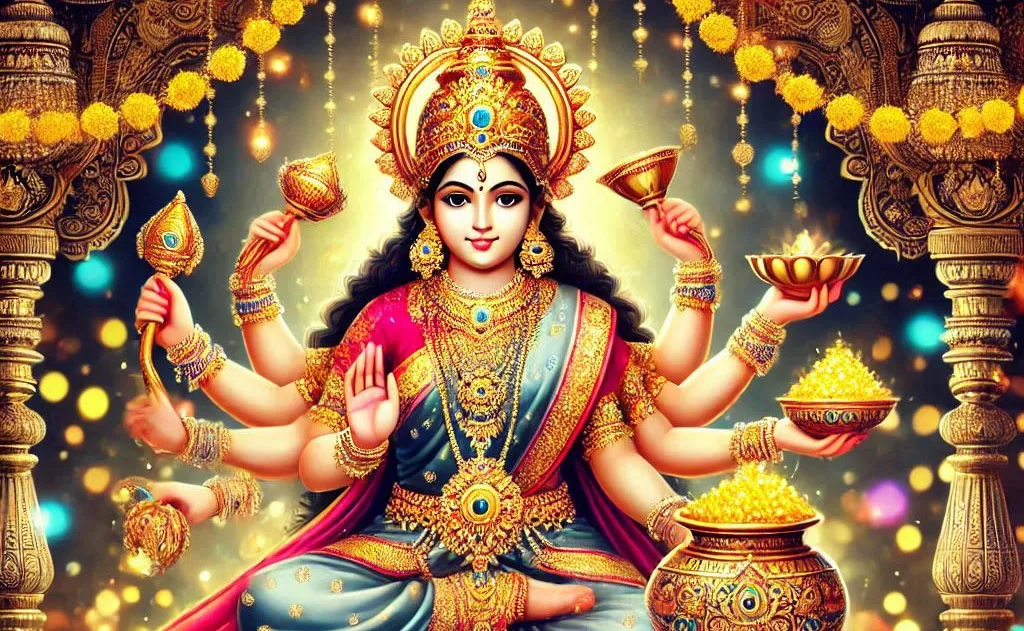
Mahalakshmi Vrata 2026: Significance, Rituals, and the Sixteen-Day Puja That Brings Lakshmi Home
The 16-day women's vrata where Goddess Mahalakshmi is invited home as a guest — Bhadrapada Shukla Ashtami to Ashwin Shukla Ashtami. Cosmic origin from Mahabharata, daily ritual sequence, the sacred 16 knots, traditional songs, and how to perform the complete vrata.
The 16-day women's vrata where Goddess Mahalakshmi is invited home as a guest — Bhadrapada Shukla Ashtami to Ashwin Shukla Ashtami. Cosmic origin from Mahabharata, daily ritual sequence, the sacred 16 knots, traditional songs, and how to perform the complete vrata.
Of all the vratas observed by Hindu women, none is as elaborate or as deeply rooted in domestic tradition as Mahalakshmi Vrata. For sixteen consecutive days — from the Ashtami of Bhadrapada Shukla to the Ashtami of Ashwin Shukla — married women across South India invite Goddess Mahalakshmi into their homes as an honoured guest. They prepare for her arrival, perform daily worship, sing traditional songs, tie sixteen sacred knots on a single thread, and on the sixteenth day, conduct the udyapan (concluding ceremony) that releases her back to her cosmic abode with offerings of gratitude.
This HinduTone guide opens the Mahalakshmi Vrata: the cosmic origin in the Mahabharata where Lord Krishna himself prescribes the ritual to Yudhishthira, the day-by-day sequence of the sixteen-day observance, the symbolism of the sixteen knots, the traditional Lakshmi songs, dates for 2026, and why this is considered the most spiritually transformative vrata a Hindu woman can undertake.
Mahalakshmi Vrata 2026: Dates and Astronomical Window
In 2026, Mahalakshmi Vrata is observed from Tuesday, September 22 (Bhadrapada Shukla Ashtami) through Wednesday, October 7 (Ashwin Shukla Ashtami). The vrata spans sixteen consecutive days, with the most significant ceremonies occurring on day one (Ahvana — invitation), day eight (Madhya Ashtami), and day sixteen (Udyapan — conclusion).
- Day 1 (Ahvana — Invitation): Tuesday, September 22, 2026 — Bhadrapada Shukla Ashtami
- Day 8 (Madhya Ashtami — Midpoint): Tuesday, September 29, 2026
- Day 16 (Udyapan — Conclusion): Wednesday, October 7, 2026 — Ashwin Shukla Ashtami
- Best muhurat each day: morning (after bath, before noon) or evening (during pradosh, just before sunset)
- The vrata may be undertaken once, repeated annually, or vowed for 16 consecutive years for the deepest merit.
The Cosmic Story: Krishna Teaches Yudhishthira
The Mahabharata's Aranya Parva preserves the original story. After the Pandavas had been exiled to the forest, Draupadi was burdened by the responsibilities of managing a household without resources. Approaching her husband Yudhishthira, she lamented the loss of prosperity, the difficulty of feeding guests, the impossibility of maintaining the dignity of a queen in poverty.
Yudhishthira sought counsel from the visiting sage Markandeya, who in turn directed him to Lord Krishna. When asked about the means to restore prosperity, Krishna explained that there existed an ancient vrata, taught to him by his own mother Devaki — the Mahalakshmi Vrata — by which Goddess Lakshmi herself could be invited to take residence in any home. The vrata, Krishna explained, was not a ritual of asking but a ritual of hosting; the goddess responded not to demand but to invitation.
Krishna prescribed the sixteen-day sequence in detail. Draupadi performed it. By the end of the sixteen days, the goddess herself had blessed the Pandavas' forest dwelling with such abundance that even refugees from neighboring kingdoms could be fed. The vrata thereafter spread through royal women, brahmin women, merchant women, and finally to every Hindu woman who chose to undertake it. It has been continuously observed for over two thousand years.
The Setup: Welcoming Goddess Mahalakshmi as a Guest
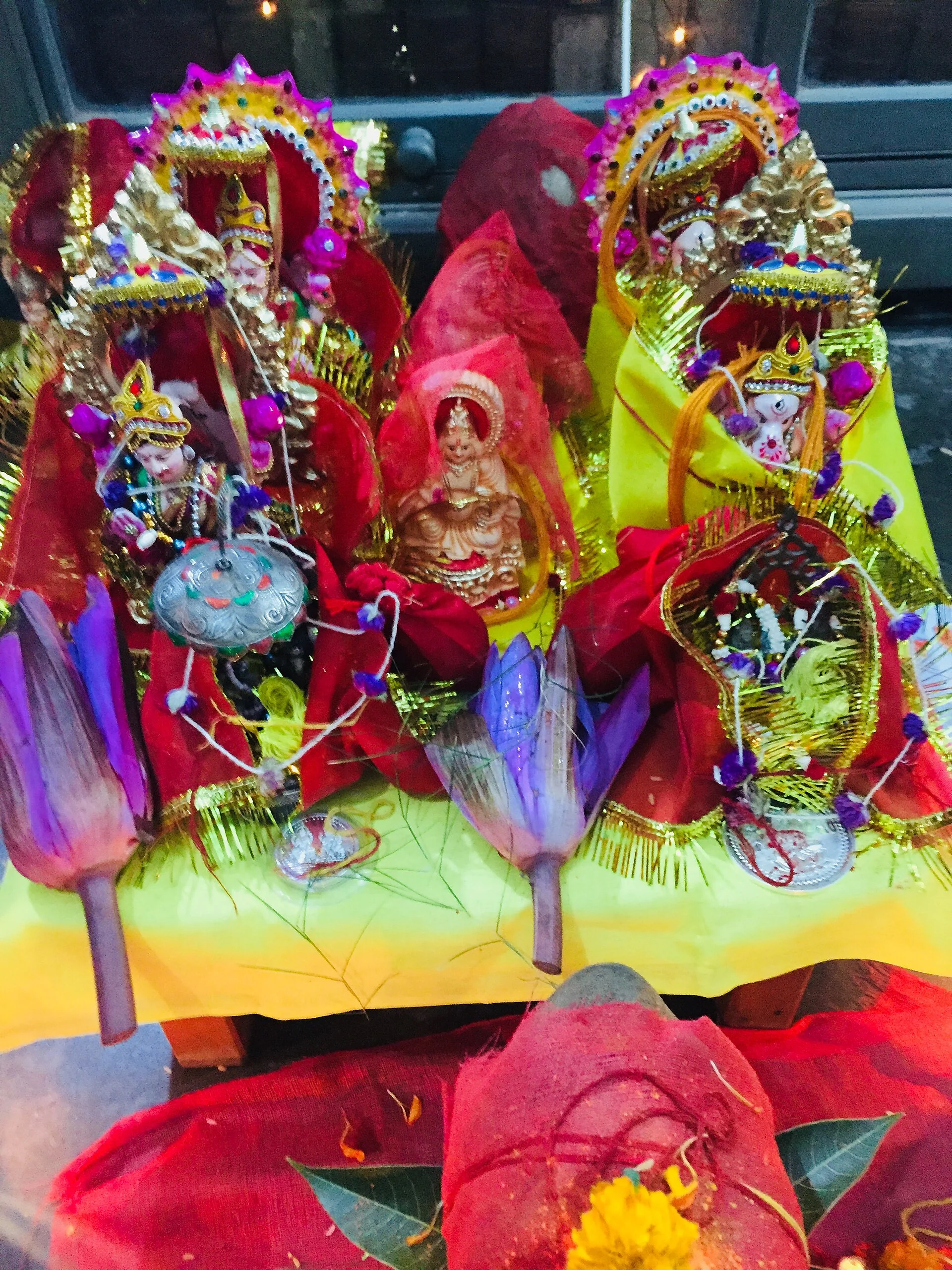
Unlike most Hindu pujas which install a deity to be worshipped, Mahalakshmi Vrata installs the deity as a guest to be hosted. The distinction matters: every act of the sixteen days is structured around hospitality, not adoration. The goddess is brought into the home, given a seat, fed, sung to, dressed, and entertained — as one would treat the most honoured family member arriving for an extended stay.
- A clean wooden plank or low stool is placed in the puja room — this is Lakshmi's seat for sixteen days.
- On the plank, a copper or silver pot (kalasha) is set, filled with raw rice, with a coconut on top — this is the goddess's body.
- The kalasha is wrapped in a yellow or red silk cloth and decorated with turmeric and kumkum. A small mirror is placed in front so the goddess can see her own reflection.
- A traditional Mahalakshmi murti (often of turmeric paste, freshly made each year) is placed beside the kalasha.
- Sixteen mango leaves are placed around the kalasha — one for each day of the vrata.
- The puja space is kept lit with a steady oil lamp through all sixteen days; the lamp is never allowed to go out.
The Sixteen Sacred Knots: Pavitra Granthi
The most distinctive element of Mahalakshmi Vrata is the Pavitra Granthi — the sacred thread with sixteen knots. The woman performing the vrata wears this thread on her right wrist throughout the sixteen days. Each knot is tied by the woman herself, with mantras, at specific moments in the puja sequence.
- The thread is made of yellow cotton or silk, soaked in turmeric water for purification.
- Each of sixteen knots represents one of the sixteen days; a knot is tied on the corresponding morning before the day's puja.
- Each knot is also said to represent one of Lakshmi's sixteen forms: Adi Lakshmi (the original form), Dhanya Lakshmi (grain), Dhairya Lakshmi (courage), Gaja Lakshmi (royalty), Santana Lakshmi (children), Vijaya Lakshmi (victory), Vidya Lakshmi (knowledge), Dhana Lakshmi (wealth), and eight more.
- The thread is not removed for any reason during the sixteen days; if it breaks, the woman must immediately tie a fresh thread and re-knot all knots up to that day.
- On the sixteenth day, after the udyapan, the thread is removed and placed at the feet of the goddess, then kept in the family's prosperity-safe (jewellery box or kalasha) until the next year's vrata.
The Day-by-Day Ritual Sequence
The sixteen days follow a structured progression: invitation (days 1-3), establishment (days 4-7), midpoint celebration (day 8), continued worship (days 9-15), and udyapan (day 16). Each day has its own focus.
- Day 1 (Ahvana): the goddess is formally invited into the home with the Lakshmi Ashtottara and the Pavitra Granthi is tied with the first knot.
- Days 2-7: daily morning and evening pujas. Specific offerings each day — rice, milk, fruit, sweet, garland, sandal paste. A different of Lakshmi's sixteen forms is honoured each day.
- Day 8 (Madhya Ashtami): the midpoint celebration. The household prepares a special meal (typically panchamrit, payasam, and 9 vegetables) and invites neighboring women to share. The goddess accepts the most elaborate offering of the cycle on this day.
- Days 9-15: continuation. The household becomes increasingly lit, decorated, and fragrant. The puja room is the focal point of the home; visitors are received there.
- Day 16 (Udyapan): the goddess is bid farewell. A large abhishekam is performed; sixteen women are fed in her name; the kalasha water is poured at the household threshold to invite her annual return.
Throughout the sixteen days, women observe partial fasting — eating only once a day (typically at midday), avoiding non-vegetarian food, and refraining from anger, gossip, and harsh speech. The internal discipline is as important as the external ritual.
Traditional Lakshmi Songs: The Soundtrack of the Vrata
A unique element of Mahalakshmi Vrata is its rich tradition of songs. Unlike many Hindu rituals where Sanskrit mantras dominate, Mahalakshmi Vrata is sung in Telugu, Tamil, Kannada, and Marathi — in the languages of the women who observe it. The songs are intimate, addressing the goddess as a beloved guest:
- "Vakratunda Mahakaya" — sung to remove obstacles before each day's puja.
- "Sri Sukta" — the 15-verse Vedic hymn to Lakshmi from the Rig Veda, sung on days 8 and 16.
- "Lakshmi Astothara Shata Namavali" — the 108 names of Lakshmi, recited each day after the main puja.
- Regional Lakshmi padams — traditional songs in mother tongue. In Telugu households, the "Adi Lakshmi" padam is sung; in Tamil households, the "Mahalakshmi Stotram"; in Kannada households, the "Sri Lakshmi Strotra".
- "Kanakadhara Stotra" — Adi Shankaracharya's eight-verse song that, the tradition holds, can produce literal showers of gold; sung on day 16.
The Sixteen Forms of Mahalakshmi
Each day of the vrata is dedicated to one of Lakshmi's sixteen forms (Shodasha Lakshmi). Understanding these forms reveals the philosophical depth of the practice:
- Adi Lakshmi (original form) — Day 1: the primordial source of all wealth.
- Dhanya Lakshmi (grain) — Day 2: agricultural abundance and food security.
- Dhairya Lakshmi (courage) — Day 3: inner strength to face adversity.
- Gaja Lakshmi (royalty) — Day 4: royal status and dignity.
- Santana Lakshmi (children) — Day 5: progeny and family continuity.
- Vijaya Lakshmi (victory) — Day 6: triumph in undertakings.
- Vidya Lakshmi (knowledge) — Day 7: wisdom and learning.
- Dhana Lakshmi (wealth) — Day 8 (midpoint): material prosperity.
- Aishwarya Lakshmi (sovereignty) — Day 9: command and authority.
- Saubhagya Lakshmi (good fortune) — Day 10: marital harmony.
- Rajya Lakshmi (state wealth) — Day 11: stable kingdoms / households.
- Vara Lakshmi (boon-giver) — Day 12: granter of all sincere requests.
- Mahalakshmi (supreme form) — Day 13: the universal goddess.
- Bhagya Lakshmi (destiny) — Day 14: the unfolding of one's path.
- Mokshalakshmi (liberation) — Day 15: spiritual freedom.
- Sarvashri Lakshmi (all-prosperity) — Day 16: the synthesis of all preceding forms.
Regional Variations Across South India
Mahalakshmi Vrata is observed slightly differently in each southern state, with each region adding its own emphasis:
- Andhra Pradesh & Telangana: emphasis on the kalasha and turmeric murti. Pavitra Granthi tied on right wrist; sixteen women fed at udyapan.
- Tamil Nadu: known as Varalakshmi Nombu in some traditions. Particularly important for newly married women; the bride performs her first vrata in her marital home.
- Karnataka: emphasis on songs — extensive Lakshmi padam repertoire. The midpoint day (Madhya Ashtami) involves singing competitions among neighborhood women.
- Maharashtra: less common but observed in Vidarbha and Marathwada; merged with the Mahalakshmi temple at Kolhapur traditions.
- Kerala: rare; the related Onam Lakshmi pujas dominate in this state.
Spiritual Benefits and Modern Relevance
The shastras promise specific benefits for the woman who completes Mahalakshmi Vrata sincerely:
- Restoration of family prosperity — both material wealth and emotional abundance.
- Removal of doshas (afflictions) that have caused stagnation in business or career.
- Strengthening of the marriage bond and harmony in the household.
- Birth of healthy children for couples seeking progeny.
- Protection of the family from negative external influences.
- Spiritual: the practice of hospitality toward the goddess teaches the deeper truth that prosperity is not something one possesses but something one welcomes.
In contemporary India, with its dual-income households and frequent transcontinental moves, Mahalakshmi Vrata remains surprisingly relevant. Many modern women adapt the practice — performing the puja in apartments instead of traditional homes, ordering custom puja kits online, performing the vrata for shorter durations when sixteen days isn't feasible. The shastras themselves permit a five-day or three-day "compressed" version for women who genuinely cannot manage the full sixteen, with proportionally adjusted benefits.
How to Begin Your First Mahalakshmi Vrata
For a woman undertaking Mahalakshmi Vrata for the first time, the shastras prescribe a specific preparation:
- Consult an elder — mother, mother-in-law, grandmother, or a temple priest — for the family's specific tradition. Each lineage has small variations.
- Acquire the puja materials a week in advance: yellow silk cloth, kalasha, coconut, sixteen mango leaves, turmeric powder, kumkum, sandal paste, oil lamp wicks, ghee, jasmine and lotus flowers, betel leaves, fruits.
- Mark the start date on the calendar — Bhadrapada Shukla Ashtami (in 2026, that is Tuesday September 22).
- On the start day: wake before sunrise, take a holy bath, wear clean traditional clothing, and begin the Ahvana ceremony at the prescribed muhurat.
- Plan to be at home for the morning and evening pujas every day for sixteen days. The household routine must accommodate the goddess's presence.
- Plan the udyapan: invite at least sixteen women for the final day's meal. The udyapan is when the vrata's merit is fully sealed.
- Maintain inner discipline — fast partially, avoid anger and gossip, speak with devotion throughout.
Why Mahalakshmi Vrata Endures
Across two thousand years, through invasions and reform movements, through colonial rule and modern industrialization, Mahalakshmi Vrata has survived in homes across South India. It has not survived because of temples or priests or scriptural enforcement. It has survived because mothers taught daughters, who taught their daughters, who taught theirs.
The teaching is simple: prosperity is not earned, it is welcomed. The goddess of wealth does not respond to demand, only to invitation. The home that creates space for her arrives, decorates for her, sings to her, feeds her — that home becomes her permanent dwelling. And the woman who can do this, sustained for sixteen days, learns something about hospitality that transforms not just her household but herself.
Sri Maha Lakshmyai Namah. May the goddess of wealth take residence in your home this Bhadrapada.
Frequently asked questions
When is Mahalakshmi Vrata observed in 2026?
It runs for sixteen consecutive days, from Tuesday, September 22 (Bhadrapada Shukla Ashtami) to Wednesday, October 7 (Ashwin Shukla Ashtami). The key days are Ahvana on day one, Madhya Ashtami on day eight and Udyapan on day sixteen.
What is the origin of Mahalakshmi Vrata as commonly told?
In the Mahabharata's Aranya Parva, Krishna teaches the vrata to Yudhishthira, saying he learned it from his mother Devaki. Draupadi performed it in the forest, and the goddess is said to have blessed the Pandavas' dwelling with abundance.
What is the Pavitra Granthi thread with sixteen knots?
It is a yellow cotton or silk thread soaked in turmeric water and worn on the right wrist. The woman ties one knot each morning before the day's puja, and each knot stands for a day and a form of Lakshmi.
What fasting rules do women follow during the sixteen days?
Women keep a partial fast, eating only once a day, typically at midday, and avoiding non-vegetarian food. They also refrain from anger, gossip and harsh speech, since inner discipline matters as much as the ritual.
What happens on the sixteenth day of the vrata?
On the Udyapan day, the goddess is bid farewell with a large abhishekam, and sixteen women are fed in her name. The kalasha water is poured at the household threshold, and the thread is removed and placed at the goddess's feet.
You might also like
Sri Suktam: Complete Guide to the 15-Verse Vedic Hymn to Goddess Lakshmi
Where Does Mahalakshmi Reside? Discovering the Sacred Abodes of Lakshmi Devi
Kiranotsav at Kolhapur Mahalakshmi: A Divine Play of Light and Faith