Lord Shiva: The Three Faces NRI Devotees Should Know in 2026
Bholenath, Nataraja and Adiyogi — three faces of the same deity that show up in NRI households at three different moments of life. A 2026 primer.
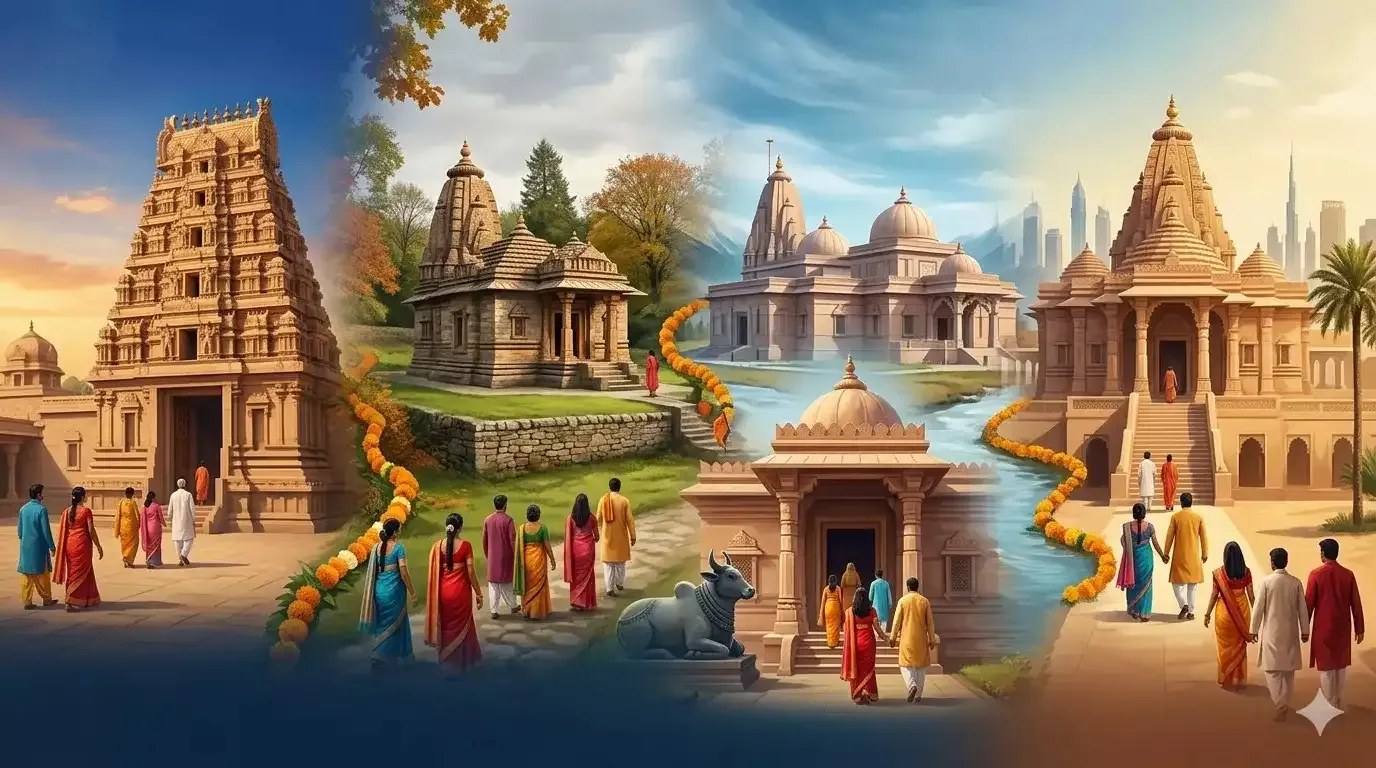
Walk into a Shiva temple in Edison, New Jersey on a Monday evening in the month of Shravan and the scene is recognisable to anyone who has stood in any Shiva temple anywhere in the world. The bell at the entrance, the line of devotees with bilva leaves and water pots, the rudraksha-mala in the priest's hand, the rhythmic chant of Om Namah Shivaya rising and falling with the abhishekam. What is less recognisable to first-time NRI devotees — particularly second-generation ones — is that the deity at the centre of all that ritual is being approached in at least three meaningfully different ways at once.
Shiva is not one image with one prayer. The same god shows up across the tradition in three distinct registers, and recognising which register a particular practice draws on is what turns rote ritual into devotional clarity. The three faces are not in competition; they are different doors into the same house. A 2026 NRI devotee, especially one explaining the tradition to a child raised outside India, benefits from understanding all three.
Face one: Bholenath — the householder's god
Bholenath, literally "the lord who is easily pleased," is the Shiva most familiar to ordinary devotional life. The Shiva of the monthly Pradosham, the Shiva of Maha Shivaratri's night-long vigil, the Shiva who responds to a simple offering of water on a Lingam without needing elaborate ritual. This is the deity who shows up in the family puja room of an NRI apartment in Toronto or Singapore — accessible, approachable, never demanding more than the devotee can give.
The Bholenath frame is the one most NRI households operate in by default. A Monday evening visit to the local temple, a chant of Om Namah Shivaya on the way to work, a fast on Shivaratri kept in spite of a workday — these are the everyday devotional gestures of householder life, and they map onto Bholenath's register cleanly. The theological premise is that grace is closer than discipline; that intention matters more than precision; that the devotee who shows up with sincerity is met with grace regardless of credentials.
Face two: Nataraja — the cosmic dancer
Nataraja is the Shiva of the cosmic dance — the four-armed figure encircled by flames, one foot raised, one foot pressed onto the demon of ignorance, hand gestures signifying creation, preservation, destruction, concealment and grace. The image is iconic in Indian visual culture, has been adopted as a symbol of cosmic order by physicists who installed a bronze Nataraja at CERN, and operates at a meaningfully different register from the householder Shiva.
Where Bholenath is approached, Nataraja is contemplated. The Nataraja frame asks the devotee to consider the universe as a continuous dance of opposites — creation and destruction, sound and silence, manifestation and dissolution. NRI devotees who first encounter Shiva through art, philosophy or comparative religion often meet Nataraja first; the image lends itself to a reflective, almost philosophical posture that the Bholenath frame doesn't require. The same devotee who chants Om Namah Shivaya on a Monday might pause before a Nataraja bronze in a museum and recognise a different invitation: to step back from the immediate concerns of the householder life and notice the larger pattern the dance describes.
Face three: Adiyogi — the first teacher
Adiyogi — the first yogi — is the Shiva of the meditative tradition. The 112-foot Adiyogi statue at the Isha Yoga Center in Coimbatore brought this face of Shiva into broader contemporary awareness, but the underlying tradition is ancient. Adiyogi is Shiva as the originator of yoga, the one who first transmitted the inner technologies of self-knowledge to the Saptarishis on the banks of Lake Kantisarovar in the Himalayas.
The Adiyogi frame is the one that NRI devotees increasingly encounter through contemporary spiritual practice rather than through inherited family religion. Yoga studios in New York and London, meditation programs in Sydney and Singapore, the contemporary spiritual literature that the second-generation diaspora picks up — these increasingly trace their lineage back to Adiyogi. The devotee meeting Shiva through the Adiyogi frame is not necessarily performing ritual; they are practising sadhana, with the deity figured as a teacher rather than an object of worship.
How the three faces co-exist
The temptation, particularly for the rationally-minded NRI devotee navigating between traditions, is to choose one frame and consider the others as cultural relics or pedagogical metaphors. The tradition itself does not ask for this choice. The same devotee who keeps a household Shivaratri vigil at Bholenath can stand before a Nataraja bronze and feel the philosophical resonance, then sit for a morning meditation under the Adiyogi frame. The three faces are not three deities; they are three ways the same deity meets the devotee at three different moments of life.
A useful way to think about this for an NRI family explaining the tradition to children: Bholenath shows up in the daily and weekly rhythms of devotional life, Nataraja appears at moments when the family steps back from the everyday to consider the larger pattern, and Adiyogi is present whenever the family takes up an inner practice — yoga, meditation, sustained contemplation. None of the three excludes the others; the devotee draws on whichever frame is appropriate to the moment.
What this means for an NRI household in 2026
Three practical implications follow. The first is that ritual literacy benefits from being framed as access to all three doors rather than to one. A child growing up in an NRI household who understands that Bholenath is approached, Nataraja is contemplated, and Adiyogi is practised has three distinct relationships with the tradition rather than one homogenised one.
The second is that visiting different Shiva temples — a traditional South Indian agama temple, a contemporary multi-tradition Shiva mandir, an installation focused on Nataraja iconography, a yoga centre that draws on the Adiyogi lineage — gives the family three different experiences of the same deity. Each visit deepens a different aspect; together they build a fuller picture than any single visit could.
The third is that the household devotional practice can hold all three frames simultaneously without contradiction. The morning lamp lit before a small Shiva Lingam, the Nataraja print on the wall of the living room, the meditation cushion in a corner of the bedroom — these three objects together describe a household relationship with Shiva that is richer than any one of them in isolation. The 2026 NRI devotee who recognises this is operating in a tradition that has always held all three faces at once.
Frequently asked questions
What are the three faces of Lord Shiva?
They are Bholenath, the approachable householder's god; Nataraja, the cosmic dancer; and Adiyogi, the first yogi and teacher. They are not three deities but three ways the same deity meets the devotee.
What does Bholenath mean?
Bholenath means 'the lord who is easily pleased'. This face of Shiva responds to a simple offering of water on a Lingam without elaborate ritual, and is the one most NRI households follow by default.
How can NRI families teach children about Shiva's three faces?
Explain that Bholenath is approached, Nataraja is contemplated and Adiyogi is practised. Bholenath appears in daily and weekly devotion, Nataraja when the family steps back to see the larger pattern, and Adiyogi in yoga and meditation.
What does the Nataraja form of Shiva represent?
Nataraja is the four-armed dancing figure encircled by flames, with gestures signifying creation, preservation, destruction, concealment and grace. It invites reflection on the universe as a dance of opposites.
Why is Adiyogi popular with second-generation NRI devotees?
Adiyogi is Shiva as the originator of yoga, so devotees meet him through yoga studios and meditation programs in places like New York, London, Sydney and Singapore. The deity is figured as a teacher rather than an object of worship.
Where does Adiyogi's teaching tradition begin?
As commonly told, Adiyogi first transmitted the inner technologies of self-knowledge to the Saptarishis on the banks of Lake Kantisarovar in the Himalayas. A 112-foot Adiyogi statue stands at the Isha Yoga Center in Coimbatore.
Share this with family and friends
Send it on WhatsApp, post it, or copy the link.
More from Lord Shiva
- The World’s Only Hindu Glass Temple — Arulmigu Sri Rajakaliamman, Malaysia
- Maha Shivaratri Four Prahar Puja — The Complete Night-by-Night Ritual Guide
- The Temple in the Sea — One Man’s 25-Year Act of Devotion That Moved a Nation
- Top 20 Shivalayams Outside India: The Ultimate Global Pilgrim’s Guide to Shiva Temples Worldwide
- Monday Rituals in Hinduism — Somavar Shiva Puja, Vrat & Complete NRI Guide for 2026
You might also like
Shiva Vrats of June 2026: Kalashtami (June 8) & Masik Shivaratri (June 13)

Mỹ Sơn Sanctuary: Divine Mysteries & Soul-Stirring Miracles of Lord Shiva in Vietnam
Shiva Tandava Stotram: Full Sanskrit Lyrics with IAST and Meaning of All 17 Verses