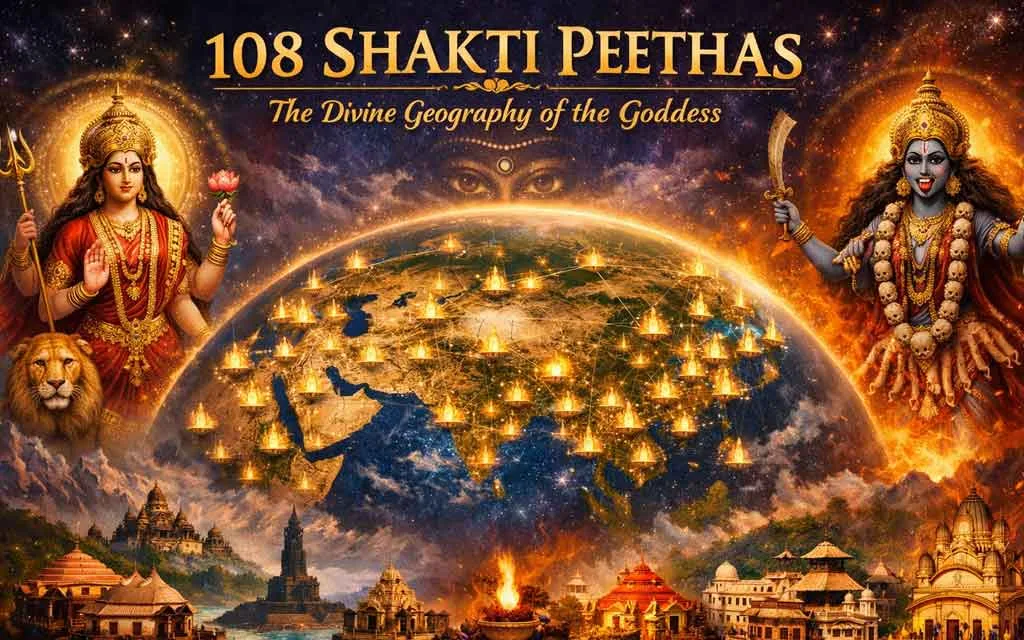
108 Shakti Peethas: The Divine Geography of the Goddess — Complete Guide
Introduction: Where the Goddess Touches the Earth There are places in this world where the veil between human and divine grows thin — where the air itself hums…
Introduction: Where the Goddess Touches the Earth There are places in this world where the veil between human and divine grows thin — where the air itself hums…
Introduction: Where the Goddess Touches the Earth
There are places in this world where the veil between human and divine grows thin — where the air itself hums with an energy older than history, where stone breathes with the presence of something infinite and feminine and fierce.
These are the Shakti Peethas — the Sacred Seats of the Goddess.
Scattered across India, Nepal, Bangladesh, Sri Lanka, Tibet, and Pakistan, the Shakti Peethas are not merely temples. They are wounds of love — spots where the body of the great Goddess Sati fell to Earth in grief and sacrifice, and where divine power has pooled and concentrated ever since, like light gathering in a prism.
Hindu tradition recognizes 108 Shakti Peethas in total, with 51 considered primary (one for each letter of the Sanskrit alphabet) and 18 regarded as Maha Shakti Peethas (great seats of supreme power). Together, they form the most sacred spiritual geography on Earth — a living map of the Goddess's divine body spread across an entire subcontinent.
To visit a Shakti Peetha is not tourism. It is pilgrimage. It is the act of placing your feet where the divine once fell, of breathing air saturated with millennia of prayers, of standing at the precise point where Heaven touched Earth and decided to stay.
This is the complete story of the 108 Shakti Peethas — their origin, their significance, their geography, their power, and what they mean for every devotee of the Divine Mother.
Part 1: The Sacred Origin Story — Sati, Shiva, and the Breaking of the World
Daksha's Great Yajna and the Insult That Shook the Cosmos
To understand the Shakti Peethas, we must go back to the beginning — to a divine drama of love, pride, grief, and cosmic transformation that is one of the most profound stories in all of Hindu mythology.
Daksha Prajapati was one of the great progenitor lords of creation — son of Lord Brahma and father of countless divine beings. He was powerful, respected, and deeply proud. Among his daughters was Sati — born as a partial incarnation of the primordial Adi Shakti herself, the eternal Divine Mother who had chosen to take human form for love.
And the one she loved was Lord Shiva — the ascetic, the destroyer, the lord of cremation grounds and wandering yogis. Daksha despised Shiva. He saw in him everything wild, untamed, and outside the pale of Vedic respectability. But Sati's love was not something that could be argued away — it was cosmic, fated, and absolute. She married Shiva against her father's will and went to live with him in the mountains of Kailash.
For a time, there was peace.
Then Daksha organized the greatest yajna (fire sacrifice) ever performed — a cosmic ritual to which all the gods, sages, and divine beings of the three worlds were invited. Everyone was invited — except Shiva and Sati.
The deliberate exclusion was an act of supreme arrogance and public humiliation. When Sati learned of the yajna from the procession of gods passing by Kailash on their way to her father's court, she was consumed with the desire to attend. Shiva warned her — if she went uninvited, she would be dishonored. But Sati was a daughter who believed that a father's home is always home. She went.
The Immolation of Sati
What Sati found at her father's yajna was not welcome. Daksha received her with contempt and open hostility, hurling insults at Shiva in front of the assembled gods — calling him unworthy, impure, a disgrace unfit to receive the sacred fire.
Sati stood and listened. And then something broke inside her — not her love for Shiva, but her connection to the body born from Daksha's lineage.
She could not bear that the body born of this man had been used to dishonor her divine husband. She would not carry Daksha's blood one moment more.
Before the assembled gods and the roaring sacred fire, Sati immolated herself — stepping into the yajna flames and surrendering her physical form.
The news reached Lord Shiva.
What happened next was the dissolution of the world.
Shiva's Grief and the Dance of Destruction
Shiva arrived at Daksha's court and his grief became rage — a rage so vast it threatened to unmake creation itself. He destroyed Daksha's yajna. He slew Daksha (who was later restored by Brahma's grace, but with a goat's head). He took the body of Sati from the flames.
And then he walked.
He walked through the three worlds carrying the lifeless body of his beloved, his grief a living fire that scorched the earth where he stepped. His sorrow curdled into cosmic fury — and the Tandava he danced was not the joyful cosmic dance of creation but the dance of absolute devastation. The universe trembled. Stars fell out of their courses. The seas rose. The mountains shook.
The gods were terrified. If Shiva's grief was not interrupted, existence itself would end.
Vishnu's Compassion and the Sudarshana Chakra
Lord Vishnu — the preserver of all creation — saw what was happening and understood that something had to be done. But Shiva could not simply be stopped. His grief was divine and his loss was real. The only solution was to remove its cause — to dissolve the physical body of Sati so that Shiva would no longer have a tangible object of his sorrow to carry.
Lord Vishnu followed behind Shiva and, with his Sudarshana Chakra (the divine discus weapon), began to sever the body of Sati into pieces as Shiva carried it.
As each piece fell to Earth, Shiva's grief was divided and diminished — parceled out across the landscape of the world, transformed from a single overwhelming agony into scattered points of sacred power.
By the time the last piece had fallen, Shiva's destructive fury had ebbed. He sat, still in grief but no longer threatening to destroy the cosmos. He withdrew into meditation, eventually to be awakened by Parvati — the reincarnation of Sati herself — whose love and devotion would bring him back to the world.
And on the Earth, at every place where a piece of Sati's body had fallen, a Shakti Peetha was born.
Why the Shakti Peethas Are Sacred
This is why the Shakti Peethas are unlike any other temple or pilgrimage site in the Hindu world:
They are not places where someone had a vision, or where a saint performed a miracle, or where a river meets the sea. They are places where the body of the Goddess herself touched the Earth.
The Shakti Peetha is the literal point of divine immanence — where the formless became form, where the eternal was momentarily physical, and where that physicality was so potent that it persists to this day in stone, in soil, in the very air of the place.
Every Shakti Peetha is simultaneously:
- A point of intense Shakti (divine energy)
- A sacred wound of love transformed into power
- A portal between the human and the divine
- A living body of the goddess, distributed across the world
To visit them is to walk the body of the Divine Mother herself.
Part 2: The Structure of the Shakti Peethas
How Many Shakti Peethas Are There?
Different Hindu scriptures give different counts — and this is not a contradiction but a reflection of the living, layered nature of Hindu tradition:
The most widely accepted and devotionally comprehensive count is 108 — aligning with the sacred significance of 108 in Hindu cosmology (see our complete guide to the significance of 108). Among these, 51 are considered primary because they correspond to the 51 letters of the Sanskrit alphabet — the sacred sounds that constitute the divine language of creation.
What Falls Where: Body Parts and Their Peethas
The Shakti Peethas are organized by which part of Sati's body fell at each location. This is not macabre — it is a profound statement about the sacredness of the physical body in Hindu philosophy.
The Goddess's body did not simply decay and disappear. It was transubstantiated — each organ, each limb, each sense organ becoming a point of concentrated divine power. The body of the Goddess is the world itself.
Primary body parts associated with major Peethas:
The Bhairava: Shiva's Guardian at Every Peetha
At every Shakti Peetha, Lord Shiva is present — not as the destroyer, but as the eternal guardian and consort of the Goddess. He takes a specific form at each Peetha, collectively called the Bhairava — the fierce protector.
This dual presence is deeply significant: Shakti without Shiva is energy without consciousness; Shiva without Shakti is consciousness without energy. At the Peethas, both are present — the divine feminine as the primary deity, the divine masculine as her eternal protector.
Every Shakti Peetha therefore houses:
- The Devi (Goddess) — as the main presiding deity
- The Bhairava (Shiva's form) — as her guardian consort
This makes each Peetha a complete temple of both Shakti and Shiva — an integrated expression of the divine union that underlies all creation.
Part 3: The 18 Maha Shakti Peethas — The Supreme Seats of Power
Among all 108 Shakti Peethas, 18 are considered Maha Shakti Peethas — the great seats of supreme power. These 18 are mentioned consistently across multiple scriptures and are the most visited, most revered, and most energetically potent of all the Peethas.
Complete List of the 18 Maha Shakti Peethas
1. Hingula (Hinglaj) — Balochistan, Pakistan
Body Part: Head (Mastaka) of Sati
Goddess: Hingula / Kottari
Bhairava: Bhimlochan
The most northwestern of all Shakti Peethas, Hinglaj Mata is one of the most significant. Despite being located in modern-day Pakistan, it continues to be visited by thousands of Hindu pilgrims annually. The temple is set in a cave in the Makran coastal range — a flame of natural gas burns eternally within, representing the Goddess's presence. It is the first among the Maha Peethas because Sati's head — the seat of consciousness — fell here first.
2. Sharkara Devi — Sugandha Shakti Peetha, Shikarpur, West Bengal
Body Part: Nose
Goddess: Sugandha (Sweet Fragrance)
Bhairava: Tribagish
Located in Shikarpur near Bokaro in West Bengal, this Peetha is associated with Sati's nose — the organ of the divine fragrance (sugandha) that permeates all sacred places. The goddess here is worshipped as Sugandha — she who is the source of all divine scent, the fragrance of creation itself.
3. Vishalakshi — Varanasi (Kashi), Uttar Pradesh
Body Part: Right eye (some traditions: earrings)
Goddess: Vishalakshi (Wide-Eyed One)
Bhairava: Kala Bhairava
Varanasi — the oldest living city in the world and the most sacred city in Hinduism — is itself a Shakti Peetha. The presiding goddess is Vishalakshi (the wide-eyed one), whose gaze encompasses all of creation. Her temple stands near the sacred Manikarnika Ghat — the cremation ground where Shiva holds the dying so they may receive the Taraka Mantra and attain liberation. The earring (manikarnika) of Sati is said to have fallen here — giving the famous ghat its name.
4. Dakshayani — Amarnath, Jammu & Kashmir
Body Part: Throat (some traditions: heart or right hand)
Goddess: Maheshwari
Bhairava: Trisandhyeshwar
The sacred cave of Amarnath — one of the holiest of all Shiva pilgrimage sites — is simultaneously a Shakti Peetha. The Goddess here is Maheshwari — Shiva's beloved. The sacred ice Shivalinga of Amarnath and the presence of the Goddess make this perhaps the most complete expression of divine union among all Peethas. Located at 3,888 meters in the Himalayas, the pilgrimage to Amarnath is itself a profound act of devotion.
5. Jwalaji — Jawalamukhi, Himachal Pradesh
Body Part: Tongue
Goddess: Jwalamukhi (Flame-Faced One)
Bhairava: Unmatta / Chanda
One of the most spectacular of all Shakti Peethas — Jwalamukhi in the Kangra Valley of Himachal Pradesh is where Sati's tongue fell. Here, natural flames of burning gas emerge from cracks in the earth and have been burning eternally for thousands of years — never extinguished, never fed by human hand. These flames are the Goddess. No idol is installed in the temple — the nine eternal flames are the nine forms of Devi. The Mughal emperor Akbar, awed by the phenomenon, is said to have offered a golden canopy to the flame, which the Goddess rejected by turning it into another metal — a legend of divine sovereignty.
6. Brahmarandhra — Kangra, Himachal Pradesh
Body Part: Crown of the head
Goddess: Vajreshwari
Bhairava: Jai
Vajreshwari at Kangra is the goddess of thunderbolts and diamonds — indestructible divine power. The Kangra Devi temple is one of the oldest in India, mentioned in the Mahabharata and visited by the Pandavas. Sati's crown (brahmarandhra — the topmost point of the skull associated with cosmic consciousness) fell here, making this Peetha associated with the highest spiritual awakening.
7. Chamundeshwari — Mysuru (Mysore), Karnataka
Body Part: Hair
Goddess: Chamundeshwari
Bhairava: Kapali / Krimikandeshvar
Set atop the Chamundi Hills overlooking the royal city of Mysore, Chamundeshwari is the fierce form of the Goddess who slew the demons Chanda and Munda — and later, the great demon king Mahishasura whose defeat is celebrated as Navaratri. The Mysore Dasara festival — one of India's grandest royal celebrations — centers on Chamundeshwari. Sati's hair fell on the Chamundi Hills, imbuing the entire hillside with her presence.
8. Tripura Sundari — Udaipur, Tripura
Body Part: Right foot
Goddess: Tripura Sundari (Shodashi)
Bhairava: Tripuresh
Tripura Sundari — "the beautiful one of the three worlds" — is one of the ten Mahavidyas, the supreme tantric forms of the Goddess. Her temple at Udaipur in Tripura is built on a hill (Trikuta) and the three-peaked mountain itself is considered sacred. She is worshipped here in her Shodashi form — the sixteen-year-old girl who is the complete perfection of divine beauty, grace, and power. The deity sits on a lotus raised over a bed formed by the bodies of Brahma, Vishnu, Rudra, and Sadashiva — a profound iconographic statement of Shakti's supremacy.
9. Kamakhya — Guwahati, Assam
Body Part: Yoni (genitalia) — the most sacred of all
Goddess: Kamakhya
Bhairava: Umananda
Kamakhya on the Nilachal Hill in Guwahati is perhaps the most famous and most powerful of all Shakti Peethas — and the most theologically significant. The body part that fell here was Sati's yoni — the sacred feminine generative power, the source of all creation.
The Kamakhya temple contains no conventional idol. The sanctum houses a natural cleft in the rock — the yoni peetha — which is perpetually moist with natural spring water. This is the Goddess in her most primal, unrepresented, formless form — pure creative power.
Ambubachi Mela — held annually in June when the Brahmaputra River runs red with iron-rich soil (symbolizing the Goddess's menstruation) — draws hundreds of thousands of tantric practitioners, sadhus, devotees, and pilgrims from across India. The Kamakhya Peetha is the supreme center of Tantric Shaktism in all of India — where the goddess is worshipped not despite her feminine biological nature but precisely because of it.
10. Dakshina Kalika — Kalighat, Kolkata, West Bengal
Body Part: Right toes (some traditions: four toes of the right foot)
Goddess: Kalika / Kali
Bhairava: Nakulesh
Kalighat in Kolkata — one of the four great dhams (pilgrimages) of Bengal — is where Sati's right toes fell. The presiding goddess is Kali — the dark, terrifying, and utterly liberating form of the Divine Mother. The Kalighat Kali is depicted with a long tongue dripping blood, standing on Lord Shiva, wearing a garland of severed heads. She is not a goddess of death — she is a goddess of the death of the ego, the destroyer of all illusions, the mother who loves fiercely enough to show you the truth even when it hurts.
Kolkata — the city of joy — was built around this temple, and the city's very name is said to derive from Kalikatta — the land of Kali. She is the patron goddess of Bengal.
11. Kankaleshwari — Birbhum, West Bengal
Body Part: Lower teeth
Goddess: Kankaleshwari
Bhairava: Ruru
Located at Bakkureshwar in West Bengal, this Peetha is associated with Sati's lower teeth. The region is known for its numerous hot springs — natural thermal features seen as signs of the earth's living divine energy. Multiple temples in the area collectively constitute the Peetha.
12. Attahas — Labhpur, West Bengal
Body Part: Upper lip
Goddess: Phullara
Bhairava: Vishwesh
Attahas means "the great laughter" — and at this Peetha, Sati's upper lip is enshrined. The goddess is called Phullara — "she who blooms." Her presence here is associated with the divine laughter that is the sound of liberation — the ananda (bliss) that underlies all existence. The temple is in the Birbhum district of West Bengal, famous for its vibrant Shakta devotional traditions.
13. Nandikeshwari — Nandikeshvara, West Bengal
Body Part: Necklace
Goddess: Nandini
Bhairava: Nandikeshvara
This Peetha in the Birbhum district enshrines Sati's necklace. The goddess here is Nandini — "she who brings joy." The jewels of Sati's adornment were not mere ornaments — they were expressions of divine grace and beauty, and where they fell, they concentrated the energy of that divine adornment into the earth.
14. Sarvashaileshwari — Shrisailam, Andhra Pradesh
Body Part: Neck
Goddess: Bhramaramba (Bhramari)
Bhairava: Mallikarjuna
Shrisailam on the banks of the Krishna River in Andhra Pradesh is doubly sacred — it is simultaneously a Shakti Peetha (Bhramaramba) and one of the 12 Jyotirlingas of Shiva (Mallikarjuna). The Goddess here is Bhramaramba — "she who is surrounded by bees" — the goddess who manifests as a swarm of bees to protect her devotees. This dual status — Shakti Peetha and Jyotirlinga — makes Shrisailam one of the most important pilgrimage sites in all of South India.
15. Vimala — Puri, Odisha
Body Part: Navel
Goddess: Vimala
Bhairava: Jagannath / Jagat Ananda
Puri — one of the four sacred Dhams of Hinduism — is home to the famous Jagannath Temple, and within its complex stands the Vimala Shakti Peetha where Sati's navel fell. The goddess here is Vimala — the pure and spotless one. It is said that the prasad offered to Lord Jagannath becomes mahaprasad (supremely sacred) only after it is first offered to Goddess Vimala — affirming the Shakta principle that Shakti is the animating principle even within Vaishnava sacred space.
16. Mahakali — Ujjain, Madhya Pradesh
Body Part: Upper lip (some traditions: elbow)
Goddess: Mahakali / Harsiddhi
Bhairava: Chamunda
Ujjain — the ancient city of Avanti and one of the seven Moksha-puris (cities that grant liberation) — is home to the Harsiddhi Mata temple, one of the Shakti Peethas associated with Sati's elbow. The Goddess here is Harsiddhi — "she who grants all accomplishments." Ujjain is also the site of the Mahakaleshwar Jyotirlinga — making this city, like Shrisailam, both a Shakti Peetha and a Jyotirlinga site.
17. Bhavani — Tuljapur, Maharashtra
Body Part: Heart
Goddess: Tuljabhavani
Bhairava: Khandoba
Tuljabhavani at Tuljapur in Maharashtra is the Kuladevi (clan goddess) of the Marathas — the patron goddess of the Maratha empire and the deity to whom the great warrior king Chhatrapati Shivaji Maharaj prayed before his campaigns. It is said that the goddess appeared to young Shivaji and gave him her divine sword, blessing him to establish a Hindu kingdom. Tuljabhavani is worshipped by millions across Maharashtra as a personal family deity — her temple one of the most visited pilgrimage sites in the state.
18. Dakshineshwari — Kolkata region / Dakshineswar
Body Part: Varies by tradition
Goddess: Bhavatarini Kali
Bhairava: Nakul Ishwar
The Dakshineswar Kali Temple on the banks of the Hooghly River near Kolkata is the temple where the great saint Ramakrishna Paramahamsa spent his life worshipping the Divine Mother, experiencing divine ecstasy, and teaching the world that all religions lead to the same truth. Ramakrishna's devotion to the Mother here inspired his disciple Swami Vivekananda — who carried the message of Vedanta to the world.
Part 4: The 51 Primary Shakti Peethas — Complete List by Region
North India
East India (West Bengal, Odisha, Bihar, Jharkhand)
South India (Andhra Pradesh, Tamil Nadu, Karnataka, Kerala)
West India (Maharashtra, Gujarat, Rajasthan)
Northeast India (Assam, Tripura, Meghalaya, Manipur)
Nepal, Bangladesh, Sri Lanka, and Beyond
Part 5: Pilgrimage to the Shakti Peethas — A Devotee's Complete Guide
The Spiritual Significance of the Pilgrimage
A pilgrimage to the Shakti Peethas is called Shakti Peetha Yatra — and it is considered one of the most spiritually potent journeys a Hindu devotee can undertake. The Devi Bhagavata Purana declares:
Visiting all 51 Shakti Peethas earns the devotee merit equivalent to performing 10,000 Ashvamedha Yajnas (horse sacrifices) and grants liberation from the cycle of rebirth.
Even visiting a single Shakti Peetha with a pure heart and genuine devotion is said to:
- Dissolve lifetimes of accumulated karma
- Grant protection from illness, enemies, and misfortune
- Awaken the kundalini — the divine feminine power dormant within every being
- Invite the Goddess's grace into every area of life
- Accelerate spiritual progress on the path toward liberation
Best Times to Visit Shakti Peethas
Conduct at a Shakti Peetha
A Shakti Peetha is not a tourist site — it is a living divine presence. Devotees are expected to:
Before visiting:
- Observe a fast (at minimum skip a meal before visiting)
- Bathe and wear clean, modest clothing (preferably red, the Goddess's color)
- Set a clear intention (sankalpa) for your visit
During the visit:
- Remove footwear before entering any Shakti Peetha
- Maintain silence or devotional speech — no casual conversation within the sanctum
- Do not carry or consume meat, alcohol, or intoxicants on pilgrimage days
- Offer red flowers (hibiscus is most sacred to the Goddess), kumkum (vermilion), and coconut
- Recite the names of the Goddess — the Devi Ashtottara or the Lalita Sahasranama
- Participate in the Archana if available
After visiting:
- Accept and receive prasad with both hands and consume it with reverence
- Do not haggle in temple premises or act in commercial ways around the sanctum
- Take a moment of quiet sitting after darshan — the energy of a Peetha is best absorbed in stillness
Sacred Items to Offer at Shakti Peethas
Part 6: The Goddess at Each Peetha — Her Many Forms and Names
The Goddess at each Shakti Peetha is not simply "the same goddess with a different name." Each form of the Goddess at each Peetha expresses a specific quality of divine feminine power — a specific facet of the infinite diamond that is Adi Shakti.
The Ten Mahavidyas and Their Peetha Connections
The Ten Mahavidyas — the ten supreme tantric forms of the Goddess — are all directly connected to the Shakti Peetha tradition:
Navaratri and the Shakti Peethas
Navaratri — the nine-night festival of the Goddess — is the supreme occasion for Shakti Peetha worship. Held twice yearly (Chaitra Navaratri in spring and Sharada Navaratri in autumn), the festival sees:
- All 51 primary Shakti Peethas performing elaborate 9-day pujas
- Millions of pilgrims traveling to Shakti Peethas across India
- Special darshans and extended temple hours at most Peethas
- Ashtami (the 8th night) and Navami (the 9th night) as the most sacred nights
- Kanya Puja — the worship of young girls as living embodiments of the Goddess
At Kamakhya, the Navaratri celebration is among the largest religious gatherings in all of northeast India. At Vaishno Devi, over 8 million pilgrims visit during the Navaratri season. At Chamundeshwari, the Mysore Dasara procession draws hundreds of thousands.
Part 7: The Philosophy Behind the Shakti Peethas
Shakti as the Ground of All Being
The Shakti Peetha tradition is not merely mythology or devotional practice — it is a profound philosophical statement about the nature of reality.
At the heart of Shakta philosophy (the theology of the Goddess) is this truth: Shakti — the divine feminine power — is not secondary to or derivative of any masculine divine principle. She is the ground of all being. She is consciousness-as-power. She is the universe itself.
The Devi Mahatmya — the most important scripture of Shaktism — opens with the declaration: "She is the eternal wisdom, she is the great illusion, she is the great queen, she is the great mother, she is the great power, she is the great darkness." She is not a consort. She is the source.
The Shakti Peethas express this truth geographically: the body of the Goddess IS the Earth. India is not a land where the Goddess is worshipped — India is the body of the Goddess herself. The mountains are her limbs, the rivers her blood, the forests her hair, and the sacred Peethas are the precise points where her divine anatomy touches human awareness.
The Tantric Significance of the Peethas
The Shakti Peethas are central to Tantra — the school of Hindu philosophy and practice that honors the body, sexuality, and the physical world as sacred rather than as obstacles to liberation.
The Yoni Peetha of Kamakhya is the supreme expression of this philosophy: the most taboo aspect of the feminine body — in many traditions — is here worshipped as the most sacred point of the entire universe. This is not transgression for its own sake. It is the radical affirmation that all of life is sacred, that the source of creation is sacred, that the feminine in all its power and physicality is divine.
Tantric practitioners travel to the Shakti Peethas specifically to access the concentrated Shakti energy at each site — using it to fuel their internal practices of mantra, yantra, and meditation, working toward the awakening of the kundalini and ultimate liberation.
The Ecological Vision of the Shakti Peethas
The Shakti Peethas also encode a profound ecological vision: the Earth herself is the body of the Divine Mother. To harm the Earth is to harm the Goddess. The rivers, mountains, forests, and stones of India are not background for human activity — they are her living body.
This vision has inspired generations of environmental protection in Hindu culture:
- Sacred groves (dev vans) protected around Shakti Peethas for millennia
- Rivers treated as sacred — the Ganga, Yamuna, and other rivers as liquid forms of the Goddess
- Mountains revered — the Himalayas as the abode of the divine feminine
The global ecological crisis, from this perspective, is not merely a technical problem — it is a spiritual one, arising from the loss of the understanding that the Earth is sacred.
Part 8: Stories and Miracles of the Shakti Peethas
The Miracle of Jawalamukhi
When the Mughal Emperor Akbar traveled to Jawalamukhi to test the power of the eternal flames — reportedly intending to extinguish them — he ordered an iron canopy placed over the flame and water poured upon it. The flames were not extinguished. Akbar, humbled and awed, offered a golden vessel to the Goddess. The legend says the Goddess, to demonstrate that she accepts devotion but not arrogance, turned the gold into a different metal (Panchaloha). The vessel can still be seen at the temple today.
Kamakhya and the Legend of the Tantric Goddess
The legend of Kamakhya is intertwined with the story of Narakasura — the demon king who ruled Assam (Pragjyotishapura) and who imprisoned 16,000 women in his palace. Lord Krishna liberated the women and slew Narakasura — and it is said that Narakasura himself had received his powers from Kamakhya. The festival of Diwali in Assam celebrates this liberation — and Kamakhya is worshipped as the power that ultimately enables the defeat of all demonic forces.
Vaishno Devi — The Goddess Who Fled and Conquered
The beloved story of Vaishno Devi (Trikuta Parvat, Jammu) tells of the young girl Vaishnavi — a devotee of Vishnu — who was born of a divine promise to demonstrate that Shakti and Vishnu are not separate. Bhairon Nath, a tantric who desired her as a disciple in his dark practices, pursued her. She fled into the mountains and, in the cave of Trikuta, transformed into the divine rock formations of the three goddesses — Mahakali, Mahalakshmi, and Mahasaraswati. She then turned and destroyed Bhairon Nath — giving him liberation even in death, because the Goddess's touch, even in wrath, is grace.
Today, Vaishno Devi draws over 10 million pilgrims annually — the most visited pilgrimage site in all of India.
Tuljabhavani and Shivaji Maharaj
The story of Chhatrapati Shivaji Maharaj and Tuljabhavani is one of the most stirring in Maharashtra's history. The young Shivaji, meditating before the Goddess before his military campaigns, is said to have received a divine sword from Tuljabhavani herself — the Bhavani Talwar (Sword of Bhavani) — which blessed him with invincible courage and the mission to establish Swaraj (self-rule). Whether historical or legendary, this story expresses the deep Shakta roots of the Maratha independence movement.
Frequently Asked Questions About the Shakti Peethas
Q1. What is the difference between a Shakti Peetha and a regular goddess temple?
A Shakti Peetha is specifically a site where a part of Sati's body fell after Lord Vishnu severed it with his Sudarshana Chakra. A regular goddess temple is a place of worship that may have been established through other means — a saint's vision, community devotion, or royal patronage. The Shakti Peethas have a specific mythological origin and are believed to carry a uniquely concentrated divine energy.
Q2. Can women visit all Shakti Peethas including Kamakhya during their menstrual cycle?
At most Shakti Peethas, women in menstruation are traditionally asked not to enter the inner sanctum — following the general practice of many Hindu temples. However, at Kamakhya specifically, the entire philosophy of the temple reverses this: the Goddess's menstruation (Ambubachi) is celebrated as a supreme sacred event, and the tradition is far more welcoming to women in all their natural states. Practices vary by temple and lineage; it is respectful to inquire locally.
Q3. Is it possible to visit all 51 or 108 Shakti Peethas?
Yes — the Shakti Peetha Yatra (pilgrimage to all Peethas) is undertaken by dedicated devotees. Several Peethas are now in Pakistan (Hinglaj) and Bangladesh (Jashoreshwari), making cross-border pilgrimage logistically complex but not impossible. Organized pilgrimages to the Indian Peethas are available through multiple travel and temple organizations.
Q4. Which Shakti Peetha is most powerful?
All Shakti Peethas are equally sacred as expressions of the same Goddess. However, Kamakhya (associated with the Yoni — the creative source), Kalighat (Kolkata), Vaishno Devi, and Jwalamukhi are among the most energetically potent and most visited. The "most powerful" Peetha is ultimately the one where your own heart opens most completely.
Q5. What is Ambubachi Mela at Kamakhya?
Ambubachi Mela is an annual festival at Kamakhya temple in Guwahati, Assam, held in June (typically the 22nd to 25th of June). During this period, the Goddess is believed to be menstruating — and the temple is closed for three days. On the fourth day, it reopens with immense celebration. Hundreds of thousands of tantric practitioners, sadhus, and devotees gather for this event — considered supremely auspicious for all forms of spiritual practice.
Q6. Are there Shakti Peethas outside India?
Yes. Peethas are found in Nepal (Guhyeshwari, Kathmandu), Bangladesh (Jashoreshwari, Sugandha), Sri Lanka (Shankari, Trincomalee), Pakistan (Hinglaj, Balochistan), and Tibet (in some traditions). This pan-South-Asian distribution of the Peethas reflects the historical reach of the Shakta tradition across the entire subcontinent.
Conclusion: Walking the Body of the Goddess
The story of the 108 Shakti Peethas is ultimately a story about love so vast it became the world itself.
Sati's love for Shiva was total — so total that when it was dishonored, she gave up the very body that had been used to insult him. And in that act of ultimate sacrifice, something extraordinary happened: her body did not simply die. It was transfigured. Distributed across the landscape of an entire subcontinent. Transformed from mortality into sacred geography.
Every Shakti Peetha is a reminder that love transforms everything it touches — even grief, even loss, even the dissolution of a physical body — into something eternal and sacred.
When you stand at a Shakti Peetha, you are standing at a place where a mother's love for her beloved became stone and soil and sacred flame. Where a cosmic grief became a landscape of grace. Where the personal became the universal.
The Goddess did not disappear when Sati died. She became the world.
She is in the eternal flame of Jwalamukhi. She is in the red earth of Kamakhya. She is in the fierce stone face of Chamundeshwari. She is in the ocean at Kanyakumari. She is in the dark cave of Hinglaj. She is in the red cloth, the hibiscus flower, the kumkum, the coconut, the silent prayer of every devotee who has ever approached her in any of her 108 sacred homes.
She is everywhere. But at the Shakti Peethas, she is especially, particularly, intimately here.
Jai Mata Di. Jai Adi Shakti. Jai Maa.
Also Read on HinduTone
- Sacred Hindu Numbers: The Significance of 108
- Lord Ganesha: 108 Names, Significance & Mantras
- 108 Divya Desams: The Sacred Vishnu Temples of South India
- Navaratri: Complete Guide to the 9-Night Festival of the Goddess
- Goddess Kali: Who She Is, What She Represents, and How to Worship Her
- Kamakhya Temple: The Most Powerful Shakti Peetha in India
- The Ten Mahavidyas: The Complete Guide to the Tantric Goddesses
- Vaishno Devi Pilgrimage: Complete Guide for 2025
- Goddess Durga: 108 Names, Mantras & Significance
- Devi Mahatmya: The Complete Story and Significance
Published on: HinduTone — Your Complete Guide to Hindu Spirituality, Temples & Sacred Traditions
Website: www.hindutone.com
Category: Hindu Temples | Shakti Peethas | Goddess Worship | Hindu Pilgrimage
Tags: 108 Shakti Peethas, 51 Shakti Peethas, Maha Shakti Peethas, Sati story, Kamakhya temple, Kalighat, Vaishno Devi, Shakti Peetha pilgrimage, Devi temples India, Adi Shakti, Hindu goddess temples, Navaratri pilgrimage, tantric temples India, sacred geography India, Jwalamukhi, Tripura Sundari, Chamundeshwari, Tuljabhavani, goddess worship Hinduism
About HinduTone: HinduTone is a dedicated spiritual platform celebrating the full depth of Hindu philosophy, sacred traditions, temple culture, and devotional wisdom. From ancient scriptures to living pilgrimage sites — HinduTone guides seekers on every step of the spiritual path.
Disclaimer: This article is compiled from traditional Hindu scriptures, Puranic literature, and regional devotional traditions. The count and identification of Shakti Peethas varies across different texts and traditions. Information is presented for spiritual education and devotional enrichment. Readers are encouraged to consult their own lineage teachers for personal guidance.
You might also like
Mandukya Upanishad: The Shortest Path to Liberation (Moksha) in Advaita Vedanta | HinduTone
Purushottam Maas 2026: Lord Vishnu's Sacred Gift of Spiritual Multiplication & Divine Grace
Vaishaka Masam Rituals: Complete Devotional Guide with Mythological Stories from Puranas | HinduTone