Hare Krishna Mahamantra Complete Guide: Meaning, Japa Method, ISKCON, 16 Rounds & Spiritual Benefits
Complete Hare Krishna Mahamantra guide — the 32-syllable Vaishnava mantra. Sanskrit + transliteration + meaning, 3 sacred sources (Kali Santarana Upanishad, Chaitanya Mahaprabhu, Bhaktivedanta Prabhupada/ISKCON), 16-round japa method, 108-bead mala technique, daily practice plan, NRI guide, FAQs.
Complete Hare Krishna Mahamantra guide — the 32-syllable Vaishnava mantra. Sanskrit + transliteration + meaning, 3 sacred sources (Kali Santarana Upanishad, Chaitanya Mahaprabhu, Bhaktivedanta Prabhupada/ISKCON), 16-round japa method, 108-bead mala technique, daily practice plan, NRI guide, FAQs.
Of all the mantras chanted across the global Hindu world today, none is more recognized than the Hare Krishna Mahamantra — the 32-syllable Sanskrit mantra: "Hare Krishna Hare Krishna, Krishna Krishna Hare Hare, Hare Rama Hare Rama, Rama Rama Hare Hare." From Mathura's ancient temples to Times Square parades, from Indian villages to global airports, from Hindu households to Western yoga studios — this mantra has crossed every cultural boundary in human history and remains the single most-chanted Hindu mantra in the modern era.
The Hare Krishna Mahamantra is not merely a prayer — it is a complete spiritual technology. It contains the names of God in three principal forms (Krishna, Rama, and the divine feminine Hare/Radha) compressed into 32 syllables. Chanted on a 108-bead mala (japa mala), the practice creates a continuous awareness of the divine that gradually transforms the chanter's entire consciousness.
This complete HinduTone guide covers the mahamantra in full: its meaning, its three sacred sources (Kali Santarana Upanishad, Chaitanya Mahaprabhu's tradition, and modern ISKCON globalization), how to chant it correctly (japa technique, mala usage, daily count), the spiritual mechanism behind why it works, benefits documented across centuries, integration with modern life, ISKCON's global movement, and frequently asked questions about this universal Hindu mantra.
The Mantra — Sanskrit, Roman, and Meaning
The Hare Krishna Mahamantra consists of 32 syllables in the following sequence:
हरे कृष्ण हरे कृष्ण कृष्ण कृष्ण हरे हरे । हरे राम हरे राम राम राम हरे हरे ॥
Roman Transliteration:
Hare Krishna Hare Krishna · Krishna Krishna Hare Hare · Hare Rama Hare Rama · Rama Rama Hare Hare
The three sacred names compressed into the mantra:
- Hare: The divine feminine principle — variously identified as Hari (Vishnu, the cosmic preserver), Radha (Krishna's eternal consort), or the Goddess Lakshmi-Hari. The vocative form "Hare" means "O divine feminine grace" or "O Lord of grace."
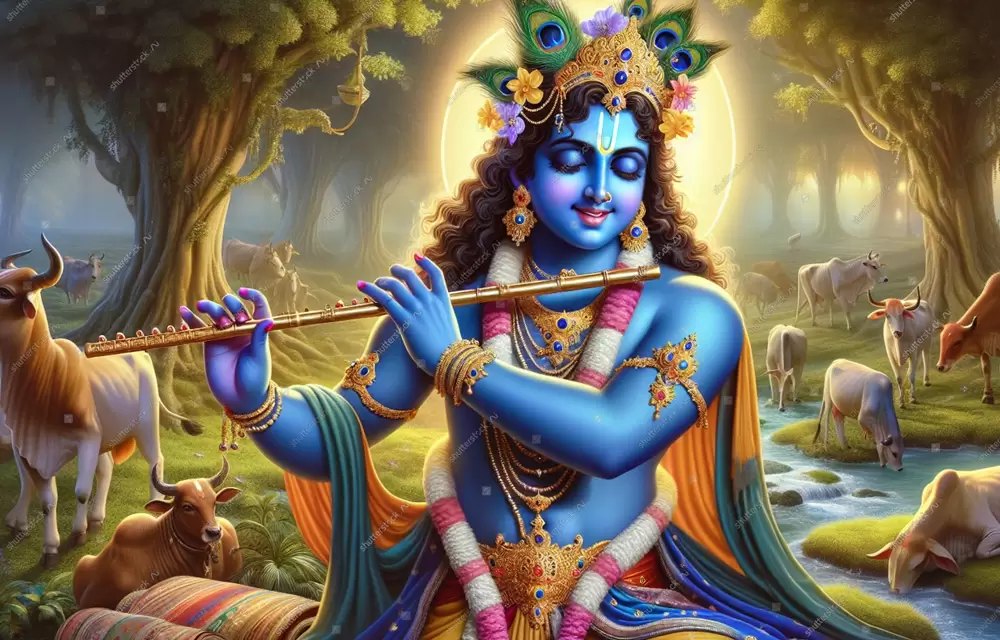
- Krishna: The 8th avatar of Vishnu — born in Mathura, raised in Vrindavan, who spoke the Bhagavad Gita to Arjuna. Means "the dark-bodied one" or "the all-attractive one."
- Rama: The 7th avatar of Vishnu — the king of Ayodhya, the hero of the Ramayana. Means "the eternally joyful one" or "the supreme delight."
The mantra therefore invokes three primary aspects of the divine: the cosmic feminine (Hare/Radha), Lord Krishna (the supreme avatar), and Lord Rama (the perfect avatar). Together, the 32 syllables call upon the entire spectrum of Vaishnava divinity.
Why "Mahamantra"? — The Supreme Mantra
Mahamantra means "great mantra" or "supreme mantra." The Hare Krishna Mahamantra holds this exalted title for specific scriptural reasons:
- Brevity: 32 syllables only — easily memorized, easily recited
- Completeness: Names the divine feminine + Krishna + Rama — the full Vaishnava trinity
- Vibrational power: When chanted aloud, the Sanskrit vibrations carry the mantra's spiritual potency
- Accessibility: No formal initiation required; chantable by anyone, anywhere, anytime
- Universality: Works regardless of language, culture, or religious background
- Scriptural authority: Recommended in three major scriptures including the Kali Santarana Upanishad
- Bhagavata authority: Vedavyasa's Srimad Bhagavata Purana (10.31.20) cites Krishna's names as the supreme mantra
- Continuous chanting compatibility: Can be chanted while walking, working, traveling
Above all, the Hare Krishna Mahamantra is uniquely powerful because it is "ajapa-japa" — capable of being chanted both consciously and subconsciously. Once a devotee internalizes the rhythm, the mantra continues chanting itself in the background of awareness, day and night.
The Three Sacred Sources of the Mahamantra
1. Kali Santarana Upanishad — Vedic Authority
The Kali Santarana Upanishad is a minor upanishad of the Krishna Yajurveda branch. It contains the explicit and complete recitation of the Hare Krishna Mahamantra exactly as we know it today, with the scriptural declaration:
"Hare Krishna Hare Krishna, Krishna Krishna Hare Hare, Hare Rama Hare Rama, Rama Rama Hare Hare — these sixteen names are destructive of all the inauspicious effects of Kaliyuga. No higher way is to be found in all the Vedas."
This Upanishad is the foundational scriptural basis for the mantra. It establishes that:
- The mantra has Vedic authority (Upanishads are part of the Vedanta canon)
- The mantra is specifically the supreme practice for Kaliyuga (our current cosmic age)
- The mantra destroys all inauspicious karmic effects
- No higher spiritual practice exists than this mantra
2. Chaitanya Mahaprabhu (1486-1534 CE) — Bengal Vaishnava Movement
In the 16th century, the great Bengali saint Sri Chaitanya Mahaprabhu received the Hare Krishna Mahamantra from his guru Isvara Puri. Chaitanya then revolutionized Hindu spiritual practice by making the mantra the central focus of his Vaishnava movement.
Chaitanya's key contributions:
- Public chanting (sankirtana) — making the mantra a community practice rather than only individual silent japa
- Procession-style chanting (kirtan) — chanting accompanied by music, dance, and ecstatic devotion
- Mass accessibility — opening the practice to all castes, all classes, all genders
- Devotional ecstasy (bhava) — recognizing that the mantra naturally generates spiritual rapture
- Distribution to disciples — sending the mantra to Bengal, Odisha, Mathura, Vrindavan
Chaitanya is celebrated by ISKCON and global Hindu Vaishnavites as the supreme exemplar of the mahamantra practice. His ecstatic public kirtans in Bengal between 1510-1534 transformed regional Hinduism and laid the foundation for the global movement that would emerge 400 years later.
3. A.C. Bhaktivedanta Swami Prabhupada (1896-1977) — ISKCON Globalization
In 1965, the 69-year-old Bhaktivedanta Swami Prabhupada arrived in New York City aboard a freight steamship with $7 in his pocket, a few personal items, and the Bhagavata Purana commentary in his suitcase. Within 12 years, he had:
- Founded the International Society for Krishna Consciousness (ISKCON) in 1966
- Established over 100 temples in 6 continents
- Translated and commented on 60+ Sanskrit texts including the Bhagavad Gita and Bhagavata Purana
- Made the Hare Krishna Mahamantra a global household name
- Trained thousands of Western disciples in Vaishnava devotional practice
- Created the Hare Krishna brand identity (saffron robes, shaven heads with sikha, japa mala beads, prasadam distribution)
Prabhupada's legacy is enormous: today, ISKCON operates 600+ temples worldwide, including in every major NRI city. The Hare Krishna Mahamantra has been chanted by hundreds of millions of devotees globally since his time. The famous Hare Krishna Festival in Times Square (1969) brought the mantra to global media attention; George Harrison's "My Sweet Lord" (1970) made the mantra internationally recognized.
How to Chant the Mahamantra — Japa Method
The Hare Krishna Mahamantra is most powerfully practiced as japa (continuous repetition) using a mala (rosary) of 108 beads. The traditional technique:
Preparation
- Bathe and dress in clean clothes (preferably saffron, orange, or white)
- Sit on a clean asana (mat) facing East or North
- Have your japa mala ready — 108 beads (typically tulsi wood, rudraksha, or sandalwood)
- Have a chanting log/book to track daily rounds
- Set up a small altar with a Krishna image, Radha-Krishna murti, or simply a flame
- Take three deep breaths to settle the mind
The Japa Technique
- Hold the mala in your right hand (left hand carries different energy in Vedic tradition)
- The mala's 108th bead is the "guru bead" — slightly larger or distinct. Do not cross over it; turn the mala around to begin a new round
- Place the mala over the middle finger, with the index finger separate (the index finger represents ego and should not touch the beads)
- Use the thumb to slide each bead toward you (toward the body, symbolically receiving divine grace)
- For each bead, chant the full 32-syllable mantra aloud, in a clear audible voice (japa is most effective when audible to oneself)
- Continue through all 108 beads = one "round" of japa
- Track your daily rounds — most devotees aim for 16 rounds per day (ISKCON's standard initiation requirement)
- Some devotees chant 2-4 rounds per day as a starting practice
Daily Round Targets
- Beginner: 1-2 rounds per day (~10-20 minutes)
- Standard practitioner: 4-8 rounds per day (~30-90 minutes)
- Serious devotee: 16 rounds per day (ISKCON's minimum for initiated devotees) (~2 hours)
- Intensive sadhana: 32-64 rounds per day for short retreats
- Mahamantra anushthan: 108 rounds in a single sitting for special occasions
16 rounds per day (~2 hours) is the standard for serious sadhana. ISKCON initiated devotees commit to this minimum daily. The 16 rounds × 108 beads × 32 syllables = 55,296 chanted syllables per day = approximately 1,728 mahamantras = the supreme daily Vaishnava sadhana.
When to Chant
- Best time: Brahma Muhurta (early morning, 4:00-6:00 AM) — most powerful for sadhana
- Standard practice: Sunrise to mid-morning (6:00-9:00 AM)
- Throughout the day: While walking, commuting, working — mental japa is acceptable and powerful
- Evening: Pradosha time (just before sunset) is auspicious
- Group chanting (sankirtana): Most powerful — Saturday/Sunday community kirtans at temples
- Special occasions: Janmashtami, Ekadashi, Rama Navami — chanting amplifies during festivals
- In crisis or distress: Any time — the mantra is the protective shield
The 16-Round Tradition
The 16-round daily count has a specific history. When Bhaktivedanta Swami Prabhupada was establishing ISKCON in the West (1965-1977), he wanted to set a clear daily standard. He chose 16 rounds because:
- Achievable: 2-2.5 hours of chanting fits a serious devotee's daily schedule
- Compressed: 16 × 108 × 32 = 55,296 syllables — substantial daily output
- 16 is a sacred Vedic number — 16 letters in the mantra (Hare-Krishna-Hare-Krishna-Krishna-Krishna-Hare-Hare-Hare-Rama-Hare-Rama-Rama-Rama-Hare-Hare = 16 holy names)
- Manageable: One round in 5-10 minutes; 16 rounds in 80-160 minutes
- Adaptable: Can be spread throughout the day (morning + commute + evening)
Today, the 16-round count remains the standard for ISKCON-initiated devotees worldwide. Beyond ISKCON, many non-ISKCON Vaishnavite practitioners also aim for 16 rounds. New practitioners typically start with 2-4 rounds and gradually build up.
Pronunciation Tips
Correct pronunciation enhances the mantra's vibrational power. Some tips:
- "Hare" — pronounced "Ha-ré" (two syllables, with stress on the second)
- "Krishna" — pronounced "Krish-na" (the sh is a palatal sound, the n is dental)
- "Rama" — pronounced "Raa-ma" (long "aa", followed by short "ma")
- Maintain steady rhythm — not too fast (loses meaning), not too slow (loses momentum)
- Audible to yourself — not just mental whispering
- Maintain steady breath flow — let the breath carry the mantra
- Focus on the sound — the mantra is the sound, not just the meaning
Even imperfect pronunciation carries the mantra's power. The divine names themselves contain the spiritual essence; what matters is sincere devotional intention.
The Spiritual Mechanism — Why Mahamantra Works
Hindu tradition explains the mahamantra's spiritual mechanism through several principles:
1. Naama-Roopa (Name-Form Identity)
In Vaishnava philosophy, the name of God (Naama) and the form of God (Roopa) are non-different. When you chant "Krishna," you are not merely speaking a word — you are invoking Krishna himself. The sound vibration carries the divine presence. This is the foundational principle: the Sanskrit names of God ARE God in vibrational form.
2. Cleansing the Mirror of the Mind
Mantra-japa gradually cleanses the mind of the layers of accumulated mental impurity (chitta-shuddhi). Hindu tradition compares the mind to a mirror covered in dust — the mantra is the cleaning agent that removes the dust, revealing the original brightness of the soul.
3. Connection to Cosmic Devotion
Every time the mantra is chanted anywhere in the world, the devotee participates in a global ongoing devotional current. Hundreds of millions of devotees are chanting this exact mantra at any given moment. Your individual chanting becomes part of the cosmic devotional symphony.
4. The Replacement Principle
Random thoughts continuously cycle through the mind — many unproductive, some destructive. Mantra-japa replaces this random mental noise with divine sound. As the mantra takes over, peace replaces agitation, devotion replaces craving, clarity replaces confusion.
5. Bhakti Cultivation
Repeated devotional chanting naturally cultivates bhakti (loving devotion). What begins as mechanical repetition gradually deepens into sincere love. The transformation happens organically through faithful practice.
Benefits of Mahamantra Chanting
The benefits of regular Hare Krishna Mahamantra chanting are documented in scripture and confirmed by millennia of devotee testimony:
Spiritual Benefits
- Direct connection with Krishna, Radha, and Rama — the divine Vaishnava trinity
- Cleansing of karmic burdens accumulated over many lifetimes
- Liberation from the cycle of birth and death (per the Kali Santarana Upanishad)
- Cultivation of bhakti (loving devotion)
- Awakening of spiritual perception
- Connection to the cosmic kirtan that has been continuous for thousands of years
- Direct path to Krishna-bhakti without elaborate ritual preparation
- Cleansing of the chitta (mind-stuff) of accumulated mental impurity
Mental & Emotional Benefits
- Reduction of anxiety, depression, and chronic mental restlessness
- Improved focus and meditation capacity
- Stress reduction (validated by modern neuroscience studies on mantra-chanting)
- Emotional regulation through the steady rhythmic chanting
- Reduction of intrusive negative thoughts
- Improved mood stability
- Better sleep quality
- Sense of cosmic belonging and purpose
Physical Benefits
- Improved cardiovascular response to stress
- Reduced cortisol (stress hormone) levels
- Better breathing patterns through the meter's influence
- Reduced inflammation markers
- Better immune function in regular practitioners
- Improved cognitive performance
- Reduced blood pressure
- Vibrational stimulation of internal organs through the chanting resonance
Social & Community Benefits
- Connection to the global Vaishnava community
- Access to ISKCON temples worldwide
- Family practice — pass mantra to children and grandchildren
- Sangha (community) at local kirtan gatherings
- Easy entry point into deeper Vaishnava philosophy and Bhagavata study
Integration With Modern Life
The Hare Krishna Mahamantra integrates beautifully with modern busy lifestyles:
- Commuting: Mental japa while walking, driving, or on public transport. Many practitioners do 2-4 rounds during their daily commute.
- Workplace breaks: 5-10 minute breaks during the workday for 1-2 rounds. Especially valuable before important meetings or decisions.
- Phone calls and meetings: Subtle mental chanting between sentences or during waiting periods.
- Exercise: Many practitioners chant during walks, runs, or treadmill sessions. The mantra rhythm syncs with movement.
- Cooking and household tasks: Listening to recorded mahamantra audio while doing routine tasks transforms mundane time into sadhana.
- Falling asleep: Listening to mahamantra audio while drifting off creates subconscious devotional impressions.
- Family practice: Group chanting during evening family time builds shared devotional culture.
The ISKCON Global Movement
The International Society for Krishna Consciousness (ISKCON), founded by Bhaktivedanta Swami Prabhupada in 1966, has been the primary vehicle for the mahamantra's global propagation. Key facts:
- ISKCON operates 600+ temples worldwide (as of 2026)
- Major NRI centers: Mumbai, Bangalore, Hyderabad, Delhi, Atlanta, Houston, Chicago, Mayapur (West Bengal), New Delhi, London, Berlin, Toronto, Sydney, Singapore, Kuala Lumpur, Cape Town, Mauritius, and many more
- Bhaktivedanta Books — translation of major Vaishnava scriptures in 90+ languages
- Bhakti-vriksha — small house-based groups around temples
- Govinda Restaurants — vegetarian Indian restaurants globally, all proceeds support ISKCON
- Akshaya Patra — partnership project providing midday meals to 2+ million Indian school children daily
- Annual events: Janmashtami (mid-August), Gaur Purnima (March), Rathayatra (multiple summer dates worldwide)
- Daily darshan, kirtan, and prasadam available at all ISKCON temples
For NRI Hindus, ISKCON serves as the primary access point for Hare Krishna Mahamantra practice. The temples function as community hubs where mahamantra culture is preserved and transmitted to next generations.
Famous Mahamantra Stories
Chaitanya Mahaprabhu's Ecstatic Kirtans
In 16th-century Bengal, Sri Chaitanya Mahaprabhu would conduct massive public kirtans in the streets of Navadwip. Devotees describe Chaitanya falling into spiritual ecstasy during chanting — sometimes weeping, sometimes dancing with abandon, sometimes losing consciousness in divine rapture. His public chanting tradition transformed Bengal's religious culture and laid the foundation for the global mahamantra movement.
George Harrison and "My Sweet Lord"
George Harrison of the Beatles met Bhaktivedanta Swami Prabhupada in 1969-70 and adopted the Hare Krishna Mahamantra. His 1970 song "My Sweet Lord" includes the mahamantra as the chorus — making it the first Hindu mantra to top international music charts. The song reached #1 in the US, UK, and 9 other countries. Harrison continued chanting the mantra throughout his life and became a major financial supporter of ISKCON's Bhaktivedanta Manor near London.
Bhaktivedanta Swami in NYC
When Prabhupada arrived in New York at age 69 in 1965, he had nothing but the mantra. Within 5 years, he had established temples on three continents. His Tompkins Square Park kirtans in Manhattan (1966) attracted Beat Generation poets including Allen Ginsberg. The mantra spread through the counterculture movement, then mainstream culture, then globally. The Times Square Hare Krishna Festival (1969) brought tens of thousands to NYC for chanting — and brought the mantra to global media attention.
Modern Devotee Stories
Countless modern devotees report transformative mahamantra experiences:
- Cancer patients who undertook 16-round daily practice during chemotherapy reported reduced pain and accelerated recovery
- Recovering addicts who replaced addictive thinking with mantra-chanting found sustainable sobriety
- Depression sufferers who began daily japa reported significant mood improvement
- NRI professionals using mantra-chanting during high-stress work periods report better outcomes
- Parents who introduced children to the mahamantra reported improved family bonding and child behavior
- Travelers chanting during long flights find anxiety reduction and better sleep
These are not "miracles" in the supernatural sense — they reflect what consistent devotional practice accomplishes for the human psyche and life trajectory.
Comparison with Other Hindu Mantras
How does the Hare Krishna Mahamantra compare to other major Hindu mantras?
- Gayatri Mantra (24 syllables): The supreme Vedic mantra dedicated to Savitar (Sun). Requires initiation in traditional practice; intellectual depth.
- Mahamrityunjaya Mantra (32 syllables): The supreme healing mantra dedicated to Shiva. For long life and protection from death.
- Om Namah Shivaya (5 syllables): Panchakshari mantra of Shiva. Foundational Shaiva practice.
- Om Namo Narayanaya (8 syllables): Ashtakshari mantra of Vishnu. Foundational Vaishnava practice.
- Hare Krishna Mahamantra (32 syllables): Specifically for the Kali Yuga; combines Krishna, Rama, and the divine feminine; no initiation required; community kirtan tradition.
The unique strength of the Hare Krishna Mahamantra: it combines accessibility (no initiation needed), brevity (32 syllables), community practice (sankirtana), modern global presence (ISKCON), and direct Vaishnava devotional path. For Kali Yuga, it is considered the supreme.
Mahamantra for NRI Hindus
The Hare Krishna Mahamantra is particularly powerful for NRI Hindus:
- Accessibility — no formal initiation required
- Audio-rich — countless quality recordings on YouTube, Spotify, Apple Music; perfect for commutes
- Global ISKCON presence — every major NRI city has an ISKCON temple
- Children's practice — the mantra rhythm captivates young listeners; easily memorizable
- Cross-generational — connects grandparents in India with grandchildren abroad
- Crisis tool — universal protective mantra during difficult passages
- Family practice — Sunday evening family chanting builds devotional culture
- Bridge to deeper study — natural entry point into Bhagavad Gita, Bhagavata Purana, and Vaishnava philosophy
- Cultural identity — particularly important for NRI youth seeking heritage connection
- Time-zone universal — chantable from any country, any time zone, any hour
Building Your Daily Mahamantra Practice
For new practitioners, a structured 30-day plan to build a sustainable mahamantra practice:
- Days 1-3: Listen to a quality mahamantra recording daily (Krishna Das, Radha Krishna Das, or ISKCON-recommended recordings). No active chanting yet — just absorb.
- Days 4-7: Acquire a 108-bead japa mala (tulsi wood traditional). Practice holding it correctly. Try chanting one round (108 mahamantras) daily.
- Days 8-14: Continue 1 round daily. Time it — should take 5-10 minutes. Build comfort with the rhythm.
- Days 15-21: Increase to 2 rounds daily. The morning hour becomes your sacred chanting time.
- Days 22-28: Increase to 4 rounds daily. Begin tracking in a chanting log.
- Days 29-30: Evaluate your practice. Decide: continue at 4 rounds (sustainable for most), or build toward 8 or 16 rounds.
- Day 31 onwards: Daily morning practice continues as ongoing sadhana. Many practitioners maintain 4 rounds for life; some build toward the 16-round ISKCON standard.
Frequently Asked Questions (FAQ)
1. Do I need formal initiation to chant the mahamantra?
No. The Hare Krishna Mahamantra is uniquely accessible — no initiation required. Anyone can begin chanting today. However, those seeking deeper spiritual progression often join ISKCON or another Vaishnava lineage for guru-disciple relationship and structured progression.
2. What is the difference between mantra-japa and bhajan?
Japa is individual silent or audible chanting using a mala. Bhajan is community singing of devotional songs (often including the mahamantra as a central refrain). Kirtan is the most ecstatic form — group chanting with musical instruments and often dancing.
3. Can I chant if I don't know Sanskrit?
Absolutely. The mahamantra is in Sanskrit, but no understanding of Sanskrit grammar is needed. The phonetic sounds carry the spiritual power. Modern transliteration makes the mantra accessible to all language backgrounds.
4. Can women chant the mahamantra?
Yes — absolutely. The mahamantra has no gender restriction. Women across India and the global diaspora are among the most devoted mahamantra practitioners.
5. Can children learn the mahamantra?
Yes — and it is recommended. Children find the rhythmic Sanskrit captivating. Many NRI parents teach the mahamantra to children as their first major Sanskrit prayer.
6. What kind of mala should I use?
Tulsi wood (sacred to Krishna) is most traditional. Rudraksha is acceptable. Sandalwood (chandan) is also used. Avoid plastic or metal malas for serious sadhana.
7. Can I chant while doing other activities?
Yes — mental japa is acceptable while walking, working, exercising. Audible focused japa during a dedicated daily session is the ideal; mental japa throughout the day is a beautiful supplementary practice.
8. What if I miss a day of chanting?
Resume the next day without guilt. Consistency over weeks matters more than perfect attendance. Krishna receives the sincere devotee regardless of perfect schedule adherence.
9. Does the mahamantra work for non-Hindus?
The mahamantra is universal. ISKCON has Western devotees of every background. The mantra's spiritual mechanism (cleansing, transformation, devotion-cultivation) operates regardless of cultural origin. Many practitioners began as non-Hindu and remain non-Hindu while practicing the mantra deeply.
10. How long until I see results from mahamantra chanting?
Some subtle effects (calmer mind, reduced reactivity) within 7-14 days of regular practice. Deeper transformation (sustained peace, devotional joy) within 3-6 months of 4+ rounds daily. The 16-round ISKCON standard produces profound shifts over 1-3 years.
Conclusion
The Hare Krishna Mahamantra is the supreme spiritual technology of the modern Hindu age. Composed of 32 sacred Sanskrit syllables — calling upon the divine feminine (Hare), Krishna, and Rama — the mantra has been chanted continuously for thousands of years across India and globally for the past 60 years through ISKCON's movement.
Begin today. Acquire a 108-bead japa mala. Listen to a quality recording. Find your daily rhythm — 1 round, 4 rounds, eventually 16 rounds. Visit your local ISKCON temple. Read the Bhagavad Gita. Join Sunday kirtans. Within months of consistent practice, the mantra will be chanting itself in the background of your consciousness, day and night — and Lord Sri Krishna's divine grace will accompany your every step.
"Hare Krishna Hare Krishna, Krishna Krishna Hare Hare, Hare Rama Hare Rama, Rama Rama Hare Hare" — let these 32 syllables be your daily companion. Through them, the cosmic Lord himself enters your life.
May Lord Sri Krishna bless your mahamantra practice with the supreme grace of Vaishnava devotion. 🙏 Hare Krishna! Hare Krishna! Krishna Krishna Hare Hare!
Did you find this guide helpful? Share your mahamantra chanting experience in the comments below. If this guide moved your heart, please share with family and friends. Subscribe to hindutone.com for more devotional guides. 🙏 Jai Sri Krishna!
Related Reading on HinduTone
- Krishna Janmashtami 2026: Complete Guide & NRI Celebration
- Importance of Thursday in Hinduism: Guruvar Vrat & Vishnu Worship
- Vaikuntha Ekadashi 2026 at Tirumala: Sorgavasal Darshan
- Aditya Hridayam Complete Guide: All 30 Verses
- Hanuman Chalisa: Complete 40 Verses with Hindi, Transliteration & Meaning
- Sundar Kand: Complete Guide & 7-Day Saptaha Paath
- Shiv Tandava Stotram: Ravana's Cosmic Dance Hymn
- Maha Mrityunjaya Mantra: Lyrics, Meaning & How to Chant
You might also like
Krishna Janmashtami 2026: Complete Guide — Date August 14, Puja Vidhi, Vrat Fasting, Mathura & Vrindavan, NRI Celebration
Hare Krishna Maha Mantra: Meaning & Benefits
Bhagavad Gita Chapter 12 — Bhakti Yoga Complete Commentary: All 20 Verses, Devotee Qualities, 30-Day NRI Practice Guide for 2026