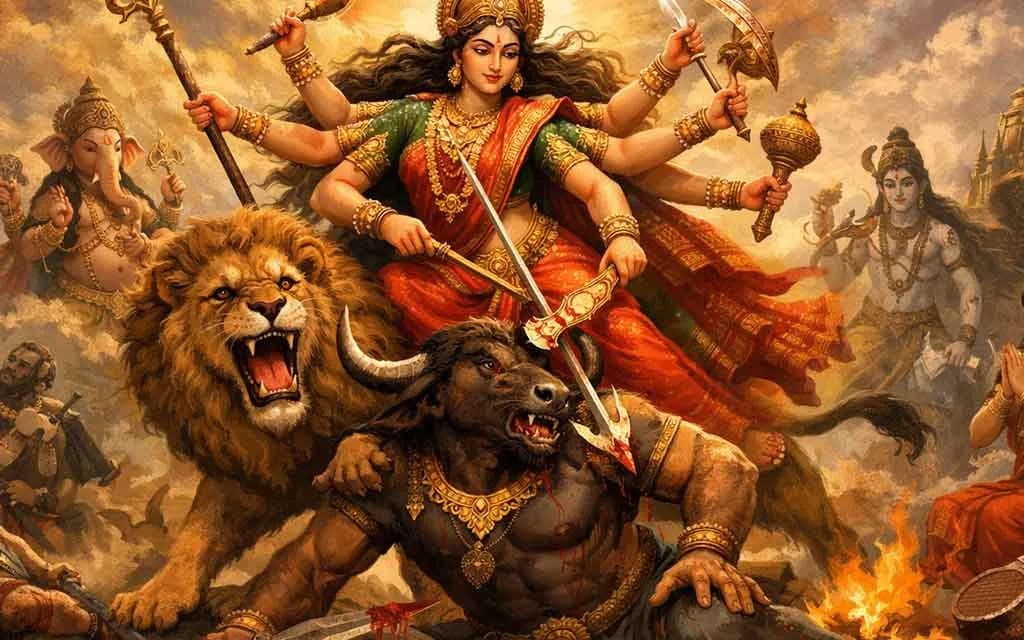
Hare Krishna Maha Mantra: Meaning & Benefits
Hare Krishna Maha Mantra — meaning, full Sanskrit, how to chant 16 rounds (1728 names) daily for joy, devotion & liberation in Kali Yuga.
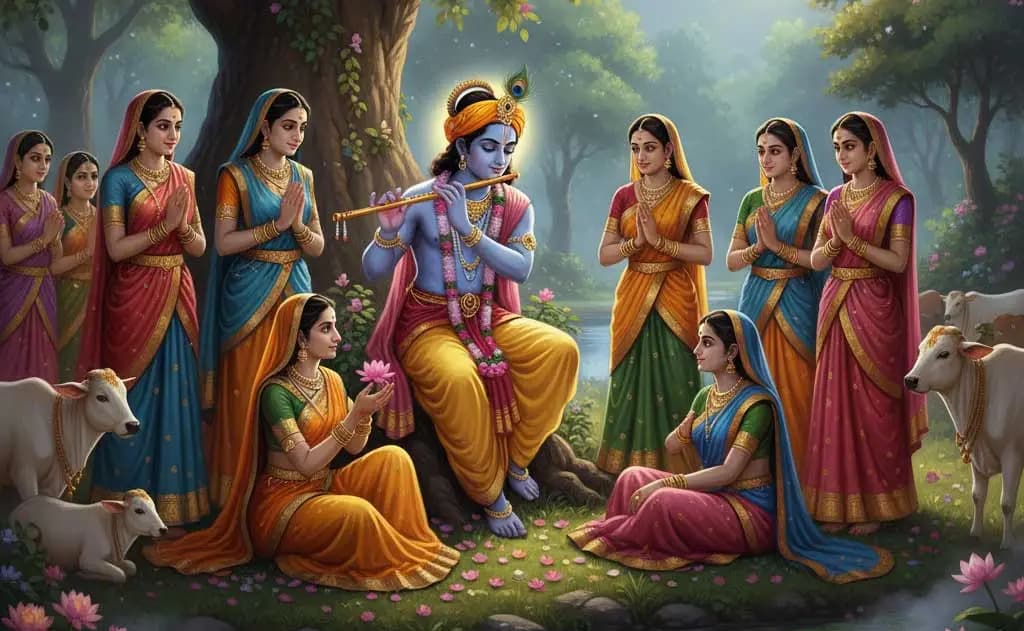
Hare Krishna Maha Mantra — meaning, full Sanskrit, how to chant 16 rounds (1728 names) daily for joy, devotion & liberation in Kali Yuga.
Hare Krishna Maha Mantra benefits have transformed millions of lives across continents — from the streets of Mathura where Sri Krishna was born to the avenues of Manhattan where Srila Prabhupada chanted it under a tree in 1965 and started the global Krishna Consciousness movement. The 16-word "Maha Mantra" — Hare Krishna Hare Krishna, Krishna Krishna Hare Hare; Hare Rama Hare Rama, Rama Rama Hare Hare — is described in the Kali-Santarana Upanishad as the single mantra capable of liberating one from the suffering of Kali Yuga. American practitioners — yoga teachers, meditators, recovering addicts, professionals in burnout, parents seeking joy — have made it the most-chanted Sanskrit mantra in the West. This complete Hare Krishna Maha Mantra meaning and chanting guide gives you the Sanskrit, transliteration, word-by-word translation, the recommended chanting count (16 rounds = 1728 names daily, the ISKCON gold standard), the documented benefits, and 7 frequently-asked questions.
Origin and Scriptural Source
The Hare Krishna Maha Mantra appears in the Kali-Santarana Upanishad — a Vaishnava Upanishad of the Krishna Yajurveda. The Upanishad presents the mantra as a direct gift to humanity for crossing (santarana) the suffering of Kali Yuga. It was popularised in the modern era by Sri Caitanya Mahaprabhu (1486-1534) of Bengal, and brought to the West in 1965 by His Divine Grace A. C. Bhaktivedanta Swami Srila Prabhupada, founder of ISKCON (the International Society for Krishna Consciousness).
Full Sanskrit Text and Transliteration
In Devanagari:
हरे कृष्ण हरे कृष्ण कृष्ण कृष्ण हरे हरे । हरे राम हरे राम राम राम हरे हरे ॥
Roman / English transliteration:
Hare Krishna Hare Krishna, Krishna Krishna Hare Hare; Hare Rama Hare Rama, Rama Rama Hare Hare.
Advertisement
Total: 32 syllables in two halves of 16 syllables each. The mantra contains 16 names of God: 8 "Hare", 4 "Krishna", 4 "Rama".
Word-by-Word Meaning
Hare — "O Hari!" or "O Energy of the Lord (Sri Radha)" — the vocative form. Hari is one of the most beloved names of Vishnu, meaning "the one who removes" (sins, sorrows, illusions).
Krishna — Sri Krishna — the all-attractive supreme personality of Godhead, the avatar of Vishnu born in Mathura. Literally "the dark one" or "the all-attractive".
Rama — Sri Rama — the seventh avatar of Vishnu, the source of all bliss; literally "the one who delights".
"O Lord Hari! O Energy of the Lord! O Krishna, the all-attractive Supreme Person! O Rama, the source of all bliss! Engage me in your loving service."
Pronunciation Guide for Beginners
Hare — "Hah-ray" — soft "Hah", clear "ray".
AdvertisementKrishna — "Krish-na" — slight roll on the "r"; the "Krish" is one rapid syllable.
Rama — "Raa-ma" — long "aa" in the first syllable; soft "ma" at the end.
Pace — start slowly. As the mind settles, the rhythm naturally finds its pulse — usually one full Maha Mantra in about 8-10 seconds at meditative pace.
Amazing Benefits of the Hare Krishna Maha Mantra for Modern Life
For joy, anxiety and depression
Of all major Hindu mantras, the Hare Krishna Maha Mantra is unique in being a rasa-mantra — its primary effect is the awakening of ananda (joy). Modern Western practitioners (including studies on ISKCON-attending college students) report measurable reductions in clinical anxiety scores, depression markers and rumination after 8 weeks of daily 16-round practice.
For addiction recovery
ISKCON has run successful addiction-recovery programmes for half a century. The Maha Mantra's rhythmic, ecstatic quality engages the brain's reward circuitry in a way that gradually replaces craving for substances with craving for chanting. Recovery centres in California, New York, the UK and Australia formally include daily kirtan in their protocols.
For relationships, family and community
Group chanting (sankirtana) is a uniquely social mantra practice. Couples, families and communities who chant together — at home, at temple, in kirtan halls — report dramatic improvements in connection, conflict resolution, and shared meaning.
For deep spiritual progress in Kali Yuga
The Kali-Santarana Upanishad explicitly identifies this mantra as yuga-dharma — the most efficacious spiritual practice for the present age. Sri Caitanya Mahaprabhu and the entire Gaudiya Vaishnava tradition have taught that no other practice (yajna, meditation, austerity) approaches the speed and effectiveness of nama-sankirtana for self-realisation in Kali Yuga.
How to Chant for Maximum Power
Time — Brahma Muhurta (4:30-5:30 AM) is the gold standard. ISKCON practitioners chant their 16 rounds before breakfast.
Posture — sit cross-legged or stand and walk while chanting; the Maha Mantra is uniquely portable.
Mala — a 108-bead tulasi mala is the traditional choice. Each Maha Mantra is one bead; one full mala = 108 Maha Mantras = 1 round.
Count — 16 rounds = 1728 Maha Mantras daily is the formal vow taken by initiated Vaishnavas in ISKCON. Beginners start with 1 round (108) and build up.
Pace — a full round at meditative pace takes ~7-9 minutes. 16 rounds takes ~2 hours.
Sankalpa — "I chant the Hare Krishna Maha Mantra to please Krishna, to deepen my devotion, and for the welfare of all beings."
AdvertisementTwo modes: japa (private) and kirtan (group) — japa with mala in soft audible voice, kirtan with mridanga + karatalas in loud melodic call-and-response. Both are equally valid; ideally you do both each day.
Closing — end with three "Jaya Sri Krishna" or "Hari bol" and a few minutes of silent sitting.
Recommended chanting count by goal
Beginner (week 1-4) — 1 round (108) per day = ~10 min
Householder Vaishnava — 4 rounds (432) per day = ~30 min
ISKCON initiated devotee — 16 rounds = 1728 names per day = ~2 hr (the formal vow)
Group kirtan (sankirtana) — anywhere from 30 minutes to multi-hour sessions on Sundays and Ekadashis
Lifetime — Sri Caitanya Mahaprabhu chanted 192 rounds daily (~24 hours of japa + kirtan)
Advertisement
Common Mistakes to Avoid
Chanting mechanically while planning the day — give attention to each name.
Letting the tongue rush ahead of the mind — slow down.
Skipping rounds and "making them up" later — daily consistency is everything.
Counting incorrectly on the mala — never cross over the meru bead.
Chanting after meat or in a polluted state — Vaishnava tradition recommends a vegetarian diet alongside chanting.
Quotes and References
"Hare Krishna Hare Krishna, Krishna Krishna Hare Hare; Hare Rama Hare Rama, Rama Rama Hare Hare — these sixteen names destroy all the inauspicious effects of Kali. There is no other way, no other way, no other way." — Kali-Santarana Upanishad, mantra 2.
"In this Kali Yuga the only deliverance is the chanting of the holy names of the Lord; there is no other way." — Brihan-Naradiya Purana, 38.126.
"Chant Hare Krishna and your life will be sublime." — A. C. Bhaktivedanta Swami Srila Prabhupada, founder of ISKCON.
"The holy name of Krishna is the sweetest of all sweetness, the most auspicious of all auspiciousness, and the most beneficial of all benefits." — Sri Caitanya Mahaprabhu, Sikshashtaka 1.
Lesser-Known Facts
Srila Prabhupada arrived in New York with $7 and a trunk of Bhagavatam books in September 1965; he chanted under a tree at Tompkins Square Park and began ISKCON within a year.
George Harrison's "My Sweet Lord" (1970) is the highest-charting song in pop history to feature the Hare Krishna Maha Mantra in its chorus.
Today there are over 800 ISKCON temples and centres in 100+ countries; the largest are in Mumbai, Mayapur, Vrindavan, Houston, Los Angeles and London.
The Sri Sri Radha Krishna temple in New Delhi distributes free Krishna prasadam meals to over 350,000 children every school day through the Annamrita Foundation — funded substantially by donations from devotees who began with the Maha Mantra.
Studies in addiction medicine (notably at the University of California San Francisco) have measured measurable improvements in substance-use disorder treatment outcomes for participants who add daily Hare Krishna kirtan to standard care.
Conclusion: A Mantra for Joy in Kali Yuga
The complete Hare Krishna Maha Mantra meaning and chanting is summed up in the simplest possible idea: the holy name itself is divine. Where other mantras require precise pronunciation, fixed times and ritual purity, the Maha Mantra rewards even an imperfect, half-distracted attempt with a smile from within. Begin with one round (108) tomorrow morning. By the time you reach four rounds, you will know exactly why millions of people across continents have made this their daily anchor.
Share this guide with anyone in your life who could use more joy, and complete the series with our companion guides on Gayatri Mantra, Om Namah Shivaya, Mahamrityunjaya Mantra and Om Gan Ganapataye Namah.
Frequently Asked Questions
How many times should I chant the Hare Krishna Maha Mantra daily?
The ISKCON standard is 16 rounds = 1728 Maha Mantras = ~2 hours daily (the formal initiation vow). Beginners start with 1 round (108) and build up. Even 1 round daily for 8 weeks produces measurable transformation.
When is the best time to chant?
Brahma Muhurta (4:30-5:30 AM) — most ISKCON devotees finish their 16 rounds before breakfast. The mantra can be chanted anytime, day or night.
What does the Maha Mantra mean?
"O Lord Hari! O Energy of the Lord (Radha)! O Krishna! O Rama! Engage me in your loving service." It is a direct call to the supreme personality of Godhead through 16 of his most beloved names.
Do I need to be a Hare Krishna or ISKCON member to chant?
Absolutely not. The mantra is universally available to anyone of any background. Many Christian, Jewish, Muslim and atheist practitioners chant it daily — Srila Prabhupada always emphasised that Krishna is for everyone.
What is the difference between japa and kirtan?
Japa is private repetitive chanting on a mala (typically with the eyes closed and the voice soft). Kirtan is group melodic chanting with instruments (mridanga, karatalas, harmonium). Both are equally beneficial; ideally you do both each day.
Can children chant the Maha Mantra?
Yes — and this is the easiest mantra for children to learn. ISKCON's "Krishna Conscious" school curriculum begins teaching the Maha Mantra at age 4-5.
What kind of mala should I use?
A 108-bead tulasi mala is the traditional Vaishnava choice. Sandalwood is the second option. Avoid rudraksha for this specific mantra — it is associated with Shiva worship.
Is the Maha Mantra a religion or a practice?
Both, depending on how you approach it. As a religion, it is the central practice of Gaudiya Vaishnavism. As a practice, it is universally accessible — anyone can chant for the documented psychological, emotional and spiritual benefits regardless of religious affiliation.
Explore HinduTone — May 2026 hub
Continue your reading across HinduTone's May 2026 publishing cluster — every post in this hub is interlinked for a complete devotional and informational journey.
🪔 Festivals & Vrats: Hindu Festivals in May 2026 — Complete Vrats & Puja Guide · Ganga Dussehra 2026 — Story, Muhurat & Home Vidhi · Adhik Maas 2026 — Purushottam Maas Dates & Rules.
🌟 Vedic Horoscopes: May 2026 Monthly Horoscope — All 12 Rashis · Weekly Horoscope May 11–17, 2026 · Weekly Horoscope May 18–24, 2026.
👤 Famous Hindus — Biographies: Narendra Modi Biography · Swami Vivekananda Biography · Sadhguru Biography — Jaggi Vasudev · Mata Amritanandamayi (Amma) Biography.
🕉️ Powerful Mantras: Gayatri Mantra — Meaning, Benefits & Chanting · Om Namah Shivaya — Meaning & Power · Mahamrityunjaya Mantra — Healing Mantra.
You might also like
Hidden Science Behind the Hanuman Chalisa: Neuroscience, Sound, Quantum & the Earth-Sun Verse
Om Gan Ganapataye Namah: Meaning & Benefits
Mahamrityunjaya Mantra: Meaning & Healing Power