Krishna Janmashtami 2026: Complete Guide — Date August 14, Puja Vidhi, Vrat Fasting, Mathura & Vrindavan, NRI Celebration
Complete Krishna Janmashtami 2026 guide — Wednesday August 14, 2026. Tithi timings, divine birth story, fasting rules (Nirjala/Phalahar), midnight Janmotsav puja, Dahi Handi, Mathura/Vrindavan/Iskcon celebrations, NRI guide, Krishna mantras, FAQs.
Complete Krishna Janmashtami 2026 guide — Wednesday August 14, 2026. Tithi timings, divine birth story, fasting rules (Nirjala/Phalahar), midnight Janmotsav puja, Dahi Handi, Mathura/Vrindavan/Iskcon celebrations, NRI guide, Krishna mantras, FAQs.
Of all the festivals in the Hindu calendar, none generates more universal joy than Krishna Janmashtami — the birthday of Lord Sri Krishna, the eighth avatar of Lord Vishnu, the cosmic playmate of the gopis at Vrindavan, the divine charioteer of Arjuna, the speaker of the Bhagavad Gita, the eternally beloved Lord whose smile has lit Hindu hearts for 5,000 years.
Krishna Janmashtami 2026 falls on Wednesday, August 14, 2026 — the eighth lunar day (Ashtami) of the dark fortnight (Krishna Paksha) in the Hindu month of Bhadrapada. On this single night, devotees across India and the global diaspora gather to celebrate the divine birth at midnight — the same midnight hour when, 5,000+ years ago, Lord Sri Krishna was born to Devaki and Vasudeva in a prison cell in Mathura, while torrential rains poured and the cosmic deities themselves descended to witness the avatar of Vishnu.
This complete HinduTone guide covers everything about Janmashtami 2026 — the exact date and timing, the dramatic birth story, the fasting rules (Nirjala or Phalahar), the midnight Janmotsav puja, the famous Dahi Handi tradition, where to celebrate (Mathura, Vrindavan, ISKCON temples worldwide), the unique festival traditions of different Indian regions, NRI celebration planning, and frequently asked questions about this most beloved festival.
When is Krishna Janmashtami 2026?
Krishna Janmashtami 2026 occurs on the following dates and timings:
- Date: Wednesday, August 14, 2026
- Tithi: Ashtami of Bhadrapada Krishna Paksha (8th day of the dark fortnight)
- Tithi begins: Tuesday, August 13, 2026, approximately 18:30 IST
- Tithi ends: Wednesday, August 14, 2026, approximately 17:00 IST
- Janmashtami Vrat day: Wednesday, August 14, 2026
- Janmotsav Puja time (midnight birth ceremony): Wednesday, August 14 to Thursday, August 15, 2026 — 23:30 to 00:30 IST
- Parana (fast-breaking) time: Thursday, August 15, 2026 morning
Note: Exact tithi timings vary slightly by panchang tradition (Drik Siddhanta, Vakya, or Lahiri). The above timings follow Drik Siddhanta. Mathura and Vrindavan timings (which are authoritative for many Vaishnavites) align with the above. NRI devotees should adjust to local sunrise-sunset times.
The Divine Birth Story
Krishna Janmashtami commemorates one of the most dramatic events in Hindu mythology. The cosmic background:
Approximately 5,000 years ago, the demon king Kamsa ruled Mathura with cruelty. A divine prophecy warned Kamsa that the eighth child of his sister Devaki would kill him. In response, Kamsa imprisoned Devaki and her husband Vasudeva, killing each of their first seven children at birth. When the eighth child — Lord Sri Krishna — was about to be born, Kamsa was prepared to kill this child too.
On the night of Bhadrapada Krishna Ashtami in approximately 3228 BCE, at midnight, Krishna was born in the prison cell. Vishnu himself appeared to Devaki and Vasudeva, then transformed into the infant Krishna. The miracle began: the prison guards fell into deep sleep. The locks of the cell opened. The fetters that bound Vasudeva fell away.
Vasudeva, instructed by the divine vision, carried the infant Krishna across the river Yamuna to Gokul. The Yamuna was in flood, but the river parted to allow Vasudeva to walk across with the infant. The cosmic serpent Sheshanaga rose from the waters and held an umbrella over the infant Krishna to protect him from the torrential rain.
In Gokul, Vasudeva exchanged the infant Krishna with the newborn daughter of Yashoda and Nanda. He carried the girl back to prison. When Kamsa came to kill the eighth child, the girl transformed into Goddess Yogamaya — Krishna's sister — and declared: "Your destroyer is already born and being raised elsewhere. Your time is near."
Krishna grew up in Gokul, then Vrindavan, performing his famous childhood leelas (divine plays) — stealing butter, playing the flute, dancing with the gopis, lifting Mount Govardhana, defeating cosmic demons. Eventually, at age 11, he returned to Mathura and slew Kamsa, fulfilling the cosmic prophecy.
Janmashtami celebrates the divine moment of birth — the cosmic event that introduced Krishna into the world. Every year on this single night, the world re-witnesses that birth.
The Significance of Janmashtami
Krishna Janmashtami carries multiple layers of significance:
- Krishna is the 8th avatar of Lord Vishnu — descended to restore dharma during the Mahabharata era
- He is the speaker of the Bhagavad Gita — perhaps the most-read Hindu scripture worldwide
- He is the cosmic playmate (with the gopis) — the embodiment of divine love (bhakti)
- He is the divine charioteer of Arjuna — the eternal guide of the devotee
- He is the cosmic teacher (Yogeshwara) — the supreme yogi
- He is the protector of children (Bal Krishna) — the eternal child-form deity
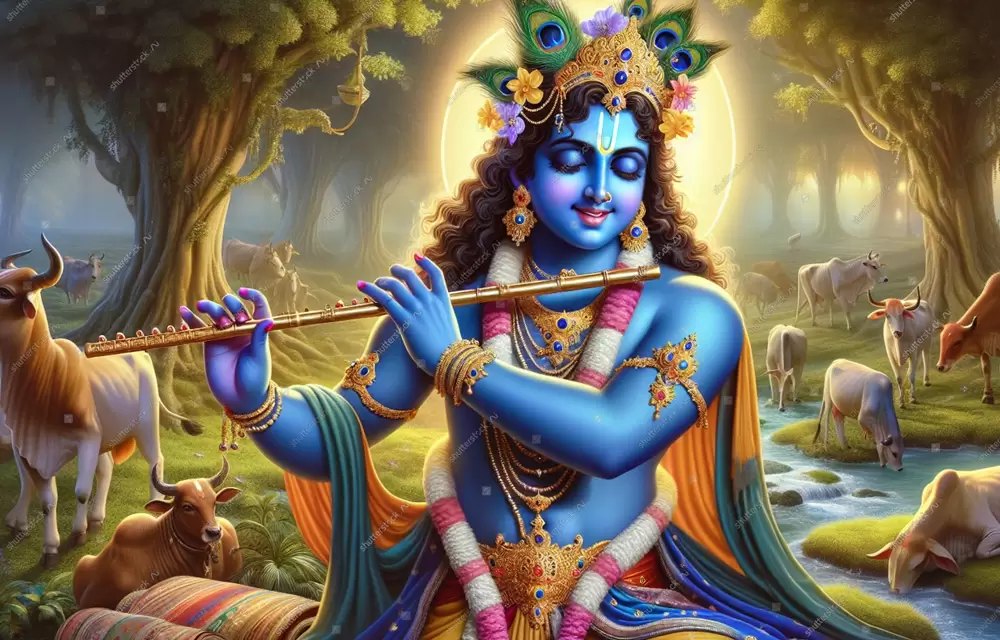
- He is the eternal flute player (Murari) — the divine musician of the cosmos
- His birth represents dharma triumphing over adharma — the eternal cosmic principle
Janmashtami is therefore simultaneously: a celebration of Krishna's birth, a reminder of dharma's triumph, an opportunity for devotional joy, and the most spiritually charged single midnight of the Hindu calendar.
Janmashtami Vrat Fasting Rules
The Janmashtami fast is among the most disciplined Hindu observances. Tradition allows three levels of vrat:
1. Nirjala Vrat (Strict, Most Powerful)
No food and no water from sunrise on August 14 until midnight (the moment of Krishna's birth) — approximately 18-19 hours. After the midnight puja and prasad acceptance, the devotee may sip water and rest. The full Parana (break-fast) is the next morning. Recommended only for healthy adults; not for elderly, pregnant women, children, or those on medication.
2. Phalahar Vrat (Standard, Most Common)
Permitted: water, milk, dry fruits, fresh fruits, sabudana (tapioca), kuttu (buckwheat), shingora flour, sendha namak (rock salt). Forbidden: grains (rice, wheat), pulses, regular salt, onion, garlic, alcohol. Eat lightly throughout the day; have the main vrat meal in the afternoon. Maintain the fasting energy through to midnight puja. Most devotees follow this level.
3. Saatvik Vrat (Lightest)
One simple sattvic meal in the afternoon — usually rice or wheat with sweetened milk preparations (kheer, peda, milk-based sweets). The main observance becomes mental discipline + midnight puja attendance rather than physical fasting. Suitable for elderly, those with health conditions, or first-time vrat observers.
Critical Vrat Rules
- Wake up before sunrise on August 14
- Bathe and wear new or clean traditional clothing (yellow, gold, or blue — Krishna's favored colors)
- Take a vow (sankalp) in the morning declaring your fast
- No grains throughout the day (Bhadrapada vrat tradition)
- No salt during the daytime (some traditions allow sendha namak in evening preparations)
- No onion, garlic, mushrooms
- No alcohol, tobacco, or animal products
- Speak gently throughout the day
- Sleep on a mat or hard surface (not soft bed) as symbolic austerity
- Spend the day in Krishna-bhajan, Gita-recitation, Bhagavata-Purana reading
- Visit a Krishna temple if possible
- Prepare special prasad — butter (makhan), milk, kheer, peda, banana, panjiri
The Midnight Janmotsav Puja
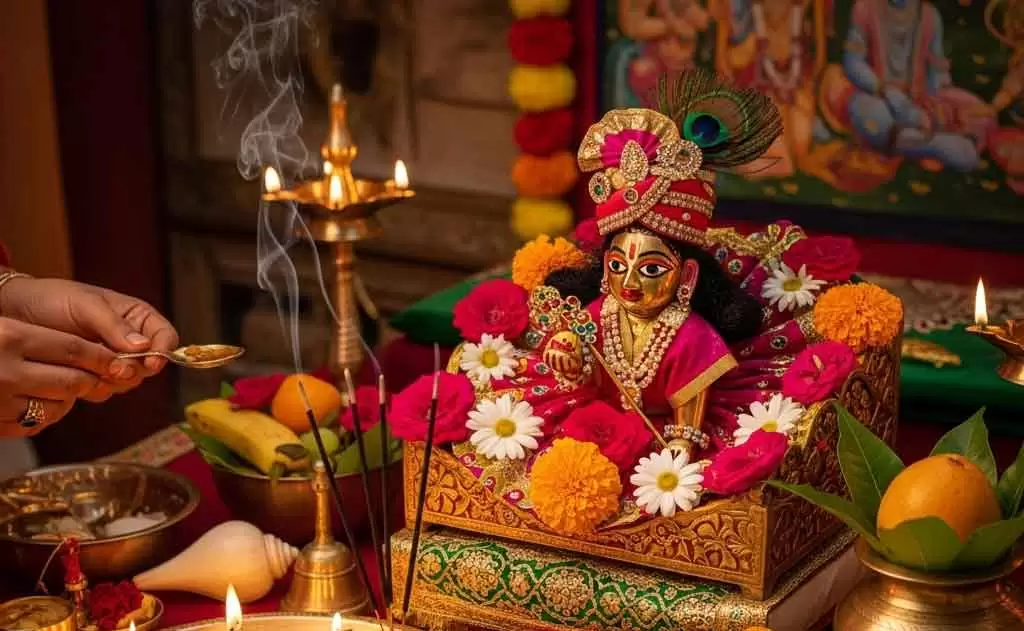
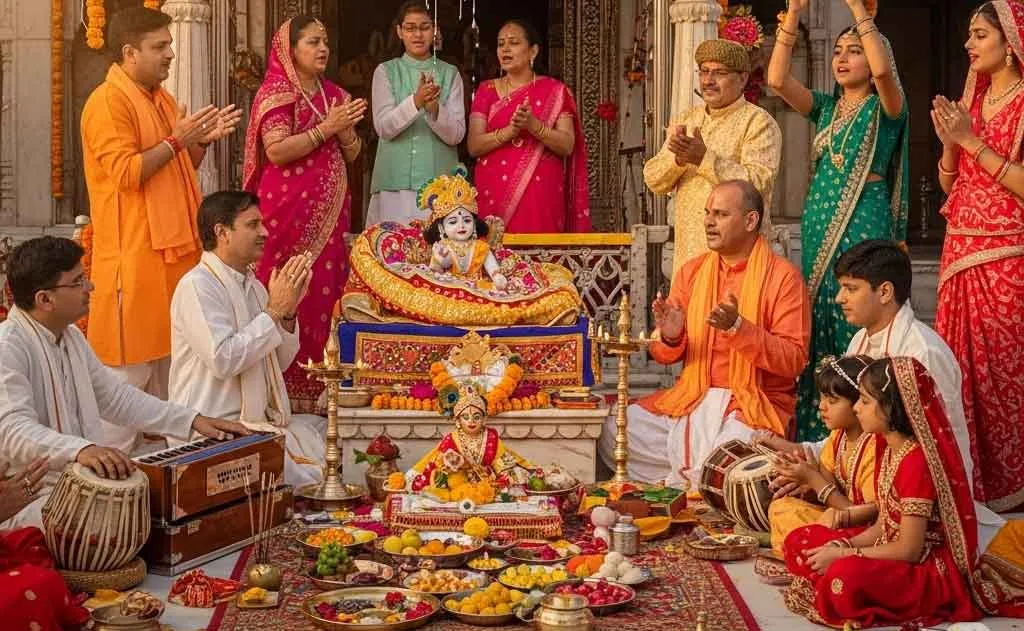
The central ritual of Janmashtami is the midnight puja — performed at the exact moment Krishna was born (around 12:00 AM midnight on Wednesday August 14, 2026). The puja sequence:
- Begin preparation by 23:00 (11:00 PM) — bathe, change into clean clothes
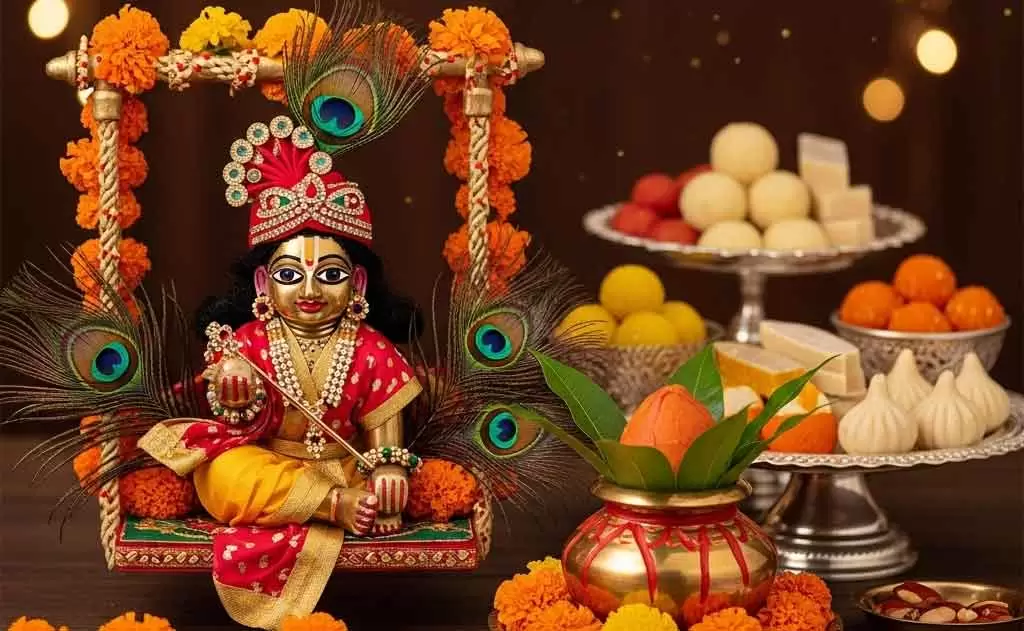
- Set up the puja altar with a small wooden swing/jhula (palna) containing a Krishna idol or image
- Decorate the altar with flowers, peacock feathers (sacred to Krishna), and small ghee diyas
- Place a copper vessel of water for abhishekam, a vessel of milk, and other sacred items
- Prepare special prasad: butter, makhan, peda, kheer, fruits, panjiri
- At precisely midnight, perform the Janma Snanam (birth bath ceremony) — bathe the Krishna idol with milk, then water, while reciting Krishna mantras
- Apply turmeric, kumkum, and sandalwood paste
- Place the bathed and decorated Krishna idol in the cradle (palna)
- Rock the cradle gently while singing "Govinda Govinda" or "Krishna Krishna" mantras
- Recite the Krishna Janmashtami Vrat Katha (the dramatic birth story narrated above)
- Perform Aarti — "Aarti Kunj Bihari Ki" or "Om Jai Jagdish Hare" with the family gathered
- Distribute prasad to all family members
- Sit in silence for 5-10 minutes meditating on the newborn Krishna
- Break the fast (parana) after the midnight puja
The atmosphere at midnight is one of cosmic joy — across temples worldwide, the chant "Krishna Janma Bhayo" ("Krishna has been born") echoes simultaneously. NRI families watching live streams from Mathura, Vrindavan, or ISKCON temples join the global devotional moment.
Dahi Handi — The Famous Tradition
In Maharashtra and Gujarat, Janmashtami includes one of the most spectacular Hindu festival traditions: Dahi Handi (also spelled Dahi Handi or Dahihandi). Inspired by Krishna's childhood love of stealing butter (makhan chor):
- A clay pot (handi) filled with curd, butter, and dry fruits is hung high in the air — sometimes 30-40 feet above the ground
- Teams of young men (govindas) form human pyramids to reach and break the pot
- The team that succeeds wins a prize and devotional glory
- Major festivals in Mumbai, Pune, and Maharashtra cities feature commercial Dahi Handi competitions
- The Mumbai Dahi Handi sometimes reaches 30,000+ participants across the city
- The dahi (curd) inside the broken pot is distributed as prasad to all gathered
This tradition celebrates Krishna's childhood mischief — his famous theft of butter from gopis' homes, an act of divine play that has come to symbolize the devotee's reach for the divine even when it appears unreachable.
Where to Celebrate Janmashtami — Famous Destinations
Mathura, Uttar Pradesh — Krishna's Birthplace
Mathura is the most spiritually significant Janmashtami destination. The Sri Krishna Janmasthan Temple (the actual birthplace of Krishna) holds the supreme celebration. The festivities continue for several days. Special darshan tickets sell out months in advance.
Vrindavan, Uttar Pradesh — Where Krishna Grew Up
Vrindavan is Krishna's playground — where he danced with the gopis, played his flute, performed his childhood leelas. Multiple temples celebrate including Banke Bihari Mandir, Radha Vallabh Mandir, and the famous Iskcon Vrindavan. The Janmashtami atmosphere here is uniquely devotional — saint-like rather than commercial.
Dwarka, Gujarat — Krishna's Royal City
Dwarka is the city Krishna established as his adult kingdom. The Dwarkadhish Temple celebrates Janmashtami with special rituals. The annual Janmashtami here connects Krishna's birth (Mathura) to his royal reign (Dwarka).
Iskcon Temples Worldwide
The International Society for Krishna Consciousness (ISKCON) has Iskcon temples in nearly every major NRI city — Mumbai, Bangalore, Hyderabad, USA (Houston, Atlanta, San Diego, Chicago), UK (Bhaktivedanta Manor, London), Australia (Melbourne, Sydney), UAE (Abu Dhabi), Singapore, Malaysia. Iskcon temples conduct elaborate 24-hour Janmashtami programs with chanting, dancing, prasad distribution, and midnight puja simultaneously broadcast worldwide.
Other Major Locations
- Banke Bihari Mandir, Vrindavan — most famous Krishna temple, exceptionally crowded
- Radha Vallabh Mandir, Vrindavan — devotional intensity
- Sri Mariamman Temple, Singapore — major NRI Hindu Janmashtami
- BAPS Swaminarayan temples worldwide — elaborate Janmashtami celebrations
- Pandharpur, Maharashtra — Krishna as Vitthala
- Puri, Odisha — Krishna as Jagannath
- Local Krishna temples in your city — most major Hindu temples worldwide observe Janmashtami
Special Janmashtami Prasad and Foods
Krishna had specific food preferences that have become Janmashtami prasad traditions:
Makhan (Butter)
Krishna's most-famous food. Fresh white butter is the supreme Janmashtami offering. Most temples and homes specifically prepare makhan as prasad — sometimes combined with mishri (rock sugar) and tulsi (sacred basil).
Kheer (Sweet Rice Pudding)
Made with milk, rice, sugar, cardamom, and dry fruits. The traditional Janmashtami sweet that many families serve as the evening meal.
Peda
Mathura is famous for its peda — milk solidified with sugar into compact sweet rounds. Mathura ke peda is among India's most iconic regional sweets.
Panjiri (Bhang Panjiri / Dhaniya Panjiri)
A traditional Krishna prasad made of roasted flour, ghee, sugar, dry fruits, and aromatic spices. Particularly popular in Mathura.
Charanamrut
A sacred drink of milk, curd, ghee, honey, and tulsi leaves — bathed over the Krishna idol and then distributed as prasad. Highly meritorious.
Other Traditional Foods
- Sweetened condensed milk (for kheer base)
- Coconut burfi
- Boondi laddu
- Halwa (sooji or wheat-flour halwa with ghee + sugar)
- Fruit chaat with sendha namak (rock salt)
- Mishri (rock sugar) — Krishna's favored sweet
- Tulsi leaves added to most prasad preparations
Famous Krishna Mantras for Janmashtami
Chanting these mantras throughout Janmashtami amplifies the devotional experience:
- Krishna Beej Mantra: Om Krishnaaya Namah — foundational mantra; recite 108 times daily
- Krishna Mahamantra: Hare Krishna Hare Krishna, Krishna Krishna Hare Hare, Hare Rama Hare Rama, Rama Rama Hare Hare — the supreme bhakti mantra, recited continuously
- Govinda Mantra: Om Govindaaya Namah — for divine charioteer (cosmic guide) energy
- Krishna Gayatri: Om Devakinandanaaya Vidmahe, Vasudevaaya Dheemahi, Tanno Krishna Prachodayat
- Murari Mantra: Om Sri Murari Namah — invoking Krishna as the divine flute player
- Govindaa Govinda — the spontaneous chant of joy upon receiving Krishna darshan
- Bhagavad Gita Chapter 2 — particularly Verse 2.47 (the famous "Karmany evadhikaras te") for dharmic guidance
Janmashtami for NRI Hindus
Janmashtami is particularly powerful for NRI Hindus, with several distinct considerations:
- Time-zone planning — midnight in India = different times worldwide. Most NRI temples adjust to local midnight or follow Indian time for the simultaneous celebration
- Iskcon temples in every major NRI city — these conduct full 24-hour programs with English-medium kathas
- BAPS Swaminarayan temples — extensive NRI Janmashtami programs
- Family gathering — Janmashtami has become a major NRI family gathering occasion. Multi-generational celebrations with grandparents, parents, children sharing the tradition
- Indian groceries — buy makhan, mishri, peda, panjiri, tulsi leaves; stock up early as demand surges
- NRI parenting — Janmashtami is the ideal day to introduce Krishna stories, the Bhagavad Gita, and Hindu mythology to children
- Online live streams — Mathura, Vrindavan, Iskcon all broadcast 24-hour Janmashtami programs accessible via YouTube
- Sponsor a seva — TTD, Mathura, Vrindavan all accept remote sponsorship for Janmashtami rituals
- Workplace flexibility — many NRI professionals take Aug 15, 2026 (US Independence Day weekend in 2026) as recovery day after the late midnight celebration
Regional Janmashtami Traditions in India
Maharashtra and Gujarat — Dahi Handi
Mumbai, Pune, Ahmedabad, Surat — major Dahi Handi competitions with human pyramid teams reaching 30+ feet high. Live broadcasts on TV. Crores in prize money.
Uttar Pradesh — The Birth Cities
Mathura and Vrindavan host the most authentic and devotional celebrations. Crowd of 5-7 million devotees throughout the festival period.
Tamil Nadu — Krishna Jayanti
Particularly observed in households with Krishna devotion. Children dressed as Krishna and Radha. Traditional Carnatic music compositions about Krishna.
West Bengal — Gokulashtami
Bengali tradition emphasizes Krishna as Madanmohan. Special bhajans, traditional rasik (devotional) music, and intensive Krishna chanting.
Andhra Pradesh and Karnataka — Krishna Janmashtami
Traditional South Indian Krishna celebration. Special bhajans, Tamil-Sanskrit Krishna recitations, and family gatherings.
Rajasthan — Sri Nathji Tradition
The famous Sri Nathji temple in Nathdwara, Rajasthan, holds elaborate Janmashtami celebrations. The 7-foot black stone idol of Krishna receives the supreme abhishekam.
Frequently Asked Questions (FAQ)
1. Can I observe Janmashtami at home if I cannot visit a temple?
Absolutely. Most Hindu families observe Janmashtami at home. The midnight puja with cradle (palna), abhishekam, prasad distribution carries full spiritual benefit at any location.
2. What is the difference between Janmashtami and Gokulashtami?
Same festival, different regional names. Janmashtami is the universal/North Indian name. Gokulashtami is the Bengali/East Indian name. Both refer to the same Krishna birthday on Bhadrapada Krishna Ashtami.
3. Do I need to fast the full 24 hours?
No. The Phalahar Vrat (allowing fruits, milk, dry fruits, sendha namak) is the standard observance. The Nirjala Vrat (no food/no water) is the strictest level but only for healthy adults.
4. What if I have diabetes or other health conditions?
Modified observance is acceptable. Take regular medication. Eat small healthy meals throughout the day. Maintain devotional focus through mantra-chanting, scripture reading, and midnight puja attendance — these carry the spiritual benefit without health risk.
5. Can pregnant women observe Janmashtami vrat?
Light observance — phalahar throughout the day. Many traditional Hindu families consider Janmashtami vrat especially auspicious during pregnancy. The vrat is dedicated to blessing the unborn child with Krishna's divine qualities.
6. Can children participate in Janmashtami?
Yes, children are central to Janmashtami. Many families dress children as little Krishnas (and little Radhas) for the celebration. Children participate in the cradle-rocking, prasad distribution, and family bhajan singing.
7. Is Dahi Handi spiritually significant or just festive?
Both. Dahi Handi commemorates Krishna's love of butter — a divine play (leela) that has come to symbolize the devotee's reach for the divine. The physical competition has commercial elements but the underlying devotional symbolism is real.
8. What happens during the midnight birth ceremony?
At exactly 12:00 AM, the entire temple/home performs the Janma Snanam (birth bath) of Krishna. The infant Krishna idol is bathed with milk, water, and pancha-amrit (5-fold elixir). Mantras are chanted. The cradle is rocked. Prasad is distributed. The collective devotional energy at this moment is among the most concentrated of any Hindu festival.
9. When does the fast actually end?
Different traditions: Some break the fast after the midnight puja (eat at 1:00 AM). Others wait until the next morning (parana on August 15, 2026). Some traditional families wait until Bhadrapada Krishna Navami (the day after Janmashtami) for the formal parana. Choose based on your tradition and stamina.
10. How does Janmashtami 2026 compare to other years?
Wednesday August 14, 2026 is a working weekday in India. NRI families typically extend through Thursday August 15 (US Independence Day weekend in 2026 also includes the previous weekend). Mathura and Vrindavan crowds will be significant but the weekday timing means slightly fewer crowds than weekend Janmashtamis.
Krishna Worship Throughout the Year
Beyond Janmashtami, Krishna devotion is maintained throughout the year:
- Daily morning Krishna puja — Hare Krishna mantra, Bhagavad Gita reading
- Ekadashi observance — every two weeks (Krishna is the deity of all Ekadashi observances)
- Vaikuntha Ekadashi (December 2026) — the supreme Vishnu/Krishna ekadashi
- Govardhana Puja (November) — celebrating Krishna lifting the mountain
- Holi (March 2026) — the festival Krishna celebrated with Radha and the gopis
- Daily Hare Krishna mantra chanting — universal devotion
- Iskcon Sunday programs — global weekly Krishna sadhana
- Krishna janmashtami next year — August 4, 2027 (tentative; verify panchang)
Conclusion
Krishna Janmashtami 2026 — Wednesday, August 14, 2026 — is the most joyful festival of the entire Hindu calendar. The cosmic birth that occurred 5,000+ years ago in a Mathura prison is re-witnessed annually by hundreds of millions of devotees worldwide. The midnight moment unites the world in a single devotional thought: "Krishna has been born."
Whether you celebrate at Mathura or Vrindavan, at an Iskcon temple in your NRI city, or in the simplicity of your home with a small cradle and a clay Krishna idol — the festival carries the same spiritual current. Krishna himself does not differentiate between the grand temple celebration and the simple home puja. He simply asks for devotion.
Begin preparing now (this guide is your roadmap). On August 14, 2026, observe the vrat with your chosen level of austerity. Recite the Bhagavad Gita. Chant the Hare Krishna mantra. Visit your local temple. Watch the midnight Mathura broadcast on YouTube. Prepare makhan with mishri and tulsi. Rock the cradle. Distribute prasad. Be present at midnight.
And then, as Krishna himself promised in the Bhagavad Gita (4.7-8): "Whenever dharma declines and adharma rises, I take birth to restore dharma. For the protection of the good and destruction of the evil, I appear age after age." This Janmashtami is your annual reminder of that cosmic promise.
May Lord Sri Krishna bless your home with butter-sweet love, divine joy, and the eternal dance of bhakti that transforms every devotee's life. 🙏 Hare Krishna! Hare Krishna! Krishna Krishna Hare Hare! Jai Sri Krishna!
Did you find this guide helpful? Share your Janmashtami plans and traditions in the comments below. If this guide helped you prepare, please share with family and friends. Subscribe to hindutone.com for more festival and devotional guides. 🙏 Jai Murari! Jai Govinda!
Related Reading on HinduTone
- Importance of Thursday in Hinduism: Guruvar Vrat & Vishnu Worship
- Vaikuntha Ekadashi 2026 at Tirumala: Sorgavasal Darshan
- Tirumala Brahmotsavam 2026: 9-Day Vahana Seva Schedule
- Sri Padmavathi Temple Tiruchanur Complete Guide 2026
- Aditya Hridayam Complete Guide: All 30 Verses
- Importance of Sunday in Hinduism: Ravivar Vrat & Surya
- Hanuman Chalisa: Complete 40 Verses with Meaning
- Sundar Kand: Complete Guide & 7-Day Saptaha Paath
You might also like
Hare Krishna Mahamantra Complete Guide: Meaning, Japa Method, ISKCON, 16 Rounds & Spiritual Benefits
Janmashtami Rituals & Puja Vidhi: Step-by-Step Guide for 2025
The Divine Significance of Janmashtami: Celebrating Lord Krishna's Sacred Birth