Importance of Sunday in Hinduism: Ravivar Vrat, Lord Surya Worship, Aditya Hridayam & 12 Adityas
Complete guide to the importance of Sunday (Ravivar) in Hinduism — Lord Surya (Sun God) worship, Aditya Hridayam (Rama-Ravana Sun mantra), Surya Namaskar, 12 Adityas, Gayatri Mantra, Konark Sun Temple, Chhath Puja, NRI guide, FAQs.
Complete guide to the importance of Sunday (Ravivar) in Hinduism — Lord Surya (Sun God) worship, Aditya Hridayam (Rama-Ravana Sun mantra), Surya Namaskar, 12 Adityas, Gayatri Mantra, Konark Sun Temple, Chhath Puja, NRI guide, FAQs.
Of all the seven days of the Hindu week, Sunday is the day of light, vitality, health, and the cosmic radiance that sustains all life. Where Monday brings stillness, Tuesday brings courage, Wednesday brings wisdom, Thursday brings divine guidance, Friday brings prosperity, and Saturday brings karmic accountability — Sunday brings the primordial cosmic principle: the Sun itself, the source of all visible energy, the deity who illuminates both the physical world and the soul. The importance of Sunday in Hinduism rests on one supreme divine connection: Lord Surya — the Sun God, the visible eye of Brahman, the cosmic dispenser of vitality, health, fame, leadership, and the most ancient of all deities worshipped by humanity. Known as Ravivar in Hindi and Bhanuvar or Adityavar in Sanskrit, Sunday is when devotees acknowledge the eternal source of life and align themselves with the cosmic light.
For millions of Hindu families across India and the global diaspora — particularly those facing health challenges, professionals seeking leadership advancement, students preparing for competitive examinations, those recovering from chronic illness, those struggling with eye-related issues, and devotees practicing Aditya Hridayam (the supreme Sun mantra given by sage Agastya to Lord Rama himself) — Sunday is the most powerful day of the week to invoke divine radiance. In this complete guide, we explore why Sunday holds such profound spiritual weight, how to observe the Ravivar Vrat, the rituals and mantras that please Lord Surya, the famous Aditya Hridayam (the hymn that gave Rama strength to defeat Ravana), and the timeless traditions that demonstrate the power of Sunday devotion.
Religious Significance of Sunday in Hinduism
The Sanskrit name for Sunday is Adityavar or Bhanuvar — derived from Aditya (the cosmic Sun, one of the 12 Adityas in Vedic cosmology) and from Bhanu (a name for the Sun meaning "the radiant one"). The Hindi name Ravivar comes from Ravi, another name for the Sun meaning "the cosmic eye." Multiple Sanskrit names for Sunday all point to the same essence: a day of cosmic illumination and the divine radiance of Lord Surya.
Sunday is traditionally dedicated to Lord Surya — the Sun God, the visible cosmic deity that ancient Hindu seers (including the Vedic Rishis) revered as the most accessible form of the divine. While other deities require imagination, faith, or ritual evocation to perceive, Surya is directly visible every morning. The Vedas declare Surya as the "eye of Brahman" — the cosmic divine experienced through direct sensory perception.
Lord Surya stands at the apex of the navagrahas (nine planets) — he is the King of Planets (Grahapati), the source of energy that sustains all other planets, and the deity to whom even Brahma, Vishnu, and Shiva offer reverence. In Vedic cosmology, the Sun is not merely a celestial body but a conscious, dignified, transcendent being who governs the cosmic order of dharma.
Hindu families approach Sunday with a sense of awakening and discipline. Most rise before sunrise to perform Surya Namaskar (sun salutations); many offer arghya (water offering) directly to the rising Sun; many recite the Gayatri Mantra (the supreme Vedic mantra dedicated to Savitar, the Sun deity) at dawn. The day itself carries an energy of brightness, optimism, leadership, and the awakening of all powers latent within.
Astrological Significance of Sunday — The Power of Surya
In Vedic astrology (Jyotish), Sunday is ruled by Lord Surya (Sun) — the planet (in astrological terminology) that governs vitality, health, fame, leadership, government favor, father-son relationships, self-confidence, eye health, the heart and circulatory system, royal authority, and the soul itself. A strong, well-placed Sun in one's horoscope brings excellent health, leadership ability, fame, success in government roles, healthy father-son relationships, and a strong sense of self. A weak or afflicted Sun manifests as poor health, lack of confidence, ego problems, government disputes, eye diseases, heart issues, fatherhood difficulties, and disconnection from one's soul-purpose.
Among all the planets, Surya is unique because he is the Atmakaraka — the karaka (significator) of the soul itself. The other planets govern aspects of life (mind, beauty, intelligence, wisdom); only Surya governs the very essence of who we are. This is why Sunday observances are considered the deepest of all weekly rituals.
Astrologers across India and NRI communities recommend the Ravivar Vrat to those experiencing:
- Chronic health issues — particularly heart disease, eye problems, headaches, skin issues
- Lack of vitality and chronic fatigue
- Career stagnation in government, leadership, or authority roles
- Father-son or father-daughter conflicts
- Loss of fame, reputation, or social standing
- Weak self-confidence, indecisive leadership
- Eye diseases or vision problems
- Heart issues, circulation problems
- Hair loss, skin problems
- Difficulty finding purpose or soul-direction
- Problems with bosses, kings, government officials
- Lack of children (specifically sons)
Surya rules the colors red, orange, gold, and pink — which is why devotees wear these colors on Sunday, light orange-flame diyas (ghee or sesame oil), offer red flowers (especially red hibiscus), and place red items on the altar. These warm colors mirror the visible Sun and invoke its radiant grace.
Lord Surya — The Sun God
Lord Surya is depicted as a golden-bodied, dignified deity riding a chariot drawn by seven horses (representing the seven days of the week, the seven chakras, or the seven rays of light). His charioteer is Aruna (the deity of dawn), and he carries two lotus flowers in his hands. The seven horses symbolize the cosmic energies that emerge from the Sun.
Hindu tradition identifies Surya through multiple sacred names:
- Aditya — son of Aditi (mother of all celestial deities)
- Bhanu — the radiant one
- Bhaskara — the maker of light
- Divakara — the maker of the day
- Mitra — the cosmic friend (one of the seven Adityas)
- Pushan — the nourisher of all
- Savitar — the creative aspect of the Sun (to whom the Gayatri Mantra is dedicated)
- Vivasvat — the cosmic father (father of Yama, Manu, and the Twin Ashvins)
Surya occupies a special place in the Hindu trinity-system as well — he is the visible manifestation of the Trimurti (Brahma, Vishnu, Shiva) in dynamic form. Brahma resides at dawn, Vishnu at noon, Shiva at sunset; all three express themselves as Surya in his daily journey across the sky.
Aditya Hridayam — The Supreme Sun Mantra
Of all the prayers dedicated to Surya, none is more sacred and more powerful than the Aditya Hridayam — the "Heart of the Sun" prayer composed in the Ramayana itself. The famous origin story:
During the final battle of the Ramayana, Lord Rama was exhausted after days of warfare against Ravana. Standing in despair on the battlefield, watching the apparently unbeatable demon king before him, Rama doubted whether even his divine powers could overcome the enemy. At that moment, sage Agastya descended from the sky and approached Rama. The sage shared a sacred mantra — the Aditya Hridayam — and instructed Rama: "Recite this prayer to Lord Surya three times. The Sun is the supreme guardian of cosmic order. He will give you the strength to defeat any enemy."
Rama recited the Aditya Hridayam three times. His vigor returned. His clarity sharpened. He picked up his bow and shot the final arrow that pierced Ravana's heart, ending the demon king's tyranny over the world. The Aditya Hridayam became, from that moment forward, the prayer for those facing seemingly impossible challenges.
The Aditya Hridayam consists of approximately 30 verses describing Lord Surya's power, his many names, his cosmic functions, and his mercy on devotees. Reciting it once daily (especially on Sundays) is considered one of the most powerful Hindu practices for victory over difficulty, healing, leadership, and the awakening of personal power.
"Whoever recites this Aditya Hridayam with focused mind in the morning will be victorious in all battles, recover from all diseases, and gain the favor of the Lord of cosmic order." — Sage Agastya to Lord Rama
Ravivar Vrat: Fasting Rules, Dos and Don'ts
The Ravivar Vrat (Sunday fast) is among the most disciplined Hindu observances — reflecting Surya's nature: bright, energetic, and oriented toward the soul. The vrat is observed by those seeking robust health, leadership, fame, and spiritual breakthrough.
Types of Sunday Fasts
There are four popular forms of the Sunday fast:
- Weekly Ravivar Vrat — the regular Sunday fast observed every week. Recommended for ongoing health and vitality.
- 12-Sunday Vrat — a vow to fast for 12 consecutive Sundays (representing the 12 Adityas), particularly for major life challenges.
- Solah Ravivar Vrat — 16 consecutive Sundays for sustained leadership, fame, or health practice.
- Sankranti Ravivar — special observance on the Sankranti (Sun's transit into a new zodiac sign) Sundays of the year.
Dos on Sunday
- Wake up before sunrise — Surya's most powerful time is just before and just after dawn
- Take a full bath with cold water if possible (cold water awakens Sun energy in the body)
- Wear red, orange, or gold clothing — Surya's favored colors
- Perform Surya Namaskar (Sun Salutations) at sunrise — 12 rounds traditional
- Offer arghya (water offering) directly to the rising Sun — pour water from a copper vessel while chanting "Om Suryaya Namah"
- Visit a Surya temple, Navagraha temple (with Surya section), or set up a home altar with Surya image
- Light a ghee diya with red flame or orange-tinted oil
- Apply red sandalwood and kumkum tilak
- Offer red flowers (especially hibiscus), wheat, jaggery, ghee, sesame seeds, and copper coins
- Recite the Aditya Hridayam (the most powerful Sun prayer) — once is excellent, three times is supreme
- Recite the Gayatri Mantra 108 times — the supreme Vedic mantra dedicated to Savitar (the Sun)
- Donate red items, wheat, jaggery, copper, or food to needy people — especially powerful on Sundays
- Eat one sattvic meal in the afternoon — wheat or rice based with jaggery, red gram, sesame
- Eat in copper vessels (traditional belief — copper strengthens Surya energy)
Don'ts on Sunday
- Avoid consuming non-vegetarian food, onion, garlic, alcohol, and tobacco
- Do not eat salt on Sundays (traditional Hindu observance)
- Avoid disrespecting fathers, elders, or authority figures — Surya rules these relationships
- Do not start activities late in the day — Sunday is for early rising and morning achievement
- Avoid wearing black on Sunday — Sun energy and dark colors are opposed
- Do not skip breakfast (some traditions emphasize a hearty breakfast then afternoon fasting)
- Avoid haircuts, shaving, nail-cutting on Sundays (regional belief)
- Do not engage in idle gossip or wasted time — Sun energy demands productive action
- Avoid lending money on Sundays (some traditions consider it inauspicious)
- Do not skip the morning sun salutation — this is considered the central Sunday discipline
Rituals and Mantras for Sunday
Performing the Sunday puja with sincerity is the heart of the observance. The Sun does not require elaborate offerings; the simple act of facing the rising Sun with reverence transmits the deepest devotion.
Step-by-Step Sunday Puja
- Wake before sunrise — the most important Sunday discipline
- Bathe and dress in red, orange, or gold attire
- Face East (the direction of the rising Sun) and stand outdoors if possible
- Hold a copper vessel of water and offer arghya — pour the water slowly while chanting "Om Mitraya Namah"
- Continue with the 12 Surya Namaskar postures — each accompanied by one of the 12 sacred Sun names
- Apply red tilak and kumkum to your forehead
- Perform abhishekam to the Surya altar (water, milk, then water again)
- Offer red flowers, wheat, jaggery, ghee, sesame seeds
- Recite the Aditya Hridayam — once if time-pressed; three times for full benefit
- Recite the Gayatri Mantra 108 times — using a red-coral or rudraksha mala
- Take a sankalp for health, leadership, fame, or family welfare
- Read the Ravivar Vrat Katha — the traditional Sunday story
- Perform Surya Aarti — bright flame, sustained brightness
- Distribute prasad — red preparations (jaggery, wheat halwa, red rice) shared with family and outsiders
Powerful Sunday Mantras
Chanting these mantras on Sunday is believed to invoke Lord Surya's direct grace:
- Surya Beej Mantra: Om Hraam Hreem Hraum Sah Suryaaya Namah — strengthens Sun; recite 108 times
- Surya Mantra: Om Suryaaya Namah — foundational Sun mantra; recite 1008 times during 12-Sunday vrat
- Surya Gayatri: Om Bhaskaraaya Vidmahe, Mahadyutikaraaya Dheemahi, Tanno Aditya Prachodayat
- Gayatri Mantra: Om Bhuh Bhuvah Svah, Tat Savitur Varenyam, Bhargo Devasya Dheemahi, Dhiyo Yo Nah Prachodayat — the supreme Vedic mantra dedicated to Savitar (Sun)
- Aditya Hridayam — the 30-verse hymn that gave Rama strength to defeat Ravana (most powerful Sunday recitation)
- Surya Namaskar Mantras — the 12 sacred Sun names recited during Sun Salutations
- Sandhya Vandana — the dawn-noon-dusk prayer cycle (essential Vedic practice)
Reciting the Aditya Hridayam on Sunday is considered one of the most spiritually powerful single practices in Hinduism. Combined with morning Surya Namaskar and water arghya, this constitutes a complete Sunday sadhana.
12 Sacred Names of Lord Surya
Hindu tradition identifies 12 sacred names of Lord Surya, recited during the 12 Surya Namaskar postures. Each name unlocks a specific aspect of the Sun's grace:
- Om Mitraya Namah — the cosmic friend
- Om Ravaye Namah — the bright one
- Om Suryaya Namah — the all-seeing one
- Om Bhanave Namah — the radiant one
- Om Khagaya Namah — the sky-traveler
- Om Pushne Namah — the nourisher
- Om Hiranyagarbhaya Namah — the golden womb of cosmos
- Om Marichaye Namah — the ray of light
- Om Adityaya Namah — son of Aditi
- Om Savitre Namah — the creator of light
- Om Arkaya Namah — the worthy of worship
- Om Bhaskaraya Namah — the maker of light
Reciting these 12 names while performing the 12 Surya Namaskar postures is the supreme Sunday discipline — combining body, breath, and mantra into a single devotional offering.
Benefits of Observing Ravivar Vrat
The rewards of honoring Sunday extend across the health, leadership, fame, and spiritual dimensions of life. Devotees who observe the Ravivar Vrat with sincere faith consistently report:
- Excellent health and vitality — Surya rules the heart, eyes, and overall vital force
- Strong leadership ability and natural authority
- Improved father-son and father-daughter relationships
- Career advancement in government, leadership, or authority roles
- Fame, recognition, and social standing
- Restoration of self-confidence after setbacks
- Improved eye health and vision
- Heart and circulatory system strengthening
- Hair vitality and skin radiance
- Discovery of one's soul-purpose (Atmakaraka function of Surya)
- Government favor — for those in legal or bureaucratic matters
- Recovery from chronic illness
- Children (particularly sons)
- Mental clarity and decisive thinking
- Spiritual breakthrough — the soul itself receives Surya's blessing
Beyond these specific benefits, the weekly discipline of pre-dawn rising, Surya Namaskar, and morning meditation creates a powerful physical and spiritual rhythm — the body and soul both align with the rising cosmic light.
Stories and Beliefs Associated with Sunday Worship
The Aditya Hridayam Origin — Rama and Ravana
The most famous story of Sunday devotion is the Aditya Hridayam origin in the Ramayana, as already described above. Lord Rama, exhausted after days of battle against Ravana, was given the Aditya Hridayam by sage Agastya. After reciting it three times, Rama gained the strength to defeat Ravana. This story is recited every Sunday across Hindu households — particularly during difficult life passages — as a reminder that even divine avatars need Surya's blessing.
King Sambasta and Surya
A king named Sambasta lost his prosperity, his health, and his kingdom over a period of years. In despair, he undertook a 12-Sunday vrat with complete devotion. He observed the Ravivar Vrat strictly, recited the Aditya Hridayam each Sunday, performed Surya Namaskar at dawn, and donated copper coins and red items to needy travelers. By the 12th Sunday, his health had returned, his wealth was restored, his kingdom regained, and his sons were prosperous. This katha — recited every Sunday across Hindu homes — captures the essential teaching: Surya is the deity who restores what has been lost.
Chhath Puja — The Greatest Sun Festival
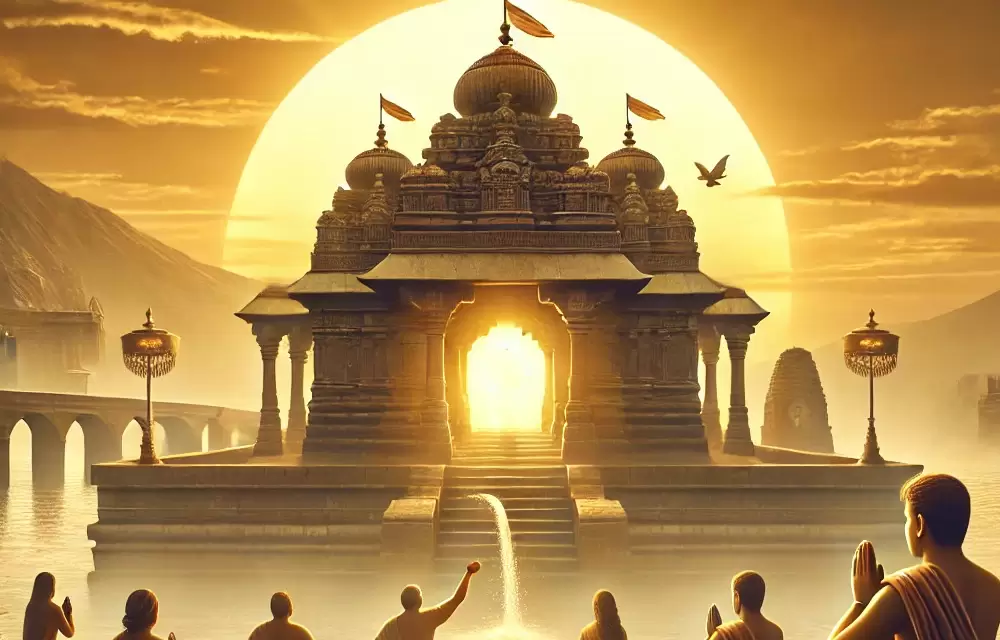
Chhath Puja, observed over 4 days during Karthika month (October-November), is the largest annual Sun-worship festival in India. Particularly observed in Bihar, Uttar Pradesh, and Jharkhand, Chhath Puja involves devotees standing in rivers/water bodies to offer Sun-worship at sunrise and sunset over 4 days. The festival celebrates Surya's wife Usha (dawn) and his sister Chhathi Maiya. Chhath Puja is considered the most ancient continuously-observed Sun-worship festival in India — possibly predating even the Vedic civilization.
The Twelve Adityas
In Vedic cosmology, the Sun is not one deity but Twelve — the Twelve Adityas, sons of sage Kashyapa and Aditi, who jointly govern the cosmic order. Each Aditya represents a different aspect of Sun-energy: Mitra (friendship), Aryaman (chivalry), Bhaga (wealth), Varuna (water), Daksha (skill), Amsha (share), Tvashtri (craft), Savitar (creation), Pushan (nourishment), Sakra (Indra/lightning), Vivasvan (visibility), and Vishnu (cosmic order). Together they form the cosmic family that maintains existence. Sunday devotion honors all 12.
Famous Sun Temples in India
Several major Sun temples are particularly sacred for Sunday worship:
- Konark Sun Temple, Odisha — the most famous Sun temple in India, UNESCO World Heritage site, 13th century
- Modhera Sun Temple, Gujarat — 11th century Solanki dynasty masterpiece, also dedicated to Surya
- Suryanar Kovil, Tamil Nadu — one of the nine Navagraha temples, primarily dedicated to Surya
- Surya Pahar, Assam — ancient rock-cut Sun temple in the Northeast
- Surya Mandir, Ranchi, Jharkhand — major Sun temple, important during Chhath Puja
- Konark sub-shrines worldwide — replicas in NRI Hindu temples (BAPS, ISKCON)
- Local Navagraha temples — all major Hindu temples have a Surya section
Sunday Worship for NRI Hindus
Sunday devotion is particularly powerful for NRI Hindus and modern practitioners:
- Time-zone friendly — Sundays exist worldwide; the practice fits any schedule
- NRI weekend culture — Sunday is most NRI families' rest day; perfect alignment with deep spiritual practice
- Surya Namaskar — practiced globally as both yoga and devotion; bridges physical fitness with bhakti
- Aditya Hridayam — easily memorized; many NRI families recite it together
- Children's practice — Sunday morning Surya Namaskar with the whole family is a beloved NRI tradition
- NRI temples globally — most conduct Sunday Surya programs
- Online Aditya Hridayam satsangs — widely attended on Sundays
- Combine with weekly family meals — Sunday eating in copper vessels is a tradition many NRI families maintain
- Father-son bonding — Sunday is the day fathers traditionally teach Sun worship to children
- Sunrise photography and meditation — modern Sunday practice that aligns with traditional Surya devotion
Frequently Asked Questions (FAQ)
1. What is the most important Sunday practice?
Three combined practices form the complete Sunday sadhana: morning Surya Namaskar at sunrise, water arghya offering, and Aditya Hridayam recitation. Together they take 20-30 minutes and constitute the supreme Sunday observance.
2. Can I observe Sunday if I cannot wake up before sunrise?
Yes — but morning practice is strongly recommended. If unable to rise before dawn, perform the Sunday puja within 2-3 hours after sunrise. The water arghya, mantra recitation, and Surya Namaskar can be done at any morning time.
3. Is the Aditya Hridayam difficult to memorize?
No — it consists of approximately 30 verses, and most devotees memorize the opening 8-10 verses (the most powerful section) in 4-6 weeks of daily reading. Audio recordings are widely available for those preferring to listen along.
4. Can pregnant women observe Ravivar Vrat?
Yes — but adjust to lighter eating. Surya devotion during pregnancy is considered particularly auspicious for blessing the unborn child with vitality and health.
5. What is Sandhya Vandana?
Sandhya Vandana is the Vedic threefold prayer cycle (dawn, noon, dusk) dedicated to Surya. Traditional Brahmin families observe it daily; it can be observed weekly on Sundays by other devotees as a Sunday-specific discipline.
6. Are Sun Salutations more spiritual or physical?
Both. Surya Namaskar combines 12 yoga postures with 12 sacred mantras into a single devotional practice. Even when practiced as fitness, the body absorbs Surya energy. Practiced with mantras, it becomes the most profound single physical-spiritual discipline in Hinduism.
7. What is the difference between Surya and Surya Bhagavan?
Surya is the cosmic deity; Surya Bhagavan is the divine personalized form of Surya. Sunday worship of either is identical in spiritual benefit.
8. Can the 12-Sunday vrat be done at home?
Yes. Set up a Surya altar with the 12-Aditya mantras prominently displayed. Recite the Aditya Hridayam each Sunday. Practice 12 Surya Namaskar. Donate red items. The vow is fulfilled at home; temple visit is preferred but not required.
9. What if I miss a Sunday?
Resume the next Sunday without guilt. If observing a 12-Sunday vrat and you miss one Sunday, restart from Sunday 1. The discipline of completion matters more than perfect attendance.
10. Does Sunday worship benefit non-Hindus?
Sun worship transcends sectarian boundaries — it has been practiced by all ancient civilizations (Egyptian Ra, Greek Helios, Roman Sol, Persian Mithra). Anyone may practice Sunday rituals with full benefit; the Sun is the universal divine that all faiths can recognize.
Conclusion
The importance of Sunday in Hinduism is the supreme intersection of cosmic light, divine awakening, and the eternal source of all life. Dedicated to Lord Surya — the visible Sun God, the cosmic eye of Brahman, the most ancient continuously-worshipped deity in human history — Sunday offers every seeker a weekly opportunity to align with the source of vitality, health, fame, leadership, and the soul itself.
Whether you observe the full Ravivar Vrat, undertake the 12-Sunday vow, perform daily Surya Namaskar, recite the Aditya Hridayam — or simply rise before dawn and offer water to the rising Sun — the radiance-grace of Lord Surya is always available to the sincere devotee.
In a world that increasingly chases artificial light, screens, and indoor stagnation, Sunday is the day Hindu tradition has trusted for millennia to remind us of the original divine radiance — the cosmic light that awakens, heals, energizes, and ultimately reveals our soul's purpose. The Aditya Hridayam that gave Rama strength to defeat Ravana is available to you, every Sunday morning, in the simple act of facing the rising Sun with reverence.
May Lord Surya bless you with vitality, health, fame, leadership, and the divine radiance that awakens your soul to its true purpose on every sacred Sunday. 🙏 Om Suryaaya Namah! Om Mitraya Namah!
Did you find this guide helpful? Share your Sunday rituals and Surya devotion in the comments below. If this article touched your heart, share it with family and friends. Subscribe to hindutone.com for more devotional guides. 🙏 Jai Surya Bhagavan! Aditya Hridayam Punyam!
Related Reading on HinduTone
- Importance of Monday in Hinduism: Somvar Vrat & Lord Shiva
- Importance of Tuesday in Hinduism: Mangalwar Vrat & Hanuman
- Importance of Wednesday in Hinduism: Budhwar Vrat & Ganesh
- Importance of Thursday in Hinduism: Guruvar Vrat & Vishnu
- Importance of Friday in Hinduism: Shukravar Vrat & Lakshmi
- Importance of Saturday in Hinduism: Shanivar Vrat & Shani Dev
- Sri Padmavathi Temple Tiruchanur Complete Guide 2026
- Vaikuntha Ekadashi 2026 at Tirumala: Sorgavasal Darshan
- Hanuman Chalisa: Complete 40 Verses with Meaning
You might also like
Importance of Wednesday in Hinduism: Budhwar Vrat, Lord Ganesh & Budh Worship, Rituals & Benefits
Importance of Thursday in Hinduism: Guruvar Vrat, Lord Vishnu & Brihaspati Worship, Sai Baba & Rituals
Importance of Friday in Hinduism: Shukravar Vrat, Mahalakshmi Worship, Solah Shukravar & Rituals