TTD Tirupati Laddu Prasadam Complete Guide 2026: Types, Booking, Price, NRI Postal Scheme & GI Tag History
Complete TTD Tirupati Laddu guide 2026 — Sri Vari Laddu types (Proktham, Asthanam, Kalyanotsavam, Vaikuntha), price (₹50-200), free laddu with darshan, NRI postal scheme, GI tag history, storage, freshness, quality reforms, FAQs.
Complete TTD Tirupati Laddu guide 2026 — Sri Vari Laddu types (Proktham, Asthanam, Kalyanotsavam, Vaikuntha), price (₹50-200), free laddu with darshan, NRI postal scheme, GI tag history, storage, freshness, quality reforms, FAQs.
No Tirumala yatra is complete without holding a warm, golden Tirupati Laddu in your hands. Known officially as Sri Vari Laddu, this prasadam is far more than a sweet — it is a divine offering, a piece of Lord Venkateswara's grace, a globally recognized religious confection, and one of only a handful of food items in India holding a coveted Geographical Indication (GI) tag.
For NRI families flying home with carefully cushioned laddu boxes in their cabin baggage, for grandmothers who keep one wrapped in muslin for years, for devotees who travel hundreds of miles just to receive a single laddu — this prasadam carries layers of meaning that this complete guide will help you understand and access correctly.
In this 2026 guide, we cover the complete history of the Tirupati Laddu, its GI-tagged status, all variants (Proktham, Asthanam, Kalyanotsavam, NRI special), how to receive the free laddu with darshan, how to purchase additional laddu, pricing, the postal scheme for NRIs, freshness and storage, recent quality concerns, and the spiritual significance behind every bite.
What is the Tirupati Laddu (Sri Vari Laddu)?
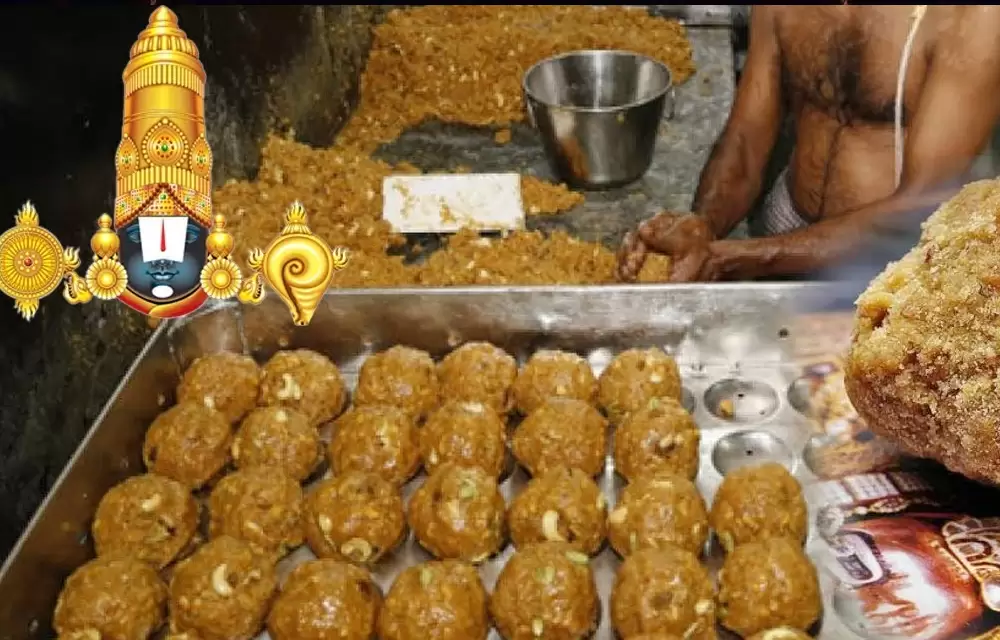
The Tirupati Laddu — officially called Sri Vari Laddu (meaning "the Lord's Laddu") — is the principal prasadam (sacred food offering) distributed at Tirumala's Sri Venkateswara Swamy Temple. Approximately 4 lakh laddus are prepared every single day in the temple's sacred kitchen called the Potu — one of the largest single-product sacred kitchens in the world.
Each laddu weighs approximately 175 grams, is round, golden-orange in color, and is offered to Lord Venkateswara during daily rituals before being distributed to devotees. The laddu's composition is a centuries-old recipe combining besan (chickpea flour), pure ghee, sugar, cashews, cardamom, and raisins — but the precise proportions, water content, frying technique, and shaping method constitute a closely guarded TTD trade secret.
The GI Tag — A Sacred Trademark
In September 2009, the Geographical Indications Registry of India officially recognized "Tirupati Laddu" as a Geographical Indication (GI) — a legal designation that protects the laddu's identity, recipe, and Tirumala-exclusive production. This was a historic moment in Indian religious heritage protection.
The GI tag means:
- No commercial entity outside TTD's Potu can legally sell sweets labeled "Tirupati Laddu" or "Sri Vari Laddu".
- The recipe and preparation method are protected as a trade secret.
- Only laddus made in the Tirumala Potu kitchen carry the authentic prasadam status.
- Counterfeit "Tirupati-style laddus" sold by sweet shops anywhere in India are not the actual prasadam.
- The TTD has legal standing to prevent commercial exploitation of the name.
This makes the Tirupati Laddu one of the very few religious foods in India with formal intellectual property protection — placing it alongside other GI-tagged Indian foods like Darjeeling Tea, Basmati Rice, and Mysore Pak (yes, that famous sweet has GI status too).
The Sacred History of the Laddu
Records suggest a sweet offering has been part of Tirumala worship since at least the 11th century. Originally, the offering was a paste-like preparation called "boondi" before evolving into the round laddu form around the 18th century.
The modern recipe — using fine besan, pure cow ghee, sugar syrup, cardamom, cashews, and raisins — was standardized in the 19th century during the regime of the Mahant rulers of Tirumala. After TTD's formation in 1933, the recipe and quantity were further codified. By the 1970s-80s, when the temple began handling lakhs of devotees daily, the laddu manufacturing scale grew enormously.
Today, the Potu kitchen runs 24/7, employing approximately 600 traditional cooks (called archakas and paricharakas). The kitchen produces 350,000 to 450,000 laddus daily, scaling up to over 800,000 during peak festivals like Brahmotsavam. Quality control involves rigorous ingredient inspection, temperature monitoring, and weight verification.
Types of Tirupati Laddu
TTD distributes several variants of the laddu, each with distinct preparation, ingredients, and significance:
1. Proktham Laddu (Regular Laddu — ₹50 each)
This is the standard laddu received free with every darshan ticket and sold at TTD counters. Approximately 175g, golden-orange, with a balanced ghee-sugar-besan ratio. Most devotees take 4-6 of these home as prasadam for family and friends.
Free entitlement: 1 laddu per ticket (Sarvadarshan, ₹300, NRI). Additional laddus available for purchase at ₹50 each.
2. Asthanam Laddu (Special/Festival Laddu — ₹200 each)
Larger, richer, and prepared with extra dry fruits during specific festivals (Brahmotsavam, Vaikuntha Ekadashi, Hanuman Jayanti, Garuda Sevotsavam). Approximately 750g. Limited quantity and availability — typically distributed only on specific festival days.
Highly prized among devotees; available only at counters during the festival days, often selling out within hours.
3. Kalyanotsavam Laddu
Distributed exclusively to those who book and attend the daily Kalyanotsavam (divine wedding) seva. This special laddu is part of the seva offering. Devotees performing Kalyanotsavam also receive sacred turmeric, kumkum, akshatha, and other items in addition to the laddu.
4. NRI Special Laddu
Prepared specifically for NRI devotees, this laddu has slightly different specifications (often longer shelf life through specific preparation techniques) and is available at the NRI Darshan counter. The standard size; bookable at premium darshan packages.
5. Vaikuntha Ekadashi Laddu
On the holiest single day at Tirumala (Margashirsha Shukla Ekadashi, December), specially-prepared Vaikuntha laddus are distributed. These are made with additional cardamom and saffron and carry exceptional spiritual significance — devotees often preserve and gift these specifically.
6. Brahmotsavam Special Laddu
Distributed during the annual 9-day Brahmotsavam (September-October), these laddus mark the most spiritually charged time of the year. Available in both Proktham and Asthanam sizes.
How to Receive Your Free Laddu with Darshan
Every TTD darshan ticket (including free Sarvadarshan, ₹300, NRI) entitles the holder to receive 1 free Proktham laddu (175g). The collection process is straightforward but requires understanding the procedure:
- Complete your darshan and exit through the standard route.
- Proceed to the designated Laddu Distribution Counter — usually located near the temple exit at Tirumala.
- Present your darshan ticket and ID proof.
- Receive 1 freshly-packaged laddu wrapped in paper.
- Note: 1 laddu per ticket means each devotee in your booking gets 1 free laddu — for a family of 4, you receive 4 free laddus.
- The laddu is good for 7-15 days at room temperature, 30+ days refrigerated.
Purchasing Additional Laddu (₹50 each)
Beyond your free laddu, devotees can purchase additional laddu from dedicated TTD counters at Tirumala:
- Maximum per ticket: 5 laddus (free 1 + 4 paid)
- Price: ₹50 per laddu (2026 rates)
- Payment: Cash, UPI, debit/credit card accepted
- Counter location: Multiple counters around the temple complex, plus main counter at Vaikuntham II queue exit
- Counter hours: 6:00 AM to 9:00 PM daily
- Quality assurance: Every laddu has a TTD seal and freshness label
- Wrapping: Each laddu wrapped in food-grade paper; boxes available for purchase separately (₹20 for 5-laddu box)
Important: TTD has strict rules against bulk laddu purchases by individuals (preventing resale). Maximum 5 per ticket. Family bookings can multiply this, but individual mass purchase is monitored.
NRI Postal Laddu Scheme
TTD operates a postal laddu scheme specifically for NRI devotees who cannot visit Tirumala personally. This is a uniquely helpful service for NRI families:
- Book online via the official TTD website
- Pay ₹500 per laddu (includes postal shipping within India)
- International shipping (USA, UK, UAE, Australia, etc.) costs additional ₹1500-3000 per shipment
- Maximum 5 laddus per NRI per year through postal scheme
- Delivery time: 7-15 days domestic; 15-30 days international
- Laddu has special preservation packaging for transport
- Recipients receive temple-authenticated prasadam at home
- NRI account holders can sponsor laddu delivery to family in India
Laddu Pricing — Complete 2026 Schedule
- Free Proktham Laddu: Included with every darshan ticket (1 per ticket)
- Additional Proktham Laddu: ₹50 each (max 4 paid per ticket)
- Asthanam Festival Laddu: ₹200 each (limited; festival days only)
- Kalyanotsavam Laddu: Part of Kalyanotsavam seva fee (₹1,500 per seva)
- Vaikuntha Ekadashi Laddu: ₹100 each (December festival)
- Brahmotsavam Special Laddu: ₹100-200 (September-October)
- NRI Postal Laddu (within India): ₹500
- NRI Postal Laddu (international): ₹500 + ₹1500-3000 shipping
Storage, Freshness & Carrying Home
At Room Temperature
- Fresh laddus: 7-15 days at room temperature in dry conditions
- Wrap each individually in muslin or wax paper
- Keep in airtight container away from direct sunlight
- Humidity is the main enemy — store in dry, cool place
Refrigerated
- In refrigerator: 30-45 days
- Use proper airtight container; avoid contact with strong-smelling foods
- Bring to room temperature before consumption (10-15 minutes out of fridge)
Frozen
- In freezer: 3-4 months
- Wrap in plastic + foil + airtight container
- Thaw at room temperature for 30 minutes before eating
- Texture remains intact; freshness preserved
Carrying on International Flights
- Laddus are allowed in carry-on baggage for international flights
- Pack in temperature-controlled bags or insulated lunch boxes
- Most US Customs allow temple prasadam; declare it on customs form
- EU and UAE allow without restriction
- Australia has stricter quarantine — declare and prepare for inspection
Recent Quality Concerns & 2024-2026 Quality Reforms
In recent years, the Tirupati Laddu has faced scrutiny following reports of ghee adulteration concerns. The Andhra Pradesh state government and TTD have taken extensive corrective measures since 2024:
- Established a quality control board with independent food scientists
- Implemented stricter ghee sourcing — only TTD-approved suppliers with on-site testing
- Daily quality testing of laddu samples in independent labs
- New ingredient tracking system with batch-level traceability
- Increased Potu kitchen sanitation standards to ISO certification levels
- Regular third-party audits
- Transparency reports published quarterly
Devotees can be assured that the 2026 Tirupati Laddu maintains the highest quality standards in TTD's history. The reform measures have actually strengthened the laddu's religious and consumer authenticity.
Common Myths & Facts
- Myth: Tirupati Laddu has a special "secret ingredient" that makes it different. Fact: The ingredients are public — besan, ghee, sugar, cashew, cardamom, raisins. The "secret" is the proportions, water content, frying technique, and the divine offering process.
- Myth: Laddus from local Tirupati sweet shops are the same as TTD prasadam. Fact: No. Only TTD-Potu laddus are the authentic prasadam. Shop versions are commercial Tirupati-style laddus, GI-protected name aside.
- Myth: You can request a "special big laddu" for ₹1,000. Fact: TTD has standardized sizes: Proktham (175g) and Asthanam (750g). No premium-priced individual customizations are sold.
- Myth: All laddus are the same. Fact: Different types exist (Proktham, Asthanam, Kalyanotsavam, Vaikuntha) — different sizes, additional dry fruits, festival-specific preparations.
- Myth: Laddus must be eaten within 24 hours. Fact: Fresh laddu can be stored 7-15 days at room temperature, 30+ days refrigerated, 3-4 months frozen.
- Myth: Laddu cannot be carried in international flights. Fact: Yes it can — most countries allow temple prasadam. Declare on customs forms.
Spiritual Significance of the Laddu
The Tirupati Laddu is more than food — it carries layers of spiritual meaning in the Hindu tradition:
- It is prasadam — sacred food blessed by Lord Venkateswara during the daily naivedyam ritual.
- Consuming prasadam is considered receiving the Lord's grace directly — equivalent to receiving His blessing in tangible form.
- Sharing prasadam with family and friends extends the Lord's blessing across your community.
- The round shape symbolizes wholeness and the cyclical nature of divine grace.
- The golden color represents abundance and prosperity.
- The ghee represents purity and the spiritual nourishment.
- The cardamom represents the subtle fragrance of dharma.
- The cashews and raisins represent the diverse blessings the Lord bestows on devotees.
Many Hindu families consider receiving and sharing the Tirupati Laddu as a major life event — preserved gifts at weddings, distributed at birth ceremonies, kept on the home altar for years as a continuous reminder of the Lord's presence.
Best Tips for NRI Devotees
- Book your TTD darshan + accommodation + laddu together as a complete yatra package — saves time and ensures availability.
- Carry your TTD ticket prominently to receive free laddu without delay.
- Purchase extra laddus to bring back to your home country — they're your prasadam to share with family.
- Consider the NRI postal scheme for relatives abroad who can't join your yatra.
- During Brahmotsavam, plan to receive the Special Asthanam Laddu — limited availability.
- Save your TTD seal-marked laddu wrappers as keepsakes — they carry the official temple stamp.
- For Vaikuntha Ekadashi (December), pre-book the special Vaikuntha Laddu well in advance.
- Discuss with your customs officer when bringing laddus into your country — most allow temple prasadam.
Also read: latest TTD news and Tirumala darshan tickets and quota release guide.
Frequently Asked Questions (FAQ)
1. How many laddus can I take per darshan ticket?
Maximum 5 laddus per ticket: 1 free + 4 paid additional. Family bookings allow this per person — so a family of 4 can take 4 free + 16 paid = 20 total.
2. Is the Tirupati Laddu vegetarian?
100% vegetarian. The Tirupati Laddu uses no eggs, no meat products, no animal-derived ingredients except cow ghee (which is dairy/vegetarian-acceptable in Hindu tradition).
3. Are the laddus pure vegetarian (no eggs)?
Yes, completely egg-free and vegan-acceptable except for the ghee (which is dairy). All ingredients are inspected for compliance with sattvic standards.
4. How long does a Tirupati Laddu stay fresh?
7-15 days at room temperature in dry conditions; 30-45 days refrigerated; 3-4 months frozen.
5. Can I send Tirupati Laddu to relatives abroad?
Yes, via the TTD NRI Postal Laddu Scheme. Costs ₹500 + international shipping (₹1500-3000). Allowed up to 5 laddus per NRI per year through postal scheme.
6. Is the laddu different during Brahmotsavam?
Yes — during the 9-day Brahmotsavam (September-October), TTD distributes Special Asthanam Laddus (750g, with extra dry fruits) in addition to regular laddus. Highly prized.
7. Where is the Laddu Potu kitchen located?
The Potu kitchen is located inside the Tirumala temple complex, just west of the main sanctum. Visitors are not allowed inside — it's a sacred working space staffed only by initiated archakas and paricharakas.
8. How many laddus are made each day?
Approximately 350,000 to 450,000 daily; during major festivals like Brahmotsavam, production scales up to 800,000+ per day. Annual production: 130+ million laddus.
9. What is the difference between Proktham and Asthanam laddu?
Proktham (₹50) is the regular daily laddu (175g) with standard recipe. Asthanam (₹200) is the festival-special version (750g), prepared with extra cashews, raisins, and ghee, and only available during specific festivals.
10. Is the Kalyanotsavam Laddu only for those performing Kalyanotsavam seva?
Generally yes. The Kalyanotsavam laddu is part of the seva offering, distributed to those who book and attend the divine wedding ceremony. It's not separately available for purchase.
Conclusion
The Tirupati Laddu is not merely a sweet — it is sacred grace in tangible form. For every devotee who undertakes the Tirumala yatra, holding this warm golden prasadam in their hands becomes one of the most cherished memories of their spiritual journey. Whether you're a first-time visitor, a regular pilgrim, an NRI bringing back prasadam for family, or a grandparent gifting to grandchildren — the Tirupati Laddu carries within it the blessing of Lord Sri Venkateswara himself.
Use this guide to make informed choices about the types of laddu you receive, how many you bring home, how you store them, and how you share them. Plan your Tirumala yatra with darshan + accommodation + laddu as the three pillars of your visit.
May Lord Sri Venkateswara bless every laddu you receive with His divine grace, and may every sharing of that prasadam multiply the blessing across your family. 🙏 Om Namo Venkateshaya!
Have you collected Tirupati Laddu before? Share your favorite memories and tips in the comments below. If this guide helped you understand the prasadam better, please share it with family and friends preparing for their yatra. Subscribe to hindutone.com for more temple and pilgrimage guides. 🙏 Jai Srinivasa!
Related Reading on HinduTone
- Tirumala Darshan Booking Process 2026: TTD Online Step-by-Step Guide
- Tirumala Accommodation Booking Guide 2026: Complete Step-by-Step
- 12 Jyotirlingas of Lord Shiva: Complete Pilgrimage Guide
- Best Shiva Temples to Visit in USA, UK, Canada & UAE — NRI Guide 2026
- Hanuman Chalisa: Complete 40 Verses with Meaning
- Sundar Kand: Complete Guide & 7-Day Saptaha Paath
- Importance of Monday in Hinduism: Somvar Vrat & Shiva Worship
- Importance of Tuesday in Hinduism: Mangalwar Vrat & Hanuman
You might also like

Krishna Janmashtami 2026: Complete Guide — Date August 14, Puja Vidhi, Vrat Fasting, Mathura & Vrindavan, NRI Celebration

Hare Krishna Mahamantra Complete Guide: Meaning, Japa Method, ISKCON, 16 Rounds & Spiritual Benefits
Aditya Hridayam Complete Guide: All 30 Verses Sanskrit, Transliteration, Meaning, Chanting Method & Benefits