
Daylight Saving & Hindu Puja Timings: An NRI Guide
Daylight saving shifts every sun-based timing (arghya, sandhya, fast-breaking, Chhath, muhurats). The 2026/27 clock-change dates and a recompute checklist for NRIs.
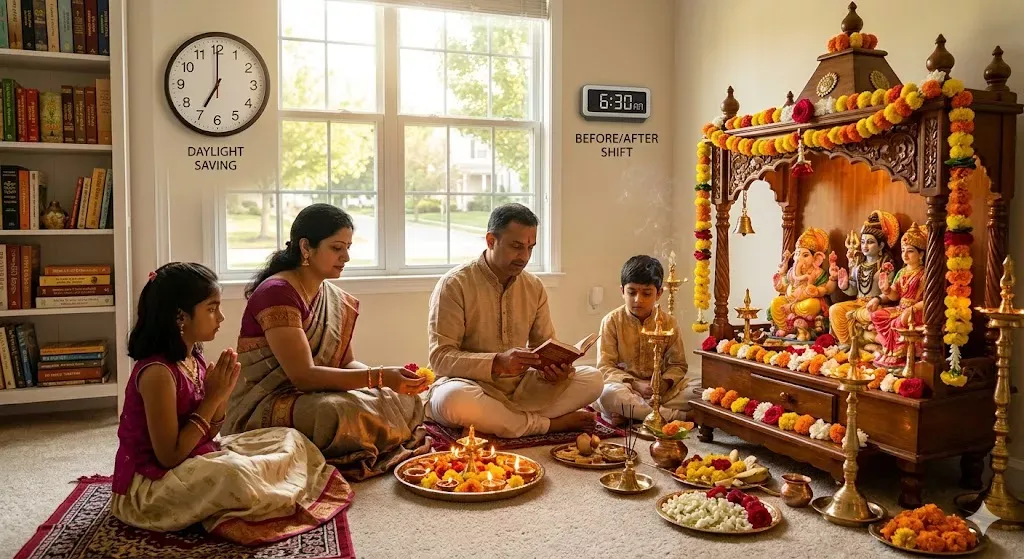
Quick answer: Daylight saving moves your sunrise and sunset clock-times by an hour overnight, so every sun-based timing — Surya arghya, sandhya, fast-breaking, Chhath and festival muhurats — shifts too. After any clock change, re-check your local sunrise/sunset and recompute these. In 2026 the US and eastern Canada fall back on 1 Nov (Manitoba, Alberta and most of BC no longer do), the UK/EU on 25 Oct; Australia started DST on 4 Oct 2026; the UAE keeps no DST.
Many Hindu observances are pegged to the Sun, not the clock — so when governments change the clocks, the clock-time of your puja changes. This guide lists the 2026/27 change dates and what to re-check, especially as the clock changes land right in the Chhath/Diwali/Sankranti season.
2026–2027 daylight-saving change dates
| Region | Clocks change | Effect |
|---|---|---|
| USA · Ontario · Quebec · Atlantic Canada | Fall back Sun 1 Nov 2026; spring forward Sun 14 Mar 2027 | Sunrise/sunset ~1 hr earlier from 1 Nov |
| Manitoba · Alberta · most of BC · Saskatchewan | No change on 1 Nov 2026 (MB, AB, BC now keep daylight time all year; SK never changes) | Sun times stay late on the clock all winter |
| UK & EU | Fall back Sun 25 Oct 2026; spring forward Sun 28 Mar 2027 | Sunrise/sunset ~1 hr earlier from 25 Oct |
| Australia (NSW/VIC/SA/TAS/ACT) | DST started Sun 4 Oct 2026; ends Sun 4 Apr 2027 | Sunrise/sunset ~1 hr later during DST |
| UAE · Qld/NT/WA | No daylight saving | Sun times stable year-round |
Clock change 2026: From 1 November 2026 Manitoba (UTC−5), Alberta (UTC−6) and most of British Columbia (UTC−7) keep daylight time all winter, while Ontario, Quebec and the Atlantic provinces turn their clocks back (Global News).
Which observances depend on local sun-time
- Surya Arghya & morning puja — offered at sunrise; shifts with every clock change.
- Sandhya (twilight) prayers — tied to sunset/sunrise.
- Fast-breaking (parana) — many vrats break at sunrise, sunset or moonrise.
- Chhath Sandhya & Usha Arghya — exactly at sunset and sunrise; see Chhath Puja 2026.
- Festival muhurats — Sankranti punya kaal, Diwali Lakshmi puja pradosh, etc. are computed from local sun times.
The Chhath / Diwali / Sankranti overlap
Note the timing: northern-hemisphere clocks fall back (US 1 Nov, UK/EU 25 Oct) just before the Diwali–Chhath season, so sunrise/sunset suddenly land an hour earlier — which is why “what time is arghya now” spikes every autumn. For 2026, Chhath’s Sandhya/Usha Arghya (15–16 Nov) and Makar Sankranti & Pongal 2027 both fall after the clock change, so use post-change local times.
Your “recompute your timings” checklist
- After the clock change, look up your city’s new sunrise and sunset.
- Reset your arghya/sandhya alarm to the new sunrise/sunset time.
- For festivals, re-check the muhurat in your city (panchang app) rather than reusing last year’s clock time.
- NRIs coordinating with family in India: remember India keeps no DST, so the time difference itself changes by an hour twice a year.
Note: the EU has debated abolishing seasonal clock changes, but as of now DST is still in effect — verify each year.
Related reading
- Surya Arghya — how & when to offer water
- Chhath Puja 2026
- Makar Sankranti & Pongal 2027
- how to worship Surya Dev
Frequently Asked Questions
Does daylight saving change Hindu puja timings?
Yes — any timing based on sunrise, sunset or moonrise (arghya, sandhya, fast-breaking, Chhath, festival muhurats) shifts by about an hour when the clocks change. Re-check your local sun times after each change.
When do clocks change in 2026–2027?
The US and Ontario, Quebec and Atlantic Canada fall back on 1 November 2026 (spring forward 14 March 2027), while Manitoba, Alberta and most of British Columbia keep daylight time all year; the UK & EU fall back on 25 October 2026 (spring forward 28 March 2027); Australia’s DST started 4 October 2026 and ends 4 April 2027; the UAE observes no DST.
Why does “arghya time” spike every autumn?
Because the northern clocks fall back just before the Diwali–Chhath season, sunrise and sunset suddenly land an hour earlier, so devotees search for the corrected local arghya and Chhath timings.
Does India observe daylight saving?
No. India stays on IST year-round, so the time difference between India and DST-observing countries itself changes by an hour twice a year — worth noting when coordinating pujas with family.
Share this with family and friends
Send it on WhatsApp, post it, or copy the link.
More from Spirituality
- Ekagrata (One-Pointedness): Yoga Concentration and Samyama Glossary
- Complete MBBS Once in Life: The Spiritual Meaning of Mahabharata, Bhagavatam, Bhagavad Gita & Ramayana
- Sri Medha Dakshinamurthy Swami Dhyanam | Meditation Sloka for Intelligence, Eloquence & Self-Realization
- What Is True Poverty? | Dharma Is the Greatest Wealth | Sanatana Dharma
- Correct Yourself First! | The Power of Constructive Criticism for Personal Growth
You might also like

Ahankara, the Wall Before Self-Knowledge | True Knowledge Dawns When the Ego Goes

Daiva Sankalpam (Divine Will): The Story of the Sadhu on the Sinking Boat

Deeparadhana: Significance of Lighting the Lamp, Deepam Jyoti Parabrahma Meaning, Oil and Wicks
