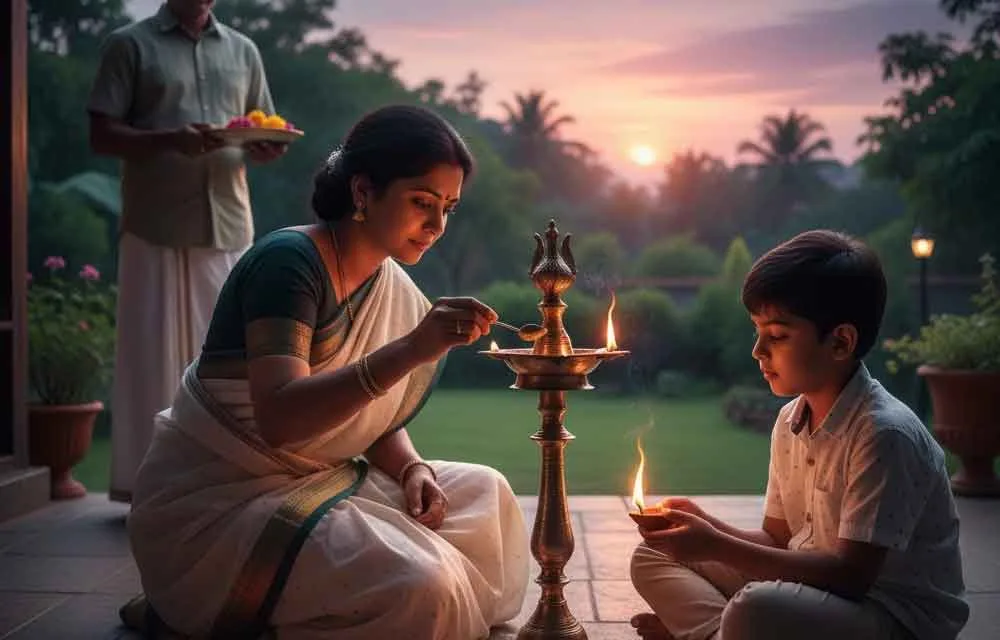
Surya Arghya: How & When to Offer Water to the Sun
How and when to offer Surya Arghya: step-by-step vidhi, the Surya Gayatri & beej mantras, and a city-wise sunrise reference for NRIs (with the daylight-saving caveat).

Quick answer: Offer Surya Arghya at sunrise: face east, stand with a small copper/brass vessel of water (add a little red sandalwood, kumkum and red flowers), raise it to brow height and pour it slowly so the sunlight passes through the falling stream, while chanting the Surya mantra. Do it daily — and use your own city’s sunrise, which shifts through the year (and with daylight saving).
Arghya — offering water to the Sun — is the simplest and most universal Surya practice. This guide gives the step-by-step vidhi, the arghya mantras in Devanagari, transliteration and meaning, and a city-wise sunrise reference for NRIs, since the right time is always your local sunrise.
How to offer Surya Arghya — step by step
- After a bath, soon after sunrise, face east toward the Sun.
- Fill a small copper or brass vessel (kalash/lota) with clean water; add a pinch of red sandalwood (raktachandan), kumkum, akshata (rice) and a few red flowers if available.
- Hold the vessel in both hands, raise it to forehead level, and pour the water out slowly in a thin stream so the morning sunlight passes through it.
- While pouring, chant the Surya mantra (below) — once, three or seven times.
- Look gently toward the Sun through the falling water (never stare at a strong sun), then offer pranam.
- On Sundays and Ratha Saptami the arghya is considered especially powerful.
Arghya mantras
Surya Gayatri:
ॐ भास्कराय विद्महे महाद्युतिकराय धीमहि। तन्नो आदित्यः प्रचोदयात्॥
Om Bhaskaraya Vidmahe Mahadyutikaraya Dhimahi, Tanno Adityah Prachodayat.
We meditate on the radiant Bhaskara (Sun) of great brilliance; may that Aditya inspire and illumine our intellect.
Surya Beej Mantra:
ॐ ह्रां ह्रीं ह्रौं सः सूर्याय नमः॥
Om Hraam Hreem Hraum Sah Suryaya Namah.
A seed (beej) salutation to Surya, invoking the Sun’s vitality and grace.
A simple namaskara mantra — Om Suryaya Namah — is also perfectly valid for daily arghya.
Best time = your local sunrise (city sunrise ranges)
Arghya is offered at/just after sunrise, so the clock time changes through the year and with daylight saving. Use your city’s actual sunrise on the day; the table shows how far it swings between mid-summer and mid-winter.
| City | Earliest sunrise (summer) | Latest sunrise (winter) |
|---|---|---|
| New York | ~5:26 AM | ~7:17 AM |
| Chicago | ~5:16 AM | ~7:16 AM |
| San Francisco | ~5:49 AM | ~7:22 AM |
| Toronto | ~5:37 AM | ~7:49 AM |
| London | ~4:44 AM | ~8:05 AM |
| Frankfurt | ~5:16 AM | ~8:22 AM |
| Dubai | ~5:30 AM | ~7:01 AM |
| Sydney (seasons reversed) | ~5:41 AM (Dec) | ~7:01 AM (Jun) |
Daylight saving shifts this. When clocks change, your sunrise clock-time jumps by an hour overnight — see our daylight saving & puja timing guide. A panchang app or weather app gives your exact daily sunrise.
Common mistakes to avoid
- Staring directly at a bright, fully-risen sun — offer at gentle early sunrise and look through the water, not at the disc.
- Using India’s sunrise time instead of your own city’s.
- Forgetting that the clock time moves with the seasons and DST.
Related reading
- how to worship Surya Dev
- Aditya Hridayam
- Surya Puja at home for NRIs
- Chhath Puja 2026
- Hindu Festival Calendar 2026
Frequently Asked Questions
What is the best time to offer Surya Arghya?
At sunrise or shortly after, when the sun is low and gentle. The exact clock time is your own city’s sunrise, which changes through the year and with daylight saving — use a panchang or weather app for the day’s sunrise.
Which mantra is chanted for Surya Arghya?
Commonly the Surya Gayatri (Om Bhaskaraya Vidmahe…), the Surya beej (Om Hraam Hreem Hraum Sah Suryaya Namah), or the simple Om Suryaya Namah — chanted once, three or seven times while pouring the water.
Which vessel should I use for arghya?
Traditionally a copper or brass lota/kalash; add a little red sandalwood, kumkum, rice and red flowers to the water if available. Plain clean water is acceptable too.
Can I offer arghya if I cannot see the sun (clouds/winter)?
Yes — face east at your local sunrise time and offer the water with the mantra; intention and correct timing matter most. See our Surya puja at home guide for indoor/winter adaptations.
Is Sunday special for Surya Arghya?
Yes. Sunday is Surya’s day, and Ratha Saptami is the most powerful day of the year for sun worship, though daily arghya at sunrise is the ideal.
Share this with family and friends
Send it on WhatsApp, post it, or copy the link.
More from Spirituality
- Chilkur Balaji 'Visa Balaji' Temple: The 11 and 108 Pradakshina Custom Explained for NRIs
- Ekagrata (One-Pointedness): Yoga Concentration and Samyama Glossary
- Complete MBBS Once in Life: The Spiritual Meaning of Mahabharata, Bhagavatam, Bhagavad Gita & Ramayana
- Sri Medha Dakshinamurthy Swami Dhyanam | Meditation Sloka for Intelligence, Eloquence & Self-Realization
- What Is True Poverty? | Dharma Is the Greatest Wealth | Sanatana Dharma
You might also like
Surya Puja at Home: A Practical Guide for NRIs

Ahankara, the Wall Before Self-Knowledge | True Knowledge Dawns When the Ego Goes

Daiva Sankalpam (Divine Will): The Story of the Sadhu on the Sinking Boat