
Chhath Puja 2026: Dates, Arghya Timings & Full Vidhi
Chhath Puja 2026 (Drik Panchang): Nahay Khay Fri 13 Nov, Kharna Sat 14, Sandhya Arghya Sun 15 and Usha Arghya Mon 16 Nov. Drik sunrise and sunset for all four days in Patna, Gaya, Muzaffarpur, Bhagalpur, Darbhanga, Ranchi, Varanasi, Delhi, Mumbai, Kolkata and Kathmandu, a diaspora table, samagri, vrat rules with a health note, the katha and ghat safety.
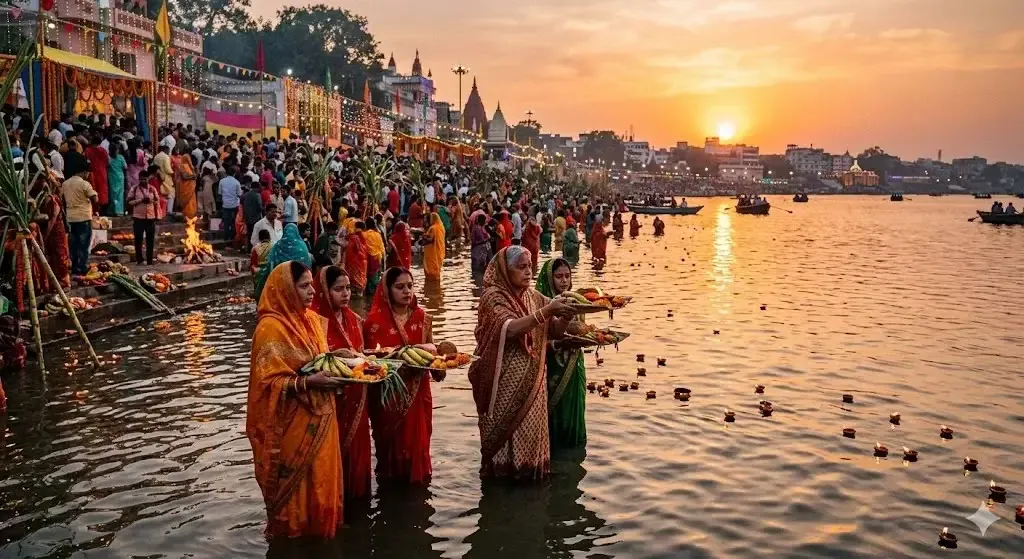
Quick answer: Chhath Puja 2026 runs Friday 13 to Monday 16 November (Drik Panchang): Nahay Khay on the 13th, Kharna on the 14th, Sandhya Arghya to the setting sun on Sunday 15th and Usha Arghya to the rising sun on Monday 16th. In Patna the Sandhya Arghya sunset is 5:01 PM and the Usha Arghya sunrise is 6:07 AM. The fast is broken only after the morning arghya. Find your city's times in the tables below.
Last updated: 21 October 2026. Dates and sunrise and sunset times are from the Drik Panchang Chhath Puja calendar 2026 set to each city (fetched 21 October 2026). One city, Darbhanga, is marked * and comes from our calculator, which uses Drik's sunrise and sunset method and matched Drik within a minute for every other city on this page.
Chhath Puja is the great four-day festival of Surya (the Sun God) and Chhathi Maiya, observed with a rigorous 36-hour nirjala fast, most fervently across Bihar, Jharkhand, eastern Uttar Pradesh and Nepal's Mithila and Bhojpuri regions, and now by their diaspora worldwide. Its two defining moments are the Sandhya Arghya to the setting sun and the Usha Arghya to the rising sun, offered standing in water at a ghat. This guide gives the verified 2026 dates, the day-by-day vidhi, city-wise sunrise and sunset for all four days, a table for families abroad, the samagri list, the vrat rules with a health note, the story of Chhathi Maiya and ghat safety.
Chhath Puja 2026 kab hai (छठ पूजा 2026 कब है): the four days
| Day | Date 2026 | Tithi at sunrise (Drik) | Ritual |
|---|---|---|---|
| 1 · Nahay Khay (नहाय खाय) | Fri, 13 Nov | Kartika Shukla Chaturthi | Holy bath; the home is cleaned; one sattvic meal (often lauki-bhaat with chana dal). Purity begins. |
| 2 · Kharna / Lohanda (खरना) | Sat, 14 Nov | Panchami | Day-long fast, broken after sunset with rasiao kheer and roti prasad; then the 36-hour nirjala fast begins. |
| 3 · Sandhya Arghya (संध्या अर्घ्य) | Sun, 15 Nov | Shashthi | Evening arghya: offering to the SETTING sun, standing in water at the ghat. The main day of Chhath. |
| 4 · Usha Arghya and Parana (उषा अर्घ्य) | Mon, 16 Nov | Saptami | Morning arghya to the RISING sun; the fast is broken (parana). |
Why Sunday? In Drik Panchang, Panchami ends at 11:23 PM IST on Saturday 14 November and Shashthi then runs until 2:00 AM IST on Monday 16 November. Shashthi is therefore the tithi at sunset on Sunday 15 November across India and Nepal, and the evening arghya falls on that day. Sandhya Arghya comes a week after Diwali (Sunday 8 November 2026) and four days after Bhaiya Dooj (Wednesday 11 November).
Sandhya Arghya ka samay (संध्या अर्घ्य का समय) and Usha Arghya time, city-wise
Sandhya Arghya is at sunset on Sunday 15 November; Usha Arghya at sunrise on Monday 16 November. The Kharna column is Saturday's sunset, after which the Kharna prasad is taken. Times are local, from Drik Panchang for each city; on a river bank, behind trees or buildings, the sun may disappear or appear a minute or two off these figures.
| City | State / country | Kharna: sunset, Sat 14 Nov | Sandhya Arghya: sunset, Sun 15 Nov | Usha Arghya: sunrise, Mon 16 Nov |
|---|---|---|---|---|
| Patna | Bihar | 5:01 PM | 5:01 PM | 6:07 AM |
| Gaya | Bihar | 5:03 PM | 5:03 PM | 6:07 AM |
| Muzaffarpur | Bihar | 5:00 PM | 4:59 PM | 6:07 AM |
| Bhagalpur | Bihar | 4:55 PM | 4:54 PM | 6:00 AM |
| Darbhanga * | Bihar | 4:58 PM | 4:57 PM | 6:05 AM |
| Ranchi | Jharkhand | 5:04 PM | 5:04 PM | 6:03 AM |
| Varanasi | Uttar Pradesh | 5:10 PM | 5:10 PM | 6:16 AM |
| Delhi | Delhi | 5:28 PM | 5:28 PM | 6:44 AM |
| Mumbai | Maharashtra | 6:00 PM | 6:00 PM | 6:46 AM |
| Kolkata | West Bengal | 4:53 PM | 4:53 PM | 5:50 AM |
| Kathmandu (Nepal time) | Nepal | 5:12 PM | 5:12 PM | 6:25 AM |
* Darbhanga: calculated (Drik method), because Drik's Darbhanga page could not be fetched on 21 October; allow a minute either way. All times are IST except Kathmandu (Nepal time, UTC+5:45). For more Bihar, Jharkhand and UP towns, including Jamshedpur, Gorakhpur, Prayagraj, Lucknow and Noida, see our Chhath Puja 2026 arghya time city-wise page for Bihar, Jharkhand, UP and Delhi.
Eastern cities come first: Bhagalpur and Kolkata see the sun set before 5 PM, while Delhi's sunset is about 27 minutes after Patna's and Mumbai's nearly an hour later. Most vratis reach the water 30 to 60 minutes before sunset, and families leave for the dawn arghya in the dark, so plan around the crowds rather than the exact minute.
Sunrise and sunset for all four days of Chhath 2026
Each cell shows sunrise / sunset (Drik Panchang). Nahay Khay and Kharna customs follow the day; the Kharna prasad is taken after Saturday's sunset.
| City | Nahay Khay, Fri 13 Nov | Kharna, Sat 14 Nov | Sandhya Arghya, Sun 15 Nov | Usha Arghya, Mon 16 Nov |
|---|---|---|---|---|
| Patna | 6:05 AM / 5:02 PM | 6:06 AM / 5:01 PM | 6:07 AM / 5:01 PM | 6:07 AM / 5:01 PM |
| Gaya | 6:05 AM / 5:04 PM | 6:05 AM / 5:03 PM | 6:06 AM / 5:03 PM | 6:07 AM / 5:02 PM |
| Muzaffarpur | 6:05 AM / 5:00 PM | 6:06 AM / 5:00 PM | 6:07 AM / 4:59 PM | 6:07 AM / 4:59 PM |
| Bhagalpur | 5:57 AM / 4:55 PM | 5:58 AM / 4:55 PM | 5:59 AM / 4:54 PM | 6:00 AM / 4:54 PM |
| Darbhanga * | 6:03 AM / 4:58 PM | 6:04 AM / 4:58 PM | 6:04 AM / 4:57 PM | 6:05 AM / 4:57 PM |
| Ranchi | 6:01 AM / 5:05 PM | 6:02 AM / 5:04 PM | 6:02 AM / 5:04 PM | 6:03 AM / 5:04 PM |
| Varanasi | 6:13 AM / 5:11 PM | 6:14 AM / 5:10 PM | 6:15 AM / 5:10 PM | 6:16 AM / 5:10 PM |
| Delhi | 6:42 AM / 5:28 PM | 6:43 AM / 5:28 PM | 6:44 AM / 5:28 PM | 6:44 AM / 5:27 PM |
| Mumbai | 6:45 AM / 6:01 PM | 6:45 AM / 6:00 PM | 6:46 AM / 6:00 PM | 6:46 AM / 6:00 PM |
| Kolkata | 5:48 AM / 4:54 PM | 5:48 AM / 4:53 PM | 5:49 AM / 4:53 PM | 5:50 AM / 4:53 PM |
| Kathmandu (Nepal time) | 6:23 AM / 5:13 PM | 6:24 AM / 5:12 PM | 6:25 AM / 5:12 PM | 6:25 AM / 5:11 PM |
Chhath Puja 2026 abroad: arghya times for the diaspora
Abroad, the arghya is offered at your own city's sunset and sunrise. Never use India's times. Drik Panchang's Chhath calendar keeps the same four dates (13 to 16 November) for all of these cities:
| City | Local clock in November | Kharna: sunset, Sat 14 Nov | Sandhya Arghya: sunset, Sun 15 Nov | Usha Arghya: sunrise, Mon 16 Nov |
|---|---|---|---|---|
| New York | EST (UTC−5) | 4:39 PM | 4:38 PM | 6:44 AM |
| New Jersey (Edison) | EST (UTC−5) | 4:41 PM | 4:40 PM | 6:45 AM |
| Houston | CST (UTC−6) | 5:26 PM | 5:26 PM | 6:47 AM |
| Toronto | EST (UTC−5) | 4:53 PM | 4:52 PM | 7:13 AM |
| London | GMT (UTC+0) | 4:13 PM | 4:11 PM | 7:20 AM |
| Dubai | GST (UTC+4) | 5:32 PM | 5:32 PM | 6:37 AM |
| Mauritius (Port Louis) | MUT (UTC+4) | 6:26 PM | 6:27 PM | 5:22 AM |
| Sydney | AEDT (UTC+11) | 7:35 PM | 7:36 PM | 5:43 AM |
Clock notes for 2026: the USA left daylight time on Sunday 1 November and Toronto is on Eastern Standard Time (UTC−5). Canada's western provinces did not fall back this year: from 1 November 2026 British Columbia stays on UTC−7, Alberta on UTC−6 and Manitoba on UTC−5 all year. If you are in Vancouver, Calgary, Edmonton or Winnipeg, use our Chhath Puja guide for Canada, Australia and the UAE rather than a generic app. The UK has been on GMT since 25 October. Sydney is on daylight time (AEDT), which is why its arghya is late in the evening and early in the morning.
In the Americas, Shashthi tithi falls across Saturday afternoon and Sunday afternoon local time, so it has already ended by sunset on Sunday 15 November. Some calendars computed strictly for local time may therefore show Saturday 14 November for the evening arghya; Drik Panchang's Chhath calendar for these cities keeps Sunday 15 November. Follow your samiti, temple or family elders.
Country guides with more cities: Chhath Puja 2026 in the USA (10 cities), Chhath Puja 2026 in the UK, Chhath Puja 2026 in Europe: arghya times and Chhath Puja 2026 in New Zealand, Singapore, Malaysia, Mauritius and South Africa (New Zealand is a day later).
Day-by-day vidhi: Nahay Khay, Kharna (खरना), Sandhya and Usha Arghya
- Nahay Khay (Friday 13 November): the vratin bathes, traditionally in the Ganga or another river or pond, and the house and kitchen are cleaned. One pure meal is eaten, often lauki (bottle gourd) with rice and chana dal, cooked without onion or garlic and usually with rock salt. Family members eat after the vratin.
- Kharna (Saturday 14 November): a full day's fast. After sunset, worship is offered and the prasad of rasiao kheer (rice cooked in milk with jaggery) and roti, often made on a fresh clay chulha with mango wood, is offered to the Sun and eaten first by the vratin, in quiet. It is then shared with family and neighbours. After Kharna the 36-hour waterless fast begins.
- Sandhya Arghya (Sunday 15 November): the day goes in preparing thekua and arranging the soop and daura. In the late afternoon the family walks to the ghat, the daura often carried on the head, singing Chhath geet. Standing in the river or a water body, the vratin offers arghya, water or milk poured as the soop of thekua, fruits and sugarcane is raised to the setting sun. Many families then hold kosi at night, lamps lit under a canopy of sugarcane stalks.
- Usha Arghya and Parana (Monday 16 November): before sunrise the family returns to the ghat. Arghya is offered to the rising sun, Chhathi Maiya is prayed to, and the vratin breaks the fast with a little prasad and water. Prasad is shared with everyone present.
There is no priest and no idol in the core ritual: the devotee offers directly to the Sun, in public, at the water's edge. Family customs differ on details such as the Kharna menu, kosi and which fruits go in the soop, so follow your elders where they differ from this outline.
Chhath puja samagri list (छठ पूजा सामग्री)
The essentials are the soop, the daura, thekua, fruit, a lamp and water for the arghya. The rest varies by family:
| Item | What it is for |
|---|---|
| Soop (सूप) | Bamboo winnowing basket on which the prasad is raised during the arghya; many families use one soop per vratin or per wish, often new each year |
| Daura / dauri (दउरा) | Deep bamboo basket that carries the prasad and fruit to the ghat |
| Thekua (ठेकुआ) | The signature Chhath prasad: wheat flour, jaggery and ghee, shaped in a wooden mould and fried. See our prasad recipes |
| Kasar or rice laddoo | Laddoo of roasted rice flour and jaggery, made in many homes alongside thekua |
| Sugarcane with leaves | Offered at the ghat and used for the kosi canopy |
| Fruit | A bunch of bananas, coconut, citron or other large lemon, sweet lime, water chestnut (singhara), sweet potato, radish and seasonal fruit |
| Fresh turmeric and ginger plants | Offered whole, with leaves, in many families |
| Diya, ghee, cotton wicks | Lamps for the soop, the ghat and the kosi |
| Lota or kalash | Copper, brass or steel vessel for pouring water or milk in the arghya |
| Sindoor, rice, flowers, betel leaf, supari, incense | Puja items for Chhathi Maiya |
| New or freshly washed clothes | Commonly a cotton sari for women vratins and a dhoti for men |
| Rasiao kheer and roti ingredients | Rice, milk, jaggery and wheat flour for the Kharna prasad |
Abroad, bamboo soops and dauras are sold by Indian grocers before Chhath; a clean steel plate or wicker tray is a common substitute. Our Chhath Puja 2026 prasad recipes guide (thekua, rasiao kheer, kasar and fruits) covers the food step by step.
Chhath vrat rules (छठ व्रत के नियम)
These are the rules most families follow; details vary by region and household:
- Purity from Nahay Khay: the home and kitchen are cleaned, and the prasad is cooked separately, often on a new clay chulha with mango wood.
- No onion, garlic, meat, eggs or alcohol in the house for the four days; rock salt is used on Nahay Khay, and the Kharna prasad is usually made without salt.
- The vratin usually prepares the prasad and does not taste it while cooking.
- Many vratins sleep on the floor on a mat or blanket during the vrat.
- The waterless fast runs from after the Kharna prasad until parana after the Usha Arghya.
- Family members help with every task, carrying the daura, standing in the water beside the vratin and keeping the ghat clean.
- Once a household takes up Chhath, many families keep it every year; if someone cannot, another family member often keeps it on their behalf.
Health note: the 36-hour nirjala fast and who should modify it
Please read this before you fast. Going about 36 hours without food or water, and standing in cold water at dusk and dawn, puts real strain on the body. The tradition itself allows for care: a modified fast, taking part in the arghya without fasting, or another family member keeping the vrat are all common and respected. Speak to your doctor before keeping the nirjala fast if any of these apply:
- Pregnancy or breastfeeding: dehydration can be harmful to you and the baby. Most doctors advise against a waterless fast; ask about a fruit and water fast or join the arghya without fasting.
- Diabetes: especially if you take insulin or tablets that lower blood sugar, a long fast can cause dangerous lows and dehydration. Your doctor may need to change doses or advise against fasting.
- Older people: dehydration, dizziness and falls on wet ghat steps are bigger risks with age. Keep the fast short, sit when you can and have someone stand beside you in the water.
- Regular medication: for blood pressure, heart, kidney, thyroid, epilepsy or mental health, and diuretics, ask whether you can skip doses or take them without food or water. Do not stop medicines on your own.
- Heart, kidney or liver disease, low blood pressure, a history of fainting or a recent illness or surgery: a waterless fast may not be safe at all.
- Children and teenagers: they can help and join the arghya; they should not keep a nirjala fast.
Stop the fast and get medical help if the vratin feels faint, confused or very weak, has chest pain, palpitations or a severe headache, stops passing urine or starts shivering uncontrollably after leaving the water. In India call 112. Chhathi Maiya's blessing does not depend on harming your health; families have always adjusted the vrat for those who need it.
Chhath katha: Chhathi Maiya and Surya, in our own words
Chhath honours Surya, the visible source of life, and Chhathi Maiya, who is commonly identified with Shashthi Devi, the goddess who protects children. In many songs she is called Surya's sister. The festival is famous for its discipline and equality: rich and poor stand in the same water and make the same offering.
The best-known story, as families tell it, is that of King Priyavrat and Queen Malini, who longed for a child. When their son was born lifeless, a radiant goddess appeared, Shashthi Devi, and restored the child to life, asking the king to spread her worship. The story of Shashthi Devi and Priyavrat is told in Puranic texts such as the Devi Bhagavata and Brahmavaivarta Puranas; its link to the Chhath vrat comes through popular tradition.
Other stories link the vrat to the epics. Karna, the son of Surya, is said to have stood waist-deep in water every day offering arghya to his father, and the custom of standing in water is often traced to him. Draupadi and the Pandavas are said to have kept the vrat in their hard years, on the advice of a sage, and to have regained what they had lost. In another telling, Sita and Rama worshipped the sun on Kartika Shukla Shashthi after returning to Ayodhya.
Regional variations: in Bhojpur and Magadh the Karna and Draupadi stories are common; in Mithila, songs and stories centre on Chhathi Maiya as a mother goddess; some towns in Bihar have their own local traditions about Sita keeping the vrat there. In Nepal's Terai the same festival is kept with Maithili and Bhojpuri songs. None of these needs to be treated as the only true version; families tell the story their own elders told.
Chhath geet: the folk songs of Chhath, in Bhojpuri, Maithili and Magahi, are sung while making thekua, walking to the ghat and waiting for the sun. They speak of carrying the daura, of the bamboo basket bending under the offerings, and of asking Chhathi Maiya for the family's well-being. Singers such as Sharda Sinha made many of them known far beyond Bihar. We do not print lyrics here; listen to the versions your family sings.
Families keep Chhath to give thanks and to pray for health, children and the family's well-being. Like every vrat, it is an offering of devotion, not a bargain, and no particular result is promised.
Ghat safety: crowds and water
The river ghats of Patna, Varanasi and other cities, and the ponds and canals used in Delhi, Kolkata and Mumbai, are very crowded on both arghya days. Simple precautions save lives:
- Crowds: arrive early and leave without rushing. Avoid narrow steps, bridges and slopes when crowds surge; if a crowd starts pushing, move sideways out of it and keep your arms in front of your chest. Follow police and volunteer directions and the one-way routes they set.
- Water: stay inside the barricades and depth markers. River levels and currents change, and the bottom can drop suddenly. Do not swim, and do not go deeper for a better view of the sun. At big ghats the administration often posts rescue boats; stay where they can see you.
- Children: keep small children out of the water, hold their hands on steps and put a card with a phone number in every child's pocket.
- The vratin: by Sunday evening the vratin has had no water since Saturday night. Have someone stand close in the water, help them up wet steps, and bring a dry change of clothes and a warm shawl for the cold Monday dawn.
- Fire and electricity: keep diyas away from saris, dupattas and dry leaves, and keep children away from temporary lighting cables near the water.
- Meeting point: mobile networks often jam at the arghya hour. Agree on a fixed landmark where the family regroups.
- Abroad: public lakes and beaches may need permission, and November water in North America, the UK and Europe can be very cold. Keep time in the water short, or use a clean tub or backyard pool.
These are general tips. Follow your local administration, police and ghat committee, which may change ghats, timings and access each year. For river-bank and travel crowds around the festival, see our note on festival special trains 2026 (Dasara, Diwali and Chhath).
Eco-friendly Chhath
- Use the bamboo soop and daura, clay diyas and leaf plates, all reusable or biodegradable, instead of plastic and thermocol.
- Take every plastic bag and wrapper home; do not throw polythene or synthetic decorations into the water.
- Use artificial ponds and tanks where the administration provides them; they are often safer for children and older vratins.
- Keep soap and detergent out of the river during the ritual bath, and share leftover prasad and fruit rather than waste it.
Chhath abroad: find your city
Observing Chhath overseas? The arghya is always offered at your own city's sunset and sunrise. See our region guides: Chhath in the USA, the UK, and Canada, Australia & the UAE.
Also read: festival special trains 2026.
Also read: Chhath Puja 2026 in New Zealand, Singapore, Malaysia, Mauritius and South Africa.
Frequently asked questions
Chhath Puja 2026 kab hai (छठ पूजा 2026 कब है)?
According to Drik Panchang, Chhath Puja 2026 runs from Friday 13 to Monday 16 November: Nahay Khay on Friday 13 November, Kharna on Saturday 14 November, Sandhya Arghya on Sunday 15 November (Kartika Shukla Shashthi) and Usha Arghya with parana on Monday 16 November.
What time is Sandhya Arghya on 15 November 2026?
Sandhya Arghya is offered at sunset on Sunday 15 November. Drik Panchang gives sunset at 5:01 PM in Patna, 5:03 PM in Gaya, 5:04 PM in Ranchi, 5:10 PM in Varanasi, 5:28 PM in Delhi, 4:53 PM in Kolkata and 6:00 PM in Mumbai.
What time is Usha Arghya on 16 November 2026?
Usha Arghya is offered at sunrise on Monday 16 November: 6:07 AM in Patna, 6:07 AM in Gaya, 6:03 AM in Ranchi, 6:16 AM in Varanasi, 6:44 AM in Delhi, 5:50 AM in Kolkata and 6:46 AM in Mumbai (Drik Panchang). The vrati breaks the fast after this arghya.
When is Kharna 2026?
Kharna (Lohanda) is on Saturday 14 November 2026. The vrati fasts through the day and takes the kheer and roti prasad after sunset, which in Patna is at 5:01 PM. The nirjala fast begins after this prasad.
How long is the Chhath fast, and who should not keep it nirjala?
The nirjala (waterless) fast runs from after the Kharna prasad on Saturday evening until parana after the Usha Arghya on Monday morning, about 36 hours. Pregnant or breastfeeding women, people with diabetes, heart or kidney disease or low blood pressure, older people and anyone on regular medication should talk to their doctor first and keep a modified fast if advised.
Is Chhath Puja 2026 on the same dates in the USA, UK and Australia?
Drik Panchang's Chhath calendar lists the same four dates, 13 to 16 November 2026, for New York, Houston, Toronto, London, Dubai, Mauritius and Sydney. New Zealand is a day later. The arghya is always offered at your own city's sunset and sunrise, never at India's times.
Editor's note (21 October 2026)
Editor's note (21 October 2026): This guide was expanded in place. The four dates, the tithi times and every sunrise and sunset on this page are from Drik Panchang's Chhath Puja calendar 2026 for each city, fetched on 21 October 2026, except Darbhanga, which is from our calculator using Drik's method. The Patna Usha Arghya sunrise is now 6:07 AM (Drik), replacing an earlier approximate figure. The health note is general information, not medical advice. The katha is our own summary of widely told traditions. We do not list ghat events, organisers or schedules; follow your local administration, ghat committee, samiti or temple.
Related reading
- Chhath Puja 2026 arghya time city-wise (Bihar, Jharkhand, UP, Delhi, Kolkata, Kathmandu)
- Chhath Puja 2026 prasad recipes: thekua, rasiao kheer and fruits
- Panchang for Sunday 15 November 2026: Chhath Puja and Skanda Sashti
- November 2026 Hindu festival calendar
- how to worship Surya Dev
- Aditya Hridayam
- Surya Grahan 12 August 2026
- Diwali 2026
- Hindu Festival Calendar 2026
Share this with family and friends
Send it on WhatsApp, post it, or copy the link.
More from Festivals
- Mirabai Jayanti 2026: A Living Symbol of Krishna Bhakti – Life, Significance and Bhajans
- Masik Shivaratri 2027 Dates: Monthly Shivaratri List, Nishita Kaal Times and Dates Abroad
- Sankashti Chaturthi 2027 Dates and Moonrise Times: Full List for India and Abroad
- Pradosh Vrat 2027 Dates: All 25 Pradosham Days, Pradosh Kaal Times and Dates Abroad
- Amavasya 2027 Dates: New Moon Days, Darsha Amavasya, Tithi Times and Dates Abroad
You might also like
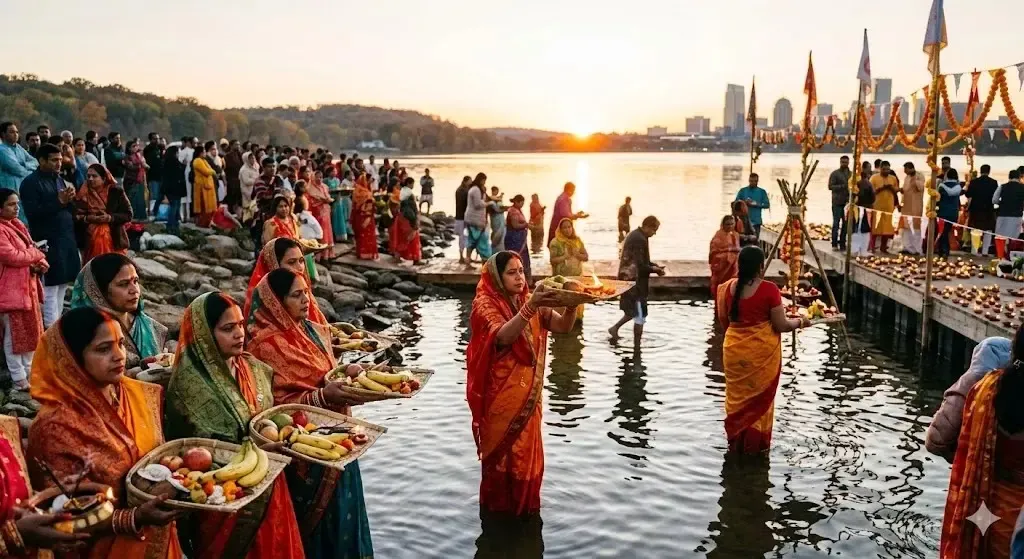
Chhath Puja 2026 in the USA: Dates 13 to 16 November, Sandhya and Usha Arghya Times for 10 Cities, and How to Keep Chhath Without a River
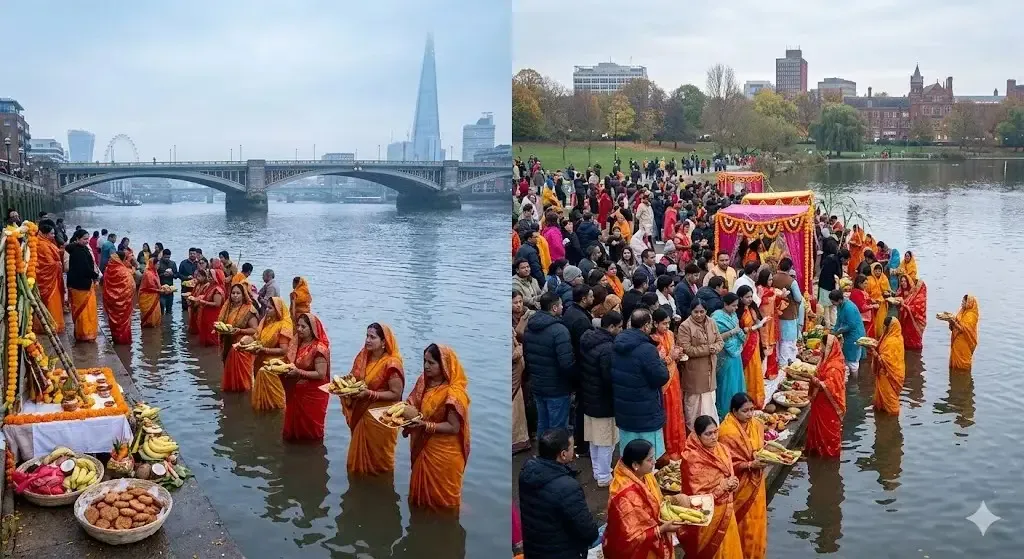
Chhath Puja 2026 in the UK: 13 to 16 November, Sandhya and Usha Arghya Times for London, Leicester, Birmingham, Manchester and Glasgow
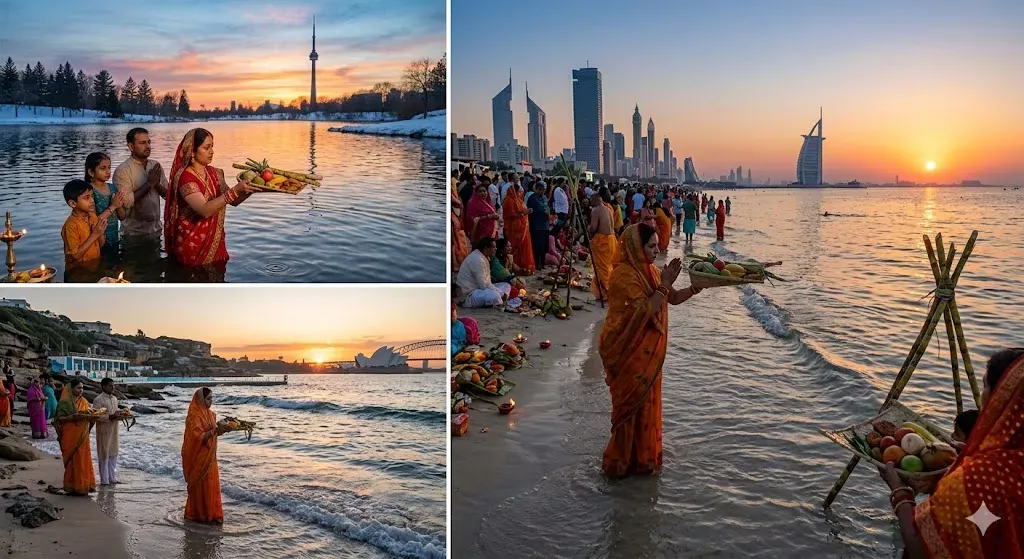
Chhath Puja 2026 in Canada, Australia and the UAE: 13 to 16 November, Arghya Times for Toronto, Vancouver, Sydney, Melbourne, Dubai and More