Diwali 2026 — 5-Day Festival Calendar at a Glance
[image: 🌟] Special Note for 2026: Diwali falling on Sunday (Ravivar) is considered extraordinarily auspicious.
[image: 🌟] Special Note for 2026: Diwali falling on Sunday (Ravivar) is considered extraordinarily auspicious.
[image: 🌟] Special Note for 2026: Diwali falling on Sunday (Ravivar) is considered extraordinarily auspicious. Sunday is ruled by Surya (the Sun) — the deity of light, vitality, and positive energy — which perfectly mirrors Diwali's core theme of light triumphing over darkness. Sunday Diwali is believed to bestow enhanced blessings and success for the coming year.
[image: 🕯️] Lakshmi Puja Muhurat 2026 — Exact Timings
The most critical factor for Diwali observance is performing Lakshmi Puja at the correct muhurat. Lakshmi Puja must be performed during Pradosh Kaal (evening twilight after sunset) when the Amavasya Tithi prevails and ideally during Vrishabha Lagna (Taurus Ascendant) — the "Sthir" (fixed) Lagna that ensures Goddess Lakshmi stays permanently in your home.
Main Diwali 2026 Muhurat (New Delhi / Hyderabad IST)
[image: ⚠️] City-Wise Note: Muhurat timings vary by 15–45 minutes depending on your city's longitude. For precise local timings, always verify with your local Panchang (almanac), temple authorities, or trusted astrology platforms like DrikPanchang.com.
Why Vrishabha Lagna is the Best Muhurat
Ancient texts including Dharma Sindhu and Nirnaya Sindhu state that Lakshmi Puja performed during Vrishabha (Taurus) Lagna — a fixed or "Sthir" Lagna — ensures that the Goddess's blessings of wealth, health, and prosperity become permanent in the household, rather than temporary. This is why the Pradosh + Vrishabha Lagna window is the prime Diwali puja slot.
Muhurat for Different Cities (Approximate IST)
[image: 📌] Verify exact timings with DrikPanchang.com using your specific city coordinates for precision.
[image: 🌟] What is Diwali? — Meaning, Origin & Deep Significance
The Word "Diwali"
The word Diwali (also spelled Deepavali) derives from two Sanskrit words — "Dipa" (lamp, light) and "Avali" (row, series). It literally means "Row of Lights" — an apt description of the golden streams of diyas that transform every home, temple, and street into a luminous galaxy on this night.
Why is Diwali Celebrated? — The Sacred Stories
Diwali commemorates multiple divine events across different traditions — a testament to its universal spiritual significance.
1. Lord Rama's Return to Ayodhya (Most Celebrated) The most widely known legend celebrates Lord Rama's triumphant return to Ayodhya with Sita and Lakshmana after 14 years of forest exile and the defeat of demon king Ravana. The citizens of Ayodhya welcomed their beloved king by lighting thousands of diyas (oil lamps) — illuminating every street, home, and path. Diwali recreates this moment of joyous homecoming every year.
2. Victory of Lord Krishna over Narakasura (Narak Chaturdashi) The day before Diwali — Narak Chaturdashi — celebrates Lord Krishna's (and Satyabhama's) defeat of the demon Narakasura, who had imprisoned 16,000 women in his dungeons. Upon hearing the news of Narakasura's death, people lit diyas in celebration. This legend is particularly celebrated in South India, Maharashtra, and among Vaishnava communities.
3. Goddess Lakshmi's Birthday (Kartik Amavasya) According to the Vishnu Purana, Goddess Lakshmi was born from the churning of the cosmic ocean (Samudra Manthan) on this very Amavasya. She emerged in her full divine splendor, radiant with lotus flowers, gold coins, and divine grace. Kartik Amavasya is considered her birthday — and thus the most powerful night of the year to worship her.
4. Lord Mahavira's Nirvana (Jain Tradition) The founder of Jainism, Tirthankara Mahavira, attained Moksha (final liberation) on this Amavasya night. Diwali is thus the most sacred day in the Jain calendar as well, celebrated as the "Festival of Lamps" marking the divine light of Mahavira's enlightenment.
5. Goddess Kali's Victory (Bengali Tradition) In Bengal and eastern India, the Diwali night (Kali Puja) is dedicated to Goddess Kali — the fierce protective form of the Divine Mother who destroyed all demons on this night. Elaborate Kali Puja pandals and midnight rituals mark this observance.
6. Bali Vamana Story (Govardhan Puja — Day 4) Lord Vishnu in his Vamana (dwarf) avatar descended to reclaim the three worlds from demon king Bali. On Govardhan Puja day, Bali's descent to the underworld is marked — and in some traditions, Bali is celebrated as a just king who returns annually to bless his people.
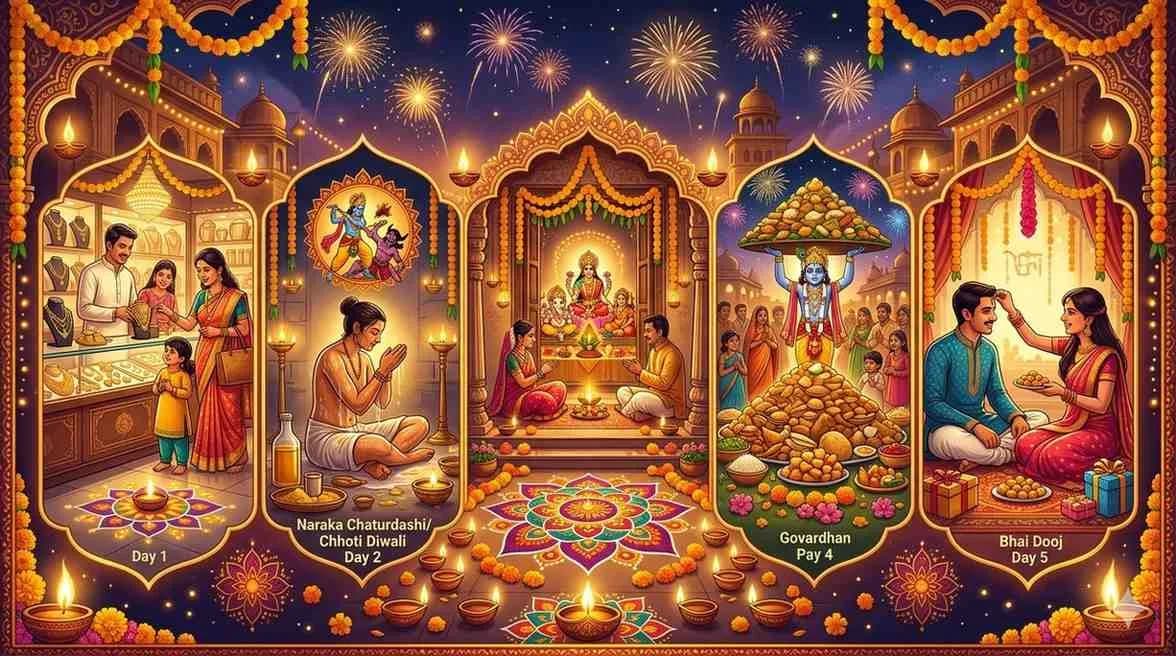
[image: 🪔] Day 1 — Dhanteras 2026 (November 6, Friday)
Dhanteras — from "Dhan" (wealth) and "Teras" (thirteenth) — marks the 13th day of the dark fortnight of Kartik and is dedicated to Lord Dhanvantari (divine physician, avatar of Vishnu) and Goddess Lakshmi with Lord Kubera (deity of wealth).
Key Dhanteras Rituals
Gold & Silver Purchase Buying gold, silver, new utensils, or valuable items on Dhanteras is considered supremely auspicious — it is believed that wealth purchased on this day multiplies manifold. Even buying a small silver coin is considered sufficient for the blessing.
- Best Shopping Muhurat: 6:00 PM – 8:30 PM (Pradosh Kaal, IST)
- Avoid: Rahu Kaal (10:30 AM – 12:00 PM)
Yama Deepam (Lamp for Death God) In the evening, a single four-wick diya (Chatur-mukhi deepam) is lit facing South — the direction of Yama, the God of Death. This lamp is kept burning to appease Yama and seek protection from untimely death and disease for all family members. This is one of the most important but often overlooked Dhanteras rituals.
Lakshmi–Kubera Puja A special puja to both Goddess Lakshmi and Lord Kubera (keeper of the universe's treasures) is performed to seek blessings for wealth and financial stability for the entire year.
[image: 🕯️] Day 2 — Choti Diwali / Narak Chaturdashi 2026 (November 7, Saturday)
The day before main Diwali is called Choti Diwali ("small Diwali") or Narak Chaturdashi — commemorating Lord Krishna's defeat of Narakasura.
Key Narak Chaturdashi Rituals
Abhyang Snan (Sacred Oil Bath at Dawn) The most important ritual of this day — devotees wake before sunrise and apply sesame or coconut oil all over the body before taking a bath. This ritual symbolizes the cleansing of all sins and the removal of Narak (hell) from the devotee's life. The bath must be completed before sunrise.
Mehndi (Henna) Application Women apply intricate mehndi (henna) designs on their hands and feet as part of the Diwali beautification ritual.
14 Diyas at Dusk In the evening, 14 diyas are lit and placed in various corners of the house, facing different directions — to drive away evil forces, remove the shadow of ancestors, and purify the home's energy before the main Diwali night.
[image: ✨] Day 3 — MAIN DIWALI 2026 (November 8, Sunday) — Complete Puja Vidhi
This is the heart of the five-day festival — Kartik Amavasya, the night Goddess Lakshmi roams the earth and blesses the homes that welcome her with light, cleanliness, and devotion.
Morning Preparations
1. Deep Cleaning (Shodhan) Clean every corner of your home — this is not optional. Goddess Lakshmi is said to enter only clean, well-lit, and joyful homes. Sweep, mop, declutter, and sprinkle Gangajal (holy water) in every room.
2. Rangoli at the Entrance Draw a beautiful Rangoli at the main entrance with vibrant colors — including the symbol of Goddess Lakshmi's footprints (Lakshmi Charan) leading inward from the door. This is the ritual welcome mat for the Goddess. Use fresh flowers, marigold petals, or colored powder.
3. Decorate the Home
- Hang torans (mango leaf festoons) at all doorways.
- Hang marigold garlands and string lights.
- Place diyas on windowsills, balconies, rooftops, and courtyards.
- Float flower petals and diyas in water bowls around the entrance.
4. Wear New Clothes Bathe before sunset and wear new or clean traditional clothes. Preferred colors: red, yellow, saffron, gold, or deep orange — colors of prosperity and auspiciousness.
Lakshmi Puja Samagri (Complete Items List)
Step-by-Step Lakshmi Puja Vidhi — 16 Sacred Steps
Before Puja Begins: Clean the puja room, sprinkle Gangajal while chanting:
"Om Apavitrah Pavitro Va Sarvavasthaam Gato Api Va, Yah Smaret Pundarikaksham Sa Bahyabhyantarah Shuchihi"
Step 1 — Kalash Sthapana (Establishing the Sacred Vessel)
- Place the Kalash (copper/clay pot) filled with water.
- Insert 5 mango leaves circularly at the top.
- Place a betel nut, coin, marigold flower, and rice grains inside.
- Place a coconut on top, wrapped in red cloth.
- The Kalash represents all holy rivers, the ocean, and the divine presence.
Step 2 — Idol Placement
- Place Goddess Lakshmi at the center of the red cloth on the chowki.
- Place Lord Ganesha to the left of Lakshmi (from Lakshmi's perspective — i.e., to your right when facing the idol).
- Place a small image of Lord Kubera and Goddess Saraswati flanking them.
- Arrange coins and jewelry before the idol.
Step 3 — Sankalpa Take water in the right palm and make a solemn resolve:
"Om Vishnu, Vishnu, Vishnu — Adya Kartik Krishnapaksha Amavasya Tithau, Shri Mahalakshmi Puja Karikhye" ("Today, on Kartik Amavasya, I perform this puja of Goddess Mahalakshmi.")
Step 4 — Ganesh Puja (First) Always begin by invoking Lord Ganesha:
"Om Gam Ganapataye Namah — Vakratunda Mahakaya, Suryakoti Samaprabha, Nirvighnam Kuru Me Deva, Sarva Karyeshu Sarvada"
Step 5 — Avahana (Inviting the Goddess) Invoke Goddess Lakshmi into the idol with folded hands:
"Om Mahalakshmyai Cha Vidmahe, Vishnu Patnyai Cha Dhimahi, Tanno Lakshmi Prachodayat"
Step 6 — Panchamrit Abhishekam Bathe the Lakshmi idol in the five sacred nectars:
- Milk → "Om Stutaye Namah"
- Curd → "Om Shriyai Namah"
- Honey → "Om Kamale Namah"
- Sugar → "Om Prasannayai Namah"
- Ghee → "Om Shubhayai Namah"
Then rinse with pure water. Wipe gently with a clean white cloth.
Step 7 — Vastra & Shringar (Adornment) Offer new yellow or red cloth. Apply kumkum to the forehead, turmeric paste to the palms, and a vermilion bindi. Adorn the idol with jewelry, flowers, and a garland of marigold and lotus.
Step 8 — Lotus & Flower Offering Offer lotus flowers (Lakshmi's sacred flower) and fresh petals. For every lotus offered, chant:
"Om Shreem Hreem Kamalaye Namah"
Step 9 — Dhupa (Incense) Light sandalwood or khus incense and wave it clockwise before the Goddess 7 times, chanting:
"Om Dhupam Aaghrapa Yami Namah"
Step 10 — Dipa (Lamp) Light the ghee diya and wave it clockwise before the Goddess. Chant:
"Om Deepam Darshaymi Namah"
Step 11 — Naivedya (Food Offering / Bhog) Offer kheer, malpua, batashe, fruits, and coconut. Place the thali before the Goddess and invite her to accept the offering:
"Om Naivedyam Samarpayami Namah"
Step 12 — Sri Sukta Recitation Recite the Sri Sukta — the 16-verse Vedic hymn from the Rigveda dedicated exclusively to Goddess Lakshmi. This is the most ancient and powerful Lakshmi hymn in existence and its recitation during Diwali is considered the most meritorious spiritual act of the year.
Step 13 — Lakshmi Chalisa & 108 Names
- Recite the Lakshmi Chalisa (40 sacred verses).
- Chant the Ashtottara Shatanamavali — the 108 sacred names of Goddess Lakshmi.
Step 14 — Kubera Puja Offer a special prayer to Lord Kubera, the divine treasurer. Place a Kubera Yantra (or Kubera image) beside the Lakshmi idol and chant:
"Om Hreem Shreem Hreem Kuberaya Namah — Dhan Dhan Dhan Kuru Kuru Swaha"
Step 15 — Chopda Puja (For Business Owners) Business owners perform the most important financial ritual of the year — Chopda Puja (worship of account books):
- Place new account books (bahi khata) before the Goddess.
- Tie yellow thread around the books.
- Apply kumkum and turmeric tilak to each book.
- Chant: "Om Shreem Hreem Shreem Mahalakshmyai Namah"
- Write "Shri" or "Om Shreem" on the first page of each ledger.
- Seek the Goddess's blessings for a prosperous new financial year.
Step 16 — Aarti & Pradakshina Conclude the puja with the grand Lakshmi Aarti:
"Om Jai Lakshmi Mata, Maiya Jai Lakshmi Mata, Tumko Nishidin Sevat, Har Vishnu Data"
- Wave the five-wick camphor aarti clockwise 7 times to the face and 4 times to the feet.
- Ring the bell throughout the aarti — never clap during Lakshmi aarti (use only a bell).
- Perform 3 pradakshinas (circumambulations) of the altar.
- Perform Sashtanga Pranam (full prostration).
- Distribute prasad — kheer, batashe, and fruits — to all family members.
The Diya Lighting Ritual
After the puja, light diyas throughout the home in this sacred sequence:
- First diya at the puja room / mandir
- Then at the main entrance (welcoming Lakshmi in)
- Then at windows and balconies (visible from outside)
- Then at the kitchen (where the family's nourishment comes from)
- Then at the staircase and corners of every room
- Finally, place diyas outside the home — on the compound wall, gate, and rooftop.
[image: 🕯️] Light a minimum of 11 diyas using ghee (cow's ghee is most sacred) or sesame oil. For maximum blessing, light 108 diyas. Keep them burning all night — never let the diyas go out before midnight.
[image: 🌄] Day 4 — Govardhan Puja 2026 (November 9, Monday)
Govardhan Puja commemorates Lord Krishna lifting the Govardhan Hill on his little finger to shelter the people of Vrindavan from Indra's devastating rainstorms — an act that humbled the king of the gods and established Lord Krishna's divine supremacy.
Key Govardhan Puja Rituals
Annakut (Mountain of Food) The central ritual — a mountain of food (Annakut) is created using 56 different food items (Chhappan Bhog) and offered to Lord Krishna. This symbolizes the Govardhan Hill itself. Common Chhappan Bhog items include: kheer, halwa, laddoo, puri, sabzi, chutney, papad, pickle, coconut ladoo, dry fruits, and various sweets.
Gujarati & Marwari New Year (Bestu Varas) For the Gujarati and Marwari business communities, Govardhan Puja marks the beginning of Vikram Samvat 2083 — their new year. New account books are opened, deity puja is performed, and the financial new year begins with divine blessings.
Gau Puja (Cow Worship) Cows are decorated with flowers, garlands, and colors, and worshipped as the embodiment of the sacred Govardhan Hill and Goddess Lakshmi.
[image: 👫] Day 5 — Bhai Dooj 2026 (November 10, Tuesday)
Bhai Dooj (also called Yama Dwitiya or Bhaiya Duj) celebrates the sacred bond between brothers and sisters — the Hindu counterpart of Raksha Bandhan.
The Sacred Legend
On this day, Yamraj (God of Death) visited his sister Yamuna (the sacred river goddess) at her home. She welcomed him with a loving meal, applied a tilak on his forehead, and prayed for his wellbeing. Deeply moved, Yamraj blessed her — declaring that any brother who receives his sister's tilak on this day will be protected from untimely death. This is why Bhai Dooj tilak is considered a life-protecting ritual.
Key Bhai Dooj Rituals
Tilak Ceremony Sisters invite brothers to their home (or visit the brother's home). The sister:
- Prepares a puja thali with kumkum, rice, diya, flowers, and sweets.
- Applies a tilak of kumkum and rice grains on the brother's forehead.
- Prays for his long life, health, and prosperity.
- The brother gives a heartfelt gift and blesses his sister.
- Tilak Muhurat for Bhai Dooj 2026: 1:00 PM – 3:30 PM (IST, approximately)
[image: 🌺] The 8 Forms of Lakshmi (Ashta Lakshmi) Worshipped on Diwali
On Diwali, Goddess Lakshmi is not just the deity of money — she represents eight dimensions of abundance. Performing Ashta Lakshmi puja on Diwali invites all eight forms of prosperity:
[image: 🌸] Tip: Begin your Lakshmi Puja by invoking all 8 forms with: "Om Ashta Lakshmyai Namah" and offer 8 lotus flowers — one for each form of the Goddess.
[image: 🔱] Powerful Diwali Mantras & Stotras
Mahalakshmi Beej Mantra (Most Powerful)
"Om Shreem Hreem Shreem Kamale Kamalalaye Praseed Praseed, Om Shreem Hreem Shreem Mahalakshmyai Namah" Chant 108 times during puja for wealth, prosperity, and divine grace.
Lakshmi Gayatri Mantra
"Om Mahalakshmyai Cha Vidmahe, Vishnu Patnyai Cha Dhimahi, Tanno Lakshmi Prachodayat" For divine inspiration and continuous flow of blessings.
Sri Sukta Opening Verse (Rigveda)
"Hiranya Varnam Harinim Suvarnarajatasrajaam, Chandraam Hiranmayim Lakshmi Jaatavedo Ma Aavaha" "O Agni, bring to me that Lakshmi who is golden-hued, adorned with golden and silver garlands, radiant as the moon — invoke her for me."
Kubera Mantra (For Business Prosperity)
"Om Hreem Shreem Hreem Kuberaya Namah" Chant 108 times before Chopda Puja for business success.
Ganesh Mantra (To Begin All Puja)
"Om Gam Ganapataye Namah — Riddhi Siddhi Sahitaaya Namah"
Diwali Aarti — Om Jai Lakshmi Mata
The iconic Diwali aarti sung across India:
"Om Jai Lakshmi Mata, Maiya Jai Lakshmi Mata, Tumko Nishidin Sevat, Har Vishnu Data, Om Jai Lakshmi Mata..."
[image: 🎨] Diwali Rangoli 2026 — Traditional Designs & Meaning
Rangoli (called Muggu in Telugu, Kolam in Tamil, Rangavali in Sanskrit) is one of the most beautiful Diwali traditions — colorful geometric or floral patterns drawn at the home entrance to welcome Goddess Lakshmi.
Most Auspicious Diwali Rangoli Symbols
Materials Used
- Traditional: Colored rice flour, chalk powder, flower petals (marigold, rose)
- Modern: Colored rangoli powder, LED lights within patterns
- Eco-Friendly 2026 Tip: Use only natural flower petals, turmeric, kumkum, and rice flour — avoid synthetic chemical colors.
[image: 🍬] Traditional Diwali Sweets & Snacks by Region
No Diwali is complete without its magnificent array of festive sweets — gifted, shared, and savored with pure joy.
North India
- Kaju Katli (cashew fudge) — the quintessential Diwali gift box sweet
- Besan Laddoo — roasted gram flour spheres with ghee and cardamom
- Gulab Jamun — soft milk-solid dumplings in rose-scented syrup
- Mathri & Chakli — savory crackers for the snack thali
- Mawa Barfi — milk-solid fudge with saffron and pistachio
Maharashtra
- Chakli — spiral-shaped deep-fried rice flour snack
- Karanji (Gujiya) — crescent pastries filled with coconut-jaggery
- Anarsa — rice flour cookies dipped in white sesame seeds
- Chivda — flattened rice snack mix with peanuts and curry leaves
South India (AP, Telangana, Karnataka, Tamil Nadu)
- Murukku — spiral crunchy rice-lentil snack
- Bobbatlu / Holige / Obbattu — lentil-jaggery stuffed flatbread
- Rava Laddoo — semolina spheres with coconut and cardamom
- Bellam Pongal — jaggery-sweetened rice-lentil porridge
- Kajjikayalu — deep-fried pastry pockets with sweet coconut filling
Gujarat
- Mohanthal — besan halwa-fudge with saffron and cardamom
- Sukhdi (Gol Papdi) — wheat flour, ghee, and jaggery squares
- Mawa Ghughra — sweet potato filling in fried pastry shells
Bengal
- Sandesh — fresh cheese confection in many flavors
- Mishti Doi — sweet fermented yogurt
- Rasgulla — spongy cottage cheese balls in sugar syrup
- Nolen Gurer Payesh — date-palm jaggery rice pudding
[image: 🎉] Diwali 2026 — Regional Celebrations Across India
Gujarat — Chopda Puja & Diwali Fair (Diwali Mela)
In Gujarat, Diwali is the beginning of a new business year. The most important ritual is Chopda Puja — inaugurating new account books before Goddess Lakshmi on Diwali night. Surat, Ahmedabad, and Rajkot host some of India's most spectacular Diwali Melas (fairs) with fireworks, traditional performances, and massive community gatherings.
Bengal — Kali Puja (Shyama Puja)
In West Bengal, Odisha, and Assam, Kali Puja (also called Shyama Puja) is performed on the Diwali night with great devotion. Elaborate Kali Puja pandals are erected with powerful black or blue Kali idols. Tantrik midnight rituals are performed by priests. The city of Kolkata transforms into a galaxy of lights as even non-Kali temples participate in the illumination celebrations.
Andhra Pradesh & Telangana — Deepavali (3 Days)
In Telugu states, Diwali is primarily a 3-day celebration:
- Narak Chaturdashi — Abhyang Snan before dawn; Narakasura effigy burning
- Diwali (Lakshmi Puja Night) — Grand Lakshmi puja with traditional oil lamps
- Bali Padyami (Govardhan Puja) — Worship of King Bali who is believed to visit homes
Traditional Deepam (lamp) artistry is a hallmark of Telugu Diwali celebrations — intricate oil lamp arrangements in geometric patterns called "Deepa Rangoli" glow before every home.
Tamil Nadu — Karthigai Deepam Connection
In Tamil Nadu, Diwali is observed as Naraka Chaturdashi — focusing on the Abhyang Snan ritual. Crackers are burst at 4–5 AM after the pre-dawn ritual bath. The main illumination festival in Tamil tradition is actually Karthigai Deepam (coming a month later in November), when homes are lined with rows of oil lamps on every step and surface.
Rajasthan — Diwali in the Pink City
Jaipur hosts one of India's most visually spectacular Diwali celebrations. The City Palace, Hawa Mahal, Amber Fort, and all historical monuments are dramatically illuminated. Massive community fireworks fill the desert sky with color, and the bazaars of Jaipur overflow with Diwali shoppers purchasing jewelry, textiles, and traditional crafts.
Mumbai — The City of Lights
Mumbai (Bombay) celebrates Diwali with an incomparable energy:
- The city's iconic Marine Drive is decked with light displays.
- Dharavi — the world's largest urban slum — produces stunning hand-painted diyas and Diwali earthenware, exported across the country.
- Corporate Diwali parties and employee gifting drives are massive events in Mumbai's business calendar.
- The famous Diwali padwa celebration in Gujarati and Marwari households of South Mumbai is legendary.
Ayodhya — The Grand Deepotsav 2026
Ayodhya — the birthplace of Lord Rama — hosts the nation's most sacred Diwali. Since the historic Ram Mandir consecration in January 2024, Deepotsav (Festival of Lamps) in Ayodhya has been elevated to a national event:
- Millions of diyas are lit on the banks of the Saryu River — creating a river of light that is visible from space.
- A grand Ramlila performance and laser show narrate the story of Rama's return.
- Prime Minister of India and the Uttar Pradesh Chief Minister traditionally participate in lighting the first diya.
- Ayodhya's Deepotsav is a Guinness World Record holder for the most oil lamps lit simultaneously.
Varanasi — Ganga Ghats Illuminated
Varanasi's Dashashwamedh Ghat and all 84 ghats along the Ganga are transformed into a breathtaking panorama of floating diyas, fireworks, and Ganga aarti — creating one of the most spiritually powerful Diwali scenes in the world.
[image: 🎁] Diwali 2026 Gift Guide
Diwali is India's biggest gifting season — second only to weddings.
Traditional Gifts (Always Auspicious)
- Dry fruit boxes — premium cashew, almond, pistachio, raisin hampers
- Sweets boxes — kaju katli, laddoo, and assorted mithai collections
- Diyas and candles — hand-painted clay diyas, beeswax candles
- Silver coins / gold coins — with Lakshmi–Ganesha imprint
- Puja thali sets — brass or silver thali with diya, incense holder, bell
Modern Gifting (Corporate & Thoughtful)
- Gourmet hampers — premium chocolates, artisanal cookies, infused ghee
- Home fragrance sets — diffusers, incense sets, room sprays
- Artisanal pottery — hand-painted Diwali-themed earthenware
- Experiences — spa vouchers, fine dining, retreat bookings
- Charitable gifting — donate in a loved one's name to a verified NGO
[image: 📦] Corporate Gifting Deadline: Order by October 5–15, 2026 for customized/branded gifts and by October 20 for standard hampers to ensure delivery before Dhanteras (November 6).
[image: 🌿] Diwali Fasting (Vrat) on Kartik Amavasya
Many devotees observe a complete fast on Diwali, breaking it only after the Lakshmi Puja in the evening.
[image: ✅] Permitted Vrat Foods
- All fresh fruits and dry fruits
- Milk, curd, ghee, paneer, makhana (fox nuts)
- Sabudana (tapioca) dishes, kuttu flour chapatis
- Rock salt (sendha namak) only
- Coconut water, lassi, and fruit juices
- Potatoes, sweet potatoes, arbi, sabudana kheer
[image: ❌] Prohibited on Vrat
- All grains (wheat, rice, barley)
- Onion and garlic
- Non-vegetarian food, eggs, alcohol
- Common table salt
- Packaged or processed foods
Related
See the main Diwali 2026 complete guide for the five-day dates, Lakshmi Puja muhurat and full rituals.
[image: ❓] Frequently Asked Questions — Diwali 2026
Q1. When is Diwali 2026? Diwali 2026 falls on Sunday, November 8, 2026 — the Amavasya (new moon) of the Hindu month of Kartik.
Q2. What is the Lakshmi Puja Muhurat for Diwali 2026? The most auspicious Lakshmi Puja time is during Pradosh Kaal + Vrishabha Lagna — approximately 5:54 PM to 7:50 PM IST (New Delhi timings). Timings vary by city; verify with your local Panchang.
Q3. When is Dhanteras 2026? Dhanteras 2026 is on Friday, November 6, 2026. Best time to purchase gold and silver is during Pradosh Kaal: 6:00 PM – 8:30 PM.
Q4. When is Govardhan Puja 2026? Govardhan Puja 2026 is on Monday, November 9, 2026 — the day after main Diwali.
Q5. When is Bhai Dooj 2026? Bhai Dooj 2026 is on Tuesday, November 10, 2026. The tilak muhurat is approximately 1:00 PM – 3:30 PM IST.
Q6. Why is Diwali 2026 special? Diwali 2026 falls on Sunday (Ravivar) — ruled by the Sun — making it extraordinarily auspicious as the Sun's symbolism of light perfectly aligns with Diwali's theme of light over darkness.
Q7. Which direction should the Lakshmi idol face during puja? The Lakshmi idol should face East or North. Never place it facing South (associated with Yama, the death god). Sit facing East or North while performing the puja.
Q8. How many diyas should I light on Diwali? Traditionally, light an odd number — 11, 21, 51, or 108 diyas. At minimum, light 5 diyas (representing the five elements). For maximum blessings, 108 diyas lit with ghee and kept burning all night is ideal.
Q9. What is Chopda Puja? Chopda Puja is the ritual worship of new account books by business owners during Diwali night. New ledgers (bahi khata) are placed before Goddess Lakshmi during Vrishabha Lagna, blessed with kumkum and turmeric, and inaugurated for the new financial year.
Q10. Can Diwali puja be done after 8 PM if we miss the muhurat? Yes. While the Pradosh Kaal + Vrishabha Lagna window is ideal, puja can still be meaningfully performed until midnight. The divine presence of Goddess Lakshmi on Amavasya night is considered active through midnight. Do not begin after midnight.
Q11. What is the significance of Lakshmi's footprints in rangoli? Drawing Lakshmi Charan (Lakshmi's footsteps) in kumkum or flower petals from the doorway leading inward symbolizes the Goddess entering and staying in your home. This is one of the most beloved and auspicious Diwali floor art traditions.
Q12. Is Diwali only a Hindu festival? No. Diwali is also celebrated by Jains (as the day of Lord Mahavira's nirvana), Sikhs (as Bandi Chhor Divas — celebrating Guru Hargobind Singh's release from imprisonment), and some Buddhist communities. It is truly a pan-Indian festival of light.
[image: 🙏] Final Blessings — Happy Diwali 2026!
Diwali is the universe's reminder that no darkness is permanent, no hardship is endless, and the light within you — however small — is unconquerable.
Every diya you light on November 8, 2026 is not just a flame of wax and wick. It is a declaration: that truth endures, that goodness prevails, that Goddess Lakshmi hears every sincere prayer offered with a clean heart and a welcoming home.
From the banks of the Saryu in Ayodhya to the floating diyas of Varanasi, from the fireworks above Mumbai's Marine Drive to the rangoli on your own doorstep — one light connects all of us on this sacred night.
May Goddess Lakshmi shower infinite abundance on your home. May Lord Ganesha remove every obstacle from your path. May the light of Diwali never leave your heart.
Shubh Deepavali 2026! Happy Diwali!
Published by HinduTone — Your complete guide to Hindu festivals, rituals, mantras, and spiritual living.
Spread the joy — share this article with your family and friends and help everyone celebrate Diwali 2026 with full knowledge, devotion, and abundance!
The Diwali 2026 five days & rituals
You might also like
Diwali 2026 — Sun 8 November: Complete 5-Day Festival Guide, Muhurat, Rituals & NRI Country-Wise Celebrations
Hindu Festival Calendar 2026 — Complete Guide for NRIs (Dates, Tithis, Puja)
June 2026 Hindu Festival Calendar — Complete Dates, Vrat & Puja Guide for NRIs