Vat Savitri Vrat 2026: Date, Muhurat, Story of Savitri & Satyavan, Puja Vidhi, Banyan Tree Ritual & NRI Apartment Adaptations
Vat Savitri Vrat 2026 falls on Wednesday, 27 May 2026 — Jyestha Amavasya. This is one of the most spiritually charged vrats for married women — observed for the long life and welfare of the husband, marital harmony, and dharmic protection of the family. Complete guide: 2026 muhurat, the immortal Mahabharata story of Savitri and Satyavan, traditional banyan tree (Vat Vriksha) circumambulation, the seven-knot thread ritual, simple puja vidhi, vrat recipes, NRI apartment adaptations (no banyan tree required), regional differences (North vs South / Vat Purnima 14 June 2026), and 12 FAQs.

Vat Savitri Vrat 2026 falls on Wednesday, 27 May 2026 — Jyestha Amavasya. This is one of the most spiritually charged vrats for married women — observed for the long life and welfare of the husband, marital harmony, and dharmic protection of the family.
“Yama-Raja-tvam-Yacita, Pati-Daana-Maha-Vrata, Savitri-Sannidhana-Tva, Maa-Mam-Tyaja, Maa-Mam-Tyaja.” — The cry of Savitri to Yama himself — "I have begged from you the giver of life, do not abandon me." The original mantra of every Vat Savitri Vrat.
Vat Savitri Vrat 2026 — date, tithi and the regional split
Vat Savitri Vrat 2026 falls on Wednesday, 27 May 2026 — Jyestha Amavasya — across the North Indian Purnimanta tradition (which includes UP, Bihar, Punjab, Haryana, Delhi, MP, Gujarat, Rajasthan, Chhattisgarh and most NRI households of these origins). On this same day, married women across the diaspora observe the day-long fast and the iconic banyan-tree (Vat Vriksha) circumambulation for the long life and welfare of their husband.
Regional note — Vat Purnima: In Maharashtra, parts of Karnataka, Goa and South Gujarat (Amanta tradition), the same vrat is observed instead on Jyestha Purnima — Sunday 14 June 2026, and called Vat Purnima. The story, mantras and rituals are identical; only the calendar reckoning differs by half a lunar month.
Tithi window for 27 May 2026
Amavasya begins: Tuesday 26 May 2026, evening.
Amavasya ends: Wednesday 27 May 2026, evening.
Vrat day: Wednesday 27 May 2026 — observe the full fast from sunrise.
AdvertisementMadhyahna kala (peak puja window): approximately 11:30 AM – 1:00 PM local time.
See our Top 5 Festivals in Jyestha Masam 2026 for the full Jyestha-month context.
The immortal story of Savitri and Satyavan
The Savitri-Satyavan katha is one of the most celebrated upakhyanas (sub-stories) in the Mahabharata — narrated by the sage Markandeya to Yudhishthira during the Pandavas’ Vana Parva exile. It is, in essence, the story of a wife’s sankalpa so absolute that she wins back her husband from Yama, the lord of death himself.
Princess Savitri was the daughter of King Ashwapati of Madra. Born after years of penance, she was so radiant that no prince dared seek her hand. The king sent her to choose her own husband. Travelling through forests, she met Satyavan — a noble, gentle, dharmic young man who lived in a hermitage with his old, blind, exiled father (the dethroned king Dyumatsena) and his pious mother. Savitri's heart chose him at first sight. She returned home, told her father, and the wedding was set.
Before the wedding, the divine sage Narada arrived and warned the king: "Savitri has chosen well in every quality but one — Satyavan will die in exactly one year." The king urged his daughter to choose another husband. Savitri replied with the now-iconic line: "Sakrid amsha pradiyate, sakrid kanyaa pradiyate, sakrid aha dadaaniti, treenya etaani sakrid sakrid" — "A daughter is given only once. The dharma of choice has been done. I will marry Satyavan."
For one year Savitri lived as the perfect daughter-in-law in the hermitage. On the very day Satyavan was destined to die, she observed a three-day fast (Triratri Vrata) and accompanied him into the forest where he was to cut wood. As Satyavan worked, his head suddenly began to ache. He laid his head in Savitri's lap and breathed his last.
Then Savitri saw a being descending — Yama himself, with the rope of death. He bound the soul of Satyavan and turned to leave. Savitri rose and followed. Yama said, "Turn back, daughter. The dead must go alone." Savitri replied, "Where my husband goes, I go. That is dharma." Yama, moved by her devotion, granted her one boon — anything except her husband's life. She asked for the restoration of her father-in-law's eyesight. Granted.
Yama walked on. Savitri followed. He granted a second boon — except her husband's life. She asked for her father-in-law's lost kingdom. Granted. Yama walked on. She followed. He granted a third — except her husband's life. She asked for one hundred sons for her own father. Granted. Yama walked on. She followed. The fourth — except her husband's life. She asked for one hundred sons of her own.
Yama said, "Granted." And then realised his catastrophic logical mistake — for one hundred sons of her own to be born, Satyavan must live. Yama smiled at the depth of her dharmic intelligence, untied the rope of death, and granted her not one but four hundred years of long life with her husband. Satyavan opened his eyes. The Vat Vriksha (banyan tree) under which all this happened became sacred forever.
Why the banyan tree — and what it represents
The Vat Vriksha (Ficus benghalensis, the Indian banyan) is no ordinary tree. It is a tree that lives for thousands of years; the roots that descend from its branches become new trunks; one tree becomes a forest of itself. In the Bhagavata Skanda 8 it is identified with the cosmic order itself. The Bhagavad Gita 15.1–3 uses the upside-down banyan as a metaphor for the world. Savitri performed her tapasya beneath such a tree because:
Longevity: the banyan is the longest-living tree in India — up to 2,000 years. Its blessing of long life is literal and metaphysical.
Family: one banyan tree contains hundreds of trunks — symbolising one family with countless branches. Savitri prayed for an unbroken family.
AdvertisementShelter: the banyan canopy is the largest of any tree — a symbol of protection, like the husband's shelter for the family.
Eternal presence: Vishnu, Shiva and Brahma are all believed to dwell at the banyan in different traditions.
Pure satvik: the banyan does not attract birds-of-prey; its shade is satvik.
Step-by-step Vat Savitri puja vidhi
Morning preparation
Wake before sunrise. Take a head bath. Wear traditional sixteen-shringar — saree, bangles, mehndi, kumkum, mangalsutra.
Apply sindoor and perform a brief Sankalpa: "On Jyestha Amavasya 2026, in [city], I observe Vat Savitri Vrat for the long life of my husband, marital harmony, and family welfare."
Set up the puja thali: a steel/copper thali with — water, kalava (red-yellow thread), kumkum, akshat, fresh flowers, fruits, sweets, panchamrit, ghee, betel leaves, supari, a coin for dakshina, mehndi, bangles, saree-bordered cloth, and 7 small white threads (the rakshakar threads).
At the banyan tree (or substitute — see below)
Sprinkle water at the base of the tree as a respectful greeting.
AdvertisementApply tilak of kumkum, akshat and sandal paste to the trunk.
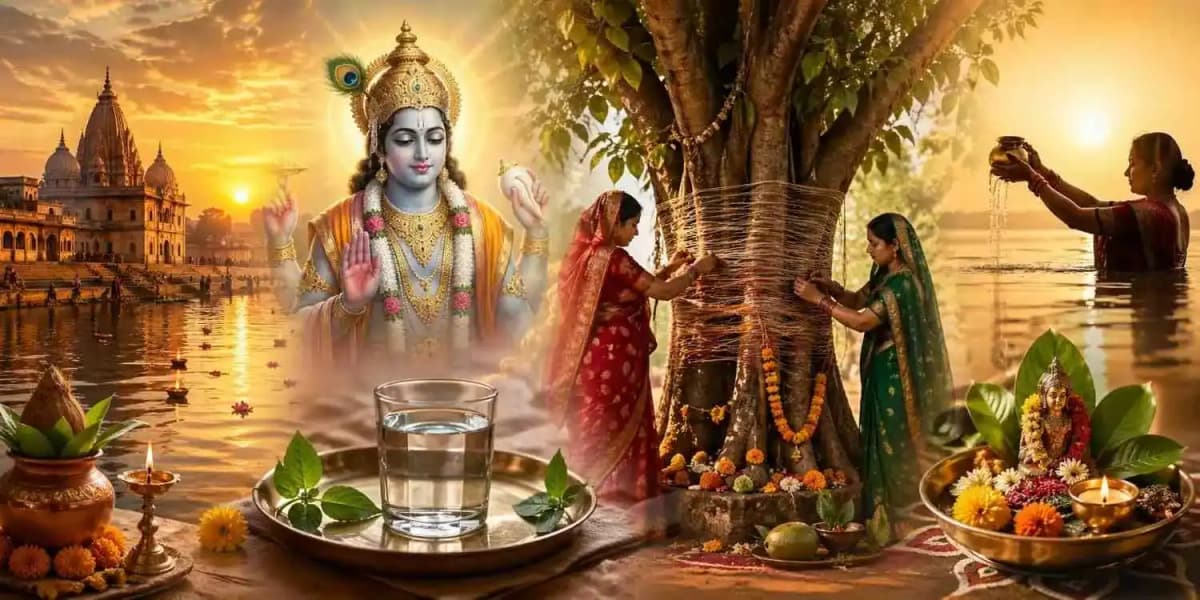
Tie the seven threads around the trunk while reciting "Vat-Mooley Stithitam Brahma, Vat-Madhye Janardana, Vat-Agre tu Shivam Vidyat, Savitri Vat-Samshrita."
Circumambulate (parikrama) the tree seven times — each circumambulation while chanting Savitri Mata's mantra and offering a few drops of water.
Offer the naivedya (fruits, sweets, panchamrit, betel) at the base of the tree.
Read the Savitri-Satyavan katha aloud — the Mahabharata Vana Parva chapter, or the simplified Vrat Katha.
Tie the rakshakar thread on your husband's wrist (if at home) or on your own wrist on his behalf.
Evening break-fast (after sunset)
Light a single ghee diya at the home altar. Offer the puja prasad.
AdvertisementTouch the husband's feet and seek his blessing — the classical pativrata gesture.
Eat the prasad together. Many traditions break the nirjala fast with mango (in season — May/June), watermelon, panchamrit and a small phalahari meal.
NRI apartment adaptations — when there is no banyan
Banyan trees are rare in apartment cities of the USA, UK, Canada, Australia and the UAE. Sanatana Dharma, ever practical, allows the following substitutions — endorsed by NRI Brahmin acharyas across diaspora temples:
A neighbourhood oak, fig, mulberry, ficus or sycamore: any large mature tree with a similar canopy. Approach with sankalpa: "I invoke the energy of the Vat Vriksha in this tree for the duration of my puja." Tie the seven threads, do parikrama.
A potted Ficus benjamina: a small ficus plant on the apartment balcony — the closest botanical relative of the banyan. Place at the puja altar; do parikrama 7 times around the pot.
A community Hindu temple: many NRI temples plant a banyan or ficus in their courtyard precisely for Vat Savitri. Visit BAPS (Robbinsville, Toronto, Neasden, Sydney, Abu Dhabi), Sri Venkateswara (Penn Hills, Helensburgh), Hindu Sabha Mississauga.
A symbolic banyan picture: frame a high-quality picture of a famous banyan (e.g., Adyar Banyan in Chennai, Pillalamarri in Telangana, the Great Banyan in Howrah). Place at the altar; do mental parikrama 7 times.
Online sankalpa: book a Vat Savitri seva at a major Indian banyan-shrine — for example Akshay Vat at Allahabad, Pillalamarri Vat near Hyderabad, Markandeya temple in Vatadhar Kerala. The seva is performed in your name on 27 May.
Vat Savitri vrat food and recipes
Pre-vrat sehri (before sunrise)
Banana + milk + dates + almonds smoothie.
Sweet-potato chaat with sendha namak.
Curd + jaggery + a piece of fruit.
Day-long fast
Strict (nirjala): no food, no water until sunset puja. Recommended only for healthy women without medical contraindications.
Fruit only: fresh fruits and water through the day.
Phalahara: fruits, milk, sabudana, paneer, makhana, ghee, sendha namak. No grains, salt, onion, garlic.
Break-fast (evening)
Mango: the iconic Vat Savitri break-fast in May/June — full-ripe Alphonso, Kesar, Banganapalli or Dasheri.
Watermelon and muskmelon.
Panchamrit + tulsi.
Sabudana kheer or sama-rice kheer.
Fresh poori with kaddu sabzi (some traditions break the fast with cooked food after the vrat-dakshina).
Singhara halwa, peda, or boondi laddu as the prasad sweet.
Mantras for Vat Savitri Vrat
Savitri Gayatri: Om Savitri-Devyai Vidmahe, Sahadharminyai Dhimahi, Tanno Savitri Prachodayat.
Vat Vriksha mantra: "Vat-Mooley Stithitam Brahma, Vat-Madhye Janardana, Vat-Agre tu Shivam Vidyat, Savitri Vat-Samshrita."
Yama mantra (request for boon of long life): "Yamaraja-Stva Mam Patiur, Aayur-Vridhim Karoti Cha."
Mahalakshmi Vichitra Vrata mantra: Om Mahalakshmyaicha Vidmahe, Vishnupatnyaicha Dhimahi.
Vishnu Sahasranama — for the day-long maha-vrat. See Vishnu Sahasranama — 1000 Names of Lord Vishnu.
Maha Mrityunjaya Mantra — invoking Lord Shiva for the husband's longevity. See Maha Mrityunjaya Mantra for Hindus.
Benefits of observing Vat Savitri Vrat
Long life of the husband — the supreme classical boon.
Marital harmony and renewal of love between spouses.
Removal of marital obstacles — career separations, health issues, in-law difficulties.
Family unity — particularly for blended families and step-relations.
Children's welfare — Savitri-Satyavan also bore 100 sons; the vrat covers progeny boons.
Removal of ‘ashubha’: the day-long fast purifies the household subtle field.
Inner strength: the women who keep this vrat report a notable rise in confidence and dharmic clarity over years.
Frequently asked questions about Vat Savitri Vrat 2026
When is Vat Savitri Vrat 2026?
Wednesday 27 May 2026 (Jyestha Amavasya — North Indian Purnimanta tradition). Maharashtra observes Vat Purnima on Sunday 14 June 2026.
Why are there two dates?
Because of the lunar calendar split: the Purnimanta tradition (most of North India + diaspora of those origins) places Jyestha Amavasya on 27 May; the Amanta tradition (Maharashtra, Karnataka, Goa) follows Jyestha Purnima on 14 June. Story, rituals and merit are identical.
Who should observe Vat Savitri Vrat?
Married women — for the long life and welfare of the husband and the family. Unmarried women may observe a partial vrat for the boon of a Satyavan-like husband.
Is the fast nirjala?
The strict observance is nirjala (without water). Health-permitting only — phalahara is fully accepted, especially for working women, pregnant women, the elderly and the unwell.
What if I cannot find a banyan tree near my apartment?
Use a substitute: a neighbourhood oak/fig/sycamore, a balcony Ficus benjamina, the courtyard tree of a Hindu temple, or a framed banyan picture. Sankalpa-substitution applies.
Can I do Vat Savitri Vrat in an office work day?
Yes — many NRI professionals do. Wake early for sankalpa, do morning puja at home, observe phalahara during the day, and do the seven-thread tying at the closest tree (or potted ficus) before evening.
What is the rakshakar thread?
A small white thread blessed during the puja and tied on the husband's wrist as a "raksha" (protection) for the year.
What food should I prepare for the family?
A satvik thali for the husband and family — pulav, paneer sabzi, kaddu, dal, raita, mango, prasad sweet. The family eats; the woman who fasts breaks her fast at sunset.
Can NRIs in the UAE / UK / USA observe Vat Savitri?
Yes — the tithi covers the daylight hours of 27 May 2026 in all these time zones. Observe per local sunrise.
Can a couple observe the vrat together?
Increasingly common — many NRI couples now observe Vat Savitri jointly, with the husband supporting the wife in the fast and helping with the puja.
Do widowed or divorced women observe Vat Savitri?
Some traditions exempt them; others say they may observe it for the welfare of children and family. Sanatana Dharma respects individual sankalpa.
Is there a global online Vat Savitri puja?
Yes — Akshay Vat (Allahabad), Pillalamarri Vat (Telangana), Markandeya Vat (Kerala), and major BAPS / Sri Venkateswara temples accept online Vat Savitri sankalpa.
Closing — the strength of one woman’s sankalpa
Vat Savitri Vrat is the day Sanatana Dharma reminds the world that one woman's dharmic resolve can pull a husband back from death itself. The fast is rigorous; the story is heart-stopping; the tree is ancient; the boon is real. On 27 May 2026, light the diya, tie the threads, recite the Savitri Gayatri, eat one ripe mango at sunset, touch your husband's feet, and feel the blessings of every wife who has walked this vrat for five thousand years.
Subhamastu. Subh Vat Savitri Vrat 2026. Akhand-saubhagyavati bhava.
Subscribe to HinduTone for monthly NRI vrat and festival guides.
May 2026 cluster — also on HinduTone
Part of HinduTone's Hindu Festivals May 2026 cluster. Read alongside: Hindu Festivals in May 2026 — complete vrats & puja guide · Adhik Maas 2026 — Purushottam Maas dates & rules · Ganga Dussehra 2026 — story, muhurat & home puja vidhi · Buddha Purnima 2026 — significance, history, rituals.
You might also like
Top 5 Festivals in Jyestha Masam 2026 and Their Profound Spiritual Secrets: Nirjala Ekadashi, Vat Savitri Vrat & More

Hindu Festivals in May & June 2026: Ganga Saptami, Sita Navami, Buddha Purnima, Ganga Dussehra, Nirjala Ekadashi — Complete Vaishakha–Jyeshtha Guide
Hindu Vrat Guide 2026 for Busy Professionals Abroad: Ekadashi, Pradosh, Shivratri, Karva Chauth & Sankashti Calendar with Office-Friendly Recipes