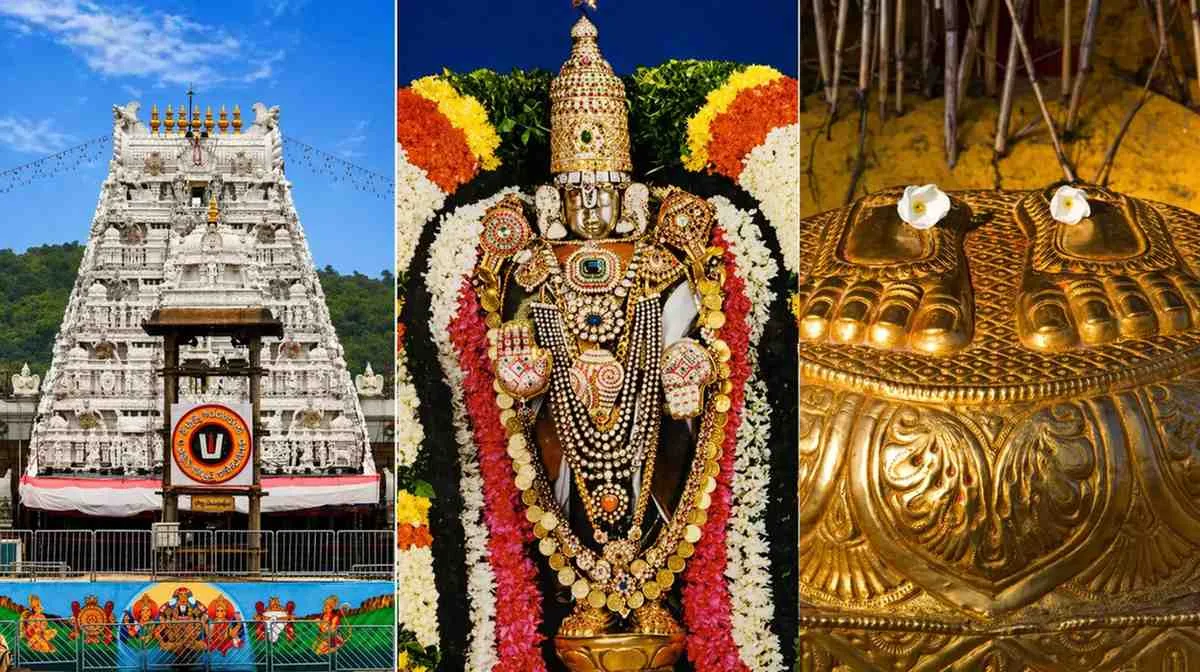
Tirumala Brahmotsavam 2026: Complete 9-Day Vahana Seva Schedule, Garuda Vahanam Darshan & NRI Booking Guide
Complete Tirumala Brahmotsavam 2026 guide — 9-day vahana seva schedule (Sept 17-25), Garuda Vahanam, Kalyanotsavam, Dhwajarohanam, Avabhrutha Snanam, NRI booking strategy, other Brahmotsavams, FAQs.
Complete Tirumala Brahmotsavam 2026 guide — 9-day vahana seva schedule (Sept 17-25), Garuda Vahanam, Kalyanotsavam, Dhwajarohanam, Avabhrutha Snanam, NRI booking strategy, other Brahmotsavams, FAQs.
Of all the temple festivals in India, none surpasses the Tirumala Brahmotsavam — the 9-day annual celebration of Lord Sri Venkateswara at the Tirumala Tirupati hill temple. For 1,500+ years, this festival has been the spiritual high-water mark of the Tirumala calendar, drawing 2-3 million devotees during its 9 days. Each day brings a different vahana seva (chariot procession), each evening features a different celestial mount, and the entire festival culminates in the most photographed moment in all Hindu festivals — the Garuda Vahanam.
For NRI Hindu families planning a once-in-a-lifetime Tirumala visit, Brahmotsavam is the supreme window. The combined energy of the daily vahana sevas, the sacred Dhwajarohanam (flag-raising), the Kalyanotsavam (Vishnu-Lakshmi divine wedding), the Avabhrutha Snanam (closing holy bath), and the presence of millions of fellow devotees creates a spiritual intensity unmatched at any other time of year.
This complete HinduTone guide covers the 2026 Brahmotsavam dates, the day-by-day vahana seva schedule, the spiritual significance of each vahana, the famous Garuda Vahanam, booking strategy for darshan and accommodation, what to expect at Tirumala during Brahmotsavam, NRI-specific planning, related celebrations at other major Vishnu temples, and frequently asked questions.
What is Tirumala Brahmotsavam?
Brahmotsavam means "the festival ordained by Lord Brahma". According to tradition, Lord Brahma himself instituted this 9-day annual celebration at Tirumala to commemorate the manifestation of Lord Vishnu as Sri Venkateswara. The festival has been observed continuously at Tirumala since the 8th century CE, with formal records dating back to the Pallava and Chola eras.
The festival follows the Hindu lunar calendar — specifically, Brahmotsavam begins when Sun enters the Kanya rasi (Virgo zodiac) in the month of Bhadrapada. The 9 days span Tula Sankranti — the transition from Kanya to Tula (Libra). For 2026, this corresponds to the period of approximately September 17 to October 5, 2026 (TTD will publish the exact dates 4-6 months before the festival; some flexibility in start date is determined by Tirumala Sthala Purohit).
Brahmotsavam 2026 Dates (Tentative — Confirm with TTD)
- Brahmotsavam start (Day 1 Dhwajarohanam): ~September 17, 2026 (Bhadrapada Krishna Pratipada)
- Garuda Vahanam (Day 4 evening): ~September 20, 2026 (the most-attended single evening)
- Brahmotsavam end (Day 9 Avabhrutha Snanam): ~September 25, 2026
- Tula Sankranti: Approximately October 17, 2026 (Sun enters Libra)
- Note: TTD publishes the official festival schedule approximately 4-6 months before the start. Always confirm exact dates via the TTD website or official social media (X/Twitter, Facebook).
⚠️ Booking caution: Brahmotsavam is the single most concentrated booking period of the TTD calendar. Standard ₹300 darshan and accommodation slots fill within minutes of release. Plan 90+ days in advance.
Day-by-Day 9-Day Vahana Seva Schedule
Each day of Brahmotsavam features a unique morning and evening vahana procession. Below is the traditional schedule. The morning processions (Mahabhishekam and ratham seva) typically run from 6:00 AM to 11:00 AM. The evening processions (the famous vahana sevas) run from 5:00 PM to 8:00 PM, drawing the largest crowds.
Day 1: Pedda Sesha Vahanam (morning) / Chinna Sesha Vahanam (evening)
The Lord rides the great Adisesha — the celestial serpent on which He reclines in cosmic sleep. The Sesha Vahanam represents primordial creation and the cosmic foundation. The Pedda (large) Sesha is mounted in the morning processions; the Chinna (smaller) Sesha in the evening Garuda Vahanam pre-rituals.
Spiritual significance: Adisesha is Lord Vishnu's eternal vehicle and devotee — the most intimate of all His connections. Walking with the Lord on Adisesha is considered the most ancient form of vahana seva.
Day 2: Hamsa Vahanam (morning) / Mutyapu Pandiri Vahanam (evening)
Day 2 morning brings Hamsa Vahanam — the Lord rides a swan. The swan represents Saraswati's grace, the discrimination between true and false (the swan that can separate milk from water). Evening features the famous pearl-tower vahanam with Hamsa decorations.
Spiritual significance: The Hamsa form is one of Lord Vishnu's 10 avatars. The discrimination-bird symbolizes the devotee's ability to choose dharma over adharma.
Day 3: Simha Vahanam (morning) / Muthyapu Pallaki / Kalpavruksha Vahanam (evening)
Lord Vishnu rides a lion — symbol of valor and divine power. This is one of the most photographed vahanams. Evening sees the wish-fulfilling tree (Kalpavruksha) decorated vahanam, where every devotee's prayer is believed to be heard.
Spiritual significance: The lion mount represents Vishnu's fierce Narasimha avatar — the form that protects the devout from demons. Simha is also Garuda's rival, and the Lord rides both during Brahmotsavam.
Day 4: Sarvabhupala Vahanam (morning) / Garuda Vahanam (evening)
Day 4 morning: Lord rides the Sarvabhupala (king of all kings) vahanam — bedecked with regal ornaments. EVENING: The most awaited moment of the entire 9-day festival — Garuda Vahanam. Lord Sri Venkateswara rides Garuda, the great eagle, surrounded by an ecstatic crowd of 2 million+ devotees.
Spiritual significance: Garuda Vahanam is the supreme moment. Devotees from every continent specifically travel to Tirumala for this single evening procession. The Lord on Garuda represents divine power in flight — the cosmic deity bestowing grace from above.
Day 5: Hanumanta Vahanam (morning) / Gaja Vahanam / Swarna Ratham (evening)
Lord rides Hanuman — emphasizing the eternal connection between Vishnu (Ram-incarnation) and his greatest devotee. In the evening, the Lord rides on Gaja Vahanam (elephant) and the Swarna Ratham (golden chariot) — symbolizing royal abundance.
Spiritual significance: The Hanumanta Vahanam celebrates the devotee-Lord relationship at its purest. The Gaja represents royal authority and abundance — the Lord as cosmic king.
Day 6: Surya Prabha Vahanam (morning) / Chandra Prabha Vahanam (evening)
Day 6 morning: Lord rides the Sun-chariot. Evening: Lord rides the Moon-chariot. These are sun-flame and moon-glow decorated vahanams — the most visually spectacular of the entire festival.
Spiritual significance: Surya and Chandra represent the duality of cosmic creation — heat and cool, masculine and feminine, day and night. The Lord transcends both polarities.
Day 7: Ashwa Vahanam (morning) / Anjaneya Vahanam (evening)
Lord rides Ashva (horse) symbolizing speed of divine response and royal might. Evening: Anjaneya (Hanuman) Vahanam — another beloved moment.
Spiritual significance: The Ashva (horse) is the vehicle of cosmic dharma, present in the legendary Ashvamedha Yagna (horse sacrifice). The horse on Brahmotsavam day 7 symbolizes the Lord's authority to bestow dharma upon all worlds.
Day 8: Pushpa Pallaki Vahanam (morning) / Chakra Snanam (evening)
Lord is carried in a flower-bedecked palanquin — Pushpa Pallaki. Evening: Chakra Snanam — the sacred bath of the Sudarshana Chakra (Vishnu's discus). This is the symbolic conclusion of the festival's active processions.
Spiritual significance: Pushpa Pallaki represents the gentlest form of vahana seva — Vishnu carried by His devotees among flowers. The Chakra Snanam purifies the entire festival period.
Day 9: Dhwajarohanam reversal / Brahmotsavam closing (morning) / Avabhrutha Snanam (evening)
Day 9 marks the closing rituals. The Dhwaja (flag) that was raised on Day 1 is lowered. The Avabhrutha Snanam — the concluding holy bath — is performed at the temple tank. The festival officially ends.
Spiritual significance: The Avabhrutha Snanam represents the completion and purification. All accumulated festival blessings flow into this final ritual bath.
The Garuda Vahanam — The Supreme Moment
Of all the vahana sevas, the Garuda Vahanam on Day 4 evening is the most spiritually charged and most widely attended moment of the entire Hindu calendar. Lord Sri Venkateswara is mounted on Garuda — the divine eagle that is His eternal vehicle — and proceeded through the streets of Tirumala in a procession witnessed by 2-3 million devotees on this single evening.
Why Garuda Vahanam is so special:
- Garuda is Lord Vishnu's eternal vehicle — the most intimate of all the vahanas
- The Lord's riding-of-Garuda is a celestial moment that all Hindu lore considers transformative
- The 2-3 million-strong crowd creates a spiritual energy that radiates outward across the Tirumala hills
- TTD broadcasts the Garuda Vahanam live worldwide; NRI families simultaneously observe via TV/YouTube
- Many devotees take a 9-day Brahmotsavam vrat (fast/discipline) leading up to this single moment
- The mantra "Govinda Govinda" rises in unison from millions — the loudest collective prayer in any Hindu festival
Tradition holds that even a single sight of the Lord on Garuda during Brahmotsavam — whether in person at Tirumala or via livestream worldwide — bestows the equivalent of completing 100 ekadashi vrats.
Pre-Brahmotsavam Rituals
Ankurarpanam (Day -1)
The day before Day 1 of Brahmotsavam, sacred seeds (rice, wheat, mustard) are sown in earthen pots — symbolizing the bountiful harvest. Brahmins recite specific Brahmotsavam mantras. These pots are kept growing throughout the 9 days, and the green sprouts are distributed at the festival close.
Dhwajarohanam (Day 1)
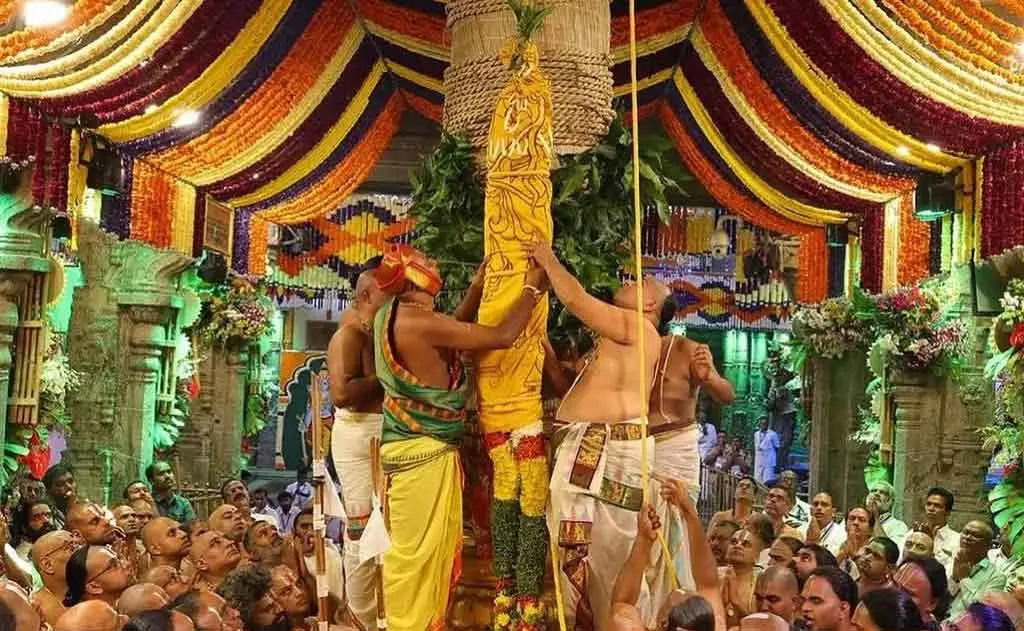
The festival officially begins with the raising of the temple flag (Dhwaja) — bearing the symbol of Garuda. The flag is hoisted on a specially-erected pole (Dhwajasthambham) and remains aloft for 9 days. This is the ceremonial declaration that "the Brahmotsavam has begun" — and Lord Brahma himself is believed to descend to participate.
Kalyanotsavam (Day 3)
The divine wedding of Sri Venkateswara with Sridevi (Lakshmi) and Bhudevi is reenacted. This 3-hour ceremony is one of the most cherished moments — devotees who book this seva receive the divine couple's direct blessing.
The Avabhrutha Snanam — Festival Closing
On Day 9 (the final day), the Avabhrutha Snanam (concluding holy bath) is performed at the sacred Swami Pushkarini temple tank. The Lord's utsava murti (festival idol) is bathed with holy waters from 7 sacred rivers — Ganga, Yamuna, Saraswati, Godavari, Krishna, Narmada, and Cauvery — symbolically uniting all of India's sacred waters in the closing ritual.
This bath represents the completion and purification of all 9 days of festival energies. Devotees who participate at the Pushkarini receive the spiritually-charged bath waters as prasad. The festival officially ends with this ritual, and Lord Brahma is believed to return to Brahmaloka with the merit of the entire 9-day celebration.
Booking Strategy for Brahmotsavam 2026
Brahmotsavam attracts 2-3 million pilgrims across 9 days. Daily Tirumala crowd swells from the normal 50,000 to 250,000-400,000. Bookings are intensely competitive. Use this strategy:
Timeline
- June 2026: Begin monitoring TTD official social media for Brahmotsavam 2026 announcement
- July 2026: TTD typically publishes the official 9-day schedule
- August 2026: Book Tirumala accommodation (Padmavathi/Venkateswara/Varahaswami Guest Houses) for at least 3-4 nights
- August 2026: Book Sri Vari/Special Entry Darshan tickets for the day(s) you want to be at Tirumala
- September 2026: Final preparations — fasting practice, mantra-chanting, travel logistics
- Brahmotsavam dates: Plan to arrive 1 day before your darshan day, depart 1 day after
Booking Combinations
- Garuda Vahanam (Day 4 — Sept 20, 2026): Most-coveted booking. Open quota typically 60-90 days before, sells out within 5-15 minutes.
- Kalyanotsavam (Day 3): Bookable as a special seva. Limited slots. Family-recommended.
- Avabhrutha Snanam (Day 9): Pushkarini ritual; bookable separately for the closing bath.
- Multi-day pass: TTD occasionally offers Brahmotsavam multi-day darshan packages — check for these.
- NRI special: Premium booking categories exist for international devotees with passport/OCI.
NRI Brahmotsavam Planning
Brahmotsavam is the supreme NRI Tirumala yatra opportunity. International planning considerations:
- Book international flights to Hyderabad (HYD) or Bangalore (BLR) — Tirupati airport handles less international traffic
- Plan for 5-7 day total trip — arrive 2 days before your festival date, depart 2 days after
- During Brahmotsavam, Tirupati hotels and Tirumala accommodation see 10× surge pricing — book in August
- Apply for OCI/Aadhaar verification before travel — required for TTD booking
- Consider combined family yatra with multiple generations — Brahmotsavam is the ideal occasion
- Plan for jet lag — arrive 24 hours before your darshan/vahana seva ticket time
- Bring traditional Hindu attire for the festival — saree, dhoti, formal wear
- Carry warm clothing for evening vahana sevas (temperature drops after sunset on the hill)
- Inform your TTD account holder about the booking — coordinate as a family
- Plan for the Pushkarini bath on the closing day — bring small towel for prasad water collection
Other Major Brahmotsavams Across India
While Tirumala Brahmotsavam is supreme, several major Vishnu temples observe their own annual Brahmotsavam celebrations:
- Sri Ranganathaswamy Temple, Srirangam: Maha Brahmotsavam in March-April — one of the most elaborate annual festivals in India.
- Sri Padmanabhaswamy Temple, Thiruvananthapuram: Painkuni festival (Brahmotsavam equivalent) in March-April — 10 days with daily vahana sevas.
- Sri Jagannath Temple, Puri: Rath Yatra (June-July) is Jagannath's Brahmotsavam-equivalent — most famous of all chariot festivals.
- Sri Vitthala Mandir, Pandharpur: Ashada Ekadashi Yatra is the major annual celebration.
- Sri Venkateswara temples worldwide: NRI temples (BAPS, ISKCON, Sri Venkateswara temples) conduct mini-Brahmotsavams locally during Tirumala's festival week.
Watching Brahmotsavam from Home (NRI/Domestic)
For devotees who cannot travel to Tirumala, the Brahmotsavam viewing experience has been transformed by technology:
- TTD's official YouTube channel broadcasts all 9 days live
- SVBC (Sri Venkateswara Bhakti Channel) provides 24-hour Tirumala broadcasts
- Major Telugu/Tamil regional TV channels cover Garuda Vahanam live
- Social media (Twitter/X, Facebook, Instagram) provides real-time devotee experiences
- Many NRI Sri Vaishnava temples organize community viewing parties on Garuda Vahanam evening
- Set up a home altar specifically for Brahmotsavam — daily flower offerings, ghee diyas, special prasad
- Take 1-2 days of vrat (Day 4 and Day 9 ideal)
- Chant Vishnu Sahasranama on Day 1 (Dhwajarohanam) and Day 9 (Avabhrutha)
- Make daanam (charity) — distribute meals or donate to temple/charity
Frequently Asked Questions (FAQ)
1. When exactly is Tirumala Brahmotsavam 2026?
Tentatively September 17-25, 2026. TTD will confirm exact dates via official channels typically 4-6 months in advance.
2. What is the most famous moment of Brahmotsavam?
Garuda Vahanam on Day 4 evening (approximately September 20, 2026). 2-3 million devotees attend this single procession.
3. Can I attend just one day or do I need to come for all 9?
Single-day visits are common. Each vahana seva is meaningful in itself. Garuda Vahanam (Day 4 evening) is the most popular single-day visit.
4. How early do I need to book accommodation for Brahmotsavam?
At least 60-90 days in advance. Premium accommodations (Padmavathi, Venkateswara Guest Houses) sell out within 30 minutes of opening.
5. Is the Garuda Vahanam darshan free?
Sarvadarshan (free) tickets are available for Garuda Vahanam, but the crowd is enormous — expect 10-18 hour wait. Better: book Sri Vari/Special Entry darshan or NRI darshan in advance.
6. Can NRIs participate in Kalyanotsavam during Brahmotsavam?
Yes. Kalyanotsavam is bookable as a seva (₹1,500). NRI devotees can book this and participate as a family. Combined with Brahmotsavam, this is one of the most spiritually rewarding NRI yatras possible.
7. What is the difference between Brahmotsavam and the daily Tirumala worship?
Daily worship at Tirumala includes Suprabhatam, Tomala Seva, Archana, and Kalyanotsavam. These continue year-round. Brahmotsavam is the 9-day annual celebration ON TOP OF the daily worship — with additional vahana sevas, special processions, the Dhwajarohanam, and the Avabhrutha Snanam.
8. Can pregnant women or elderly devotees attend Brahmotsavam?
Yes — many do. The crowds are intense, so plan with care. Avoid Garuda Vahanam evening if mobility is limited. Book Senior Citizen/Divyangjan special darshan for ease of access. Have water, light snacks, and medication on hand.
9. Does TTD provide special transport during Brahmotsavam?
Yes. TTD operates additional bus services from Tirupati to Tirumala during Brahmotsavam — frequency is enhanced. The Alipiri foothill checkpoint becomes congested; arrive 2-3 hours before your scheduled darshan time.
10. Can I watch Brahmotsavam from another city or country?
Yes — TTD's official YouTube channel and SVBC TV broadcast all 9 days live. Most NRI Vaishnava temples organize community viewing on Garuda Vahanam day. The spiritual benefit of viewing with devotion is widely accepted.
Conclusion
The Tirumala Brahmotsavam is the supreme annual celebration of Lord Sri Venkateswara — 9 days of vahana sevas, divine processions, the Garuda Vahanam, the Dhwajarohanam, the Kalyanotsavam, and the closing Avabhrutha Snanam. For 1,500+ years, this festival has been the spiritual high-water mark of the Hindu calendar at India's most-visited temple.
For NRI families planning their once-in-a-lifetime Tirumala yatra, Brahmotsavam 2026 (September 17-25, tentative) is the supreme window. Plan early. Book in August. Arrive with reverence. Receive the Lord's blessing through the 9 days of vahana sevas. Then carry that blessing home for your entire family.
May Lord Sri Venkateswara bless your Brahmotsavam yatra with the supreme darshan and the eternal residence in His celestial abode. 🙏 Om Namo Venkateshaya! Govinda Govinda!
Are you planning a Tirumala visit for Brahmotsavam 2026? Or watching from home? Share your experience and questions in the comments below. If this guide helped you plan, please share with family and friends planning their yatra. Subscribe to hindutone.com for more temple and festival guides. 🙏 Jai Srinivasa! Govinda!
Related Reading on HinduTone
- Vaikuntha Ekadashi 2026 at Tirumala: Sorgavasal Darshan Complete Guide
- Tirumala Darshan Booking Process 2026: TTD Online Step-by-Step
- Tirumala Accommodation Booking Guide 2026
- TTD Tirupati Laddu Prasadam Complete Guide 2026
- 12 Jyotirlingas of Lord Shiva: Complete Pilgrimage Guide
- Importance of Monday in Hinduism: Somvar Vrat & Shiva
- Importance of Tuesday in Hinduism: Mangalwar Vrat & Hanuman
- Hanuman Chalisa: Complete 40 Verses with Meaning
You might also like
Tirumala Tirupati Govindaraja Swamy Brahmotsavam 2026: 9-Day Festival Schedule, Vahana Sevas & Rituals
Tirumala Darshan Booking Process 2026: Step-by-Step Complete Guide | TTD Online Booking
Vaikuntha Ekadashi 2026 at Tirumala: Sorgavasal Darshan Complete Guide, Fasting, Mantras & NRI Planning