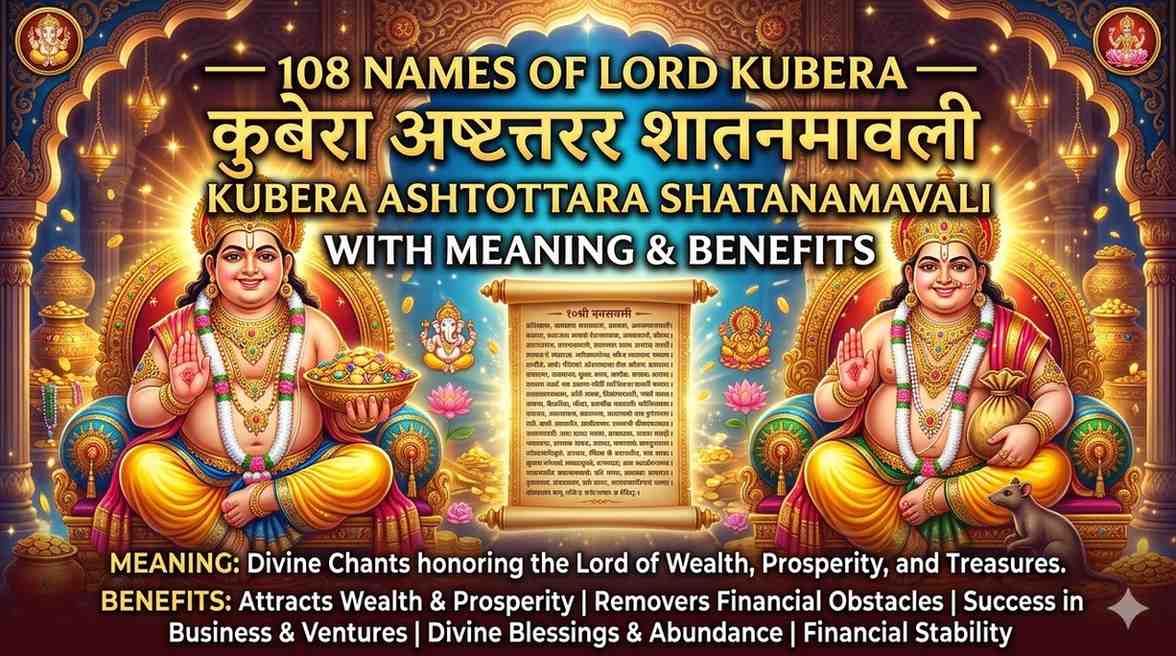
108 Names of Lord Kubera — Kubera Ashtottara Shatanamavali with Meaning & Benefits
"Om Hreem Shreem Hreem Kuberaya Namah — Dhan Dhan Dhan Kuru Kuru Swaha" Sri Kubera Ashtottara Shatanamavali — the 108 sacred names of Lord Kubera — is one of the most potent wealth-attracting scriptures in all of Hinduism. Each of the 108 divine names is a window into a different facet of Lord Kubera's infinite power: his role as the divine treasurer of all the universe's wealth, the king of the Yakshas, the lord of all nine cosmic treasures (Nava Nidhi), the friend of Lord Shiva, and the regent of the North direction.
"Om Hreem Shreem Hreem Kuberaya Namah — Dhan Dhan Dhan Kuru Kuru Swaha"
Sri Kubera Ashtottara Shatanamavali — the 108 sacred names of Lord Kubera — is one of the most potent wealth-attracting scriptures in all of Hinduism. Each of the 108 divine names is a window into a different facet of Lord Kubera's infinite power: his role as the divine treasurer of all the universe's wealth, the king of the Yakshas, the lord of all nine cosmic treasures (Nava Nidhi), the friend of Lord Shiva, and the regent of the North direction.
The Sri Kubera Ashtottara Shatanamavali is a sacred scripture listing the 108 divine names of Lord Kubera, the Hindu God of wealth and prosperity. Each name highlights his qualities, powers, and divine attributes. Lord Kubera is a deity that the three great religions of India — Hinduism, Buddhism, and Jainism — all venerate as their own, making him one of the most universally worshipped deities of the Indian subcontinent.
In this complete HinduTone guide, you will find all 108 names in Sanskrit (Devanagari), transliteration (IAST romanization), and English meaning — along with the spiritual significance behind the number 108, detailed benefits of chanting, best days and times, puja vidhi, and the most powerful Kubera mantras.
[image: 🌟] Who is Lord Kubera? — Identity, Form & Divine Role
Lord Kubera is the "treasurer of the gods" and the "king of the Yakshas" — a true representation of wealth, prosperity, and glory. Also known as Kuber, Kuvera, Kuberan, and Dhanpati, he is worshipped as the God of wealth by Hindus.
Divine Appearance of Lord Kubera
Lord Kubera is depicted with a distinctive form that embodies his divine role:
- Complexion: Golden or fair — reflecting his mastery over gold and treasures
- Body: Pot-bellied, stout, and short — symbolic of fullness, abundance, and material satisfaction
- Three legs and eight teeth — a unique divine form mentioned in ancient texts
- One eye: According to some traditions, one eye is divine and one is mortal — representing his ability to see both the material and spiritual planes
- Crown: Bejeweled with all nine Nava Nidhis (cosmic treasures)
- Hands: Carries a money bag (Nidhipot), a mace (gada), a pomegranate, and the divine Amrita Kalasha in different depictions
- Vehicle (Vahana): A man (Nara) or sometimes a mongoose spitting gold coins
- Direction: Guardian of the North (Uttara) — the direction of prosperity and spiritual growth
Kubera in Sacred Scriptures
Lord Kubera appears prominently in many ancient texts:
- Atharva Veda — contains early mentions of Kubera as a spirit-ruler
- Mahabharata — describes Kubera's magnificent city of Alaka on Mount Meru
- Ramayana — his golden city of Lanka was originally built for Kubera before Ravana (his half-brother) conquered it
- Vishnu Purana — describes the churning of the ocean and Kubera's cosmic role
- Yaksha Prashna (Mahabharata) — the famous philosophical dialogue involving the Yaksha tradition Kubera presides over
[image: 🔢] Why 108 Names? — The Sacred Mathematics
The number 108 holds extraordinary significance across Hindu, Buddhist, and Jain traditions:
[image: 📿] Kubera Ashtottara — How & When to Chant
Best Days for Kubera Ashtottara Chanting
Best Time of Day
Puja Setup for Kubera Ashtottara Chanting
Items Needed:
- Lord Kubera idol, image, or Kubera Yantra
- Yellow or gold-colored cloth for the altar
- Yellow flowers (most sacred to Kubera) — marigold, yellow chrysanthemum
- Ghee lamp (deepam) or sesame oil lamp
- Gold or silver coins placed before the idol
- Yellow thread and yellow sandalwood paste
- A Sphatik mala (crystal rosary) or gold-colored mala with 108 beads
- Incense — sandalwood or saffron
Facing Direction: Always face North or Northeast while chanting the Kubera Ashtottara — Kubera is the Lord and Guardian of the North.
Chanting Method (Japa Vidhi)
- Take a bath and wear clean clothes — preferably yellow or gold
- Sit on a yellow or gold cloth (asana) facing North
- Light the diya and incense
- Place gold/silver coins before Kubera idol and resolve your intention
- Take the 108-bead mala in your right hand
- Begin with the invocation mantra (below)
- Chant each of the 108 names, moving one bead per name
- Complete the full circuit without interruption
- Conclude with the Kubera Gayatri Mantra (below)
- Offer flowers and prasad (yellow sweets, banana, coconut)
[image: 📖] Sri Kubera Ashtottara Shatanamavali — All 108 Names
Begin the recitation with this invocation:
"Om Asya Sri Kubera Ashtottara Shatanamavali Stotrasya, Shiva Rishi, Anushtup Chandah, Kubero Devata, Dhana Prapti Arthe Jape Viniyogah"
(Meaning: "For this Sri Kubera Ashtottara Shatanamavali, Shiva is the seer, Anushtup is the meter, Kubera is the deity, and the purpose is to recite for attainment of wealth.")
Names 1–10: The Supreme Titles
Names 11–20: The Nine Cosmic Treasures (Nava Nidhi)
Names 21–30: The Royal Titles
Names 31–40: The Cosmic Commander
Names 41–50: The Celestial King
Names 51–60: The Radiant Sovereign
Names 61–70: The Divine Protector
Names 71–80: The Cosmic Treasury
Names 81–90: The Mountain-Dweller
Names 91–100: The Cosmic Friend
Names 101–108: The Final Eight — The Most Powerful Names
Concluding Prayer (Phala Shruti)
After chanting all 108 names, conclude with this prayer:
"Iti Sri Kubera Ashtottara Shatanamavali Sampoornam" (Thus is completed the sacred Kubera Ashtottara Shatanamavali.)
"Om Yaksha Rajaya Vidmahe, Alakadhishaya Dhimahi, Tanno Kubera Prachodayat" (Kubera Gayatri — recite 3 times to seal and energize the chanting.)
"Kuberaya Vaishravanaya Dhanadhanyadhipataye, Dhanadhanyadi Samriddhim Me Dehi Tapaya Swaha" (The great Kubera wealth-granting mantra — recite once for final blessing.)
[image: 🔱] Most Powerful Kubera Mantras — Chant for Wealth
1. Kubera Maha Mantra (Supreme Wealth Mantra)
"Om Hreem Shreem Hreem Kuberaya Namah" Chant 108 times daily for steady accumulation of wealth and financial stability.
2. Kubera Dhana Prapti Mantra
"Om Yaksha Rajaya Vidmahe, Vaishravanaya Dhimahi, Tanno Kubera Prachodayat" The Kubera Gayatri — chant for divine inspiration for wealth creation.
3. Kubera Ashta Lakshmi Mantra
"Om Shreem Om Hreem Shreem Hreem Kleem Shreem Kleem Vitteshvaraya Namah" For the combined blessings of Kubera and Ashta Lakshmi — the ultimate wealth formula.
4. Kubera Dhana Vrishti Mantra (Rain of Wealth)
"Om Yaksha Kuberaya Vaishravanaya, Dhanadhanyadhipataye, Dhanadhanyadi Samriddhim Me Dehi Tapaya Swaha, Sri Suvarna Vrishti Kuru Me Grhe Sri Kubera, Mahalakshmi Haripriyal" The most expansive Kubera mantra — chanted for a literal "rain of gold" into the home.
5. Kubera Beej Mantra
"Om Shreem Hreem Kleem Shreem Kleem Vitteshvaraya Namah" The seed syllable mantra — most potent for energizing a Kubera Yantra.
[image: 🌺] Benefits of Chanting Kubera Ashtottara Shatanamavali
Chanting the Sri Kubera Ashtottara Shatanamavali regularly is believed to attract wealth, abundance, and stability in life, while also removing obstacles related to finance and prosperity.
Here is the full spectrum of blessings received through sincere, regular chanting:
Wealth & Financial Benefits
Spiritual & Personal Benefits
[image: 🏛️] Major Lord Kubera Temples in India
Visiting these sacred Kubera shrines while chanting the Ashtottara amplifies the spiritual blessings exponentially:
[image: 🙏] The Tirupati Connection: One of the most beloved stories in Hindu mythology tells how Lord Venkateswara (Vishnu) took a massive loan from Lord Kubera for his wedding with Goddess Padmavathi. Devotees' donations to the Tirupati temple are considered repayments of this divine loan — making Tirupati the richest temple in the world and Lord Kubera's greatest divine creditor!
[image: 🪬] Kubera Yantra — The Geometric Form of Divine Wealth
The Kubera Yantra is a sacred geometric diagram that serves as the visual and energetic representation of Lord Kubera's divine presence. When energized through mantras and installed in a home or business, it continuously radiates wealth-attracting energy.
How to Use the Kubera Yantra
- Placement: Install on the North wall or North corner of your home or office — never on the South wall
- Material: Copper or gold-plated Yantra is most potent; printed paper Yantra is also effective
- Energizing: On a Friday or Dhanteras, perform Panchamrit Abhishekam, apply kumkum and sandal paste, and chant the Kubera Ashtottara 3 times
- Daily Worship: Light a diya before it daily and chant "Om Hreem Shreem Hreem Kuberaya Namah" 108 times
- Placement Level: Always at eye level or higher — never on the floor
The Numbers on the Kubera Yantra
The Kubera Yantra contains a magic square of 9 numbers arranged in 3×3 grid where every row, column, and diagonal adds up to the same number:
Each row, column, and diagonal sums to 72 — a sacred number in Kubera numerology representing the fullness of his divine treasury.
[image: ❓] Frequently Asked Questions — Kubera Ashtottara Shatanamavali
Q1. What is Kubera Ashtottara Shatanamavali? The Sri Kubera Ashtottara Shatanamavali is a sacred scripture listing the 108 divine names of Lord Kubera, the Hindu God of wealth and prosperity. Each name highlights his qualities, powers, and divine attributes.
Q2. When is the best time to chant Kubera Ashtottara? The most auspicious times are during Brahma Muhurta (4:30–5:30 AM), Pradosh Kaal (dusk), on Fridays and Thursdays, on Dhanteras and Diwali night, and during the Kartik month (October–November). The Ashtottara can also be chanted daily at any fixed time with consistent devotion.
Q3. How many times should I chant the Kubera Ashtottara? Chanting the 108 names regularly attracts wealth, abundance, and stability while removing obstacles related to finance and prosperity. For maximum benefit, chant the complete Ashtottara once or three times daily. On special occasions like Dhanteras and Diwali, chanting it 11 times is supremely auspicious.
Q4. Can women chant Kubera Ashtottara? Yes, absolutely. There is no restriction. Women, men, and children of all ages can chant the Kubera Ashtottara with full devotion and receive its blessings completely.
Q5. Which direction should I face while chanting Kubera Ashtottara? Always face North (Kubera's direction) or Northeast while chanting. Place the Kubera idol or Yantra on the North wall of your puja room for maximum benefit.
Q6. Can Kubera Ashtottara be chanted without a specific ritual? Yes. While the full puja vidhi amplifies the benefits, sincere chanting of the 108 names with devotion, even without formal ritual, bestows Kubera's blessings. The most important factor is regularity and faith.
Q7. What mala (rosary) should I use for Kubera Ashtottara? A Sphatik (crystal quartz) mala is ideal for Kubera mantra chanting as crystal represents purity and amplifies the energy of wealth mantras. A gold-colored mala or Tulsi mala are also acceptable.
Q8. What is the difference between Kubera Ashtottara and Kubera Sahasranama? The Kubera Ashtottara has 108 names and is suitable for daily chanting (approximately 10–15 minutes). The Kubera Sahasranama has 1,000 names and is a more elaborate scripture for special occasions, pujas, and advanced practitioners.
Q9. Is there a specific flower for Lord Kubera puja? Yellow flowers — particularly yellow marigold and yellow chrysanthemum — are most sacred to Lord Kubera. Yellow is his divine color, representing gold, wealth, and auspiciousness. Lotus flowers are also deeply associated with him.
Q10. On which festivals should Kubera Ashtottara be chanted for maximum benefit? Lord Kubera is worshipped especially on Dhanteras and Sharad Purnima — these are the two most powerful days for Kubera worship. Chanting the full Ashtottara on these days, along with Diwali night, is considered extraordinarily meritorious.
[image: 🙏] Closing Prayer — May Kubera's Abundance Flow to You
The 108 sacred names of Lord Kubera are not merely a scripture — they are a living divine conversation with the cosmic treasurer of the universe. Every name you chant is a key that opens a vault; every name you know deepens your connection with the deity who holds the keys to abundance itself.
Lord Kubera is the "treasurer of the gods" and the "king of the yaksha" — a true representation of wealth, prosperity, and glory. And yet, the deepest teaching of Kubera worship is this: he who truly knows Kubera's names knows that wealth is not the goal — it is the fruit of living righteously, giving generously, and worshipping devotedly.
May the 108 names of Lord Kubera fill your home with golden light. May your treasury overflow with his nine divine Nidhis. May every sincere prayer you offer reach the North of Mount Meru. May Lord Kubera — friend of Shiva, king of Yakshas, lord of all treasures — smile upon you.
"Om Yaksha Rajaya Vidmahe, Alakadhishaya Dhimahi, Tanno Kubera Prachodayat"
Om Kuberaya Namah! Shubham Bhavatu!
Published by HinduTone — Your complete guide to Hindu festivals, rituals, mantras, and spiritual living.
Print this article, bookmark it, and use it for your daily Kubera puja. Share with family and friends who seek prosperity and abundance through devotion
You might also like

Hanuman Chalisa: Complete Meaning, Scientific & Spiritual Benefits, and a 30-Day Daily Practice for NRIs
Wednesday Rituals in Hinduism: Must-Perform Budhvar Puja, Vrats & Temples for Hindus in USA, UK, Canada, GCC, India & Australia
Ganapati Atharvashirsha: Meaning, Benefits & Full Text — Complete Guide