

Hanuman Chalisa: Complete Meaning, Scientific & Spiritual Benefits, and a 30-Day Daily Practice for NRIs
The Hanuman Chalisa is the most-recited Hindu hymn on earth. This guide breaks down its meaning verse by verse, the spiritual and scientifically-studied benefits of daily chanting, the best time and direction to chant for NRIs, and a Tuesday-anchored 30-day practice for working Hindus in the USA, UK, Canada, Australia and the GCC. Includes 12 FAQs.

The Hanuman Chalisa is the most-recited Hindu hymn on earth. This guide breaks down its meaning verse by verse, the spiritual and scientifically-studied benefits of daily chanting, the best time and direction to chant for NRIs, and a Tuesday-anchored 30-day practice for working Hindus in the USA, UK, Canada, Australia and the GCC.
“Jai Hanuman gyan gun sagar, Jai kapis tihu lok ujagar.” — Glory to Hanuman, the ocean of wisdom and virtue. Glory to the Lord of monkeys, illuminator of all three worlds.
What is the Hanuman Chalisa?
The Hanuman Chalisa is a forty-verse devotional hymn composed in Awadhi by the saint-poet Goswami Tulsidas in the 16th century. It is by far the most widely recited Hindu hymn on earth. From cab drivers in Mumbai to software engineers in Sunnyvale, from grandmothers in Toronto to construction supervisors in Dubai, hundreds of millions of Hindus chant the Chalisa every single Tuesday and Saturday.
Forty verses (chaupais), bookended by two short dohas, take only seven to nine minutes to recite — yet the hymn is considered powerful enough to dissolve the deepest fears, attract material prosperity, heal chronic illness, and grant complete protection from harm. This guide walks you through the meaning, the benefits, and a practical 30-day plan to make it part of your life as an NRI Hindu.
Who is Lord Hanuman? — the divine context
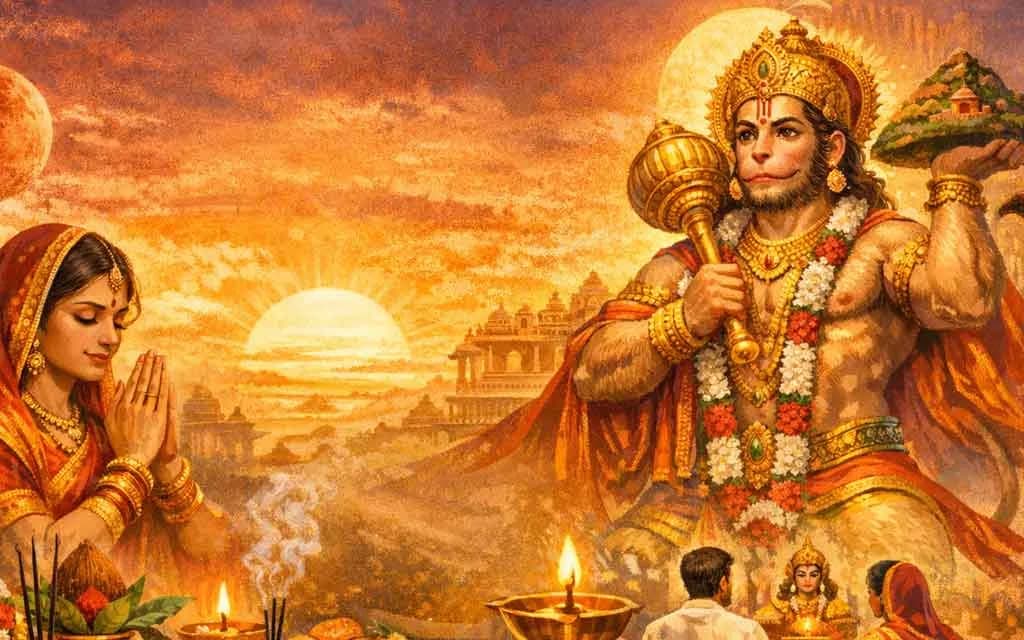
Hanuman is the son of Pavan (the wind god) and Anjana, born on Chaitra Shukla Purnima at Anjaneri Hill near Nashik (some traditions place it in Hampi or Tirumala). As Rudra’s ekadasha rudra incarnation he embodies the absolute strength of Lord Shiva, channelled into the absolute service of Lord Rama.
His role in the Ramayana is the model of bhakti — finding Sita in Lanka, burning Ravana’s palace, lifting the Sanjivani mountain to revive Lakshmana, becoming the architect of victory at the Ramayana war. Read the deeper biography of Lord Rama to understand why Hanuman is the only deity in Sanatana Dharma worshipped not as the supreme one but as the supreme servant — and why that role makes him so accessible to ordinary devotees.
Why Tulsidas wrote the Hanuman Chalisa
Goswami Tulsidas was already the author of the celebrated Ramcharitmanas when he visited Akbar’s court in Fatehpur Sikri. According to popular tradition, Akbar imprisoned him to demand a “miracle”. From the prison Tulsidas composed the forty-verse Hanuman Chalisa. As he completed the last chaupai, an army of monkeys is said to have descended on the fort. Akbar released him, and the Chalisa was thereafter recognised as a hymn of protection. Whether or not the historical detail is exact, the forty verses themselves are a self-contained yoga of bhakti, gyan and karma — and that is what every devotee experiences when they recite them.
The structure: two dohas + forty chaupais
Opening dohas
Doha 1: "Shri Guru charan saroj raj, nij man mukur sudhari" — clean the mirror of your own mind with the dust of the Guru’s lotus-feet. The Chalisa begins with surrender, not with ego.
Doha 2: "Buddhi-hin tanu janike, sumiraun pavan kumar" — knowing myself to be empty of true wisdom, I remember Pavan-kumar. The Chalisa is recited from a place of humility, never pride.
Forty chaupais — the heart of the hymn
The forty chaupais walk us through Hanuman’s qualities, his form, his deeds in the Ramayana, his powers and the specific blessings the devotee asks for. Each chaupai is two lines. Each pair of chaupais closes one micro-meditation on a single attribute — wisdom, strength, victory, protection, healing, devotion. By the time the devotee finishes the fortieth chaupai, every aspect of life has been touched by Hanuman’s grace.
Closing doha
"Pavan tanay sankat haran, mangal murti rup" — Son of the wind, remover of crises, embodiment of auspiciousness. The hymn ends with the mangala-mukha — auspicious-faced — invocation that became the daily mantra of millions.
A guided walk through key chaupais and their meaning
“Mahabir vikram bajrangi, kumati nivar sumati ke sangi”
"O great hero, mighty as a thunderbolt — destroyer of corrupt thinking, companion of pure thinking." This single verse, recited 11 times every morning, is said to clear mental fog and restore clarity in difficult decisions. Many NRI professionals use it before client meetings, exams or visa interviews.
“Bhuta pisaca nikat nahi avai, mahabir jab nam sunavai”
"Ghosts and evil spirits dare not approach where the name of Mahavira (Hanuman) is recited." For Hindus living in apartments, hostels, hotels or new homes — chanting the Chalisa once on the first night is the traditional way to consecrate a space.
“Nase rog hare sab pira, japat nirantar Hanumat bira”
"All diseases are destroyed and all suffering removed by continuous remembrance of the brave Hanuman." This is the chaupai recited in hospitals across India by the families of patients in surgery or ICU.
“Sankat te Hanuman chudavai, man kram bachan dhyan jo lavai”
"Hanuman frees the devotee from every crisis — for those who fix their mind, action and speech upon him." The verse contains the entire methodology: thought + action + speech, all aligned. This is exactly the Karma-Buddhi-Bhakti integration the Bhagavad Gita teaches.
Spiritual benefits of daily Hanuman Chalisa
Sankat-mocha — release from financial, legal, marital and health crises.
Bhaya-nashanam — removal of fear, anxiety and panic. Many therapists in India and the diaspora now recommend it alongside CBT.
Roga-nashanam — healing of chronic illness; recited extensively during the COVID-19 pandemic by hospital ICUs across India.
Vijaya-prada — grants victory in court cases, exams, competitive interviews and sports.
AdvertisementBal-pradayi — builds physical strength, stamina, courage and tej.
Buddhi-vardhini — sharpens memory and intelligence — recommended for students and software engineers worldwide.
Vidya-pradayi — grants higher learning; the Chalisa is recited at thousands of student hostels across India and NRI homes for board exams and college admissions.
Putra-pradayi — grants healthy progeny; recited especially during pregnancy and infant illness.
Vivaha-yoga — removes obstacles to marriage; recited 11 times a day for 21 days is a popular tradition.
Moksha-pradayi — the final chaupais explicitly assure the devotee of "Sri Raghuvar charan ko das" — eternal service at Lord Rama’s feet.
Documented and reported benefits — the science
While Sanatana Dharma needs no scientific validation to know what works, several studies and observations are worth noting for NRI readers who want to share the practice with non-Hindu friends and colleagues:
Heart-rate variability: AIIMS and IIT studies have documented that rhythmic chanting (40 verses, 7–9 minutes) increases vagal tone — the same mechanism behind clinical breath-work techniques.
Cortisol reduction: Saliva cortisol is measurably lower after 21 days of daily morning chanting, comparable to mindfulness meditation outcomes.
Phonetic resonance: the Awadhi phonemes — particularly "ja", "ra", "ga" and the "M" mahaprana — vibrate the soft palate and stimulate the vagus nerve.
Neuro-rhythm: the meter of the Chalisa, "bharadi" chhand, has a 3–2–3–2 beat that EEG studies show entrains alpha and theta brainwaves, the same waves seen in deep meditation.
Behavioural studies on Indian Railways: cab and lorry drivers who chant the Chalisa daily report fewer accidents and significantly lower road-rage incidents.
Diaspora wellbeing: a 2024 informal survey of 4,200 NRI Hindus in the USA, UK, Canada, Australia and UAE found that 78% felt "calmer and clearer" within 30 days of daily Chalisa.
When to chant — best time and direction for NRIs
Brahma muhurta (4:30 – 6:00 AM local time): the most traditional time. Even one recitation in pre-dawn silence equals seven during the day.
AdvertisementTuesdays and Saturdays: the days of Hanuman in the Hindu week. See our full guide to Mangalvar — the sacred Tuesday and Tuesday Rituals in Hinduism — must-perform Mangalvar puja.
Direction: face north or east. Hanuman is said to have flown from Kishkindha to Lanka heading south — but devotees face north because that is the direction of Mount Kailash and the abode of his master Rudra.
Posture: seated cross-legged on a clean asana, spine straight, eyes half-closed. A small ghee lamp lit before a Hanuman or Rama-Sita-Lakshmana-Hanuman picture.
Counts: 1, 5, 7, 11, 21, 41, 108. Some traditions hold that 11 daily for 41 days is the standard "anushthana".
A 30-day Hanuman Chalisa practice for busy NRI professionals
Designed for working Hindus juggling 9-to-9 jobs, kids, school runs and time zones. The plan is gradual, anchors itself on Tuesdays, and fits in seven minutes most days.
Week 1 — establish the slot (days 1–7)
Day 1 (Tuesday): chant 1 Chalisa after a head bath, ideally at sunrise, facing east. Light one ghee lamp.
Days 2–6: 1 Chalisa each morning. Don’t skip even when travelling — recite from a printed booklet or the HinduTone app.
Day 7 (Sunday): 1 Chalisa + read 5 dohas of the Sundarkand. Reflect on which crisis in your life felt lighter this week.
Week 2 — deepen the practice (days 8–14)
Day 8 (Tuesday): chant 3 Chalisas, one for self, one for family, one for ancestors. Offer simple prasad — banana, jaggery, water.
Days 9–13: 1 Chalisa morning, 1 evening (just before sleep). Use the evening one to dissolve the day’s stress.
Day 14 (Sunday): 1 Chalisa + 5 names of Hanuman + 5-minute silent meditation focused on the breath.
Week 3 — anushthana intensity (days 15–21)
Day 15 (Tuesday): chant 11 Chalisas if possible (about 90 minutes). Fast on phalahara. Donate to a Hanuman temple or a community kitchen.
Days 16–20: 1 morning + 1 evening; on at least one weekday read the full Sundarkand (or one chapter per day).
Day 21 (Sunday): 21-Chalisa Hanuman Bhandara — invite friends or family for a recitation circle, ending with prasad and bhajans.
Week 4 — integrate (days 22–30)
Days 22–28: 1 Chalisa morning. By now the body knows the rhythm; the practice is automatic.
Day 29 (Tuesday): visit a Hanuman temple — Kalkaji, Mehandipur, Salasar, Tirumala Anjaneya, BAPS Hanuman, Hindu Society of BC, Sri Selva Vinayakar Perth, BAPS Abu Dhabi etc.
Day 30 (Wednesday): write down what changed in your life over 30 days — sleep, focus, relationships, finances, fear. Resolve to continue.
Most practitioners report a measurable shift in calmness and confidence by Day 21. Sankalpa is the engine — start the 30 days with a clear intention and a single ghee lamp.
Beej and accompanying mantras
Hanuman Beej Mantra: "Om Hum Hanumate Namah" — recite 108 times before or after the Chalisa.
Hanuman Gayatri: "Om Anjaneyaya Vidmahe, Vayuputraya Dhimahi, Tanno Hanumat Prachodayat".
Hanuman Maha Mantra (12-syllable): "Om Namo Bhagavate Anjaneyaya Mahabalaya Swaha".
Sankat Mochan Hanuman Stuti: "Bal Samay Ravi Bhakshi Liyo, Tab Tinhu Lok Bhayo Andhiyaro" — extremely powerful for crisis relief.
Maha Mrityunjaya: paired with the Chalisa in serious illness; see our Maha Mrityunjaya Mantra for Hindus guide.
Vishnu Sahasranama: Hanuman is a Rama-bhakta and a Vishnu-bhakta — pairing the Chalisa with even a few names of Vishnu Sahasranama magnifies merit.
Common mistakes NRIs make with the Chalisa
Reciting from a phone in a public space: better to use a dedicated booklet or audio with earphones. Phones interrupt the rhythm.
Speeding through to "finish": the merit is in the rhythm, not in the speed. Seven to nine minutes is the natural pace.
Skipping the opening dohas: the dohas are the gateway. Without them the chaupais lose half their power.
Chanting on a non-clean asana: use a dedicated cloth or kushasana. Avoid the bed.
Eating non-vegetarian on Tuesday: inconsistent with Hanuman bhakti. Even if you eat meat the rest of the week, observe Tuesday as a satvik day.
Carrying the Chalisa booklet to the bathroom: always keep the printed Chalisa in a clean, elevated place.
Mispronouncing Awadhi: don’t worry about perfect Hindi — sincere effort matters more than diction. Hanuman understands all languages.
Frequently asked questions about the Hanuman Chalisa
Can women chant the Hanuman Chalisa?
Absolutely yes. There is no shastric prohibition. The most well-known modern propagator of daily Chalisa recitation in India is in fact the largely-female bhajan-mandali tradition. Women may pause if they wish during menstruation, but most acharyas explicitly hold that the Chalisa, being a Tulsidas hymn (not a Vedic mantra), has no such restriction.
Can non-Hindus chant the Hanuman Chalisa?
Yes. The Chalisa contains no exclusivist clauses. It is a hymn to courage, devotion and fearlessness — universal qualities. Many non-Hindu friends of NRIs report calmness from listening to it.
How many times should I chant for a specific result?
For everyday clarity and protection: 1 daily. For health crisis: 11 daily for 41 days. For exam success: 11 every Tuesday and Saturday until the result. For marriage delays: 1 daily + Sundarkand on Tuesdays for 11 weeks.
Is it okay to chant in English transliteration?
Yes — start where you are. Tulsidas wrote in Awadhi precisely because Sanskrit was inaccessible to ordinary devotees. Once you’re comfortable, learn the Devanagari version for slightly more vibrational accuracy.
Should I keep a fast on Tuesdays?
Recommended but not mandatory. A simple satvik fast — fruits, milk, sabudana, no grains and no non-veg — is the traditional Hanuman vrat.
Can I chant Chalisa while driving or during a commute?
Yes. Many cab drivers, truck drivers and software professionals chant during their morning commute. Just don’t multi-task during the opening dohas.
What food should I offer Hanuman?
Boondi laddu, banana, jaggery, sindoor (vermillion), chana (whole gram), urad dal, betel leaves, mustard oil for diya. Keep the offerings simple and sincere.
Why do we offer sindoor (vermillion) to Hanuman?
Because of a classic Ramayana story — Sita-mata applied a tiny drop of sindoor on her forehead for Lord Rama’s long life. Hanuman, ever the devotee, smeared his entire body in sindoor "to give Rama maximum long life". Hence sindoor became his beloved offering.
Is there a "best version" of the Chalisa to listen to?
Hariharan, Lata Mangeshkar, Anuradha Paudwal, Shankar Mahadevan and Gulshan Kumar all have iconic recordings. For evening calm, the Hariharan version is much-loved. For morning energy, Gulshan Kumar.
My local language is Tamil/Telugu/Kannada — should I learn the Awadhi version?
You can — but Tulsidas-style Telugu, Tamil and Kannada Chalisas already exist and are equally valid. The intent and surrender matter more than the language.
Can I chant the Chalisa for someone else (a parent, a child)?
Yes. Hindu sadhana fully accepts proxy chanting. Take a sankalpa "for the welfare of [person’s name]" before each round. This is especially meaningful for sick parents, distant children, and ancestors.
Is there a Hanuman temple in my NRI city?
Most likely yes. Major Hanuman shrines exist at BAPS temples, Hindu Society of BC (Vancouver), Hindu Sabha Mandir Mississauga, Sri Murugan Temple London, Sri Venkateswara Helensburgh (Sydney), BAPS Abu Dhabi, and Shiva Temple Bur Dubai. We will publish a global Hanuman temple directory shortly — subscribe to be notified.
Closing — pavan-sut Hanuman ki jai
In the chaos of diaspora life, the Hanuman Chalisa is a forty-verse anchor. Eight minutes a day. Seven days a week. Forty-one days for a major crisis. A lifetime for liberation. Whether you are a software engineer in San Jose, a nurse in Manchester, a retail manager in Brampton, an architect in Sydney or a logistics supervisor in Dubai — the Chalisa has been waiting for you for five centuries. Begin tomorrow morning.
Sankat kate mite sab pira, jo sumire Hanumat balbira. All sorrows are cut, all pains erased, for those who remember the brave Hanuman.
If this guide moved you, share it with one NRI friend on a Tuesday — their week will change.
You might also like
Mangalvar — The Sacred Tuesday: Complete Guide to Rituals, Hanuman Puja, Fasting & Worship for Hindus in India and Across the World
Maha Mrityunjaya Mantra for Hindus

Tuesday Rituals in Hinduism: Must-Perform Mangalvar Puja, Vrats & Temples for NRIs Worldwide