Buddha Purnima 2026 in Canada, UK, Australia & UAE: Complete NRI Celebration Guide for Hindus & Buddhists
Buddha Purnima 2026 is on Tuesday, 12 May 2026 — Vaishakha Shukla Purnima. Complete guide for NRIs in Canada, UK, Australia and UAE: country-specific moonrise and fast timings, temple events at BAPS Toronto, Neasden, Sydney Murugan, Dubai Hindu Temple, home puja vidhi, scriptural significance of Buddha as the 9th avatar of Lord Vishnu, meditation, charity ideas and 12 FAQs.
Buddha Purnima 2026 is on Tuesday, 12 May 2026 — Vaishakha Shukla Purnima. Complete guide for NRIs in Canada, UK, Australia and UAE: country-specific moonrise and fast timings, temple events at BAPS Toronto, Neasden, Sydney Murugan, Dubai Hindu Temple, home puja vidhi, scriptural significance of Buddha as the 9th avatar of Lord Vishnu, meditation, charity ideas and 12 FAQs.
“Buddham saranam gacchami, Dharmam saranam gacchami, Sangham saranam gacchami.” — I take refuge in the Buddha, in the Dharma, in the Sangha. On Buddha Purnima, this triple refuge is chanted by Hindus and Buddhists alike across the world.
Buddha Purnima 2026 — date, tithi and country-wise moonrise for NRIs
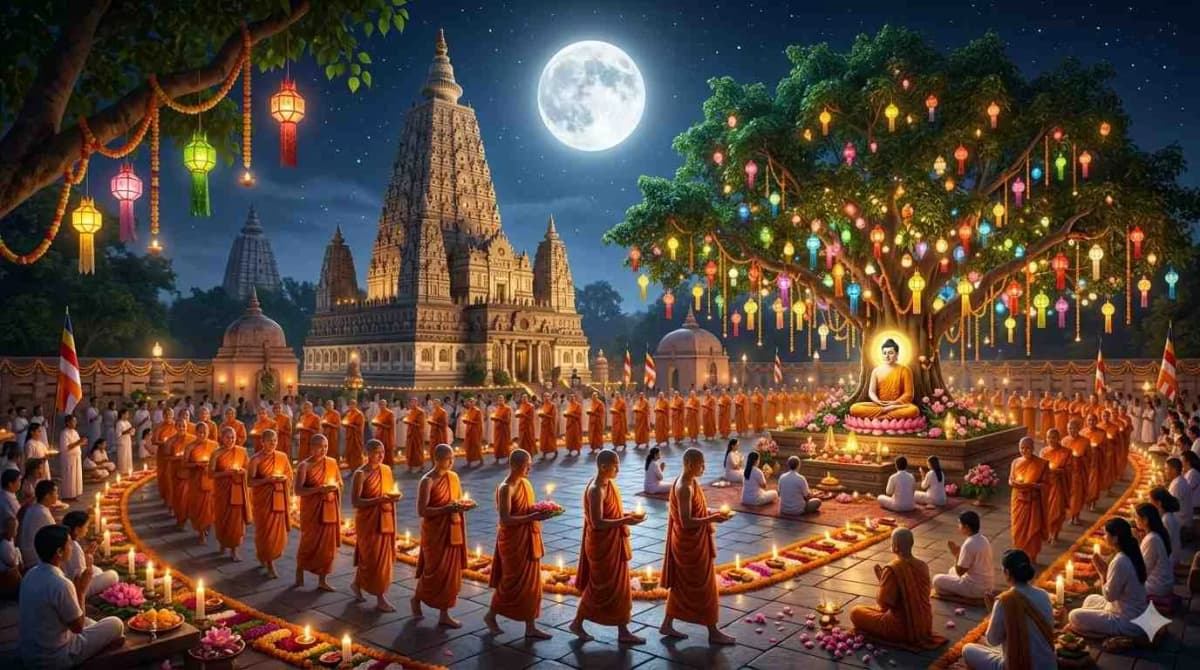
Buddha Purnima 2026 falls on Tuesday, 12 May 2026 — Vaishakha Shukla Purnima, the full-moon day of the lunar month of Vaishakha. This single day commemorates three of the most extraordinary moments in spiritual history — the birth, the enlightenment under the Bodhi tree at Bodhgaya, and the mahaparinirvana of Bhagavan Buddha. For the Hindu diaspora in Canada, the United Kingdom, Australia and the United Arab Emirates, this is one of the most spiritually charged Purnimas of the year, equal in merit to a holy bath at the Ganga.
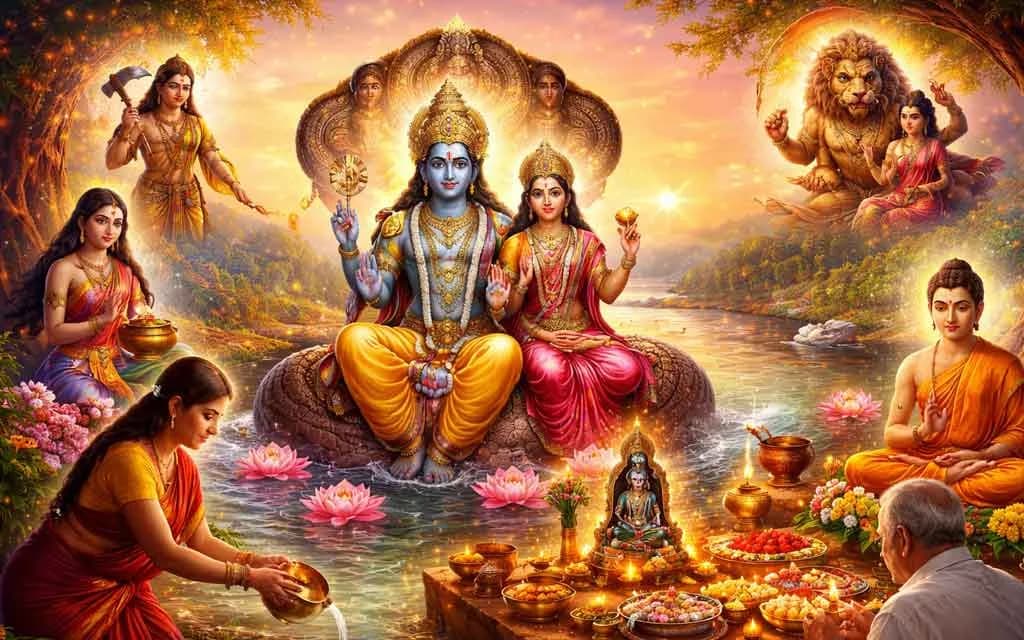
In Sanatana Dharma the Buddha is revered as the ninth avatar of Bhagavan Vishnu (see our piece on the Vaishaka Masam Festivals 2026 — complete list with dates, importance & rituals). The same full-moon day is also observed as Kurma Jayanti (the appearance of the Tortoise avatar) and as Chitra Pournami in southern India and Tamil diaspora homes — making 12 May 2026 unusually significant for almost every Vaishnava and Shaivite tradition.
Country-by-country tithi window and moonrise for 12 May 2026
Canada (Toronto / EDT): Vaishakha Purnima tithi runs from late evening of 11 May into mid-evening of 12 May. Moonrise on 12 May is approximately 8:42 PM EDT. Plan home puja and Satyanarayana Vrat katha after sunset, before moonrise.
Canada (Vancouver / PDT): The full-moon window aligns with 12 May local date. Moonrise around 8:55 PM PDT. Many BC temples hold combined Buddha Purnima + Kurma Jayanti aratis between 7 and 9 PM.
United Kingdom (BST): Tithi covers all of 12 May 2026. Moonrise is approximately 9:03 PM BST. The full moon will be visible across London, Birmingham, Leicester, Manchester and Glasgow weather permitting.
AdvertisementAustralia (Sydney / AEST): Because Australia is ahead of UTC, Vaishakha Purnima begins on the morning of 12 May and continues into the morning of 13 May. Moonrise on 12 May is around 5:02 PM AEST — perfect for an after-work puja and family meditation.
Australia (Perth / AWST): Full-moon window runs through the entire day of 12 May local time. Moonrise around 5:17 PM AWST.
United Arab Emirates (GST / Dubai, Abu Dhabi, Sharjah): The full-moon tithi starts on the night of 11 May and ends in the early evening of 12 May. Moonrise in Dubai on 12 May is around 6:48 PM GST — ideal for a sunset rooftop or villa puja before dinner.
Always cross-check with a Drik Panchanga app for your exact city — Vaishakha Purnima begins and ends at slightly different clock times depending on longitude, and the merit of the day attaches to the tithi window, not the calendar date.
Why Buddha Purnima matters to the Hindu diaspora
For Hindus living abroad, Buddha Purnima is far more than a Buddhist holiday. It is a shared dharmic celebration that unites Sanatana Dharma, Buddhism, Jainism and Sikhism — all four Indic traditions that consider non-violence (ahimsa), truth (satya) and compassion (karuna) as the highest virtues. In the multicultural societies of Canada, the UK, Australia and the UAE, Buddha Purnima becomes a powerful day to introduce the next generation of NRI children to the depth and breadth of their dharmic heritage.
Spiritually, observing Buddha Purnima is said to grant freedom from accumulated karmas, peace of mind, and the ability to overcome fear, anger and addiction. The full moon of Vaishakha is considered a thinning point between worlds — meditation, japa, charity and silence performed today are said to multiply manifold. Read also our deeper piece on Buddha Purnima 2026 — significance, history, rituals & message of peace and the parallel Buddha Purnima 2026 in the USA guide for our American readers.
Buddha as the 9th avatar of Lord Vishnu — the scriptural view
The Bhagavata Purana, Skanda 1, Chapter 3, Verse 24 explicitly lists the Buddha among Bhagavan Vishnu’s ten principal avatars: “Tatah kalau sampravritte sammohaya sura-dvisham — buddho namnanjana-sutah kikateshu bhavisyati” — “Then, in the early part of Kali Yuga, in order to delude the enemies of the devas, the Lord will appear in the land of Kikata (Bodhgaya) as Buddha, the son of Anjana.” The Vishnu Purana, Agni Purana, Garuda Purana and Devi Bhagavata all confirm this. Adi Shankaracharya in his Brahma Sutra Bhashya treats the Buddha respectfully even while debating the Madhyamika school’s metaphysics.
The list of 10 avatars (Dasavataram) — Matsya, Kurma, Varaha, Narasimha, Vamana, Parashurama, Rama, Krishna, Buddha, and the future Kalki — is depicted on every major Vaishnava temple gopuram from Tirumala to Srirangam to Pashupatinath. For a complete walkthrough see our Dasavataram section. Buddha Purnima is therefore both a Vaishnava festival and an inter-traditional festival of dharma.
The story of Bhagavan Buddha — birth, enlightenment, mahaparinirvana
Prince Siddhartha Gautama was born in 563 BCE under a sal tree in Lumbini (modern-day Nepal) to King Suddhodana of the Shakya clan and Queen Mayadevi. The royal seer Asita prophesied that he would either become a chakravartin emperor or a buddha — an enlightened one. To shield him from the second path, his father raised him in unbroken luxury inside the palace at Kapilavastu.
At twenty-nine, after seeing the four sights — an old man, a sick man, a corpse and a wandering ascetic — the prince renounced his throne, his beloved wife Yashodhara and his infant son Rahula, and set out into the forests. After six years of severe tapasya, including extreme fasting on the banks of the Niranjana, he sat in meditation under a peepal tree at Bodhgaya in Bihar. On the full-moon night of Vaishakha he attained complete enlightenment — becoming the Buddha. He gave his first discourse, the Dhamma-chakka-pavattana Sutta, at Sarnath near Varanasi to five companions, setting in motion the wheel of dharma.
For the next forty-five years he taught across the Gangetic plain — at Rajgir, Vaishali, Kushinagar, Shravasti, Varanasi. On the full-moon of Vaishakha, around 483 BCE, at the age of eighty, he attained mahaparinirvana at Kushinagar. Birth, enlightenment, mahaparinirvana — the same Vaishakha Purnima — is why this day is the holiest in the Buddhist calendar and one of the holiest in the Hindu calendar.
Major temple events for Buddha Purnima 2026 — diaspora cities
Canada — Toronto, Vancouver, Calgary, Montreal, Edmonton
BAPS Shri Swaminarayan Mandir, Toronto: special evening arati and a Buddha-Vishnu katha pravachan; community prasad. Children’s session on the four noble truths re-explained from a Vaishnava lens.
AdvertisementVishnu Mandir, Richmond Hill (ON): Satyanarayana Vrat katha begins at 6 PM, followed by a candle-lit moon arati on the lawn. Free vegetarian dinner.
Hindu Society of BC, Vancouver: meditation circle 7–8 PM, abhishekam to Buddha and Vishnu murtis, group recitation of the Vishnu Sahasranama.
Hindu Society of Calgary: Buddha Purnima + Kurma Jayanti combined puja with Tirumala-style laddu prasad.
Hindu Mandir of Ottawa-Carleton: children’s “8-fold path & Hindu yamas-niyamas” workshop, then community arati.
United Kingdom — London, Leicester, Birmingham, Manchester, Glasgow
BAPS Neasden Mandir, London: Vaishakha Purnima abhishek, Bhagavad Gita parayana, special darshan after moonrise. Free Akshar Niwas vegetarian dinner.
Shri Sanatan Mandir, Leicester: Buddha Purnima discourse on ahimsa and the parallels with the Yamas of Patanjali’s Yoga Sutras; Vishnu Sahasranama paath.
Shree Krishna Mandir, Birmingham: moon-rise arati, Govinda namasankirtan and Tulsi puja.
AdvertisementHindu Cultural Society of South Wales / Cardiff Hindu Temple: inter-faith Vesak gathering with the local Buddhist Vihara — chanting of the Triratna and the Vishnu Sahasranama side by side.
Sri Murugan Temple, East Ham London: special abhishekam to Sri Vishnu and Sri Lakshmi after sunset.
Australia — Sydney, Melbourne, Brisbane, Perth, Adelaide
Sri Venkateswara Temple, Helensburgh (Sydney): special pancha-suktha homam from 5:30 PM AEST, full Vishnu Sahasranama parayana, moon-rise arati, free annadana.
Sri Vakrathunda Vinayagar Temple, The Basin (Melbourne): inter-temple program — chant of Buddha Vandana followed by Sri Sukta and Lakshmi Sahasranama.
Hindu Society of Queensland, Burbank (Brisbane): evening meditation circle 6:30 PM AEST, Bhagavad Gita Chapter 12 (Bhakti Yoga) recitation, prasad.
Sri Selva Vinayakar Temple, Bull Creek (Perth): Vaishakha Purnima sankalpam, Sai Sat Charitra parayana followed by community kirtan.
Murugan Temple, Mawson Lakes (Adelaide): moon arati, free vegetarian dinner, kids’ Dasavataram art competition.
Advertisement
UAE — Dubai, Abu Dhabi, Sharjah
BAPS Hindu Mandir, Abu Dhabi: Vaishakha Purnima maha-abhishek, akhand path of the Vachanamrut, sunset arati, traditional thali prasad.
Shiva Temple, Bur Dubai (Sindhi Guru Darbar complex): a special moon-rise puja from 6:30 PM GST, group bhajans dedicated to Bhagavan Vishnu.
Krishna Temple, Bur Dubai: Govinda namasankirtan and Vishnu Sahasranama from 7 PM.
Sharjah Hindu community halls: pop-up Buddha Purnima satsangs are organised every year by Bharatiya Cultural Society — check WhatsApp groups closer to the date.
Pro tip: most temples in Canada, the UK, Australia and the UAE livestream Buddha Purnima programs on YouTube and Instagram. If you cannot attend in person, joining a livestream and offering a virtual sankalpa from your home altar is considered fully valid darshan.
How to celebrate Buddha Purnima 2026 at home — simple NRI puja vidhi
Morning (any time before noon)
Holy bath with sankalpa: rise early, take a head bath. Sit facing east and resolve quietly: “On this Vaishakha Purnima 2026 I observe Buddha Purnima for the welfare of all beings — sarva-jana sukhino bhavantu.”
Clean and decorate the puja space: spread a fresh white or pale-yellow cloth. Place a photo or small murti of Bhagavan Vishnu/Buddha at the centre, garlanded with white flowers (jasmine, lily, lotus if available).
Tulsi and lotus offering: tulsi leaves are dear to Vishnu; even three fresh leaves are enough. NRIs without tulsi can use mint leaves with a sankalpa-substitution mantra.
Light a single ghee lamp: one wick is enough. The eka-jyoti represents the singular wisdom of nirvana that Buddha attained on this very day.
Afternoon — fasting, charity, study
Fast (vrat) until moonrise: simple phalahara — fruit, milk, water, dry fruits, sabudana. Avoid grains, meat, eggs, alcohol, garlic and onion.
Dana (charity): feeding birds, leaving water for street animals, donating to a temple food kitchen, or supporting a Buddhist Vihara are all considered exceptionally meritorious. NRIs can donate online to the Mahabodhi Society at Bodhgaya, Sarnath, or to Akshaya Patra.
Sutra / Gita study: recite the Dhammapada (chapters 1, 14 and 26) and Bhagavad Gita Chapter 12 — Bhakti Yoga. Both texts beautifully echo each other on the supreme value of equanimity and compassion.
Evening — Satyanarayana Vrat & moon-rise arati
Satyanarayana Vrat katha: on every Purnima, especially Vaishakha Purnima, the Satyanarayana Vrat katha is the gold-standard family ritual. The katha is short, can be read in English, and brings prosperity, marital harmony and removal of obstacles. Recite the five chapters, offer panchamrit and sapata-bhog (banana, ghee, wheat-flour halwa, milk, sugar).
Moon-rise arati: when the full moon rises, step outside (balcony or yard), offer arghya — a copper or steel tumbler of water with white flowers — to Chandra Bhagavan, then to the moon as a symbol of Buddha’s mind. Light a single oil lamp and sing one verse of the Vishnu Sahasranama.
Family meditation: fifteen minutes of silent meditation on the breath, followed by 108 repetitions of "Om Namo Bhagavate Vasudevaya" or "Buddham saranam gacchami". Even children as young as five can do this with parents.
Break the fast (parana): at moonrise or after, with prasad — Satyanarayana sapata-bhog, kheer, fruits.
Twelve mantras and shlokas to chant on Buddha Purnima
1. Buddham saranam gacchami, Dharmam saranam gacchami, Sangham saranam gacchami.
2. Om Namo Bhagavate Vasudevaya — the dvadashakshari Vishnu mantra (108 times).
3. Om Sarve Bhavantu Sukhinah, Sarve Santu Niramayah — Brihadaranyaka Upanishad’s peace prayer.
4. Asato ma sad gamaya, Tamaso ma jyotir gamaya, Mrityor ma amritam gamaya — Pavamana Mantra.
5. Om Mani Padme Hum — the universal Avalokiteshvara mantra revered across both traditions.
6. Vishnu Sahasranama — at minimum the first 25 names.
7. Lalita Sahasranama (for those with a guru-paramparika diksha).
8. Bhagavad Gita 12.13–14 — the verses on the qualities of a true bhakta.
9. Buddha Vandana — Iti pi so bhagavā arahaṃ sammā-sambuddho…
10. Mangala Sutta — for protection and well-being of family.
11. Maha Mrityunjaya Mantra — for healing, longevity and freedom from fear.
12. Achyuta-Ananta-Govinda — chanted thrice removes accumulated doshas.
Charity ideas for NRIs — small acts, big merit
Annadana: sponsor one meal at a temple food kitchen — Akshaya Patra (US/UK), BAPS Sahayog programs, or a local Sikh langar.
Vidya-dana: donate Bhagavad Gita and Dhammapada copies to your local public library or workplace prayer room.
Vana-dana: plant a peepal, fig or bodhi tree sapling in your backyard or community garden.
Jala-dana: keep a clean water bowl on your balcony for birds; in UAE summer this saves real lives.
Aushadha-dana: contribute to medical-aid temple trusts at Tirumala, Sabarimala, BAPS hospitals, or Mahabodhi Society.
Vastra-dana: clear out unused warm clothes and donate to homeless shelters — winter cities like Calgary, Edinburgh, Manchester benefit greatly.
Buddha Purnima for NRI children — a teachable moment
For young diaspora children growing up in Toronto, London, Sydney or Dubai, Buddha Purnima is one of the easiest Hindu festivals to explain to non-Hindu friends and teachers. It is publicly recognised — the United Nations even declares it the International Day of Vesak. Use the day to:
Tell the story: the prince who saw suffering, gave up the palace, and discovered the truth that ends suffering.
Visit a temple together: let children offer flowers, ring the bell, do a small arati.
Watch a child-friendly Dasavataram episode: teach that Buddha is one of the ten great forms of Vishnu.
Practise one act of compassion: feeding a stray, donating a toy, writing a kindness card.
Five-minute family meditation: eyes closed, watching the breath. Even toddlers can do two minutes.
Common mistakes NRIs should avoid on Buddha Purnima
Eating non-vegetarian: this is fundamentally inconsistent with the day’s message of ahimsa. Even egg should ideally be avoided.
Mixing the festival with “fun fasting” trends: Vaishakha Purnima vrat is a spiritual fast, not an intermittent-fasting health hack — keep the sankalpa.
Skipping the moonrise arati: the ritual peak of the day is sunset–moonrise, not noon. Don’t finish puja at lunchtime.
Forgetting Vishnu sankalpa: for Hindus, Buddha Purnima is also Vaishnava worship. Begin with the Vishnu sankalpa even if your altar centres a Buddha image.
Using artificial flowers: always use fresh flowers, leaves or even garden grass — never plastic for any Hindu puja.
Frequently asked questions about Buddha Purnima 2026
When exactly is Buddha Purnima 2026?
Tuesday, 12 May 2026 — Vaishakha Shukla Purnima. The tithi begins late evening of 11 May and ends evening of 12 May; observe puja during the daylight hours of 12 May and break the fast at moonrise.
Is Buddha Purnima a Hindu festival or a Buddhist festival?
Both. Hindus revere the Buddha as the ninth avatar of Bhagavan Vishnu (Bhagavata Purana 1.3.24), and the day is also Vaishakha Purnima — one of the most important full-moon days of the Hindu calendar, equivalent in merit to Ganga snan. Buddhists worldwide observe it as the day of birth, enlightenment and parinirvana of Bhagavan Buddha.
Can NRIs observe a Satyanarayana Vrat instead?
Yes — every Purnima is auspicious for Satyanarayana Vrat, and Vaishakha Purnima is among the strongest. Many NRI families combine the Buddha Purnima fast with a full Satyanarayana Vrat katha at home.
Should I fast all day?
A phalahara (fruit + milk + dry fruits) fast from sunrise to moonrise is recommended. The elderly, pregnant women, children, and those on medication can do a partial fast — a single satvik meal at noon is fully acceptable.
Which Hindu temples in Toronto observe Buddha Purnima?
BAPS Shri Swaminarayan Mandir Toronto, Vishnu Mandir Richmond Hill, Hindu Sabha Mandir Mississauga, ISKCON Toronto and the Hindu Heritage Centre all hold Vaishakha Purnima programs with arati at moonrise.
How do I observe Buddha Purnima in Dubai if I cannot reach a temple?
Set up a small altar at home with a Vishnu/Buddha image, offer fresh flowers and water, light a ghee lamp, fast on phalahara, recite the 12 mantras above, and watch the BAPS Abu Dhabi livestream. Step out at moonrise (~6:48 PM GST) for an arghya offering on your balcony.
Is it correct to chant Buddhist mantras for a Hindu?
Absolutely. Mantras like Om Mani Padme Hum and the Triratna refuge are pan-Indic, deeply Sanskritic, and harmonise with Sanatana Dharma. Adi Shankaracharya himself respected the Buddhist sangha as a dharmic order even where he debated their metaphysics.
Why do some calendars show Buddha Purnima on a different date?
Sri Lankan and Theravada Buddhist countries follow a slightly different lunisolar calculation; Tibetan Buddhist calendars use the Tibetan calendar (Saga Dawa). For Indian and NRI Hindus the correct date is Vaishakha Shukla Purnima per Drik Panchanga — 12 May 2026.
What food should NRIs cook on Buddha Purnima?
Pure satvik vegetarian — kheer, sabudana khichdi, fruit chaat, banana halwa, dal-rice with ghee, payasam, lassi. No onion, garlic, mushrooms, eggs, meat or alcohol. Some traditions avoid grains entirely until moonrise.
Can I do online dana on Buddha Purnima?
Yes. Donations to recognised Hindu and Buddhist trusts — Tirumala Tirupati Devasthanams, BAPS, Akshaya Patra, Mahabodhi Society, Bodhgaya Temple Trust, Sarnath Mulagandhakuti Vihara — count fully and are tax-deductible in many NRI jurisdictions (US 501(c)(3), UK Gift Aid, Canada CRA, Australia DGR).
Do I need a Brahmin priest to do Buddha Purnima puja at home?
No. Buddha Purnima is among the simplest pujas — sankalpa, arati, fast, mantra japa, moon offering. A priest is optional. For a full Satyanarayana Vrat, a priest enriches the experience but is not mandatory; the katha itself can be read by any family member with shraddha.
What gift should NRIs give on Buddha Purnima?
Books on the Bhagavad Gita and Dhammapada, a tulsi sapling, a small Buddha or Vishnu murti, sandalwood mala, a Bodhi-leaf framed picture, or a donation receipt in the recipient’s name. Avoid leather, alcohol, non-veg restaurant vouchers.
A quiet sankalpa for a noisy world
In an age of constant scrolling, hyper-political feeds and burnout, Buddha Purnima offers the diaspora something Silicon Valley keeps trying to repackage: a single full-moon night to put the phone down, sit on the floor with the family, light one lamp, eat one simple meal, and resolve one act of compassion. The Buddha did not invent this — he rediscovered it from the eternal Sanatana Dharma. On 12 May 2026, we get to do the same.
Sarve bhavantu sukhinah, sarve santu niramayah, sarve bhadrani pashyantu, ma kashchid duhkha bhag bhavet. May all beings be happy. May all be free of disease. May all see auspicious things. May none suffer.
If this guide helped you, share it with one NRI friend on Buddha Purnima night, save it for your family WhatsApp group, and subscribe to HinduTone for monthly festival guides written specifically for the global Hindu diaspora.
You might also like
Buddha Purnima 2026 – Significance, History, Rituals & Message of Peace
Buddha Purnima 2026 in the USA: Date, Significance, Story, Rituals & Message of Peace for Hindu & Buddhist Devotees | HinduTone
Hindu Festivals in May & June 2026: Ganga Saptami, Sita Navami, Buddha Purnima, Ganga Dussehra, Nirjala Ekadashi — Complete Vaishakha–Jyeshtha Guide