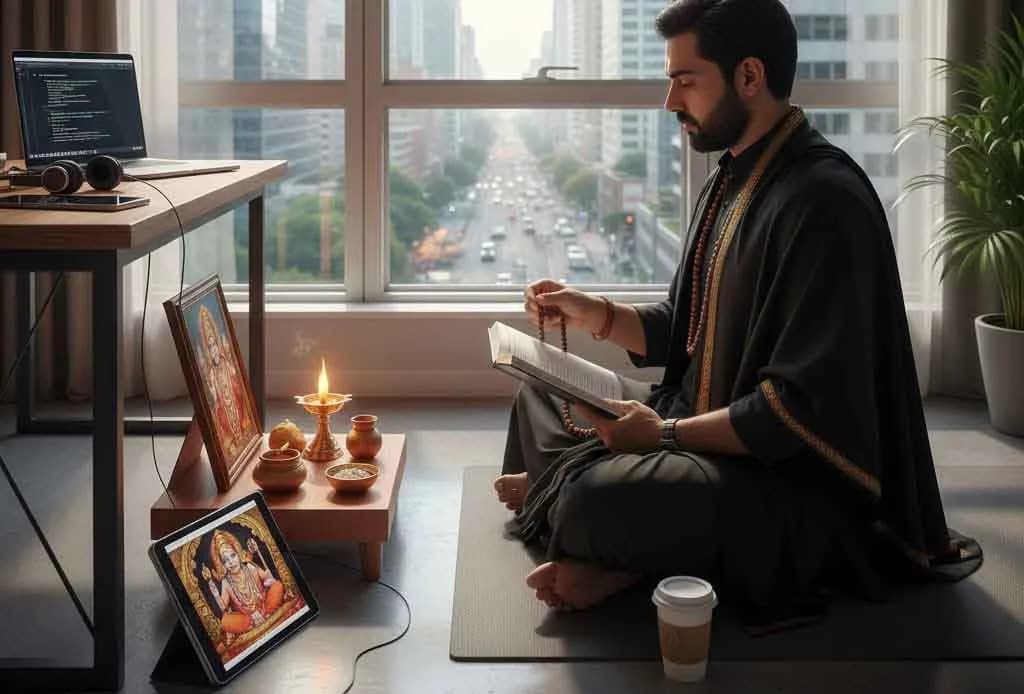
Naishtika Brahmacharya: Lord Ayyappa’s Eternal Vow Explained — Manu Smriti, Bhagavata, Yoga Sutra and the 41-Day Vratham
The definitive guide to Naishtika Brahmacharya — Lord Ayyappa’s eternal vow at Sabarimala. Scriptural reading across Manu Smriti II.247-249, Bhagavata Purana 7.6 and 11.18, Patanjali Yoga Sutra II.30/II.38, and the Atharva Veda. Why the 41-day Mandala vratham is participation in the deity’s vow, how brahmacharya is gathering not suppression, the great Naishtika exemplars from Hanuman to Ramana Maharshi, and how a modern householder can keep the vow during pilgrimage. With FAQ.
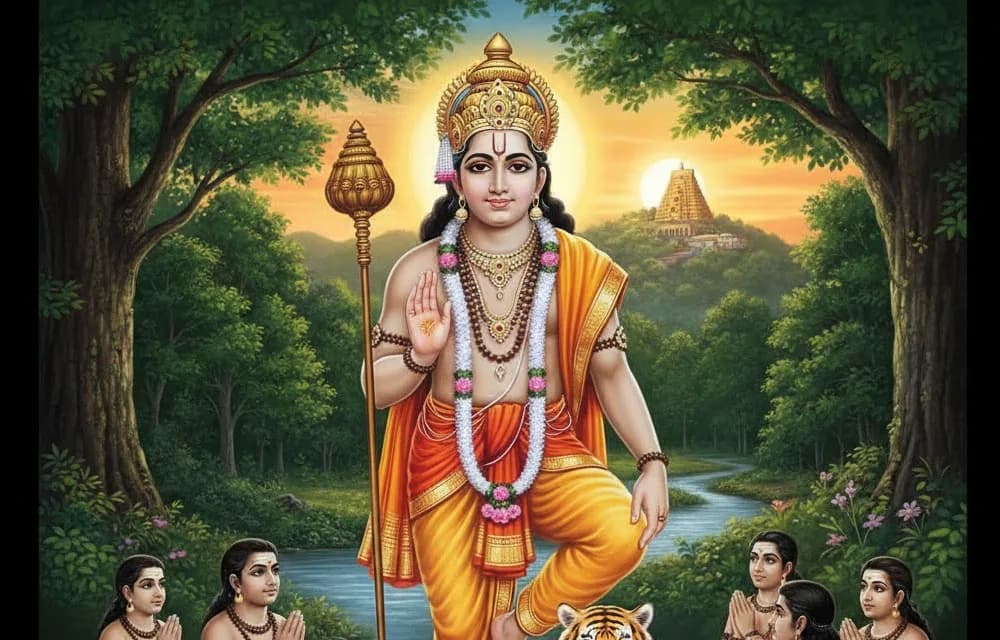
The definitive guide to Naishtika Brahmacharya — Lord Ayyappa’s eternal vow at Sabarimala. Scriptural reading across Manu Smriti II.
“Brahmacharyena tapasa devah mrityum apaaghnata” — "By brahmacharya and tapas, the gods conquered death." — Atharva Veda XI.5.19
A vow that holds a deity, a devotee, and a doctrine together
At the heart of every step a Sabarimala pilgrim takes — every coconut broken, every bead of the mala, every saranam chanted up the eighteen sacred steps — sits a single Sanskrit word: Brahmacharya. And not brahmacharya in any general sense, but the specific, lifelong form: Naishtika Brahmacharya — the eternal vow.
Sabarimala’s Lord Ayyappa is established in this state. The 41-day Mandala Deeksham the devotee observes is itself a brief, devoted participation in this vow. Without understanding what Naishtika Brahmacharya is — in scripture, in classical philosophy, in the lived life of sadhakas across millennia — the modern reader cannot really understand Sabarimala, the figure of Ayyappa, or the strange, lasting power of those 41 days.
This essay reads the concept across the four classical sources where it is most precisely defined — Manu Smriti, Bhagavata Purana, Patanjali’s Yoga Sutra, and the Vedanta — and follows it through to the practical, devotional life of the Ayyappa devotee in 2026. Read alongside our Sabarimala 2026-27 Season Guide and Ayyappa Swamy — symbol of Dharma, Discipline & Devotion.
The word — what does Brahmacharya actually mean?
Modern English usually translates brahmacharya as "celibacy". That translation is correct in part — sexual restraint is a major component — but it is far too narrow. The Sanskrit term is built from two roots:
Brahma — the absolute, the ultimate reality, also "the highest".
AdvertisementCharya — "conduct, walking, way of life".
Brahmacharya, then, literally means "walking in the Brahman" or "a way of life directed at the Absolute". Sexual continence is one expression of this; the wider meaning is the disciplined channelling of all energies — physical, sensory, emotional, intellectual — toward the highest end. A brahmachari is not someone who simply abstains; a brahmachari is someone whose every act is being walked toward the divine.
Two forms of Brahmacharya in classical shastra
Hindu tradition distinguishes — most sharply in the Manu Smriti — between two principal forms:
1. Upakurvana Brahmachari
The Upakurvana (literally "auxiliary, of-temporary-purpose") brahmachari takes the vow during the brahmacharya ashrama (the student stage of life) — typically from upanayana around age 8 until the completion of Vedic studies (typically 12, 24, 36 or 48 years depending on the depth of study). At the end of studies, the upakurvana brahmachari takes the samavartana snanam (graduation bath), returns home, and enters grihastha ashrama — the householder’s stage — getting married, raising children and supporting society.
This is the brahmacharya that nearly every Hindu — including those who are now grandparents — was once part of in the traditional system. It is foundational, but temporary by design.
2. Naishtika Brahmachari
The Naishtika (literally "of fixed resolve, permanent, eternal") brahmachari takes the vow for life. They never enter grihastha; they remain in lifelong dedication to the Absolute. Manu Smriti II.249 describes the Naishtika as one who lives at the guru’s home until death, with vows of:
Lifelong celibacy.
Continuous vedaadhyayana (study and recitation of the Veda).
Service to guru, devas and elders.
Begging-bowl simplicity (bhiksha for sustenance).
No accumulation of wealth.
Tapas (austerity) as the daily climate of life.
Advertisement
Manu describes this not as a deprivation but as a mahaprasthana — a great onward journey, a "highway" — and lists the Naishtika among the highest realisations of the dharmic life, equal in fruit to the renunciate sannyasin.
A third path — the householder brahmachari
Classical shastra also recognises that even within grihastha a couple may take a vow of restrained, dharmic conjugal life — grihastha brahmacharya — where intercourse is regulated by rtu (the ritual season) and oriented to dharma rather than indulgence. This is not Naishtika, but it carries the brahmachari ethic into household life.
The Manu Smriti on Naishtika Brahmacharya
Manu Smriti II.249: "naishtikascharitamevam grihastha-ashramaadrte"
— "The Naishtika lives the brahmacharya practice perpetually, without ever entering the householder stage."
And II.247-248 describe the eight nityas (daily duties) of the Naishtika:
Daily Sandhyavandanam at the three sandhyas.
Agnihotra (the daily fire offering).
AdvertisementVeda recitation (svadhyaya).
Service to elders.
Bhiksha (alms-begging) for sustenance.
Tapas (austerity).
Strict ahimsa, satya, asteya.
Eternal celibacy in body, speech, and mind.
II.169 famously declares: "Tapasa kalmasham hanti vidyaya yati amrtam" — "By tapas one destroys all impurities; by knowledge one attains the immortal." Naishtika brahmacharya is the gathering up of these two paths into a single way of life.
The Bhagavata Purana — Naishtika as bhakti
The Bhagavata adds something beautiful that the Smriti cannot. In the Bhagavata, Naishtika brahmacharya is read not only as discipline but as bhakti — the channelling of one’s entire life-energy into love of the Lord. Here, brahmacharya is no longer a sterile abstinence; it is the most intense form of rati (loving fervour) — directed not at any human beloved but at Bhagavan.
Bhagavata 7.6.1-3 (Prahlada’s teaching to his classmates) says:
"kaumara aacharet praajno dharmaan bhagavataan iha / durlabham maanusham janma tad apy adhruvam arthadam"
"From childhood (kaumara), the wise should practise the dharmas dedicated to the Lord; rare is human birth, even rarer its purposeful use." The Naishtika begins early and walks straight.
Among Bhagavata’s most beloved Naishtika exemplars are Sanaka, Sanatana, Sananda and Sanatkumara (the four child-sages), Suka (Vyasa’s son who narrated the Bhagavata itself), Hanuman, and — pre-eminently — Sri Ayyappa Swamy / Sri Dharma Sastha at Sabarimala.
Patanjali’s Yoga Sutra — brahmacharya among the Yamas
Patanjali, in the Yoga Sutras (II.30–II.38), places brahmacharya as one of the five Yamas — the foundational ethical observances of the eightfold path. The five Yamas are:
Ahimsa — non-violence.
Satya — truthfulness.
Asteya — non-stealing.
Brahmacharya — continence / walking in the Absolute.
Aparigraha — non-grasping.
Yoga Sutra II.38 makes a precise psycho-physical claim: "brahmacharya pratishthayaam virya laabhah" — "When brahmacharya is firmly established, virya (the gathered creative energy) is attained."
That word virya is the key. In the yogic body it is the ojas — the subtle vital essence — that brahmacharya redirects upward from the sexual centres to the higher chakras, until it stabilises as a luminous, settled mental-physical force. The traditional Indian medical text Charaka Samhita (Sutrasthana 17) explicitly correlates ojas with bodily strength, immunity, mental clarity, and longevity.
Why Lord Ayyappa is Naishtika Brahmachari at Sabarimala
The Sthala Purana of Sabarimala
According to Bhutanatha Upakhyana tradition, Sri Manikanta — Lord Ayyappa — was incarnated as the divine son of Hari (Vishnu in Mohini-form) and Hara (Shiva), to vanquish the demoness Mahishi who had been granted a boon that she could only be killed by a child of Hari and Hara. Having defeated Mahishi at the place that became known as Erumeli, the Lord, in the form of a young prince, lived at the Pandalam royal palace, where he was raised by Rajashekhara Pandyan and Koperundevi Devi.
Upon completing his earthly mission, Manikanta announced his return to his eternal abode and asked the king to build a temple at Sabarimala — where the divine arrow he shot had landed. He gave one final instruction that would shape the temple’s ritual life for centuries: he would remain at Sabarimala in his Naishtika Brahmachari form — neither marrying, nor entering grihastha, but eternally established in the vow.
The Mahishi-Bhasmasura connection
Some sthala-purana traditions add a beautiful coda: at the moment Mahishi was vanquished, a divine maiden emerged from her body — Maalikapurathamma — who declared her love for Manikanta and asked to marry him. The Lord, bound by his Naishtika sankalpa, replied that he would marry her only on the day no first-time devotee (kanni-Ayyappan) brings the irumudi to him — a day, the tradition says, that will never come, since the stream of devotees is unbroken. Maalikapurathamma is honoured at her own shrine just below the sannidhanam, and her love is itself a form of eternal waiting — a waiting that protects the deity’s vow forever.
The 41-day vratham — devotee participation in the deity’s vow
A profound theological idea sits at the heart of the Sabarimala pilgrimage: the devotee, for 41 days, becomes a temporary Naishtika. The vratham is not a pre-condition for reaching the Lord — it is the devotee’s loving participation in the same vow the Lord himself keeps. This is why every pilgrim, regardless of caste, age, occupation or wealth, is addressed during the 41 days as Swamy — for in this time he is Swamy, walking in the Lord’s walk.
What the 41 days look like
Mala Dharana: the wearing of the Tulasi or Rudraksha mala — the formal entry into the vow.
Sattvic conduct: truth in speech, restraint in body, humility in dealings.
Continence: lifelong continence is held in concentrated form for 41 days.
Abstention: no anger, no harsh speech, no intoxicants, no leather, no jewellery beyond the mala.
Sleep: on the floor.
Daily puja: Ayyappa-bhajan, 108 names, Harivarasanam at night.
Dress: black, blue or saffron — the colours of the vow-bound.
See our practical guide to wearing the mala — Ayyappa Mala Mahatmya — the spiritual significance — and the diaspora-specific Ayyappa Deeksha for NRIs.
Why 41 days?
The number 41 is not arbitrary. Several converging traditions speak to it:
Ayurveda: 41 days is one pakshma cycle in some classical texts — long enough for measurable bodily reset.
Yogic: 40 days is the minimum a sustained sadhana needs to begin restructuring the prana flow; the 41st is a day of sealing.
Tantric Mandala: a Mandala is a 41-day puja arc — the Mandala-Pooja season at Sabarimala is exactly 41 days for this reason.
Numerology: 41 = 40 days of preparation + 1 day of arrival; or ~6 weeks, the natural human duration for habit formation.
Whatever the etymology, the 41-day window is observed across many Hindu vrata traditions — Karthika Vratam, Tirumala Lakshmi Vratam, the deekshas of certain Shaktipeethams. Sabarimala is the most widely practised today.
How the Sabarimala vratham maps to Patanjali’s Yamas and Niyamas
Ahimsa → no harm to any creature, vegetarian food, kindness in speech.
Satya → truth in word and intention; the Swamy-call.
Asteya → no taking what is not given; charity rather than consumption.
Brahmacharya → continence — the central observance.
Aparigraha → minimal possessions; simple dress; the irumudi the only baggage.
Saucha → outer and inner cleanliness; daily bath, sattvic food.
Santosha → contentment; no comfort beyond what the vow allows.
Tapas → heat of austerity; the trek itself becomes the tapas.
Svadhyaya → daily Ayyappa Sahasranama, Bhutanatha Ashtakam, Harivarasanam.
Ishvara Pranidhana → surrender at the eighteen sacred steps.
The pilgrimage is, in this light, a complete eight-limbed yoga compressed into 41 days and one mountain.
Naishtika Brahmacharya in modern life — the householder’s 41 days
For the working professional
The modern Sabarimala devotee is most often a householder — engineer, doctor, businessman, accountant, manager. The 41 days are practiced alongside work and family. This is not a contradiction. It is precisely the design.
Continue your work; bring sattva-bhava into the office.
Withdraw from non-essential social occasions; politely decline alcohol, late nights.
Wake early; chant before family wakes.
Speak less; speak truth.
Eat simply; eat once daily if able.
Sleep on the floor in your own bedroom, separately from spouse — many couples do this together when both are observing.
Meet your colleagues with the same Swamy-attitude — no one is "less"; everyone is the same Lord in disguise.
For the youth
See our deep-dive: Ayyappa Deeksha in Modern Life — how youth can balance bhakti and career.
For the elder
In the traditional fourfold ashrama scheme, the senior years are vanaprastha (forest-dweller / elder gradually withdrawing) and finally sannyasa (renunciation). The 41-day Mandala vratham is, in effect, a yearly rehearsal of vanaprastha — a structured turn from samsara toward the Self, returning every Mandala season to deepen the inner withdrawal.
Other great Naishtika Brahmacharis in Sanatan tradition
Hanuman: the most beloved Naishtika of the Ramayana — perfect bhakti, undivided service, lifelong devotion to Sri Rama.
Bhishma Pitamaha: the Mahabharata patriarch who took the bhishma-pratijna (the terrible vow) of lifelong celibacy.
Suka Brahmarshi: Vyasa’s son, born as a Naishtika in the womb, narrator of the Bhagavata.
Sanaka, Sanatana, Sananda, Sanatkumara: the eternal child-sages, mind-born sons of Brahma, exemplars of the vow from creation onwards.
Adi Shankaracharya: the great Vedantin who entered Naishtika and renunciation in childhood.
Sri Ramana Maharshi: 20th-century Naishtika who walked away from his home to Arunachala at 16 and never returned.
Sri Ramakrishna Paramahamsa and his disciple Swami Vivekananda: Naishtikas of the modern Hindu renaissance.
Read our piece on the philosophical foundation of one such tradition: Adi Shankaracharya — life, philosophy, the saint who saved Sanatan Dharma.
Common misconceptions about Naishtika Brahmacharya
"It is anti-women"
It is not. The Naishtika vow is taken by an individual about their own life — it does not characterise women in any way. The greatest Naishtikas honour their mothers, gurus’ wives, and the cosmic Mother above all. Sri Ramakrishna’s extraordinary worship of Maa Kali is a paramount example.
"It is suppression"
Patanjali II.38 explicitly says brahmacharya is the GATHERING of energy, not its suppression. The energy is not destroyed — it is redirected upward, becoming ojas, virya, clarity, longevity, presence. Suppression and channelling are entirely different processes.
"It is only for monks"
No. The 41-day Sabarimala vratham is observed by working householders across the world every year. The Naishtika life-form is one option in shastra; the householder brahmacharya and the temporary brahmacharya vrata are equally honoured paths.
"It is incompatible with modern psychology"
Modern research on practices like the "40-day reset", monastic retreats, controlled fasting, and silence retreats shows measurable benefits in attention, emotional regulation, and metabolic health. The 41-day Mandala vratham is one of the world’s oldest continuously-practised versions of such a structured reset.
Frequently asked questions — Naishtika Brahmacharya
What is Naishtika Brahmacharya?
A lifelong vow of brahmacharya described in classical Hindu shastra, especially Manu Smriti II.247-249. The Naishtika never enters grihastha (householder stage) but lives the brahmachari practice perpetually — daily Veda study, sattvic food, simplicity, lifelong celibacy, and dedication to the Absolute.
How is Naishtika different from Upakurvana Brahmacharya?
Upakurvana brahmacharya is the temporary student-stage vow taken until the completion of Vedic studies, after which the brahmachari enters grihastha. Naishtika is the lifelong form — the vow is never broken, and the seeker never enters the householder stage.
Why is Lord Ayyappa Naishtika Brahmachari?
Per the sthala-purana of Sabarimala, after Lord Ayyappa completed his earthly mission of vanquishing Mahishi and instructing the Pandalam king, he chose to remain at Sabarimala in the Naishtika Brahmachari form to be eternally available to devotees as a teacher, protector, and guide rather than entering household life.
Where in the Vedas and Smritis is Naishtika defined?
Manu Smriti chapter II (verses 247-249), Bhagavata Purana 7.6 and 11.18, Patanjali Yoga Sutra II.30 and II.38, and the Atharva Veda XI.5 (Brahmacharya Sukta). The Mahabharata also discusses it through the figure of Bhishma.
What is the 41-day Mandala vratham’s relationship to Naishtika?
It is a temporary, focused participation in the deity’s lifelong vow. For 41 days, the householder devotee assumes brahmachari conduct, addresses every other vrata-pilgrim as Swamy, and walks in the same discipline the Lord eternally walks. After pilgrimage, the devotee returns to grihastha while carrying the inner reset.
Is Naishtika Brahmacharya about suppression?
No. Patanjali explicitly defines brahmacharya as the gathering and upward channelling of vital energy (virya/ojas), not its suppression. The shastric framework treats it as a positive, generative discipline.
Can householders observe brahmacharya?
Yes. The shastra recognises grihastha-brahmacharya — restrained, dharma-aligned conjugal life regulated by ritu (the sacred cycles). The Sabarimala 41-day vratham is observed annually by householder devotees worldwide.
Who are some great Naishtikas in Hindu tradition?
Hanuman, Bhishma, Suka, the four child-sages Sanaka–Sanatkumara, Adi Shankaracharya, Sri Ramana Maharshi, Sri Ramakrishna and Swami Vivekananda are among the most widely revered Naishtikas. Lord Ayyappa is the divine pre-eminent example.
A closing reflection
At the most personal level, the Naishtika ideal — even for those of us who will never live it whole — points to a single, freeing insight: the human life is not given to us only for accumulation. Some of it must be walked toward the Absolute. The Naishtika makes that the entire life. The Mandala-vratha pilgrim makes that 41 days. The household sadhaka makes that an hour at brahma-muhurta every dawn.
Whatever the duration, the direction is the same. And every step in that direction — Manu Smriti II.249, Patanjali II.38, the bead of the mala on the chest of the next-door uncle on the way to Pamba — is a continuation of the same eternal sankalpa the deity at Sabarimala has been holding without break for centuries: Brahmacharyena tapasa devah mrityum apaaghnata — by brahmacharya and tapas, the gods conquered death.
🌺 Swamiye Saranam Ayyappa · Om Bhutanathaya Vidmahe · Naishtika Brahmacharine Dhimahi 🙏
Disclaimer: Sanskrit translations and verse citations follow standard recensions of Manu Smriti, Bhagavata Purana, and Patanjali’s Yoga Sutra. For deeper textual study, consult a qualified Sanskrit acharya or refer to authoritative scholarly editions.
You might also like
Ayyappa Swamy – The Symbol of Dharma, Discipline & Devotion
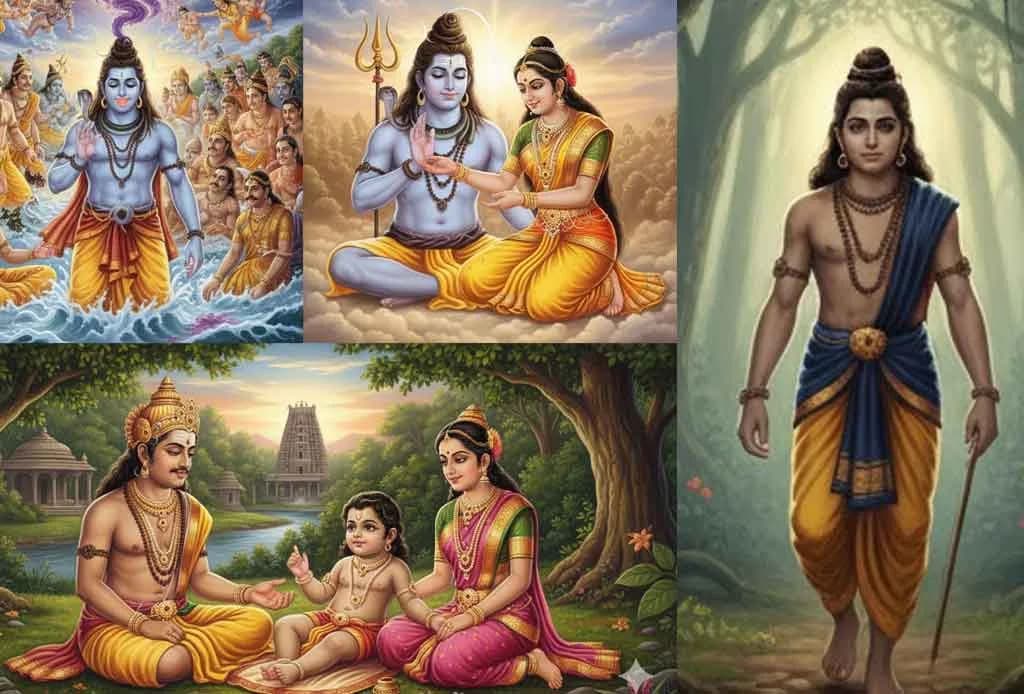
Ayyappa Swamy Story: From Manikanta's Birth to Divine Sabarimala Darshan
Ayyappa Swamy 108 Names - Ashtottara Shatanamavali