The Sabarimala 2018 Verdict: Background, Tradition, and Current Legal Status — A Neutral Explainer
Comprehensive, neutral explainer of the Sabarimala 2018 Supreme Court verdict — the Indian Young Lawyers Association v. State of Kerala judgment, the Naishtika Brahmacharya tradition behind it, the bench composition, the majority and dissenting reasoning, the 2019 review reference of broader constitutional questions to a 9-judge bench, common misconceptions, and how the temple operates today. With FAQ and primary-source links.
Comprehensive, neutral explainer of the Sabarimala 2018 Supreme Court verdict — the Indian Young Lawyers Association v. State of Kerala judgment, the Naishtika Brahmacharya tradition behind it, the bench composition, the majority and dissenting reasoning, the 2019 review reference of broader constitutional questions to a 9-judge bench, common misconceptions, and how the temple operates today.
Editor’s note: this article is a neutral, source-anchored explainer of the Sabarimala temple’s 2018 Supreme Court judgment, the religious tradition behind it, and the present legal status. It is not legal advice, not political commentary, and does not characterise any community by faith. We link primary sources throughout.
Why Sabarimala became the most-discussed religious case of the decade
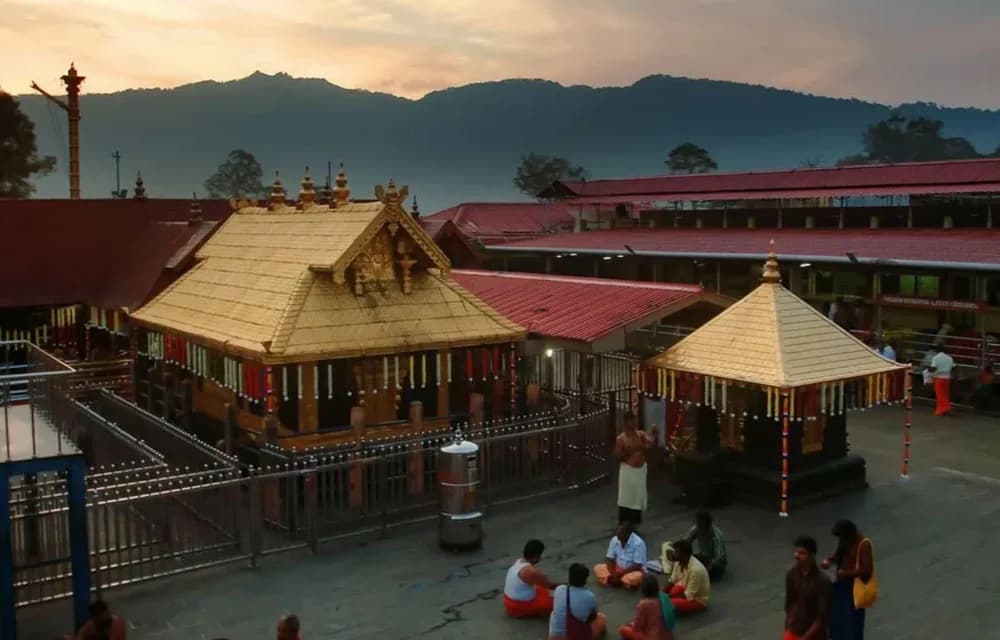
The hill shrine of Sri Dharma Sastha at Sabarimala in Pathanamthitta, Kerala, is one of the world’s busiest pilgrimage sites — drawing 30 to 50 million devotees each Mandala-Makaravilakku season. The temple is administered by the Travancore Devaswom Board (TDB), a statutory body under the Government of Kerala. Until 28 September 2018, the temple followed a centuries-old custom restricting entry of women in the menstruating-age range (often described as 10–50 years), grounded in the deity’s Naishtika Brahmacharya (lifelong celibate) form.
On that date, a five-judge Constitution Bench of the Supreme Court of India delivered its judgment in Indian Young Lawyers Association v. State of Kerala (Writ Petition (Civil) No. 373 of 2006), holding by 4:1 that the practice violated the constitutional right of women to equality and the right of women devotees to worship. The judgment, the dissent, the 2019 review reference to a 9-judge bench, and the temple’s lived practice in the seasons that followed are the four pillars on which any honest understanding of "the Sabarimala issue" rests. This explainer takes them in turn.
Read alongside our Sabarimala Temple 2026 — everything NRIs need to know and Ayyappa Swamy — the symbol of Dharma, Discipline and Devotion.
The tradition: Naishtika Brahmacharya and the deity’s vow
Sabarimala’s presiding deity is Sri Dharma Sastha — popularly worshipped as Sri Ayyappa Swamy. Sthala-purana sources, including the Bhutanatha Upakhyana tradition followed at the temple, hold that Lord Ayyappa is established at Sabarimala as a Naishtika Brahmachari — a deity in a lifelong celibate state. Devotees observe a strict 41-day vratham (Mandala Deeksham) before pilgrimage, abstaining from sense-pleasures, wearing the mala, and following sattvic conduct, in spiritual participation with the deity’s vow.
The temple’s longstanding age-restricted entry custom flowed from this theological setting. Whether the custom was essential to the deity’s worship in the constitutional sense — i.e. whether removing it would alter the religion as practised at this shrine — is precisely the question the Supreme Court took up. We will return to this below.
For the deeper scriptural picture of the Naishtika vow, see our companion piece Naishtika Brahmacharya — Lord Ayyappa’s eternal vow explained.
The petition that reached the Supreme Court
How the case got to a Constitution Bench
The petition was filed in 2006 by the Indian Young Lawyers Association under Article 32 of the Constitution. The original challenge concerned Rule 3(b) of the Kerala Hindu Places of Public Worship (Authorisation of Entry) Rules, 1965 — a rule that permitted custom-based exclusion of women at certain ages from temples. After preliminary hearings before various benches, the matter was referred to a 5-judge Constitution Bench in October 2017 for authoritative determination of the constitutional questions involved.
The questions framed
Did the centuries-old practice violate Articles 14, 15, 17 (untouchability), 25(1) and 51A(e) of the Constitution?
Did the practice constitute "essential religious practice" of a denomination protected by Article 26?
Were Sabarimala worshippers a separate religious denomination?
Was Rule 3(b) of the 1965 Rules ultra vires the parent Act?
AdvertisementDid the rule violate constitutional morality and Part III rights?
The 2018 verdict — what the court actually held
The bench and the result
Date of judgment: 28 September 2018.
Bench: CJI Dipak Misra, Justice R.F. Nariman, Justice A.M. Khanwilkar, Justice D.Y. Chandrachud, and Justice Indu Malhotra.
Result: 4:1 in favour of allowing entry of women of all age groups. The age-restriction practice was struck down. Justice Indu Malhotra dissented.
Reasoning of the majority — in plain English
Sabarimala worshippers are not a separate denomination: the majority held that Ayyappa devotees do not form a religious denomination distinct from the broader Hindu fold under Article 26, so denominational autonomy did not cover the practice.
The practice is not "essential religious practice": the practice could not be shown to alter the fundamental nature of Hindu worship if removed; therefore it did not enjoy Article 25 protection from constitutional scrutiny.
AdvertisementConstitutional morality trumps social morality: the majority held that practices that exclude based on physiological characteristics conflict with the equality and dignity guaranteed by Articles 14 and 15.
Article 17 reasoning (Justice Chandrachud, concurring): treating women’s biological functions as cause for exclusion implicated the abolition of untouchability under Article 17 — a notable but not unanimous strand of reasoning.
Rule 3(b): insofar as it sanctioned the exclusion, it was held inconsistent with the parent statute and unconstitutional.
The Indu Malhotra dissent — what she wrote
Justice Indu Malhotra, the only woman on the bench, dissented at length. Her opinion is widely studied and is worth representing fairly. The principal points were:
The court should not ordinarily inquire into the rationality of religious beliefs that do not have shocking practices like sati or human sacrifice — the test is not what the court finds reasonable, but what the religion considers essential to itself.
What constitutes "essential religious practice" should be decided primarily by the religious community, not the court.
Constitutional morality, in a country of plural religions, must accommodate the right of each religion to determine its own practices, subject to outer limits like public order and morality.
AdvertisementSabarimala worshippers, in her view, did form a religious denomination protected by Article 26.
Articles 25 and 26 are themselves part of constitutional morality — they cannot be overridden in the name of it.
The dissent was not a defence of any social hierarchy; it was a methodological argument about the proper scope of judicial review of religious practice. That distinction is important and is sometimes lost in popular characterisations of the case.
The immediate aftermath — protests, review, and a 9-judge reference
The 2018–19 season
Implementation of the verdict generated significant public protest in Kerala and beyond, with large numbers of women devotees themselves participating in opposition to the entry of women of menstruating age, citing devotion to the deity’s Naishtika Brahmacharya. The pilgrimage season opened on 17 October 2018 under heavy police presence. A small number of women in the previously restricted age range did enter the temple in early 2019; the temple subsequently performed shuddhi (purificatory rites) on its own scriptural footing.
The review petitions
Numerous review petitions were filed under Article 137 of the Constitution. The original five-judge bench heard them in February 2019. On 14 November 2019, a 5-judge bench (with the bench composition changed from 2018) issued an order in Kantaru Rajeevaru v. Indian Young Lawyers Association that, by a 3:2 majority, referred a set of broader constitutional questions to a larger bench of seven or more judges. The questions referred were not narrow to Sabarimala — they encompassed:
The interplay between freedom of religion under Articles 25 and 26 with other fundamental rights.
The scope and ambit of "essential religious practice" doctrine and whether it should be revisited.
AdvertisementWhether courts should venture into determining what is essential to a religion.
How "constitutional morality" is to be understood when in tension with religious morality.
The relationship between Articles 25(2)(b) and 26 — particularly when reformative legislation intersects with denominational autonomy.
Other related questions concerning Muslim and Parsi practices that the court had pending.
Justices R.F. Nariman and D.Y. Chandrachud dissented from the reference itself, holding that the original Sabarimala judgment should be implemented while the broader doctrinal questions were considered separately. The 2018 judgment was not stayed by the reference order. A nine-judge bench was subsequently constituted to consider the referred questions.
Where the matter currently stands
The 2018 majority verdict has not been overruled. It remains the operative judgment.
It has not been stayed. The 14 Nov 2019 reference did not pause the 2018 ruling.
The 9-judge bench is to determine the larger doctrinal questions on essential religious practices and the scope of religious freedom. The judgment in those questions, when delivered, will reshape the framework within which any Sabarimala-specific question is understood.
Practical situation at the temple: TDB administers the shrine on day-to-day basis. The Mandala-Makaravilakku season operates on its traditional schedule. Litigation in subordinate courts continues on incidental matters.
The deeper constitutional questions the case raised
What is "essential religious practice"?
The doctrine of essential religious practices was developed by the Indian Supreme Court from the 1950s onward (notably in The Commissioner, Hindu Religious Endowments, Madras v. Sri Lakshmindra Thirtha Swamiar of Sri Shirur Mutt (1954)). Under it, the state may regulate or even reform religious practice — but it cannot interfere with what is essential to the religion. Determining what is essential, however, has historically been done by the courts themselves, usually through scriptural and customary inquiry. Critics of the doctrine — across the political and religious spectrum — argue that this approach makes secular judges arbiters of religious truth, an awkward role for any court.
Article 26 and denominational autonomy
Article 26 protects the right of religious denominations to manage their own affairs in matters of religion. Whether Sabarimala worshippers constituted such a denomination was a key disputed question. The 2018 majority said no; the dissent said yes. The 9-judge bench is expected to bring further clarity on what makes a "denomination" for constitutional purposes.
Constitutional morality
The phrase "constitutional morality", borrowed in part from Dr. B.R. Ambedkar’s usage in the Constituent Assembly, became central to the 2018 majority’s reasoning. Whether constitutional morality can be deployed to override fundamental rights guaranteed under Articles 25 and 26 — or whether those rights are themselves part of constitutional morality — is itself among the questions referred for larger-bench consideration.
Common misconceptions about the verdict
"The court banned tradition at Sabarimala"
No. The court struck down a specific age-restriction practice that excluded women aged ~10–50 from entering. It did not abolish the deity’s Naishtika Brahmacharya status, the 41-day vrata, the irumudi-kettu, the Pathinettam Padi, or any other element of the worship. The temple’s ritual life continues unchanged.
"Women were never allowed at Sabarimala"
Inaccurate. Women below ten and above fifty have continuously visited Sabarimala. Special darshans like Choroonu (first rice-feeding) for infant girls have always been performed at the shrine.
"The 2019 reference overruled the 2018 verdict"
No. The 14 November 2019 order did not overrule, stay or modify the 2018 verdict. It referred broader constitutional questions to a larger bench. The 2018 verdict remains operative.
"This was a Hindu vs non-Hindu case"
No. The petitioners, the bench, the dissenting judge, and the affected devotees were overwhelmingly Hindu. The case is best understood as an internal constitutional question about the relationship between religious customs and Part III rights.
"Justice Indu Malhotra’s dissent was anti-women"
Her opinion was a methodological argument about the proper limits of judicial review of religious practice — not an argument for women’s subordination. The dissent specifically noted that the court should not be the arbiter of what is essential to a religion, and her reasoning is now studied seriously in constitutional law scholarship across the spectrum.
How the temple operates today — for the practising devotee
Pilgrimage season: Mandala (mid-November to late December) and Makaravilakku (around 14 January). Special monthly opening for the first 5 days of each Malayalam month.
Vratham: 41-day Mandala Deeksham (mala-dharana, sattvic food, sleeping on the floor, no shaving) for those undertaking pilgrimage.
Irumudi-kettu: the two-pouch sacred bundle is mandatory for ascending the 18 sacred steps.
Pathinettam Padi: the 18 sacred steps to the sannidhanam — only for those carrying the irumudi.
Online queue: virtual queue and special darshans are managed via sabarimalaonline.org.
Trekking: via Pamba (~5 km) or Karimala (longer, traditional). Pamba snanam before ascent.
For 2026-27 specifics — opening dates, daily schedule, irumudi preparation, Makaravilakku darshan timings — see our complete Sabarimala Mandalam-Makaravilakku 2026-27 Season Guide.
Frequently asked questions — Sabarimala 2018 verdict
When was the Sabarimala verdict delivered?
On 28 September 2018, by a 5-judge Constitution Bench of the Supreme Court of India in Indian Young Lawyers Association v. State of Kerala, Writ Petition (Civil) No. 373 of 2006. The result was 4:1 striking down the age-restriction practice. Justice Indu Malhotra dissented.
Who were the judges on the bench?
CJI Dipak Misra, Justice R.F. Nariman, Justice A.M. Khanwilkar, Justice D.Y. Chandrachud and Justice Indu Malhotra.
Did the 2019 review overturn the 2018 verdict?
No. The 14 November 2019 order in Kantaru Rajeevaru v. Indian Young Lawyers Association referred broader constitutional questions on essential religious practices and Articles 25–26 to a larger bench (a 9-judge bench was subsequently constituted). The 2018 verdict was neither stayed nor overruled.
What is "essential religious practice"?
A doctrine developed by the Supreme Court from the 1954 Shirur Mutt case onwards, holding that the state may regulate religion but cannot interfere with practices that are essential to the religion. Whether a practice is essential is presently determined by courts — itself a question now before the 9-judge bench.
Is the temple open to all women now?
The 2018 verdict held that women of all age groups have the right to enter. In practice, the operational situation at the temple is shaped by ground conditions, queue management, devotee sentiment and ongoing litigation. The Travancore Devaswom Board administers the temple on a day-to-day basis.
What is Naishtika Brahmacharya?
Naishtika Brahmacharya is a lifelong vow of celibacy described in Hindu shastra (notably the Manu Smriti and Bhagavata Purana). Lord Ayyappa is worshipped at Sabarimala in this Naishtika Brahmachari form. Devotees observe a 41-day vratham in spiritual participation with the deity’s vow. See our scriptural deep-dive on this concept linked above.
Did the verdict affect the Naishtika Brahmacharya tradition?
The court’s ruling concerned a specific entry rule. The deity’s sankalpa, the 41-day vrata, the irumudi-kettu, the Pathinettam Padi and other ritual elements were not affected by the judgment.
Where can I read the judgment?
The full text is available on the Supreme Court of India website (main.sci.gov.in) and on Indian Kanoon (indiankanoon.org) — search for "Indian Young Lawyers Association v. State of Kerala 2018".
What is Rule 3(b) of the 1965 Kerala Rules?
Rule 3(b) of the Kerala Hindu Places of Public Worship (Authorisation of Entry) Rules, 1965, permitted certain age-based exclusions in temples by reference to "custom and usage". The 2018 majority struck down its application to Sabarimala’s women-of-menstruating-age exclusion.
Who administers Sabarimala?
The Travancore Devaswom Board (TDB), a statutory body under Kerala Government, in accordance with the Travancore-Cochin Hindu Religious Institutions Act, 1950.
A closing note for the practising Sanatani
The Sabarimala verdict is, at its centre, a question about how a constitutional court engages with deep religious tradition — and that is a question the larger constitutional bench is now revisiting. Whatever its eventual answer, the temple’s living dharmic life continues: the 41-day vrata is observed, the irumudi-kettu is filled, the Pamba is bathed in, the eighteen steps are climbed, the deity is darshaned. Those acts of bhakti are not in court; they are at home, on the road, on the hill.
Read this together with our Ayyappa Swamy story — from Manikanta’s birth to divine Sabarimala darshan, Significance of the Irumudi-Kettu, and Ayyappa and Vavar Swamy — a lesson of Hindu-Muslim unity from Sabarimala.
🌺 Swamiye Saranam Ayyappa 🙏
Disclaimer: This article is an explainer of public legal and religious-tradition history; it is not legal advice. Court judgments may be revisited; readers should consult primary sources (main.sci.gov.in, indiankanoon.org) and qualified counsel for legal questions.
You might also like
Janmashtami 2026 in India: Date, Rituals & Top Temples to Visit
Sabarimala Ayyappa: Divine Mysteries & Soul-Stirring Miracles of the Forest Lord
Angkor Wat: Divine Mysteries & Soul-Stirring Miracles of Lord Vishnu's Cosmic Temple