

Nada Brahman — The Universe as Sacred Sound | Complete Guide & Devotional Stories
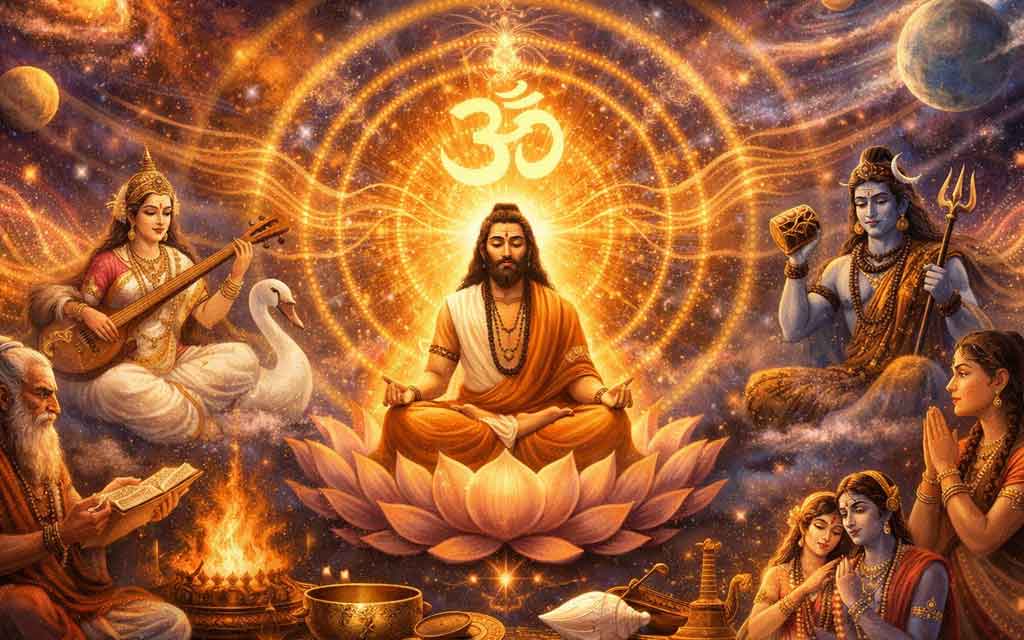
“Nada Brahman — the Absolute is Sound. All that exists, from the subtlest vibration of pure consciousness to the roar of the ocean and the silence of the stars, is Nada. And the one who realizes this realizes everything.” — Ancient Tantric teaching
Close your eyes for a moment.
Listen — not to the words on this page, but to the field of sound in which you are always already immersed. The hum of the world. The distant rhythm of traffic. The whisper of wind. The beat of your own heart. The ringing silence between sounds. And beneath all of it — if you listen very, very carefully — a sound that has no source, that comes from nowhere and everywhere at once.
The sages of ancient India listened to that deepest sound for thousands of years. And what they heard changed everything. They heard the universe singing itself into existence. They heard creation, preservation, and dissolution as movements of a single, eternal music. They heard, beneath every sound and behind every silence, the one vibration they called Nada Brahman — the Absolute as Sacred Sound.
This is not poetry. It is the deepest reality described by the greatest minds India ever produced — confirmed in startling ways by the discoveries of modern physics, neuroscience, and acoustic science.
Welcome to the most profound sound journey you will ever take.
 Table of Contents
 Table of Contents
- What Is Nada Brahman?
- The Philosophy — How Sound Creates the Universe
- Shabda Brahman vs Nada Brahman — The Distinction
- The Four Levels of Sound (Vak)
- Ahata and Anahata Nada — Struck and Unstruck Sound
- Nada Brahman in the Scriptures
- Nada Brahman in Kashmir Shaivism — Spanda
- The Cosmic Journey of Sound — From Silence to Universe
- Nada Brahman and Music — Sangita as Worship
- Devotional Stories of Nada Brahman
- The Story of Tansen and the Divine Raga
- The Story of Tyagaraja’s Nada Upasana
- The Story of Narada and the Secret of Music
- The Story of Mirabai — When the Veena Played Itself
- The Story of Purandaradasa — The Father of Carnatic Music
- The Story of the Sage Who Heard the Unstruck Sound
- Nada Yoga — The Path of Sound to Liberation
- Nada Brahman and the Chakras
- Nada Brahman and Modern Science
- How to Practice Nada Upasana
- Benefits of Nada Upasana
- FAQs
What Is Nada Brahman? {#what-is}
Nada Brahman (Sanskrit: नाद ब्रह्मन्) is the teaching — found across the Vedas, Upanishads, Tantras, and the entire tradition of Indian classical music — that the ultimate reality (Brahman) is not silent but musical, and that the entire universe arises from, is sustained by, and returns into primordial sacred sound (Nada).
The word Nada (नाद) comes from the Sanskrit root nad — meaning to flow, to sound, to reverberate. Nada is not merely sound in the ordinary sense. It is the primal vibration of consciousness itself — the first movement within the stillness of the Absolute that sets all of creation into motion.
Brahman (ब्रह्मन्) is the Sanskrit name for the ultimate reality — the one infinite, eternal, self-luminous consciousness that underlies, permeates, and transcends all of existence.
Put them together: Nada Brahman — the Absolute is Sound. The universe is music. Creation is God singing.
Key distinctions:
| Term | Meaning | Level |
|---|---|---|
| Nada | Primordial vibration / cosmic sound | The first movement within the Absolute |
| Shabda | Sacred word / speech / language | The manifestation of Nada as structured sound |
| Nada Brahman | The Absolute as cosmic vibration | The deepest philosophical teaching |
| Shabda Brahman | The Absolute as sacred word | The linguistic/mantra dimension of the same teaching |
| Anahata Nada | The unstruck/unmanifest sound | The sound heard in deep meditation — the voice of the Absolute |
| Ahata Nada | The struck/manifest sound | All ordinary music, speech, and sound |
| Om / Pranava | The primal audible sound | The gateway between Nada and Shabda |
The Philosophy — How Sound Creates the Universe {#philosophy}
The Silence Before the Beginning
Before the universe existed, there was only pure consciousness — the Absolute, Brahman, Shiva, the Self. This state is called Turiya (the fourth) or Nirguna Brahman (the Absolute without qualities). It is described as:
Shantam — perfectly peaceful. Shivam — supremely auspicious. Advaitam — non-dual, without a second.
In this state, there is no time, no space, no sound, no light — only the infinite, self-luminous awareness resting in its own nature. The ancient texts describe it as the silence between heartbeats — not absence, but fullness so complete that nothing needs to be added.
The First Trembling — Spanda
Then — for no reason that reason can capture, through no cause that thought can trace — the Absolute trembled.
Not a physical trembling. A trembling of consciousness within itself. A subtle, interior pulsation — the first hint of “I AM” within the silence of pure being. The Shaiva texts call this the Spanda — the divine throb, the original quiver of self-recognition within the Absolute.
This Spanda is Para Nada — the transcendent, unmanifest sound that precedes all audible sound. It is not heard by ears. It is the sound of the universe deciding to become a universe.
From Trembling to Creation
From this first trembling, in a cascade of increasingly dense vibrations, the entire universe crystallises:
| Stage | Name | Description |
|---|---|---|
| 1 | Turiya / Shiva | Pure consciousness — absolute silence |
| 2 | Spanda | The first divine trembling — Para Nada arises |
| 3 | Para Nada | Transcendent sound — beyond all hearing |
| 4 | Pashyanti | “Seeing” sound — light-vibration, undifferentiated |
| 5 | Madhyama | “Middle” sound — mental, the sound of thought |
| 6 | Vaikhari | “Embodied” sound — audible speech and music |
| 7 | Sthula Jagat | The gross physical universe — the densest vibration of all |
This is the staggering teaching of Nada Brahman: the chair you are sitting on, the screen you are reading from, the body that breathes you — all of these are the same sacred sound vibrating at different densities. Matter is not different from sound. Matter IS sound — divine sound slowed down to the point of becoming tangible.
This is exactly what Einstein’s equation E=mc² points toward — that matter and energy are interconvertible. The Nada Brahman teaching goes further: energy itself is vibration, and vibration is consciousness singing.
Shabda Brahman vs Nada Brahman — The Distinction {#shabda-vs-nada}
These two terms are often used interchangeably, but they carry slightly different emphases:
| Feature | Nada Brahman | Shabda Brahman |
|---|---|---|
| Emphasis | The vibrational/musical aspect of the Absolute | The linguistic/word aspect of the Absolute |
| Primary tradition | Music, Tantra, Kundalini Yoga | Vedic grammar, Mantra shastra, Mimamsa philosophy |
| Key philosopher | Abhinavagupta (Kashmir Shaivism) | Bhartrhari (Vakyapadiya) |
| Primary text | Nada Bindu Upanishad, Spanda Karikas | Vakyapadiya, Vedas |
| Sound as | Cosmic vibration — the universe’s music | Cosmic word — the universe’s language |
| Path | Nada Yoga, music as sadhana | Mantra Yoga, Vedic recitation |
| Entry point | Inner sound heard in meditation | Sacred syllable recited in worship |
| Ultimate reality | Nada = Brahman | Shabda = Brahman |
The complementary truth: Nada and Shabda are two faces of the same reality. Nada is the music; Shabda is the meaning within the music. The universe is not merely vibrating — it is vibrating intelligently, communicating, expressing, revealing. The cosmos is not just music; it is music with lyrics. Those lyrics are the sacred language of the Vedas, the mantras, and the names of the divine.
The Four Levels of Sound (Vak) {#four-levels}
The ancient Indian sages mapped sound into four increasingly subtle levels — from the gross, audible sounds of ordinary life all the way to the transcendent, inaudible source of all sound. This map is called the Chatvari Vak (the four forms of speech/sound):
Level 1 — Vaikhari (वैखरी) — The Embodied Sound
 Level 1 — Vaikhari (वैखरी) — The Embodied Sound
“Vai” means “embodied” or “manifest in the body.”
Vaikhari is the sound we ordinarily mean when we say “sound” — the vibration of air produced by vocal cords, instruments, wind, water, and all physical sources. This is the world of music, speech, language, birdsong, thunder, and every audible phenomenon.
Vaikhari is the gross body of sound — the outermost layer, the one accessible to the physical ear.
In meditation: Vaikhari is the level at which we begin — chanting mantras aloud, singing devotional songs, listening to sacred music. This is the entry point of Nada Upasana.
Level 2 — Madhyama (मध्यमा) — The Middle Sound
 Level 2 — Madhyama (मध्यमा) — The Middle Sound
“Madhyama” means “middle” — positioned between the gross and the subtle.
Madhyama is the sound of thought — the inner speech of the mind. When you read these words silently, you “hear” them in your mind without producing any physical sound. That inner hearing is Madhyama Vak. It is the mental sound-before-speech — the word forming in the mind before the mouth opens.
Madhyama is where meaning lives. While Vaikhari is the physical carrier wave of sound, Madhyama is the meaning-content that rides within it. A word spoken in a language you do not know enters as Vaikhari but does not reach Madhyama — it does not become meaning. A word in your own language passes through Vaikhari and immediately generates meaning at the Madhyama level.
In meditation: As external chanting deepens into silent repetition (Manasika Japa), the practitioner moves from Vaikhari to Madhyama. The mantra is now entirely interior.
Level 3 — Pashyanti (पश्यन्ती) — The Seeing Sound
 Level 3 — Pashyanti (पश्यन्ती) — The Seeing Sound
“Pashyanti” means “the seeing one” — the sound that is seen rather than heard.
Pashyanti is the level where sound and light merge — where the word has not yet differentiated into specific meaning or specific sound, but exists as a luminous, undifferentiated vibration of awareness. It is the level at which poets, musicians, and mystics receive inspiration — as a flash of pure knowing that has not yet been translated into words.
A composer who suddenly “hears” an entire symphony in a moment of inspiration — before they can write a single note — is touching Pashyanti. A sage who receives a divine vision that they must then “translate” into human language is working at the Pashyanti level.
In meditation: Pashyanti is accessed in very deep states of meditation — when the mental chatter of Madhyama dissolves and what remains is a direct, wordless knowing. Some practitioners report seeing the mantra as pure light at this level.
Level 4 — Para Vak (परा वाक्) — The Supreme Sound
 Level 4 — Para Vak (परा वाक्) — The Supreme Sound
“Para” means “beyond” — the supreme, transcendent, highest.
Para Vak is the source of all sound — the level of pure, undifferentiated vibration within the Absolute itself. It is not heard, not seen, not thought. It IS. It is the sound of existence itself — the primordial hum of being that underlies all manifestation.
Para Vak is identical with Para Nada — the transcendent Nada. It is what the Upanishads describe as the sound of Om at its deepest level, before Om has been articulated. It is Brahman as the potential of all sound — the silence that is pregnant with the entire universe.
In meditation: Para Vak is not accessed — it is recognized. When all mental activity dissolves in the deepest samadhi, what remains is Para Vak — the awareness-as-sound that is the practitioner’s own deepest nature.
The Journey of Sound — From Para to Vaikhari (Creation)
| Direction | Movement | Process |
|---|---|---|
| Para → Pashyanti → Madhyama → Vaikhari | From subtle to gross | Srishti — Creation, the universe manifesting |
| Vaikhari → Madhyama → Pashyanti → Para | From gross to subtle | Laya / Moksha — Dissolution, the path of liberation |
The spiritual path of Nada is the return journey — from the gross sounds of ordinary life, inward through the levels of sound, back to the Para Vak from which everything arose. This is the path of Nada Upasana and Nada Yoga.
Ahata and Anahata Nada — Struck and Unstruck Sound {#ahata-anahata}
One of the most important and practically useful distinctions in Nada Brahman philosophy is between Ahata and Anahata Nada.
Ahata Nada — The Struck Sound (आहत नाद)
“Ahata” means “struck” or “produced by contact.”
All ordinary sound is Ahata — it is produced by the contact (striking) of two things: a bow on a string, a finger on a drum, air on vocal cords, wind on leaves. Ahata Nada is the entire world of music, speech, nature sounds, and all auditory phenomena. It begins, it lasts, and it ends.
Ahata Nada is the sound of creation — the universe expressing itself through the medium of physical vibration.
Anahata Nada — The Unstruck Sound (अनाहत नाद)
“Anahata” means “unstruck” — produced without contact, without cause, without end.
Anahata Nada is the primordial sound that underlies all struck sound — the cosmic hum of existence itself, heard not by the physical ears but by the inner ear of deep awareness. It has no beginning and no end. It does not arise from contact because it never ceased — it is the continuous, eternal vibrational ground of the universe.
In the yogic tradition, Anahata Nada is most commonly experienced as:
- A high-pitched ringing sound in the right ear during deep meditation
- The sound “Om” spontaneously heard in silence
- A deep, subsonic hum or roar felt in the body
- A celestial sound — flute, bells, thunder, ocean — with no external source
- Pure silence that is somehow full rather than empty
Interestingly — and not coincidentally — the heart chakra is also called “Anahata.” The heart is the centre where the unstruck sound is first heard in the body. When the heart is pure and the mind is still, the Anahata Nada rises into conscious awareness as the voice of the divine, speaking from within.
The Ten Internal Sounds of Nada Yoga
The Hatha Yoga Pradipika (one of the primary texts of Hatha Yoga) describes ten stages of Anahata Nada that the practitioner progressively hears in meditation, moving from gross to subtle:
| Stage | Sound | Quality | Effect |
|---|---|---|---|
| 1 | Chini (chirping) | Like a cricket | Mild concentration |
| 2 | Chini-chini | Higher-pitched buzzing | Deeper focus |
| 3 | Bell (Ghanta) | Like a distant temple bell | Absorption begins |
| 4 | Conch (Shankha) | Deep oceanic roar | Mind enters stillness |
| 5 | Lute (Tantri) | String instrument | Subtle joy arises |
| 6 | Cymbal (Tala) | Metallic ringing | Deeper bliss |
| 7 | Flute (Venu) | Ethereal flute | The mind is arrested |
| 8 | Drum (Bheri) | Deep, steady drumbeat | Profound absorption |
| 9 | Mridangam | Complex rhythmic sound | Approaching the source |
| 10 | Thunder (Megha) | The roar of the cosmos | Liberation at the threshold |
The practitioner is taught: “Fix the mind on whatever sound arises — do not let it wander. Merge the mind into that sound. When the sound merges into silence, you have arrived.”
Nada Brahman in the Scriptures {#scriptures}
The Vedas
The Rigveda (the oldest of the four Vedas) opens with the word “Agnim” — but before Agnim, there is “Om”. The entire Vedic tradition begins with the acknowledgment that the primordial sound is the foundation of all knowledge.
The Samaveda — devoted entirely to sacred music and the science of chanting — is itself the Veda of Nada. Its melodies (Samans) are considered the sonic bodies of the deities. To sing the Saman correctly is to invoke the god it embodies.
Nada Bindu Upanishad
The Nada Bindu Upanishad is perhaps the most important scripture specifically dedicated to Nada Brahman. It opens with the declaration:
“The syllable Om consists of three letters — A, U, M. The Om which is the basis of all speech is in reality the non-dual Brahman. One who meditates on the Nada will reach Brahman through Nada.”
The Nada Bindu Upanishad teaches a complete Nada Yoga system — the progressive withdrawal of the mind from gross sounds to the subtlest sounds, culminating in the silence that IS the Absolute.
Its central teaching: “As a bee sipping honey does not care whether the flower is sweet-smelling or not, so the mind absorbed in Nada does not crave for sense objects. The mind cut off from sense objects by the knife of Nada becomes dissolved in the supreme space of consciousness.”
Hatha Yoga Pradipika
The Hatha Yoga Pradipika (Chapter 4) contains an extensive teaching on Nada Anusandhana (inner sound investigation):
“With closed ears and closed eyes, the attentive Yogi should listen to the inner sound within the right ear. By constant practice of this yoga, all obstacles are overcome. In the beginning, the sounds heard are loud and varied. As practice deepens, the sounds become more and more subtle. The Yogi should leave the gross sound and focus on the subtle. If the mind wanders, bring it back to the subtler sound. With whatever sound the mind unites, it becomes one with it and dissolves.”
Sivananda Lahari (Adi Shankaracharya)
The great Adi Shankaracharya — the philosopher of Advaita Vedanta who synthesised the entire Hindu tradition — wrote the Sivananda Lahari, which contains this celebrated verse on Nada:
“The universe arose from Nada. The universe IS Nada. Nada is Shiva. Shiva is Nada. The one who knows this Nada knows the Absolute.”
Svararnava Tantra
The Svararnava Tantra explicitly states:
“All that exists in this universe — moving and unmoving — is nothing but Nada. Nada is Brahman. Knowing this, the wise one is liberated.”
Nada Brahman in Kashmir Shaivism — Spanda {#kashmir-shaivism}
No philosophical tradition has explored Nada Brahman with greater depth and precision than Kashmir Shaivism — the non-dual Shaiva philosophy that flourished in Kashmir between the 8th and 12th centuries CE.
The Great Philosophers of Sound
| Philosopher | Era | Key Text | Contribution |
|---|---|---|---|
| Vasugupta | 9th century CE | Shiva Sutras, Spanda Karikas | Revealed the doctrine of Spanda |
| Abhinavagupta | 10th–11th century CE | Tantraloka, Paratrishika Vivarana | The most comprehensive synthesis of Nada philosophy |
| Kshemaraja | 11th century CE | Pratyabhijnahridayam | Accessible summary of the Spanda/Nada teaching |
| Utpaladeva | 10th century CE | Ishvara Pratyabhijna | The recognition school — universe as self-expression of Shiva |
The Doctrine of Spanda — The Divine Pulse
The central teaching of Kashmir Shaivism on sound is Spanda — the teaching that the Absolute is not static but vibratory. The word Spanda means “vibration,” “throb,” “pulse,” or “movement.”
The Spanda Karikas (Verses on Divine Vibration) teach:
“That from which the activities of speech and its objects arise, that from which even the self-existence of all apparently external things emerges — that alone is the highest reality, eternally pulsating, which the wise know as Spanda.”
The profound implication: Spanda is not something the Absolute does. Spanda is what the Absolute IS. The universe is not a product that the divine made — it is the divine’s own vibrational self-expression, the divine’s own song.
The Doctrine of Pratibha — Divine Flash
Abhinavagupta’s concept of Pratibha (divine flash/illumination) explains how sound and consciousness relate at the deepest level. Pratibha is the sudden, spontaneous, self-luminous flash of recognition within consciousness — and it IS Nada at the level of Pashyanti.
When a musician receives a melody in a sudden inspiration, when a poet receives a line from “beyond” themselves, when a devotee suddenly understands a truth they have been contemplating for years — this is Pratibha. And Pratibha is the self-disclosure of Nada Brahman within individual consciousness.
The Cosmic Journey of Sound — From Silence to Universe {#cosmic-journey}
Let us now follow the complete journey of Nada — from the primordial silence of the Absolute to the multiplicity of the created universe, and then back again:
Stage 1: Paramashiva — The Ocean of Silence
Before the beginning, only the Absolute.
Paramashiva rests in absolute stillness — pure consciousness, pure bliss, containing within itself the potential of the entire universe as a seed contains a forest. No vibration. No sound. Absolute fullness, absolute peace.
This is Shunyata — the sacred void — but not the emptiness of absence. The emptiness of infinite fullness.
Stage 2: Iccha — The First Desire
 Stage 2: Iccha — The First Desire
The Absolute desires to know itself.
Within the stillness, the first movement arises — not a physical movement, but a movement of consciousness within itself. The Absolute “wants” to experience itself, to see itself in a mirror. This desire (Iccha) is the Iccha Shakti — the power of will — the first of the Goddess’s three powers.
This is the moment before Para Nada — the intention before the sound.
Stage 3: Para Nada — The Transcendent Vibration
The intention becomes vibration.
Iccha Shakti sets the Absolute into the subtlest possible vibration — Para Nada. This is not a physical sound. It is the sound of consciousness recognizing itself. The universe has not yet appeared — but the first vibration of its potential has arisen.
Para Nada cannot be heard by any instrument or any physical ear. It can only be recognized — in the deepest samadhi — as one’s own nature.
Stage 4: Para Bindu — The Pregnant Point
The vibration concentrates into a point of infinite potential.
Para Nada condenses into Para Bindu — the supreme point. This is the geometric dot at the centre of the Sri Yantra, the physical singularity of the Big Bang, the seed of the universe. The entire cosmos is contained in this point — in potential, in seed form.
Stage 5: Pashyanti — Sound Becomes Light
 Stage 5: Pashyanti — Sound Becomes Light
The point begins to expand.
Para Bindu expands outward as Pashyanti — the level of sound-as-light. This is not yet differentiated into specific sounds or meanings, but is a luminous, undulating field of pure potentiality. At this level, sound and light are indistinguishable.
This is the level of divine vision (Divya Drishti) — the level at which rishis (seers) receive the Vedas, not as heard sounds but as directly cognized realities of light and vibration.
Stage 6: Madhyama — Sound Becomes Thought
Pashyanti differentiates into specific patterns.
The luminous field of Pashyanti begins to differentiate into specific vibrational patterns — archetypes, proto-meanings, the templates of things-to-be. This is Madhyama — the mental level of sound. The ideas of mountain, river, tree, human, atom — all arise here as sonic archetypes before they take physical form.
Stage 7: Vaikhari — Sound Becomes the World
The patterns crystallize into physical reality.
Madhyama’s archetypes crystallize into Vaikhari — the physical, audible, tangible world. Every physical object is Vaikhari Nada — a particular frequency of vibration slowed to the point of matter. The universe is God’s voice made solid.
Human speech and music arise here — our language and our art are the universe’s way of reflecting its own Vaikhari nature back to itself through conscious beings.
The Return — Laya (Dissolution)
 The Return — Laya (Dissolution)
The reverse journey — Vaikhari → Madhyama → Pashyanti → Para Nada → Silence.
The spiritual path of Nada Brahman is the return journey — using the gross sounds of music and mantra to travel inward through the increasingly subtle levels of sound, until one arrives at the Para Nada — and in recognizing Para Nada as one’s own nature, returns home.
This is not a physical journey. It happens entirely within consciousness. And it is the purpose of all music, all mantra, all meditation.
Nada Brahman and Music — Sangita as Worship {#music}
In the Hindu tradition, music (Sangita) is not entertainment — it is a direct path to the divine. This understanding flows directly from Nada Brahman philosophy: if the universe is sound, then the highest form of sound — carefully organized, intentionally performed, devotionally offered music — is the most direct way to touch the universe’s own nature.
The Three Components of Sangita
Classical Indian music theory defines Sangita as the union of three arts:
| Component | Sanskrit | Description |
|---|---|---|
| Vocal music | Gita | The human voice — the most natural and direct instrument |
| Instrumental music | Vadya | Musical instruments — extensions of the human voice |
| Dance | Nritya | The body as an instrument of the divine — movement as sound made visible |
The Sacred Origin of Music
According to Hindu tradition, music did not originate with human beings — it originated with the divine. The gods themselves are musicians:
- Lord Shiva plays the Damaru (two-headed drum) — whose rhythmic beating creates and dissolves the universe. The 14 foundational rules of Sanskrit grammar (the Maheshvara Sutras) are said to have arisen from the 14 beats of Shiva’s Damaru.
- Lord Vishnu plays the Shankha (conch) — whose sound, Panchajanya, is the sound of dharma and divine order.
- Lord Krishna plays the Murali (flute) — whose music represents the call of the divine to the individual soul.
- Goddess Saraswati plays the Veena — the seven strings of which correspond to the seven notes of the musical scale (Sa, Re, Ga, Ma, Pa, Dha, Ni).
- Sage Narada plays the Tambura — and wanders the cosmos singing the glories of Vishnu.
The Seven Notes as Cosmic Frequencies
The seven notes of Indian classical music — Sa, Re, Ga, Ma, Pa, Dha, Ni (corresponding to Do, Re, Mi, Fa, Sol, La, Ti in Western notation) — are not mere musical conveniences. Each is a specific cosmic frequency:
| Note | Sanskrit | Deity | Animal Sound | Chakra | Quality |
|---|---|---|---|---|---|
| Sa | Shadja | Agni (Fire) | Peacock | Muladhara | Foundation, stability |
| Re | Rishabha | Brahma | Bull/Chakora bird | Svadhisthana | Creativity, flow |
| Ga | Gandhara | Saraswati | Goat | Manipura | Will, power |
| Ma | Madhyama | Vishnu | Dove | Anahata | Love, balance |
| Pa | Panchama | Shiva | Kokila (cuckoo) | Vishuddha | Expression, truth |
| Dha | Dhaivata | Ganesha | Horse | Ajna | Wisdom, intuition |
| Ni | Nishada | Surya (Sun) | Elephant | Sahasrara | Liberation, transcendence |
This table reveals something extraordinary: Indian classical music is not merely aesthetic — it is a complete science of consciousness, using sound to systematically activate and harmonize every level of the human energy system.
Devotional Stories of Nada Brahman {#stories}
Story 1: Tansen and the Divine Raga — When Music Lit Fire
 Story 1: Tansen and the Divine Raga — When Music Lit Fire
In the court of the Mughal Emperor Akbar lived the most celebrated musician India has ever known — Tansen, whose music was said to make stone weep and rain fall from cloudless skies.
One day, Emperor Akbar — having heard of Tansen’s miraculous abilities — demanded that he perform Raga Deepak, the raga of fire. It was known that a true performance of Deepak, rendered at the pinnacle of mastery, would cause lamps to spontaneously ignite — and would also cause the performer’s own body to burn with internal heat, threatening his life.
Tansen was afraid. But the Emperor insisted.
Before the performance, Tansen summoned his daughters — Tani and Saraswati — and taught them Raga Megh Malhar, the raga of rain and clouds. He instructed them: “When the lamps begin to light — begin to sing. Sing with your whole heart. Let the Megh Malhar bring rain.”
On the appointed evening, Tansen began to sing Raga Deepak. The court fell into an awed silence. As his voice rose into the higher registers — pure, perfect, precise — something extraordinary happened. The oil lamps in the great hall, unlit and untouched, began to glow. One by one, threads of flame appeared on each wick as if the sound itself were igniting them.
The courtiers gasped. The emperor stared in disbelief. The very air seemed to tremble with heat.
Tansen’s body began to sweat and shimmer. His voice was unwavering — but his skin reddened, and those close to him could feel the heat radiating from his body as if he were himself a lamp.
At precisely that moment, from a distant balcony — barely audible at first — the voices of Tani and Saraswati began to rise:
“Baraso re megha, baraso…”
Clouds gathered with impossible speed. The temperature in the hall dropped. Drops of rain fell from the clouds above the palace. And as the first rain touched Tansen’s burning skin, the fire within him cooled, and he completed the raga safely.
The teaching: Every raga is a specific energy pattern — a particular manifestation of Nada Brahman. Deepak is fire-consciousness. Megh Malhar is water-consciousness. The universe’s elemental forces are not separate from sound — they ARE sound, vibrating at different frequencies. The master musician who truly embodies a raga does not merely play it — they BECOME it.
Story 2: Tyagaraja’s Nada Upasana — The Composer Who Lived in Sound
In the temple town of Thiruvaiyaru in Tamil Nadu, in the late 18th century, lived one of the greatest composers in the history of Indian music — Saint Tyagaraja. A devotee of Lord Rama of unparalleled intensity, Tyagaraja composed over 24,000 compositions in Telugu and Sanskrit — and composed them not by effort but by divine reception.
Tyagaraja’s daily practice was extraordinary. Each morning before dawn, he would sit before his image of Rama and begin his Nada Upasana — the worship of Rama through music. He would sing raga after raga — not to perform, not to impress, but to dissolve.
One morning, deep in the rendering of Raga Bhairavi — the ancient raga of dawn, devotion, and longing — Tyagaraja closed his eyes and something left his ordinary awareness behind. His voice continued, but it was no longer him singing. The raga was singing itself through him.
Hours passed. The lamps burned down. His disciples, watching from the doorway, did not dare interrupt.
When he finally opened his eyes, tears streaming down his face, he spoke one sentence:
“I have just heard Rama sing. My voice was the instrument. Rama was the musician.”
That morning he composed the immortal Pancharatna Krithi — “Jagadananda Karaka” (He who brings joy to the universe) — the composition that remains, to this day, the summit of the Carnatic music tradition.
The teaching: Tyagaraja’s life embodied the supreme truth of Nada Brahman — that the individual musician is not the source of music. The individual is only the instrument. The real musician is the divine. When the ego of the performer dissolves completely into the sound, what plays is not the man but the Absolute. This is the state called Nada Samadhi — absorption into sound.
Story 3: Narada and the Secret of Music — Why Devotion Exceeds Skill
The sage Narada — the divine wanderer, the eternal musician of the cosmos, the one who carries his tambura and the name of Vishnu across all the three worlds — once grew proud.
He had mastered every raga, every tala, every subtlety of Nada Shastra. He could make listeners weep with Bhairavi, fill them with courage with Bhairav, and transport them to ecstasy with Yaman. He was, by every measure of musical accomplishment, the greatest musician in all the three worlds.
One day, as he played and sang before Lord Vishnu at Vaikunta, a thought arose in his mind — barely a whisper, but present: “Is there anyone who sings better than I do?”
Vishnu, who knows every thought in every mind, smiled.
“Narada,” he said gently, “come with me.”
He led Narada to a strange place — a vast dark valley where the ground was littered with broken, writhing forms. They were half-human, half-instrument — people merged with veenas, with flutes, with drums — all groaning in apparent agony.
Narada recoiled in horror. “Lord! What is this terrible place? Who are these beings?”
Vishnu said: “These are the ragas — the musical scales. They are wounded, Narada. They are in pain.”
“But — why? How can ragas be wounded?”
“Because they were not sung correctly. Because they were performed without devotion, without understanding, without surrender. When music is performed from ego — even with perfect technical skill — the raga does not fly; it falls and breaks.”
Narada stood in silence, shaken.
Then Vishnu led him elsewhere — to a meadow of such breathtaking beauty that words fail. In the centre, radiant beings danced and played — and from them arose music of such unearthly beauty that Narada, for all his mastery, felt he had never heard music before.
“Who are these?” he whispered.
“These too are ragas,” Vishnu said. “Healed. Whole. Alive. They were sung by simple devotees — farmers, potters, weavers — people with no technical training, but hearts so full of love that their singing carried the ragas directly to the Absolute.”
Narada fell at Vishnu’s feet.
“Forgive me, Lord. I have known music but not its source. I have known the sound but not the silence from which it comes.”
Vishnu raised him gently. “Now you know the secret, Narada. Nada without Bhakti (devotion) is a lamp without oil. It makes a shape but gives no light. Nada with Bhakti is the sun — it needs no container, no technique, no perfection. It simply shines.”
The teaching: Nada Brahman cannot be accessed through technical skill alone. It requires the dissolution of ego — the surrender of the performer into the performance, the merger of the musician into the music. Devotion (Bhakti) is not a supplement to musical excellence — in the deepest sense, it IS the music.
Story 4: Mirabai — When the Veena Played Itself
Mirabai — the 16th-century Rajput princess who abandoned palace, royalty, and social convention to wander as a bhakta of Lord Krishna — is one of the most luminous examples of Nada Brahman lived as a life.
She did not study music. She did not study philosophy. She did not perform spiritual austerities in the conventional sense. She simply loved Krishna with a love so absolute that everything else ceased to matter.
And from that love, music poured.
The story is told that one evening in Vrindavan, Mirabai sat before the image of Krishna in the Vrindavan temple, her small veena in her hands. She had been in deep pain — separated from her beloved Lord, longing with a longing that had no resolution.
She touched the strings of the veena. And then something happened that those present could never adequately explain.
She stopped playing.
She put her hands in her lap.
The veena continued.
It played on its own — melody after melody, each more heartbreaking and more beautiful than the last. The temple fell into a silence so profound that the lampflame stopped flickering. Devotees who had been restless and distracted found their minds arrested, their eyes filled with tears they could not explain.
For three hours, the veena sang by itself.
When it finally fell silent, Mirabai opened her eyes. She looked at the image of Krishna with an expression that those present described as “the face of someone who has just returned from a very, very long journey home.”
She said nothing. She placed a single marigold at Krishna’s feet and walked out into the evening.
The teaching: This is the ultimate truth of Nada Brahman — when the devotee completely disappears into their devotion, what plays is no longer the instrument of the human being. What plays is the divine itself. The veena playing itself is not a miracle of supernatural intervention. It is the natural consequence of the ego’s dissolution into love. When there is no “Mirabai playing the veena” — there is only Nada playing itself.
Story 5: Purandaradasa — The Father of Carnatic Music
Purandaradasa (1484–1564 CE) — revered as the Pitamaha of Carnatic Music (the grandfather/father of the entire tradition) — lived a life that was itself a teaching on Nada Brahman.
He began life as Srinivasa Nayaka — the wealthiest moneylender in Karnataka, utterly devoted to accumulation, famously miserly, refusing alms to even the most desperate.
The transformation came in the form of his own wife.
A poor Brahmin had come to Srinivasa repeatedly, begging for money to complete a sacred ritual. Each time, Srinivasa refused. In desperation, the Brahmin went to Srinivasa’s wife, who — in a moment of pure compassion — secretly gave him her own gold nose-ring.
When Srinivasa discovered the nose-ring missing, he flew into a rage. His wife, rather than expose herself to danger, prayed desperately to Vittala (the form of Vishnu worshipped at Pandharpur). She prepared to drink poison.
At that moment — at the precise instant of her surrender — her nose-ring appeared in the cup of water she had drawn. And simultaneously, Srinivasa, at his pawn shop, opened a box he had received as pledge — and found the same nose-ring there.
His moneylender’s logic crumbled. How could the same object be in two places? There was no rational explanation. But there was a devotional one.
He ran home. He fell at his wife’s feet. He wept.
And from that moment, Srinivasa ceased to exist and Purandaradasa was born.
He gave away every possession, accepted the ochre robes of a wandering devotee, took his tambura, and spent the remaining 50 years of his life wandering from temple to temple, composing devotional songs to Vittala — songs so precisely calibrated to the human heart that they remain the foundational curriculum of Carnatic music to this day.
He composed over 475,000 compositions — songs so numerous that if one sang them continuously for 24 hours a day, it would take over 50 years to sing them all.
His famous statement summarizes the Nada Brahman teaching in one line:
“Music is the ladder that reaches where logic cannot climb.”
The teaching: Purandaradasa’s life shows that Nada Brahman is not reached through wealth, status, or even learning. It is reached through the complete dissolution of the small self — through the earthquake of divine grace that shatters every barrier between the individual and the Absolute. When that dissolution happens, what flows through the emptied vessel is not human music. It is cosmic music — the universe singing through a willing, empty, transparent soul.
Story 6: The Sage Who Heard the Unstruck Sound — A Teaching Story
In a certain ashram in the mountains, an elderly sage sat in meditation from before dawn until after dusk, every day, for forty years.
Students came and went. Some stayed for years. All of them, eventually, asked the same question:
“Guruji, what do you hear in your meditation? What is it that keeps you there, hour after hour, day after day, decade after decade?”
For forty years, the sage gave no answer. He only smiled — a smile that somehow simultaneously contained joy and sorrow, fullness and longing, arrival and perpetual journey.
One morning, a young student who had been with the sage for three years — a musician by training, who had joined the ashram after becoming convinced that music was not enough — sat beside the sage before dawn. He did not ask a question. He simply sat, and breathed, and listened.
The pre-dawn silence of the mountain was extraordinary. The wind had stopped. The birds had not yet begun. It was the silence between night and day — the Brahma Muhurta — the holiest hour.
And in that silence, for the first time in his life, the young musician heard it.
Not with his ears. His ears heard nothing. But from somewhere deep in the centre of his chest — from the space behind his sternum, from the region the ancient texts called Anahata — a sound arose.
It was not loud. It was the subtlest thing he had ever heard. And yet it was more present, more real, more vivid than any sound he had ever perceived with his physical ears.
It was like the sound of the entire universe breathing.
It was like a tone that contained every tone.
It was like silence that had learned to sing.
He sat, transfixed, for what he later calculated must have been two hours. He did not move. He did not breathe consciously. He simply listened.
When it faded — or rather, when his attention could no longer sustain itself at that level of subtlety — he opened his eyes.
The sage was watching him. And for the first time, the sage spoke:
“Now you know what I hear.”
The young musician — tears streaming down his face — asked the only question he could form:
“What IS it?”
The sage looked at the rising sun, just cresting the mountain.
“It is the sound the universe makes when it forgets it is separate from itself. It is the Absolute, recognising its own reflection in the mirror of a human soul. It is Nada Brahman — the universe singing its own name.”
He paused.
“And now that you have heard it, you will never again be entirely comfortable with ordinary silence. Because you will always know what lives inside it.”
The teaching: The Anahata Nada — the unstruck sound — is not something exotic or rare. It is the most fundamental sound in existence — the hum of being itself. We do not hear it because we are surrounded by the louder sounds of thought, emotion, and sense perception. But in the right conditions — deep silence, an open heart, a still mind — it rises into awareness as naturally as a spring rises through earth. And when it is heard, it is recognized as the most familiar thing in the universe — more familiar than one’s own name, more intimate than one’s own breath.
Nada Yoga — The Path of Sound to Liberation {#nada-yoga}
Nada Yoga is the formal yogic path that uses sound as its primary vehicle for spiritual liberation. It is one of the most ancient and complete paths of yoga, though less widely known than Hatha Yoga, Karma Yoga, or Bhakti Yoga.
The Four Stages of Nada Yoga
| Stage | Name | Practice | Sound Experienced |
|---|---|---|---|
| 1 | Arambha | Beginning stage | External sound (Ahata) — music, chanting |
| 2 | Ghata | The clay pot stage | Transition inward — outer sound leads to inner |
| 3 | Parichaya | Acquaintance | Consistent Anahata Nada heard in meditation |
| 4 | Nishpatti | Culmination | Merger of mind into Nada — Samadhi |
The Method of Nada Anusandhana
Nada Anusandhana (investigation/inquiry into inner sound) is the primary Nada Yoga technique:
Step 1 — Shanmukhi Mudra (Closing the Six Gates) Sit in Siddhasana (accomplished posture). Use the fingers to close the six gates of the face: thumbs on the ear passages, index fingers on the closed eyelids, middle fingers on the nostrils (lightly), ring and little fingers above and below the lips. This withdraws the sense organs from external stimulation.
Step 2 — Listen With the gates closed and the senses withdrawn, listen — not for any specific sound, but with an open, attentive quality of awareness directed inward. The right ear is traditionally recommended as more sensitive to inner sounds.
Step 3 — Track the Subtler Sound As sounds arise in awareness — from gross (like a waterfall or cicadas) to subtle (like a flute or bells) — always move the attention to the subtler sound, leaving the grosser one behind. Never pursue the gross; always follow the subtle inward.
Step 4 — Merge When a sufficiently subtle sound is found, merge the mind completely into it. Do not analyze, do not compare, do not narrate. Simply dissolve the boundary between the listener and the sound. Be the sound.
Step 5 — The Great Silence When even the subtlest inner sound dissolves — what remains is not emptiness but the fullness of Para Vak — the source of all sound. Abide there.
Nada Brahman and the Chakras {#chakras}
Every chakra in the subtle body has a specific Bija Mantra (seed sound) — a monosyllabic sound that is the sonic body of that chakra’s energy. This reveals that the entire chakra system is a system of sacred sound — the body itself is a musical instrument:
| Chakra | Location | Bija Mantra | Quality | Sound Character |
|---|---|---|---|---|
| Muladhara | Base of spine | LAM (लं) | Earth, stability | Deep bass — like a drum |
| Svadhisthana | Sacral | VAM (वं) | Water, creativity | Flowing — like a stream |
| Manipura | Solar plexus | RAM (रं) | Fire, will | Crackling — like fire |
| Anahata | Heart | YAM (यं) | Air, love | Gentle — like a breeze through leaves |
| Vishuddha | Throat | HAM (हं) | Space, expression | Clear — like a bell in open air |
| Ajna | Third eye | OM (ॐ) | Light, wisdom | Subtle — like a sustained tone |
| Sahasrara | Crown | Silence / OM | Pure consciousness | The unstruck sound — Anahata Nada |
The significance: Chanting the Bija Mantra of each chakra is not symbolic — it is the direct activation of that chakra’s energy through its own natural vibrational frequency. The body, viewed through Nada Brahman, is a complete seven-octave musical instrument — and the practice of Nada Yoga is learning to play it in tune.
Nada Brahman and Modern Science {#science}
The teaching that the universe is fundamentally vibrational — that all matter is sound at different densities — has received extraordinary independent confirmation from modern science:
String Theory
String Theory — currently the leading framework in theoretical physics for unifying quantum mechanics and general relativity — proposes that the fundamental constituents of the universe are not particles but one-dimensional vibrating strings of energy. Different vibration modes of these strings produce different particles and forces.
In String Theory’s own language: matter is music. The universe is a symphony of one-dimensional vibrating strings, each note of which is a particle, a force, a constituent of reality.
This is Nada Brahman stated in the language of mathematics.
The Cosmic Microwave Background — The Echo of Creation
The Cosmic Microwave Background (CMB) — the residual radiation from the Big Bang — has been mapped by the WMAP and Planck space observatories. Analysis of the CMB reveals acoustic oscillations — sound waves that propagated through the early universe in the first 380,000 years after the Big Bang.
These sound waves literally shaped the large-scale structure of the universe — determining where galaxies would form and where voids would remain. The universe as we see it today — its pattern of galaxies and clusters — is a frozen snapshot of its own primordial music.
Cymatics — Sound Creates Form
Cymatics (from the Greek kyma — wave) is the science of visible sound. When sound is directed at a medium (sand on a metal plate, water in a dish), it creates precise geometric patterns — patterns that become more complex and more beautiful as the frequency rises.
The patterns produced by the Bija Mantras of the chakras, when processed through cymatic equipment, produce patterns remarkably similar to the traditional geometric representations of those chakras. The sound literally creates the geometry.
The Earth’s Resonant Frequency
The Earth itself has a fundamental resonant frequency — the Schumann Resonance — of approximately 7.83 Hz. This is the frequency at which electromagnetic waves resonate in the cavity between the Earth’s surface and the ionosphere. It is, quite literally, the Earth’s own note — the sound of the Earth as a musical instrument.
This 7.83 Hz frequency falls precisely in the range of theta brainwaves — the brainwave state associated with deep meditation, creative insight, and spiritual experience. The Earth’s own music resonates with the human brain’s meditative frequency. The universe is tuned to itself.
How to Practice Nada Upasana {#practice}
Nada Upasana — the devotional practice of approaching the divine through sound — is the practical application of the Nada Brahman philosophy. Here is a complete, progressive system:
Level 1 — Listening Practice (Shravana)
For beginners — 4 weeks
The first practice is simply learning to listen — deeply, totally, without agenda.
Daily practice (15–20 minutes):
- Sit comfortably. Close the eyes.
- Listen to whatever sounds are present — traffic, wind, birds, the hum of electricity.
- Do not label, do not analyze. Simply receive each sound as it is.
- When the mind wanders, return to listening.
- Gradually become aware of the silence between sounds — the background of quiet in which all sounds arise and dissolve.
This practice develops: Pratyahara (withdrawal of the senses from habitual distraction), the basic receptivity required for deeper Nada practice.
Level 2 — Devotional Music (Sangita Upasana)
Weeks 5–12
Daily practice (30–45 minutes): Choose a devotional music tradition that resonates:
- Carnatic classical music (South India) — for deep meditative absorption
- Hindustani classical (North India) — for emotional depth and the raga system
- Bhajan and Kirtan — for devotional surrender and heart opening
- Vedic chanting — for the precise vibration of Sanskrit mantras
Listen with closed eyes, full attention, and an open heart. The quality of listening, not the style of music, is what matters.
Alternatively: Learn to sing even simple devotional songs (Bhajans). The vibration of your own voice is the most direct Nada practice available to you.
Level 3 — Om and Bija Mantra Practice
 Level 3 — Om and Bija Mantra Practice
Ongoing — minimum 3 months
Daily practice (20–30 minutes):
- Begin with 21 repetitions of Om — full, slow, with all three letters and the silence
- Chant the Bija Mantras of the seven chakras in ascending order — LAM, VAM, RAM, YAM, HAM, Om, Silence — 7 times each
- Rest in silence for 5–10 minutes after the final Om
This practice systematically activates the seven levels of sound within the body — from the grossest (Muladhara) to the most subtle (Sahasrara).
Level 4 — Nada Anusandhana (Inner Sound Meditation)
 Level 4 — Nada Anusandhana (Inner Sound Meditation)
After 3+ months of prior practice
Daily practice (30–45 minutes): Use the Shanmukhi Mudra technique described in the Nada Yoga section above. Listen inward. Follow the sound from gross to subtle. Merge. Dissolve. Return.
This is the heart of Nada Upasana — the direct investigation of the Anahata Nada, the unstruck sound, the voice of the Absolute.
Benefits of Nada Upasana {#benefits}
Physical Benefits
- Cellular healing — Every cell in the body responds to specific sound frequencies; Nada Upasana creates healing resonance at the cellular level
- Heart health — The Anahata (heart) chakra activation through Nada practice improves both physical and energetic heart health
- Sleep — Nada practice shifts brainwaves from beta to theta — directly improving sleep quality
- Stress physiology — Measurable reduction in cortisol, adrenaline, and inflammatory markers
Psychological Benefits
- Concentration — Following subtle inner sounds trains razor-sharp one-pointed awareness
- Emotional release — Music and sound access emotional material that words cannot reach
- Creativity — Nada practice opens the Pashyanti level of consciousness — the source of artistic inspiration
- Equanimity — The practitioner learns to be the space in which sounds arise — rather than being carried away by them
Spiritual Benefits
- Direct perception of Brahman — The Anahata Nada IS a direct perception of the Absolute — not a representation but the thing itself
- Kundalini awakening — Nada is one of the most effective and gentle methods of awakening Kundalini energy
- Bhakti deepening — Devotional music transforms intellectual knowledge of the divine into felt, lived, embodied love
- Samadhi — The merger of mind into the Anahata Nada is a recognized form of Samadhi — described in multiple Yoga texts
- Liberation — The Nada Bindu Upanishad states directly: “One who meditates on Nada, attains liberation.”
Frequently Asked Questions (FAQs) {#faqs}
Q1. Is Nada Brahman only relevant to musicians and music lovers? Not at all. While music is one of its primary expressions, Nada Brahman is a complete philosophical and spiritual system accessible to everyone. The Anahata Nada (inner sound) practice requires no musical training — only the capacity to sit still and listen. In fact, some of the deepest Nada practitioners in history were not professional musicians but simple devotees.
Q2. What does the Anahata Nada actually sound like? It varies by practitioner and by depth of meditation. Common descriptions include: a high-pitched ringing in the right ear, a distant flute or bell, a deep hum like a large engine far away, the sound of Om spontaneously arising, or an oceanic roar. The Hatha Yoga Pradipika describes ten progressive sounds from cricket-chirp to cosmic thunder. The key is not what it sounds like but the quality of absorption it induces.
Q3. How is Nada Brahman different from music therapy? Music therapy uses sound as a therapeutic tool for specific physical and psychological conditions. Nada Brahman is a complete philosophical and spiritual system that encompasses therapy but goes far beyond it. Where music therapy aims at healing, Nada Brahman aims at liberation — the recognition of one’s own identity as the source of all sound.
Q4. Can Nada Upasana be combined with other spiritual practices? Yes, and in fact it should be. Nada Upasana combines beautifully with Bhakti Yoga (devotional practice), Mantra Yoga (sacred sound repetition), Kundalini Yoga (subtle body activation), and any form of meditation. It is a support and amplifier for virtually every other spiritual practice.
Q5. Is there a specific time of day best for Nada practice? The Brahma Muhurta (approximately 90 minutes before sunrise — around 4:30 to 6:00 AM) is considered the most auspicious time. At this hour, the world is at its quietest, the mind is fresh from sleep, and the subtle body is at its most receptive. Twilight (both dawn and dusk) is also considered excellent — the Sandhya times when day and night, ordinary consciousness and deep awareness, touch each other.
Q6. What is the connection between Nada Brahman and the Saraswati tradition? Goddess Saraswati — the goddess of music, learning, speech, and wisdom — is the divine personification of Nada Brahman. Her four arms hold the Veena (music), the Veda (sacred knowledge), the rosary (mantra japa), and the water pot (purification). She sits on a white lotus, and her mount is the swan — the bird that can separate milk from water, symbolising the discrimination between the eternal and the temporal. Worshipping Saraswati is worshipping Nada Brahman in its most accessible, beautiful form.
Q7. Are there specific ragas that are associated with spiritual experience? Yes. In Indian classical music, certain ragas are especially associated with specific spiritual states:
- Raga Bhairav (dawn raga) — deep meditative stillness, dissolution of ego
- Raga Bhairavi — intense longing for the divine, devotional surrender
- Raga Yaman — evening raga of beauty, divine love, the aesthetic of the infinite
- Raga Darbari Kanada — midnight raga of depth, gravity, and the sublime
- Raga Bageshri — the raga of longing and awaiting — associated with the Mirabai tradition
- Raga Todi — intense, piercing spiritual longing Listening to these ragas performed by masters — at the right time of day, with receptive attention — is itself a powerful form of Nada Upasana.
Conclusion: The Universe Is Still Singing
The teaching of Nada Brahman is not an ancient belief that modern humanity has outgrown. It is the most contemporary, the most relevant, and perhaps the most urgently needed teaching of our time.
We live in a world of noise — noise of technology, noise of information, noise of opinion, noise of ambition. We have forgotten how to listen. Not just to each other — to ourselves. To the world. To the sound that underlies all sound.
The sages who cognized Nada Brahman were not escapists from the world. They were the most awake, most present, most alive human beings who ever lived — precisely because they had learned to hear what most of us cannot: the universe singing its own name.
Tansen heard it and could light lamps with sound. Tyagaraja heard it and let Rama sing through him. Narada heard it and wandered the cosmos in perpetual joy. Mirabai heard it and let her veena play itself. Purandaradasa heard it and composed half a million songs of love. The old sage in the mountains heard it and needed nothing else.
And somewhere, in the deepest silence between your thoughts — in the space between one heartbeat and the next — you are already hearing it too.
You have always been hearing it.
You have just been listening to louder things.
Nada Brahman — Maheshvara. The universe as sacred sound — the great Lord. Nada Brahman — Maheshvara.
Tat Tvam Asi — That Thou Art.
ॐ शान्तिः शान्तिः शान्तिः Om Shantih Shantih Shantih.
Explore more sacred Hindu philosophy, mantras, devotional stories, and spiritual guides at HinduTone.com
Related posts:
 Aum: The Living Vibration of the Universe Backed by Science and Spirituality
 Rudrabhishekam at Home: A Simplified Step-by-Step Guide
 Shravan Putrada Ekadashi 2025: A Divine Path to Progeny and Moksha
 Ekadashis of September 2025: Parsva and Indira Ekadashi for Spiritual Cleansing
 Temples as Cultural Hubs for Hindus in the West
 Rare Triple Ekadashi in December 2025: Mokshada, Saphala & Pausha Putrada (Vaikuntha) Dates & Significance
 Vaikuntha Ekadashi in Karnataka Temples: Udupi, Melkote & Belur
 Top 10 Celebrities Who Openly Follow & Promote Sanatan Dharma – Inspiring Stories of Faith, Devotion, and Eternal Roots (2026 Updated)