
Om (Aum) — The Meaning of the Primordial Sound Explained | Complete Hindu Guide
"Om iti ekaksharam Brahma — Om, this one syllable, is Brahman." — Bhagavad Gita, Chapter 8, Verse 13 There is one sound that has no beginning and no end.
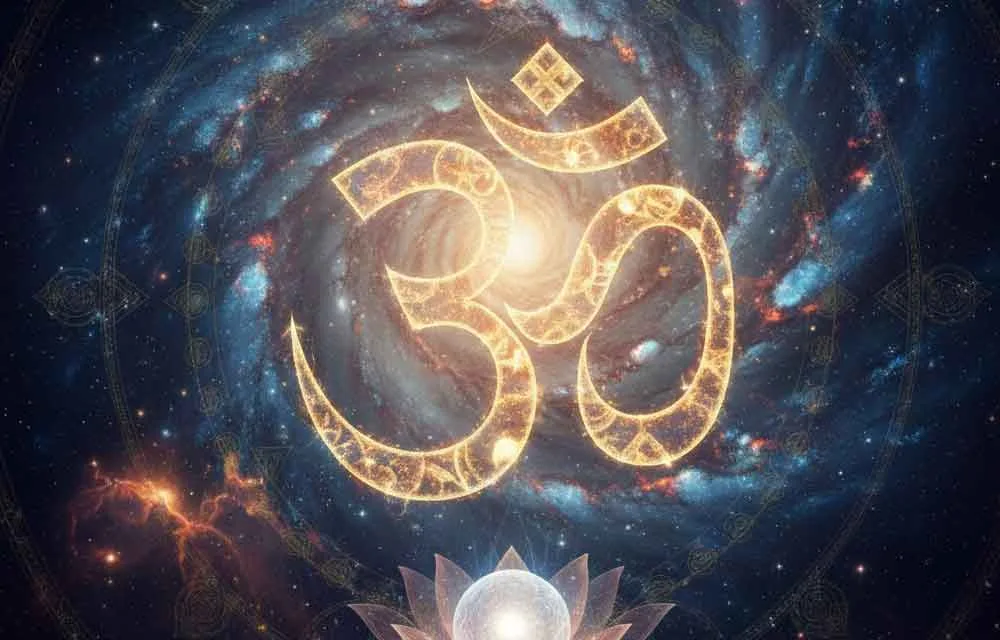
"Om iti ekaksharam Brahma — Om, this one syllable, is Brahman.
"Om iti ekaksharam Brahma — Om, this one syllable, is Brahman." — Bhagavad Gita, Chapter 8, Verse 13
There is one sound that has no beginning and no end. One syllable that contains within it the entire universe — every galaxy, every atom, every thought, every breath. One vibration so fundamental that modern science has independently arrived at its reality from a completely different direction.
That sound is Om.
Spelled in Sanskrit as ॐ, transliterated as Om or Aum, this single syllable is the most sacred sound in Hinduism — and arguably the most profound symbol in the entire history of human spirituality. It appears at the beginning and end of virtually every Hindu prayer, mantra, scripture reading, and sacred ritual. It is chanted in temples, whispered in meditation, carved into temple doorways, painted on sacred texts, and tattooed on bodies across every continent.
Yet most people — including many Hindus — know only the surface of what Om truly means.
This guide goes all the way to the root.
Table of Contents
- What Is Om? The One-Line Answer
- The Sanskrit of Om — ॐ
- Om in the Vedas — The Oldest Reference
- Om in the Upanishads — The Deepest Teaching
- Mandukya Upanishad — The Complete Map
- Chandogya Upanishad
- Taittiriya Upanishad
- Katha Upanishad
- Om in the Bhagavad Gita
- The Three Letters — A, U, M
- A — The First Sound
- U — The Sustaining Sound
- M — The Closing Sound
- The Silence After M
- The Four States of Consciousness in Om
- The Symbol ॐ — Every Curve Explained
- Om as Nada Brahman — The Universe as Sound
- Om and Modern Science — Vibration, Frequency, and the Big Bang
- Om in Other Religions and Traditions
- Types of Om Chanting
- How to Chant Om — The Complete Method
- Benefits of Chanting Om
- Om in Daily Hindu Practice
- Common Misconceptions About Om
- FAQs
What Is Om? The One-Line Answer {#what-is-om}
Om (Aum) is the primordial sound — the vibrational essence of the universe itself — from which all creation arises, through which all creation is sustained, and into which all creation ultimately returns.
It is simultaneously:
- The root mantra from which all other mantras arise
- The sonic form of Brahman (the Absolute, the Ultimate Reality)
- The sacred syllable that represents the totality of existence
- A meditation technique that leads to the deepest states of consciousness
- The name of the nameless — the sound-form of that which is beyond all sound and form
In the Hindu tradition, Om is called the Pranava (प्रणव) — from the root pra + nava, meaning "that which is ever new" or "that which pervades and reverberates through prana (life-force)". It is also called Udgitha (the supreme chant), Ekakshara (the one syllable), and Shabda Brahman (the Absolute as sound).
Quick reference:
The Sanskrit of Om — ॐ {#sanskrit}
The symbol ॐ is one of the most instantly recognizable glyphs in the world. In Sanskrit, it is written as a single ligature — a merged, composite character — that is itself a visual representation of the sound and its meaning.
The symbol appears in the Devanagari script as ॐ and is also written in virtually every other Indic script tradition — Tamil (ௐ), Telugu (ఓం), Kannada (ಓಂ), Malayalam (ഓം), Gujarati (ૐ), Bengali (ওম্), and others — each with its own regional calligraphic beauty.
In terms of Sanskrit grammar, Om is classified as an Avyaya (indeclinable) — meaning it does not change its form regardless of grammatical context. It stands alone, unchanged, immovable — just as the Absolute it represents is unchanging and immovable beneath all apparent change.
Why "Om" AND "Aum"?
Both spellings refer to the same syllable. The difference is in the level of phonetic detail:
When spoken correctly, Om IS Aum — the letters A and U naturally merge into a long O sound in Sanskrit (this is called sandhi, the rule of euphonic combination). A + U = O is a standard Sanskrit grammatical rule. So writing "Aum" is a way of making the three components visually explicit.
Om in the Vedas — The Oldest Reference {#vedas}
Om appears in the Vedas — the oldest scriptures in the world, composed between 1500–1200 BCE (and arguably much earlier in oral tradition). In the Vedic tradition, Om is the opening syllable of virtually every sacred chant and is treated as the most fundamental sound of the cosmic reality.
The Rigveda
The Rigveda's Aitareya Brahmana describes how at the beginning of creation, the gods sought to find a method of worshipping the universe. They chanted the three Vedas — and from those chants arose three sacred syllables: Bhuh, Bhuvah, Svaha (the three Vyahritis — the three sacred exclamations representing earth, atmosphere, and sky). These three were then distilled into the single syllable Om.
This teaching reveals Om as the essence of all the Vedas — the concentrated quintessence of all sacred knowledge.
The Samaveda
The Samaveda — entirely devoted to sacred music and chanting — begins with the Udgitha Prakarana, which states that Om is the Udgitha: the highest, most sublime musical note, the sound that carries prayers to the divine. The entire Samaveda's science of sacred sound flows from Om.
The Atharvaveda
The Atharvaveda explicitly identifies Om with Brahman (the Absolute) and describes it as the sound that underlies all of creation — the vibrational ground of the universe. "Prajapati vai idam agre asit — In the beginning was Prajapati (the Lord of Creation). With him was the Word (Vak). And the Word was Om."
Om as the Essence of the Four Vedas
This is one of the most ancient mappings of the components of Om — each letter corresponding to one of the four Vedas and one of the three realms of existence.
Om in the Upanishads — The Deepest Teaching {#upanishads}
If the Vedas introduce Om, the Upanishads — the philosophical summit of the Vedic tradition — reveal its complete, unfathomable depth. Om is mentioned or discussed in over 20 Upanishads, but four are especially central.
Mandukya Upanishad — The Complete Map of Om {#mandukya}
The Mandukya Upanishad is the shortest of all the major Upanishads — just 12 verses — but is considered by the great philosopher Adi Shankaracharya as sufficient by itself to grant liberation. Its ENTIRE subject is Om.
The Mandukya begins with the declaration:
"Omityetadaksharam idam sarvam — Om: this syllable is all this. All that is past, present, and future — all of this is Om. And whatever transcends the three times — that too is Om."
It then maps Om to the four states of consciousness that every human being experiences:
This mapping is one of the most extraordinary insights in all of philosophy — the claim that Om is not merely a sound but a complete map of all possible states of human consciousness.
Chandogya Upanishad {#chandogya}
The Chandogya Upanishad opens with the famous teaching of the sage Aitareya:
"Let one meditate on Om, the Udgitha, with devotion — for the Udgitha is sung beginning with Om."
It describes Om as the source of all manifest existence and teaches that the meditation on Om is the highest form of Upasana (contemplative worship). The Chandogya further equates Om with Prana (life-force) — stating that Om IS the breath of the universe.
Key teaching: "The essence of all these beings is the earth. The essence of the earth is water. The essence of water is plants. The essence of plants is the human being. The essence of the human being is speech. The essence of speech is the Rigveda. The essence of the Rigveda is the Samaveda. The essence of the Samaveda is the Udgitha (Om). This Om is the finest essence of all, the highest, deserving the highest place."
Taittiriya Upanishad {#taittiriya}
The Taittiriya Upanishad begins with the sacred instruction:
"Om iti Brahma. Om itidam sarvam — Om is Brahman. Om is all this universe."
It further teaches that a student of sacred knowledge should begin every session of study with Om, for "Om is the door through which all sacred knowledge enters."
The Taittiriya also introduces the teaching of the five sheaths (Pancha Kosha) of the human being — from gross physical body to the blissful causal body — and teaches that Om is the sound that penetrates all five sheaths and reveals the pure Atman (Self) at the centre.
Katha Upanishad {#katha}
In the Katha Upanishad, the god of Death Yama reveals the secret of liberation to the young seeker Nachiketa. The teaching on Om is given as the supreme secret:
"The syllable which all the Vedas proclaim, which all austerities declare, desiring which people live the life of religious studentship — I will tell you briefly what that is: It is Om. This syllable is Brahman. This syllable is the highest. Knowing this syllable, whatever one desires — one obtains."
This verse establishes Om as the single syllable in which all the wisdom of the entire Vedic tradition is contained.
Om in the Bhagavad Gita {#gita}
Lord Krishna mentions Om multiple times in the Bhagavad Gita, establishing its centrality to spiritual practice:
Chapter 7, Verse 8:
"I am the sacred syllable Om in all the Vedas."
Here Krishna identifies himself — the Supreme Being — directly with Om. Om is not merely a reference to the Absolute; it IS the Absolute in sonic form.
Chapter 8, Verse 13:
"Om iti ekaksharam Brahma, vyaharan mam anusmaran — Chanting the one syllable Om — Brahman — while remembering me, whoever departs from the body at death, reaches the supreme goal."
This verse reveals Om as the sound to be held in consciousness at the moment of death — the sound that carries the departing soul to liberation.
Chapter 9, Verse 17:
"I am the father of this universe, the mother, the grandfather and the sustainer. I am the object of knowledge, the purifier, the syllable Om, and the three Vedas."
Chapter 17, Verse 23–24:
"Om Tat Sat — this has been declared to be the triple designation of Brahman. By it were ordained of old the Brahmins, the Vedas, and the sacrifices. Therefore, acts of sacrifice, gift, and austerity, enjoined by the scriptures, are always begun by those who study the Brahman with the utterance of Om."
This final reference establishes the sacred formula Om Tat Sat — "Om: That: Truth/Reality" — as the triple name of Brahman. Every sacred act in Hinduism begins with Om because every sacred act is an offering to the Absolute that Om represents.
The Three Letters — A, U, M {#three-letters}
The full sound of Om when chanted correctly has three distinct phonetic components, plus the silence that follows. Each component carries a universe of meaning.
A — The First Sound {#letter-a}
Phonetics: Pronounced as the "a" in "father" — a wide-open, back-of-the-throat sound made with the mouth fully open.
Why A is First: In Sanskrit phonology, the letter A (अ) is the first letter of the alphabet and the root of all sounds. Every vowel in Sanskrit is a modification of the base sound A. Every consonant requires A to be voiced. A is literally the phonetic ground from which all language arises.
The Bhagavad Gita (Chapter 10, Verse 33) confirms this: "Among letters I am the letter A."
What A Represents:
Spiritual significance: The sound A represents the beginning of all manifestation — the first moment of creation when the Absolute chose to become the Many. It is the energy of outward movement, expression, and world-engagement.
U — The Sustaining Sound {#letter-u}
Phonetics: Pronounced as the "oo" in "tool" — a mid-resonance sound where the lips are rounded and the sound rolls forward from the back of the throat to the front of the mouth.
Why U is Middle: As the sound moves from A to U, the resonance visibly moves forward in the mouth — from throat to middle. This forward movement mirrors the sustaining, maintaining energy that U represents. It is the sound of continuation — the river of existence flowing between its source and its destination.
What U Represents:
Spiritual significance: U represents the dream state — but in a profound sense, the entire waking life is itself a kind of dream, a story being told within consciousness. The U reminds us that even our most real-seeming experiences are ultimately luminous appearances within the field of pure awareness.
M — The Closing Sound {#letter-m}
Phonetics: Pronounced as "mmm" — the lips come together, the sound closes, and the resonance now vibrates entirely within the skull and chest as a humming vibration.
Why M is Last: As A and U converge, the lips close on M and the sound is internalized. This inward movement mirrors the energy of dissolution, rest, and return. The external, audible sound ends — and what remains is the resonance within.
What M Represents:
Spiritual significance: M is the sound of the return journey — from manifestation back to the source. Deep sleep is the daily preview of death and liberation. Every night, consciousness withdraws from the waking and dream worlds and rests in its own source. M is the sound of that homecoming.
The Silence After M — The Fourth Dimension {#silence}
Phonetics: The cessation of all sound after M dissolves.
This is the most important part of Om — and it makes no sound.
After the M closes, there is a natural period of resonance and then silence. In the Mandukya Upanishad, this silence is called Turiya — the fourth state — and it is identified with Brahman itself — the Absolute that is beyond all three letters and all three states of consciousness.
What the Silence Represents:
Spiritual significance: The silence IS the point. The three letters of Om are a vehicle — they carry the mind to the threshold of the Absolute. The silence is the Absolute itself. When you chant Om and then sit in the silence that follows, you are — for those precious moments — resting in your own true nature. This is why the Mandukya states that Om alone is sufficient for liberation — because its silence is the direct experience of Turiya.
The Four States of Consciousness in Om {#four-states}
The Mandukya Upanishad's mapping of Om to the four states of consciousness is one of the most sophisticated pieces of philosophical mapping in any tradition:
The radical teaching of the Mandukya:
Most people are aware of the first three states. The fourth — Turiya — is not a fourth state that alternates with the other three. It is the background of pure awareness within which all three states arise and dissolve. Just as a cinema screen is always present — whether the film being projected is an action scene, a dream sequence, or blank darkness — Turiya is always present behind waking, dreaming, and deep sleep.
Turiya is what you ARE. The three states are what you experience. Om is the sound that wakes you up to this distinction.
The Symbol ॐ — Every Curve Explained {#symbol}
The written symbol ॐ is not merely a decorative logo — it is a visual representation of the same four states of consciousness mapped in the sound of Om. Every curve, every dot, every line carries meaning.
        ·  ← The Dot (Bindu)
       /
      ˜  ← The Curve (Ardha-matra / Maya)
     /
    3  ← The numeral-3 shape (three curves)
The profound message of the symbol:
The dot (Turiya / Brahman) is separated from the three curves (the three states / the three letters) by the curved line (Maya — cosmic illusion). The spiritual path is the process of crossing this line — dissolving Maya — and recognizing the dot as your true nature. The dot is not separate from the three curves; it is their source and support.
When you realize this — when you recognize that the Turiya (the witness, the pure awareness) is your true identity — the curved line of Maya dissolves, and you see that the symbol was always showing one reality, not four separate things.
Om as Nada Brahman — The Universe as Sound {#nada-brahman}
One of the most important philosophical doctrines underlying Om is Nada Brahman — the teaching that the universe is fundamentally constituted of sound (vibration).
The Doctrine of Nada Brahman
In the Hindu philosophical tradition — especially in Kashmir Shaivism, the Grammarian school of Bhartrhari, and Tantra — the universe did not arise from matter or energy in the modern physics sense. It arose from Nada — cosmic vibration, primordial sound.
The sequence of creation as taught in Nada Brahman philosophy:
In this view, Om is the Para Nada — the first, primal vibration that arose within the Absolute. Everything else — every atom, every galaxy, every living being — is a denser, slower form of that same primordial vibration. To chant Om is to consciously retrace the universe's journey back to its source.
Spanda — The Divine Throb
In Kashmir Shaivism, the primal vibration is called Spanda — the divine throb or pulse of consciousness. The philosopher Vasugupta (9th century CE) wrote the Spanda Karikas — a text dedicated to this understanding. The universe is a continuous pulsation of consciousness — a cosmic heartbeat. Om is the sound of that heartbeat.
Om and Modern Science — Vibration, Frequency, and the Big Bang {#science}
Modern science has arrived at several remarkable convergences with the Hindu understanding of Om as the primordial sound of the universe.
The Big Bang as Primordial Sound
The Big Bang — the origin event of our universe approximately 13.8 billion years ago — produced a cosmic sound wave. In 2003, NASA's Chandra X-Ray Observatory team detected acoustic waves (sound waves) generated in the early universe — deep bass notes that have been vibrating for billions of years. These are, quite literally, the sounds of the universe's birth.
Mark Whittle of the University of Virginia has processed these cosmic acoustic oscillations into audible sound — and the result is a descending roar that begins at the moment of the Big Bang and continues to echo. This is the closest modern science has come to detecting the universe's primordial sound.
Om's Frequency — 136.1 Hz
The chanting of Om naturally produces a frequency of approximately 136.1 Hz — a frequency that corresponds to the orbital period of the Earth around the Sun (converted to audible frequency). This frequency is sometimes called the "Earth frequency" or "Om frequency" in acoustic research.
Interestingly, 136.1 Hz is also close to the frequency used in Ayurvedic sound healing and has been shown to produce calming effects on the autonomic nervous system.
Cymatics and the Sri Yantra
Cymatics — the science of visible sound — is the study of the geometric patterns produced when sound vibrates a medium (sand, water, metal filings). When the frequency of Om (136.1 Hz) is played through a medium, it produces geometric patterns that are strikingly similar to the Sri Yantra — the sacred geometry of Goddess Lalita.
This convergence is not coincidental to those in the tradition — the Sri Yantra IS the geometric body of Om. The sound and the form are two aspects of the same primordial reality.
Neurological Effects of Om Chanting
Modern neuroscience has documented significant, measurable effects of Om chanting on the brain and nervous system:
Om in Other Religions and Traditions {#other-traditions}
While Om is most deeply developed in Hinduism, its presence — or near-equivalents — appears across multiple traditions:
Buddhism
Om appears prominently in Vajrayana (Tibetan) Buddhism — especially in the most famous mantra: "Om Mani Padme Hum" (the six-syllable mantra of Avalokiteshvara / Chenrezig). Here Om retains its function as the primordial sound and the sound of the Absolute, while the remaining syllables specify the particular quality being invoked.
Jainism
Jainism uses Om as a composite mantra representing the Pancha Parameshthis (the five supreme beings):
- A = Arihanta (the liberated)
- A = Ashariris (the formless)
- A = Acharya (the teachers)
- U = Upadhyaya (the scholars)
- M = Muni (the monks)
Sikhism
The Sikh tradition's foundational concept is Ik Onkar (ੴ) — "One Om-Creator" — written as a composite symbol that combines the numeral 1 with a stylized form of Om. It appears as the very first symbol of the Guru Granth Sahib (the Sikh sacred scripture), representing the oneness of the Creator.
Christianity
Scholars have noted a possible connection between Om and the Christian "Amen" (Hebrew: אָמֵן) and the Gnostic "Iao." While etymological connection is debated, the functional parallel is clear: Amen is the closing sound of Christian prayer, just as Om is the closing (and opening) sound of Hindu prayer. Both serve as the sonic affirmation of the Absolute.
Ancient Egypt
The Egyptian sacred sound "Amun" (also the name of a primary deity) bears a phonetic and functional resemblance to Om/Aum that has been noted by comparative religion scholars.
Types of Om Chanting {#types-of-chanting}
The Nada Meditation Method
The most powerful form of Om practice is prolonged Om chanting as a sound meditation:
- Inhale deeply
- Chant A (mouth open, 30% of the breath)
- Transition to U (lips rounding, 30% of the breath)
- Close into M (lips together, humming, 30% of the breath)
- Hold the remaining 10% as silence — rest in the resonance
- Inhale again only when completely natural
This practice, when sustained for 20–30 minutes, induces a state that meditators describe as identical to deep samadhi — an effortless absorption into pure awareness.
How to Chant Om — The Complete Method {#how-to-chant}
Preparation
Body:
- Sit in a comfortable meditation posture — Sukhasana (cross-legged), Vajrasana (kneeling), or on a chair with the spine straight
- Keep the spine erect — not rigid but naturally upright
- Rest the hands on the knees in Jnana Mudra (thumb and index finger touching, other fingers extended) or Chin Mudra
Place:
- A clean, quiet space
- Face east or north — toward the rising sun or the North Star
- Light a ghee lamp or candle if available
- Early morning (Brahma Muhurta: 4:30–6:00 AM) is ideal; dawn and dusk are also auspicious
Mind:
- Take three slow, deep breaths before beginning
- Set a clear intention: "I am chanting Om to align my consciousness with the Absolute"
- Release all thoughts of past and future — simply arrive in this moment
The Correct Pronunciation — Step by Step
Step 1 — Inhale Take a full, deep breath — filling the lungs completely from the diaphragm upward.
Step 2 — Begin A
- Open the mouth fully
- Release the breath as the sound "Aaaa..."
- The resonance should be felt in the belly and lower chest
- This portion lasts approximately ⅓ of your breath
- Mouth: wide open, no lip movement needed
Step 3 — Transition to U
- Without stopping the sound, begin rounding the lips
- The sound transitions naturally from "Aaaa" to "Uuuu..." (as in "tool")
- The resonance rises from belly to chest to throat
- This portion lasts approximately ⅓ of your breath
- Mouth: lips gently rounded and forward
Step 4 — Close into M
- Gently bring the lips together
- The sound transitions to "Mmmm..." — a humming vibration
- The resonance now vibrates throughout the skull — forehead, crown, the entire head
- This portion lasts approximately ⅓ of your breath
- Place: lips closed, teeth slightly apart to let the sound resonate
Step 5 — The Sacred Silence
- When the breath is fully released, allow the M to fade naturally
- Do NOT immediately inhale — rest in the silence
- Feel the resonance lingering in the body
- Observe the awareness that remains when all sound is gone
- This silence is Turiya — your true nature
- Stay here for as long as feels natural before the next breath arises
Step 6 — Repeat Begin the next Om only when the breath arises naturally — not forced.
Recommended Practice Durations
Benefits of Chanting Om {#benefits}
Physical Benefits
- Respiratory health — Deepens and regulates the breath; helps with asthma and respiratory conditions
- Cardiovascular health — Slows heart rate, improves heart rate variability
- Immune function — Reduces stress hormones that suppress immune response
- Sleep quality — Regular practice significantly improves sleep onset and depth
- Thyroid and parathyroid — The vibration of M directly stimulates the throat region, benefiting thyroid health
- Nervous system — Activates the parasympathetic (rest-and-digest) nervous system through vagal stimulation
Psychological Benefits
- Anxiety reduction — Measurable reduction in anxiety markers after as few as 5 minutes
- Concentration — Dramatically improves one-pointed focus and attention span
- Mood elevation — Increases serotonin and endorphin release
- Mental clarity — Quiets the incessant mental chatter of the Default Mode Network
- Emotional regulation — Develops equanimity — the ability to observe emotions without being swept away
Spiritual Benefits
- Alignment with Brahman — Each repetition is a conscious act of alignment with the Absolute
- Chakra activation — The three letters resonate with and activate different chakra groups
- Kundalini — Extended Om practice is one of the gentlest yet most effective methods of awakening Kundalini
- Samadhi — The silence after Om is a direct doorway to meditative absorption
- Purification — Cleanses accumulated mental impressions (samskaras) of past thoughts and actions
- Liberation — The Mandukya Upanishad states that understanding and chanting Om with full knowledge is sufficient for liberation (Moksha)
Environmental and Atmospheric Benefits
- Om chanting purifies the atmosphere of a space — removing stagnant, negative energies
- Creates a field of coherence — when multiple people chant Om together, the coherent sound field has measurable effects on group consciousness
- In Vedic tradition, Om chanting before any ceremony purifies the space and invites auspicious energies
Om in Daily Hindu Practice {#daily-practice}
Om is not merely a meditation technique — it is woven into the fabric of every aspect of Hindu religious life.
Where Om Appears in Daily Practice
The Three Shantis — Om Shanti Shanti Shantih
Every Vedic recitation, every prayer, every spiritual gathering ends with:
"Om Shanti Shanti Shantih" — "Om, Peace, Peace, Peace."
Why three times? Because peace is invoked at three levels:
- First Shanti — Peace from Adhibhautika sufferings (physical — disease, injury, natural disasters)
- Second Shanti — Peace from Adhidaivika sufferings (celestial — fate, time, karma)
- Third Shanti — Peace from Adhyatmika sufferings (internal — mental, emotional, spiritual)
The three Shantis cover the entire field of possible suffering. Om initiates the invocation — the Absolute itself is called as the source and guarantor of peace at all three levels.
Common Misconceptions About Om {#misconceptions}
Misconception 1: "Om is just a Hindu religious symbol"
Truth: Om transcends religious identity. While it is most deeply developed in Hinduism, it appears in Buddhism, Jainism, and Sikhism, and has functional parallels in other traditions. At its deepest level, Om is the sound of the universe itself — it belongs to no religion because it pre-dates all religion.
Misconception 2: "You have to be Hindu to chant Om"
Truth: Om is the sound of the Absolute — it is available to all human beings. The Mandukya Upanishad does not restrict its teaching. Anyone who sincerely chants Om with understanding and devotion receives its benefit.
Misconception 3: "Om is pronounced 'Ohm' like the electrical unit"
Truth: The electrical unit Ohm (Ω, named after physicist Georg Ohm) is pronounced identically to Om by coincidence of English spelling. The Sanskrit Om/Aum is pronounced with the A-U-M sequence described above — not as a simple single vowel sound.
Misconception 4: "Chanting Om is enough — I don't need to understand it"
Truth: The tradition holds that understanding (Jnana) combined with practice (Abhyasa) is far more powerful than mechanical repetition. The Mandukya Upanishad emphasises meditating ON Om — not merely producing the sound. Understanding the symbolism of A, U, M, and the silence transforms Om from a sound into a complete meditation.
Misconception 5: "The Om symbol is just a decoration"
Truth: The ॐ symbol is a precise visual map of the four states of consciousness — the same map taught in the Mandukya Upanishad. Every element of its form carries deep philosophical meaning. Wearing or displaying it without understanding is an opportunity missed.
Misconception 6: "Om is only for meditation — not for daily life"
Truth: Om is the ground of all existence — waking, dreaming, and sleeping. It is appropriate in every context — morning prayer, meal blessing, yoga practice, creative work, and the transition into sleep. The entire spiritual path could be described as learning to hear Om in every sound, see the Absolute in every form, and rest in the silence behind every experience.
Frequently Asked Questions (FAQs) {#faqs}
Q1. How many times should I chant Om? Traditionally, Om is chanted in multiples of 3, 9, 27, or 108. For daily practice, 21 repetitions is a good starting point. For deeper meditation, 108 repetitions (one full mala) is the standard. There is no maximum — more is always better in terms of spiritual benefit.
Q2. Is there any time when I should NOT chant Om? Om can be chanted at any time. However, the tradition recommends avoiding loud Om chanting immediately after a heavy meal or when experiencing extreme emotional agitation. The ideal state is calm, clean, and focused.
Q3. Can Om chanting cause any harm? Om chanting is one of the safest spiritual practices in existence. Done correctly — with awareness, proper breathing, and relaxed attention — there are no adverse effects. As with any intense breathwork, if you feel lightheaded, simply breathe normally and pause.
Q4. What is the difference between Om and Om Namah Shivaya? Om alone is the primordial sound — the Absolute itself in sonic form. Om Namah Shivaya is a specific Shaiva mantra that uses Om as its opening and adds "Namah Shivaya" (salutation to Shiva). Think of Om as the ocean and all other mantras as waves — they arise from Om and return to Om.
Q5. Why do yoga classes chant Om three times? The three-times chanting mirrors the three levels of Om's peace: peace in the body, peace in the mind, peace in the spirit. It also mirrors the three letters A, U, M — and honours the tradition of chanting Om in odd multiples of three.
Q6. Is Om the same as Amen? They are not etymologically identical, but they are functionally analogous — both serve as the sacred affirmation that closes prayer in their respective traditions. The deeper parallel is philosophical: both represent the devotee's alignment with ultimate reality. The sonic similarity (Om → Aum → Amen) has been noted by comparative religion scholars, though direct derivation is debated.
Q7. What does it mean when I feel vibrations in my body while chanting Om? This is entirely normal and actually desirable. The vibrations you feel in the chest, throat, skull, and crown during Om chanting are the physical-level effect of the sound resonating with the subtle body's energy centres (chakras). Extended practice develops this sensitivity — and eventually the practitioner can direct the vibration to specific areas of the body for healing and activation.
Q8. Can children chant Om? Yes — and the tradition actually recommends it. Children in traditional Hindu homes and Gurukulas (schools) began every day and every lesson with Om. Its effects on concentration, calmness, and spiritual sensitivity are especially potent when established in childhood.
Conclusion
Om is not a word. It is not a symbol. It is not a technique.
Om is the universe listening to itself.
It is the sound the Absolute makes when it decides to become a cosmos — and the sound it makes when the cosmos recognizes itself as the Absolute. It is the first breath of creation and the last breath of dissolution. It is the roar of the Big Bang and the silence of deep space. It is the heartbeat of the living universe — always present, behind every sound, beneath every silence.
When you chant Om with full understanding — knowing that A is your waking life, U is your dreaming life, M is your sleeping life, and the silence is your eternal nature — you are not merely making a sound. You are consciously identifying with the ground of all existence. You are, for those moments, the universe knowing itself through one of its own temporary forms.
And in that knowing — the Mandukya Upanishad promises — is liberation itself.
ॐ शान्तिः शान्तिः शान्तिः Om Shantih Shantih Shantih. Om — Peace — Peace — Peace.
Explore more sacred Hindu mantras, scriptures, and spiritual guides at HinduTone.com.
You might also like
The 22 Faces of OM (AUM) – The Universal Sound of Creation
What Makes Sanatana Dharma Unique Among World Religions?
The Devotion of Prahlad: A Tale of Faith and Divine Protection