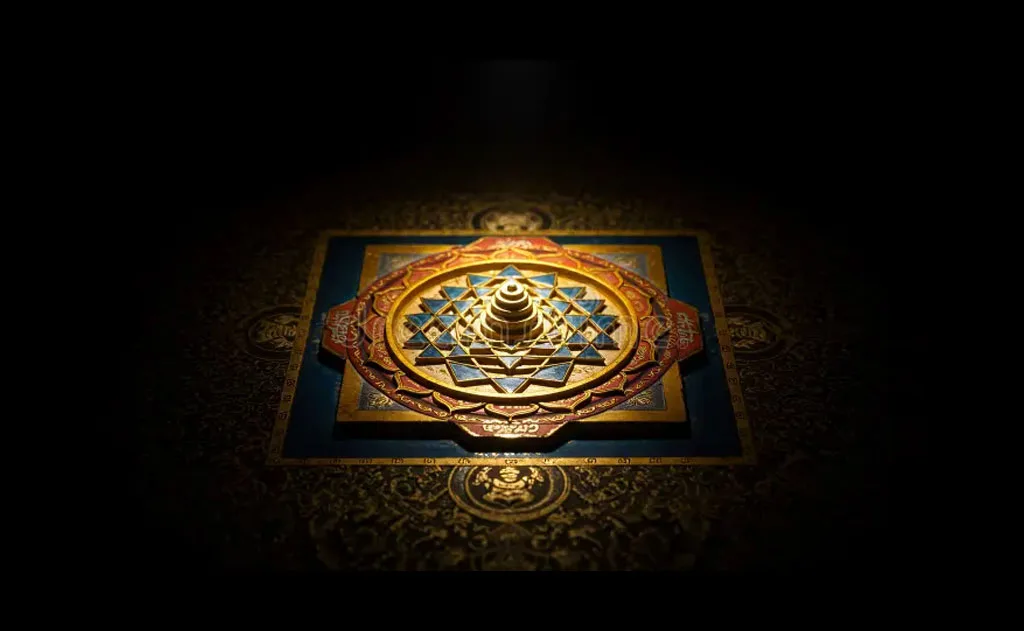
Yantra vs Mantra vs Tantra — What Is the Difference? | Complete Hindu Guide
"Mantrah prokto hi devasya, Yantram tasya shareeram cha, Tantram tasya prayogashcha — The Mantra is the deity's soul, the Yantra is the deity's body, and the…
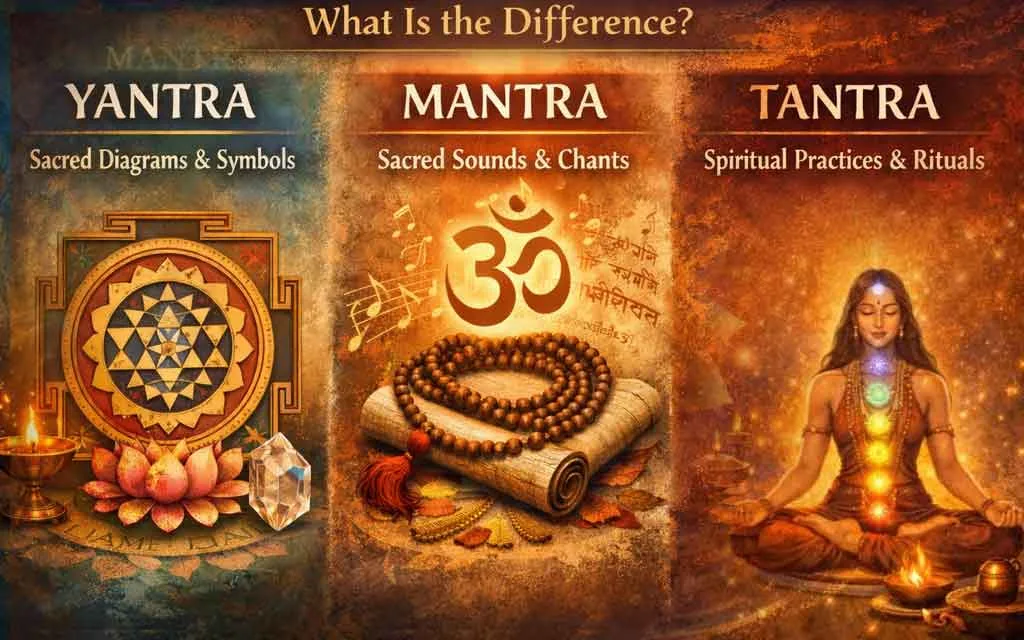
"Mantrah prokto hi devasya, Yantram tasya shareeram cha, Tantram tasya prayogashcha — The Mantra is the deity's soul, the Yantra is the deity's body, and the…
"Mantrah prokto hi devasya, Yantram tasya shareeram cha, Tantram tasya prayogashcha — The Mantra is the deity's soul, the Yantra is the deity's body, and the Tantra is the method of application." — Traditional Tantric maxim
Few subjects in Hinduism generate more confusion — and more curiosity — than the triad of Yantra, Mantra, and Tantra. In the West, "Tantra" has been almost entirely reduced to a misunderstood practice around sexuality. "Mantra" is often treated as a motivational buzzword. And "Yantra" remains largely unknown outside serious practitioners.
The truth is far more profound, far more beautiful, and far more practical.
Yantra, Mantra, and Tantra are the three inseparable limbs of the same sacred body. They represent the three dimensions through which the human being makes contact with divine reality — through Form (Yantra), through Sound (Mantra), and through Method (Tantra). Remove any one of the three, and the practice becomes incomplete. Together, they constitute one of the most sophisticated spiritual technologies ever developed by any civilization.
This guide cuts through centuries of distortion to give you the clear, authentic, and complete picture — rooted in the original Hindu scriptures and living traditions.
Table of Contents
- The One-Line Answer
- Origins — Where Do These Three Come From?
- What Is a Mantra?
- Definition and Meaning
- How Mantras Work
- Types of Mantras
- Rules of Mantra Practice
- What Is a Yantra?
- Definition and Meaning
- How Yantras Work
- Types of Yantras
- Rules of Yantra Use
- What Is Tantra?
- Definition and Meaning
- What Tantra Is NOT
- The Six Schools of Tantra
- Left-Hand vs Right-Hand Tantra
- Core Principles of Tantra
- Yantra, Mantra, Tantra — How They Work Together
- The Body-Speech-Mind Framework
- Comparison Table — Yantra vs Mantra vs Tantra
- Common Misconceptions Corrected
- How to Begin Practice
- FAQs
The One-Line Answer {#one-line}
Before diving deep, here is the clearest possible summary:
In traditional practice:
- Tantra is the map — the complete system of philosophy and practice
- Mantra is the key — the sound that unlocks divine energy
- Yantra is the door — the geometric form that receives and holds that energy
Origins — Where Do These Three Come From? {#origins}
All three arise from the same ancient current of Indian spirituality — the Agamic tradition — which runs parallel to, and often predates, the Vedic tradition.
The Agamas
The Agamas are a vast body of Hindu scriptures separate from (though related to) the Vedas. They deal specifically with:
- Temple construction and ritual (Kriya)
- Philosophical understanding (Jnana)
- Yoga and meditation (Yoga)
- Worship of the deity (Charya)
The Tantric texts (Tantras, Agamas, Samhitas) are the source of formal Yantra, Mantra, and Tantra practice. They include thousands of texts, of which the most important in the Shakta tradition include:
The Vedic Connection
While Tantra proper is Agamic, Mantra practice is deeply Vedic. The Vedas themselves are collections of sacred mantras — the Rigveda, Samaveda, Yajurveda, and Atharvaveda are repositories of mantric knowledge. The Tantric tradition absorbed and expanded the Vedic mantra system, adding the Bija (seed) mantras and Shakti mantras to the older Vedic corpus.
What Is a Mantra? {#mantra}
Definition and Meaning
The Sanskrit word Mantra (मन्त्र) is composed of:
- Man (मन्) — from manas (mind/consciousness)
- Tra (त्र) — tool, instrument, or liberator
A Mantra is therefore "that which liberates the mind" — or more precisely, a sacred sound formula that, when properly recited, produces specific effects on the consciousness of the practitioner and on the subtle energy field around them.
The great Tantric text Kularnava Tantra defines a Mantra as: "That which protects the one who reflects upon it."
The Philosophy Behind Mantras — Shabda Brahman
Hindu philosophy — particularly Kashmir Shaivism and the Grammarian tradition of Bhartrhari — holds that the universe itself arose from sound. This primordial sound is called Shabda Brahman (the Absolute as Sound) or Nada Brahman (the Absolute as Cosmic Vibration).
The sequence of cosmic sound manifestation is:
Mantras operate at the Para and Pashyanti levels — they are not merely spoken words; they are vibrations at the level of pure consciousness. This is why mantras retain power even when the practitioner does not understand their literal meaning — because their effect is vibrational, not semantic.
How Mantras Work
1. Vibrational Physics Each Sanskrit syllable produces a specific vibration pattern when correctly pronounced. These vibrations resonate with corresponding energy patterns in the subtle body (chakras, nadis) and in the universe at large. This is not metaphor — cymatics (the science of visible sound) has demonstrated that sound creates predictable geometric patterns in matter.
2. Neurological Rewiring Modern neuroscience has confirmed that repetitive sound patterns alter brainwave states — moving from beta (active thinking) to alpha (relaxed focus) to theta (deep meditation) states. Mantra repetition (japa) is one of the most efficient methods of inducing theta brainwaves — the state in which profound healing, creativity, and spiritual insight arise.
3. Deity Invocation In the devotional understanding, each mantra IS the deity — not a symbol of the deity but the deity's own vibrational body. Reciting "Om Namah Shivaya" does not merely remind you of Shiva — it IS Shiva's presence in sound form. This is the doctrine of Mantra = Devata (mantra equals the deity).
4. Samskara Formation In Yoga psychology, repeated mental action creates deep grooves (samskaras) in consciousness. Mantra repetition gradually replaces negative mental patterns with positive, sacred vibrations — slowly transforming the quality of the mind from rajasic (agitated) and tamasic (dull) to sattvic (pure, luminous).
Types of Mantras
By Structure:
By Deity:
By Purpose:
The Most Important Mantras in Hinduism:
Rules of Mantra Practice (Japa Vidhi)
1. Consistency — Same time, same place, same number of repetitions daily. The mind responds to ritual structure.
2. The Right Number — Traditionally, 108 repetitions per sitting (one round of the mala). For serious sadhana, 1,008 or more.
3. Correct Pronunciation — Especially for Sanskrit mantras, proper pronunciation activates the correct vibration. If unsure, learn from a qualified teacher or authentic audio recording.
4. Mental Posture — Japa (repetition) should be accompanied by awareness, not mechanical repetition. The mind should be present with each syllable.
5. Initiation (Diksha) — For the most powerful mantras (especially Bija mantras and Panchadashi), receiving the mantra from a qualified guru (Mantra Diksha) is traditionally recommended. The guru's transmission carries the lineage's accumulated spiritual energy (Shakti-pata).
6. The Three Modes:
What Is a Yantra? {#yantra}
Definition and Meaning
The Sanskrit word Yantra (यन्त्र) comes from:
- Yam (यम्) — to hold, sustain, restrain, support
- Tra (त्र) — tool, instrument
A Yantra is therefore "an instrument that holds (the divine energy)" — a geometric form that serves as the physical body of a deity or cosmic force, capable of containing, concentrating, and radiating that force's energy.
The Vishvasara Tantra states: "The Yantra is to the deity what the body is to the soul. Just as the soul dwells in the body, the divine energy dwells in the Yantra."
The Geometry of the Sacred
Why geometry? Because the universe itself IS geometric. From the spiral of a galaxy to the structure of a DNA molecule, from the hexagonal cells of a honeycomb to the fractal branching of a snowflake — nature organizes itself through geometric patterns.
Hindu sages, through deep meditation, directly perceived these patterns as the building blocks of consciousness and matter. The basic geometric forms used in Yantras encode these primal patterns:
How Yantras Work
1. Geometric Resonance Just as a mantra resonates as sound, a yantra resonates as form. The specific angles, ratios, and proportions of a Yantra correspond to specific energy frequencies. When you gaze at a correctly drawn Yantra, your eyes follow specific geometric pathways that guide the mind into corresponding states of consciousness.
2. Sacred Space Creation A properly consecrated Yantra creates a field of sacred energy (Shakti Kshetra) in its physical surroundings. This is why Yantras are installed in temples and homes — they literally transform the energy of the space.
3. Deity Embodiment Through the process of Prana Pratishtha (life-force installation) — a Tantric ritual of consecration using mantras, breath, and visualization — the Yantra becomes the living body of the deity. It is no longer merely a symbol; it is the deity's actual presence in geometric form.
4. Focus for Meditation (Dharana) The Yantra serves as an external object for the practice of Trataka (fixed-gaze meditation) and Dharana (concentration). Gazing at the Yantra's central point (Bindu) while maintaining steady attention trains the mind in one-pointedness (Ekagrata) — the foundation of all higher meditation.
Types of Yantras
By Purpose:
By Deity:
By Material:
Rules of Yantra Use
Placement:
- Keep the Yantra at eye level on your altar — never on the floor
- The Yantra should face east or north
- Do not place in the bedroom or bathroom
Maintenance:
- Clean regularly with a soft, dry cloth
- For copper: clean periodically with tamarind water or lemon
- Do not let the Yantra become dusty or dirty — this affects its energy
Daily Worship:
- Light a ghee lamp and incense before the Yantra daily
- Offer flowers (especially red hibiscus for Shakti Yantras)
- Recite the corresponding mantra at least 108 times
- Never worship a Yantra without its corresponding Mantra
Damaged Yantras:
- A cracked, chipped, or erased Yantra should be immersed respectfully in a river — never discarded as trash
What Is Tantra? {#tantra}
Definition and Meaning
The Sanskrit word Tantra (तन्त्र) is derived from:
- Tan (तन्) — to expand, to weave, to spread
- Tra (त्र) — tool, system, that which saves/liberates
Tantra therefore means "the system that expands consciousness and weaves together all aspects of existence into a path of liberation."
The word also appears in the sense of "loom" — Tantra is the loom on which the threads of Mantra and Yantra are woven together into the complete fabric of spiritual practice.
The Kamika Agama offers a classic definition: "That which explains in detail the subjects of tattvas (cosmic principles) and mantras, and which saves (tra) through its expansion (tan) — that is called Tantra."
What Tantra Is NOT {#not}
Before explaining what Tantra IS, it is essential to clear the most damaging misconception in the modern understanding:
Tantra is NOT primarily about sex.
The reduction of Tantra to sexual practice is a distortion introduced primarily during the colonial period and amplified by Western New Age culture. Here is the truth:
The reality: If you have ever lit a lamp in a temple, recited a mantra, worn a rudraksha mala, done namaskara to a deity, or placed a tilak on your forehead — you have practised Tantra. It is already the foundation of every form of Hindu devotional practice.
The Core Vision of Tantra
Tantra's philosophical vision is radical and liberating:
"The world is not a problem to be escaped — it is the Goddess's own body to be worshipped."
While some spiritual traditions teach that the material world is an obstacle to liberation (and must be renounced), Tantra teaches the opposite:
- The body is sacred — it is the temple of the Divine
- The senses are sacred — properly directed, they lead to the Divine
- Desire is sacred — properly channelled, it becomes the fuel for liberation
- The world is sacred — it is the living body of the Goddess (Vishva = Universe = Devi)
This is the meaning of the Tantric axiom: "Yad ihasti tad anyatra; yan nehasti na tat kvachit" — "What is here is also elsewhere; what is not here is nowhere." Whatever is found in the cosmos is also found in the human body — and vice versa.
The Six Schools of Tantra {#six-schools}
Tantra is not monolithic — it is a vast family of traditions. The principal Tantric schools in Hinduism are:
Within the Shakta Tantra, the two major streams are:
Left-Hand vs Right-Hand Tantra {#left-right}
This is the most important distinction within Tantra:
The Five Makaras (Pancha Makara): In certain Tantric rituals, five substances beginning with the letter "M" are used. In right-hand Tantra, substitutes are used; in left-hand Tantra, they are used literally:
The left-hand use of these five substances is not licentiousness — it is a specific meditative practice of confronting and transcending one's deepest conditionings around purity and taboo. It is always performed within a strict ritual framework under advanced guidance.
Core Principles of Tantra {#core-principles}
1. Sarvam Khalvidam Brahma — All Is Brahman There is no division between sacred and profane. Everything is the Goddess's body. Every experience — joy and sorrow, beauty and ugliness, purity and impurity — is her self-expression.
2. Deho Devaalayah — The Body Is the Temple The human body is not a prison of the soul — it is the most sacred temple. Every ritual done in a temple is a reflection of what is happening in the subtle body of the practitioner.
3. Guru Tattva — The Principle of the Teacher Tantric knowledge is transmitted through a living lineage (Parampara). The guru is not merely a teacher — the guru IS the grace of the Goddess in human form. Without the guru's transmission (Shaktipata), the deepest Tantric knowledge cannot be received.
4. Shakti Is Primary In Tantra, the feminine principle (Shakti) is always primary — it is the active, dynamic, creative force. The masculine principle (Shiva) is the passive, witnessing consciousness. Without Shakti, Shiva is inert.
5. Sadhana Over Theory Tantra is fundamentally experiential, not intellectual. Philosophical understanding is important, but it must be backed by direct practice (Sadhana). The proof of Tantra is not in its texts — it is in the transformation of the practitioner.
6. Adhikara — Qualification Not every practice is suitable for every person. Tantra has a sophisticated system of categorizing practitioners into three types (Pashu, Vira, Divya — bound, heroic, divine) and prescribing appropriate practices for each. What liberates a Divya (divine) practitioner might harm a Pashu (bound) practitioner.
Yantra, Mantra, Tantra — How They Work Together {#together}
The three are not separate systems — they are three dimensions of a single integrated practice. This is best understood through the traditional temple worship model.
The Temple as Tantra Made Visible
A Hindu temple is literally Tantra made concrete:
In Personal Sadhana
The Body-Speech-Mind Framework {#body-speech-mind}
The most elegant way to understand the relationship of the three is through the Trikaya (three bodies) model of human existence:
This framework shows that Yantra, Mantra, and Tantra together address the complete human being — body, speech, and mind. A spiritual practice that uses all three simultaneously is infinitely more powerful than one that uses only one dimension.
This is also the meaning of the Triveni Sangam — the three rivers that meet at Prayagraj: Ganga (Mantra), Yamuna (Yantra), and the invisible Saraswati (Tantra — the hidden current that makes the other two sacred).
Comparison Table — Yantra vs Mantra vs Tantra {#comparison}
Common Misconceptions Corrected {#misconceptions}
Misconception 1: "Tantra means sex"
Truth: Sexual practice (Maithuna) is one of five symbolic substances used in ONE specific school of one branch of Tantra (Vamachara). The overwhelming majority of Tantric practice has nothing to do with sex. Lighting a lamp, reciting a mantra, and doing namaskara to a deity IS Tantra.
Misconception 2: "Mantras only work if you know Sanskrit"
Truth: While correct Sanskrit pronunciation amplifies a mantra's effect, sincere devotional recitation in any form reaches the deity. The Bhakti tradition especially emphasises that the Goddess responds to sincere love, not perfect grammar.
Misconception 3: "Yantras are just for attracting wealth"
Truth: Yantras exist for every purpose — from the most material (wealth, health) to the most spiritual (liberation, Kundalini awakening). The Sri Yantra, for instance, is primarily a vehicle for non-dual self-realization.
Misconception 4: "You need a guru for all Mantra/Yantra/Tantra practice"
Truth: Basic practices — lighting a lamp, offering flowers to a Yantra, chanting Om or Om Namah Shivaya — require no initiation. For the most powerful mantras (Panchadashi, Shodashi) and deepest rituals, a guru's guidance is strongly recommended. But the vast majority of practice is accessible to any sincere seeker.
Misconception 5: "Tantra is black magic or dangerous"
Truth: Authentic Tantra is explicitly dharmic. Most Tantric texts begin with elaborate ethical codes (Yama and Niyama equivalents) and explicitly prohibit harm to others. Practices intended to harm others (Abhichara) are condemned as adharmic in authoritative Tantric texts.
Misconception 6: "Mantras and Yantras are superstition"
Truth: The science of sound (cymatics) and sacred geometry has demonstrated the reality of vibrational patterns in matter. The mantras' neurological effects on brainwave states are measurable. Dismissing this tradition as superstition reflects unfamiliarity, not scientific accuracy.
Misconception 7: "These are three separate systems"
Truth: Yantra, Mantra, and Tantra are one integrated system. Tantra is the mother system; Mantra and Yantra are its primary tools. In practice, they are never truly separated — you always use a Mantra with a Yantra, within a Tantric ritual framework.
How to Begin Practice {#begin}
For Absolute Beginners — Start Here
Week 1–4: Mantra Foundation
- Choose one deity who resonates with you
- Begin with their simplest Nama Mantra (e.g., Om Namah Shivaya for Shiva, Om Shrim Mahalakshmyai Namah for Lakshmi)
- Chant 108 times daily (one mala round) — ideally in the morning
- No special equipment needed — just sincerity
Month 2: Add Yantra
- Acquire a good quality Yantra of your chosen deity (copper or crystal)
- Set up a simple altar
- Place the Yantra, light a ghee lamp, offer a flower
- Chant your mantra while facing the Yantra
Month 3 onward: The Tantric Framework
- Learn the basic Puja sequence: Sankalpa → Dhyana → Avahana → Offerings → Mantra → Arati → Namaskara
- Begin reading a reputable book on your tradition (e.g., Sri Vidya, Shaiva Tantra)
- If possible, connect with a qualified teacher or lineage
Recommended Daily Practice Structure
Essential Texts to Study
Frequently Asked Questions (FAQs) {#faqs}
Q1. Is it necessary to use all three — Yantra, Mantra, and Tantra together? For the most complete and powerful practice, yes. But each can be practised individually. Mantra alone (Japa) is already deeply powerful. Yantra alone (Trataka) is a complete meditation practice. And Tantra, as the overall system, contains both. You do not need to master all three simultaneously at the start.
Q2. Can women practise Tantra, Mantra, and Yantra? Absolutely. The Tantric tradition is one of the few in the ancient world that explicitly affirms the spiritual equality and even superiority of women. The Kularnava Tantra states: "The Shakti in a woman is the direct manifestation of the Goddess." Women are considered naturally more receptive to Shakti energy and are especially honoured in Sri Vidya and Kali Kula traditions.
Q3. What is the difference between a Mantra and a prayer? A prayer is a personal communication with the divine — generally in one's own language, from one's own heart. A Mantra is a precisely constructed, Sanskrit sound-formula whose vibrational effect is independent of the practitioner's personal feelings or language. Prayer engages the emotional and personal self; Mantra engages the vibrational and cosmic self. Both are valid and complementary.
Q4. Is Tantra the same as Yoga? They are related but distinct. Classical Yoga (Patanjali's Ashtanga) and Tantra share many practices (meditation, pranayama, ethical codes) but differ philosophically. Classical Yoga views Prakriti (matter) as ultimately different from Purusha (consciousness). Tantra sees them as one — Shakti and Shiva are two aspects of a single Reality. In practice, most modern forms of Hatha Yoga and Kundalini Yoga are deeply Tantric.
Q5. Do Yantras lose their power over time? A properly consecrated Yantra does not lose power — it accumulates power through regular worship. However, a neglected, damaged, or disrespected Yantra may become energetically dull. Regular worship (daily lamp, mantra, flowers) keeps the Yantra's energy alive and active.
Q6. Can I practise different deity mantras simultaneously? It depends on the mantras. Generally, it is advised to establish one primary deity (Ishta Devata) and mantra before adding others. Mixing multiple powerful Bija mantras without guidance can scatter the mind. Once the primary mantra is established (typically after one year of daily practice), secondary mantras can be added.
Q7. What is Shaktipata? Shaktipata (literally "descent of Shakti") is the transmission of divine energy from a qualified guru to a disciple. In the Tantric tradition, this transmission initiates the disciple's spiritual awakening and activates the received mantra. Shaktipata can occur through touch, gaze, word, or even thought — and in some cases, spontaneously without physical contact with the guru.
Q8. How long does it take to see results from Mantra/Yantra practice? Results vary enormously by individual karma, sincerity, and regularity of practice. Many practitioners report subtle but clear inner shifts (greater peace, clarity, synchronicities) within the first weeks. Deeper results — Kundalini awakening, sustained meditative states — typically emerge over months and years of consistent practice.
Conclusion
Yantra, Mantra, and Tantra are not three separate subjects to be studied in isolation — they are three faces of one single, integrated, living tradition. To understand one fully, you must understand all three. To practise one deeply, you will inevitably encounter all three.
Mantra gives you the sound-key that resonates with the cosmos. Yantra gives you the geometric form that holds and focuses that resonance. Tantra gives you the complete system — the understanding, the ethics, the methods, and the philosophy — that transforms the entire human being into a living embodiment of the divine.
Together, they constitute the most complete system of inner technology ever developed — a system that simultaneously addresses the body (Yantra), the speech (Mantra), and the mind (Tantra), and offers — at its pinnacle — the recognition that the one who practises, the practice itself, and the goal of the practice are all one and the same Shakti, playing with herself in the mirror of creation.
Aum Tat Sat
"Sarva Mangala Mangalye, Shive Sarvaartha Sadhike — O Auspicious One, fulfiller of all purposes, we bow to thee."
Explore more sacred Hindu texts, mantras, yantras, and spiritual guides at HinduTone.com.
You might also like
Powerful Mantras for Students & Parents Before Joining School
Powerful Hindu Mantras for Purushottam Maas 2026: Vishnu Bhakti, Chanting Guide & Global Devotion
Purushottam Maas 2026: Lord Vishnu's Sacred Gift of Spiritual Multiplication & Divine Grace