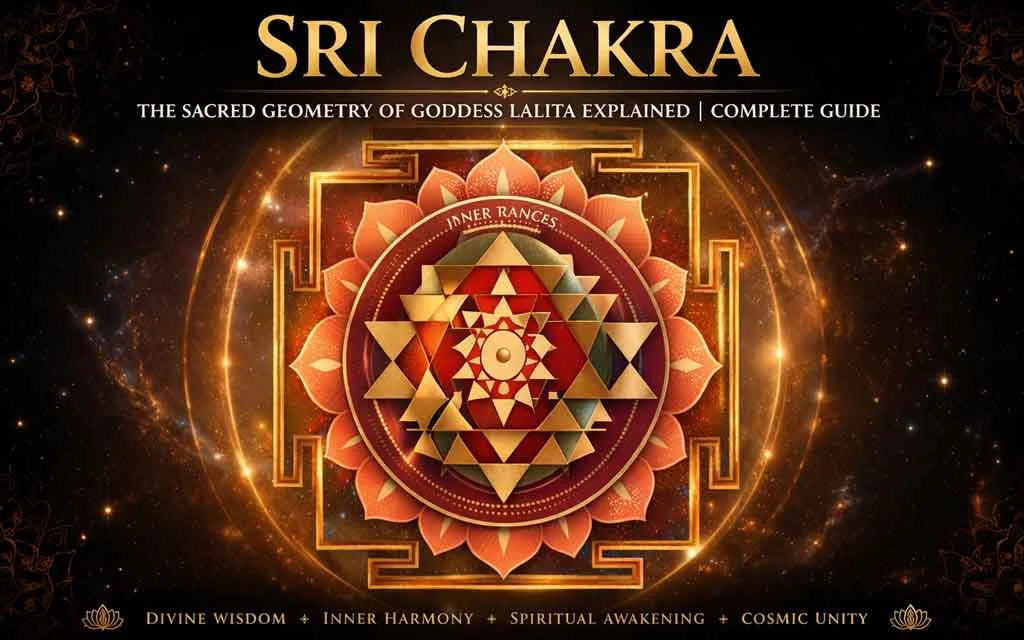
Sri Chakra — The Sacred Geometry of Goddess Lalita Explained | Complete Guide
"Shri Chakra Raja Nilaya — She who dwells in the king of all Chakras." — Lalita Sahasranama, Name 421 Of all the sacred symbols in Hinduism — and there are…
"Shri Chakra Raja Nilaya — She who dwells in the king of all Chakras.
"Shri Chakra Raja Nilaya — She who dwells in the king of all Chakras." — Lalita Sahasranama, Name 421
Of all the sacred symbols in Hinduism — and there are thousands — none is more geometrically perfect, philosophically complete, or spiritually potent than the Sri Chakra (also called the Sri Yantra). It is simultaneously the most beautiful object of meditation, the most sophisticated map of human consciousness, and the living body of Goddess Lalita Tripura Sundari, the supreme form of Adi Shakti.
The Sri Chakra is not decorative art. It is a precision-engineered diagram of the cosmos — every angle, every intersection, every petal is exact to a fraction of a degree. Modern mathematicians have found that it anticipates concepts from fractal geometry and non-Euclidean mathematics. Yet it was cognized thousands of years ago by sages in states of deep meditation.
This guide is your complete reference — from the geometry and symbolism of every layer, to the philosophy behind it, how to worship it, meditate on it, and why the Sri Chakra remains the crown jewel of the Hindu spiritual tradition.
[image: 📖] Table of Contents
- What Is the Sri Chakra?
- Sri Chakra vs Sri Yantra — What Is the Difference?
- Origin and History of the Sri Chakra
- Complete Geometry — How the Sri Chakra Is Constructed
- The Nine Circuits (Navaavarana) — Layer by Layer
- The 43 Triangles and Their Meaning
- The Bindu — The Sacred Point at the Centre
- The Deities of the Sri Chakra
- Sri Chakra as the Human Body
- Sri Chakra as the Cosmos
- Types of Sri Chakra
- Sri Chakra Worship — Navavarana Puja
- Sri Chakra Meditation
- Where to Place the Sri Chakra at Home
- Benefits of the Sri Chakra
- FAQs
What Is the Sri Chakra? {#what-is}
The Sri Chakra (Sanskrit: श्रीचक्र) is the supreme yantra — a sacred geometric diagram — of Goddess Lalita Tripura Sundari, the highest form of Adi Shakti in the Sri Vidya tradition of Hinduism.
The word Sri Chakra breaks down as:
- Sri (श्री) — Auspiciousness, beauty, prosperity, the divine feminine
- Chakra (चक्र) — Wheel, circle, diagram, energy vortex
Together: "The auspicious wheel / the sacred diagram of Sri (the Goddess)."
It consists of 9 interlocking triangles (4 pointing upward — Shiva triangles, 5 pointing downward — Shakti triangles) arranged within a series of concentric circles and lotus petals, all enclosed within a square with four gates. This creates 43 smaller triangles and a central point called the Bindu — the seat of the Goddess herself.
Quick reference:
Sri Chakra vs Sri Yantra — What Is the Difference? {#vs-yantra}
This is the most frequently asked question. The short answer: they are the same diagram, different names.
Both terms refer to the identical geometric pattern. In sacred texts like the Lalita Sahasranama, the term Sri Chakra Raja Nilaya (Name 421) is used — "She who dwells in the king of all chakras (Sri Chakra)." In many temples and popular usage, Sri Yantra is the more common name.
The only real distinction is dimensional:
- Sri Chakra / Sri Yantra = the flat, two-dimensional form (drawn or engraved)
- Meru Chakra / Meru Prastha = the three-dimensional, mountain-shaped form of the same diagram
Origin and History of the Sri Chakra {#origin}
Mythological Origin
According to Sri Vidya tradition, the Sri Chakra was not invented — it was revealed. The origin story appears in the Lalitopakhyana section of the Brahmanda Purana:
When Goddess Lalita Tripura Sundari manifested to destroy the demon Bhandasura (who had arisen from the ashes of Kamadeva), she created her divine city Sri Nagara — a city whose very layout was the Sri Chakra itself. The city had nine enclosures (corresponding to the nine circuits), and the Goddess's palace stood at the Bindu — the central point.
Her entire army, her attendant goddesses (the Shaktis), her generals, and her divine weapons were all manifestations of the different triangles and layers of the Sri Chakra. When she destroyed Bhandasura, she essentially projected the Sri Chakra into the phenomenal world as a diagram for human beings to worship and meditate upon.
Historical and Archaeological Evidence
- The Sri Chakra appears in Tantric texts dating back at least to the 8th–9th century CE, notably in the Vamakeshvara Tantra and Parasurama Kalpa Sutra
- Earlier references appear in the Atharvaveda Parishishta (appendices to the Atharva Veda)
- Copper and stone engravings of the Sri Yantra have been found at Pushkar (Rajasthan) and multiple South Indian temples
- The Kamakhya Temple (Assam), Srikalahasti Temple (Andhra Pradesh), and hundreds of Devi temples across India enshrine the Sri Chakra as the primary object of worship
- The geometry of the Sri Chakra appears to be related to the golden ratio (φ) and has connections to the mathematical constant π — relationships that have fascinated modern geometers
Complete Geometry — How the Sri Chakra Is Constructed {#geometry}
The construction of the Sri Chakra is one of the most demanding tasks in sacred geometry. Traditional texts like the Tantrarajatantra and Nityashodashikarnava give detailed instructions — and the precision required is extraordinary.
The Core Construction Challenge
The central problem is this: 9 triangles must intersect in such a way that all their intersections are perfectly aligned. This creates 43 smaller triangles with 5 different point types. The construction cannot be done freehand — it requires precise mathematical relationships between the sizes of the triangles.
Modern mathematicians have confirmed that the Sri Chakra cannot be drawn perfectly with a compass and straightedge alone using classical Euclidean methods. Traditional Indian mathematicians used a method called Samput (nested iterative approximation) that achieves near-perfect results.
Step-by-Step Conceptual Construction
Step 1 — The Bindu (Point) A single point is placed at the centre. This is the origin of everything — the unmanifest Goddess before creation.
Step 2 — The Primary Triangle (Trikona) A downward-pointing equilateral triangle is drawn around the Bindu. This is the first and most sacred triangle — the Sarva Siddhi Prada (giver of all perfections).
Step 3 — The Eight Triangles (Ashtakona) Eight triangles are interlocked around the central triangle — creating the innermost ring of the Sri Chakra proper.
Step 4 — The Ten Inner Triangles (Dasara — inner) Ten triangles form the next layer outward.
Step 5 — The Ten Outer Triangles (Dasara — outer) Another set of ten triangles forms the layer beyond.
Step 6 — The Fourteen Triangles (Chaturdasha) Fourteen triangles form the outermost triangle layer.
Step 7 — The Eight-Petal Lotus (Ashtadala) An eight-petalled lotus is drawn around the triangle complex.
Step 8 — The Sixteen-Petal Lotus (Shodasha Dala) A sixteen-petalled lotus encloses the eight-petal lotus.
Step 9 — The Three Circles (VrittaTraya) Three concentric circles enclose all the above.
Step 10 — The Square with Four Gates (Bhupura) A square with four T-shaped gates (one on each cardinal direction) encloses the entire diagram. This is the earth boundary — the interface between the sacred space of the yantra and the ordinary world.
Mathematical Precision
The Nine Circuits (Navaavarana) — Layer by Layer {#nine-circuits}
The Navaavarana (Sanskrit: नवावरण — nine enclosures/veils) are the nine concentric layers of the Sri Chakra, each representing a progressively deeper level of reality as one moves from the outer square inward to the Bindu. Moving outward from the Bindu represents creation (Srishti); moving inward represents dissolution and liberation (Laya/Moksha).
The nine Avaranas also correspond to the nine forms of the Goddess who preside over them, the nine sets of attendant Shaktis, and the nine levels of human consciousness.
Avarana 1 — Bhupura (The Earth Square)
The Outer Gate
Meaning and Symbolism: The Bhupura is the interface between the ordinary world and the sacred space of the Sri Chakra. The four gates face the four cardinal directions, welcoming the devotee from every corner of existence. The square represents stability, the earth element, and the physical body.
The 28 Shaktis of the Bhupura are called Siddhi Shaktis — powers of accomplishment. They represent the powers that a devotee must purify and master before penetrating deeper into the Sri Chakra's mysteries.
Spiritual teaching: The path inward begins with purifying one's relationship with the physical world — body, environment, and material life.
Avarana 2 — Shodasha Dala (The 16-Petal Lotus)
The Circle of Desire and Attraction
Meaning and Symbolism: The 16 petals correspond to the 16 Nitya Shaktis — the 15 lunar phases (Nithyas) plus the Goddess Lalita herself as the 16th. Each petal also represents one of the 16 vowels of the Sanskrit alphabet — the sounds of the universe.
The 16 Akarsana (attraction) Shaktis govern the 16 fundamental desires of the human being: desire for objects, life, knowledge, action, fame, wealth, beauty, language, love, memory, name, truth, space, enlightenment, form, and liberation.
Spiritual teaching: The 16 petals teach that desire is not the enemy — misdirected desire is. All desires, properly understood, are ultimately the soul's yearning for reunion with the Goddess.
Avarana 3 — Ashtadala (The 8-Petal Lotus)
The Circle of Speech and the Eight Mothers
Meaning and Symbolism: The eight petals represent the eight Vak Shaktis (powers of speech/word) — the same eight Vak Devis who composed and recited the Lalita Sahasranama. They are: Vasini, Kameshvari, Modini, Vimala, Aruna, Jayini, Sarveshvari, and Kaulini.
They also correspond to the Ashta Matrikas (eight divine mothers) and the eight directions of space (north, south, east, west, and four diagonals).
Spiritual teaching: Creative power flows through speech and intention. Words are not mere sounds — they are vibrations that shape reality. The eight petals teach mastery of speech and intention.
Avarana 4 — Chaturdasha Kona (The 14 Triangles)
The Circle of the Fourteen Powers
Meaning and Symbolism: The 14 triangles correspond to the 14 worlds (Lokas) of Hindu cosmology — 7 above and 7 below. They also correspond to the 14 channels (nadis) of the subtle body and the 10 vital airs (pranas) plus the 4 functions of the antahkarana (inner instrument: mind, intellect, ego, memory).
The 14 Shaktis here are called Sarva Samkshobhini (those who agitate everything) — they are the forces that stir up desire, emotion, and movement in creation.
Spiritual teaching: The emotional and energetic life of the human being is not a distraction from the spiritual path — it is part of the Goddess's play. Understanding the 14 forces means mastering the emotional field.
Avarana 5 — Bahir Dasara (The Outer 10 Triangles)
The Circle of the Ten Outer Fires
Meaning and Symbolism: The outer 10 triangles represent the 10 organs of the human being — 5 Jnanendriyas (organs of perception: eyes, ears, nose, tongue, skin) and 5 Karmendriyas (organs of action: hands, feet, mouth, reproductive organ, excretory organ).
The 10 Shaktis here are Sarva Artha Sadhaka (accomplishers of all purposes) — they are the divine powers working through human activity in the world.
Spiritual teaching: The body's sensory and active capacities are sacred gifts. Used with awareness, every sense perception becomes worship of the Goddess.
Avarana 6 — Antar Dasara (The Inner 10 Triangles)
The Circle of the Ten Inner Fires
Meaning and Symbolism: The inner 10 triangles represent the 10 vital airs (Pranas): Prana, Apana, Samana, Udana, Vyana (the five major pranas) and Naga, Kurma, Krikara, Devadatta, Dhananjaya (the five minor pranas).
The 10 Shaktis here are Sarva Raksha Kara (protectors of everything) — they maintain the vitality and integrity of the living being.
Spiritual teaching: Pranayama (breath control) is the doorway to this avarana. By mastering the breath, one consciously works with these 10 Shaktis and moves deeper into the Sri Chakra.
Avarana 7 — Ashtakona (The 8 Triangles)
The Circle of the Eight Vasinis
Meaning and Symbolism: The eight triangles correspond to the eight limbs of yoga (Patanjali's Ashtanga Yoga) — Yama, Niyama, Asana, Pranayama, Pratyahara, Dharana, Dhyana, Samadhi. They also correspond to the eight Siddhis (supernatural powers): Anima, Mahima, Garima, Laghima, Prapti, Prakamya, Ishitva, Vashitva.
The 8 Shaktis here are Sarva Rogahara (healers of all diseases) — physical, emotional, mental, and spiritual.
Spiritual teaching: At this deep level of the Sri Chakra, the seeker confronts their deepest patterns and receives healing. Spiritual practice becomes effortless — the Goddess herself carries the seeker inward.
Avarana 8 — Trikona (The Central Triangle)
The Abode of the Three Shaktis
Meaning and Symbolism: This is the innermost triangle — the most sacred space in the entire Sri Chakra apart from the Bindu itself. Its three angles represent the three fundamental powers of the Goddess:
- Iccha Shakti — The power of Will / Desire
- Jnana Shakti — The power of Knowledge / Wisdom
- Kriya Shakti — The power of Action / Creation
They also represent:
- Brahma, Vishnu, Shiva (Creator, Preserver, Destroyer)
- Sattva, Rajas, Tamas (the three qualities of nature)
- Past, Present, Future (the three dimensions of time)
- Sun, Moon, Fire (the three cosmic lights)
Spiritual teaching: At this level, the devotee experiences the three primal powers as their own consciousness. Will, knowledge, and action are recognized as one undivided Shakti.
Avarana 9 — Bindu (The Central Point)
The Throne of the Goddess
Meaning and Symbolism: The Bindu is the most sacred point in Hinduism's sacred geometry. It represents:
- The unmanifest Goddess before creation
- The singularity from which the entire universe arises
- The Sahasrara chakra (crown chakra) in the human body
- The Atman (individual self) in its union with Brahman (universal self)
- Moksha — liberation from all illusion
The Bindu is simultaneously infinitely small (a geometric point has no dimensions) and infinitely large (it contains the entire universe within it). This paradox is the paradox of the Goddess herself.
Spiritual teaching: You ARE the Bindu. The entire journey through the nine Avaranas — from the outer Bhupura to the innermost point — is the journey from the periphery of consciousness to its very source. Liberation is not arriving at a new place; it is recognizing what has always been at the centre.
The 43 Triangles and Their Meaning {#triangles}
The Sri Chakra's 43 triangles arise from the intersection of its 9 primary triangles and are distributed as follows:
Upward vs Downward Triangles
The 5 Shakti triangles outnumber the 4 Shiva triangles — emphasizing the primacy of Shakti (energy) over Shiva (consciousness) in Sri Vidya philosophy. Without Shakti, Shiva is shava (a corpse). Energy is the animating principle of all existence.
The Bindu — The Sacred Point at the Centre {#bindu}
The Bindu deserves special attention as it is the entire purpose and destination of the Sri Chakra.
In Sanskrit, Bindu means "point" or "drop." In sacred geometry, the Bindu is the dimensionless point — it has no length, breadth, or height, yet it is the source of all dimensions.
The Bindu in Different Traditions
The Bindu and the Big Bang
Modern cosmologists describe the universe as having originated from a singularity — a point of infinite density and zero volume from which space, time, matter, and energy all arose. The Sri Chakra's Bindu is the ancient intuition of the same truth: all of existence arises from and returns to a single, dimensionless point of pure awareness.
The Deities of the Sri Chakra {#deities}
Each of the nine Avaranas is presided over by a specific aspect of the Goddess and populated by a group of attendant Shaktis (goddesses). The complete Sri Chakra houses 108 deities — a sacred number in Hinduism corresponding to the 108 names in the Ashtottara Shatanamavali, the 108 Upanishads, and the 108 sacred sites (Divya Desams).
The Presiding Goddesses of Each Avarana
The Three Gatekeeper Goddesses
At the innermost triangle, three special goddesses guard the approach to the Bindu:
- Kameshvari (at the eastern angle) — Goddess of divine love and desire
- Vajreshvari (at the southern angle) — Goddess of lightning, willpower, and spiritual thunderbolt
- Bhagamalini (at the northern angle) — Goddess of the garland of the Absolute
Sri Chakra as the Human Body {#human-body}
One of the most extraordinary aspects of Sri Vidya philosophy is the teaching that the Sri Chakra is the human body — and the human body IS the Sri Chakra. This is the literal meaning of the Upanishadic statement "Aham Brahmasmi" (I am the Absolute) applied to sacred geometry.
The Correspondence
Kundalini and the Sri Chakra
In Kundalini Yoga, the Sri Chakra is the inner map of the Kundalini's journey from the base of the spine to the crown:
Sri Chakra as the Cosmos {#cosmos}
The Sri Chakra is simultaneously the map of the macrocosm — the entire universe from the most subtle to the most gross.
This is the meaning of the Upanishadic statement "Yat pinde tat brahmande" — "What is in the body (Pinda) is in the cosmos (Brahmanda)." The Sri Chakra is the one diagram that makes this correspondence visually, mathematically, and spiritually explicit.
Types of Sri Chakra {#types}
1. Flat Sri Chakra (Bhuprastha)
The two-dimensional form drawn or engraved on paper, cloth, copper, silver, gold, or stone. This is the most common form used in homes and temples.
Materials and their significance:
2. Three-Dimensional Sri Chakra (Meru Prastha / Meru Chakra)
The three-dimensional form of the Sri Chakra, shaped like Mount Meru — the cosmic mountain at the centre of the Hindu universe. In the Meru form, the Sri Chakra rises upward in a series of steps, with the Bindu at the highest point (the summit of the mountain).
The Meru form is considered the most powerful and most auspicious form for worship.
3. Kurma Prishtha (Tortoise-backed)
A variation where the Sri Chakra's base curves upward like the shell of a tortoise — symbolizing Vishnu's Kurma (tortoise) avatar that supports Mount Meru.
4. Ratha Prishtha (Chariot-backed)
A variation with a flat base — the simplest and most common flat form.
5. Padma (Lotus) Sri Chakra
The Sri Chakra set within a lotus — used especially in worship contexts emphasizing the Goddess's compassion and grace.
Sri Chakra Worship — Navavarana Puja {#worship}
The Navavarana Puja (nine-enclosure worship) is the formal ritual worship of the Sri Chakra in the Sri Vidya tradition. It is the most elaborate and complete form of Devi Puja in existence — and is performed daily by dedicated Sri Vidya practitioners and in temples dedicated to Goddess Lalita.
Prerequisites
- Ideally, the practitioner should have received Sri Vidya Diksha (initiation) from a qualified guru for the full Navavarana Puja
- For home worship without initiation, a simplified form — called Bahya Puja (external worship) — can be performed by any sincere devotee
The Structure of Navavarana Puja
Phase 1 — Preparation (Purva Anga)
- Sankalpa (statement of intention)
- Achamana (sipping of water with mantras)
- Pranayama (regulation of breath)
- Bhuta Shuddhi (purification of the five elements in the body)
- Nyasa (installation of the Goddess's energy in one's own body)
Phase 2 — Invocation (Avahana) The Goddess is formally invited to take her seat in the Sri Chakra through the Panchadashi mantra and the Lalita Ashtakam.
Phase 3 — The Nine Avarana Pujas Worship proceeds from the outside inward — from the Bhupura to the Bindu — honouring each layer's presiding Goddess and attendant Shaktis with:
- Flowers, specific to each Avarana
- Mantras, corresponding to each Shakti
- Mudras (sacred hand gestures)
- Mental offering (Manasa Puja) of all five sense experiences
Phase 4 — Central Worship (Bindu Puja) Worship at the Bindu — the most sacred moment of the puja — with the Shodashi mantra, the Lalita Sahasranama, and the Khadgamala Stotra.
Phase 5 — Closure (Uttara Anga)
- Khadgamala Stotra recitation
- Lalita Sahasranama or Trishati
- Arati (waving of the lamp)
- Pushpanjali (offering of flowers)
- Pradakshina (circumambulation, mental or physical)
- Visarjana (formal farewell — the Goddess is thanked and released from the yantra)
Simplified Home Worship
For those without formal initiation, a simplified daily practice:
- Clean the Sri Chakra and your altar
- Light a ghee lamp and incense
- Offer red flowers (hibiscus, rose) and kumkum
- Chant the Navaarna Mantra 9 times: Aim Hrim Klim Chamundayai Vichche
- Recite the Lalita Sahasranama or at minimum 108 names
- Offer a coconut or fruit as prasad
- Conclude with the Khadgamala Stotra (the garland of weapons — the fastest circuit of the Sri Chakra's deities)
Sri Chakra Meditation {#meditation}
The Sri Chakra is one of the most powerful objects of meditation in the Hindu tradition. There are several approaches:
1. Trataka (Fixed Gazing)
Place the Sri Chakra at eye level, about 2 feet away. Gaze softly at the Bindu (central point) without blinking for as long as comfortable. When the eyes water, close them and visualize the Sri Chakra internally. This purifies the mind and develops one-pointed concentration.
2. Antar Yatra (Inner Journey)
Close your eyes and mentally enter the Sri Chakra from the outer Bhupura. Move inward through each Avarana slowly, visualizing its colour, form, and presiding Goddess. This is a guided inner pilgrimage from the periphery of consciousness to its source.
3. Bahir Yatra (Outward Journey)
Begin at the Bindu and expand outward through each Avarana — experiencing the Goddess's creation of the universe from within your own consciousness. This is the meditation of the creative artist, the teacher, and the karma yogi.
4. Kundalini Sri Chakra Meditation
Correlate each Avarana with its corresponding chakra in the body. Begin at Muladhara (Bhupura) and move the awareness upward to Sahasrara (Bindu), breathing consciously at each stage. This is a powerful Kundalini practice.
5. Nada (Sound) Meditation
Chant the Navaarna Mantra (Aim Hrim Klim Chamundayai Vichche) while meditating on each Avarana. The vibration of the mantra resonates with each layer and purifies the corresponding level of consciousness.
Where to Place the Sri Chakra at Home {#placement}
Ideal Placement
Placement Rules
- Place the Sri Chakra on a clean, elevated surface — never on the floor
- It should be at or above eye level when you are seated for worship
- Face the Sri Chakra toward the east or north
- Keep it clean — wipe with a clean cloth; for copper or silver, clean with tamarind water or lemon
- Do not place the Sri Chakra in a bedroom or bathroom
- The Sri Chakra should ideally be the highest object on your altar
- If you have multiple yantras, the Sri Chakra should be at the centre or top
Activating (Prana Pratishtha) the Sri Chakra
A newly acquired Sri Chakra should ideally be consecrated before worship:
- Wash with panchamrita (five nectars: milk, curd, honey, ghee, sugar water)
- Wash with pure water
- Dry with a clean red or white cloth
- Anoint with kumkum and sandalwood paste
- Recite the Navaarna Mantra 108 times while holding the yantra
- Place it on the altar and offer flowers
- From this day, begin regular worship
Benefits of the Sri Chakra {#benefits}
According to the Tantric texts, the Lalita Sahasranama, and centuries of practitioner testimony, regular worship and meditation on the Sri Chakra yields:
Material Benefits (Bhukti)
- Wealth and Prosperity — Removal of financial obstacles; attraction of abundance
- Home and Property — Harmony and protection in the household
- Family Wellbeing — Peace in relationships, blessings for children
- Legal and Professional Success — Victory in disputes, career advancement
- Health — Healing of chronic conditions, protection from disease
Psychological Benefits (Chitta Shuddhi)
- Mental Clarity — Reduction of anxiety, obsessive thinking, confusion
- Emotional Balance — Release of fear, grief, anger, and past trauma
- Creativity and Intelligence — Enhanced lateral thinking and problem-solving
- Focus and Concentration — Deep one-pointed awareness
Spiritual Benefits (Mukti)
- Shakti Awakening — Activation of Kundalini energy
- Meditative Depth — The Sri Chakra draws the mind inward effortlessly
- Devi Anugraha — The personal grace of Goddess Lalita
- Liberation — Progressive dissolution of ego and merger with the Absolute
Environmental Benefits
- Vastu Correction — The Sri Chakra is considered the most powerful Vastu yantra — it harmonizes the energies of any space
- Sacred Space Creation — Its presence transforms a room into a temple
- Negative Energy Removal — Clears the space of stagnant, negative, or harmful energies
Frequently Asked Questions (FAQs) {#faqs}
Q1. Is Sri Chakra and Sri Yantra the same? Yes. They are the same sacred diagram. "Sri Chakra" is the tantric name used in Sri Vidya texts; "Sri Yantra" is the more common devotional name. The 3D form is called Meru Chakra or Meru Prastha.
Q2. Do I need initiation (diksha) to worship the Sri Chakra? For simple devotional worship — offering flowers, lighting a lamp, chanting the Lalita Sahasranama — no initiation is required. For the full Navavarana Puja with Panchadashi/Shodashi mantras, traditional guidance recommends initiation from a qualified Sri Vidya guru.
Q3. Which is better — gold, silver, or crystal Sri Chakra? All are auspicious. Crystal (Sphatika) is considered the purest and most universally suitable — it absorbs no energies of its own and amplifies the devotee's intention. Gold is the most powerful but expensive. Copper is excellent for daily worship.
Q4. Can the Sri Chakra be kept in the bedroom? Traditionally, the Sri Chakra should not be kept in the bedroom or bathroom. The ideal location is the puja room or a dedicated altar space. If space does not permit, place it in the northeast corner of the home's main room.
Q5. What happens if the Sri Chakra is damaged? A damaged Sri Chakra (cracked, chipped, or with lines erased) should be respectfully immersed in a river or body of flowing water (Visarjana) and replaced with a new one. It should not be discarded as ordinary waste.
Q6. Can the Sri Chakra be self-drawn? Yes — drawing the Sri Chakra yourself is a powerful meditative practice called Yantra Likhana. The act of drawing it with full concentration is itself a form of meditation and worship. However, the geometry must be precise — use established templates or learn from a qualified teacher.
Q7. What is the Khadgamala Stotra? The Khadgamala Stotra is a powerful hymn that lists all the deities of the Sri Chakra's nine Avaranas in sequence. Reciting it is equivalent to performing the complete Navavarana Puja mentally — a profound shortcut for busy practitioners. It takes about 10–15 minutes to recite.
Q8. Why does the Sri Chakra have 5 downward and 4 upward triangles? The 5 downward (Shakti) triangles represent the creative, dynamic feminine principle. The 4 upward (Shiva) triangles represent the witnessing, static masculine principle. Their union creates all 43 sub-triangles — symbolizing how the interplay of consciousness and energy gives rise to all of creation.
Conclusion
The Sri Chakra is the ultimate gift of the Hindu tantric tradition to humanity — a diagram that simultaneously reveals the structure of the cosmos, the map of the human body-mind complex, and the shortest path to the recognition of one's own infinite nature.
It is not an object of superstition or mere decoration. It is a precision instrument of consciousness — designed by sages who had mapped the territory of the inner world with the same rigour that modern scientists map the outer universe. And at its centre — the dimensionless, infinite Bindu — sits the Goddess Lalita Tripura Sundari, the supreme paradox: she who is everything and nothing, form and formlessness, the first and the last, the beginning and the point beyond all endings.
To gaze upon the Sri Chakra with an open heart is to gaze upon your own deepest nature. To worship it sincerely is to receive her grace. And to realize that the Bindu at its centre is the very awareness reading these words right now — that is liberation.
Aum Shrim Hrim Shrim Kamale Kamalalaye Prasida Prasida
Sri Chakra Raja Nilaya — She who dwells in the king of all chakras.
Explore more sacred Hindu texts, yantras, mantras, and spiritual guides at HinduTone.com.
You might also like

Chilkur Balaji 'Visa Balaji' Temple: The 11 and 108 Pradakshina Custom Explained for NRIs
Sri Medha Dakshinamurthy Swami Dhyanam | Meditation Sloka for Intelligence, Eloquence & Self-Realization
Complete MBBS Once in Life: The Spiritual Meaning of Mahabharata, Bhagavatam, Bhagavad Gita & Ramayana