Shani Deva Temples Worldwide & Must-Performed Rituals — Complete Devotee's Guide
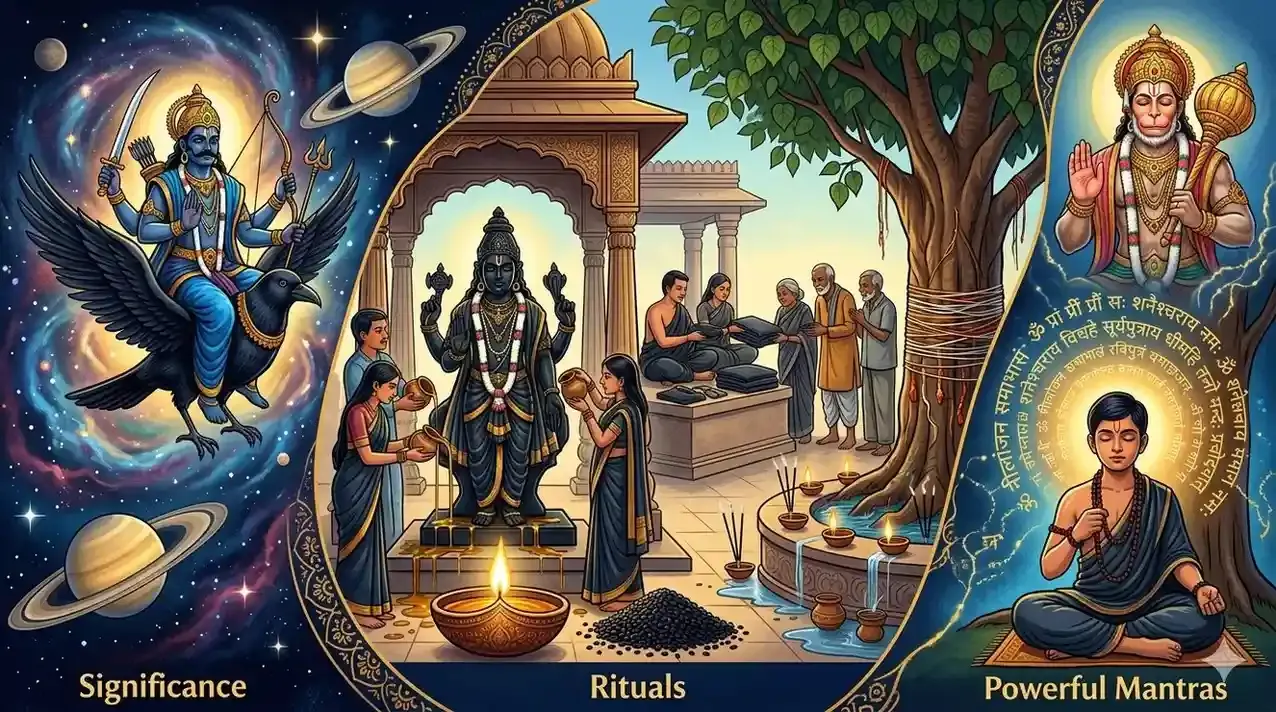
Website: HinduTone.com | Category: Shani Dev · Hindu Temples · Vedic Rituals · Navagraha | Read Time: 15 min “Shani Deva is not evil. He is the cosmic judge of karma — the remover of arrogance, the purifier of consciousness. The darkness he
Website: HinduTone.com | Category: Shani Dev · Hindu Temples · Vedic Rituals · Navagraha | Read Time: 15 min
“Shani Deva is not evil. He is the cosmic judge of karma — the remover of arrogance, the purifier of consciousness. The darkness he brings is not destruction. It is the doorway to the deepest awakening.”
Introduction: Why Visiting a Shani Temple Changes Everything
There is a unique energy in a Shani temple that you will not find anywhere else.
It is not the energy of joy or celebration. It is something deeper — a stillness, a weight, a seriousness that strips away pretence and brings you face to face with your own truth. Devotees who visit Shani temples regularly speak of a gradual but unmistakable transformation: the clearing of long-standing obstacles, the resolution of karma, the cultivation of patience and inner discipline that money cannot buy.
Shani Dev — Lord of karma, justice, and discipline — is revered as one of the most powerful dispensers of karmic justice in the Hindu pantheon. He rewards the righteous, corrects the arrogant, and ultimately restores every soul to its authentic path.
This complete guide covers every major Shani temple across India and the world, the must-performed rituals for devotees, the step-by-step Saturday puja vidhi, and the powerful mantras that align you with Shani’s transformative grace.
Jai Shani Dev. 🙏
1. Shani Deva Temples in India — The Sacred Pilgrimage Circuit
India is home to some of the most ancient, powerful, and spiritually charged Shani temples in the world. Each carries a unique history, mythology, and spiritual vibration. Here is the complete guide to the most important Shani temples across every region of India.
1. Shani Shingnapur — Ahmednagar, Maharashtra (Most Famous)
Location: Nevasa Taluka, Ahmednagar District, Maharashtra. Significance: The most visited Shani temple in India — and arguably in the world.
Shani Shingnapur Temple is unique for its open-air structure, where there is no roof above the idol of Shani Dev. It is a sacred place known for its belief that Shani Dev protects the village and the people who visit. Village homes don’t have doors since it’s believed that Lord Shani keeps thieves and any negative influence away. This is one of the most extraordinary expressions of devotion in all of Hinduism — an entire village living without locks, under the protection of Shani Deva.
What Makes It Unique:
The deity is a self-manifested (swayambhu) black rock slab, not a carved idol
No roof, no enclosure — Shani Dev sits open to the sky
Mustard oil abhishek is performed by thousands of devotees every Saturday
AdvertisementThe temple is busiest on Saturdays and Amavasya (new moon days)
Best Time to Visit: Early Saturday morning (5–7 AM) to avoid peak crowds. Nearest City: Ahmednagar (35 km) | Mumbai (3.5 hours by road). Nearest Airport: Aurangabad (84 km).
2. Shani Dham Temple — New Delhi (World’s Tallest Shani Idol)
Location: Asola, Chhatarpur Road, New Delhi. Significance: Home to the world’s tallest Shani Dev idol.
Shani Dham Temple is known to be home to the tallest statue of Lord Shani in all of the world. Standing tall and majestic at a height of 21 feet, this statue was built by the spiritual guru Sant Nagpal Baba. Shani Dham was founded by Guru Sant Namdev Ji Maharaj and is a significant place of worship for those impacted by Sade Sati and Shani Mahadasha. Special rites such as oil abhishek and Shani Mahatmya chanting are performed by devotees.
What Makes It Unique:
21-foot black stone idol — the tallest Shani statue in the world
Shani Mahapuja performed with hundreds of priests on special occasions
Major centre for Shani Graha Shanti Puja and Sade Sati remedies
AdvertisementEnormously crowded on Shani Jayanti and Amavasya Saturdays
Best Time to Visit: Saturday evenings | Shani Jayanti (Jyeshtha Amavasya). Nearest Metro: Chhatarpur (Delhi Metro, Yellow Line).
3. Thirunallar Saniswaran Temple — Karaikal, Tamil Nadu (Most Powerful for Dosha Relief)
Location: Thirunallar village, Karaikal district, Puducherry region, Tamil Nadu. Significance: The most revered Shani temple in South India — part of the Navagraha circuit.
Dharbaranyeswarar Temple at Thirunallar is the most important and powerful temple in the Navagraha circuit for Lord Shani (Saturn) worship. The temple is renowned for its ability to relieve the malefic effects of Saturn, particularly the feared Sade Sati. It is also said that Tirunallar Saniswaran Temple is the only temple where Saturn lost his power to the Lord Shiva. Worshipping Shani Bhagavan here helps one to develop positive power and to manage difficulties in life. This temple is famous for Maragadha Lingam and Golden crow.
The sacred Nala Theertham (tank) here is believed to cleanse all Shani Dosha. Devotees take a ritual bath in this tank before entering the temple. King Nala of the Nishadha kingdom — whose story is told in the Mahabharata — found liberation from Shani’s curse at this very spot.
The Thirunallar Ritual (Must-Do for Shani Dosha):
Take a dip in the Nala Theertham tank at dawn
Worship Kalitheertha Vinayaka at the entrance
AdvertisementOffer coconuts and prayers at the main sanctum
Circumambulate the shrine 7 times
Offer sesame oil and black sesame to Shani Bhagavan
Best Time to Visit: Shani Peyarchi (Saturn’s transit between zodiac signs) — thousands gather. Nearest City: Karaikal (5 km) | Nagapattinam (15 km).
4. Kokilavan Shani Temple — Kosi Kalan, Mathura, Uttar Pradesh
Location: Kosi Kalan, near Mathura, Uttar Pradesh. Significance: One of the most ancient Shani temples — associated with Shani’s guru Barkhandi Baba.
Kokilavan Dham is the place where the famous Shani Dev Temple is situated in Kosi Kalan near Mathura in Uttar Pradesh. This is a very ancient temple of Shani Dev and his guru Barkhandi Baba. Devotees from all over India come here to do pooja here. The forest of Kokilavan (the forest of cuckoos) is where Shani Dev is said to have performed his own tapas (penance). The energy here is ancient, raw, and deeply transformative.
Best Time to Visit: Saturdays | Shani Amavasya
5. Shanishchara Temple — Gwalior, Madhya Pradesh (Ramayan-Era Temple)
Location: Gwalior, Madhya Pradesh. Significance: Said to date from the Ramayana period — the oldest Shani temple by tradition.
According to legend, this is the mark where Shani Dev fell, when he was thrown by Sri Hanuman from Lanka to be rescued from Ravana. The temple houses the original black idol of Shani brought from Lanka. The main offering to Lord Shani is mustard oil. It is believed that Parikrama of ‘Shani Parvat’, a mountain of 14 km perimeter, relieves people from the curse of Shani Dev. The 14 km Shani Parvat parikrama is one of the most intense and rewarding pilgrimages for Shani devotees.
Best Time to Visit: Every Saturday | Amavasya Shanivar (new moon Saturday — the grandest puja).
6. Navgrah Shani Mandir — Ujjain, Madhya Pradesh
Location: Dedhiya region, 8 km from Ujjain, on the banks of the Kshipra River. Significance: Ancient Navagraha temple where King Vikramaditya himself worshipped Shani Dev.
The temple is dedicated to the nine planets and features idols for all Navagrahas. The main temple is devoted to Shani Dev, with King Vikramaditya believed to have worshipped here. Every Shani Amavasya here sees an extraordinary ritual: more than five quintals of oil are poured on Lord Shani, and later the oil is auctioned.
Best Time to Visit: Saturday evenings | Shani Amavasya | During the Kumbh Mela at Ujjain.
7. Yerdanur Shani Temple — Medak District, Telangana
Location: Yerdanur village, Medak district, Telangana. Significance: One of the largest Shani statues in South India.
Yerdanur Shani Temple is situated in a small village in Medak district of Telangana. Temple premises has one of the largest 20-ft statues of Lord Shani Dev at Yerdanur. The black monolithic idol here is carved from a single stone and weighs approximately 9 tonnes — one of the most imposing and awe-inspiring Shani idols in the country.
Best Time to Visit: Saturdays | Shani Jayanti.
8. Sri Shani Kshetra — Bannanje, Udupi, Karnataka
Location: Bannanje, Udupi, Karnataka. Significance: Features a 23-foot Shani statue — one of the tallest in South India.
Sri Shani Kshetra of Bannanje is situated in Udupi and has a 23 feet tall statue of Shani. This coastal Karnataka temple is deeply revered among Tulu Nadu devotees and draws pilgrims from across Karnataka and Goa.
9. Mandeswara Swamy Temple — Mandapalli, East Godavari, Andhra Pradesh
Location: Mandapalli (Mandapeta), East Godavari district, Andhra Pradesh. Significance: The most popular Shani temple in Andhra Pradesh.
Mandeswara Swamy Temple is located at Mandapalli in East Godavari district of Andhra Pradesh and is the most popular Shani temple in the state. The temple complex has a shrine to Saturn — Saneeswara — and this small temple attracts a large number of pilgrims.
10. Thirukollikadu Mangala Shani Temple — Thiruvarur, Tamil Nadu
Location: Thirukollikadu, near Thiruvarur, Tamil Nadu. Significance: The only temple where Shani manifests as Mangala Shani — the auspicious Saturn.
Tamil Nadu’s Thirukollikadu is well-known for its shrine where Lord Shani manifests as Mangala Shani. Here, in contrast to his menacing persona, Shani Dev bestows serenity, wealth, and good fortune upon his followers. The temple is particularly busy during Shani Peyarchi and is a part of the Navagraha pilgrimage circuit.
Other Notable Shani Temples in India
Shri Shanichara Temple — Morena, Madhya Pradesh — Holy water pond; ancient black stone idol
Navgrah Shani Mandir Pune — Pune, Maharashtra — Major urban Shani centre
Shani Mandir Indore — Indore, Madhya Pradesh — Busy Saturday puja hub
Shani Dham Nagpur — Nagpur, Maharashtra — Important central India pilgrimage
Sri Shani Bhagwan Devalayam — Hyderabad, Telangana — Navagraha complex; strong spiritual energy
Shani Mandir Raigarh — Raigarh, Chhattisgarh — Ancient forest-setting temple
Shani Kshetra Kuchanoor — Kuchanoor, Tamil Nadu — Major Sade Sati remedy temple
2. Shani Deva Temples Outside India — Worldwide Locations
The global Indian diaspora has carried the reverence for Shani Deva across every continent. Here are the major Shani and Navagraha temples accessible to devotees worldwide.
United States of America
Sarvamangala Shri Saneeswara Temple — New York. The Shri Navagraha Devasthanam of North America Inc. — the first of the 9 temples of Navagraha Devasthanam — is dedicated to Lord Saneeswara and has been consecrated in the City of New York. This is the ‘first’ Saneeswara Temple in the world outside India. This historic temple is a landmark for NRI devotees across the entire North American continent, offering authentic Shani puja, Navagraha abhishekam, and Sade Sati remedial rituals conducted by Agama-trained priests.
Other Major US Hindu Temples with Navagraha/Shani Shrines:
Shiva Vishnu Temple — Livermore, California — Major Navagraha shrine
Sri Venkateswara Temple — Pittsburgh, Pennsylvania — Navagraha altar
Meenakshi Temple — Pearland, Texas — Tamil-style Navagraha; active Shani worship
Sri Siva Vishnu Temple — Lanham, Maryland — Navagraha puja every Saturday
Hindu Temple of Greater Chicago — Lemont, Illinois — Active Shani puja community
Sri Venkateswara Temple — Bridgewater, New Jersey — Navagraha circuit; Saturday pujas
United Kingdom
Leicester’s large Hindu community maintains active Shani worship. The Shree Sanatan Hindu Mandir and several temples in Wembley and Southall (London) conduct regular Saturday Shani pujas, Navagraha abhishekam, and Hanuman-Shani combined worship.
Shree Swaminarayan Mandir — Neasden, London — World-class Hindu temple; Navagraha prayers
Shree Sanatan Mandir — Wembley, London — Active Shani puja community
Shree Ram Mandir — Leicester — Regular Saturday Shani worship
Shri Venkateswara (Balaji) Temple — Tividale, Midlands — South Indian Navagraha tradition
Canada
Brampton, with one of the largest South Asian populations outside India, has multiple active Hindu temples. The Hindu Sabha Mandir and several Navagraha temples in the Greater Toronto Area offer regular Shani puja on Saturdays with full rituals.
Hindu Sabha Mandir — Brampton, Ontario — Major Navagraha puja
BAPS Swaminarayan Mandir — Toronto, Ontario — Vedic traditions maintained
Hindu Temple Society — Vancouver, BC — West coast Shani puja hub
Swaminarayan Temple — Calgary, Alberta — Active Saturday worship
Australia
Hindu Council of Australia coordinates multiple temples across Sydney, Melbourne, and Brisbane that conduct Navagraha pujas including Shani worship. The Shri Shirdi Sai Baba Temple (Sydney) and Sanatan Mandir (Melbourne) are major centres.
Sanatan Mandir — Melbourne, Victoria — Regular Shani puja
Shri Venkateswara Temple — Helensburgh, NSW — Full Navagraha circuit
Hindu Temple — Brisbane, Queensland — Active South Indian traditions
Southeast Asia and Middle East
Sri Srinivasa Perumal Temple — Singapore — Tamil Hindu tradition; active Shani shrine
Sri Mahamariamman Temple — Kuala Lumpur, Malaysia — One of Southeast Asia’s oldest Hindu temples
Sri Veeramakaliamman Temple — Singapore — Navagraha shrine active
Shiva Temple — Bur Dubai — Dubai, UAE — Serves millions of NRI devotees
Sindhi Gurdarbar Temple — Dubai, UAE — Active Hindu community worship
Trinidad & Tobago / Caribbean
The large Indo-Caribbean Hindu community maintains active Shani worship traditions. The Sanatan Dharma Maha Sabha temples across Trinidad conduct Saturday Shani puja in the traditional South Indian and North Indian styles.
3. The Navagraha Circuit — Shani’s Place in the Sacred Nine
The nine Navagraha temples of Tamil Nadu form one of the most sacred pilgrimage circuits in Hinduism, with each temple dedicated to one of the nine celestial bodies. Tirunallar Saniswaran Temple is the Navagraha Sthalam for Saturn (Shani) in this sacred circuit.
The Nine Navagraha Temples of Tamil Nadu:
Sun (Surya) — Suryanar Koil, Kumbakonam
Moon (Chandra) — Thingalur, Thanjavur
Mars (Mangal) — Vaitheeswaran Koil, Sirkazhi
Mercury (Budh) — Thiruvenkadu, Sirkazhi
Jupiter (Guru) — Alangudi, Thanjavur
Venus (Shukra) — Kanjanur, Kumbakonam
Saturn (Shani) — Thirunallar Saniswaran Temple, Karaikal
Rahu — Thirunageswaram, Kumbakonam
Ketu — Keezhperumpallam, Sirkazhi
Completing the full Navagraha pilgrimage circuit — especially during Shani Peyarchi — is considered one of the most powerful spiritual acts for clearing all planetary doshas and accelerating karmic resolution.
4. Must-Performed Rituals for Shani Deva Devotees
Every Shani devotee — whether visiting a temple or worshipping at home — should know and regularly perform these essential rituals. Each one carries deep spiritual meaning and measurable karmic impact.
Ritual 1: Shanivar Vrat (Saturday Fast)
Observing a fast every Saturday is the most consistently recommended Shani ritual across all Vedic texts and traditions. As per Hindu scriptures, worshipping Shani on Saturdays helps in spiritual development and lowers Shani Dosha.
How to Observe:
Wake before sunrise and bathe (add a few black sesame seeds to the bathwater if possible)
Wear black or dark blue clothing throughout the day
Eat only one simple meal before sunset — no salt, no non-vegetarian food
Perform Shani puja morning and evening
Recite Shani Chalisa, Shani Stotra, or Shani Sahasranama
Visit a Shani temple or Peepal tree in the evening
Break the fast after the puja is complete, with prasad
Ritual 2: Tel Abhishekam (Mustard Oil Offering)
The recommended way of worshipping Shani is by offering black sesame (Til) to his statue or lighting a mustard oil lamp, and bowing your head down while chanting the Shani mantra. Pouring mustard oil on Shani’s idol while chanting the Shani Beej Mantra is the single most powerful act of Shani worship. The dark colour of these oils is associated with Shani Dev’s nature — deep, penetrating, and purifying.
How to Perform:
Pour mustard oil slowly over the Shani idol or Shani Yantra
Chant Om Praam Preem Praum Sah Shanaischaraya Namah continuously while pouring
Allow the oil to flow completely — do not stop mid-offering
Light a mustard oil diya (lamp) after the abhishek
Offer the collected oil to the poor or to crows after the ritual
Ritual 3: Peepal Tree Worship
The Peepal tree (Ficus religiosa) is considered Shani Dev’s sacred tree and the abode of ancestors. Worshipping the Peepal on Saturdays is one of the most effective remedies for Shani Dosha and Sade Sati.
Saturday Peepal Ritual:
Go to a Peepal tree at sunrise on Saturday
Pour water at its roots 7 times while circling clockwise
Light a mustard oil lamp under the tree
Tie a black thread around the trunk 7 times (a traditional offering)
Offer black sesame seeds at the base
Recite Shani mantra 108 times facing the tree
Ritual 4: Crow Feeding (Kak Seva)
In Vedic tradition, the crow is the living embodiment of Shani Dev’s presence. Feeding crows with til-rice on Saturdays is one of the most universally recommended remedies for Sade Sati.
How to Perform:
On every Saturday, prepare a small offering of cooked rice mixed with black sesame (til) and a few drops of mustard oil
Go to an open area or your terrace before noon
Place the offering and call the crows with a gentle call
Do not eat before the crows have eaten your offering
This ritual is especially powerful on Shani Amavasya
Ritual 5: Charity and Service (Daan)
Performing acts of charity, especially donating black items like black cloth, iron, or food to the needy, is believed to reduce the malefic effects of Saturn and earn Shani’s grace.
What to Donate on Saturdays:
Black sesame seeds and black urad dal — to the poor or to temples
Mustard oil — to Shani temples for the community lamp
Iron items — to blacksmiths, iron workers, or the poor
Black cloth — to the elderly or the destitute
Shoes or footwear — to the shoeless
Food — particularly to those who perform hard manual labour (a group governed by Saturn)
Ritual 6: Hanuman Puja on Saturday
Lord Hanuman is considered the supreme protector against Shani Dev’s harshness. It is said that Shani Dev himself agreed not to trouble Hanuman’s devotees. Worshipping Hanuman on Saturdays is, therefore, equally important as Shani puja.
The mythological basis: When Hanuman rescued Shani Dev from Ravana’s prison in Lanka, Shani Dev gave Hanuman a boon — that whoever sincerely worships Hanuman, especially on Saturdays, would be protected from Shani’s harshest effects.
Saturday Hanuman Ritual:
Recite Hanuman Chalisa — minimum once, ideally 5 or 11 times
Offer sindoor (vermilion) mixed with oil to Hanuman Ji’s idol — this is His most beloved offering
Offer jasmine garland and betel leaves
Offer prasad of boondi laddoo or motichoor laddoo
Ritual 7: Shani Graha Shanti Havan
Shani Graha Shanti Puja is performed with Shodashopachara steps along with reciting Shani Mantra 23,000 times. The puja also involves the Homa (Havan) ritual wherein ghee, sesame, barley, and other sacred material related to Lord Saturn are offered to Agni while reciting Shanti Mantras.
This intensive ritual — usually performed by a team of Vedic priests — is recommended for those entering or in the peak phase of Sade Sati, those experiencing Shani Mahadasha or Shani Antardasha, those seeking relief from long-standing professional, financial, or health challenges, and those beginning important new life chapters (marriage, business, relocation).
5. Saturday Shani Puja Vidhi — Step-by-Step Complete Guide
What You Need (Puja Samagri)
Shani Dev idol or image — Focus of devotion
Mustard oil (sarson ka tel) — Primary abhishek and lamp fuel
Black sesame seeds (kala til) — Shani’s most beloved offering
Black urad dal — Auspicious offering for Saturn
Aparajita or blue/black flowers — Shani’s sacred flowers
Iron vessel or bowl — Saturn’s metal
Black cloth — Shani’s colour
Rudraksha mala (108 beads) — For mantra chanting
Panchamrit (milk, curd, honey, ghee, sugar) — For abhishekam
Incense (agarbatti) — Preferably sandalwood or camphor
Puja Steps
Step 1 — Preparation. Wake up before sunrise. Take a bath and, if possible, add a few black sesame (til) seeds to the water. Wear clean clothes, preferably black or dark blue.
Step 2 — Sankalp (Vow of Intention). With folded hands, take a Sankalp — stating your name and your intention to observe the vrat and puja for Lord Shani’s blessings.
Step 3 — Set Up the Altar. Place an idol or image of Lord Shani Dev on a clean, dark cloth. Keep a brass or iron lamp ready, along with mustard oil for the lamp and for Tailabhishekam.
Step 4 — Cleanse the Idol. Prior to performing the Puja, cleanse the idol with Ganga jal, Panchamrit (mixture of five items), oil and water.
Step 5 — Invoke Shani Dev. Light a lamp filled with mustard oil and place it in front of the idol or picture of Shani Dev. Chant the Invocation Mantra: Om Sham Shanaischaryaye Namah or Om Praam Preem Praum Sah Shanaischaraya Namah to invite the presence of Shani Dev.
Step 6 — Perform Tailabhishekam. Pour mustard oil over the idol or Shani Yantra while chanting the Shani Beej Mantra. This is the most significant ritual of Shani worship.
Step 7 — Offer Sacred Items. Offer black flowers, black sesame seeds (til), black cloth, and iron items to Shani Dev.
Step 8 — Chant the Shani Mantra. Chant the Shani Mantra: Om Sham Shanicharaya Namah — repeat the mantra 108 times using a mala (prayer beads). This mantra is considered highly effective for invoking Shani Dev’s blessings and protection.
Step 9 — Recite Shani Chalisa or Shani Stotra. Read or listen to the full Shani Chalisa. If time permits, also recite the Dasharathkrit Shani Stotra — one of the oldest and most powerful Shani stotras, said to have been composed by King Dasharatha (father of Lord Rama) during his own Shani affliction.
Step 10 — Aarti and Conclusion. Perform Shani Dev’s aarti. Offer prasad (black sesame laddoo or sheera). Distribute prasad to family members. Conclude with a moment of silent meditation and personal prayer.
6. Shani Tailabhishekam — The Most Powerful Shani Ritual
Tailabhishekam — the ritual bathing of Shani Dev’s idol with oil — is the single most powerful act of Shani worship. Here is why it works spiritually:
In Vedic cosmology, Saturn’s energy is cold, dense, and contracting — qualities associated with the earth element and the colour black. Mustard oil, with its warming, penetrating nature, is the perfect counterbalance — it softens Saturn’s hardness and enables his energy to flow benevolently rather than restrictively.
The Science of the Shani Oil Ritual
Mustard oil (sarson ka tel): Warm, penetrating, activates Saturn’s positive qualities
Black sesame oil (til ka tel): Deeply purifying, removes accumulated karma
Panchamrit: Purifies and sanctifies; represents five elements
Performing Tailabhishekam at Home
Place Shani idol or yantra on an iron plate
Begin chanting Om Praam Preem Praum Sah Shanaischaraya Namah
Pour mustard oil slowly in a continuous stream from above the head of the idol
Continue chanting throughout — never stop mid-abhishek
After the oil, perform a water rinse with Gangajal
Wipe the idol gently with a black cloth
Light a fresh mustard oil lamp in front of the idol
7. Shani Mantras — Complete Collection with Meaning
The Shani Beej Mantra (Most Powerful)
ॐ प्रां प्रीं प्रौं सः शनैश्चराय नमः Om Praam Preem Praum Sah Shanaischaraya Namah
When: Every Saturday | 108 times minimum | Best during Saturn hora. Power: Directly activates and pacifies Saturn’s energy in the birth chart.
The Shani Mool Mantra
ॐ शं शनैश्चराय नमः Om Sham Shanicharaya Namah
When: Daily — especially on Saturdays. Power: The simplest and most accessible Shani mantra — suitable for all devotees.
The Shani Gayatri Mantra
ॐ शनैश्चराय विद्महे छायापुत्राय धीमहि, तन्नो मन्दः प्रचोदयात् Om Shanaischaraya Vidmahe Chaayaputraya Dheemahi, Tanno Mandah Prachodayaat
When: Morning puja on Saturdays | During Sade Sati. Power: Invokes Shani’s full cosmic consciousness — the Gayatri form elevates and purifies the highest levels of karmic imprint.
Dasharathkrit Shani Stotra — Opening Verse
नमस्ते कोणसंस्थाय पिंगलाय नमोऽस्तु ते। नमस्ते बभ्रुरूपाय कृष्णाय च नमोऽस्तु ते।। I bow to you, the one stationed in the corner (of the sky). I bow to you, the tawny-coloured one. I bow to you of the brown form. I bow to you, the dark one.
The full Dasharathkrit Shani Stotra, composed by King Dasharatha, is available in the HinduTone Mantra Library.
8. Shani Deva Rituals for Sade Sati & Shani Dosha Relief
If you are currently in Sade Sati, Shani Mahadasha, or Shani Antardasha, these are the most essential rituals for transforming the period from one of struggle to one of growth.
The Sade Sati Relief Protocol
Daily (Every Day):
Recite Hanuman Chalisa — minimum once
Light a mustard oil lamp in front of Shani’s image at dawn and dusk
Chant Om Sham Shanicharaya Namah 108 times
Every Saturday:
Observe Shanivar Vrat (fast until evening)
Perform full Shani puja with Tailabhishekam
Feed crows with sesame rice
Donate mustard oil, black sesame, or black urad dal to the poor
Visit a Shani temple if accessible
Worship the Peepal tree with oil lamp and water offering
Every Amavasya (New Moon):
Perform Shani Amavasya puja — one of the most powerful days for Shani worship
Offer sesame oil at the Peepal tree
Donate to the poor and serve food to the elderly
Recite Shani Chalisa 11 times
Once During Sade Sati:
Visit Thirunallar Saniswaran Temple (or any major Shani temple) and perform the full ritual bath and darshan
Commission a Shani Graha Shanti Havan through a qualified temple or pandit
Recite the full Shani Sahasranama (1,000 names of Shani) on a Saturday
9. What to Offer Shani Deva — Sacred Items & Their Significance
Mustard oil (sarson ka tel): Saturn’s most sacred liquid — purifies and pacifies. Abhishekam on idol; lamp fuel; donation to temple
Black sesame (kala til): Shani’s favourite grain — removes karmic seeds. Offered at feet of idol; added to bathwater; fed to crows
Black urad dal: Saturn’s grain — grounds his energy. Donated to the poor every Saturday
Iron: Saturn’s metal — most directly connects to his frequency. Iron vessels, nails, or items donated to workers
Black cloth: Shani’s colour — absorbs and purifies Saturn’s energy. Offered on the idol; donated to the poor
Blue sapphire (neelam): Saturn’s gemstone — only worn after expert consultation. Never offer or wear without a verified Vedic astrologer’s recommendation
Crows feeding (til-rice): Crow is Shani’s vahana — feeding them is feeding the Lord. Every Saturday morning before your own meal
Aparajita flowers: Shani’s favourite flower — blue/violet, sacred to Saturn. Offered fresh at the idol
Peepal tree worship: Shani’s abode — ancestors reside here. Water, oil lamp, and sesame offering every Saturday
10. Shani Dev Puja for NRI Devotees Worldwide
Living outside India does not diminish the power of your devotion to Shani Deva. Here is how NRI devotees across the world can maintain authentic, effective Shani worship.
Setting Up a Shani Puja Space at Home
Dedicate a small corner with a Shani image, Shani yantra, or black stone
Keep an iron plate underneath as Shani’s base
Keep a supply of mustard oil, black sesame, and black urad dal from your local Indian grocery
Use battery-operated or LED lamps where open flames are restricted
Finding Puja Items Abroad
Indian grocery stores in all major NRI cities stock agarbatti, til, sarson tel, and kumkum
Amazon (USA, UK, Canada, Australia) carries Shani idols, yantras, and puja kits
Online Vedic stores like HinduTone, ExoticIndia, and MyPoojaBox ship internationally
Connecting with Shani Temples Abroad
Use the temple listings in Section 2 of this guide to find your nearest Shani or Navagraha temple
Many temples now offer online puja booking — commission a Tailabhishekam or Graha Shanti puja remotely at Thirunallar or Shani Shingnapur
Join your local Indian cultural association’s Saturday puja group
Virtual Shani Darshan
Many major Shani temples offer live darshan streaming:
Shani Shingnapur — live webcam darshan available
Shani Dham Delhi — YouTube live aarti every Saturday
Thirunallar Saniswaran — available through temple trust website
Frequently Asked Questions
Which is the most powerful Shani temple in India?
Both Shani Shingnapur (Maharashtra) and Thirunallar Saniswaran Temple (Tamil Nadu/Karaikal) are considered the most powerful. Shani Shingnapur is the most famous and widely visited. Thirunallar is considered the most powerful specifically for Sade Sati and Shani Dosha relief — the sacred Nala Theertham bath here is said to directly purify Saturn karma. For North Indians, Shani Dham Delhi (world’s tallest Shani idol) and Shanishchara Temple Gwalior (Ramayana-era temple) are especially significant.
How often should I visit a Shani temple?
Every Saturday is ideal — even brief darshan and oil offering makes a profound cumulative difference over months and years. If weekly visits are not possible, prioritise Shani Amavasya (new moon Saturday), Shani Jayanti, and during Shani Peyarchi (Saturn’s zodiac transit). During Sade Sati, monthly or fortnightly temple visits significantly ease the transit.
Can women perform Shani puja?
Yes. Women can and do perform Shani puja. Some traditions advise women not to touch the Shani idol directly during puja. Offering flowers, diya, and mantra chanting at a respectful distance is perfectly acceptable and equally effective. At Thirunallar, all devotees regardless of gender take the ritual bath and perform darshan. At Shani Shingnapur, specific rules apply for approaching the sanctum — follow the temple’s guidelines.
What is the best mantra for Shani Dosha relief?
The Shani mantra Om Sham Shanicharaya Namah repeated 108 times using a mala is considered highly effective for invoking Shani Dev’s blessings and protection. For deeper dosha relief, the Shani Beej Mantra (Om Praam Preem Praum Sah Shanaischaraya Namah) is more powerful. Combining these with daily Hanuman Chalisa recitation is the most widely recommended combination across all Vedic traditions.
Is there a Shani temple outside India?
Yes. The Sarvamangala Shri Saneeswara Temple in New York City is the first Saneeswara Temple in the world outside India. There are also major Navagraha shrines with active Shani worship in the UK (London, Leicester, Midlands), Canada (Brampton, Toronto, Vancouver), Australia (Sydney, Melbourne), Singapore, Malaysia, and the UAE.
How long does Shani puja take at home?
A complete Saturday Shani puja at home takes between 30 minutes (abbreviated version with mantra chanting and oil lamp) to 90 minutes (full Tailabhishekam, Shani Chalisa, and aarti). Even 15 minutes of sincere mantra chanting with a lit mustard oil lamp has genuine spiritual value. Devotion and consistency matter more than duration.
What should I not do during Sade Sati?
Avoid: alcohol and non-vegetarian food on Saturdays (and ideally throughout Sade Sati); arrogance, dishonesty, and shortcuts; starting entirely new major ventures without astrological guidance; neglecting parents and the elderly; cutting or uprooting Peepal trees. Focus on: discipline, service, honesty, humility, and sincere spiritual practice. Shani rewards those who align with his values.
Conclusion: The Temple and the Soul Are One
The greatest Shani temple is not in Maharashtra or Tamil Nadu. It is inside you.
Every act of honesty is a Shani puja. Every gesture of service to the suffering is a Tailabhishekam. Every moment of genuine humility before life’s trials is darshan of the Lord himself.
Visit the temples — their energy is real and their power is ancient. Perform the rituals — they are the distilled wisdom of thousands of years of devotion. But know that Shani Deva is watching not just what you do in the temple, but what you do everywhere else.
Be disciplined. Be honest. Serve. Endure.
That is the deepest Shani puja of all.
Jai Shani Dev. 🙏
You might also like

Sacred Hindu Festivals & Temple News: Divine Week — May 2026

Divine Hindu Temple News, Festivals & Global Devotion in Jyeshtha Adhik Maas 2026
Shani Jayanti 2026: Date, Significance, Rituals & Powerful Mantras