Vishnu Sahasranama — Complete Guide to the 1000 Names of Vishnu, Origin, Selected Verses, Sunday Practice & 30-Day NRI Plan for 2026
Vishnu Sahasranama 2026 complete guide — origin in Mahabharata, Adi Shankaracharya bhashya, MS Subbulakshmi recording, Sunday recitation tradition, 30-day NRI practice plan, selected verses with meaning, career and family benefits.
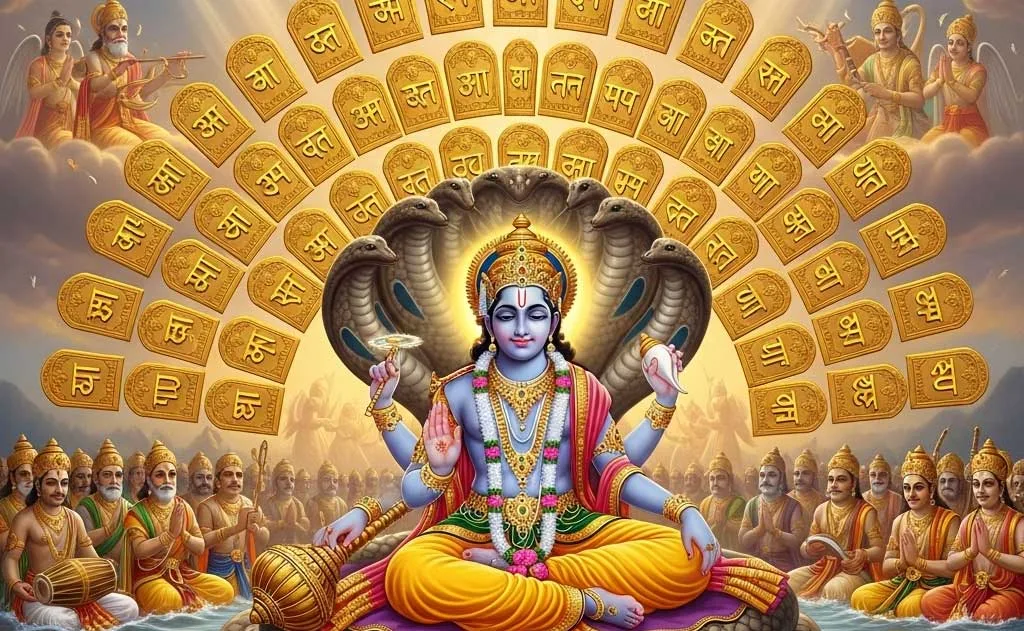
Vishnu Sahasranama 2026 complete guide — origin in Mahabharata, Adi Shankaracharya bhashya, MS Subbulakshmi recording, Sunday recitation tradition, 30-day NRI practice plan, selected verses with meaning, career and family benefits.
"Vishvam Vishnur Vashatkaro Bhoota Bhavya Bhavatprabhuh, Bhoota Krit Bhoota Bhrit Bhavo Bhoota Atma Bhoota Bhavana."
Vishnu — the universe, the controller of all, Lord of past present and future; creator, sustainer, source of all beings, soul of all beings, ground of becoming.* — Vishnu Sahasranama, opening verse
Updated for 2026. The Vishnu Sahasranama — the 1,000 names of Lord Vishnu — is the most powerful single Vishnu recitation in the Hindu canon. Composed by sage Vyasa and recorded in the Anushasana Parva of the Mahabharata, the Sahasranama was taught by Bhishma on his deathbed of arrows to Yudhishthira at the close of the Kurukshetra war. The supreme commentary (*bhashya*) was written by Adi Shankaracharya in the 8th century CE, establishing its philosophical authority. The 1968 recording by MS Subbulakshmi has become the gold-standard global Vishnu Sahasranama audio, played daily in millions of Hindu homes worldwide. For NRI Hindus across USA, UK, Canada, Australia, GCC, Germany, Singapore, Malaysia — Sunday Vishnu Sahasranama is among the most spiritually beneficial sustainable practices combining ~35 minutes of devotional listening or recitation with measurable cardiovascular and emotional benefits. This complete guide includes the origin, the 1000-name structure, 25 selected most-powerful verses with meaning, the Sunday tradition, a 30-day NRI practice plan, country-specific guidance, and the complementary Tuesday-Saturday Hanuman framework.
1. What Is the Vishnu Sahasranama?
Vishnu Sahasranama literally means "the thousand names of Vishnu." It is a Sanskrit stotra (devotional hymn) of approximately 108 verses containing 1,000 distinct epithets, attributes, and aspects of Lord Vishnu.
Each of the 1000 names captures one facet of the supreme divine — Vishnu's role as preserver, his cosmic functions, his physical descriptions, his philosophical attributes, his relationships with other deities, his avatars, and his ultimate identity with Brahman.
Key features:
- 108 verses + opening + closing dohas (varies slightly by tradition)
- Total recitation time: 35-45 minutes at devotional pace; 25-30 minutes accelerated
- Language: Sanskrit (recited in original; not translated into vernacular for chanting)
- Authoritative versions: Bhishma Parva / Anushasana Parva of Mahabharata (Vyasa); Adi Shankaracharya bhashya (commentary)
The Sahasranama is regarded across all major Hindu sampradayas (Smarta, Vaishnava, Shaiva-compatible) as among the most universally accessible and most spiritually merit-rich recitations in the entire Hindu canon.
2. The Mahabharata Origin — Bhishma to Yudhishthira
The Vishnu Sahasranama's setting is one of the most poignant in all Hindu literature.
The scene: The Kurukshetra war has ended. The Pandavas have won. Bhishma Pitamaha — the grandsire who had led the Kauravas — lies on his sharashayya (bed of arrows), awaiting his self-chosen moment of death during Uttarayana (winter solstice transition).
Yudhishthira approaches him in grief, asking the dying patriarch for the final teaching. "O Pitamaha," Yudhishthira asks, "what is the supreme dharma? What single practice grants the greatest spiritual welfare?"
Bhishma's answer is the Vishnu Sahasranama.
He teaches Yudhishthira that meditation on the 1,000 names of Vishnu, sustained over a lifetime, is the supreme spiritual practice. It grants:
- Material welfare (artha)
- Righteous fulfilment of desires (kama)
- Dharmic action (dharma)
- And ultimately, liberation (moksha)
The recitation is given in full — 1,000 names organised across 108 verses, each name a specific facet of Vishnu's totality.
Bhishma's framing is significant: this is not abstract theology. This is the dying teacher giving his most beloved student the single most important spiritual instruction. The setting establishes the Sahasranama's status as the supreme Vishnu mantra.
3. Adi Shankaracharya's Bhashya — The Philosophical Foundation
In the 8th century CE, the great Advaita Vedanta acharya Adi Shankaracharya wrote a detailed commentary (*bhashya*) on the Vishnu Sahasranama. This is among Shankara's most important works, alongside his commentaries on the Brahma Sutras, the principal Upanishads, and the Bhagavad Gita.
Shankara's bhashya does several things:
- Establishes the philosophical authority of the Sahasranama as a non-dual / monistic teaching
- Explains each of the 1000 names with its Sanskrit derivation and theological significance
- Demonstrates that Vishnu's 1000 names all point to the single supreme Brahman
- Provides interpretive framework for non-Vaishnava Hindus to engage Vishnu worship within the Advaita non-dual framework
For Indian scholars and serious practitioners, Shankara's bhashya is the standard interpretive guide. For NRI Hindus, the bhashya is available in multiple English translations — Swami Tapasyananda (Ramakrishna Math), Swami Vimalananda (Chinmaya Mission), Swami Krishnananda (Divine Life Society) are among the most respected modern editions.
4. MS Subbulakshmi and the Modern Transmission
In 1968, the legendary Carnatic vocalist MS Subbulakshmi (1916-2004) recorded the complete Vishnu Sahasranama for HMV Records. This recording became the singular global Vishnu Sahasranama audio reference.
Why MS Subbulakshmi's recording transformed the practice:
- Authoritative pronunciation — guided by senior Vedic scholars
- Devotional intensity — her voice carries the bhava (devotional sentiment) of the entire tradition
- Accessibility — pre-internet, the LP/cassette/CD made the Sahasranama available globally
- Daily-listening duration — fits perfectly into morning commute, household work, or evening winding-down
- Multi-generational appeal — has been the soundtrack of Hindu homes from Chennai to California for 6 decades
The recording is now freely available on YouTube, Spotify, Apple Music, JioSaavn, and most streaming platforms. For NRI Hindus beginning Sahasranama practice, listening to MS Subbulakshmi's recording daily is the most accessible entry point.
Other notable recordings:
- Pandit Jasraj version (Hindustani classical interpretation)
- Various Iyer-tradition chant recordings (more traditional Vedic chant style)
- Vidya Bhushana / Bombay Sisters versions for South Indian classical tradition
5. Structure — The 1000 Names Organised
The Vishnu Sahasranama is structured as follows:
Pre-amble — Bhishma's setup
The opening verses describe Yudhishthira's question and Bhishma's offering of the supreme teaching.
The Sahasranama proper — 108 verses
Each verse contains roughly 8-10 names. The names progress through several thematic clusters:
Cluster 1 — Cosmic / Universal Vishnu:
Vishvam, Vishnur, Vashatkaro, Bhoota Bhavya Bhavatprabhuh — "The universe, Vishnu, the controller, Lord of past-present-future."
Cluster 2 — Creator-Sustainer-Destroyer roles:
Names describing Vishnu's cosmic functions across creation, preservation, dissolution.
Cluster 3 — Personal attributes:
Names describing Vishnu's beauty, form, characteristics — Lotus-eyed, golden-hued, garlanded, four-armed.
Cluster 4 — Avatar references:
Names connecting to the Dasavataram — Matsya, Kurma, Varaha, Narasimha, Vamana, Parashurama, Rama, Krishna, Buddha, Kalki.
Cluster 5 — Devotee-relationship:
Names describing Vishnu's relationship with his devotees — Bhakta-priya, Bhakta-vatsala, Sharanya.
Cluster 6 — Philosophical:
Names asserting Vishnu's identity with Brahman — Sat, Chit, Ananda, Param Atma, Sarva-vyapi.
Cluster 7 — Wealth and welfare:
Names connecting to Lakshmi, prosperity, dharmic well-being.
Cluster 8 — Final closing:
The closing verses recapitulate the practice, emphasise its merit, and conclude with the dhyana of Vishnu.
Closing dhyana
After the 108 verses, the recitation includes a meditative concluding section emphasising Vishnu's eternal presence.
6. 25 Selected Most-Powerful Verses with Meaning
These 25 verses are widely regarded as among the most powerful within the Vishnu Sahasranama.
Verse 1 — The Opening (Most Important)
Vishvam Vishnur Vashatkaro Bhoota Bhavya Bhavatprabhuh
Bhoota Krit Bhoota Bhrit Bhavo Bhoota Atma Bhoota Bhavana
Meaning: Vishnu is the universe itself; the controller (Vashatkara, the master of Vedic invocation); Lord of past, present, and future; creator of beings; sustainer of beings; the source of all becoming; the soul of all beings; the ground of all existence.
This single verse contains the philosophical core of the entire Sahasranama: Vishnu = ultimate reality = your own deepest Self.
Verse 8 — Cosmic Vishnu
Sarvah Sharvah Shivah Sthanur Bhootadi Nidhir Avyayah
Sambhavo Bhavano Bharta Prabhavah Prabhur Ishvarah
Meaning: All-pervading, destroyer of evil, auspicious, eternal, beginning of beings, treasure-house, imperishable, manifest as creator, sustainer, supporter, originator, the Lord supreme.
Verse 31 — Vishnu the Witness
Sarvashcharvavid Bhanur Vishvaksenor Janardanah
Vedo Vedavid Avyangam Vedango Vedavit Kavih
Meaning: The seer of all, the omniscient, the sun, the all-attacker (against evil), the destroyer of demons; the embodiment of the Vedas; the knower of Vedas; without defect; with the Vedas as his limbs; the poet of all.
Verse 47 — Vishnu the Granter
Achyuto Vrishakapir Achintyo Vrishabhakshanah
Vrishi Priti Vardhanaha Sarvavasaha Sukhadyaha
Meaning: The undecayable; the bull-form (potency); the inconceivable; the destroyer of evil-tendencies; the destroyer of obstacles; the cause of growing love; abode of all; source of happiness.
Verse 75 — The Famous Cosmic-Triad Verse
Hiranyagarbhah Shatrughno Vyaapto Vaayur Adhokshajaha
Rituh Sudarshanah Kaalah Parameshthi Parigrahaha
Meaning: The golden cosmic womb; destroyer of enemies; the pervader; the wind-element; below-the-senses (inscrutable); the cosmic season; the discus-bearer; the time-principle; the supreme abode; the all-embracer.
Verse 88 — The Closing Power Verse
Charaachara Vyaapakaha Sarva Vishnur Vishva Vibhuh Prabhuh
Devo Devo'rcanaarchyeyaha Yajnaardhakshara Atmaka
Meaning: Pervader of movable and immovable; all-Vishnu, the world-encompassing one, the supreme Lord; the deity worshipped by deities; the half-essence of the syllable of sacrifice (representing the supreme cosmic principle).
Verse 100 (Final Cluster) — Liberation Verse
Bhagavan Bhaga Hanaadi Vandanya Vasudevah Bruhad Bhanuh
Adidevah Mahadevah Devesho Devabhrid Guruh
Meaning: The Lord of all glory; the source of all auspiciousness; the source from whom everything flows; cousin and son of Vasudeva; the immense radiance; the primal deity; the great deity; the Lord of deities; sustainer of deities; the supreme guru.
(The remaining 18 verses among the 25 most-powerful can be studied in full at home with the Adi Shankaracharya bhashya — see Section 12 for resource list.)
7. The Sunday Vishnu Sahasranama Tradition
Sunday is universally Vishnu's day in Hindu weekday tradition. While Sunday is technically Surya's (Sun's) day in the planetary scheme, Vishnu — as Vishvarupa and as the embodiment of cosmic light — is the day's primary devotional focus.
Why Sunday specifically
- Surya is Vishnu's solar manifestation (*Surya Narayana*)
- The Surya Gayatri invokes Vishnu via Surya
- Sunday morning is the household's weekly cleansing — the natural day for elaborate household puja
- Working professional alignment — Sunday is usually free from work, allowing full 35-45 minute Sahasranama recitation
- Community alignment — most Hindu temples worldwide hold Sunday community Sahasranama recitation
Daily vs Sunday practice
Two complementary patterns:
- Daily: Listen to MS Subbulakshmi recording during morning commute / household preparation (5 days a week)
- Sunday: Full verbal recitation at home altar, or community temple Sahasranama
This daily-exposure + weekly-deep-engagement pattern is what most practising NRI Hindus follow.
Vaikuntha Ekadashi (December 1, 2026)
The single most powerful Vishnu Sahasranama day of the year. Tradition holds that recitation on Vaikuntha Ekadashi grants moksha-equivalent merit. See our [Margasira Masam 2026 guide](/margasira-masam-2026-yoga-meditation-winter-morning-guide/) for the full Vaikuntha Ekadashi protocol.
8. 30-Day NRI Practice Plan
Week 1: Listening Foundation (Days 1-7)
Goal: Daily exposure to the Sahasranama; build the rhythm.
- Download MS Subbulakshmi's Vishnu Sahasranama (YouTube / Spotify / Apple Music)
- Listen daily during morning routine or commute (35-45 min)
- No memorisation expected; just deep listening
- Light a diya at home altar before listening if possible
Week 2: Sunday Recitation (Days 8-14)
Goal: Begin verbal recitation; commit to weekly Sunday practice.
- Continue daily listening
- Sunday morning: read along with text (Devanagari or transliteration) while listening
- Aim for full 35-45 minute Sunday Sahasranama
- Don't worry about pronunciation perfection — start somewhere
Week 3: Memorisation of Opening Verses (Days 15-21)
Goal: Memorise the opening verses; deepen engagement.
- Memorise verses 1-2 (the opening + Bhishma's setup)
- Begin reading 1 verse's meaning from Adi Shankara's bhashya each day
- Sunday: full recitation; this week from increasingly engaged state
Week 4: Embodiment (Days 22-30)
Goal: Sustained practice; observable inner shift.
- Continue daily listening
- Memorisation expanded to 5-10 verses
- Sunday recitation now becomes anticipated weekly anchor
- Brief journal: notice changes in sleep, anxiety, family relationships, work focus
Day 30 Review
Most practitioners report measurable shifts within 30 days:
- Calmer baseline mood
- Better sleep quality
- Less reactivity to workplace stressors
- Improved family relationship warmth
For those continuing, the 90-day mark is when neuroplastic changes consolidate. For lifetime practitioners, Sunday Sahasranama becomes the week's central spiritual anchor.
9. Family Welfare and Career Applications
The Vishnu Sahasranama is uniquely positioned for family welfare because it invokes Vishnu's role as preserver — the cosmic principle of stability, continuity, and protection.
Specific applications
Family welfare:
- Recite for child's safety, academic success, marriage
- For spouse's career, health, longevity
- For parental welfare and longevity
- For family unity and harmony
Career protection:
- Sunday Sahasranama anchors the entire work-week
- For senior leadership roles requiring vision and stability
- For long-arc career building (Vishnu = sustainer)
- For family-business stability across generations
Health:
- Auxiliary practice during family member illness
- Recovery from major surgery
- Ongoing chronic-condition management (alongside medical care)
Major life transitions:
- Marriage preparation
- Pregnancy and childbirth
- Moving abroad or returning to India
- Children's college admissions / first jobs
Vs Hanuman Chalisa:
The two practices are complementary:
- Hanuman Chalisa: Tuesday + Saturday emphasis. Mars-Saturn pacification. Career protection, courage, removal of obstacles.
- Vishnu Sahasranama: Sunday emphasis. Family welfare, preservation, long-arc stability, dharmic family-life.
The complete weekly framework for an NRI Hindu working professional:
- Sunday: Vishnu Sahasranama
- Monday: Shiva (Om Namah Shivaya)
- Tuesday: Hanuman Chalisa
- Wednesday: Ganesh (Om Gam Ganapataye Namaha)
- Thursday: Vishnu / Sai Baba
- Friday: Lakshmi (Om Shreem Mahalakshmaye Namaha)
- Saturday: Hanuman Chalisa (Sade Sati pacification)
10. Country-by-Country NRI Guide
🇺🇸 USA
- Most major temples (Pittsburgh Sri Venkateswara, BAPS Robbinsville, Atlanta Hindu Temple, Bay Area Sunnyvale) hold Sunday community Vishnu Sahasranama
- MS Subbulakshmi's recording widely played in Indian-American households
- Online recitation: Hindu Heritage Foundation, BAPS Yuva chapters
- Indian groceries stock multilingual Sahasranama books (English, Tamil, Telugu, Hindi)
🇬🇧 UK
- BAPS Neasden, Bhaktivedanta Manor Sunday Sahasranama
- Bharatiya Vidya Bhavan London Sanskrit classes for serious students
🇨🇦 Canada
- Hindu Sabha Mandir Brampton, BAPS Toronto, Surrey BC Sunday community recitation
- Indo-Canadian families increasingly participate in multi-generational Sunday Sahasranama
🇦🇺 Australia
- Sri Venkateswara Helensburgh NSW, Shree Shiva Vishnu Carrum Downs Melbourne
- Sydney + Melbourne community Sunday Sahasranama in Tamil/Telugu families
🇩🇪 Germany
- Sri Ganesh Hindu Tempel Frankfurt
- BAPS Berlin community Sunday
- Online satsang via Sri Mandir / BAPS apps for those without nearby temple
🇦🇪 GCC
- BAPS Hindu Mandir Abu Dhabi (the largest Hindu temple outside India) Sunday Sahasranama programmes
- Bur Dubai Krishna Mandir community Sahasranama
- Friday family practice common as alternative to Sunday given GCC weekend
🇿🇦 South Africa
- Sri Mahalakshmi Greenwood Park Durban + Hindu Sabha Sunday recitation
- Multi-generational family tradition strong in 165-year established Hindu community
🇸🇬 Singapore
- Sri Mariamman / Sri Veeramakaliamman temples + ISKCON Sembawang
- Sunday community programmes well-attended
🇲🇾 Malaysia
- Major South Indian temples + ISKCON KL hold Sunday Sahasranama
- Tamil heritage community continues centuries-old Sunday Vishnu observance
🇮🇳 India
- Tirumala daily Vishnu Sahasranama (multiple times); the global Sahasranama "centre"
- Sri Ranganatha Srirangam Sunday community
- Most homes have decades-old MS Subbulakshmi cassette/digital recording in daily rotation
11. FAQs
Q: How long does it take to recite the Vishnu Sahasranama?
A: 35-45 minutes at devotional pace (MS Subbulakshmi version). 25-30 minutes for daily-listening accelerated. 15-20 minutes for very fast recitation (not recommended for first 100 sessions).
Q: Can I listen to MS Subbulakshmi instead of reciting myself?
A: Yes. Listening (*shravan*) is a valid form of worship in Hindu tradition. Many practitioners listen during morning commute / household work and recite verbally only on Sundays.
Q: Do I need to know Sanskrit to recite?
A: No. Read from transliteration (Roman script with pronunciation guides). The bhava (sentiment) matters more than perfect Sanskrit pronunciation. Pronunciation improves naturally with practice over months.
Q: Can women recite the Vishnu Sahasranama?
A: Absolutely. No traditional restriction. Many women find Vishnu's preservation/maternal-protection energy particularly relevant.
Q: Can the Sahasranama be recited during menstruation?
A: Mental recitation (*manasika*) is acceptable. Strict physical-puja prohibition during menstruation does not extend to mental recitation. Modern teachers increasingly view this as outdated; use judgment.
Q: How does Vishnu Sahasranama differ from Lakshmi Sahasranama, Lalita Sahasranama, etc.?
A: Different deities, similar 1000-name structure. Vishnu Sahasranama is the foundational/oldest. Lalita Sahasranama focuses on Devi worship; Lakshmi Sahasranama on prosperity; Shiva Sahasranama on Shiva.
Q: Should I memorise the entire Sahasranama?
A: Few practitioners memorise all 108 verses. Memorising the opening 5-10 verses + the closing dhyana is the practical target. Reading the rest is acceptable.
Q: What if I'm a non-Vaishnava (Shaiva, Shakta, Smarta)?
A: All traditions accept the Sahasranama. Adi Shankara's bhashya specifically establishes its non-Vaishnava philosophical foundation. The Sahasranama works for any Hindu practitioner.
Q: Can I recite during travel / commute?
A: Yes — particularly mental recitation. Many NRI professionals listen to MS Subbulakshmi during 35-minute morning commute.
Q: What's the connection to Bhagavad Gita?
A: The Gita is Krishna's direct teaching to Arjuna; the Vishnu Sahasranama is Bhishma's teaching of Vishnu's names to Yudhishthira. They are complementary — Gita is philosophy + practice; Sahasranama is divine-attribute meditation.
Q: My family has been listening to MS Subbulakshmi for decades — should I find a new recording?
A: No need. Her recording is widely regarded as the canonical version. Stick with what your family knows; that continuity itself is part of the tradition.
Q: How does this connect to other practices like the Hanuman Chalisa?
A: Complementary. See Section 9 — the complete weekly framework combines Vishnu Sahasranama (Sunday) + Hanuman Chalisa (Tuesday/Saturday) + Shiva (Monday) + Ganesh (Wednesday) + Lakshmi (Friday).
Frequently Asked Questions
What is the Vishnu Sahasranama?
"Vishvam Vishnur Vashatkaro Bhoota Bhavya Bhavatprabhuh, Bhoota Krit Bhoota Bhrit Bhavo Bhoota Atma Bhoota Bhavana." Vishnu — the universe, the controller of all, Lord of past present and future; creator, sustainer, source of all beings, soul of all beings, ground of becoming.* — Vishnu Sahasranama, opening verse Updated for 2026. The Vishnu Sahasranama — th
How many times should the Vishnu Sahasranama be chanted?
It is traditionally chanted 108 times using a rudraksha or tulsi mala. Even 11 or 21 sincere repetitions daily are considered beneficial — steady, focused practice matters more than the count.
What is the best time to chant the Vishnu Sahasranama?
Dawn (Brahma Muhurta) after a bath is considered ideal, though it may be chanted any time with a calm, focused mind. Many devotees keep a fixed daily time to build consistency.
Who can chant the Vishnu Sahasranama?
Anyone may chant it with faith and a pure mind, regardless of age, gender or background. Beginners benefit from first hearing the correct pronunciation and understanding its meaning.
What are the benefits of chanting the Vishnu Sahasranama?
Devotees chant it to invoke Lord Vishnu's grace — for inner peace, protection, focus and spiritual progress.
You might also like
Thursday Rituals in Hinduism: Complete Guide to Guruvar Pooja, Temples & Sacred Foods

Thursday Rituals in Hinduism — Guruvara Vishnu Puja, Guru Worship & Complete NRI Guide for 2026
Margasira Masam 2026 — Yoga, Meditation & Winter Morning Spiritual Practice Complete Guide