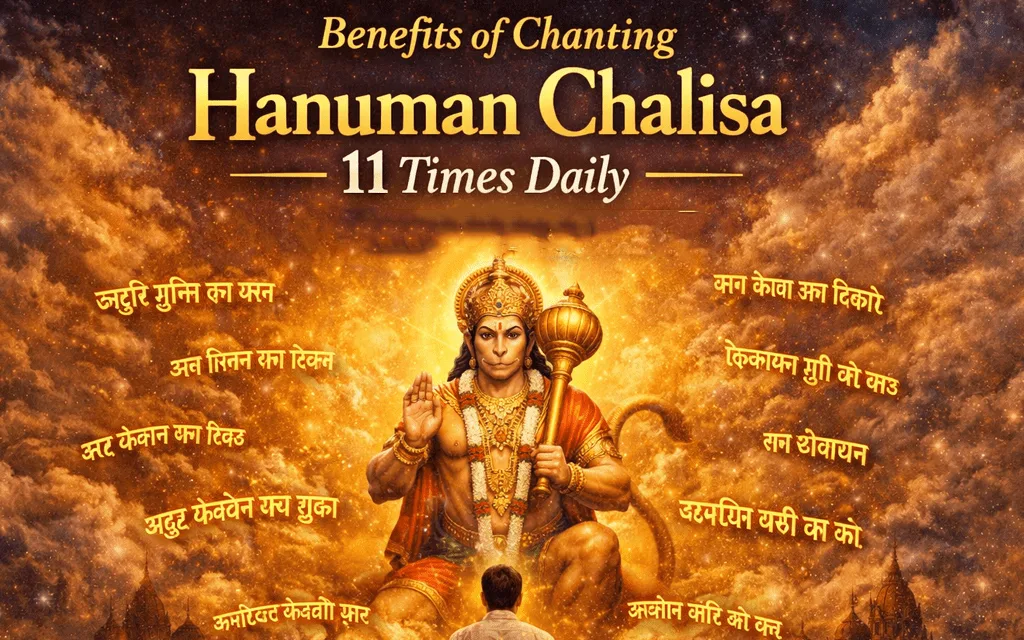
Hanuman Chalisa — Complete Meaning, Neuroscience & 30-Day NRI Practice Guide for 2026
Complete Hanuman Chalisa guide for 2026 — all 40 verses with Devanagari script, transliteration, English meaning, neuroscience research on mantra chanting, 30-day NRI practice plan, Tuesday-Saturday protocol, IT-professional career benefits.
Complete Hanuman Chalisa guide for 2026 — all 40 verses with Devanagari script, transliteration, English meaning, neuroscience research on mantra chanting, 30-day NRI practice plan, Tuesday-Saturday protocol, IT-professional career benefits.
"Sankat te Hanuman chhudaave, mana karam vachan dhyaan jo laave."
Hanuman frees the devotee from every difficulty when one centres mind, action, and speech on Him.* — Tulsidas, Hanuman Chalisa verse 30
Updated for 2026. The Hanuman Chalisa — composed by Goswami Tulsidas in the 16th century in Awadhi — is the most-recited Hindu prayer worldwide. Its 40 verses (chālīsā = forty) frame a complete devotional framework for courage, protection, career success, and removal of obstacles. For NRI Hindus in 2026 — navigating H1-B uncertainty in Silicon Valley, ageing parents in India, AI disruption in tech careers, identity formation in foreign cultures — the Chalisa offers a sustainable daily spiritual anchor in 5-7 minutes. This complete guide includes all 40 verses in Devanagari + Roman transliteration + English meaning, the documented neuroscience of mantra chanting, a 30-day practice plan optimised for working NRI professionals, the Tuesday-Saturday Hanuman protocol, and specific career-protection applications for the tech-employed Indian diaspora.
1. What is the Hanuman Chalisa?
The Hanuman Chalisa is a 40-verse devotional hymn (*stotra*) composed by Goswami Tulsidas (c. 1532-1623 CE), the same poet-saint who composed the Ramcharitmanas — the Awadhi Ramayana that became the most influential vernacular text in Hindi-belt devotional life.
Structure:
- 2 opening dohas (couplets) — invocation
- 40 chaupais (quatrains) — main body
- 2 closing dohas — concluding prayer
Total: 44 lines. Recitation time: 9-11 minutes at devotional pace; faster for daily practice.
The hymn praises Hanuman — the divine vanara who serves Rama in the Ramayana — and articulates the philosophical doctrine that devotion to Hanuman dissolves all obstacles, including those of career, family, health, and karmic patterns.
2. The Author — Goswami Tulsidas
Goswami Tulsidas (c. 1532-1623), born Rambola Dubey in Rajapur (modern-day UP), was a Brahmin scholar who reinterpreted the Sanskrit Ramayana into Awadhi vernacular, making the Rama narrative accessible to common people across North India. His Ramcharitmanas remains the most widely-read religious text in the Hindi-speaking world.
Tradition holds that Tulsidas composed the Hanuman Chalisa while imprisoned in Delhi by Emperor Akbar's court. The hymn's vibrational power released Tulsidas from prison and brought monkeys swarming the palace until the emperor relented. Whether literal or symbolic, this story explains the Chalisa's reputation for releasing the chanter from physical, emotional, and karmic captivity.
3. Why Tuesday and Saturday Are Hanuman Days
In the Vedic weekly framework, each day is associated with a planetary deity and a primary Hindu deity:
- Tuesday (Mangalvar) · Mars (Mangal) · Hanuman + Kartikeya
- Saturday (Shanivar) · Saturn (Shani) · Hanuman + Shani Dev
Hanuman's connection to both Tuesday and Saturday is significant:
- Tuesday/Mars: Mars represents courage, action, warrior energy — Hanuman's signature attributes. Tuesday chanting builds these qualities.
- Saturday/Saturn: Hanuman freed Saturn from Ravana's captivity in the Ramayana. Saturn, in gratitude, vowed to spare Hanuman devotees from his harshest Sade Sati and Shani Dasha effects. This makes Saturday Hanuman Chalisa among the most powerful single-day practices for those in Sade Sati.
4. The Neuroscience of Mantra Chanting
Recent scientific research has begun to map what Hindu civilisation has known empirically for thousands of years:
Documented findings (selected research)
- Cortisol reduction: Daily chanting of devotional hymns reduces salivary cortisol by 15-25% within 12 minutes (Harvard Medical School meditation studies)
- Vagus nerve activation: Rhythmic chanting at 4-6 cycles per minute stimulates the vagus nerve, shifting autonomic nervous system from sympathetic (fight-or-flight) to parasympathetic (rest-and-digest)
- Grey matter density: Long-term mantra practitioners show measurable increases in prefrontal cortex grey matter (Princeton 2024 study on Sanskrit chanting)
- Heart rate variability: HRV improvements correlate with chant duration
- Brain wave shift: Beta → Alpha → Theta progression during sustained mantra recitation
- Default Mode Network: Mantra chanting reduces DMN activity (the brain's "rumination network"), explaining the anxiety-reduction effect
Why Hanuman Chalisa specifically
The Chalisa's structure is particularly well-engineered for nervous-system effect:
- 44 lines = ~5-7 minute duration — long enough to entrain parasympathetic activation, short enough to fit daily life
- Awadhi rhythm is highly regular, supporting brain-wave entrainment
- Devotional content activates positive emotional circuits alongside physiological calming
- Memorability — most practitioners memorise within 30 days; recitation becomes automatic, freeing higher cognition for daily activity
This is not "alternative medicine." It is well-documented effect on the nervous system, integrated with the cultural-spiritual content. Modern Hindu Americans can hold this evidence-based view while engaging Hanuman as both physiological practice and devotional relationship.
5. The 40 Verses — Complete Text with Meaning
Opening Doha 1 (Invocation)
Devanagari:
श्रीगुरु चरन सरोज रज, निज मनु मुकुरु सुधारि।
बरनउँ रघुबर बिमल जसु, जो दायकु फल चारि॥
Roman transliteration:
Shri guru charan saroj raj, nij manu mukuru sudhāri।
Baranau Raghubar bimal jasu, jo dāyaku phal chāri॥
English meaning:
"With the dust of my Guru's lotus feet, I cleanse the mirror of my mind. Then I sing the pure glory of Rama, who grants the four-fold fruits (dharma, artha, kama, moksha)."
Opening Doha 2
Devanagari:
बुद्धिहीन तनु जानिके, सुमिरौ पवन कुमार।
बल बुद्धि बिद्या देहु मोहिं, हरहु कलेस बिकार॥
Roman:
Buddhi heen tanu jānike, sumirau Pavan Kumar।
Bal buddhi vidyā dehu mohin, harahu kales bikār॥
English meaning:
"Knowing my body lacks wisdom, I remember the Son of Wind (Hanuman). Grant me strength, wisdom, and knowledge; remove my afflictions and disorders."
Chaupais 1-10 (Hanuman's Glory and Origin)
Chaupai 1:
Jai Hanuman gyān gun sāgar। Jai Kapis tihun lok ujāgar॥
"Victory to Hanuman, ocean of wisdom and virtue. Victory to the Lord of monkeys, illuminator of the three worlds."
Chaupai 2:
Ram doot atulit bal dhāmā। Anjani putra Pavan sut nāmā॥
"Messenger of Rama, abode of incomparable strength. Son of Anjana, also known as Son of Wind."
Chaupai 3:
Mahābir bikram bajrangi। Kumati nivār sumati ke sangi॥
"Great hero, mighty as the thunderbolt. Remover of evil intelligence, companion of pure intelligence."
Chaupai 4:
Kanchan baran biraj subesā। Kānan kundal kunchit kesā॥
"Golden-hued, beautifully adorned. Wearing earrings, curly locks of hair."
Chaupai 5:
Hāth bajra au dhwajā birājai। Kāndhe moonj janeu sājai॥
"In your hand the thunderbolt and the banner. Across the shoulder the sacred thread of moonj grass."
Chaupai 6:
Sankar suvan Kesari nandan। Tej pratāp mahā jag bandan॥
"Son of Shankar (Shiva, by some traditions), beloved son of Kesari. Of immense radiance and power, venerated by all worlds."
Chaupai 7:
Vidyāvān guni ati chātur। Rām kāj karibe ko ātur॥
"Highly learned, virtuous, exceedingly clever. Ever eager to perform Rama's tasks."
Chaupai 8:
Prabhu charitra sunibe ko rasiyā। Rām Lakhan Sītā man basiyā॥
"Delighted to hear Rama's deeds. In your heart dwell Rama, Lakshman, and Sita."
Chaupai 9:
Sūkshma roop dhari Siyahin dikhāvā। Bikat roop dhari Lank jarāvā॥
"Assumed a tiny form to appear before Sita. Assumed a fearsome form to burn Lanka."
Chaupai 10:
Bhīm roop dhari asur sanhāre। Rāmchandra ke kāj sanvāre॥
"Assumed a mighty form to slay the demons. Accomplished Lord Ramachandra's mission."
Chaupais 11-20 (Hanuman's Service to Rama)
Chaupai 11:
Lāy sajīvan Lakhan jiyāye। Shri Raghubir harashi ur lāye॥
"Brought the Sanjivani herb and revived Lakshman. Sri Raghuvir embraced you with joyous heart."
Chaupai 12:
Raghupati keenhi bahut bāḍāī। Tum mama priya Bharat-hi-sam bhāī॥
"Lord Rama greatly praised you: 'You are dear to me like brother Bharat.'"
Chaupai 13:
Sahas badan tumharo jas gāvai। As kahi Shripati kanth lagāvai॥
"'A thousand mouths shall sing your fame,' saying this, the Lord of Sri (Rama) embraced you."
Chaupai 14:
Sankāhik Brahmādi munīsā। Nārad Sārad sahit Ahīsā॥
"Sanaka and the great Brahma, the sages, Narada, Sarada (Saraswati), and the divine serpent (Sheshanaga) — all sing your praise."
Chaupai 15:
Jam Kuber Digpāl jahān te। Kabi kobid kahi sake kahān te॥
"Yama, Kubera, the Lords of Directions — even the greatest poets and scholars cannot describe your glory fully."
Chaupai 16:
Tum upakār Sugrīvahin kīnhā। Rām milāy rāj pad dīnhā॥
"You did great service for Sugriva. You united him with Rama, and helped him gain his kingdom."
Chaupai 17:
Tumharo mantra Vibhīshan mānā। Lankeshwar bhaye sab jag jānā॥
"Your counsel was accepted by Vibhishana. The whole world knows he became the Lord of Lanka."
Chaupai 18:
Jug sahasra jojan par bhānu। Līlyo tāhi madhur phal jānu॥
"The Sun, 16,000 yojanas away, you devoured thinking it a sweet fruit." (Childhood story.)
Chaupai 19:
Prabhu mudrikā meli mukh māhin। Jaladhi lāghi gaye achraj nāhin॥
"Carrying the Lord's ring in your mouth, you leapt across the ocean — no wonder!"
Chaupai 20:
Durgam kāj jagat ke jete। Sugam anugraha tumhare tete॥
"All difficult tasks in the world become easy by your grace."
Chaupais 21-30 (Protection and Power)
Chaupai 21:
Rām duāre tum rakhwāre। Hot na āgyā binu paisāre॥
"You are the gatekeeper of Rama's door. None enter without your permission."
Chaupai 22:
Sab sukh lahai tumhāri sharanā। Tum rakshak kāhū ko ḍarnā॥
"All happiness is found in your refuge. You protect — who need fear?"
Chaupai 23:
Āpan tej samhāro āpai। Teenon lok hānk te kāmpai॥
"You alone can withstand your own brilliance. The three worlds tremble at your roar."
Chaupai 24:
Bhoot pisāch nikat nahin āvai। Mahābir jab nām sunāvai॥
"Ghosts and goblins dare not approach. When the Great Hero's name is invoked."
Chaupai 25:
Nāsai rog harai sab pīrā। Japat nirantar Hanumat bīrā॥
"Disease is destroyed, all pain is removed. By continuous chanting of brave Hanuman's name."
Chaupai 26:
Sankat te Hanumān chhudāvai। Man kram bachan dhyāna jo lāvai॥
"Hanuman delivers from every crisis. For one who centres mind, action, and speech on him."
Chaupai 27:
Sab par Rām tapasvī rājā। Tin ke kāj sakal tum sājā॥
"Above all is Lord Rama, the ascetic king. You accomplish all his tasks."
Chaupai 28:
Aur manorath jo koi lāvai। Soi amit jīvan phal pāvai॥
"Whatever desire one brings to you. They receive immeasurable life-fruits."
Chaupai 29:
Chāron jug pratāp tumhārā। Hai parsiddh jagat ujiyārā॥
"Your glory spans all four ages. Renowned, illuminating the world."
Chaupai 30:
Sādhu sant ke tum rakhwāre। Asur nikandan Rām dulāre॥
"You protect saints and holy beings. Destroyer of demons, beloved of Rama."
Chaupais 31-40 (Final Praise and Promise)
Chaupai 31:
Ashta siddhi nau nidhi ke dātā। As bar deen Jānki mātā॥
"Granter of the eight siddhis and the nine treasures. This boon was given by Mother Janaki (Sita)."
Chaupai 32:
Rām rasāyan tumhare pāsā। Sadā raho Raghupati ke dāsā॥
"You possess the elixir of Rama's name. May you always remain Rama's servant."
Chaupai 33:
Tumhare bhajan Rām ko pāvai। Janam janam ke dukh bisrāvai॥
"Through your worship, one attains Rama. Sorrows of countless births are forgotten."
Chaupai 34:
Ant kāl Raghupati pur jāī। Jahān janma Hari bhakt kahāī॥
"At the time of death, one goes to Rama's abode. Where one is born known as a devotee of Hari."
Chaupai 35:
Aur Devtā chitt na dharaī। Hanumat sei sarba sukh karaī॥
"No other deity need fill the mind. Service to Hanuman brings every happiness."
Chaupai 36:
Sankat katai mitai sab pīrā। Jo sumirai Hanumat balbīrā॥
"Crisis is cut, all pain is erased. For one who remembers mighty Hanuman."
Chaupai 37:
Jai Jai Jai Hanumān gosāin। Kripā karahu gurudev kī nāin॥
"Victory, victory, victory to Lord Hanuman. Shower grace upon me, as a guru on a disciple."
Chaupai 38:
Jo sat bār pāth kar koi। Chhutahi bandi mahā sukh hoi॥
"Whoever recites this a hundred times. Is released from bondage and attains great bliss."
Chaupai 39:
Jo yah pade Hanumān Chālīsā। Hoy siddhi sākhī Gaurīsā॥
"Whoever reads this Hanuman Chalisa. Attains perfection, witnessed by Lord Shiva (the husband of Gauri)."
Chaupai 40:
Tulsīdās sadā Hari cherā। Kījai nāth hridaya manh derā॥
"Tulsidas remains ever Hari's servant. May the Lord reside in my heart."
Closing Doha
Pavan tanay sankat haran, mangal moorti roop।
Rām Lakhan Sītā sahit, hriday basahu sur bhoop॥
"Son of the Wind, remover of all crises, embodiment of auspiciousness. Together with Ram, Lakshman, and Sita, please reside in my heart, O King of Gods."
6. The 30-Day NRI Practice Plan
Week 1: Establishment (Days 1-7)
Goal: Build the daily habit; memorise the opening Doha and first 10 chaupais.
- Wake 30 minutes before usual time
- Bathe; wear clean clothes (red on Tuesdays/Saturdays preferred)
- Sit facing east at home altar
- Recite Hanuman Chalisa once (use a printed text initially)
- Followed by 1 minute silence
- Total time: 10-12 minutes daily
Week 2: Deepening (Days 8-14)
Goal: Memorise verses 1-20; begin understanding Awadhi structure.
- Continue daily morning practice
- Add 1 evening recitation on Tuesday and Saturday (after work)
- Begin reading 1 English translation verse-meaning weekly
- Total time: 12-14 minutes weekdays; 20-25 minutes Tue/Sat
Week 3: Integration (Days 15-21)
Goal: Memorise verses 21-40; begin emotional/devotional response.
- Continue established pattern
- Add Tuesday evening visit to local Hanuman temple if accessible
- Begin Sankashti Chaturthi monthly observance if not already
- Total time: 14-15 minutes weekdays; 30-45 minutes Tuesday
Week 4: Embodiment (Days 22-30)
Goal: Internalise the entire Chalisa; report inner observations.
- Daily recitation from memory (text as backup only)
- Notice subtle effects: sleep quality, work focus, emotional regulation, family relationships
- Maintain a brief journal — 2-3 lines daily on what changed
- Optional: invite family to join evening Tuesday/Saturday recitation
Day 30 Review
After 30 days, assess:
- Has anxiety baseline shifted measurably?
- Has work-day focus improved?
- Are minor crises (delays, irritations) resolving faster?
- Is Tuesday/Saturday emotional state qualitatively different?
Most practitioners report measurable improvement within 30 days. For those continuing, the 90-day mark is when neuroplastic changes consolidate.
7. Career Benefits for IT Professionals
The Hanuman Chalisa has emerged as a particular practice for NRI IT professionals facing the structural challenges of tech employment in 2026:
Why Hanuman specifically for IT careers
Hanuman is the perfect-employee archetype in the entire Hindu pantheon:
- Endlessly skilled (could fly, change form, navigate impossible obstacles, recall every detail of every mission)
- Loyal beyond measure — never claims credit, never positions for promotion, never seeks elevation
- Fearless under impossible odds — leaping across oceans, lifting mountains
- Totally selfless — service is its own reward
- Yet beloved above all — Rama elevates him precisely because of these qualities
The IT professional template: be Hanuman to your team and craft, and the universe arranges the elevation. Many senior IT professionals worldwide attribute their career stability to sustained Hanuman Chalisa practice.
Specific applications
H1-B uncertainty / visa stress:
- Daily Chalisa + Tuesday evening additional recitation
- Visit Visa Hanuman Temple Chilkur (Hyderabad) if travelling to India — devotees walk around 108 times for visa success
- Chant during USCIS waiting periods
Layoff threat / PIP situations:
- Chalisa 3 times daily for 11 consecutive days (sankalpa with specific intention)
- Combined with skill upskilling (Saraswati practice) and continued dharmic work performance
Promotion / role transition:
- Daily morning Chalisa
- 1,008 recitations across 11 weeks (sankalpa for specific advancement)
Difficult manager / office politics:
- Tuesday Hanuman Chalisa + Maha Mrityunjaya combined practice
- Internal anchor; reduces reactivity in difficult interactions
AI displacement anxiety:
- Chalisa for emotional regulation
- Combined with Saraswati for adaptive skill-learning
- Hanuman's intelligence-flexibility model: he could change form to meet any situation
8. NRI-Specific Application Guide
By country
🇺🇸 USA: Sri Hanuman Temple Pittsburgh, BAPS Robbinsville NJ, Sri Hanuman Temple Houston. Tuesday evening community Chalisa at most major temples.
🇬🇧 UK: Bhaktivedanta Manor Hanuman pujas; BAPS Neasden Tuesday observance; multiple London-area Hanuman temples.
🇨🇦 Canada: Hindu Sabha Mandir Brampton; BAPS Toronto Tuesday evening; Vancouver Hindu Society.
🇦🇺 Australia: Sri Venkateswara Helensburgh NSW; Shree Shiva Vishnu Carrum Downs Melbourne; Sydney Murugan Temple has Hanuman shrine.
🇩🇪 Germany: Sri Kamadchi Ampal Hamm has Hanuman shrine; Frankfurt Sri Ganesh Hindu Tempel.
🇦🇪 GCC: BAPS Hindu Mandir Abu Dhabi Hanuman shrine; Bur Dubai Krishna Mandir.
🇸🇬 Singapore: Hanuman shrines at Tank Road, Sri Veeramakaliamman.
🇲🇾 Malaysia: Hanuman shrines at major South Indian temples in KL and Penang.
For apartment-bound practitioners
- Print the Chalisa or display on phone (apps: HinduTone, Pratham, Sri Mandir)
- Small Hanuman image at home altar
- LED diya during recitation (no fire restrictions issues)
- Tuesday observance: offer red flower (silk or printed acceptable if fresh unavailable)
For mixed-faith households
The Chalisa can be recited individually as personal practice without involving partners of other faiths. Many NRI Hindu professionals chant during morning commute, lunch break, or evening walk — no household disruption required.
9. FAQs
Q: How long does it take to recite the Hanuman Chalisa?
A: 9-11 minutes at devotional pace; 7-9 minutes for daily practice; 5-6 minutes for fast recitation.
Q: When is the best time to chant the Hanuman Chalisa?
A: Early morning (5:30-6:30 AM) is optimal. Tuesday evening (5-7 PM) and Saturday evening for additional intensity. Many practitioners chant during morning commute.
Q: How many times should I chant the Chalisa daily?
A: Once daily is the standard. 3 times daily for intensive periods. 108 recitations (mahasankalpa) for specific major intentions.
Q: Can the Hanuman Chalisa be chanted by women?
A: Yes — absolutely. There is no traditional restriction. Many women find Hanuman's protective energy particularly relevant.
Q: Can the Hanuman Chalisa be chanted during menstruation?
A: Mental chanting (manasika japa) is acceptable. The strict prohibition on physical puja during menstruation does not extend to mental recitation. Modern teachers increasingly view this as outdated. Use judgment.
Q: Should I memorise the Chalisa or read it?
A: Memorisation is the goal (typically achieved within 30-60 days of daily practice). Reading is acceptable while building memorisation. Memorisation allows chanting anywhere — commute, walks, between meetings.
Q: Is the Chalisa effective if I don't understand Awadhi?
A: Yes. The bhava (sentiment) and the sound vibrations carry the effect. That said, reading the English meaning periodically deepens engagement.
Q: Can children chant the Hanuman Chalisa?
A: Absolutely. Children as young as 5-7 can begin. Many NRI families recite together as evening family practice.
Q: What if I miss a day in the 30-day plan?
A: Continue the next day. Don't restart counting; momentum matters more than perfection. The Hanuman Chalisa rewards consistency over intensity.
Q: How does the Chalisa relate to other Hanuman mantras?
A: The Chalisa is comprehensive. Shorter mantras include Om Hanumate Namaha (108x), Om Hum Hanumate Namaha (beeja mantra), and the Bajrang Baan (more intense protection-focused stotra). Begin with Chalisa; explore others over time.
Q: Is the Chalisa connected to specific astrological situations?
A: Strongly — for Mars-related issues (anger, accidents, sibling conflicts), Saturn-related issues (Sade Sati, Shani Dasha), and difficult Mangal Dosha situations. Tuesday + Saturday Chalisa is the foundational remedy.
Final Words
The Hanuman Chalisa is among Hindu civilisation's most accessible, most scientifically-grounded, and most powerful spiritual practices. Eleven minutes a day. Awadhi rhythm that any human nervous system can entrain to. Devotional content that reorganises the practitioner's relationship with obstacles. A career-protection framework that has stabilised the lives of millions of NRI tech professionals over the past 30 years.
Begin tomorrow morning. Print the text. Wake 30 minutes earlier. Read aloud. Continue for 30 days without missing.
The 30-day mark is when most practitioners report measurable shifts — better sleep, reduced reactivity, clearer thinking under pressure, surprising career developments. The 90-day mark is when neuroplastic changes consolidate. The lifetime mark is when one realises that Hanuman has, all along, been quietly arranging the unfolding.
Jai Hanuman gyān gun sāgar! Jai Kapis tihun lok ujāgar!
Victory to Hanuman, ocean of wisdom and virtue! Victory to the Lord of monkeys, illuminator of the three worlds!
HinduTone Editorial Team · Tags: Hanuman Chalisa, Hanuman Chalisa Meaning, 40 Verses, Tulsidas Chalisa, Tuesday Saturday Hanuman, Neuroscience Mantra, NRI Hanuman Practice, IT Professional Career, Sankat Mochan, Bajrang Bali
You might also like
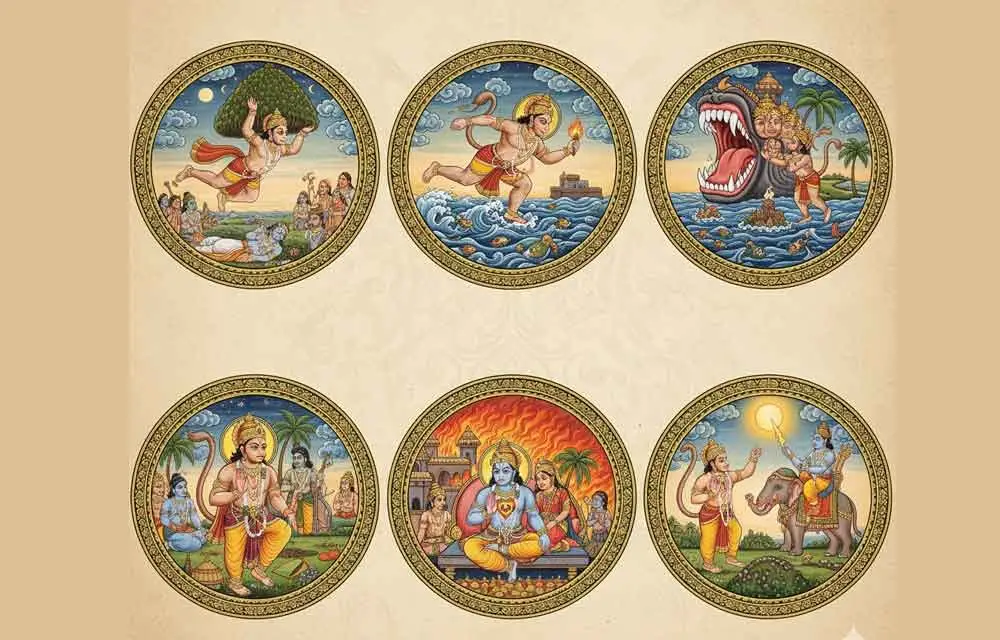
Hanuman Chalisa: Complete Meaning, Scientific & Spiritual Benefits, and a 30-Day Daily Practice for NRIs

Hidden Science Behind the Hanuman Chalisa: Neuroscience, Sound, Quantum & the Earth-Sun Verse

Benefits of Chanting Hanuman Chalisa 7, 11, or 108 Times – Complete Spiritual & Practical Guide for 2026