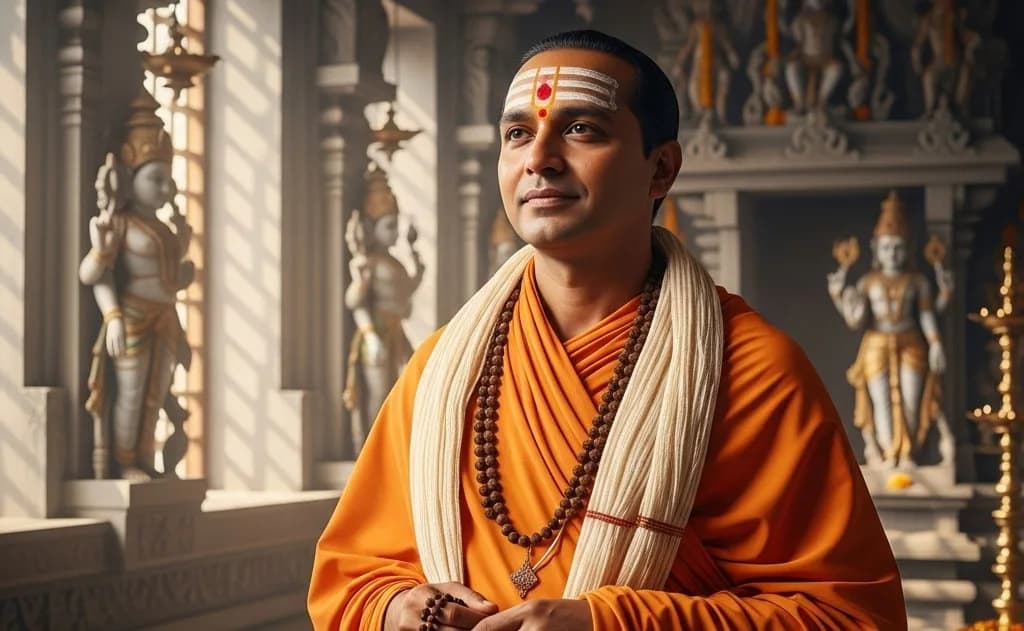
Raga and Spirituality — The Sacred Science of Indian Classical Music | Complete Guide
"Ranjayati iti Ragah — That which colours the mind is a Raga." — Matanga, Brihaddeshi (9th century CE) "Music is the shortcut to God." — Swami Vivekananda…
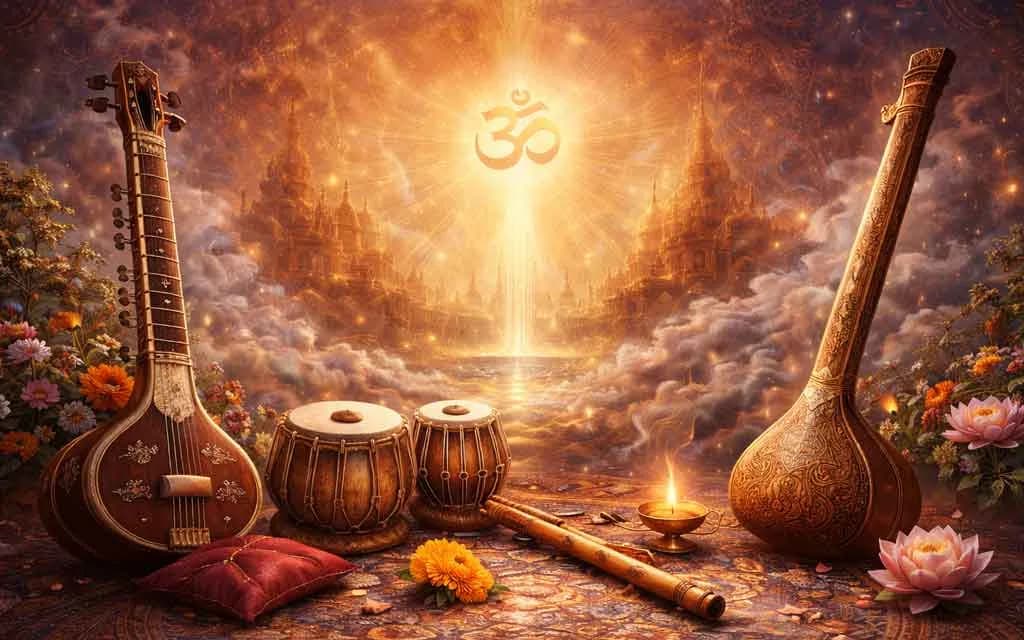
"Ranjayati iti Ragah — That which colours the mind is a Raga.
"Ranjayati iti Ragah — That which colours the mind is a Raga." — Matanga, Brihaddeshi (9th century CE)
"Music is the shortcut to God." — Swami Vivekananda
There is a reason why every Hindu temple resounds with music. Why every sacred ritual is accompanied by specific melodic patterns. Why the gods themselves are depicted holding instruments — Saraswati her Veena, Krishna his flute, Shiva his Damaru. Why the greatest saints of India — Mirabai, Tyagaraja, Purandaradasa, Tukaram, Kabir — expressed their deepest realizations not in philosophy but in song.
Indian classical music is not art for art's sake. It never was.
From its very roots in the Samaveda — the Veda of sacred chant, the world's oldest surviving musical tradition — Indian music was understood as a precise science of consciousness. A technology for moving the human mind from its ordinary agitated state into progressively deeper states of stillness, devotion, and ultimately, union with the divine.
The Raga (राग) is the fundamental unit of this science. Not a scale. Not a melody. Not a mood. A Raga is a living entity — a specific configuration of notes, rhythms, ornaments, and emotional qualities that, when performed correctly at the right time of day, in the right season, with the right intention, creates a field of consciousness that is indistinguishable from worship.
This is the sacred science of Indian classical music. This guide is your complete map.
[image: 📖] Table of Contents
- What Is a Raga? — Beyond the Western Scale
- The Divine Origin of Music in Hinduism
- Sangita — The Three Limbs of Sacred Music
- The Philosophical Foundation — Why Music Is Spiritual
- The Grammar of a Raga — Anatomy Explained
- The Time Theory of Ragas — Music as Cosmic Calendar
- The Season Theory — Ragas and Nature's Cycles
- Ragas and the Chakras — Music as Inner Anatomy
- Ragas and the Deities — Each Raga Has a Divine Form
- The Raga-Rasa Connection — Emotion as Spiritual Gateway
- Carnatic vs Hindustani — Two Rivers from One Source
- The Greatest Spiritual Ragas — A Complete Guide
- The Pancha Sabhas — The Five Cosmic Stages of Shiva
- Raga Meditation — How to Use Music for Spiritual Practice
- The Guru-Shishya Parampara — The Sacred Lineage
- Modern Science and the Spiritual Power of Ragas
- How to Begin a Raga Spiritual Practice
- FAQs
What Is a Raga? — Beyond the Western Scale {#what-is-raga}
The English word "scale" captures perhaps ten percent of what a Raga is.
A Western scale is a sequence of notes — a ladder of pitches from low to high. It defines what notes are available. That is all.
A Raga (Sanskrit: राग) is something infinitely more complex and alive. The Sanskrit root ranj means "to colour," "to tint," "to please," "to illuminate." A Raga is "that which colours the consciousness" — a specific vibration-field of sound that paints the mind with a particular quality of awareness, emotion, and spiritual energy.
A complete Raga specifies:
This last element is perhaps the most extraordinary: each Raga has a Dhyana Shloka — a verse that describes the raga not as a sequence of notes but as a divine figure — a deity, a sage, a celestial being — with specific form, colour, adornments, and expression. The musician is not playing a scale; the musician is invoking a deity through sound.
The Divine Origin of Music in Hinduism {#divine-origin}
Brahma's Gift — The Gandharva Veda
Hindu tradition holds that music is not a human invention — it is a divine revelation. The sacred science of music is contained in the Gandharva Veda — one of the four Upavedas (subsidiary Vedas) — said to have been revealed by Lord Brahma himself and transmitted through the celestial musicians (Gandharvas) and sages.
The transmission lineage:
Shiva — The Original Musician
Before Brahma, before Narada, before any transmission — there was Shiva's Damaru.
The Damaru (डमरु) — the two-faced, hourglass-shaped drum held in Shiva's hand — is the universe's first percussion instrument. Its two faces represent the duality of existence: male-female, expansion-contraction, manifestation-dissolution. The string connecting them represents the axis of the universe.
When Shiva dances the Tandava — the cosmic dance of creation and dissolution — the Damaru beats the rhythm of the universe itself. The 14 beats of the Damaru at the conclusion of Shiva's dance are said to have produced the 14 Maheshvara Sutras — the foundational rules of Sanskrit grammar. Language, grammar, and music share the same divine source: Shiva's rhythm.
Saraswati — The Goddess of Sangita
Goddess Saraswati is the divine patroness of all music. Her Veena — the Kachhapi Veena (tortoise-shaped) or the Rudra Veena (in some traditions) — is the original stringed instrument. The seven strings of the Veena correspond to:
- The seven notes of the musical scale (Sapta Swara)
- The seven chakras of the subtle body
- The seven colours of the light spectrum
- The seven planets of Vedic astrology
- The seven days of the week
- The seven worlds (Sapta Loka)
- The seven levels of consciousness
Saraswati's Veena is not metaphor. It is the universe's own instrument, played by the universe's own intelligence.
Krishna's Flute — The Call of the Divine
If Shiva's Damaru is the rhythm of creation, Krishna's flute (Murali/Venu) is the melody of divine love.
The sound of Krishna's flute is described in the Bhagavata Purana as irresistible — when it was heard in Vrindavan, the cows stopped grazing, the river stopped flowing, the birds sat motionless on the branches, and every Gopi (milkmaid) abandoned whatever she was doing and came running through the dark forest, unable to resist.
The Bhagavata's description is not merely mythological. It is a precise description of what happens when the Anahata Nada (the unstruck sound — the sound of the divine) is heard within meditation. Everything stops. Every other concern becomes irrelevant. The soul runs toward its source.
Krishna's flute represents the Para Vak — the transcendent voice of the Absolute — calling every individual soul home. And the Gopis represent individual souls (Jivas) unable to resist the pull of divine love once they have heard the music of the Absolute.
Sangita — The Three Limbs of Sacred Music {#sangita}
The Sanskrit word Sangita (संगीत) — often translated simply as "music" — actually means something far more comprehensive. It is the unity of three arts:
1. Gita (गीत) — Vocal Music
The human voice is the primary instrument of Sangita. It is the most direct channel of the soul's expression — requiring no intermediary object, no mechanical device. When the voice is trained, purified, and offered with devotion, it becomes a direct conduit of the Nada Brahman.
The Natya Shastra states: "The voice is the first instrument, created before all others. Of all the limbs of Sangita, Gita is the most exalted."
2. Vadya (वाद्य) — Instrumental Music
Musical instruments extend the voice's reach into domains of timbre, texture, and tone that the human vocal apparatus cannot access. Indian classical instruments are classified by the element they embody:
Each class of instrument is thus a sonic embodiment of one of the five cosmic elements — making the full ensemble of Indian classical music a complete sonic representation of the universe.
3. Nritya (नृत्य) — Sacred Dance
Sacred dance — Bharatanatyam, Kuchipudi, Odissi, Manipuri, Kathak, Mohiniyattam, Kathakali — is music made visible. The body becomes the instrument, gesture becomes grammar, and movement becomes the expression of cosmic energies that sound alone cannot fully convey.
The Natya Shastra's codification of 108 Karanas (fundamental movement units), 64 Angas (body sections), and hundreds of Mudras (hand gestures) represents the most sophisticated system of sacred body-language ever developed.
The Philosophical Foundation — Why Music Is Spiritual {#philosophy}
The Three Arguments for Music as Sadhana
Argument 1 — Nada Brahman (The Universe Is Sound) If the universe is fundamentally constituted of sacred sound (Nada Brahman), then the highest form of consciously organized, intentionally performed sound — classical music — is the most direct engagement with the universe's own nature. Music is not an approach to the divine; music IS the divine's own self-expression. (For the full teaching on Nada Brahman, see our guide: Nada Brahman — The Universe as Sacred Sound.)
Argument 2 — Rasa Theory (Emotion as Spiritual Gateway) The philosopher Abhinavagupta (Kashmir Shaivism, 10th century CE) made one of the most important contributions to aesthetic philosophy in human history: the teaching that aesthetic experience (Rasa) is functionally identical to spiritual experience (Brahmananda — the bliss of the Absolute).
When a listener is genuinely absorbed in a Raga — when the music creates a field of Rasa — the ego temporarily dissolves, time ceases, self-consciousness disappears, and what remains is a state of pure, open, luminous awareness. This state, Abhinavagupta argued, is Chidananda — consciousness-bliss — the very state that the yogi seeks through years of meditation.
Music gives it as a gift — without effort, without technique — simply through beauty.
Argument 3 — Samskara and Purification In Yoga psychology, the mind accumulates deep impressions (Samskaras) from past experiences — patterns of thought, emotion, and reaction that condition all future experience. Regular exposure to classical Ragas — especially with devotional intention — gradually dissolves tamasic (dull) and rajasic (agitated) samskaras and replaces them with sattvic (pure, luminous) ones.
This is precisely why classical Indian music sounds so different from popular music. Popular music is designed to excite rajas (agitation) — to stimulate, energize, titillate. Classical music is designed to cultivate sattva — to bring the mind to a state of luminous, peaceful, awake clarity. This is not a value judgment — it is a description of different technologies for different purposes.
The Concept of Bhava — The Musician's Inner State
The central requirement of classical Indian performance is Bhava — the inner state or feeling that the musician must embody. Bhava is not acting or simulation. It is genuine inner transformation — the musician must become the Rasa they are performing.
Before a performance, a classical musician does not merely warm up technically. They enter a state of preparation that is essentially meditative — stilling the mind, connecting with the deity of the Raga, aligning their inner state with the Rasa they are about to express. This is Nada Sadhana — the discipline of sacred sound.
The Sangita Ratnakara (13th century CE) states explicitly: "A musician who performs without Bhava is like a lamp without oil — the form is present but the light is absent."
The Grammar of a Raga — Anatomy Explained {#anatomy}
Understanding the technical anatomy of a Raga reveals why it is so much more than a scale:
The Note System — Sapta Swara
Indian music uses seven primary notes — the Sapta Swara (seven sounds):
Each note has up to two variants (Shuddha = natural, Komal = flat, Tivra = sharp), giving the Indian system a potential palette of 22 microtones (Shrutis) within a single octave — far richer than the 12 semitones of Western equal temperament. These microtones are not errors — they are precisely calibrated frequencies that correspond to specific states of consciousness and specific energetic effects in the listener.
Vadi and Samvadi — The King and Prime Minister
Every Raga has a Vadi (king note) and a Samvadi (prime minister note). These are the notes most emphasized in improvisation and composition — the notes around which the Raga "thinks."
The Vadi is the note that most strongly captures the Raga's character. When a master musician returns again and again to the Vadi in improvisation, they are not being repetitive — they are deepening the field of consciousness that the Raga creates. The Vadi is the Raga's spiritual centre of gravity.
Gamaka — The Ornamentation That Gives Life
Gamaka (ornamental embellishment) is perhaps the most important element of Indian classical music that Western music theory has no real equivalent for. A note in Indian music is rarely attacked directly — it is approached, caressed, shaken, slid into, oscillated on, breathed through.
The types of Gamaka include:
Gamaka is why a recording of Indian music never sounds exactly like a written score. The life is in the space between the notes — in how the musician touches, holds, releases, and transforms each sound. Gamaka is the breath of the Raga.
The Time Theory of Ragas — Music as Cosmic Calendar {#time-theory}
One of the most extraordinary and uniquely Indian contributions to music theory is the Samay Siddhanta — the theory that every Raga has a specific time of day (or night) at which its energy is most powerful and most aligned with the cosmic vibration.
This is not superstition. It is a sophisticated understanding of the relationship between human consciousness, the position of the sun, the quality of light and air at different times of day, and the specific emotional and energetic states that the human system naturally enters at those times.
The Prahar System — The Eight Watches of the Day
The 24-hour day is divided into eight Prahars (watches) of three hours each:
Why Time Matters — The Consciousness-Nature Connection
At dawn, the quality of light, the temperature of air, the brain's chemistry (fresh from sleep, serotonin rising, cortisol beginning its daily curve) all combine to create a specific quality of consciousness — open, alert, slightly melancholic, reverential. The Bhairav family of ragas — austere, meditative, with the flattened second and sixth degrees — perfectly matches and amplifies this dawn consciousness.
At dusk, a different quality prevails — the transition between day and night, a natural moment of longing, beauty, and the recognition of impermanence. The Kalyan/Yaman family — luminous, expansive, with the sharpened fourth — perfectly captures and amplifies the beauty of the evening transition.
At midnight, the consciousness deepens — the ego's daytime constructions begin to dissolve, depth and mystery prevail, and the mind naturally moves toward the philosophical and the vast. Malkauns — deeply grave, with its characteristic sequence of minor notes — amplifies midnight's quality of profound, impersonal depth.
The master musician who performs a Raga at its prescribed time is not following an arbitrary rule. They are synchronizing human consciousness with cosmic rhythm — aligning the music's vibrational field with the universe's own daily music.
The Most Spiritually Significant Times
The Season Theory — Ragas and Nature's Cycles {#season-theory}
Beyond the daily time cycle, ragas are also aligned with the six seasons (Ritu) of the traditional Indian calendar:
The Malhar family of ragas — associated with the monsoon — is the most famous example of seasonal alignment. Classical tradition holds that a true performance of Mian Ki Malhar (attributed to the legendary Tansen) can bring actual rain. Whether taken literally or metaphorically, the truth contained in this belief is profound: a perfectly performed Malhar at the height of the monsoon creates a state of consciousness that is indistinguishable from the monsoon itself — expansive, joyful, generous, and completely surrendered to the sky.
Ragas and the Chakras — Music as Inner Anatomy {#chakras}
The seven chakras of the subtle body correspond directly to the seven notes of the musical scale. This means that every raga activates a specific combination of chakras through its unique selection and emphasis of notes.
The Note-Chakra Correspondence
How Ragas Activate Specific Chakras
A Raga that emphasizes Ga (Gandhara) and Pa (Panchama) — like Raga Bhupali — primarily activates the Manipura and Vishuddha chakras, creating feelings of confidence, openness, and clear self-expression.
A Raga that emphasizes Ni (Nishada) and Ga (Gandhara) with flat versions — like Raga Bhairavi — activates the Sahasrara and Manipura simultaneously, creating the Bhairavi's characteristic combination of devotional surrender and heartfelt intensity.
A Raga built on Sa (Shadja), Ma (Madhyama), and Pa (Panchama) — the three notes considered most stable and cosmic — creates a sense of grounded, spacious peace that activates the Muladhara, Anahata, and Vishuddha simultaneously. Many of the most peaceful, meditative ragas use these three as their primary anchors.
Ragas and the Deities — Each Raga Has a Divine Form {#deities}
In the ancient tradition of Raga Vidya (the science of Ragas), each major raga is not merely a musical scale — it is a Devata (divine being) with a specific form, personality, and spiritual energy. The musician who performs a Raga correctly is not merely playing music — they are invoking a deity through sound.
The Raga Dhyana Shlokas
Each major Raga has a Dhyana Shloka — a meditation verse that describes the raga's divine form. These verses describe the raga as a person — their complexion, clothing, ornaments, posture, expression, and the deity they worship. Here are examples:
Raga Bhairav (Dawn): "He has a white complexion, smeared with white ash. His locks are matted. He sits in deep meditation. He holds a trident and a skull-cup. He is Bhairava — the fearsome form of Shiva — and he is always in perfect peace."
Raga Yaman (Evening): "She is radiant as the evening moon, adorned with golden ornaments. She sits in a garden of jasmine, her face reflecting the beauty of twilight. She is Lalita — the playful one — and she smiles the smile of one who knows that everything is well."
Raga Bhairavi (Devotional): "Her complexion is the colour of the dawn sky — neither dark nor light but the sacred blue of twilight. She holds a lotus and a veena. Her eyes are filled with tears of longing. She is always thinking of Shiva."
Key Deity-Raga Associations
The Raga-Rasa Connection — Emotion as Spiritual Gateway {#rasa}
The Rasa Siddhanta (Theory of Aesthetic Emotion) is India's greatest contribution to philosophy of art — and it is inseparable from the spiritual science of Raga.
The Nine Rasas (Navarasas)
The Natya Shastra identifies nine fundamental Rasas — emotional essences that music, dance, and drama can evoke in the audience. These are not merely feelings. They are specific configurations of consciousness:
Why Rasa Is Spiritual — Abhinavagupta's Insight
The philosopher Abhinavagupta (10th–11th century CE, Kashmir) made the most important observation in the entire history of Indian aesthetics:
"The experience of Rasa is identical in quality — though not in object — to the experience of Brahman."
When the musician perfectly embodies a Rasa and the listener's heart opens completely to receive it, something extraordinary happens: the distinction between subject and object dissolves temporarily. There is no "I who is listening" and "music that I am hearing." There is only the music, only the Rasa, only the state of luminous awareness in which everything is bathed.
This is Chidananda — consciousness-bliss. This is what the yogi sits in meditation to achieve. And great music gives it — freely, immediately, to anyone whose heart is open enough to receive it.
This is why Indian classical music has always been understood as a direct path to the divine — not a metaphor for the path, not an illustration of the path, but the path itself.
Carnatic vs Hindustani — Two Rivers from One Source {#carnatic-hindustani}
Indian classical music exists in two great parallel streams — Carnatic (South Indian) and Hindustani (North Indian). They share common philosophical roots but diverged significantly after the 12th–13th centuries CE, partly due to the influence of Persian and Central Asian musical traditions on the North.
The Great Comparison
The Melakarta System — Carnatic's Sacred Geometry
Carnatic music's 72 Melakarta ragas form a complete mathematical and spiritual system. The 72 parent ragas are organized in a matrix of 12 Chakras (groups) of 6 ragas each — and this organization is not arbitrary:
- The number 72 corresponds to the 72 major Nadi channels of the subtle body
- The number 12 corresponds to the 12 Rashis (zodiac signs)
- The number 6 corresponds to the six seasons
The Melakarta system is thus a mapping of the Raga universe onto the cosmos — every possible combination of notes finding its place in a grid that mirrors the structure of the human subtle body and the structure of time.
The Greatest Spiritual Ragas — A Complete Guide {#spiritual-ragas}
[image: 🌅] Raga Bhairav — The Raga of Shiva's Dawn
Time: Dawn (Brahma Muhurta to sunrise — 4:30–7:00 AM) Season: All seasons, especially winter Deity: Bhairava (Shiva in his awesome, luminous form) Rasa: Shanta (peace) + Vira (heroism) + Adbhuta (wonder) Character: Austere, vast, meditative, completely awake
Musical features: Both Rishabha (Re) and Dhaivata (Dha) are flattened (Komal), giving Bhairav its characteristic quality of simultaneous openness and depth. The flattened Re creates a quality of gentle ache — not sorrow, but the sweet recognition of the infinite. The flattened Dha creates a quality of inward withdrawal, of consciousness returning to its source.
Spiritual effect: Bhairav creates a state of Vairagya — dispassion, not as depression but as clear, luminous freedom from clinging. Listening to Bhairav at dawn, the mind enters a quality of awareness that is simultaneously completely alert and completely at rest.
The experience: Like standing on a mountain peak at dawn — vast sky, the world below still in darkness, the first light touching the highest peaks. Complete silence. Complete clarity. And in that clarity, a recognition: this is what I always am, beneath all the noise.
Notable recordings to seek: Pandit Bhimsen Joshi's Bhairav, Ustad Rashid Khan's Bhairav, MS Subbulakshmi's Bhairav (Carnatic equivalent: Mayamalavagoula)
[image: 🌙] Raga Yaman — The Raga of the Luminous Evening
Time: Early evening — first watch of night (6:00–9:00 PM) Season: Autumn and all seasons Deity: Goddess Lalita / Saraswati / Lakshmi — the gracious, beautiful forms of the divine Rasa: Shringara (divine love/beauty) + Adbhuta (wonder) Character: Luminous, expansive, aesthetically perfect, deeply joyful
Musical features: Yaman uses all Shuddha (natural) notes EXCEPT for the Tivra (sharp) Madhyama — giving it its characteristic uplifted, luminous quality. The sharp Ma is the raga's signature — when it appears, it creates a sensation of sudden, surprising beauty, like sunlight breaking through clouds.
Spiritual effect: Yaman creates Ananda — bliss — not the shallow bliss of excitement but the deep bliss of seeing beauty in everything. Yaman is the raga of the world revealing itself as the Goddess's form.
The experience: Sitting by a still lake at dusk. The water reflecting the first stars. The air still and fragrant. Every object around you suddenly seems to be glowing from within — as if the ordinary world has briefly remembered that it is divine.
Notable artists: Ustad Bade Ghulam Ali Khan (legendary Yaman), Pandit Jasraj, Ustad Vilayat Khan (sitar)
[image: 🎵] Raga Bhairavi — The Raga of Devotional Surrender
Time: Morning — traditionally the concluding raga of any concert (dawn) Season: Spring — but used in all seasons Deity: Goddess Parvati / Bhairavi (Shakti in her most compassionate, tender form) Rasa: Karuna (compassion/longing) + Shringara (divine love) Character: Deeply tender, heartbreaking, devotionally surrendered, intimate
Musical features: Bhairavi uses five flat notes — Komal Re, Komal Ga, Shuddha Ma, Komal Dha, Komal Ni — giving it the quality of a heart that has opened completely, with no defenses remaining. The extensive use of flattened notes creates vulnerability, tenderness, and an overwhelming quality of devotional love.
Spiritual effect: Bhairavi induces Bhakti — not the comfortable, devotional feeling of everyday worship, but the raw, total, desperate love of Mirabai, the love that does not care whether it is answered because the loving itself has become everything. Bhairavi breaks the heart open — and in that breaking, something real and eternal is revealed.
The experience: The feeling of tears arriving unexpectedly — not from sadness but from the sudden recognition of how much you love something. The feeling of the walls coming down. The feeling of prayer becoming real.
Carnatic equivalent: Todi (in Carnatic, uses similar intervals)
Raga Darbari Kanada — The Raga of Midnight's Depth
Time: Late night — second and third watches (9:00 PM – 3:00 AM) Season: All seasons, especially monsoon Deity: Shiva in Samadhi — the cosmic meditator Rasa: Shanta (peace) + Karuna (depth of feeling) + Vira (steadiness) Character: Immense gravity, solemnity, unfathomable depth
Musical features: Darbari is famous for its extremely slow, heavy approach to the flattened Ga and flattened Ni — these notes are not simply played but inhabited. A master of Darbari will oscillate on the Komal Ga for what seems like an eternity, bending it, returning to it, leaving it, approaching it again — creating a quality of depth that has no bottom.
Spiritual effect: Darbari induces Vairagya at its deepest — not as the clean Vairagya of Bhairav at dawn, but as the settled, ancient, unshakeable Vairagya of one who has seen everything and remains unmoved. Darbari is the raga of Sthitaprajna — the person of steady wisdom described in the Bhagavad Gita.
History: Attributed to the legendary court musician Tansen, who supposedly composed it for Emperor Akbar's midnight court. Akbar's entire court would fall into profound stillness when Tansen performed Darbari.
The experience: The feeling of sitting beside a very, very deep river at midnight. The water is black and barely moving. The stars are reflected in it. Everything is completely still. And in that stillness, you realize: this stillness is what you are. This depth is your own depth.
Raga Malkauns — The Raga of the Void
Time: Deep midnight (12:00 AM – 3:00 AM) Season: All seasons Deity: Shiva as Mahakala — the lord of time and dissolution Rasa: Shanta (peace) + Bhayanaka (sacred awe) Character: Ancient, vast, beyond personal — like the universe meditating on itself
Musical features: Malkauns is a pentatonic raga (only five notes) — Sa, Komal Ga, Ma, Komal Dha, Komal Ni — and it OMITS Re and Pa entirely. This gives it a quality of spaciousness, of absence — as if the normal landmarks of musical space have been removed and the listener is left in an infinite open field.
Spiritual effect: Malkauns does not evoke human emotions. It takes the listener beyond the personal altogether — into a state of pure, impersonal, vast awareness. This is the closest music comes to the experience of Nirvikalpa Samadhi — the state of consciousness without any mental modification.
Mythological connection: Malkauns is associated with Shiva's meditation in the cremation ground (Shamshana) — the Aghor aspect of Shiva who sits beyond fear, beyond attraction and repulsion, in perfect equanimity. The cremation ground represents the death of ego — and Malkauns takes the listener there.
The experience: Lying flat on the earth at midnight, looking at the Milky Way. The recognition that you are unimaginably small — and simultaneously, the recognition that the awareness looking at the Milky Way is the same awareness looking through every pair of eyes in the universe. The personal self becomes transparent. What remains is vast, quiet, and completely at rest.
[image: 🌸] Raga Bageshri — The Raga of Sweet Longing
Time: Late night — second prahar (9:00 PM – 12:00 AM) Season: All seasons, especially monsoon Deity: Goddess Lakshmi / Parvati in her tender, waiting aspect Rasa: Shringara (divine love) + Karuna (tender longing) Character: Sweet, gentle, deeply personal, the intimacy of the heart in prayer
Musical features: Bageshri uses Komal Ga and Komal Ni — giving it a quality of tender yielding, of softness. Its characteristic movement — the way it approaches the Komal Ga from below and lingers there — creates a quality of the heart pausing at the threshold of the beloved.
Spiritual effect: Bageshri is the raga of Viraha — the sacred longing of separation. In Bhakti philosophy, Viraha (the pain of being separated from God) is considered a higher spiritual state than union — because in union, the lover can become complacent, but in Viraha, the love is always fully present, always urgent, always alive. Bageshri is Mirabai's raga — the song of the soul that loves so intensely that even the pain of not-yet-arriving becomes a form of bliss.
[image: ☀️] Raga Hansadhwani — The Raga of Pure Joy
Time: Evening (6:00–9:00 PM) or any time Season: All seasons Deity: Ganesha — the remover of obstacles, the lord of auspicious beginnings Rasa: Hasya (joy) + Adbhuta (wonder) Character: Pure, luminous, celebratory — the sound of the soul arriving home
Musical features: Hansadhwani is another pentatonic raga — Sa, Re, Ga, Pa, Ni — using only five notes, all in their natural (Shuddha) form. This simplicity is deceptive: within these five notes, a master musician finds limitless variety. The absence of Ma and Dha creates a quality of lightness — as if gravity has been slightly reduced.
Spiritual effect: Hansadhwani evokes pure Ananda — uncaused joy, joy that needs no reason, joy as the natural state of consciousness when it is unobstructed. Beginning a concert or a spiritual gathering with Hansadhwani is a traditional way of removing obstacles (Ganesha's function) and establishing an auspicious, open field of consciousness.
The experience: The feeling of a child's laughter. Sunlight on water. The moment when a difficult knot suddenly releases. The recognition that joy is not something you find — it is something you ARE when you stop looking for it elsewhere.
Raga Bhupali — The Raga of Serene Devotion
Time: Early evening or late afternoon Season: All seasons Deity: Vishnu / Lord Vittala / Rama Rasa: Shanta (peace) + Shringara (devotional love) Character: Simple, dignified, utterly serene — the sound of a devoted heart at rest
Musical features: Bhupali — Sa, Re, Ga, Pa, Dha — uses five Shuddha notes and omits Ma and Ni. This gives it an expansive, open quality — like a clear sky in which clouds of thought have dissolved, leaving only clarity and space.
Spiritual effect: Bhupali is the raga of Prasad — grace received, not sought. Where Bhairavi is the intense longing, Bhupali is the quiet rest of the one who has been found. It evokes the peace of knowing that one is held, loved, and safe within the arms of the divine — not because everything is perfect, but because one is in right relationship with the Source of all things.
Famous compositions: Purandaradasa's foundational exercises for Carnatic music begin with Bhupali. Meera Bhajan — the devotional songs of Mirabai — are frequently set in Bhupali.
The Pancha Sabhas — The Five Cosmic Stages of Shiva {#pancha-sabhas}
One of the most extraordinary intersections of music and spirituality in Hinduism is the Pancha Sabha — the five cosmic stages on which Lord Shiva is said to perform his eternal Tandava dance:
The greatest of these is the Chidambaram Temple — where Shiva performs the Ananda Tandava (the dance of bliss) in the Golden Hall (Kanaka Sabha). The Nataraja (Lord of the Dance) image at Chidambaram is the supreme icon of this understanding: the universe is Shiva's dance, and Shiva's dance is music made visible.
The five elements of the five Sabhas correspond to the five types of musical instruments (Panchavadya) — confirming that the universe's music is literally the music of the five elements, each vibrating at its own frequency, all together composing the symphony of existence.
Raga Meditation — How to Use Music for Spiritual Practice {#meditation}
The Three Modes of Raga Engagement
Mode 1 — Shravana (Listening) The most accessible form. Sit comfortably, close the eyes, and listen to a Raga performance with total, open attention. The quality of listening is everything — not analytical, not evaluating, simply receiving.
Before listening: Spend 5 minutes in silence. Let the mind settle. Set an intention: "I am listening to this music as an act of worship."
During listening: Let the music work on you. Do not resist emotions. Do not intellectualize. Simply be present with whatever arises.
After listening: Sit in silence for 5–10 minutes. Do not immediately return to activity. Let the state the music has created continue to deepen in the silence.
Mode 2 — Manana (Contemplation) After becoming familiar with a Raga through listening, begin to contemplate its deeper meanings. What deity does this raga evoke? What quality of consciousness does it create? What time of day and what season does it belong to? This intellectual engagement deepens the Shravana practice.
Mode 3 — Nididhyasana (Absorption / Practice) For those with musical training — sing or play the Raga as a meditative practice. Not to perform, not to be heard, but to dissolve the boundary between you and the music. This is Nada Yoga in its most direct form.
A Complete Raga Meditation Session
Duration: 45–60 minutes
Step 1 (5 min) — Preparation: Sit in your meditation posture. Light a ghee lamp. Offer a flower to your chosen deity. Close the eyes and take 9 rounds of alternate nostril breathing (Nadi Shodhana Pranayama).
Step 2 (5 min) — Invocation: Chant the Navaarna Mantra 9 times: "Aim Hrim Klim Chamundayai Vichche" — or the appropriate mantra for your chosen deity. Set the intention of the session.
Step 3 (30–40 min) — Raga Shravana: Choose a Raga appropriate to the time of day (see the time table above). Play a high-quality recording of a master musician performing that Raga. Listen with completely open attention — let the Raga enter you.
Step 4 (10–15 min) — Silence: When the recording ends, sit in the silence that remains. Do not analyze. Do not narrate. Simply BE in the state the music has created. This silence is the most important part of the practice.
Step 5 (2 min) — Gratitude: Offer a mental bow to the Raga, its deity, the musician who performed it, and the tradition from which it comes. Conclude with Om Shanti Shanti Shantih.
Daily Practice Recommendation
The Guru-Shishya Parampara — The Sacred Lineage {#parampara}
Indian classical music cannot be fully transmitted through recordings, books, or videos. Its deepest dimensions can only be transmitted through the Guru-Shishya Parampara — the sacred lineage of teacher-to-student transmission.
This is because the deepest element of Raga — the Bhava (inner state), the Nada Upasana (worship through sound), the subtle understanding of how a Raga is lived rather than merely played — cannot be written down. It can only be transmitted through years of intimate proximity between a master and a student.
The traditional Gurukula system of music education involved the student living in the guru's house — not merely attending lessons but absorbing the guru's entire way of life, their morning practice, their way of listening, their relationship with the deity of their lineage, their attitude toward sound, silence, and the sacred.
This transmission is called Shruti — literally "that which is heard." Just as the Vedas were transmitted aurally from generation to generation, the deepest dimensions of Raga are passed from mouth to ear, from heart to heart, across the generations.
The Major Gharanas (Schools)
In Hindustani music, the Gharana (literally "house" or "family") is the lineage-school from which a musician comes. Each Gharana has its own characteristic approach, its own style of Gamaka, its own emphasis on certain Rasas, and its own understanding of the relationship between music and the divine:
Modern Science and the Spiritual Power of Ragas {#science}
Modern research has begun to document what ancient practitioners knew through direct experience: Ragas have measurable, specific effects on human physiology and psychology.
Key Research Findings
The Raga-Specific Healing Map
Different ragas have been associated with specific therapeutic effects in Raga Chikitsa (music therapy):
How to Begin a Raga Spiritual Practice {#begin}
For the Complete Beginner — A 12-Week Journey
Weeks 1–2: Pure Listening Listen to one Raga per day — 30 minutes — at its appropriate time. Begin with the most accessible ragas: Yaman (evening), Bhupali (any time), Hansadhwani (any time). Listen with closed eyes, complete attention.
Weeks 3–4: Learn the Names Begin learning the names and functions of the seven Swaras (Sa, Re, Ga, Ma, Pa, Dha, Ni). As you listen, try to identify each note when it appears. This develops Shruti Jnana — knowledge of the sound.
Weeks 5–6: Time Alignment Begin listening to Ragas at their prescribed times. Wake at dawn and listen to Bhairav. Listen to Yaman at dusk. Notice how differently the same raga sounds at different times — and how differently your body and mind respond.
Weeks 7–8: The Deities Research the deity associated with each Raga you have been listening to. Before each listening session, place an image of that deity on your altar and light a lamp. Now the listening session becomes puja.
Weeks 9–10: The Rasa Before each listening session, identify the primary Rasa of the Raga. Allow yourself to be completely present with that emotional quality — do not resist it, do not pursue it. Simply let it arise and be fully present.
Weeks 11–12: The Silence Extend the silence after each listening session. The Raga is the preparation — the silence is the destination. Spend 15–20 minutes in silence after each session. Notice what remains.
Essential Recordings for Spiritual Practice
Frequently Asked Questions (FAQs) {#faqs}
Q1. Do I need to understand music theory to benefit spiritually from Indian classical music? Absolutely not. The spiritual effect of Raga operates through the nervous system, the subtle body, and the quality of attention — none of which require intellectual understanding of music theory. A child who has never studied music can be moved to tears by a great Bhairavi performance. Begin simply by listening with an open heart. Understanding will deepen naturally over time.
Q2. How many ragas exist in Indian classical music? Estimates vary by tradition and counting method. In Hindustani music, commonly cited figures range from 300 to 500 ragas in active use, with hundreds more historically documented. In Carnatic music, the 72 Melakarta parent ragas generate hundreds of derived (Janya) ragas. The total number of theoretically possible ragas is far larger.
Q3. Is it necessary to follow the time prescriptions of Ragas? For spiritual practice — yes, as much as possible. The time prescription is not a rule imposed from outside — it is the Raga's own nature, aligned with the universe's daily rhythm. A Bhairav performed at midnight still sounds beautiful, but it will not produce the same quality of consciousness that it produces at dawn. For casual listening and aesthetic enjoyment, any time is fine.
Q4. What is the difference between a Raga and a Ragini? In the ancient Indian musicological tradition, Ragas were classified as male (Raga) and female (Ragini) — the Raginis being the wives or feminine expressions of the male Ragas. Each of the six primary Ragas was said to have five Raginis. This classification has largely been superseded in modern practice, where all melodic forms are generally called Ragas regardless of gender — but the concept survives in Raga-Ragini paintings (Ragamala art).
Q5. Can anyone learn Indian classical music for spiritual purposes, regardless of talent? Yes. The tradition distinguishes between performance-level mastery (which requires extraordinary natural talent and decades of intensive practice) and practice-level engagement (which is available to anyone willing to learn). Learning basic scales, simple compositions, and the elements of one or two ragas — practiced devotionally with a good teacher — is a valid and powerful spiritual practice for anyone.
Q6. What is Ragamala painting? Ragamala (garland of Ragas) is a tradition of miniature painting in which each Raga or Ragini is depicted as a divine figure in a specific setting, at a specific time of day, embodying a specific emotional and spiritual quality. These paintings are among the most beautiful in the entire history of Indian art — and they make visible the tradition that each Raga has a divine form. Studying Ragamala paintings is an excellent complement to Raga listening.
Q7. Is there a single Raga considered the most spiritually elevated? Different traditions give different answers. In the Carnatic tradition, the Raga Kalyani (equivalent to Yaman) and Bhairavi are often cited. In the Hindustani tradition, Bhairav, Darbari, and Malkauns are frequently mentioned for their depth. The Dhrupad tradition — the oldest surviving style of Hindustani music — considers all Dhrupad to be inherently the most sacred form, regardless of specific Raga. Ultimately, the most spiritually elevated Raga is the one that most deeply opens YOUR heart — which is a deeply individual matter.
Conclusion: The Universe Is Playing Itself Through You
The greatest paradox of Indian classical music is this: the more deeply the musician masters it, the less the music is "theirs."
Tyagaraja said Rama was singing through him. Mirabai's veena played itself. Tansen lit lamps with his voice — not because he was powerful but because he had become transparent. Purandaradasa said music is the ladder that reaches where logic cannot climb.
They were all saying the same thing from different angles: the purpose of musical mastery is not to own music but to surrender to it so completely that what plays is not the musician but the Music itself — the Nada Brahman, the Absolute vibrating through a willing, prepared, empty human instrument.
And this is available to every listener too — not only to performers. Every time you close your eyes and let Bhairav enter you at dawn — every time you allow Bhairavi to break your heart open in the best possible way — every time Malkauns dissolves your edges into the midnight vastness — you are being played by the same music that plays the universe.
The Ragas are alive. They have forms, personalities, deities, times, and seasons. They have been refined over thousands of years by thousands of musicians who offered their lives to this science. And through every great performance, every sincere listening, every dawn Bhairav and every midnight Malkauns — the universe is using this ancient technology to remember itself through the instrument of your consciousness.
Sit down. Close your eyes. Press play.
And listen — not just with your ears, but with everything you are.
The universe is performing. The concert has no intermission. Admission is free.
Nada Brahman — Maheshvara. Sa Re Ga Ma Pa Dha Ni — Sa. ॐ शान्तिः शान्तिः शान्तिः
Explore more sacred Hindu philosophy, mantras, music, and spiritual guides at HinduTone.com.
You might also like
Purushottam Maas 2026: Lord Vishnu's Sacred Gift of Spiritual Multiplication & Divine Grace
Hindu Priest Jobs New Zealand 2026 — Auckland, Wellington, Christchurch Vacancies & NZ Religious Worker Visa Guide
Hindu Priest Jobs Malaysia 2026 — Batu Caves, KL, Penang Vacancies & Tamil Hindu Career Guide