



Importance of Visiting Shiva Temples During Karthika Masam – Divine Significance and Sacred Stories
Introduction
Karthika Masam, the most sacred month dedicated to Lord Shiva, transforms every Shiva temple into a gateway to divine grace. During this auspicious period, it is believed that Lord Shiva’s presence becomes more accessible, and his blessings flow more abundantly to sincere devotees. Visiting Shiva temples during Karthika month is not merely a religious custom but a profound spiritual practice that can transform lives and lead souls toward liberation.
The Divine Declaration: Why Karthika Month Belongs to Lord Shiva
The Emergence of the Infinite Light
In ancient times, when the cosmos was young, a great debate arose among the gods about supreme divinity. To resolve this cosmic question, Lord Shiva manifested as an endless pillar of blazing light—the Jyotirlinga—that stretched infinitely into the heavens and deep into the netherworld.
This magnificent manifestation occurred on the Pournami (full moon) day of Karthika month. As Brahma and Vishnu searched in vain to find the ends of this infinite column of light, they realized the limitless nature of Shiva’s divine power. When Lord Shiva emerged from this pillar in his awe-inspiring form, the entire universe trembled with devotion.
From that moment, Karthika month became eternally consecrated to Lord Shiva. The Skanda Purana declares that during this month, Shiva resides more prominently in his temples, making them especially potent places for spiritual transformation. Every stone, every corner, every echo in a Shiva temple during Karthika carries enhanced divine vibrations.
Shiva’s Promise to Devotees
According to the Shiva Purana, Lord Shiva himself proclaimed: “Those who visit my temples during Karthika month with pure devotion shall receive my direct blessings. Their sins shall be washed away like morning dew under the sun, and their path to liberation shall be cleared of all obstacles.”
This divine promise has drawn millions of devotees to Shiva temples during this sacred period for thousands of years. The temples become charged with spiritual energy, amplifying the power of prayers, mantras, and offerings made within their sacred precincts.
The Legend of Markandeya: When Temple Visit Conquered Death
The Boy Destined to Die
One of the most powerful stories illustrating the importance of Shiva temple visits during Karthika month is that of young Markandeya. A devout Brahmin couple, Mrikandu and Marudvati, remained childless for many years. Through intense penance, they pleased Lord Shiva, who appeared before them offering a choice: a foolish son who would live long, or a brilliant, devoted son who would live only sixteen years.
Without hesitation, they chose the latter. Their son Markandeya was born—exceptionally intelligent, spiritually inclined, and utterly devoted to Lord Shiva from his earliest days.
The Final Day Approaches
As Markandeya approached his sixteenth birthday, his parents grew increasingly anxious, knowing the prophecy of his death. However, the boy, wise beyond his years, reassured them. He spent his days visiting Shiva temples, offering prayers, and performing abhishekam with complete surrender.
On the fateful day—which fell during Karthika month—Markandeya went to a Shiva temple and embraced the Shivalinga, chanting “Om Namah Shivaya” with absolute devotion. When Yama, the god of death, arrived with his noose to claim the boy’s soul, Markandeya refused to let go of the lingam.
Shiva’s Ultimate Protection
Yama threw his noose around both Markandeya and the Shivalinga. At that moment, Lord Shiva burst forth from the lingam in his fierce form, enraged that death dared to disturb a devotee in his temple, especially during the sacred Karthika month.
Shiva kicked Yama with his foot, declaring: “This devotee has taken refuge in my temple and clings to my form with complete faith. No power in the three worlds, not even death, can touch him!” He blessed Markandeya with immortality and the gift of eternal youth.
This powerful legend demonstrates that Shiva temples during Karthika month become sanctuaries where even the laws of karma can be transcended through pure devotion. The Markandeya Shivalinga in temples across India commemorates this divine intervention, reminding devotees of Shiva’s protective power.
The Story of Kannappa: True Devotion Transcends Ritual
The Hunter’s Unconventional Worship
Kannappa was a tribal hunter in ancient South India who knew nothing of Vedic rituals or temple customs. One day while hunting, he stumbled upon a Shiva lingam in the forest. Though uneducated, his heart was filled with spontaneous love for the divine form he discovered.
During Karthika month, Kannappa began visiting this forest shrine daily. Not knowing proper worship methods, he offered what he knew—he would hunt animals, taste the meat to ensure it was good, fill his mouth with water from the stream, and spray it over the lingam to clean it. He placed the meat and flowers from his hair as offerings.
The Test of Supreme Love
The orthodox priests who occasionally visited this shrine were horrified by this “impure” worship and prayed to Shiva to stop this desecration. To test his devotee and teach the priests a lesson, Lord Shiva made one eye of the lingam bleed.
Seeing this, Kannappa was distraught. Without hesitation, he plucked out his own eye and placed it on the lingam’s bleeding eye. The bleeding stopped. Then the other eye of the lingam began to bleed. Kannappa immediately prepared to offer his second eye. To mark the spot where the bleeding eye was (since he would be blind after offering his second eye), he placed his foot on the lingam’s face.
At this ultimate moment of sacrifice, Lord Shiva emerged from the lingam, stopped Kannappa’s hand, and blessed him: “Your love surpasses all ritual purity. Your devotion exceeds that of the greatest sages. You saw the divine in stone and loved without condition.”
The Eternal Teaching
This story, which is said to have occurred during Karthika month, teaches a profound truth about temple visits: What matters is not the perfection of ritual but the purity of devotion. When devotees visit Shiva temples during Karthika month with sincere love, Lord Shiva sees only the heart, not the external form of worship.
Kannappa became one of the 63 Nayanars (Shaiva saints) and his story is immortalized in temples, especially at Srikalahasti in Andhra Pradesh, where the original event is believed to have occurred.
The Miracle of Thiruvannamalai: The Hill That Is Shiva Himself
The Mountain of Light
The most sacred Shiva temple associated with Karthika month is the Arunachaleswarar Temple at Thiruvannamalai in Tamil Nadu. The very hill, Arunachala, is considered to be Lord Shiva manifest as a mountain of fire.
According to legend, when Shiva appeared as the infinite pillar of light during Karthika Pournami, he later took the form of Mount Arunachala at the request of sages and devas who wished to worship him in a stable form. He declared: “I shall remain here as Arunachala, and those who behold this hill, circumambulate it, or even think of it shall be freed from the cycle of birth and death.”
The Karthika Deepam Miracle
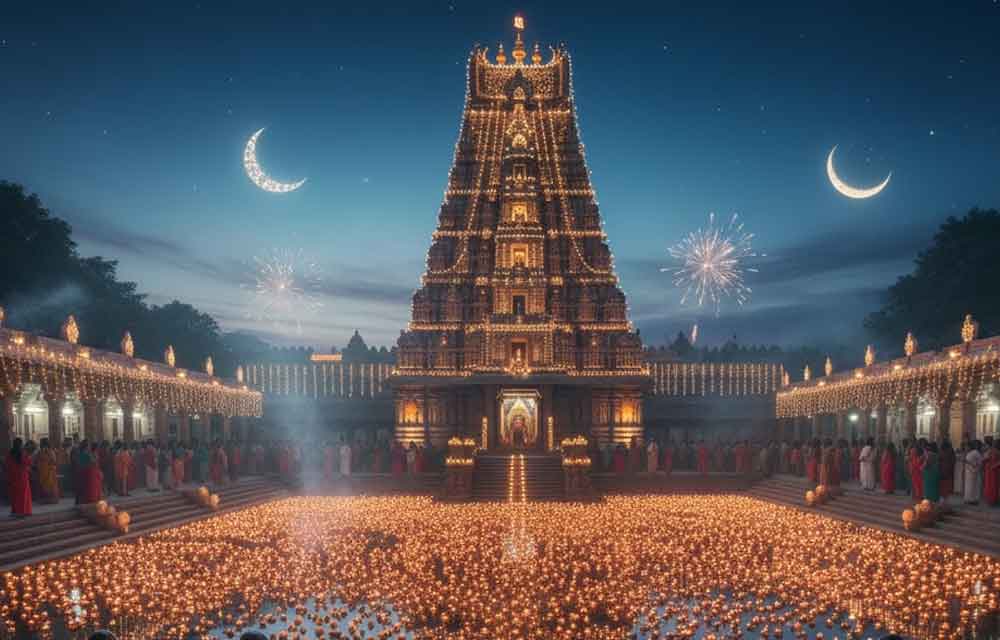
Every year on Karthika Pournami, a massive lamp (bharani) weighing tons and filled with ghee is lit atop the Arunachala Hill. This Karthika Deepam can be seen from miles away and represents Shiva’s original manifestation as the pillar of infinite light.
Millions of devotees gather at Thiruvannamalai during Karthika month, especially on the full moon day, to witness this divine spectacle and circumambulate the holy hill. It is believed that one circumambulation (girivalam) of Arunachala Hill during Karthika month equals countless lifetimes of spiritual practice.
The Saint’s Experience
The great sage Ramana Maharshi, who lived at the foot of Arunachala for decades, often spoke of the hill’s divine power. He said that Arunachala silently pulls devotees toward self-realization like a powerful magnet. Many devotees who visit this temple during Karthika month report profound spiritual experiences, visions, and life transformations.
One famous account tells of a devotee who was suffering from a terminal illness. During Karthika month, she visited Thiruvannamalai and performed girivalam barefoot despite her weakness. As she completed the 14-kilometer circumambulation, she felt a surge of divine energy. Within months, her illness completely disappeared, baffling doctors. She attributed her miraculous healing to Lord Arunachaleswara’s grace during the sacred month.
The Sacred Practice of Pradosha in Karthika
The Twilight Hour of Blessings
Pradosha is the auspicious period approximately 1.5 hours before and after sunset, considered especially sacred for Shiva worship. During Karthika month, Pradosha visits to Shiva temples are believed to carry multiplied spiritual benefits.
The Story Behind Pradosha
According to mythology, during the great churning of the cosmic ocean (Samudra Manthan), deadly poison (Halahala) emerged that threatened to destroy all creation. No one dared to touch it except Lord Shiva, who consumed it to save the universe.
Goddess Parvati, in her love and concern, held Shiva’s throat tightly so the poison wouldn’t descend into his stomach, causing it to remain in his throat, turning it blue. This happened during Pradosha time, and from that moment, this period became eternally auspicious for Shiva worship.
The devas and all beings witnessed this supreme sacrifice during Pradosha, and they began worshipping Shiva at this time. During Karthika month, Pradosha worship at Shiva temples is considered especially powerful, as it commemorates Shiva’s role as the protector and sustainer of creation.
The Pradosha Vow
A devotee named Dharmavarma in ancient times was suffering from severe poverty and family troubles. A sage advised him to visit a Shiva temple every Pradosha during Karthika month for one year. Dharmavarma followed this advice with unwavering faith, walking many miles to the nearest Shiva temple regardless of weather or personal difficulties.
On the final Pradosha of Karthika month that year, as he stood before the Shivalinga in complete surrender, Lord Shiva appeared before him in a vision and blessed him abundantly. Not only did his material problems resolve, but he attained deep spiritual wisdom and peace. His descendants continued the Pradosha worship tradition, and prosperity remained in his lineage for generations.
Somavara (Monday) Significance in Karthika Temples
The Day Consecrated to Shiva
Monday (Somavara) is intrinsically connected to Lord Shiva, as it is ruled by the Moon (Soma), which adorns Shiva’s matted locks. During Karthika month, Mondays become doubly auspicious for temple visits.
The Legend of Chandra (Moon God)
The Moon God, Chandra, once suffered from a curse that caused him to wane completely. Distressed and losing his luster, he approached Lord Shiva for help. Shiva advised him to worship in his temple during the Karthika month, especially on Mondays.
Chandra performed intense worship, offering Rudrabhishekam (sacred bathing ceremony) to the Shivalinga with great devotion. Pleased with his dedication, Lord Shiva not only lifted the curse partially (allowing the moon to wax again) but also placed him permanently on his head as an ornament.
Since then, Monday temple visits during Karthika month are believed to be particularly effective for removing curses, overcoming enemies, and gaining mental peace. Just as the Moon regained his brightness through Shiva’s grace, devotees believe their lives too can be illuminated.
A Modern Miracle
In contemporary times, a businessman facing bankruptcy and legal troubles began visiting a Shiva temple every Monday during Karthika month. He would pour sacred Ganga water over the Shivalinga and chant the Maha Mrityunjaya mantra 108 times.
On the fourth Monday, as he performed abhishekam, he experienced an overwhelming sense of peace and heard an inner voice saying, “Your troubles are ending.” Within weeks, an unexpected resolution came to his legal case, and a new business opportunity emerged that restored his fortunes. He continued his Monday temple visits for life, attributing his turnaround to Shiva’s grace during that Karthika month.
The Power of Girivalam (Temple Circumambulation)
Walking the Sacred Circle
Circumambulating (pradakshina) Shiva temples during Karthika month, especially walking around sacred Shiva hills like Arunachala, is considered a supreme spiritual practice. This act symbolizes the devotee’s recognition that the divine is the center around which their entire life revolves.
The Eternal Walker
There’s a beautiful legend about a poor, elderly woman who could barely walk due to age and poverty. During Karthika month, she heard about the immense benefits of circumambulating Shiva temples. Despite her physical limitations, she decided to slowly walk around her local Shiva temple once each day of the month.
The temple priests noticed her struggling and advised her that she need not strain herself. But she replied, “Lord Shiva carried the river Ganga on his head, held poison in his throat to save us, and dances continuously for our liberation. Can I not walk a few steps for him?”
On Karthika Pournami, as she completed her final circumambulation, she collapsed. The priests rushed to her, but she had a serene smile on her face. In her final moments, she whispered that she had seen Lord Shiva himself walking beside her throughout the month, supporting her with each step.
When they prepared her body for cremation, witnesses reported seeing a divine light surrounding her, and many claimed to hear celestial music. The story spread throughout the region, and that small temple became a major pilgrimage site during Karthika month.
Scientific and Spiritual Benefits
Modern studies have shown that the practice of pradakshina has numerous benefits:
Physical: The clockwise circumambulation creates beneficial magnetic field effects on the body, as most temple sanctums face east, aligning with Earth’s magnetic fields.
Psychological: The repetitive meditative walking calms the mind and reduces stress, creating a moving meditation effect.
Spiritual: The act symbolizes the dissolution of ego, as the devotee places the divine at the center rather than themselves.
During Karthika month, these benefits are believed to be amplified due to the special spiritual energy present in Shiva temples.
The Sacred Act of Abhishekam During Karthika
Bathing the Divine
Abhishekam (ritual bathing of the deity) is one of the most powerful forms of worship in Shiva temples. During Karthika month, performing or sponsoring abhishekam is considered especially meritorious.
The Five Sacred Substances
Traditional Shiva abhishekam uses Panchamrita (five nectars): milk, yogurt, ghee, honey, and sugar, along with sacred waters. Each substance has spiritual significance:
Milk – Represents purity and devotion Yogurt – Signifies prosperity and progeny Ghee – Symbolizes victory and valor Honey – Represents sweet speech and unity Sugar – Denotes happiness and positivity
The Merchant’s Transformation
A wealthy but miserly merchant in ancient India was urged by his devoted wife to visit Shiva temples during Karthika month. Reluctantly, he agreed to go once. At the temple, he watched as poor devotees enthusiastically sponsored abhishekams despite their limited means.
Moved by their devotion but still hesitant, he sponsored one simple milk abhishekam. As the milk flowed over the Shivalinga, he experienced an inexplicable opening of his heart. Tears flowed from his eyes, and for the first time in his life, he felt genuine love and connection with the divine.
That single abhishekam transformed him completely. He returned to the temple daily throughout Karthika month, each time sponsoring elaborate abhishekams. More importantly, he began sharing his wealth with the poor and sick. His life became a testament to the transformative power of Shiva worship during Karthika month.
His wife later revealed that she had been secretly praying to Lord Shiva for years to soften her husband’s heart, and her prayers were finally answered during that Karthika month temple visit.
Special Temples to Visit During Karthika Masam
The Pancharama Kshetras
Five ancient Shiva temples in Andhra Pradesh, known as Pancharama Kshetras, are especially powerful during Karthika month. Legend states that these temples house fragments of the original Shivalinga that was once whole but broke into five pieces during a divine event.
A pilgrimage covering all five temples during Karthika month is believed to grant complete purification and divine blessings equivalent to visiting all 108 Shiva temples mentioned in sacred texts.
Jyotirlinga Temples
The twelve Jyotirlinga temples across India—representing Shiva’s manifestation as light—become particularly charged during Karthika month. These include:
- Somnath (Gujarat)
- Mallikarjuna (Andhra Pradesh)
- Mahakaleshwar (Madhya Pradesh)
- Omkareshwar (Madhya Pradesh)
- Kedarnath (Uttarakhand)
- Bhimashankar (Maharashtra)
- Vishwanath (Uttar Pradesh)
- Trimbakeshwar (Maharashtra)
- Vaidyanath (Jharkhand)
- Nageshwar (Gujarat)
- Rameshwaram (Tamil Nadu)
- Grishneshwar (Maharashtra)
Each carries unique legends and bestows specific blessings, but visiting any of them during Karthika month is considered supremely auspicious.
Regional Temples of Significance
North India: Kashi Vishwanath (Varanasi), Kedarnath, Amarnath South India: Arunachaleswarar (Thiruvannamalai), Srikalahasti, Rameswaram East India: Lingaraj Temple (Bhubaneswar), Tarakeshwar West India: Somnath, Mahakaleshwar (Ujjain)
The Spiritual Benefits: What Devotees Gain
Liberation from Sins
The Skanda Purana explicitly states that visiting Shiva temples during Karthika month cleanses sins accumulated over countless lifetimes. Each visit acts like a spiritual bath, washing away karmic impurities.
A story tells of a man who had committed many wrongs in his life. On his deathbed, filled with regret, he remembered that once during Karthika month, he had visited a Shiva temple and offered simple flowers with genuine remorse for his actions. Due to that single sincere temple visit, Lord Shiva granted him another chance—he recovered from his illness and spent his remaining years in service and devotion.
Protection from Negative Forces
Shiva temples during Karthika month are said to create protective spiritual shields around devotees. Negative energies, evil eyes, and harmful planetary influences are neutralized.
Material and Spiritual Prosperity
While Shiva worship is ultimately aimed at spiritual liberation, devotees also report tangible benefits in their worldly lives:
- Resolution of legal problems
- Success in education and career
- Harmonious family relationships
- Good health and longevity
- Financial stability
- Mental peace and clarity
The Ultimate Gift: Moksha
The highest benefit of Karthika temple visits is progress toward moksha (liberation). Each visit is believed to bring the soul closer to breaking free from the cycle of birth and death.
How to Make Your Temple Visit More Meaningful
Preparation Before Visiting
- Purify Body and Mind: Bathe and wear clean, modest clothes
- Set Clear Intention: Know why you’re visiting and what you seek
- Maintain Silence: Observe silence during travel to the temple when possible
- Carry Offerings: Bring bilva leaves, flowers, fruits, or items for abhishekam
At the Temple
- Enter with Reverence: Ring the temple bell to announce your presence and awaken your consciousness
- Circumambulate: Walk around the temple/sanctum clockwise (usually 3, 7, or 108 times)
- Offer with Devotion: Present your offerings with sincere love
- Chant Mantras: “Om Namah Shivaya” or other Shiva mantras
- Meditate: Spend quiet moments in the temple’s presence
- Take Prasadam: Accept blessed offerings with gratitude
After the Visit
- Maintain the Energy: Try to preserve the peaceful state you achieved
- Share Blessings: Distribute prasadam to others
- Practice Teachings: Apply any insights gained to daily life
- Continue Devotion: Maintain a home altar and daily prayers
Personal Testimonies and Modern Miracles
The Childless Couple’s Prayer
A couple married for twelve years remained childless despite medical treatments. During one Karthika month, they committed to visiting a local Shiva temple every day for the entire month. They performed Rudrabhishekam and offered bilva leaves while chanting mantras.
On the final day of Karthika month, after their prayers, the temple priest inexplicably called them and blessed them, saying, “Lord Shiva has heard your prayers.” Within two months, the wife conceived naturally, and they were blessed with a healthy child nine months later.
The Student’s Success
A student failing repeatedly in important examinations visited Thiruvannamalai during Karthika month on his mother’s insistence. Skeptical but respectful, he circumambulated Arunachala Hill and prayed at the temple. During the walk, he experienced unusual mental clarity.
When he returned to his studies, he found he could understand and retain information in ways he never could before. He passed his examinations with distinction and later attributed his success to the grace received during that Karthika month temple visit.
The Healed Mind
A woman suffering from severe depression and anxiety, unresponsive to medication, began visiting a Shiva temple every Pradosha during Karthika month. The peaceful temple atmosphere, the ritual of worship, and the sense of connection with something greater than herself gradually brought healing.
By the end of the month, her symptoms had significantly reduced. She continued her temple visits regularly and, combined with therapy, found lasting mental peace. She often says, “The temple gave me a place to put down my burdens and receive strength to carry on.”
Conclusion: The Divine Invitation
Visiting Shiva temples during Karthika Masam is not merely a religious obligation but a divine invitation from Lord Shiva himself to come closer, to experience grace, and to transform. Every temple visit during this sacred month is like knocking on heaven’s door—and it is said that Shiva always answers.
The ancient sages knew what modern seekers are rediscovering: that sacred spaces, sacred times, and sacred actions create portals to higher consciousness. Shiva temples during Karthika month become such portals, where the veil between human and divine grows thinner, where prayers reach more directly, and where grace flows more abundantly.
Whether you walk miles to a famous Jyotirlinga or simply visit your neighborhood Shiva temple, what matters is the sincerity of your devotion and the openness of your heart. Lord Shiva sees not the grandeur of your offering but the purity of your love.
As you plan your temple visits this Karthika month, remember the stories of Markandeya’s courage, Kannappa’s love, and the countless devotees whose lives were transformed by simple acts of devotion. Their experiences assure us that Shiva’s grace is real, immediate, and boundless.
The temples are waiting, the month is sacred, and Lord Shiva’s blessings are ready to flow. All that remains is for you to take that first step, to enter those ancient portals with faith and devotion, and to open yourself to the transformation that awaits.
Har Har Mahadev! Om Namah Shivaya!
May your temple visits during Karthika Masam bring you abundant blessings, spiritual growth, and the eternal grace of Lord Shiva.


 ︎
︎

