
Vladimir Putin Reading Bhagavad Gita: A Devotional Moment That Touched Millions of Hindu Hearts
In a deeply moving and spiritually significant moment, Russian President Vladimir Putin was seen immersed in reading the Shrimad Bhagavad Gita during his…
In a deeply moving and spiritually significant moment, Russian President Vladimir Putin was seen immersed in reading the Shrimad Bhagavad Gita during his…
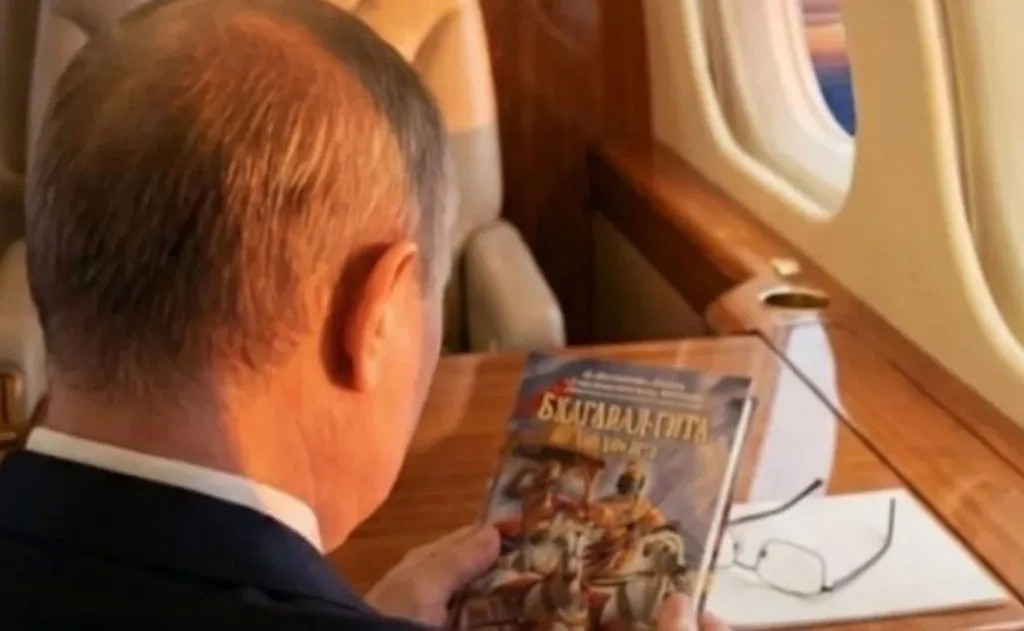
In a deeply moving and spiritually significant moment, Russian President Vladimir Putin was seen immersed in reading the Shrimad Bhagavad Gita during his return flight from India on December 5–6, 2025. Gifted a beautiful Russian translation of the holy scripture by Prime Minister Narendra Modi, President Putin’s quiet devotion to the Gita has filled millions of Hindu hearts with joy, pride, and divine emotion.
This was not just a diplomatic gesture; it was a sacred exchange of Sanatan wisdom that reminded the world of the universal power of Lord Krishna’s divine song.
The Sacred Gift: When Modi Ji Placed the Gita in Putin’s Hands
During the official meeting in New Delhi, Prime Minister Narendra Modi personally presented President Putin with a Russian edition of the Bhagavad Gita published by ISKCON. As soon as the book was placed in his hands, Putin opened it with visible respect and began reading the very first page.
Later, aboard the presidential aircraft, cameras captured the Russian leader deeply absorbed in the Gita for several minutes, turning pages with quiet reverence. For every devotee watching those images, it felt as if Arjuna himself had returned to listen to Krishna’s eternal message on the battlefield of modern times.
This single act has become one of the most soul-stirring moments in recent Hindu history: a world leader, known for his strong persona, sitting in silent surrender before the words of Lord Krishna.
Putin’s Long-Standing Love for the Bhagavad Gita
This is not the same Vladimir Putin who, in 2011, openly defended the Bhagavad Gita when certain groups in Russia tried to ban “Bhagavad Gita As It Is” by Srila Prabhupada. He called the attempt “unacceptable” and “madness,” ensuring that the sacred text remained freely available throughout Russia.
Fourteen years later, destiny brought the same holy book back into his hands, this time as a personal gift from Bharat’s Prime Minister. Devotees see this as Krishna’s divine leela, guiding even powerful rulers toward the path of dharma.
Why This Moment Melts Every Devotee’s Heart
Imagine: A leader who commands one of the world’s largest nations, Sitting alone, Reading the same verses that our grandmothers recite every morning, The same shlokas chanted in temples from Kanyakumari to Kedarnath, “Yoga-sthaḥ kuru karmāṇi” – Established in yoga, perform your duties… “Sarva-dharmān parityajya mām ekaṁ śharaṇaṁ vraja” – Abandon all varieties of dharma and simply surrender unto Me…
When Putin read these lines, millions of Hindus felt goosebumps of pure bhakti. Tears flowed in homes and temples as families shared the photos with the caption: “Krishna’s message has reached the Kremlin.”
A Prayer from Every Hindu Heart
May Lord Krishna bless President Putin with the same clarity He gave Arjuna. May the Gita’s wisdom guide his decisions toward peace, righteousness, and protection of dharma. May this sacred moment inspire every leader on earth to turn to Krishna’s lotus feet in times of crisis.
Jai Shree Krishna! Hare Krishna Hare Rama!
As devotees, let us celebrate this divine moment by reading at least one shloka of the Bhagavad Gita today and sharing its light with the world, just as Modi Ji shared it with Putin Ji.
|| Om Namo Bhagavate Vasudevaya ||
(Exclusive for www.hindutone.com – A sacred space for Sanatan devotion)
What Does the Bhagavad Gita Teach That Resonates Beyond India's Borders?
The Bhagavad Gita, comprising 700 verses across 18 chapters within the Mahabharata's Bhishma Parva, is not addressed to a single nation or culture. Lord Krishna speaks on the Kurukshetra battlefield to Arjuna, but the teachings — on duty (dharma), detachment (vairagya), selfless action (nishkama karma), and the immortality of the Atman — address the universal human condition. The opening of Chapter Two, where Krishna tells Arjuna 'nainam chhindanti shastrani' (no weapon can cut this Self), carries a philosophical depth that has drawn thinkers, statesmen, and soldiers across the world for centuries.
Figures as diverse as German philosopher Wilhelm von Humboldt, American transcendentalist Ralph Waldo Emerson, and nuclear physicist J. Robert Oppenheimer — who famously recalled verse 11.32 at the Trinity test — have testified to the Gita's power to illuminate moments of extreme moral and existential crisis. For a leader like Putin, who navigates complex geopolitical pressures, the Gita's counsel on performing one's ordained duty without attachment to outcome (Chapter 3, verse 19: 'tasmad asaktah satatam karyam karma samachara') holds a particularly immediate resonance.
The 2011 Novosibirsk Court Case: When Putin Defended the Sacred Text
In 2011, a regional prosecutor in Tomsk, Siberia, filed a lawsuit seeking to have Srila Prabhupada's 'Bhagavad Gita As It Is' declared extremist literature and banned across the Russian Federation. The case was heard in a Novosibirsk district court and drew international outrage from Hindu organisations, ISKCON communities, and the Government of India, which formally raised the matter through diplomatic channels.
Putin's administration intervened decisively. Russian government spokesperson Dmitry Peskov conveyed that the Kremlin considered such a ban unacceptable, and the case was ultimately dismissed in December 2011. The episode established a clear precedent: the Bhagavad Gita is recognised in Russia as a foundational religious text deserving legal protection, not censorship. That the very leader who shielded the Gita from a court ban would, fourteen years later, be photographed reading it in quiet contemplation on his presidential aircraft is a detail that devotees across India find deeply providential.
ISKCON's Russian Edition: How the Gita Crossed Languages and Continents
The copy gifted by Prime Minister Modi was an ISKCON-published Russian translation of the Bhagavad Gita. ISKCON — the International Society for Krishna Consciousness, founded by His Divine Grace A.C. Bhaktivedanta Swami Prabhupada in New York in 1966 — has been distributing the Gita in over 90 languages for more than five decades. The Russian translation, first circulated during the Soviet era when devotees risked imprisonment to possess it, carries a history of quiet spiritual resistance that makes the book itself a symbol of indestructible dharma.
Srila Prabhupada's translation and commentary preserve the original Sanskrit shlokas alongside transliteration and word-by-word meanings, allowing a reader with no prior Sanskrit knowledge to encounter the Gita's layered intent. When Putin turned the first pages aboard his aircraft, he was engaging with a textual tradition that passed through the hands of underground devotees in Leningrad and Moscow long before it received the dignity of an official gift from India's Prime Minister.
India and Russia: A Civilisational Bond Older Than Diplomacy
The exchange of the Bhagavad Gita as a state gift is not an isolated gesture; it draws upon a documented linguistic and cultural kinship between Sanskrit and the Proto-Indo-European roots of Slavic languages. Scholars of comparative linguistics have long noted striking parallels — the Sanskrit word 'deva' (divine being) echoes in the Russian 'div' (wonder); 'mati' (mother) appears almost unchanged across both traditions. This shared ancestral heritage gives the Gita a quality of homecoming rather than foreignness when it travels to Russia.
Diplomatically, India and Russia have maintained a relationship of strategic trust since the Soviet era, but Prime Minister Modi's choice to offer a spiritual rather than merely material gift signals a deeper intent: to frame the bilateral relationship within the language of Sanatan wisdom. Ancient Indian texts like the Arthashastra of Kautilya describe 'sama' (conciliation through shared values) as the highest form of diplomacy; the Gita as a gift is precisely that — an offering of the most universal of India's intellectual treasures.
Krishna's Vishwarupa and the Idea of a Universal Dharma for World Leaders
Chapter Eleven of the Bhagavad Gita describes the Vishwarupa Darshana — the revelation of Lord Krishna's cosmic, all-encompassing form to Arjuna. Krishna declares in verse 11.33, 'nimittamatram bhava savyasachin' — 'Be only an instrument, O Arjuna.' This teaching, that even the most powerful actor on a historical stage is ultimately an instrument of a greater cosmic order, carries specific resonance for heads of state who must make decisions affecting millions.
Hindu acharyas from Adi Shankaracharya, who wrote the definitive Advaita commentary on the Gita in the 8th century CE, to modern Vedantic teachers have consistently emphasised that the Gita's addressee is not merely one warrior but any soul placed at a crossroads of duty and conscience. Seeing Putin absorbed in these verses, devotees naturally reflect on this teaching: that the Gita seeks out the Arjuna in every powerful person — not to paralyse them with doubt, but to elevate their action from ego-driven reaction to dharmic clarity.
How This Moment Has Moved the Global Hindu Community
Images and video clips of Putin reading the Gita on his return flight spread rapidly across Hindu devotional communities on social media, with many sharing verses from the text alongside the photographs. Temples from the Shri Banke Bihari Mandir in Vrindavan to ISKCON centres in Mumbai and Houston reported devotees spontaneously gathering to recite Gita shlokas in celebration, viewing the moment as Lord Krishna's direct grace touching an unexpected corner of the world.
For the diaspora Hindu community — particularly in countries where the practice of Sanatana Dharma sometimes feels marginalised — the sight of a major world leader treating the Gita with visible respect and genuine curiosity carries emotional weight that goes beyond politics. It affirms what the Gita itself proclaims in Chapter 4, verse 7 and 8: that whenever dharma needs to reassert its presence in the world, the divine finds a way. Whether Putin's reading deepens into personal study or remains a singular moment of openness, millions of devotees have already received it as Krishna's own message — that His words belong to no single people but to all of humanity.
Frequently Asked Questions
What is Vladimir Putin Reading Bhagavad Gita?
In a deeply moving and spiritually significant moment, Russian President Vladimir Putin was seen immersed in reading the Shrimad Bhagavad Gita during his return flight from India on December 5–6, 2025. Gifted a beautiful Russian translation of the holy scripture by Prime Minister Narendra Modi, President Putin’s quiet devotion to the Gita has filled millions
What are the key points about Vladimir Putin Reading Bhagavad Gita?
This was not just a diplomatic gesture; it was a sacred exchange of Sanatan wisdom that reminded the world of the universal power of Lord Krishna’s divine song. The Sacred Gift: When Modi Ji Placed the Gita in Putin’s Hands During the official meeting in New Delhi, Prime Minister Narendra Modi personally presented President Putin with a R
Why does Vladimir Putin Reading Bhagavad Gita matter in Hinduism?
It reflects core values of Sanatana Dharma and offers practical and spiritual guidance that remains relevant across generations.
How can devotees apply Vladimir Putin Reading Bhagavad Gita in daily life?
By reflecting on its teaching, incorporating the related practices or observances into daily routine, and approaching it with sincere devotion and understanding.
You might also like
Purushottam Maas 2026: Lord Vishnu's Sacred Gift of Spiritual Multiplication & Divine Grace
Hindu Priest Jobs New Zealand 2026 — Auckland, Wellington, Christchurch Vacancies & NZ Religious Worker Visa Guide
Hindu Priest Jobs Malaysia 2026 — Batu Caves, KL, Penang Vacancies & Tamil Hindu Career Guide