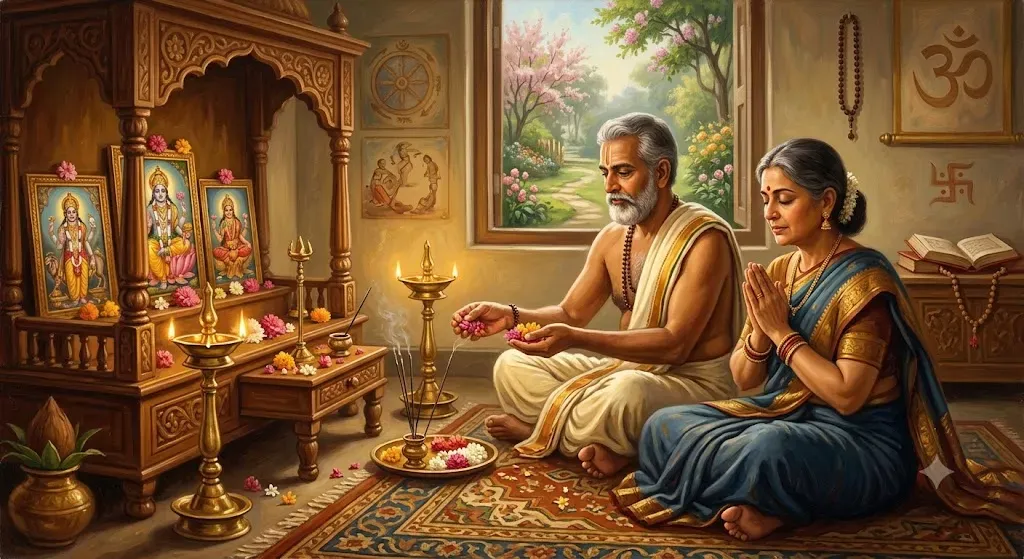
10 Bhagavad Gita Lessons Every Hindu American Needs in 2026 — Career, AI, Immigration & Inner Peace
10 Bhagavad Gita lessons for Hindu Americans in 2026 — career, AI disruption, H1-B uncertainty, ABCD parenting, mental health, dharma in the modern USA.
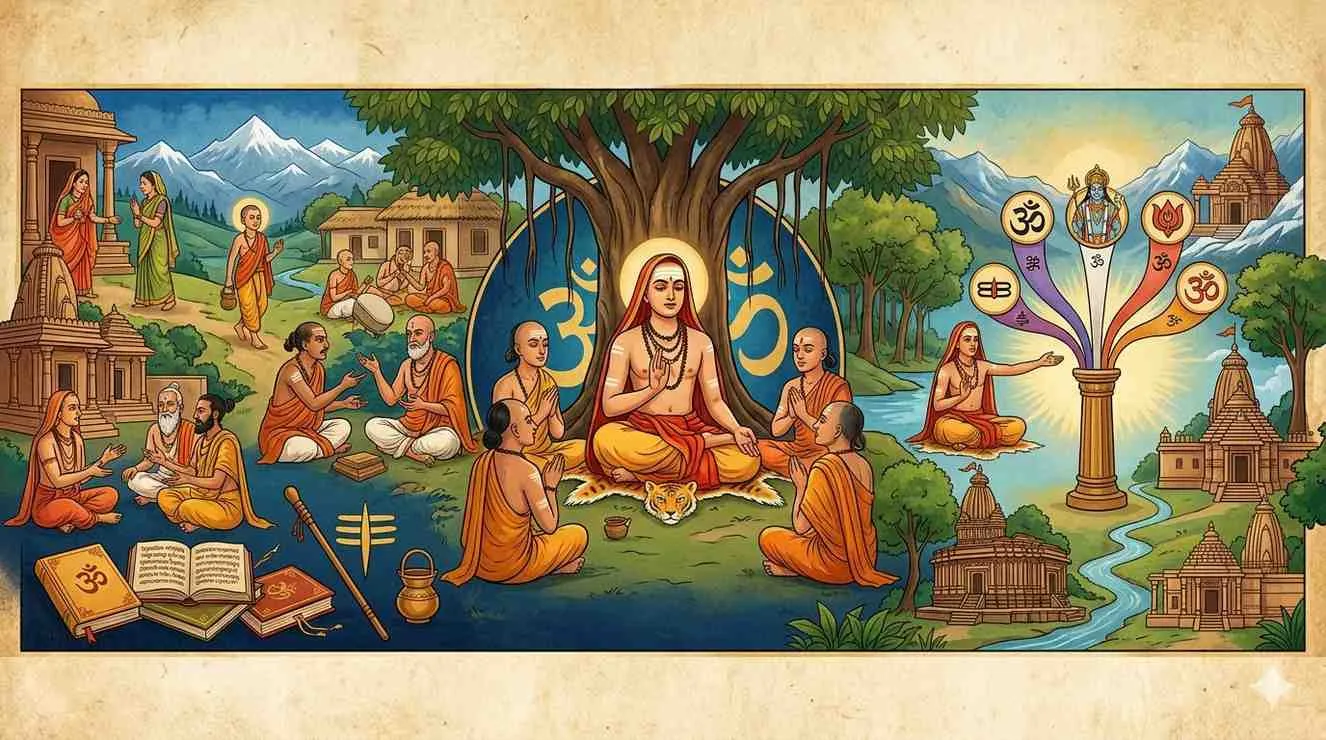
10 Bhagavad Gita lessons for Hindu Americans in 2026 — career, AI disruption, H1-B uncertainty, ABCD parenting, mental health, dharma in the modern USA.
Quick Answer: The Bhagavad Gita — Krishna's 700-verse counsel to Arjuna on the eve of cosmic battle — speaks with eerie precision to the Hindu American experience in 2026. The same uncertainty Arjuna faced on Kurukshetra (which life to live, whom to fight, how to act under crushing pressure) is the daily reality of H1-B holders facing AI job disruption, ABCD parents navigating cultural transmission, and senior Indian-American leaders deciding whether to return home or stay. This guide distils ten Gita verses into actionable wisdom for the 4.5 million Hindu Americans in 2026.
The Hindu American community has grown to 4.5 million — the fastest-growing religious minority in the United States. From Silicon Valley engineering teams to New Jersey medical practices, from Texas oil-and-gas executives to Atlanta tech entrepreneurs, the diaspora is in its third generation of meaningful weight in American life. And yet, every Hindu American faces the same questions Arjuna faced in 18 chapters of dialogue with his charioteer-friend Krishna: What is my duty? How do I act amid uncertainty? Where does my real identity lie?
Lesson 1 — Nishkama Karma: Act, But Don't Attach
Karmanye vadhikaraste, Ma Phaleshu Kadachana.* — Gita 2.47
You have a right to action; never to its fruits.
The H1-B paradox: You must work hard at your job. But your job depends on a lottery you cannot control, a sponsor who may restructure, an immigration policy that may shift. If your peace depends on the outcome of your H1-B, you have built your house on someone else's foundation.
Krishna's solution: Do your best work. Fully. With every cell of attention and effort. And then — release the result. The lottery will or will not work. The sponsor will or will not survive. The green card will or will not arrive. None of these change the dharma of doing your work well today.
This is not passivity. It is the only sustainable form of fierce engagement.
Lesson 2 — Swadharma over Paradharma: Your Duty, Not Someone Else's
Shreyan svadharmo vigunah paradharmat svanusthitat.* — Gita 3.35
Better one's own dharma performed imperfectly than another's performed well.
The ABCD pressure: Your American-born child is told they should be a doctor like the neighbour's kid. But their svadharma might be writing, design, music, social work, or a path that doesn't yet have a category. Krishna's teaching: pushing them into someone else's dharma generates suffering even if they succeed externally.
The mid-career pivot: A senior software engineer feels the pull toward teaching, painting, opening a yoga studio. The "good" career path is to stay in tech. But svadharma may not be the path that maximizes income; it is the path that aligns with the soul's authentic configuration.
Discernment: Swadharma isn't whim. It's the work you would do even if no one rewarded you for it. The work you find time for at 5 AM. The contribution you would make if money were no object.
Lesson 3 — The Eternal Atman: You Are Not Your H1-B
Vasamsi jirnani yatha vihaya, navani grhnati naro 'parani.* — Gita 2.22
As one discards worn-out clothes and puts on new ones, so the embodied soul discards worn-out bodies and enters new ones.
The 2026 anxiety: "If I lose my job, who am I? If my visa fails, what was my life for? If AI takes my role, what value remains?"
Krishna's response: You are not your job. You are not your visa status. You are not your country of birth or your country of residence. You are the eternal Atman — the consciousness that wears the body of this lifetime as a garment.
Practical application: When your H1-B visa is denied, when the layoff letter arrives, when the green card backlog hits 80 years — sit silently for ten minutes. Repeat to yourself: I am not this job. I am not this visa. I am the witness consciousness that watched both arrive and will watch them go. What I am is unchanging.
This is not denial of practical reality. It is the foundation that lets you respond to practical reality with clarity.
Lesson 4 — Equanimity in Opposites
Sukha-duhkhe same krtva, labhalabhau jayajayau.* — Gita 2.38
Treating happiness and suffering, gain and loss, victory and defeat alike — engage in battle.
Modern reality: Promotion = euphoria. Layoff = devastation. Green card approved = celebration. Visa denied = despair. The roller-coaster of Hindu American professional life leaves practitioners exhausted at the level of the nervous system.
Krishna's instruction: The wise person treats opposites the same. Not by suppressing feeling — but by recognizing that all of these are passing. The promotion will become normal in three weeks. The layoff will become a "growth story" in five years. The visa will be replaced by another visa, eventually.
Sthita-prajna: The Gita's term for the person who can hold pleasure and pain in the same hand. This is not coldness — it is freedom.
Lesson 5 — Yoga: Skill in Action
Yogah karmasu kaushalam.* — Gita 2.50
Yoga is skill in action.
The 2026 productivity obsession: Asana yoga, breath work, time-blocking, Notion templates, AI tools for productivity. All useful. But Krishna's "yoga" is something more fundamental — the integration of attention, intention, and effort into a single quality of action.
What it looks like in practice:
- The senior engineer who reviews code with full presence, neither rushed nor lazy
- The mother who packs the school lunch with attention, not while scrolling her phone
- The doctor who listens to the patient as if no other patient exists
- The temple priest who chants each mantra as if it were the first
When work has this quality, productivity is no longer the goal — it is the natural byproduct of presence.
Lesson 6 — Surrender to the Divine
Sarva-dharman parityajya, mam ekam saranam vraja.* — Gita 18.66
Abandoning all dharmas, take refuge in Me alone.
The exhausted professional: You've tried everything — the productivity systems, the spiritual practices, the therapy, the diet, the gym. Some weeks work; many weeks don't. The relentless effort itself becomes a burden.
Krishna's gift: There is a final teaching beyond all teachings — let go. Take refuge in the divine. Whatever form of the divine you connect to — Krishna, Rama, Vishnu, Shiva, Devi, the Sat-Chit-Ananda nature of reality itself — surrender to that. Sharanagati. Not as defeat, but as the realisation that the soul's deepest peace is on the other side of the small-self's struggle to optimize.
The Hindu Americans who have made this transition speak of it consistently: the work continues, but the gripping ceases. The visa drama plays out, but the peace is no longer hostage to it.
Lesson 7 — The Three Gunas: Sattva, Rajas, Tamas in Modern Life
The Gita's framework of the three qualities of nature:
- Sattva — clarity, balance, light, knowledge
- Rajas — passion, activity, ambition, restlessness
- Tamas — inertia, ignorance, lethargy, darkness
Modern Hindu American life as gunas:
Rajas dominant: The hustle. The Bay Area engineer working 12-hour days. The mother running between three kids' activities. The Indian-American entrepreneur on three boards. Effective, but exhausted. Rajas generates results and burns out.
Tamas dominant: The Netflix binge after a hard week. The procrastination on important conversations. The avoidance of one's own truth. Tamas is recovery — necessary — but excess tamas calcifies.
Sattva dominant: The morning meditation. The deep work session with the laptop and notebook only. The honest conversation with the spouse about the cross-cultural marriage friction. The decision to volunteer at the temple. Sattva is sustainable.
Krishna's prescription: Cultivate sattva. Reduce excessive rajas. Avoid tamas. Diet, environment, media consumption, friendships, daily rhythm — all influence guna balance. The Gita gives specific guidance on food (Chapter 17), worship (Chapter 17), action (Chapter 18) — all categorized by the three gunas.
Lesson 8 — Vishwaroopa: Cosmic Perspective on Small Worries
Yada yada hi dharmasya...* (4.7) and the Vishwaroopa darshan (Chapter 11)
When Arjuna asked to see Krishna's true form, Krishna granted Divya Drishti — divine sight. What Arjuna saw was the entire cosmos contained within one infinite form. Past, present, future. All beings entering and exiting like rivers into the sea. Time itself consuming all.
The Hindu American application: When your H1-B feels like an existential crisis, remember — Vishnu has lived a billion of these moments across cosmic time. Your specific drama is real, but it is one moment in an unimaginably vast unfolding. Your contribution matters. Your suffering also passes.
This is not minimization. It is contextualization. The Vishwaroopa perspective doesn't deny your pain — it places it inside a frame so vast that the pain has room to be present without devouring you.
Practice: Once a month, sit for 20 minutes contemplating the cosmic scale. The 13.8 billion years of universe. The 4.5 billion years of Earth. The 200,000 years of human existence. The 5,000 years of Hindu tradition. Your one life — one bead on the cosmic mala — is sacred precisely because it is brief.
Lesson 9 — Sthitaprajna: The Steady-Minded One
Chapter 2 verses 55-72 describe the steady-minded person. Among the qualities:
- Content with what comes; not craving what doesn't
- Acts in the world without being shaken by it
- Withdraws senses from objects as a tortoise withdraws its limbs
- Stays anchored in the Self while engaged with form
The 2026 Hindu American Sthitaprajna:
- Has lost a job and was steady
- Has won a major promotion and was steady
- Has seen children grow up Westernized differently than expected, and was steady
- Has lost a parent in India while in the USA, and was steady
- Watches the news of layoffs, political turmoil, climate events — and is steady
This is not flatness. It is the warmth of presence backed by the strength of foundational practice. Sthitaprajna feels everything fully — and is not destabilized by anything.
How to cultivate it:
- Daily meditation, even 15 minutes
- Daily mantra practice
- Weekly scripture study (Gita / Garuda Purana / Upanishads)
- Annual retreat (silent, satsang, or pilgrimage)
- Regular relationship with a guru or sangha
- Honest self-inquiry — Who am I, beneath the roles?
Lesson 10 — Krishna's Final Counsel: The Path of Grace
Chapter 18, the closing chapter, contains Krishna's final integrative teaching. After eighteen chapters of dharma, karma, yoga, meditation, devotion, and knowledge — Krishna says: Whatever you have understood, take refuge in Me alone. I will free you from all sin. Do not grieve.
The deepest teaching for Hindu Americans in 2026: All the strategy, all the optimization, all the spiritual practice — eventually points to a doorway that you walk through only by trust. Trust that the divine intelligence that arranged the conditions of your life is also arranging the conditions for your continued unfolding. Trust that the relationship between effort and grace is asymmetric — you must make the effort, but grace is what completes the picture.
For NRI Hindu Americans navigating AI uncertainty, immigration backlogs, raising children in a changed America, and holding the link with parents in India — Krishna's final word is the most consoling sentence in world literature: Ma shucah. Do not grieve.
Practical integration — How to apply this in 2026
For the H1-B holder
- Lesson 1 + 3 + 4. Do your work. You are not your visa. The roller-coaster of approval and uncertainty passes.
For the AI-disrupted senior engineer
- Lesson 2 + 7 + 9. Find your authentic next direction. Cultivate sattva. Be steady.
For the ABCD-parent
- Lesson 2 + 5 + 8. Let your children find their swadharma. Be present in the daily acts. Hold the cosmic perspective.
For the recently bereaved
- Lesson 3 + 6 + 10. The departed are not lost — they are in transition. Take refuge in the divine. Do not grieve.
For the senior leader contemplating return to India
- Lesson 2 + 4 + 9. Listen to swadharma. Hold success and "failure" equally. Steady-mindedness in either choice.
For the cross-cultural marriage
- Lesson 2 + 4 + 5. Honor your swadharma and your spouse's. Equanimity through differences. Skill in action — the daily small choices build a marriage.
For the young Hindu American just out of college
- All ten lessons. Begin a daily Gita practice. One verse a day for the rest of your life is enough to transform a lifetime.
How to begin Bhagavad Gita study in 2026
Best translations:
- Eknath Easwaran (highly accessible, Penguin Classics)
- Swami Prabhupada (BBT, devotional)
- Swami Chinmayananda (Chinmaya Mission, comprehensive commentary)
- Stephen Mitchell (literary, modern English)
- Easwaran-edited Mahatma Gandhi's Gita commentary (ethical lens)
Best podcasts/audio:
- Sounds True Bhagavad Gita audio series
- Various Indian-American gurus' YouTube series
Best in-person study:
- BAPS Robbinsville NJ Sunday Gita study
- Bay Area Chinmaya Mission classes
- Hindu Heritage Foundation NY/NJ Gita workshops
- ISKCON Houston Gita weekend retreats
Practice:
- One verse a day, with chosen translation + commentary
- Memorize the most powerful verses (2.47, 2.22, 18.66)
- Discuss with a partner or study group
- Apply to one daily situation
FAQs
Q: I'm not Hindu but my partner is. Can the Gita teach me anything?
A: Absolutely. The Gita's wisdom is universal — duty, action without attachment, equanimity, the eternal nature of consciousness. Many non-Hindus (Emerson, Thoreau, Gandhi's American friends, Steve Jobs in his later years) found the Gita transformative.
Q: My ABCD child has no interest in the Gita. What can I do?
A: Don't force. Instead, model the principles. Live with equanimity. Make your decisions visible. Children absorb dharma far more from how parents live than from what parents teach.
Q: Is the Gita compatible with my therapy practice?
A: Yes — many therapists in the diaspora now integrate Gita principles. The teachings on equanimity, observation of mind, role-vs-self distinction overlap meaningfully with cognitive-behavioral therapy and mindfulness-based therapy.
Q: I'm Buddhist/Sikh/Jain in background but live among Hindus. Should I read the Gita?
A: The Gita is shared scripture for all Dharmic traditions. Sikhism explicitly honors the Gita; Buddhism shares many concepts; Jainism's emphasis on right action aligns with Gita karma yoga.
Q: Can the Gita help with H1-B mental health?
A: Profoundly. The combination of equanimity practice (lesson 4), eternal-self awareness (lesson 3), and surrender (lesson 6) addresses the structural anxieties of visa-dependent life better than any productivity hack.
Conclusion
The Bhagavad Gita is not an ancient text. It is the most contemporaneous wisdom available to the Hindu American in 2026. Arjuna's questions on Kurukshetra are the questions of every Hindu professional in 2026 Silicon Valley, every Hindu parent in 2026 New Jersey, every Hindu grandparent visiting from India to see grandchildren in 2026 Toronto. The geography has shifted; the wisdom has not.
Begin tomorrow morning. One verse. With morning chai. With the AC humming in 2026 Houston or the rain falling on a 2026 London window. Five minutes. The Gita will meet you in whatever life you have built.
Sarva-dharman parityajya, mam ekam saranam vraja.
Aham tvam sarva-papebhyo moksayisyami; ma shucah.* — Gita 18.66
Abandon all dharmas, take refuge in Me alone. I will free you from all sin. Do not grieve.
Jai Shri Krishna! Hare Krishna! Om Tat Sat.
HinduTone Editorial Team · Tags: Bhagavad Gita 2026, Hindu Americans, Krishna Wisdom, NRI Mental Health, H1-B Stress, ABCD Parenting, AI Era Spirituality, Nishkama Karma
Frequently Asked Questions
What is 10 Bhagavad Gita Lessons Every Hindu American Needs?
The Bhagavad Gita — Krishna's 700-verse counsel to Arjuna on the eve of cosmic battle — speaks with eerie precision to the Hindu American experience in 2026. The same uncertainty Arjuna faced on Kurukshetra (which life to live, whom to fight, how to act under crushing pressure) is the daily reality of H1-B holders facing AI job disruption, ABCD parents navig
What are the key points about 10 Bhagavad Gita Lessons Every Hindu American Needs?
This guide distils ten Gita verses into actionable wisdom for the 4.5 million Hindu Americans in 2026. The Hindu American community has grown to 4.5 million — the fastest-growing religious minority in the United States.
Why does 10 Bhagavad Gita Lessons Every Hindu American Needs matter in Hinduism?
It reflects core values of Sanatana Dharma and offers practical and spiritual guidance that remains relevant across generations.
How can devotees apply 10 Bhagavad Gita Lessons Every Hindu American Needs in daily life?
By reflecting on its teaching, incorporating the related practices or observances into daily routine, and approaching it with sincere devotion and understanding.
You might also like

Magha Month 2026: A Practical Guide for Hindu Americans
Bhagavad Gita — Complete Guide for NRIs (18 Chapters + 3 Yogas)
Mantras for Career Success — Hindu Mantras for Job Growth, Promotion & Professional Growth