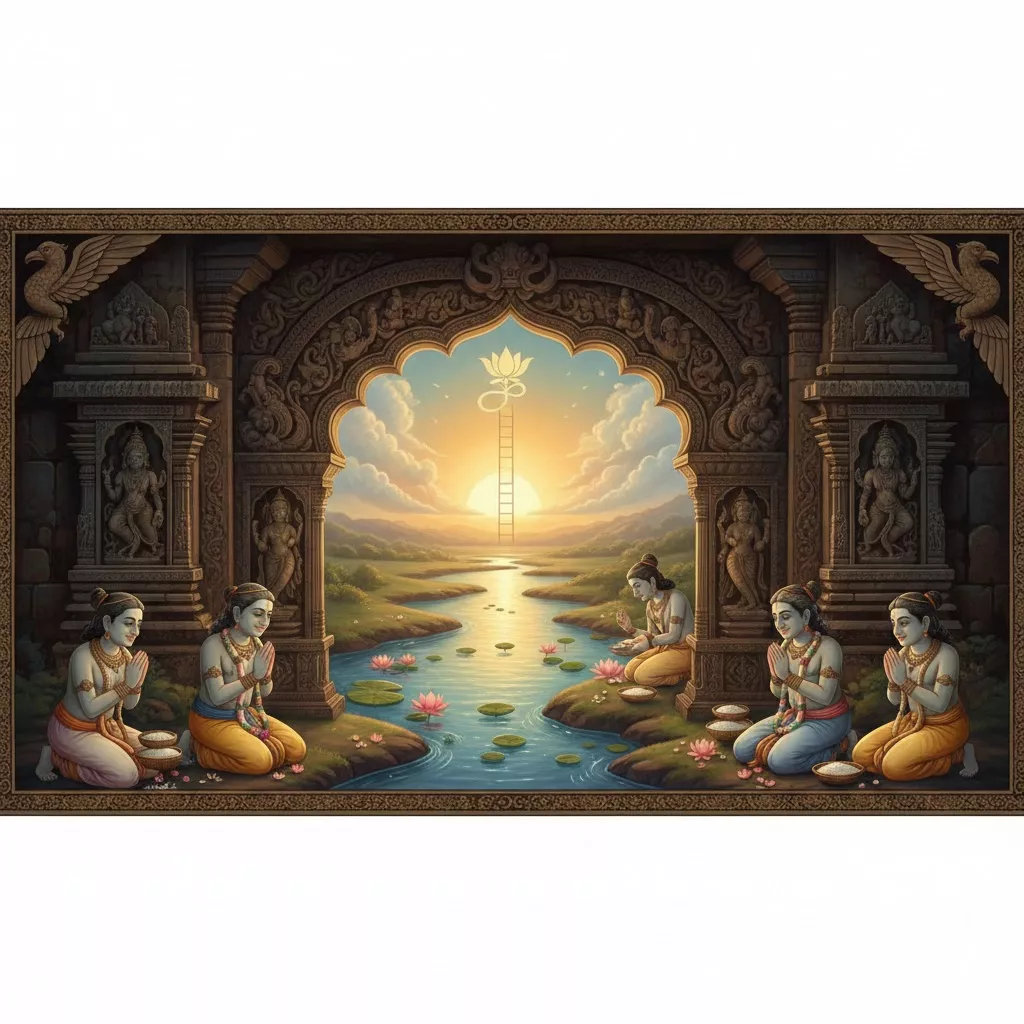
Karma & Rebirth in the Garuda Purana — A Modern Hindu Perspective for 2026
Karma and rebirth in the Garuda Purana — Sanchita, Prarabdha, Agami karma explained; Hindu reincarnation; how to live with karmic awareness in 2026 as an NRI Hindu.
Karma and rebirth in the Garuda Purana — Sanchita, Prarabdha, Agami karma explained; Hindu reincarnation; how to live with karmic awareness in 2026 as an NRI Hindu.
Quick Answer: The Garuda Purana presents karma in three categories — Sanchita (accumulated karma from all past lives), Prarabdha (the karma currently bearing fruit in this life), and Agami (new karma being created right now). Rebirth (*punar-janma*) is the process by which Sanchita karma is worked out across many embodied lifetimes until the soul attains moksha (liberation). For the modern Hindu in 2026 — navigating careers in AI-era Silicon Valley, raising children in London, retiring back to India after decades in Toronto — karma is not fate. It is the operating system of reality, and the choices made in this body shape the trajectory of the next.
The Garuda Purana's Dharma Kanda (the section on moral conduct) and Moksha Kanda (the section on liberation) together form one of the most comprehensive treatments of karma in any religious text. Read alongside the Bhagavad Gita's Chapter 4 (where Krishna explains karma yoga), the Upanishads, and Patanjali's Yoga Sutras, the Garuda Purana provides the practitioner with both the metaphysical framework and the practical guidance for living an awakened life.
1. The Three Types of Karma
Sanchita Karma (संचित कर्म) — The Accumulated Storehouse
All karma from all previous lifetimes that has not yet been worked out. The Garuda Purana describes this as a "storehouse" — an immense, mostly invisible accumulation of merit and demerit. A soul may carry karma across dozens or hundreds of lifetimes before all of it is exhausted.
For a soul at any moment, Sanchita karma is the unprocessed total. It cannot be "seen" by the conscious mind but expresses itself in tendencies, attractions, aversions, and life circumstances we cannot fully explain.
Prarabdha Karma (प्रारब्ध कर्म) — The Karma Now Fruiting
The portion of Sanchita that has "matured" into this particular lifetime. Prarabdha is what determines:
- The family you were born into
- Your country of birth, your initial socio-economic conditions
- Your body's natural strengths and weaknesses
- Major life events that seem to "happen to" you
- The lessons you must learn in this lifetime
Prarabdha cannot be avoided. It is the curriculum your soul accepted for this life. The Garuda Purana is explicit: prarabdha must be lived through. There is no skipping forward.
Agami Karma (आगामी कर्म) — The Karma Being Created Right Now
Also called Kriyamana karma (the karma you are currently performing). This is the only category over which you have direct, real-time control. Every choice, every word, every intention is creating Agami karma — which eventually consolidates into next-life Prarabdha.
The traditional analogy:
- Sanchita = an archery quiver full of arrows
- Prarabdha = the arrows already in flight (cannot be recalled)
- Agami = the new arrows you are notching to the bowstring now (you choose them)
2. How Karma Flows from Intention to Action
The Garuda Purana, the Bhagavad Gita, and the Yoga Sutras converge on a single insight: karma is not just what you do. It is the intention behind what you do.
A surgeon who cuts open a body to save a life and a murderer who cuts open a body to end one perform externally similar acts. But the karma they create is vastly different — because the intention, the sankalpa, differs.
The Bhagavad Gita Chapter 2 verses 47-48 capture the essential teaching:
Karmanye vadhikaraste, Ma Phaleshu Kadachana.
Ma Karma Phala Hetur Bhuh, Ma Te Sango'stva Karmani.
You have a right to action, not to its fruits.
Never let the fruits of action be your motive; never let attachment to inaction take hold.
This is Nishkama Karma Yoga — action without attachment to results. When you act without attachment, the karma you generate is less binding. When you act with full attachment to outcome, you bind yourself to the consequences across lifetimes.
3. The Soul's Journey Across Lifetimes
The Garuda Purana describes the soul's transitions between lifetimes:
Death: The atman exits the physical body, carrying its sukshma sharira (subtle body) which contains the impressions of this life.
Bardo / Antara-bhava: A transitional state during which the soul reviews the just-completed life. Some traditions describe this as 13 days; others extend the timeline.
The reckoning: The soul's accumulated Sanchita karma is reviewed. Yamaraja's role is administrative — the karma itself determines the next destination.
Heavenly / hellish realms: Souls whose recent life was predominantly meritorious experience Svarga (heavenly realms) for a duration proportional to that merit. Souls whose recent life accumulated significant negative karma may experience various hellish realms (the Garuda Purana describes 28 of these in vivid detail) — these are typically transformative rather than eternal.
Earthly rebirth: Most souls return to earthly birth to continue the karmic curriculum. The specific birth circumstances reflect the Sanchita karma that is now ripening into Prarabdha.
Moksha: For the rare soul whose practice has been sufficient, no further rebirth is required. The atman merges with Brahman; the individual identity dissolves.
The Garuda Purana is clear that this is not a one-time linear process. Most souls cycle through countless lifetimes before achieving moksha. The Hindu tradition does not present rebirth as a punishment — it is the school of the soul, the eternal opportunity for refinement.
4. What Determines the Next Birth?
According to the Garuda Purana, multiple factors converge:
- The dominant tendency at the moment of death. Yat manas tat tan akhilam — "whatever is in the mind at the final moment, that becomes the future." This is why the Hindu tradition places such importance on dying with the divine Name on the tongue — Rama, Krishna, Shiva, the Gayatri.
- The remaining Sanchita karma's ripeness. The next birth must process karma that is now mature enough to fruit.
- The desires unfulfilled. A soul with strong unfulfilled desires (career, love, particular country, particular family) often gets a birth that creates the opportunity to engage those desires — and learn from them.
- The associations cultivated in the previous life. Souls who deeply loved a particular teacher, spiritual community, or family member are often reborn in proximity to them.
- The grace of the divine. Bhakti traditions emphasize that sincere surrender to Krishna, Rama, Vishnu, or one's chosen deity can interrupt the standard karmic pattern.
5. The Role of Dharma in Shaping Karma
Dharma — your specific duty, your right action — is the lens through which Agami karma is shaped.
The Bhagavad Gita's central teaching is that one's swadharma (own duty, aligned with one's nature and station) is preferable to imitating another's dharma, even imperfectly performed. The Garuda Purana echoes this: ethical action aligned with your authentic duty creates positive karma; misaligned action — even if externally "spiritual" — does not.
For an NRI software engineer in 2026, swadharma might include:
- Doing your job with excellence and integrity (artha + dharma)
- Supporting your family (grhastha dharma)
- Caring for your parents in India (pitru dharma)
- Raising children with ethical foundation (samskara dharma)
- Daily spiritual practice (sadhana dharma)
- Service to community / temple (samaja dharma)
A life lived in alignment with these multiple dharmas generates harmonious Agami karma — softening Prarabdha challenges and creating favourable next-life conditions.
6. Karma and Free Will — Can We Change Our Destiny?
This is the question every modern Hindu asks. The Garuda Purana's answer is nuanced:
Prarabdha karma you cannot avoid. The H1-B difficulties, the family loss, the chronic health condition — these are working through. Fighting against them generates more karma; accepting them as the curriculum dissolves them.
Agami karma you fully control. Every choice, every word, every intention is yours. The karma you create in this moment becomes the Prarabdha of future moments and future lives.
Some Prarabdha can be softened by Agami. Strong sadhana, daana, mantra practice, and bhakti can sometimes soften the impact of difficult Prarabdha — not by avoiding it but by transforming how you carry it.
Grace can interrupt the pattern. Particularly in the bhakti traditions, sincere surrender to the divine is described as capable of dissolving karma in ways the soul itself could not engineer.
The practical reconciliation: You cannot choose your Prarabdha; you can always choose your Agami. The accumulation of Agami over years and lifetimes is what eventually changes your trajectory.
7. Karma in the Modern Context — AI, Immigration, Careers, Relationships
The 2026 NRI Hindu faces karmic challenges unique to this era:
AI job displacement: The career stability your karma helped you secure may now be disrupted by technologies you did not foresee. The Hindu response: this is Prarabdha working through. The Agami response is to act with right effort — upskill, adapt, serve excellently — without attachment to the specific career form. Saraswati's blessing through upskilling generates positive karma.
Visa and immigration uncertainty: H1-B, UK Skilled Worker, Canada PR — these systems often feel arbitrary. Karmic reading: the prarabdha of nation-of-birth creates these obstacles; the agami of right action (genuine professional excellence, ethical conduct, dharmic family life) creates the conditions for resolution.
Family across continents: The pain of parents in India and children in USA is a real karmic configuration. The Hindu response is not to choose between them — it is to fulfill the dharma of each context as fully as possible. Annual visits, weekly video calls, financial support, presence at major life events — these are not just family obligations; they are karma-discharging acts that also generate positive future-life karma.
Cross-cultural marriages: Many NRIs marry partners from other religious backgrounds. The Hindu karma framework does not condemn this. The dharma is to honor your spouse's tradition, raise children with conscious choice, and maintain your own practice with integrity.
Mental health crises in the diaspora: Anxiety, depression, identity questions are real. The Hindu response is not denial — it is comprehensive treatment combined with spiritual practice. Therapy + medication (when needed) + mantra + dharmic friendships + service to community + connection to lineage. Karma is worked out through the whole stack.
8. The Path to Dissolving Karma — Moksha
The ultimate aim, the Garuda Purana and all major Hindu traditions agree, is moksha — liberation from the rebirth cycle.
The classical paths:
- Karma Yoga — selfless action as worship
- Bhakti Yoga — devotion to a chosen deity until the boundary between self and divine dissolves
- Jnana Yoga — direct knowledge of one's true nature as the eternal Atman
- Raja Yoga — meditation-based path leading to absorption in pure consciousness
Most practitioners blend all four. The Garuda Purana's specific teaching is that bhakti — sustained, sincere devotion — is the most accessible path for most souls in the present age (Kali Yuga). Sincere chanting of the divine Name, even by an imperfect practitioner, opens the door to grace that no amount of intellectual study guarantees.
9. Daily Practices to Refine Karma
For the working NRI Hindu in 2026, practical karma-refining practices:
- Morning intention setting (5 min): Begin each day with a sankalpa — "Today I act for the welfare of all, with attention to dharma."
- Mantra japa (15 min): Choose one mantra and chant 108x. Consistency over intensity.
- Reading or listening to scripture (10 min): Bhagavad Gita, Garuda Purana, or any chosen tradition's text — daily, not just weekends.
- Service / daana (rolling): Set a percentage of income for charity. Set aside time for community service. Both purify karma.
- Reflection on actions (5 min before sleep): Brief honest review — what went well, what could have been better, what to do tomorrow.
- Annual pitru karma (Pitru Paksha): Honour the ancestral lineage. See our [Pitru Paksha 2026 NRI Guide](/garuda-puranam/pitru-paksha-2026-ancestor-rituals-nri-guide-usa-uk-canada/).
- Periodic retreat: Once a year, attend a satsang, temple stay, or silent retreat. Time outside of daily karma resets the trajectory.
10. FAQs
Q: Can good karma cancel bad karma?
A: Not directly. They run on parallel tracks. But the cultivation of positive Agami karma changes the soul's overall trajectory and softens how negative Prarabdha is experienced.
Q: If everything is predetermined by karma, why try?
A: Because Agami karma — the karma being created right now — is fully your choice. The soul that recognizes this acts with greater care; the soul that doesn't continues blind action.
Q: Do non-Hindus also have karma?
A: Yes — karma is universal in the Hindu framework, not religion-specific. Every conscious being generates karma. The Hindu path is one tradition's articulation of the universal principle.
Q: What about babies who die young — what karma is that?
A: A very short body-instance is typically the soul completing a small piece of Sanchita that didn't require a full life. Hindu families honour such souls with special rituals (Magha Shradh, see Pitru Paksha day 14).
Q: Can I remember past lives?
A: Rare. Most souls have the past lives veiled to allow this life's curriculum to be engaged freshly. Some advanced practitioners report glimpses; many "past-life memory" claims are unreliable.
Q: Is moksha achievable in this life?
A: Yes — the Hindu tradition affirms jivanmukti (liberation while still embodied). It requires extraordinary practice and grace. Most souls achieve moksha over many lifetimes; some achieve it in this one.
Q: My partner is from a different religion. How does that affect my karma?
A: Karma is determined by the quality of your intentions and actions, not your partner's religion. A loving, ethical, mutually respectful marriage generates positive karma regardless of religious diversity.
Q: Can chanting really change my karma?
A: Sincere mantra practice — repeated daily over years — refines the practitioner's intentions and actions, which is the actual mechanism of karma change. The chanting is the doorway; the transformed life is the outcome.
Final Words
The Garuda Purana's teaching on karma and rebirth is not a punitive doctrine — it is the deepest possible affirmation that every choice matters. Across countless lifetimes, the soul is refining itself toward the ultimate recognition: that it was never separate from Brahman in the first place.
For the NRI Hindu in 2026 — building a career in a foreign country, raising children between two cultures, navigating immigration uncertainty, holding the relationship with parents across continents — karma is not abstract philosophy. It is the most practical operating manual for living in alignment with truth.
Do your work with excellence. Speak truthfully. Honour your family. Serve your community. Chant your mantra. Read your scripture. And, gently, over years and lifetimes — the storehouse begins to empty.
Yogah karmasu kaushalam.
Yoga is skill in action. — Bhagavad Gita 2.50
Om Shanti. Shanti. Shanti.
HinduTone Editorial Team · Tags: Karma and Rebirth, Garuda Purana, Sanchita Prarabdha Agami, Hindu Reincarnation, Moksha, Bhagavad Gita Karma Yoga, Modern Hindu Philosophy
Frequently Asked Questions
What is Karma & Rebirth in the Garuda Purana?
The Garuda Purana presents karma in three categories — Sanchita (accumulated karma from all past lives), Prarabdha (the karma currently bearing fruit in this life), and Agami (new karma being created right now). Rebirth (*punar-janma*) is the process by which Sanchita karma is worked out across many embodied lifetimes until the soul attains moksha (liberatio
What are the key points about Karma & Rebirth in the Garuda Purana?
For the modern Hindu in 2026 — navigating careers in AI-era Silicon Valley, raising children in London, retiring back to India after decades in Toronto — karma is not fate. It is the operating system of reality, and the choices made in this body shape the trajectory of the next.
Why does Karma & Rebirth in the Garuda Purana matter in Hinduism?
It reflects core values of Sanatana Dharma and offers practical and spiritual guidance that remains relevant across generations.
How can devotees apply Karma & Rebirth in the Garuda Purana in daily life?
By reflecting on its teaching, incorporating the related practices or observances into daily routine, and approaching it with sincere devotion and understanding.
You might also like
Pitru Paksha 2026 — 16 Days of Ancestor Worship (September 26 – October 10), Daily Rituals & Complete NRI Tarpan Guide for USA, UK, Canada
Garuda Purana Afterlife Guide 2026 — What Happens After Death, NRI Grieving Abroad & 13-Day Rituals From Anywhere
What Hindus and the World Must Learn from Adi Shankaracharya — Timeless Wisdom for the Modern Age