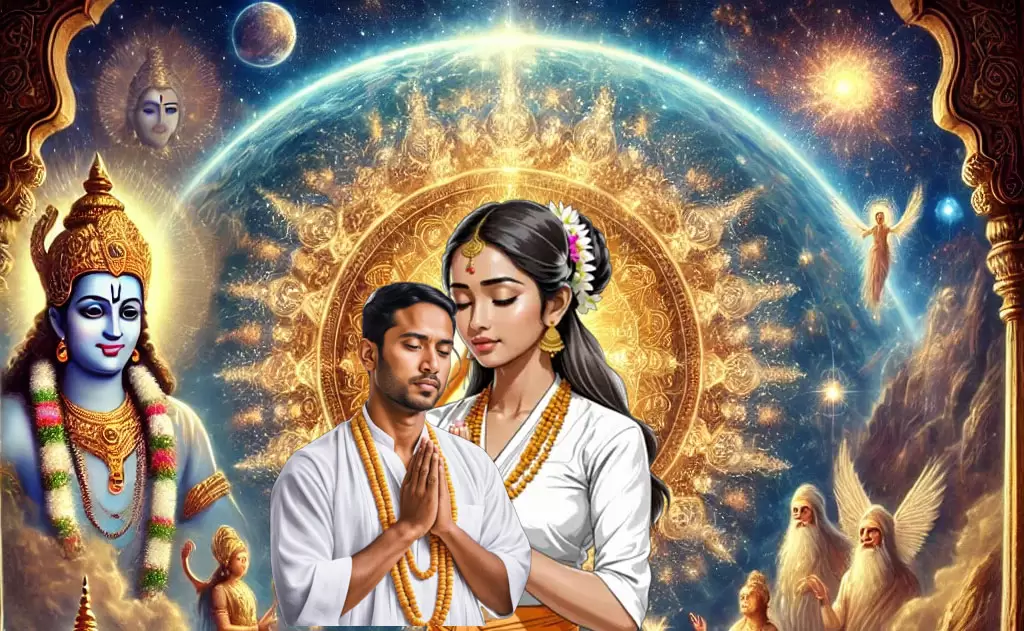
Garuda Purana Afterlife Guide 2026 — What Happens After Death, NRI Grieving Abroad & 13-Day Rituals From Anywhere
Garuda Purana on the afterlife — what happens after death (Yamloka, 13-day soul journey), NRI grieving abroad, antyeshti rituals from USA, UK, Canada, Australia.
Garuda Purana on the afterlife — what happens after death (Yamloka, 13-day soul journey), NRI grieving abroad, antyeshti rituals from USA, UK, Canada, Australia.
Quick Answer: The Garuda Purana — Vishnu's teaching to Garuda about the soul's journey after death — describes a 13-day cosmic process where the departed atman travels through Yamloka, faces a final reckoning, and either reaches a heavenly realm, returns for rebirth, or attains moksha. For NRI Hindus grieving the loss of a loved one in India while living abroad, the Garuda Purana offers both a metaphysical framework and a precise ritual sequence — antyeshti (final rites), 13-day shraddha, ekoddishta, and sapindikarana — now adapted for the diaspora through online priest services and remote pitru tarpan.
Death is the threshold no Hindu tradition takes lightly. The Garuda Purana — one of the 18 Mahapuranas — is uniquely dedicated to preta kanda (the realm of the departed), dharma kanda (the moral framework), and moksha kanda (the path to liberation). For 5,000 years it has guided families through grief, ritual, and the metaphysics of what comes after. For the global NRI Hindu — facing the unique pain of a parent's death across an ocean, the impossibility of being present at the antim sanskara, the question of how to perform pitru rituals from Silicon Valley or Wembley — the Garuda Purana's framework is more relevant in 2026 than ever before.
1. What the Garuda Purana Teaches
The Garuda Purana is structured as Vishnu's response to a question from Garuda, his divine eagle vahana. Garuda asks: "What happens to the soul after death? What rituals release it? How can the living help the departed?"
Vishnu's answer spans three sections:
- Preta Kanda — the journey of the departed soul, the realm of Yama, the role of family rituals
- Dharma Kanda — moral conduct in life that determines after-death outcome
- Moksha Kanda — the path beyond rebirth
The Garuda Purana is unique among the Puranas in being explicitly read aloud to a dying or recently-departed person. The traditional practice: family members or a Brahmin reads selected chapters during the 13 days of antyeshti and shraddha. The sound itself is said to guide the atman.
2. The 13-Day Soul Journey
The Garuda Purana describes the soul's journey across 13 days after death:
- Day 1-3: The atman remains close to the physical body and the family. The funeral rites (cremation, asthi sanchayana — collecting ashes) anchor this transition.
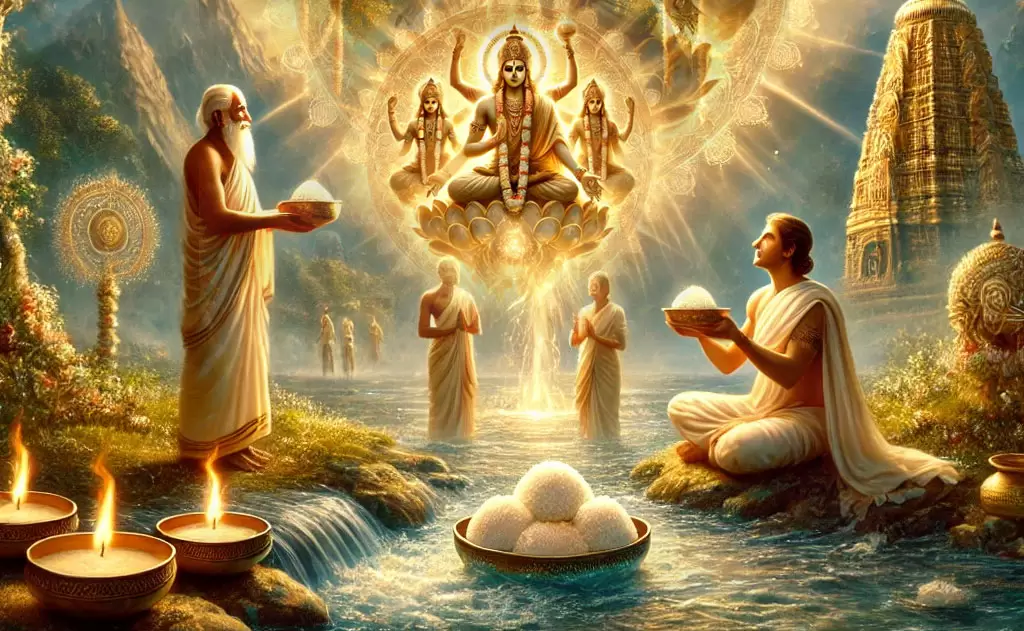
- Day 4-9: The atman travels through Vaitarani (the river of the dead), guided by the merit accumulated in life. Family pinda daan (rice-ball offerings) sustains the soul during travel.
- Day 10-12: The atman approaches Yamloka. The 12th-day Vrishotsarga and Ekoddishta rituals prepare the soul for the final transition.
- Day 13: Sapindikarana — the formal joining of the atman with the three ancestral generations. The departed becomes a pitru (ancestor) rather than a preta (wandering soul).
After Day 13, depending on karma, the soul:
- Reaches Svarga (heavenly realm) — for sustained period proportional to good karma
- Returns to earthly birth — for souls with significant remaining karma to work out
- Attains moksha — for the rare soul whose practice and grace are aligned
3. Antyeshti — The Funeral Rites
The eldest son (or, in modern practice, any willing family member of any gender) typically performs the karta role:
- Bathing the deceased
- Dressing in plain white cloth
- The body laid on a wooden bier with head pointing south
- Cremation (in India, traditionally on a riverside ghat; the chief mourner lights the pyre)
- Asthi sanchayana — collecting the asthi (post-cremation bone remains) on day 3-4
- Asthi visarjan — immersion of asthi in a sacred river (Ganga, Yamuna, or any natural water body for diaspora families)
For NRIs whose parent dies in India:
- If you can fly within 24-48 hours, do so to perform the karta role
- If not, your siblings or extended family can perform the karta role; you participate via video call
- Your physical presence is desirable but not spiritually required — your intention and participation by phone, the offering of pinda daan at a Hindu temple wherever you are, and the simultaneous mental prayer are all valid
4. The 13 Days After Death — Daily Rituals
Each day of the 13-day period has specific observances:
Day 1 (day of death + cremation): Body cremation, kapal kriya. The karta refrains from food.
Day 2: Asthi sanchayana preparation. Family eats simple meal (no salt, no oil) after sunset.
Day 3 (or 4): Asthi sanchayana. Asthi immersion if accessible (Ganga ideal).
Day 4-9: Pinda daan — rice-ball offerings to the departed. Mantras + Garuda Purana parayanam.
Day 10: Dasagatra Shraddha — ten pinda offerings completed.
Day 11: Ekoddishta Shraddha — the soul-specific shradh.
Day 12: Vrishotsarga — symbolic release of a bull (or substitute donation in modern practice).
Day 13: Sapindikarana — the soul joins the ancestral lineage. Mahabhojana (community meal) marks the closure.
For NRIs, the practical reality: a priest in India typically performs days 4-13 on your family's behalf, with you participating remotely. Many NRI families travel for the funeral day + day 13, with the in-between rituals handled by extended family in India.
5. Sapindikarana — The Spiritual Closure
Sapindikarana is the most metaphysically important ritual of the 13-day cycle. The departed atman, until now a preta (a wandering, transitional soul), is formally joined with three generations of ancestors — Pita (father), Pitamaha (grandfather), Prapitamaha (great-grandfather), or the maternal lineage equivalents.
After Sapindikarana, the departed is no longer a preta. They are a pitru — an ancestor honored annually during Pitru Paksha (Sep-Oct each year). The family transitions from aśauca (mourning impurity) to the long-term relationship of ancestral remembrance.
For NRIs, Sapindikarana is the ritual where physical presence in India is most meaningful — but again, remote participation by a priest with your family proxy is acceptable. The bhava — the sincere offering of grief into ritual — is the essential ingredient.
6. NRI Grieving Abroad — What to Do When You Can't Fly
The Hindu tradition has always evolved to accommodate diaspora reality. For NRIs whose parent dies in India while you are abroad:
If you can fly:
- Book the first available flight (international airlines prioritize bereavement bookings — Air India, British Airways, Lufthansa, Emirates have hotlines)
- Inform your employer (most have bereavement leave policies; legally protected in USA/UK/Canada/Australia)
- Carry documents: passport/OCI, your deceased parent's ID, your relationship proof
If you cannot fly:
- Participate by video call during the funeral if possible
- Have a priest in your local city perform a parallel antyeshti shanti puja
- Offer pinda daan at a local Hindu temple on each ritual day
- Read the Garuda Purana yourself (English translation acceptable) during the 13 days
- Send funds for the rituals; your family in India will perform them
Spiritual practice during grief:
- Maha Mrityunjaya mantra — 108x daily for 40 days
- Vishnu Sahasranama — Sunday recitation (the deceased's name added at the beginning)
- Donations on each day of the 13 — to temple, to charity, to anna daana
- Avoid alcohol, non-vegetarian food, sexual activity for 40 days (traditional shauca)
- Wear simple light-colored clothing for 13 days
7. Online Priest Services and Remote Shradh
The diaspora-era innovation: priest services that connect you to qualified pandits in India who perform the rituals on your behalf while you participate via video call.
Major platforms (2026):
- OnlinePuja.com, eHarithakam, Sri Mandir, BookMyPandit — Indian priest networks
- TTD International Donor desk — connects NRIs to qualified Tirupati-affiliated priests for shradh
- VHP/HSS chapters in USA, UK, Canada, Australia — local priest referrals
- Gaya Tirth Online — Bihar's Gaya is the most sacred site for pitru shradh; online services facilitate participation
Process for online shradh:
- Book priest 1-2 weeks ahead (or emergency same-day for antyeshti)
- Receive a list of materials (you provide some in person, priest provides others)
- Video call during the ritual; chant along; offer at the appropriate moment
- Make the donation as per priest's recommended dakshina
For tarpan in India that NRIs cannot perform:
- Family in India can offer tarpan on your behalf with your name read aloud
- Priests in Gaya, Triveni Sangam Prayagraj, or Brahmakapal Badrinath perform tarpan for departed pitrus year-round
8. The Hindu Funeral Abroad — USA, UK, Canada, Australia
If a parent or family member dies while in the diaspora (visiting you, or as a long-term NRI themselves), Hindu funeral arrangements must be made locally:
🇺🇸 USA
- Most major US cities have Hindu-affiliated funeral homes offering cremation with Hindu rites
- Major Hindu temples (Pittsburgh, Robbinsville NJ, Atlanta, Bay Area) connect families to priests
- Cost: $3,000-8,000 for cremation with Hindu rites
- Asthi can be carried back to India for Ganga immersion (airline requires death certificate + sealed urn)
🇬🇧 UK
- BAPS Neasden, Shree Sanatan Mandir Leicester, ISKCON UK connect families to qualified pandits
- Anam Cara, Co-op Funerals, The Asian Funeral Service specialize in Hindu funerals
- Cost: £2,500-5,000
🇨🇦 Canada
- Hindu Cremation Society of Toronto, Vancouver Hindu Society provide priest + funeral home referrals
- Cost: CAD 4,000-9,000
🇦🇺 Australia
- Sydney Murugan Temple, Sri Venkateswara Helensburgh, Melbourne Sri Shiva Vishnu connect families
- Cost: AUD 4,000-10,000
🇦🇪 GCC
- BAPS Hindu Mandir Abu Dhabi, Bur Dubai Krishna Mandir provide referrals; bodies typically repatriated to India for cremation
For NRIs, the path of asthi visarjan (ashes to Ganga) requires:
- Death certificate (notarized + apostilled)
- Sealed asthi urn (specific airline regulations)
- Customs clearance at Indian arrival airport
- Subsequent immersion ritual at Haridwar / Varanasi / Prayagraj / Allahabad
9. Grief Through the Hindu Lens — Coping Practices
The Garuda Purana places grief within a vast metaphysical context — the atman is eternal, this life is one of many, the relationship between the living and the departed continues through ritual remembrance. This framework does not eliminate grief but contextualizes it:
- Acknowledge the grief is sacred — Hindu tradition does not ask you to suppress mourning
- Use the 13-day shauca window — many emotions need to be felt fully before integration
- Speak the name of the departed during morning practice — sustains the connection
- Maintain the annual Pitru Paksha observance — Sep 26 - Oct 10 in 2026; the soul's primary nourishment from the living
- Find a sangha — community grieving is part of how Hindu families have always survived loss
- Read Bhagavad Gita Chapter 2 — Krishna's exposition on the eternal nature of the soul, addressed to a grieving Arjuna
For NRIs facing grief alone in apartments far from extended family — phone calls, video gatherings, online satsang groups, and grief-counseling services with Hindu cultural awareness (especially in USA/UK/Canada/Australia) form the modern sangha.
10. FAQs
Q: I'm in the USA. My father died in India. What do I do first?
A: Call your family immediately. Discuss whether the cremation can wait 24-48 hours for your arrival. If yes, book the first flight. If no, request video participation during the ritual. Inform your employer; bereavement leave is legally protected.
Q: Can I perform rituals on Day 13 from abroad?
A: Yes — by phone/video with family in India, simultaneously offering pinda daan or shradh at a local Hindu temple. The intention and the priest's correct recitation are both valid in the tradition.
Q: What if I can't get to a Hindu temple where I live?
A: Set up a small altar at home with a photo of the departed, light a diya, perform the offerings of water, sesame seeds, and rice. The Hindu tradition recognizes home-based ritual as valid; the priest can guide you via video.
Q: Should I read Garuda Purana myself?
A: Yes — English translations exist (Motilal Banarsidass, Penguin Classics editions). Read chapters during the 13 days; the practice is part of the karma yoga of bereavement.
Q: Can I do pitru tarpan annually from abroad?
A: Yes. During Pitru Paksha (Sep 26 - Oct 10, 2026), book online with a priest in Gaya, Prayagraj, or your nearest Hindu temple abroad. Many TTD priests offer online Pitru Paksha shradh.
Q: What about my mother who is not Hindu — do these rituals apply?
A: The Garuda Purana framework applies to anyone whose family wishes to honor them in this tradition. Hindu rituals don't require the departed to have been a Hindu — they're about the family's grief process and the soul's transition.
Q: How long does grief last in Hindu tradition?
A: The traditional 13-day shauca period closes the formal mourning; the 40-day extended observance closes deeper grief. But the relationship with the departed pitru continues annually through Pitru Paksha. Grief is not linear; it transforms over decades.
Q: My family wants me to cancel my work commitments for 13 days — what's the modern protocol?
A: Bereavement leave laws cover 3-7 days in most countries. Use that for the funeral + immediate ritual days. For the remaining 9 days, work-from-home or hybrid arrangements are acceptable; the spiritual practice can continue alongside work. Discuss with family — the elder generation may prefer traditional full observance; younger generations often blend tradition and modern flexibility.
Final Words
The Garuda Purana teaches that the relationship between the living and the departed is not severed by death — it is transformed. The 13 days of antyeshti, the annual Pitru Paksha tarpan, the simple act of speaking the name of one's father or mother during morning prayer — these are the threads that keep the ancestral lineage real and active in a NRI's apartment in San Francisco, in London's Brent Cross, in Toronto's Mississauga, in Melbourne's Dandenong.
Grief is not weakness. It is the love that has nowhere left to go but inward and forward. The Hindu tradition has always known this. The Garuda Purana is its most extended teaching on the subject.
Vāsāmsi jīrnāni yathā vihāya navāni grhnāti naro 'parāni
tathā śarīrāni vihāya jīrnāny anyāni samyāti navāni dehī* — Bhagavad Gita 2.22
As a person sheds worn-out garments and puts on new ones, so the embodied soul sheds worn-out bodies and enters new ones.
Om Shanti. Shanti. Shanti.
HinduTone Editorial Team · Tags: Garuda Purana, Hindu Afterlife, NRI Grieving, Antyeshti, Sapindikarana, Pitru Paksha, Online Shradh, Hindu Funeral USA UK Canada
Frequently Asked Questions
What is Garuda Purana Afterlife?
The Garuda Purana — Vishnu's teaching to Garuda about the soul's journey after death — describes a 13-day cosmic process where the departed atman travels through Yamloka, faces a final reckoning, and either reaches a heavenly realm, returns for rebirth, or attains moksha. For NRI Hindus grieving the loss of a loved one in India while living abroad, the Garud
What are the key points about Garuda Purana Afterlife?
Death is the threshold no Hindu tradition takes lightly. The Garuda Purana — one of the 18 Mahapuranas — is uniquely dedicated to preta kanda (the realm of the departed), dharma kanda (the moral framework), and moksha kanda (the path to liberation).
Why does Garuda Purana Afterlife matter in Hinduism?
It reflects core values of Sanatana Dharma and offers practical and spiritual guidance that remains relevant across generations.
How can devotees apply Garuda Purana Afterlife in daily life?
By reflecting on its teaching, incorporating the related practices or observances into daily routine, and approaching it with sincere devotion and understanding.
You might also like
Pitru Paksha 2026 — 16 Days of Ancestor Worship (September 26 – October 10), Daily Rituals & Complete NRI Tarpan Guide for USA, UK, Canada
Karma & Rebirth in the Garuda Purana — A Modern Hindu Perspective for 2026
The Role of Ancestors and Pitrus in the Garuda Purana