
Lakshmi Puja Muhurat 2026 Malaysia, City-Wise: Deepavali Timings for Kuala Lumpur, Penang, Ipoh, Johor Bahru and Klang
Diwali 2026 in Malaysia is on Sunday 8 November. This city-wise guide gives the Lakshmi Puja muhurat, sunset, Pradosh Kaal and the Dhanteras puja muhurat (Friday 6 November) for Kuala Lumpur, Penang, Ipoh, Johor Bahru and Klang, explains how the muhurat is worked out, and gives a simple home puja.
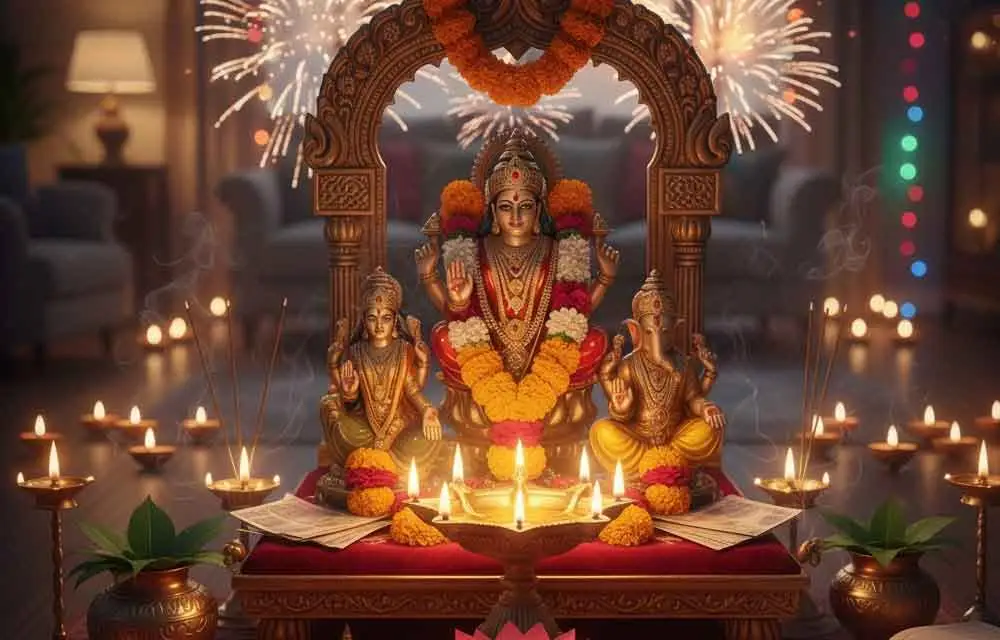
Diwali 2026 in Malaysia is on Sunday 8 November. This city-wise guide gives the Lakshmi Puja muhurat, sunset, Pradosh Kaal and the Dhanteras puja muhurat (Friday 6 November) for Kuala Lumpur, Penang, Ipoh, Johor Bahru and Klang, explains how the muhurat is worked out, and gives a simple home puja.
Quick answer: The Lakshmi Puja muhurat 2026 Malaysia times below are for Diwali 2026 Malaysia (Deepavali), which falls on Sunday 8 November 2026. The calculated Lakshmi Puja muhurat is 7:25 PM – 9:20 PM in Kuala Lumpur, 7:28 PM – 9:24 PM in Penang and 7:20 PM – 9:13 PM in Johor Bahru (Malaysia time). Dhanteras is on Friday 6 November 2026.
This page lists the sunset, Pradosh Kaal, Lakshmi Puja muhurat and Dhanteras puja muhurat for five Malaysian cities. All times are in Malaysia Time (MYT). Malaysia does not use daylight saving time.
Source note: All Malaysian times on this page are calculated by HinduTone with the Drik method (Pradosh Kaal plus Vrishabha lagna, Lahiri ayanamsha). In our checks against Drik Panchang for other cities, the method matched within one or two minutes. They are not copied from Drik Panchang. Please confirm the time on Drik Panchang for your own city.
Diwali 2026 Malaysia: the five days
These are the Diwali 2026 dates for Malaysia, from our panchang data for the country.
| Day | Festival | Date in Malaysia (2026) |
|---|---|---|
| Day 1 | Dhanteras (Dhanatrayodashi) | Friday 6 November |
| Day 2 | Naraka Chaturdashi (Deepavali oil-bath morning) | Sunday 8 November |
| Day 3 | Diwali / Lakshmi Puja | Sunday 8 November |
| Day 4 | Govardhan Puja / Annakut | Tuesday 10 November |
| Day 5 | Bhai Dooj (Bhaiya Dooj) | Wednesday 11 November |
In 2026, Naraka Chaturdashi and Lakshmi Puja fall on the same day, Sunday 8 November. So the Deepavali oil-bath morning and the evening Lakshmi Puja are on the same Sunday. Deepavali is a public holiday in most Malaysian states. Check the official holiday list for the exact public holiday date in your state.
Lakshmi Puja muhurat 2026 Malaysia: city-wise table
The table gives times for Sunday 8 November (Diwali) and Friday 6 November (Dhanteras). All values are calculated (Drik method) and shown in MYT. Confirm on Drik Panchang for your city.
| City | Sunset (8 Nov) | Pradosh Kaal (8 Nov) | Lakshmi Puja muhurat (Sun 8 Nov) | Dhanteras puja (Fri 6 Nov) |
|---|---|---|---|---|
| Kuala Lumpur | 6:56 PM | 6:56 PM – 9:20 PM | 7:25 PM – 9:20 PM | 7:33 PM – 9:20 PM |
| Penang (George Town) | 6:59 PM | 6:59 PM – 9:24 PM | 7:28 PM – 9:24 PM | 7:36 PM – 9:24 PM |
| Ipoh | 6:57 PM | 6:57 PM – 9:22 PM | 7:26 PM – 9:22 PM | 7:34 PM – 9:22 PM |
| Johor Bahru | 6:50 PM | 6:50 PM – 9:13 PM | 7:20 PM – 9:13 PM | 7:28 PM – 9:13 PM |
| Klang | 6:57 PM | 6:57 PM – 9:21 PM | 7:26 PM – 9:21 PM | 7:34 PM – 9:21 PM |
In every city, the Lakshmi Puja muhurat ends at the same minute as Pradosh Kaal. This is because Vrishabha lagna is still rising when Pradosh Kaal ends. The window therefore runs from the start of Vrishabha lagna to the end of Pradosh Kaal, and it is just under two hours long.
Our table covers Peninsular Malaysia only. Sabah and Sarawak are much further east on the same clock, so sunset there comes much earlier and the muhurat will be very different. Families in Kota Kinabalu, Kuching or Miri should check Drik Panchang for their own city.
How the Lakshmi Puja muhurat is worked out
The Diwali muhurat is different in every city. It is built from two parts:
- Pradosh Kaal: the period that starts at sunset and lasts about one-fifth of the night. Near the equator, night and day are almost equal, so Pradosh Kaal is about two hours and 24 minutes long (for example, 6:56 PM – 9:20 PM in Kuala Lumpur).
- Sthir lagna (fixed ascendant): the zodiac sign rising on the eastern horizon keeps changing. Vrishabha (Taurus) is a "fixed" (sthir) sign. Tradition says that when Lakshmi is worshipped in a fixed lagna, her blessing stays in the home.
- The muhurat: the time when Vrishabha lagna is rising inside Pradosh Kaal. That overlap is the Lakshmi Puja muhurat in the table.
The Dhanteras puja muhurat on Friday 6 November is found in the same way. For example, in Kuala Lumpur it is 7:33 PM – 9:20 PM.
Step-by-step home Lakshmi-Ganesha puja
This is a short summary. Adapt it to your family tradition. For the full method with mantras, see our Lakshmi Puja Vidhi 2026 guide.
- 1. Prepare the home: clean the home before Deepavali. Draw a kolam or rangoli at the door and place lamps at the entrance.
- 2. Set up the altar: cover a low table with a red or yellow cloth. Place images or idols of Lakshmi and Ganesha. Add a kalash (water pot) with mango leaves and a coconut.
- 3. Bathe and dress: bathe and wear clean or new clothes before the muhurat begins.
- 4. Sankalpa: inside the muhurat, light the main lamp and make a short sankalpa (intention) with water, rice and flowers.
- 5. Ganesha first: worship Ganesha first with flowers, kumkum, rice and a sweet.
- 6. Lakshmi puja: offer Lakshmi flowers, kumkum, turmeric, rice, sweets and fruit. Many families place coins or jewellery before her. Chant "Om Shreem Mahalakshmyai Namah".
- 7. Aarti: sing the Lakshmi and Ganesha aarti and offer the lamp to the family.
- 8. Lamps: light oil lamps around the home. Share sweets and prasad with family and neighbours.
Tips for Hindu families in Malaysia
- Deepavali falls on a Sunday in 2026. Plan the oil-bath morning, temple visit and family meals, and keep the evening free for Lakshmi Puja if your family follows it.
- Dhanteras on Friday 6 November is a working day. The window starts after 7:20 PM in every city, so there is time after work.
- November is a wet month in much of Peninsular Malaysia. Keep outdoor lamps under cover, or place them on the porch.
- Fireworks and firecrackers are controlled by law in Malaysia. Check the current rules before buying or using any.
- Large temples see big crowds on Deepavali morning. Check your temple's own notices for its timings.
- Do not use India's clock times in Malaysia. Always use the local MYT time for your city.
For temples to visit during the festival, see our guide to must-visit Hindu temples in Malaysia during Diwali 2026.
Frequently asked questions
When is Deepavali 2026 in Malaysia?
Diwali (Lakshmi Puja) is on Sunday 8 November 2026 in Malaysia, according to our panchang data. Naraka Chaturdashi is also on Sunday 8 November. Dhanteras is on Friday 6 November, Govardhan Puja on Tuesday 10 November and Bhai Dooj on Wednesday 11 November. For the public holiday date, check the official Malaysian holiday list for your state.
What is the Lakshmi Puja muhurat in Kuala Lumpur for Diwali 2026?
The calculated Lakshmi Puja muhurat in Kuala Lumpur is 7:25 PM – 9:20 PM (Malaysia time) on Sunday 8 November 2026. Pradosh Kaal in Kuala Lumpur is 6:56 PM – 9:20 PM. Please confirm the time on Drik Panchang for Kuala Lumpur.
Why are the times so similar across Malaysia?
The five cities in the table are all in Peninsular Malaysia and close to the equator, so their sunsets are only a few minutes apart. The Lakshmi Puja windows start between 7:20 PM (Johor Bahru) and 7:28 PM (Penang).
Can I use India's Diwali muhurat in Malaysia?
No. Lakshmi Puja is tied to Pradosh Kaal, which begins at local sunset, and to the Vrishabha lagna at your location. Converting India's time to Malaysia time gives a wrong window. Use the local times on this page.
Are these times from Drik Panchang?
No. They are calculated by HinduTone with the Drik method (Pradosh Kaal plus Vrishabha lagna, Lahiri ayanamsha). In our checks against Drik Panchang for other cities, including nearby Singapore, the method matched within one or two minutes. Please confirm the time on Drik Panchang for your city.
Do Tamil families in Malaysia do Lakshmi Puja?
Many Tamil families in Malaysia celebrate Deepavali with an early-morning oil bath, prayers at home and the temple, and visits to relatives. The evening Lakshmi Puja is a central custom for many North Indian, Gujarati, Sindhi and Punjabi families. Some families do both. Follow your own family tradition.
Editor's note
Editor's note (6 October 2026): This guide has been restored at its original address after the earlier version was lost. The festival dates come from our panchang data for Malaysia. All muhurat times are calculated by HinduTone with the Drik method and are shown in Malaysia Time. They are not taken from Drik Panchang directly, so please confirm them on Drik Panchang for your city. We have not listed temple events or the gazetted holiday date; check official sources.
Related guides
- Diwali / Deepavali 2026: complete 5-day guide
- Lakshmi Puja Vidhi 2026: complete step-by-step guide
- Must-visit Hindu temples in Malaysia during Diwali 2026
- Deepavali 2026 in Singapore: Lakshmi Puja muhurat guide
- Naraka Chaturdashi 2026
- Dhanteras 2026: date, puja vidhi and Yama Deepam
- Karthika Masam 2026 in Malaysia
- Lakshmi Puja muhurat 2026 in New Zealand, city-wise
You might also like

Guruvayur Ekadashi 2026: Date, Significance, Chembai Sangeetholsavam and Temple Traditions

Kansa Vadh 2026: Date, Story of Krishna and Kansa, and Mathura's Kansa Mela

Karthigai Month 2026: Tamil Festival Dates, Karthigai Deepam, Somavarams and Ayyappa Mala