Lord Shiva & Monday (Somvar) Worship: The Complete Guide
Canonical guide to Lord Shiva — Mahadev, the eternal yogi, lord of dharma. Who Shiva is, why Monday (Somvar) is His day, how to worship, His festivals (Sawan, Maha Shivratri, Pradosh), 12 Jyotirlingas, mantras, NRI home worship primer.
Lord Shiva (Mahadev) is one of the supreme deities of Hinduism — the destroyer of evil, the eternal yogi, the source of dharmic harmony. Monday (Somvar) is His sacred day. This is the canonical HinduTone guide to who Shiva is, why Monday is His day, how to worship Him, His major festivals (Sawan, Maha Shivratri, Pradosh, Masik Shivratri), His twelve Jyotirlingas, and how Hindu families across India and the global diaspora can build a sustained Shiva sadhana.
Updated complete guide: for step-by-step puja, verified mantras with meaning and fasting options, read Monday Shiva puja, Somvar vrat and mantras, part of our Hindu days of the week series.
This pillar links to every major HinduTone resource on Shiva worship — use it as your starting hub.
Who Is Lord Shiva — Mahadev
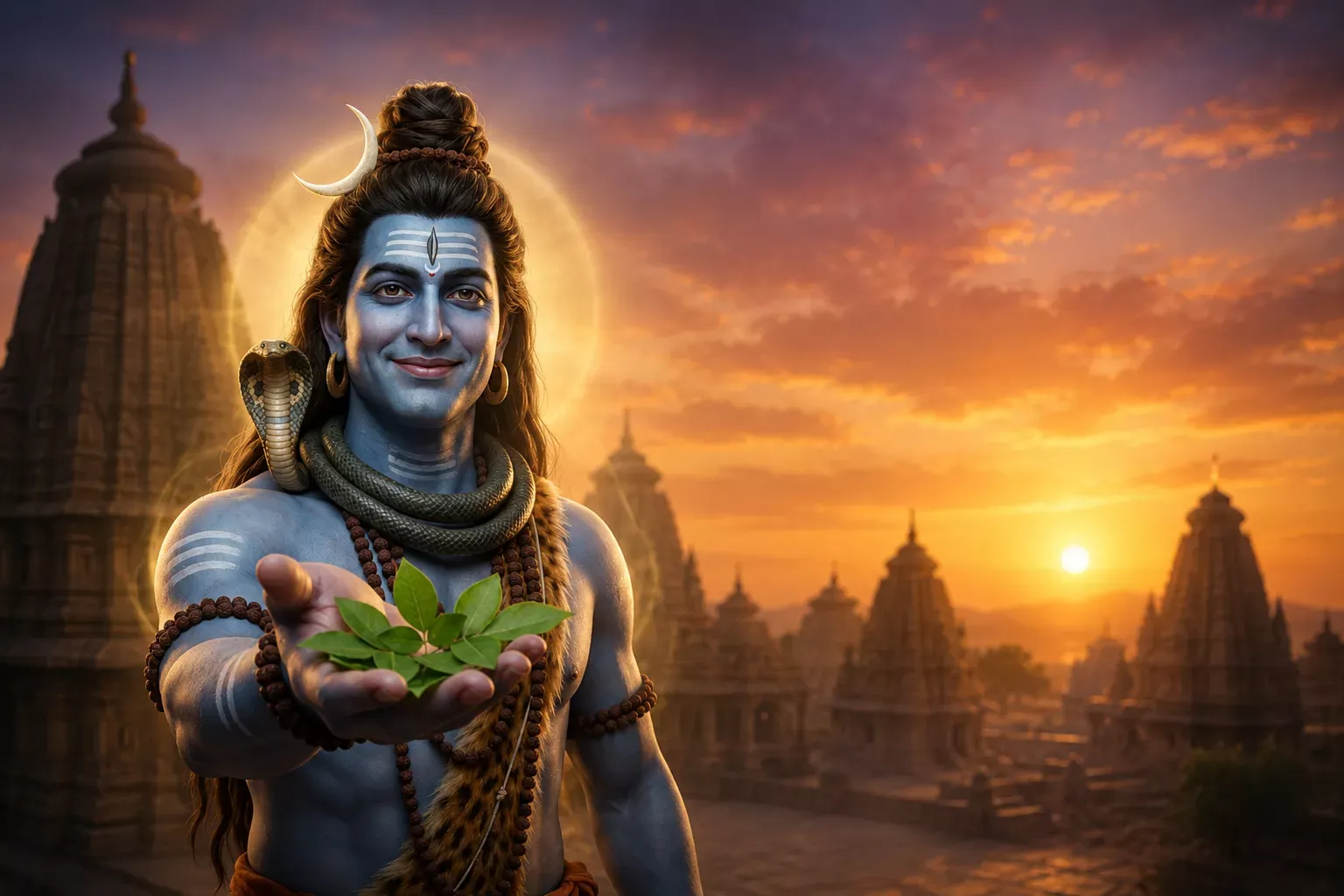
Shiva is one of the Trimurti (the cosmic trinity of Brahma the creator, Vishnu the preserver, and Shiva the dissolver-into-source). In Shaivite theology he is the supreme reality (Para Brahman) himself. He is the eternal yogi seated on Mount Kailash with his consort Parvati; the cosmic dancer (Nataraja) whose Tandava both creates and dissolves universes; the destroyer of the demonic asuras Tripurasura, Andhakasura, Gajasura; the drinker of the halahala poison from the Samudra Manthan; the husband of Sati and then Parvati; the father of Ganesha and Kartikeya.
Key forms of Shiva to know:
- Mahadev: the great god; the universal name
- Mahakal: the great destroyer of time
- Nataraja: the cosmic dancer at Chidambaram
- Pashupati: the lord of all creatures, worshipped at Pashupatinath Nepal
- Neelkanth: the blue-throated, for drinking halahala
- Tryambaka: the three-eyed (Mahamrityunjaya context)
- Bholenath: the innocent lord — pleased easily by sincere devotion
- Adi Yogi: the first yogi — source of all yoga
Why Monday (Somvar) Is Shiva's Day
Monday — Som-vaar in Sanskrit, from Soma (the moon) — is associated with Chandra (the moon god), who in mythology owes his existence to Shiva. The Padma Purana narrates: when Chandra was cursed by Daksha to wane and die, he prayed to Shiva, who placed Chandra on his own jata (matted locks) as the crescent moon. From that moment, the moon was Shiva's and Monday — the moon's day — became Shiva's day. Every Monday throughout the year is auspicious for Shiva worship; the four Mondays of Sawan and the 16 Mondays of Solah Somvar carry multiplied merit.
Core Ways to Worship Shiva
Shiva accepts multiple paths. Pick what fits your time and tradition:
- Jalabhishek: pouring water on a Shivling — the simplest, purest, most universal offering. A single mug of water with Om Namah Shivaya is shastra-complete.
- Rudrabhishek: the longer abhishekam with water + milk + curd + ghee + honey + panchamrita while reciting Sri Rudram. Performed at temples or by priests at home.
- Vrat (fasting): Somvar Vrat (every Monday), Solah Somvar (16 consecutive Mondays), Sawan Somvar (Mondays of Sawan), Maha Shivratri (annual), Masik Shivratri (monthly).
- Mantra japa: Om Namah Shivaya (Panchakshari, 5-syllable), Mahamrityunjaya Mantra, Shiva Tandava Stotram, Shiva Chalisa.
- Bel patra offering: trifoliate bilva leaves — the most pleasing offering to Shiva. Offered with the smooth side down, three leaves at a time.
- Pradakshina: circumambulation of the Shivling — half-pradakshinas (clockwise around the lingam but not crossing the somasutra channel from the yoni-pitha).
Shiva in the Puranas
The primary scriptural sources for Shiva worship are the Shiva Purana (one of the 18 Mahapuranas), the Linga Purana, parts of the Skanda Purana, the Rudra section of the Yajurveda (Sri Rudram), and the Mahanyasa. The Mahabharata Shanti Parva contains the Sahasranama (1000 names of Shiva). All Hindus, regardless of sect, recognise Shiva — he is universal.
Major Shiva Festivals — When to Mark Your Calendar
- Sawan / Shravan: the holiest month for Shiva. North/Purnimanta ~30 July - 28 August 2026. South/Amanta ~13 August - 11 September 2026. Four Mondays of jalabhishek and fasting. See our Sawan 2026 guide.
- Maha Shivratri: the cosmic anniversary of Shiva-Parvati. Saturday, 6 March 2027 (2026 was 15 Feb, past). Four-prahar all-night puja, fasting, jagran. See our Maha Shivratri 2027 guide.
- Pradosh Vrat: the trayodashi (13th lunar day) twilight Shiva puja — twice a month. Each Pradosh grants the merit of all 12 Jyotirlingas.
- Masik Shivratri: the monthly Chaturdashi night Shiva worship. Adhika Masik Shivratri (in Adhik Maas) carries 12x merit.
- Karthika Somavaram: the Karthika-month Mondays (Oct-Nov in South Indian calendar) — equivalent intensity to Sawan in South Indian tradition.
The 12 Jyotirlingas — Shiva's Self-Manifested Light Pillars
Across India there are twelve Jyotirlingas — Shiva-lingams said to have self-manifested as columns of light. Somnath (Gujarat), Mallikarjuna (Andhra), Mahakaleshwar (Madhya Pradesh), Omkareshwar (Madhya Pradesh), Kedarnath (Uttarakhand), Bhimashankar (Maharashtra), Kashi Vishwanath (Varanasi), Trayambakeshwar (Maharashtra), Vaidyanath (Jharkhand/Bihar), Nageshwar (Gujarat), Rameshwaram (Tamil Nadu), Grishneshwar (Maharashtra). A Jyotirlinga darshan is the supreme Shiva pilgrimage. Our 12 Jyotirlinga guide has the full darshan-circuit planning details for NRI pilgrims.
Mantras and Stotras for Shiva
Five foundational texts to know:
- Om Namah Shivaya (the Panchakshari Mantra): the universal Shiva mantra; 108 repetitions is the standard count.
- Mahamrityunjaya Mantra: "Om Tryambakam Yajamahe..." — the mantra for liberation from the fear of death; from the Rig Veda.
- Shiva Tandava Stotram: composed by Ravana in praise of Shiva at Mount Kailash; powerful for invoking Shiva's grace and removing obstacles.
- Shiva Chalisa: the 40-verse Hindi/Sanskrit hymn praising Shiva; recited daily by householder devotees.
- Lingashtakam: eight verses in praise of the Shivling; recited during abhishekam.
NRI Home Worship — A Practical Diaspora Primer
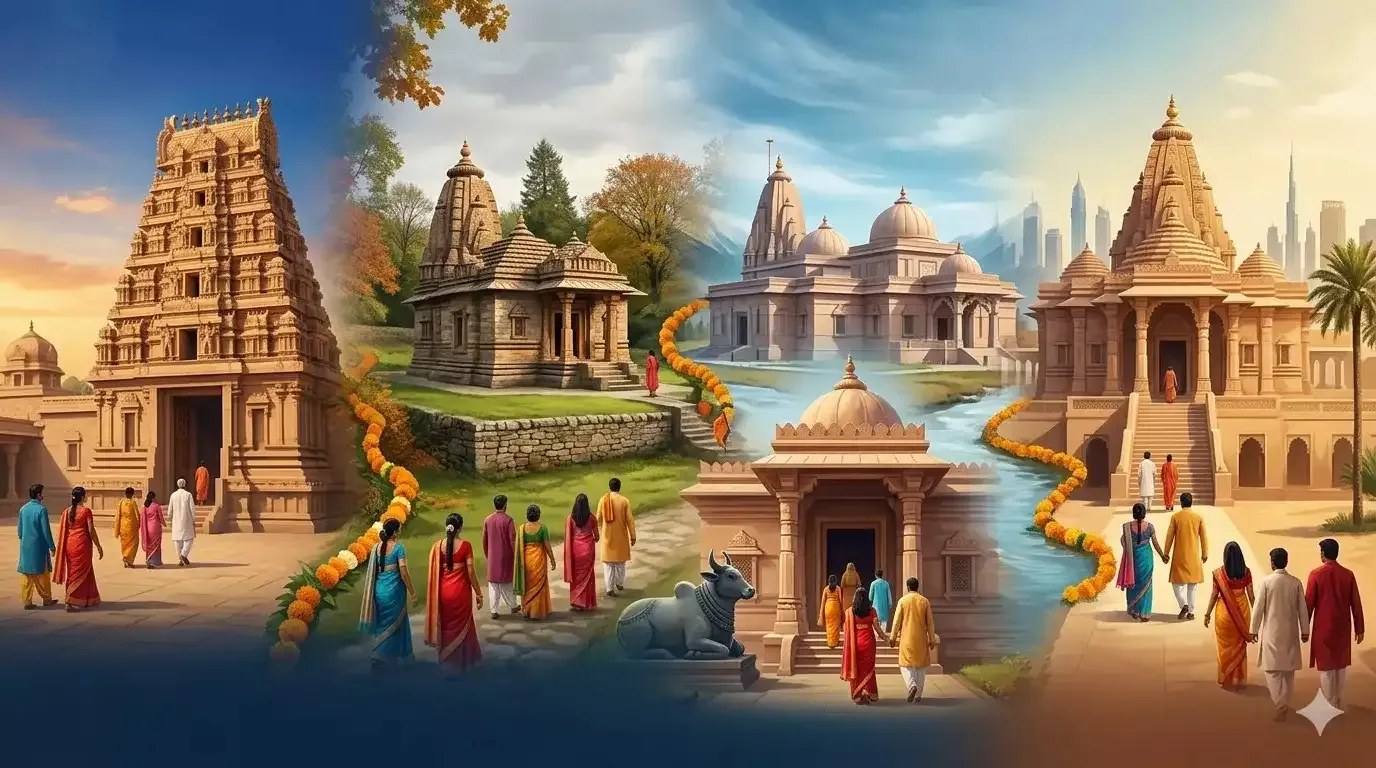
For Hindu families in the USA, UK, Canada, Australia, Singapore, UAE — you do NOT need a temple to worship Shiva. A small brass or parad Shivling on a clean altar, daily water + bilva-or-flower offering, and 108 chants of Om Namah Shivaya is shastra-complete. For Sawan Mondays and Maha Shivratri, follow your LOCAL sunrise/sunset/Nishita Kaal — Lord Shiva accepts diaspora local-time observance explicitly. See our dedicated NRI guides: Sawan abroad, Shivling puja at home for NRIs, Shiva worship calendar for NRIs.
Benefits of Shiva Worship — Traditional Understanding
Hindu tradition describes the benefits of sustained Shiva worship as: removal of accumulated karmic debt; protection from premature death (Mahamrityunjaya specifically); blessings for marriage, dharmic spouse, family harmony, progeny; liberation (moksha) for sincere seekers; victory over inner enemies (kama, krodha, lobha, moha, mada, matsarya); spiritual progress, calm mind, and the steady disposition of the Adi Yogi himself. These are traditional spiritual benefits — not medical, financial, or guaranteed worldly outcomes.
Where to Start Your Shiva Sadhana — A 7-Day Beginner Path
- Day 1 (Monday): Read this pillar guide. Set up a small Shiva altar (photo, Shivling, lamp).
- Day 2: Recite Om Namah Shivaya 108 times. Watch a Pashupatinath aarti livestream.
- Day 3: Begin daily morning Shiva mantra (5-10 minutes).
- Day 4: Read about the Mahamrityunjaya Mantra; begin 11 daily recitations.
- Day 5: Plan a Pradosh Kaal puja for the next Pradosh Vrat in your calendar.
- Day 6: Read the Shiva Tandava Stotram. Pick a Saturday or Sunday to first chant the full thing.
- Day 7 (next Monday): Begin Somvar Vrat in your chosen form (phalahar for most). Continue weekly.
Frequently Asked Questions
Is Lord Shiva the supreme God of Hinduism?
In Shaivite tradition, yes — Shiva is Para Brahman, the supreme reality. In other Hindu traditions (Vaishnavism, Shaktism), other deities are central, but Shiva is universally revered. The Vedic tradition recognises all three of the Trimurti (Brahma, Vishnu, Shiva) as aspects of the same supreme reality.
What is the difference between Maha Shivratri and Masik Shivratri?
Maha Shivratri is annual (Phalguna month — Feb/Mar — the cosmic Shiva-Parvati wedding anniversary). Masik Shivratri is monthly (every Krishna Paksha Chaturdashi). Both are night observances; Maha is more famous, Masik allows monthly engagement.
Can women worship Shiva on Monday?
Yes — unmarried women observe Somvar Vrat for a dharmic husband; married women observe for marital harmony and family well-being. Sawan Somvar Vrat by women is a centuries-old tradition.
Why do we offer bilva (bel) leaves?
The Linga Purana describes bilva as Shiva's favorite offering. Each leaf has three leaflets representing the three eyes of Shiva (and the trinity of Brahma-Vishnu-Mahesh). Offered with the smooth side facing down, three leaves at a time.
Do BAPS / Swaminarayan or ISKCON temples have Shiva worship?
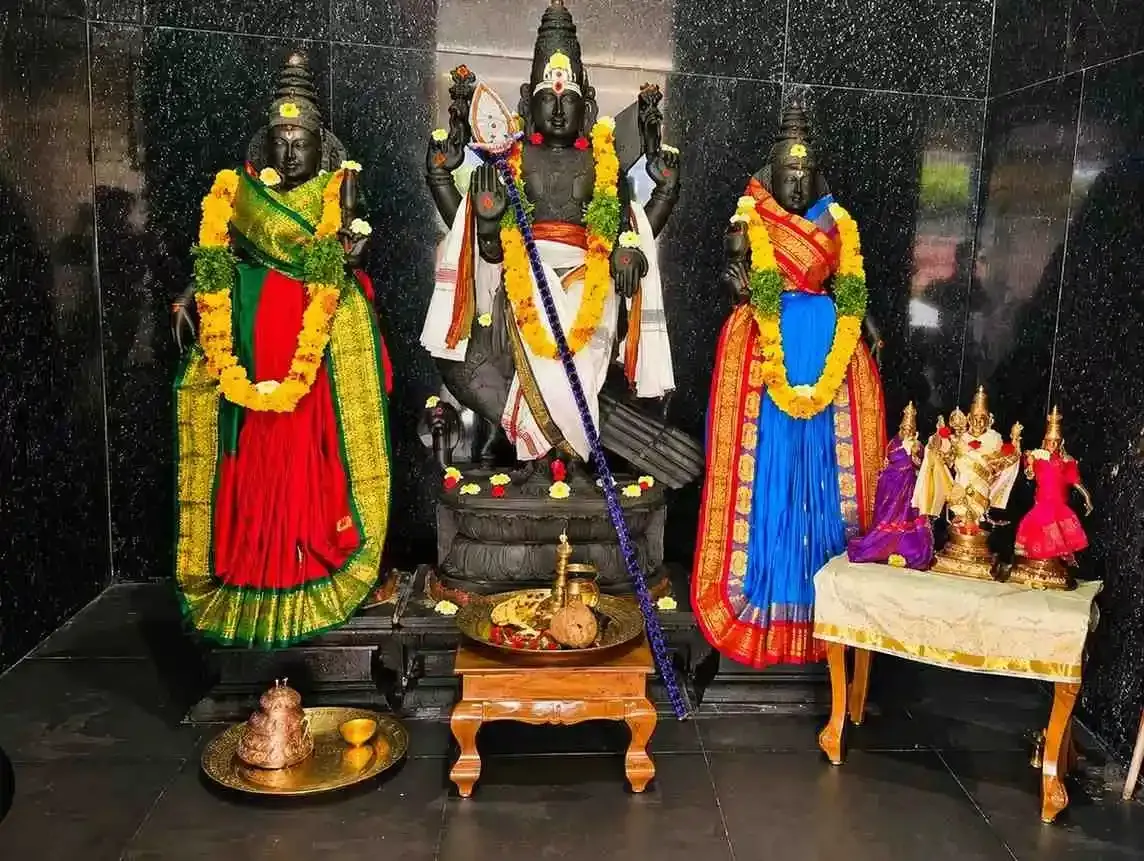
BAPS Swaminarayan sampradaya follows its own ritual tradition focused on Swaminarayan. ISKCON focuses on Krishna. Both acknowledge Shiva but do not center Shiva-specific puja. For Shiva-focused darshan, visit Agamic (South-Indian-style) Dravidian temples — Shiva-Vishnu temples, Murugan temples, or dedicated Shiva mandirs.
Can I worship Shiva and Vishnu / Krishna together?
Absolutely — Hari-Hara harmony is a foundational Hindu teaching. Many homes have both Shiva and Vishnu deities; the great acharya Adi Shankara taught that both are aspects of the same supreme Brahman. Sawan even falls partly in the Adhik Maas of Vishnu in 2026 — devotees receive Hari-Hara dual blessing.
🕉 Om Namah Shivaya. Whether you are reading this in Hyderabad, Houston, London, Sydney, or Dubai — Lord Shiva is the same. Begin your sadhana today. Har Har Mahadev. 🕉
Share this with family and friends
Send it on WhatsApp, post it, or copy the link.
More from Festivals
- Mirabai Jayanti 2026: A Living Symbol of Krishna Bhakti – Life, Significance and Bhajans
- Masik Shivaratri 2027 Dates: Monthly Shivaratri List, Nishita Kaal Times and Dates Abroad
- Sankashti Chaturthi 2027 Dates and Moonrise Times: Full List for India and Abroad
- Pradosh Vrat 2027 Dates: All 25 Pradosham Days, Pradosh Kaal Times and Dates Abroad
- Amavasya 2027 Dates: New Moon Days, Darsha Amavasya, Tithi Times and Dates Abroad