

Fun Navratri Activities for Kids: Crafts, Stories, and Games
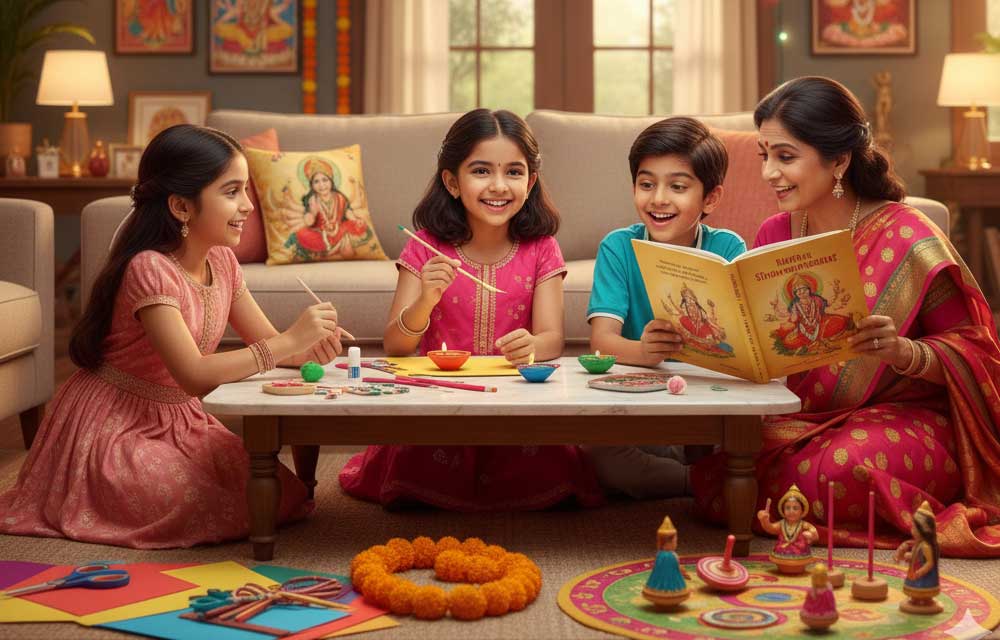
Navratri, the nine-night festival celebrating the divine feminine energy of Goddess Durga, is one of the most vibrant and joyous festivals in Hindu culture. For children, this festival offers a wonderful opportunity to learn about mythology, traditions, and the triumph of good over evil through engaging activities, colorful crafts, and enchanting stories.
Understanding Navratri: A Child-Friendly Introduction
Navratri means “nine nights” in Sanskrit, during which we celebrate nine different forms of Goddess Durga, also known as Navadurga. Each day is dedicated to a specific form of the goddess, representing different virtues and powers. The festival culminates with Dussehra, celebrating the victory of good over evil.
The Nine Forms of Goddess Durga (Navadurga):
- Day 1 – Shailaputri (Daughter of the Mountains)
- Day 2 – Brahmacharini (The Devoted Student)
- Day 3 – Chandraghanta (The Brave Warrior)
- Day 4 – Kushmanda (The Creator of the Universe)
- Day 5 – Skandamata (Mother of Lord Kartikeya)
- Day 6 – Katyayani (The Fierce Goddess)
- Day 7 – Kalaratri (The Dark Night)
- Day 8 – Mahagauri (The Fair Goddess)
- Day 9 – Siddhidatri (The Giver of Supernatural Powers)
Creative Navratri Crafts for Kids
1. Paper Doll Golu Display
Materials Needed:
- Colored cardboard or construction paper
- Scissors (adult supervision required)
- Glue sticks
- Markers, crayons, or colored pencils
- Decorative materials (glitter, sequins, fabric scraps)
- Small wooden sticks or straws
Instructions:
- Draw and cut out nine goddess figures from cardboard
- Let children color and decorate each goddess according to their traditional colors
- Create a small temple backdrop using cardboard
- Arrange the dolls in steps (like traditional Golu displays)
- Add small diyas (lamps) made from clay or paper around the display
Learning Element: Children learn about each goddess while creating their miniature temple display.
2. DIY Dandiya Sticks
Materials Needed:
- Wooden dowels or thick cardboard tubes
- Colorful ribbons
- Mirrors or shiny stickers
- Acrylic paints
- Bells (optional)
- Strong glue
Instructions:
- Paint the sticks in bright, traditional colors like red, yellow, orange, and pink
- Once dry, wrap colorful ribbons around the sticks in spiral patterns
- Attach small mirrors or shiny stickers for decoration
- Add small bells at the ends for authentic sound
- Let children personalize their sticks with their names or favorite designs
Safety Tip: Ensure sticks are smooth and rounded at the ends for safe play.
3. Goddess Durga Coloring Pages
Create detailed coloring pages featuring:
- Each of the nine goddesses with their unique attributes
- Traditional symbols like lotus flowers, lions, and weapons
- Mandala patterns incorporating Navratri themes
- Festival scenes with dancers and celebrations
4. Mini Kalash (Sacred Pot) Craft
Materials Needed:
- Small terracotta pots
- Acrylic paints
- Coconut (real or craft foam)
- Mango leaves (real or paper cutouts)
- Red cloth or paper
- Rice or small pebbles
Instructions:
- Paint the pot in bright colors with traditional patterns
- Fill with rice or pebbles for stability
- Place coconut on top
- Arrange mango leaves around the coconut
- Tie red cloth around the pot’s neck
Engaging Navratri Stories for Children
The Complete Story of Navratri: A Tale for Young Hearts
Chapter 1: The Rise of Mahishasura
Long, long ago, in the celestial realms where gods and demons lived, there was a powerful demon named Mahishasura. He was no ordinary demon – he had the magical ability to change his form from a fierce demon to a mighty buffalo, which made him incredibly strong and nearly invincible.
Mahishasura was not content with ruling just the demon world. His heart was filled with ambition and arrogance. He wanted to rule over the heavens, the earth, and everything in between. So he began a series of severe penances and prayers to Lord Brahma, the creator of the universe.
For thousands of years, Mahishasura stood on one foot, meditating without food or water. His dedication was so intense that it shook the entire universe. Finally, Lord Brahma appeared before him.
“Ask for a boon, my child,” said Brahma, pleased with his devotion.
Mahishasura’s eyes gleamed with cunning. “Grant me the power that no man or god can ever defeat me in battle,” he requested.
Brahma, bound by the cosmic laws, granted the boon. But in his cleverness, Mahishasura had forgotten to mention women in his request – a mistake that would prove to be his downfall.
Chapter 2: The Reign of Terror
With his new power, Mahishasura became unstoppable. He gathered a mighty army of demons and began conquering realm after realm. First, he took over the earthly kingdoms, causing suffering to innocent people. Then, he set his sights on heaven itself.
The war between the gods and demons raged for years. Despite their best efforts, the gods found themselves losing battle after battle. Even the mighty Indra, king of the gods, and other powerful deities like Vishnu and Shiva could not defeat Mahishasura.
Finally, the demon army stormed the gates of heaven. Mahishasura threw Indra off his throne and declared himself the ruler of all three worlds. The gods were forced to flee and hide in forests and mountains, while darkness spread across the universe.
Chapter 3: The Birth of Goddess Durga
Seeing the suffering of all living beings and the plight of the gods, the Holy Trinity – Brahma (the creator), Vishnu (the preserver), and Shiva (the destroyer) – decided to take action. They realized that only the divine feminine power, or Shakti, could defeat Mahishasura.
The three great gods, along with all the other deities, combined their energies and powers. From their collective strength and devotion emerged a brilliant, divine light. This light took the form of a magnificent goddess with ten arms, radiating such power and beauty that the entire universe was illuminated.
This was Goddess Durga, the invincible mother who had come to restore peace and righteousness.
Each god gifted her their most powerful weapons:
- Shiva gave her his trident
- Vishnu gave her his discus (chakra)
- Indra gave her his thunderbolt
- Brahma gave her a kamandal (water pot) and prayer beads
- Surya gave her rays of light
- Agni gave her a spear
The gods also gifted her a magnificent lion as her vehicle, symbolizing courage and strength.
Chapter 4: The Nine Nights of Battle
Goddess Durga, in her various forms, fought Mahishasura and his army for nine consecutive nights. Each night, she appeared in a different form, each more powerful than the last:
Night 1 – As Shailaputri: The daughter of the mountains, she began her divine mission with determination.
Night 2 – As Brahmacharini: The devoted student, she showed the importance of knowledge and learning.
Night 3 – As Chandraghanta: With a crescent moon on her forehead, she fought with the grace and power of the moon.
Night 4 – As Kushmanda: The creator of the universe, she reminded everyone of the creative power of the divine feminine.
Night 5 – As Skandamata: The loving mother, she fought to protect all her children in the universe.
Night 6 – As Katyayani: The fierce warrior, she showed no mercy to evil forces.
Night 7 – As Kalaratri: The dark night, she appeared in her most terrifying form to strike fear in the hearts of demons.
Night 8 – As Mahagauri: The fair goddess, she purified the world with her divine presence.
Night 9 – As Siddhidatri: The giver of supernatural powers, she prepared for the final battle.
Chapter 5: The Final Victory
On the tenth day, known as Vijayadashami or Dussehra, the final battle took place. Mahishasura, seeing the goddess’s power, kept changing his forms – from demon to buffalo, from buffalo to lion, from lion to elephant – trying to confuse and overpower her.
But Goddess Durga was ready. In the climactic moment, as Mahishasura took his buffalo form and charged at her with all his might, the goddess leaped onto his back. With her trident held high, she pierced his heart, ending his reign of terror forever.
As Mahishasura fell, light returned to the universe. The gods came out of hiding, flowers rained from the heavens, and joy spread across all the worlds.
The Message of the Story:
This beautiful story teaches children several important lessons:
- Good always triumphs over evil
- The power of unity (all gods working together)
- The importance of respecting the feminine divine
- That courage and righteousness can overcome any challenge
- The significance of celebrating victory of light over darkness
Interactive Storytelling Activities
- Story Acting: Let children take turns acting out different parts of the story
- Drawing Story Scenes: Have them illustrate their favorite parts of the tale
- Question Time: Ask children what they learned from each goddess
- Modern Day Connections: Discuss how the story’s lessons apply to their daily lives
Fun Navratri Games and Activities
1. Goddess Memory Game
Create cards with pictures and names of the nine goddesses. Children match the goddess with her name and special attributes.
How to Play:
- Shuffle cards face down
- Players take turns flipping two cards
- If they match a goddess with her correct name/attribute, they keep the pair
- Player with most pairs wins
2. Dandiya Dance Tutorial for Kids
Simple Steps for Young Dancers:
- Hold dandiya sticks properly (not too tight, not too loose)
- Start with basic side-to-side steps
- Learn the simple strike pattern: tap your partner’s right stick with your right stick
- Add turning movements gradually
- Practice to traditional Garba music
Safety Rules:
- Always face your partner
- Keep movements controlled
- Start slowly and build up speed
- Adults should supervise at all times
3. Navratri Color Game
Each day of Navratri has an associated color:
- Day 1: Red (Shailaputri)
- Day 2: Royal Blue (Brahmacharini)
- Day 3: Yellow (Chandraghanta)
- Day 4: Green (Kushmanda)
- Day 5: Grey (Skandamata)
- Day 6: Orange (Katyayani)
- Day 7: White (Kalaratri)
- Day 8: Pink (Mahagauri)
- Day 9: Sky Blue (Siddhidatri)
Activity Ideas:
- Daily dress-up in the goddess’s color
- Color-themed craft activities
- Food prepared in the day’s special color
- Decorate the home altar with appropriate colors
4. Navratri Treasure Hunt
Hide items around the house related to each goddess:
- Trident for Shiva’s gift to Durga
- Lotus flower for purity
- Lion figure for courage
- Coconut for prosperity
- Diyas for light over darkness
Give clues related to each goddess’s story for children to find the items.
5. Garba Circle Games
Musical Garba: Play traditional music and when it stops, children must freeze in a dance pose Follow the Leader Garba: One child leads the circle with different movements Story Garba: Dance while narrating the Durga story
Educational Activities and Learning Games
1. Navratri Math Activities
- Counting Practice: Count dandiya beats, goddess attributes, festival days
- Pattern Recognition: Create and identify patterns in rangoli designs
- Shape Learning: Identify geometric shapes in traditional decorations
2. Language Learning Through Navratri
- Vocabulary Building: Learn Sanskrit names and their meanings
- Story Sequencing: Arrange story events in correct order
- Creative Writing: Children write their own version of the Durga story
3. Science Connections
- Colors and Light: Experiment with mixing colors for rangoli
- Sound Waves: Explore how different instruments create festival music
- Cultural Geography: Locate regions where Navratri is celebrated on maps
Traditional Recipes Kids Can Help Make
1. Simple Coconut Laddu
Kid-Friendly Steps:
- Mix grated coconut with condensed milk
- Roll into small balls (adult help with heating if needed)
- Decorate with colorful sprinkles
2. Easy Fruit Chaat
Ingredients: Mixed fruits, chaat masala, lemon juice Kids Can: Wash fruits, arrange in bowls, sprinkle spices
3. Colorful Rangoli Rice
- Color rice with food coloring
- Create simple patterns for decoration
- Use as offerings or decorative elements
Creating a Family Navratri Celebration
Daily Ritual Ideas for Families
- Morning Prayers: Simple prayers children can learn
- Story Time: Read one goddess story each day
- Craft Time: Make one Navratri craft daily
- Dance Practice: Learn traditional steps together
- Cooking Together: Prepare special festival foods
- Evening Aarti: Participate in family prayers
- Gratitude Sharing: Discuss what they’re thankful for
Setting Up a Home Temple
Child-Friendly Setup:
- Low table or shelf children can reach
- Safe, battery-operated diyas instead of real flames
- Colorful cloth and flowers
- Pictures of the nine goddesses
- Small kalash (water pot) they helped decorate
- Their handmade crafts as decorations
Modern Adaptations for Today’s Kids
1. Digital Navratri Activities
- Virtual temple visits
- Online Garba dance classes
- Educational apps about Hindu festivals
- Video calls with grandparents to learn traditions
2. Eco-Friendly Celebrations
- Natural colors for rangoli (turmeric, rice powder)
- Biodegradable decorations
- Plant-based offerings
- Reusable craft materials
3. Inclusive Celebrations
- Invite friends from different backgrounds
- Explain the universal messages of the festival
- Adapt activities for children with different abilities
- Create multilingual story versions
Safety Guidelines for Navratri Activities
1. Craft Safety
- Adult supervision with scissors and glue
- Non-toxic materials only
- Age-appropriate tools
- Clean workspace
2. Dance Safety
- Proper footwear
- Adequate space
- Supervision during dandiya play
- Regular water breaks
3. Food Safety
- Wash hands before cooking activities
- Adult supervision with any heating elements
- Check for food allergies
- Proper food storage
Conclusion: Building Lasting Memories
Navratri offers families a beautiful opportunity to come together, celebrate their heritage, and create lasting memories. Through these engaging activities, children not only learn about their cultural traditions but also develop creativity, social skills, and spiritual understanding.
The festival teaches them about courage (like Goddess Durga), devotion (through prayers and rituals), creativity (through arts and crafts), and joy (through music and dance). Most importantly, it instills the timeless message that good always triumphs over evil, and that we all have the inner strength to overcome challenges.
Whether your family is celebrating Navratri for the first time or continuing a generations-old tradition, these activities will help make the festival meaningful, educational, and fun for children of all ages. The key is to participate with joy, keep the activities age-appropriate, and focus on the beautiful messages of love, courage, and righteousness that Navratri represents.
May this festival bring light, joy, and prosperity to your family, and may your children carry forward these beautiful traditions with love and understanding.
Jai Mata Di! (Victory to the Divine Mother!)
For more Hindu festival guides, cultural stories, and family-friendly religious content, visit www.hindutone.com – your trusted source for authentic Hindu traditions and modern family celebrations.
Related posts:
 Navaratri 2025: A Divine Journey Through the Nine Nights
 Durga Puja in West Bengal: A Grand Celebration of Goddess Durga’s Triumph
 Global Garba Nights: Celebrating Navratri 2025 in the Diaspora
 Astrological Auspices for Navratri 2025: Aligning Your Horoscope with Devi’s Blessings
 Sacred Temples for Navratri 2025: Virtual Darshans of Devi’s Abodes
 Echoes of Shakti: How Navratri 2025 Awakens the Divine Feminine Within



 ︎
︎

